Our readers keep the lights on and my smoothie glass nicely filled. As an Amazon Associate, I earn from qualifying purchases.
Specs are compiled from manufacturer listings and verified buyer reviews and can change over time — please confirm the key details on the product page before buying.
You slice a roast, and the cheap machine wobbles, stalls, or chews up the meat. Many budget models use weak motors and soft blades, so you get uneven slices and a machine that stops mid-cut. This guide picks the ones that actually slice straight and last, based on the specs that matter: blade steel and motor watts, not brand names.
I’m Mohammad Maruf — the founder and writer behind WellFizz. This guide is built by comparing the manufacturers’ published specifications and the patterns across verified customer reviews, so you get each pick’s real strengths and trade-offs instead of marketing spin.
The two deciding factors for any cheap meat slicer are blade material and motor wattage. After checking seven models against those benchmarks, these are the ones worth your money.cheap meat slicer
Our Picks at a Glance

How To Choose The Best Cheap Meat Slicer
A cheap meat slicer saves you money on pre-sliced deli meats, but only if it handles more than one big roast. Here is what separates the machines that last from the ones that gather dust.
Look at the Blade First
The blade is the heart of any slicer. A 7.5-inch stainless steel blade gives you enough cutting width (the maximum width of food you can fit through) for most roasts and loaves. Sharpness matters, but so does a removable design — you need to take it off for cleaning so you do not spend hours scrubbing in place.
Motor Power Determines What You Can Slice
A 150W motor handles cheese and bread fine, but tougher meats like raw pork belly or bottom round need something closer to 200W. Some machines list a “peak” wattage that is higher than their continuous rating, so look for the steady number. If you slice large batches, check the duty cycle (how long the motor can run before it needs a cooldown) — a few models require a 15-minute rest after just 5 minutes of use.
Don’t Ignore the Build Quality
Budget slicers often use plastic parts to keep costs down. A die-cast aluminum base (metal poured into a mold for strength) or stainless steel body adds weight that keeps the machine planted on your counter. Non-slip suction feet are a simple feature that makes a huge difference when you push a big roast through the blade.
Quick Comparison
| Model | Best For | Blade Length | Motor Power | Thickness Range | Amazon |
|---|---|---|---|---|---|
| Elite Gourmet EMT-625B★ Best Overall | Heavy-duty home slicing | 7.5 inches | — | 0 to ½ inch | Amazon |
| Lszy SL524Best Value | Quiet operation | 7.5 inches | 150W (300W peak) | 0 to 15mm | Amazon |
| Nutrichef NUGJ801 | Budget-friendly versatility | 7.5 inches | 200W | 0 to 15mm | Amazon |
| OSTBA SL-517-2B | Dual-blade flexibility | 6.7 inches | 150W | 0 to 15mm | Amazon |
| Cogace Q818 | Space-saving storage | 6.7 inches | — | 0 to 20mm | Amazon |
| FOHERE 519 | Aluminum build quality | 7.5 inches | 200W | 0 to 15mm | Amazon |
| Borlebbi SL-5186D12C | Quiet DC motor | 7.5 inches | 200W DC Motor | 0 to 15mm | Amazon |
In‑Depth Reviews
1. Elite Gourmet EMT-625B Ultimate Precision Electric Deli Food Meat Slicer
A heavy 11-pound aluminum body that stays planted while you work.
This slicer stays put on your counter because it weighs 11 pounds; the Lszy SL524 weighs 8.6 pounds, so it does not slide when you push a large roast through the 7.5-inch stainless steel blade. The thickness adjustment goes from razor-thin to ½ inch, so you can handle everything from paper-thin prosciutto to thick bread slices. Buyers report the blades are sharp from the start and the die-cast aluminum (metal formed in a mold for strength) construction feels durable for everyday use.
One reviewer noted this is a “great budget slicer for accurate cuts” and praised its adjustable slicing for cold cuts and crusty bread. But another buyer said the “blade dulls quickly after 6-8 cuts of bottom round beef.” The cleaning process is also time-consuming if you want a thorough clean, and some users find the cut depth knob spins without actually changing the thickness.
If you need a workhorse for weekly sandwich prep and small party platters, the solid aluminum build and forgiving ½-inch max thickness make this a reliable starting point. Just budget time for cleaning and be ready to sharpen the blade after heavier use.
What holds up
- Die-cast aluminum body is rustproof and durable.
- Adjusts from razor-thin up to ½ inch thick slices.
- Sharp blade delivers clean cuts on cold cuts, cheese, and bread.
What to watch
- Blade can dull quickly when slicing tough beef roasts.
- Cleaning is time-consuming because of food buildup.
- Cut depth knob can be inaccurate and hard to read.
Grab it for: steady, heavy-duty home slicing on a budget where counter space is not tight.
Look elsewhere if: you plan to slice large amounts of dense beef regularly — the blade needs sharpening often.
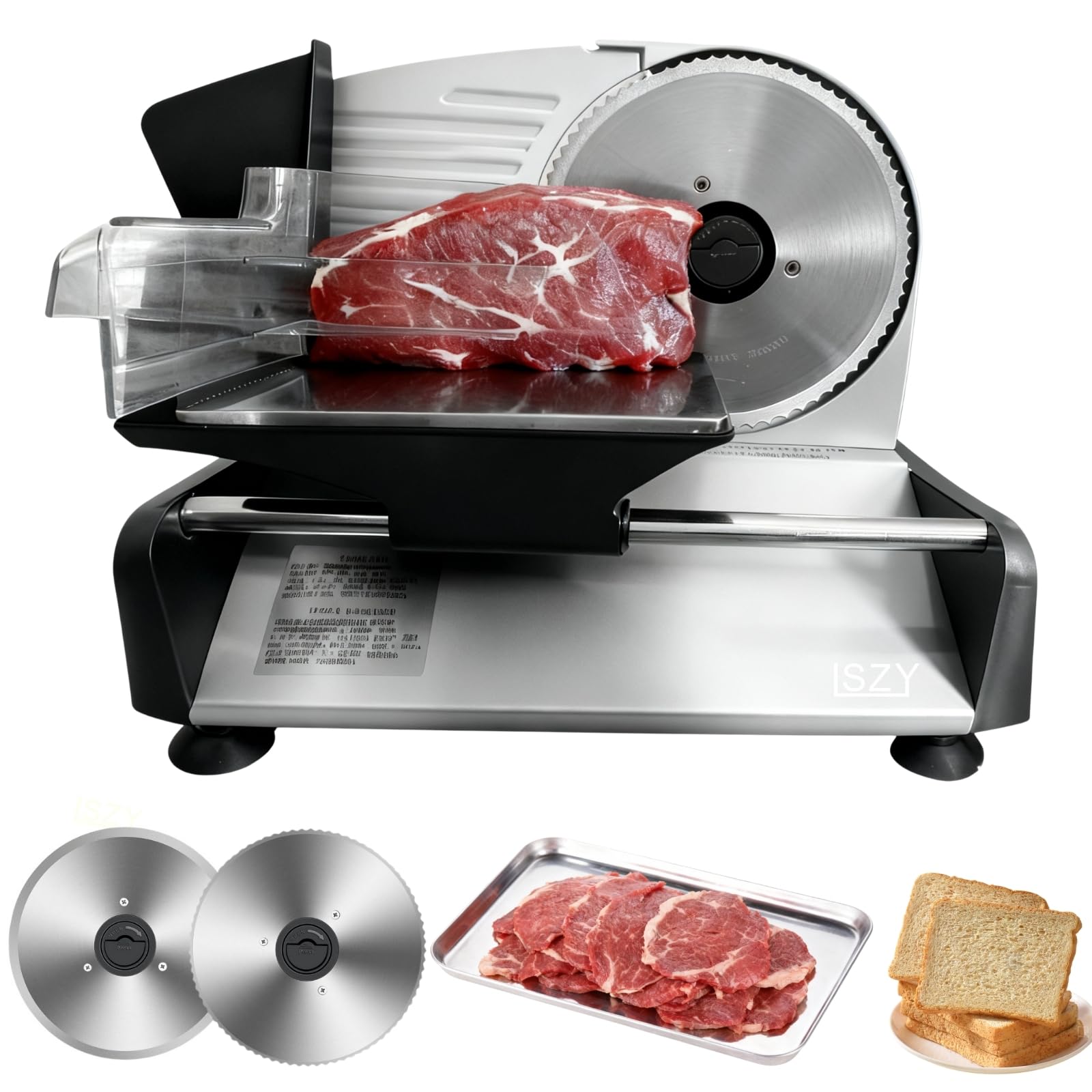
2. Meat Slicer Machine for Home (Lszy SL524)
Two interchangeable blades and a motor that stays quiet enough for a Sunday morning.
This model comes with a serrated blade (has teeth, good for bread and frozen meat) plus a smooth blade for deli meats and spam. The 7.5-inch blades swap without tools thanks to the QuickOut system, and the 150W motor peaks at 300W (its maximum momentary power) while running at ≤70dB — quiet enough that you will not wake anyone up. At 8.6 pounds, the Elite Gourmet weighs 11 pounds, so you save some arm fatigue but lose a bit of stability when pushing hard.
The ETL certification (a safety standard from Intertek) adds safety assurance, and the die-cast metal base with non-slip feet keeps it planted. One buyer called it “good value and easy to use” with sharp blades, while another said “used it twice and it broke” and noted the blade dulls quickly. The thickness dial goes from 0 to 15mm, letting you cut everything from paper-thin to a solid half-inch.
The QuickOut system makes this one of the easier budget slicers to clean, which matters because messy cleanup is the top complaint in this price range. Just handle the blades with care — they are sharp enough to demand respect.
Two-blade versatility: swap between serrated and smooth blades to match the food — bread one day, raw meat the next.
Best for: cooks who slice a variety of foods and want a quieter, easy-to-clean machine.
skip it if: you need a rugged slicer for heavy weekly roasts — durability reports are mixed.
3. Nutrichef Electric Meat Slicer NUGJ801

A 200W motor gives it the torque to push through tougher cuts.
This machine runs on a 200W motor at 110V, which gives it more pushing power than the 150W Lszy SL524 for handling bigger roasts and denser meats. The 7.5-inch stainless steel tooth blade cuts cleanly, and the adjustable dial goes from 0 to 15mm for precise control. Owners mention it is “easy to use, precise cuts every time” and works well for charcuterie boards.
One reviewer pointed out a key limitation: this slicer “requires 30 min cool down per 10 min use.” That duty cycle (the run-to-rest ratio) makes it a poor fit for batch processing a whole brisket. The platform is also small for large cuts of meat — the carriage only gives you about 4 inches of blade length. The body uses ABS plastic and aluminum rather than heavy-duty die-cast, which keeps it light but less stable than the Elite Gourmet.
For someone slicing a few pounds of salami or pepperoni every week, the strong motor and clean cuts make this a capable entry-level machine. Just plan your slicing in short bursts and let it rest between rounds.
Strong points
- 200W motor delivers more torque than typical 150W models.
- Removable blade and carriage simplify cleaning.
- Adjustable thickness from 0 to 15mm for varied slicing.
Limitations
- Needs a 30-minute cooldown after every 10 minutes of use.
- Small food carriage struggles with large roasts.
- Plastic body does not match the stability of metal-framed models.
Pick this if: you mostly slice small to medium batches and want extra motor power for occasional tough meats.
Pass it by: for weekly bulk slicing of large roasts — the cooldown requirement will frustrate you.
4. OSTBA Meat Slicer SL-517-2B

Two 304 stainless steel blades with dishwasher-safe parts for easier cleanup.
The OSTBA comes with two 6.7-inch blades — one serrated and one non-serrated — made from 304 stainless steel (a common rust-resistant grade). The OSTBA blades are 6.7 inches and the Nutrichef blades are 7.5 inches, so it fits narrower roasts, but the trade-off is that both blades and the food carriage are dishwasher safe. The 150W motor is adequate for deli meats, cheese, bread, and vegetables, and the thickness dial covers 0 to 15mm.
One reviewer cut 8+ pounds of brisket and pork belly without the machine moving, crediting the suction feet for keeping it secure. Another noted a key catch: the motor “can only run for 5 minutes then needs 15 minute rest.” That turns a big slicing job into a very long process — one person reported it took 3 hours to slice 6 pounds of roast. The cleaning also gets tedious because food builds up in tight crevices.
For small-batch home use where you slice a pound or two at a time, the dishwasher-safe parts and sturdy geared drive (gears that connect the motor directly, unlike belts that can slip) make this a practical choice. Just do not plan a party platter marathon with it.
Solid motor gearing: the sturdy geared drive handles raw pork belly without stalling, unlike some belt-driven budget models.
Good for: small, quick slicing jobs where dishwasher-safe parts save you scrubbing time.
Not for: anyone who needs to slice more than a few pounds at once without long breaks.
5. Foldable Meat Slicer (Cogace Q818)

Folds compactly for drawer storage when counter space is precious.
This slicer’s standout trick is that it folds down small enough to store in a drawer or cabinet. The 6.7-inch German RSG stainless steel blade (a specific alloy the brand says is strong and wear-resistant) is designed for durability, and the thickness adjustment goes from 0 to 20mm — a wider range than the standard 0-15mm on most of the others. It has a child safety lock and three strong suction feet for stability.
Customers note it is “a little work horse” for jerky and easy to set up, but the cleaning is a chore. One reviewer called it “extremely flimsy” and warned about the risk of cuts during cleaning. The plastic build is noticeably less sturdy than the aluminum Elite Gourmet, and it is not designed for frozen meat. The CE/ETL certifications (European and North American safety marks) do add safety confidence.
The folding design is genuinely useful if you have a tiny kitchen and hate leaving appliances on the counter. Just treat the blade with respect during cleaning and keep it to room-temperature meats and breads.
Space saver
- Folds compactly for easy storage in drawers or cabinets.
- Wider 0-20mm thickness range for thick bread or thin jerky.
- Child safety lock and CE/ETL certifications.
Build concerns
- Plastic construction feels flimsy compared to metal-framed models.
- Cleaning is challenging with exposed blade edges.
- Not suitable for frozen or very hard meats.
Best for: apartment kitchens where counter space is at a premium and slicing is occasional.
Avoid if: you plan frequent heavy slicing or prefer the solid feel of a metal body.
6. FOHERE Electric Meat Slicer 519
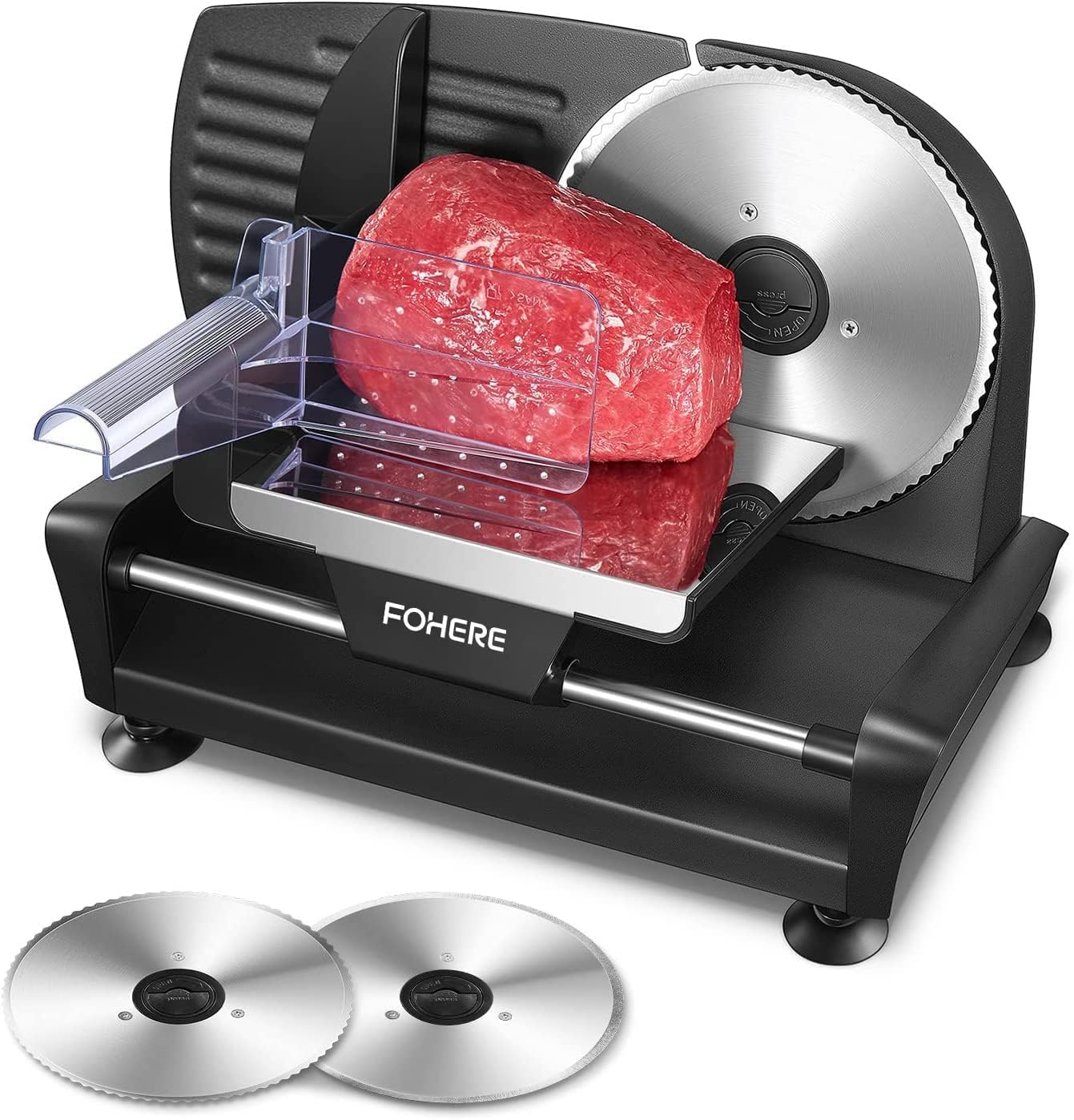
Die-cast aluminum body with two 7.5-inch blades and a 200W motor.
The FOHERE uses high-quality die-cast aluminum for its body — rust-proof and easy to clean — and includes both a serrated and a non-serrated 7.5-inch blade. The 200W motor gives it enough power for meats, cheese, bread, and vegetables. It weighs 9.19 pounds, splitting the difference between the heavy 11-pound Elite Gourmet and the lighter 8.6-pound Lszy. Reviewers point out it slices homemade sourdough bread “perfectly” and is “sturdy on the countertop.”
The thickness adjustment goes from 0 to 15mm, and the design uses FDA-compliant materials (safe for food contact) for the body and non-slip feet. One downside: the plastic slider tray is not removable, and the food carriage handle is short, which reduces stability when pushing larger cuts. A broken plastic hand guard is hard to replace since the manufacturer only offered partial reimbursement rather than a replacement part.
The combination of a strong motor and all-metal body makes this a solid mid-range contender. Just handle the plastic guard gently — it is the weak point in an otherwise sturdy build.
Rust-proof build: the die-cast aluminum body resists corrosion and wipes clean faster than stainless steel models with more crevices.
Great for: home cooks who want a durable metal slicer with two blade options and a powerful motor.
Watch out for: the plastic hand guard is fragile and the manufacturer does not sell replacements.
7. Borlebbi SL-5186D12C Quiet Deli Slicer

A quiet 200W DC motor that delivers steady torque without the racket.
This is the only model in the group with a DC motor (direct current, which runs quieter than an AC motor and keeps pulling power without slowing down). The 200W DC motor is paired with two removable 7.5-inch stainless steel blades (serrated and non-serrated) and a stainless steel tray. Thickness adjusts from 0 to 15mm. Shoppers say it is “well worth the money” and works great for partially frozen meat left out for 1-2 hours.
One buyer mentioned that meat can get behind the blade into the gear compartment, which complicates cleanup. The suction cups are also on the weaker side — they work best on a smooth cookie sheet rather than directly on the counter. The blade lock can be stubborn at first. On the positive side, the quiet motor and sharp blades make it ideal for slicing brisket and pork belly thinly for pho or hot pot.
The DC motor and dual-blade setup make this the most refined slicer in the budget tier, provided you are careful about the suction placement and occasional gear compartment debris.
Why it stands out
- 200W DC motor runs quieter than typical AC slicers.
- Two 7.5-inch blades handle both raw and cooked foods.
- Sharp blades slice brisket and pork belly thinly for hot pot or pho.
Watch for
- Meat can get behind the blade into the gear compartment.
- Suction cups are not strong on all surfaces.
- Blade lock can be difficult to disengage at first.
Pick this for: quiet, consistent slicing with a motor that handles tough meats without overheating.
pass on it if: you want suction feet that lock down aggressively — you will need a smooth surface.
Understanding the Specs
Blade Length and Material
The blade length tells you the maximum width of food you can slice. A 7.5-inch blade fits standard roasts and bread loaves, while a 6.7-inch blade works for smaller items but struggles with wider cuts. Stainless steel is the standard for rust resistance and edge retention. Removable blades make cleaning much easier since you can wash them in the sink or dishwasher without exposing the motor to water.
Motor Power and Duty Cycle
Motor wattage determines how easily the slicer cuts through dense meat. A 150W motor works for cheese, bread, and soft meats, but tougher cuts like bottom round or raw pork belly need 200W. Duty cycle (how long the motor runs before needing a cooldown) is just as important: some machines require a 15-minute rest after 5 minutes of use. If you slice in bulk, look for models that can run continuously or have shorter cooldown periods. A DC motor, like the one on the Borlebbi, delivers quieter operation and steadier torque than an AC motor.
FAQ
Can a cheap meat slicer handle frozen meat?
How often do I need to sharpen the blade?
What is the difference between a serrated and a non-serrated blade?
How long does a budget meat slicer typically last?
Can I slice cheese with an electric meat slicer?
What does the child lock feature do on a meat slicer?
Is a 150W motor enough for slicing beef?
How do I clean a meat slicer safely?
What is the ideal thickness for slicing deli meat at home?
Do budget meat slicers come with a warranty?
Final Thoughts: The Verdict
For the majority of shoppers, the best cheap meat slicer is the Elite Gourmet EMT-625B because its 11-pound die-cast aluminum body and 7.5-inch blade deliver stable, sharp slices for everyday sandwich prep and party platters at a budget price. If you value quiet operation and two blades for different foods, grab the Lszy SL524 for its QuickOut cleaning system and ≤70dB motor. And for the most refined slicing experience with a DC motor that handles tough meats quietly, the Borlebbi SL-5186D12C is the upgrade pick that earns its spot on busier counters.
How We Picked
We do not accept paid placement. Every pick is matched to a real buyer and a real use-case; we do not hands-on test units.
Sources & Methodology
Specifications: manufacturer listings and product documentation. Review insights: verified customer reviews, as of July 2026. Pricing: not shown on this page (it changes often); check the current price via the retailer link.
As an Amazon Associate, WellFizz earns from qualifying purchases. This does not affect which products we feature.
Related Guides

Mo Maruf
I created WellFizz to bridge the gap between vague wellness advice and actionable solutions. My mission is simple: to decode the research and give you practical tools you can actually use.
Beyond the data, I am a passionate traveler. I believe that stepping away from the screen to explore new environments is essential for mental clarity and physical vitality.