Our readers keep the lights on and my smoothie glass nicely filled. As an Amazon Associate, I earn from qualifying purchases.
Specs are compiled from manufacturer listings and verified buyer reviews and can change over time — please confirm the key details on the product page before buying.
You want a cup of coffee that tastes like blueberries and chocolate, not like ash and regret. The only way to get there is to start with raw green beans and a machine that lets you control exactly how dark they go. This guide covers electric and gas home coffee roasters, from beginner-friendly to seriously capable, so you stop buying stale bags and start roasting your own.
I’m Mohammad Maruf — the founder and writer behind WellFizz. This guide is built by comparing the manufacturers’ published specifications and the patterns across verified customer reviews, so you get each pick’s real strengths and trade-offs instead of marketing spin.
The right machine turns green beans into the freshest coffee you have ever tasted, whether on a tiny counter or in a garage setup. Read on to find your match among the best coffee roaster for home options on the market right now.
Our Picks at a Glance

How To Choose The Best Coffee Roaster For Home
Picking a home coffee roaster depends on three things: weekly coffee consumption, setup location (kitchen counter or garage), and desired hands-on control. A fluid-bed roaster uses hot air to tumble the beans, giving you fast, even roasts in 8 to 15 minutes — great for beginners because you can see the beans the whole time. A drum roaster spins beans inside a heated chamber, which feels more like a traditional commercial roaster and often handles bigger batches, but it takes longer and typically creates more smoke. If you plan to roast indoors, look for a machine with a smoke filter or a chaff collector that really works. Batch size is the next question: a 120-gram capacity (~4-5 scoops) is enough for a few days of coffee, while a 500-gram machine lets you roast once a week for a whole household. Finally, decide how much control you want. Manual machines let you tweak temperature and fan speed in real time so you can chase a specific flavor profile. Automatic machines use pre-set profiles, which is perfect if you just want a consistent medium roast without hovering over a hot machine.
Batch Size and Your Coffee Habit
If you drink two to three cups per day, a machine that roasts up to 226 grams (about 8 ounces) of green beans per batch will keep you stocked without over-roasting. For a household of four or more cups per day, a 300 to 500 gram capacity lets you roast once a week. Oversized batches can lead to uneven roasts because the beans crowd each other, so stick to the machine’s recommended maximum.
Heat Source: Electric vs Gas
Electric roasters plug into a standard 110V or 120V outlet for convenient countertop use. They are quiet, consistent, and require no extra gear. Gas roasters offer faster heat-up and more responsive temperature control — you can drop the heat instantly by turning down the flame — but require a propane burner and outdoor use due to the open flame and heavy smoke. If you have a garage or patio and want to experiment with roast profiles, gas is the rewarding path.
Quick Comparison
| Model | Best For | Batch Capacity | Heat Source | Dimensions (inches) | Amazon |
|---|---|---|---|---|---|
| Fresh Roast SR540★ Best Overall | Value Pick | 120 g | Electric (Hot Air) | 8.5 x 8.5 x 13.5 | Amazon |
| Fresh Roast SR800Also Great | Best Overall | 226 g | Electric (Hot Air) | 8 x 8 x 14 | Amazon |
| KALDI WIDEPro Control | Gas Pro Quality | 300 g | Gas Burner | 8.46 x 8.27 x 16.93 | Amazon |
| JIAWANSHUN 500g | Budget Large Batch | 500 g | Electric (Drum) | 6.6 x 14 x 6.6 | Amazon |
| JIAWANSHUN 1.1lb | Value/Large Batch | 500 g | Electric (Drum) | 13 x 13 x 7 | Amazon |
| GIVEROO 500g | Entry Level Drum | 500 g | Electric (Drum) | 12.6 x 12.6 x 4.72 | Amazon |
| DYVEE KAKA-G400 | Gas Outdoor | 400 g | Gas Burner | 8.46 x 8.27 x 16.93 | Amazon |
| MAGO MAGA Roma Pro | Premium Auto | 300 g | Electric (Hot Air) | 6 x 8.3 x 18.5 | Amazon |
| Precision PKF-500 | Premium Auto | 453 g | Electric (Drum) | 19 x 10.01 x 15 | Amazon |
In‑Depth Reviews
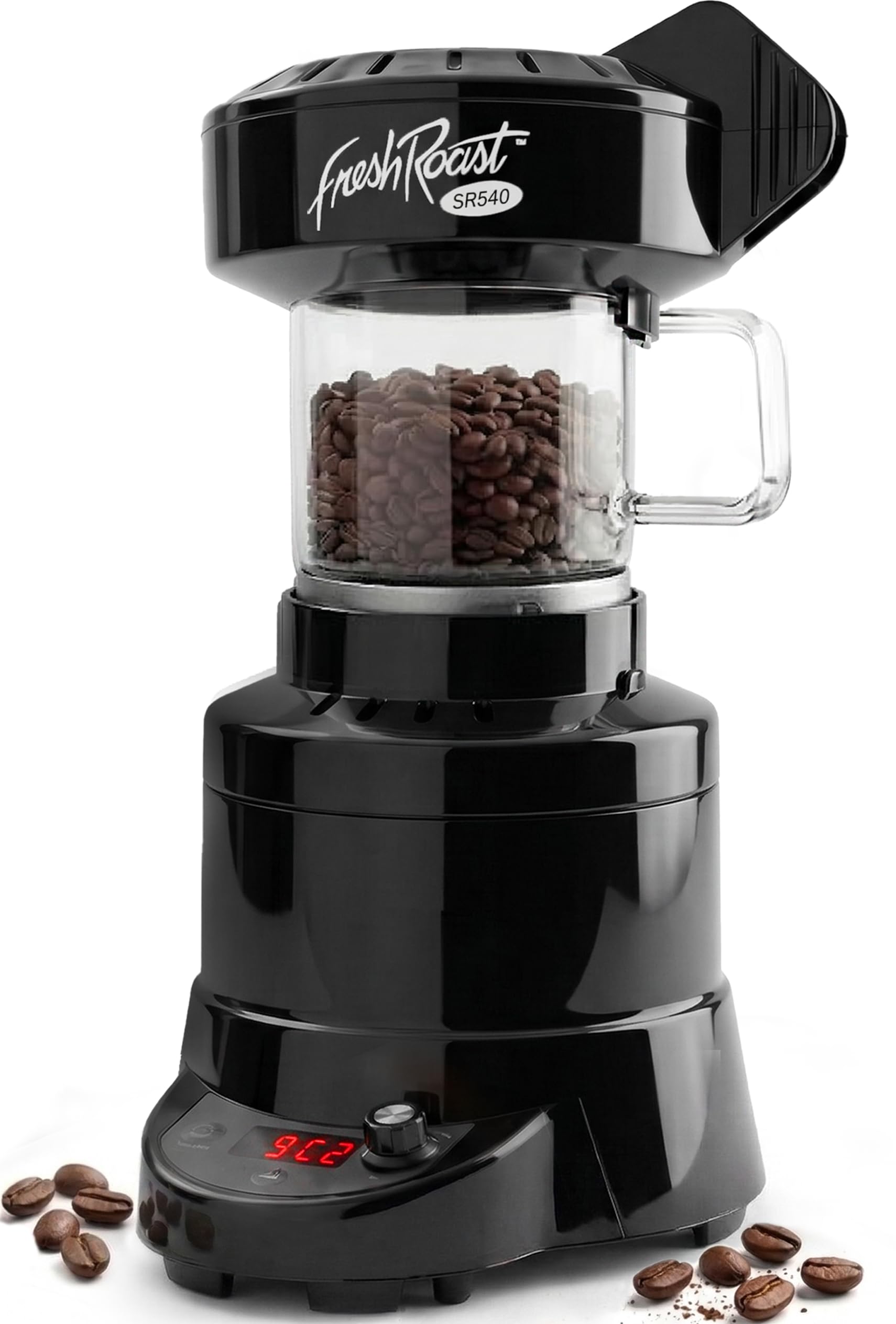
1. Fresh Roast SR540 Automatic Coffee Bean Roaster
Our pick — over 4★ from 650+ verified ratings; the strongest balance of quality and price.
A rugged, beginner-friendly fluid-bed roaster that has been producing hundreds of batches since 2021.
This is the entry point into Fresh Roast’s line, and it remains among the most popular home roasters for a reason. The SR540 holds up to 120 grams (about 4 scoops) of green beans per batch, good for 7 to 14 cups of coffee in under 10 minutes. You get nine power levels and a convection fan that you control manually, plus a glass roasting chamber so you can watch the beans go from green to yellow to brown. One buyer who has roasted “hundreds of batches since 2021” says the machine is a workhorse — they replaced the motherboard once after years of use, and the manufacturer sent a free replacement part even after the warranty expired. Another reviewer dialed in a specific method: power 8, fan 9 for 6 minutes, then dropping fan to 6 and power to 4 for a dark roast finish. The chaff basket does an excellent job capturing the papery skin that flies off during roasting, so cleanup is mostly just wiping the glass chamber.
The analog knob is the weak point — several long-term users wish the SR540 had a digital display and programmable settings like the SR800. The knob can become “wonky” after hundreds of batches, though shoppers say that Fresh Roast’s US-based customer service has been responsive about sending replacement boards. The other limit is the 120-gram batch size: if you have more than two coffee drinkers in the house, you will need to run two batches back-to-back to get through the week. There is even a reviewer who accidentally pushed a batch too far and caught the beans on fire — the machine was fine, but it is a reminder that manual roasters require your full attention during the cycle. For a solo drinker or a couple who wants fresh coffee every other day, this is the most affordable fluid-bed roaster that still gives you real control over the profile.
The Proven Workhorse
- Beginner-friendly with nine heat levels and fan control — plenty of room to experiment
- Glass roasting chamber lets you watch color changes in real time
- Excellent chaff capture — less mess than drum roasters
- US-based manufacturer with responsive customer service
The Known Limitations
- 120g batch size is small — a heavy coffee household will need multiple roasts
- Analog knob can become imprecise over hundreds of cycles
- No digital display or programmable profiles — you must manually adjust every batch
Grab it for: the person who drinks 1-3 cups daily and wants to learn roasting with a machine that has a huge user community and a track record of lasting years.
Consider a larger model if: you need to roast for more than two people at once or you hate the idea of manually timing each batch.
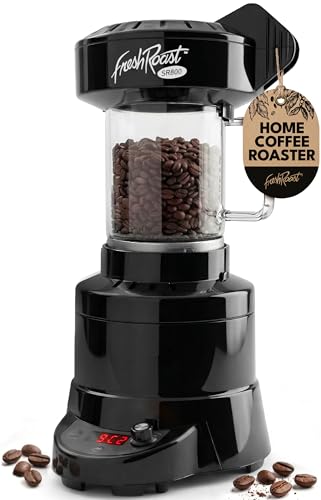
2. Fresh Roast SR800 Coffee Roaster
The hot-air roaster that handles a real household’s worth of coffee in one batch.
The SR800 doubles the SR540’s batch size to 226 grams (8 ounces) of green beans, enough for about fourteen to twenty-eight cups of coffee per roast. You get nine power settings and a separate fan speed control, all managed by pushing and turning a single knob — no confusing menus. The real-time temperature display means you can watch the bean temperature climb and adjust the heat on the fly, something buyers report is key to pulling off roasts in about 8 minutes instead of the longer cycles drum roasters need. Owners mention that the improved bean agitation over older Fresh Roast models delivers noticeably even color from edge to edge. One owner mentioned roasting ten pounds for holiday gifts in their first month of ownership, which tells you how fast the cycle really is.
The two-piece top and chaff collector do not clip into the glass chamber, so you need to be careful when handling a hot batch. Some customers note that the machine feels underpowered if your ambient temperature drops below 60°F, recommending you drop the batch to 170 grams on cold days. Still, the manual mode lets experienced roasters adjust the heat and fan profile by sight, sound, and smell, while beginners can lean on the preset options. Fresh Roast stands behind it too — one reviewer noted getting the unit repaired twice beyond the warranty period for a flat fee, and it lasted over six years with moderate use. For a household of two to three daily coffee drinkers, this is the balance between capacity and control.
The Performance Edge
- Largest fluid-bed batch capacity at 226g (8 oz) — makes up to 28 cups per roast
- Manual heat and fan controls with real-time temperature display for precise profiling
- Fast roast cycle under 10 minutes with even bean agitation
- Strong customer support with flat-rate out-of-warranty repairs
The Practical Downsides
- Chaff collector and glass chamber do not lock into place — easy to knock off while hot
- Performance drops in cold weather (below 60°F) — you must reduce batch size to 170g
- Single multi-function knob can feel unintuitive until you memorize the push-turn logic
Reach for this if: you drink three or more cups daily and want the speed and evenness of hot-air roasting with enough batch capacity to roast once or twice a week.
Look elsewhere if: you roast in a cold garage or want a fully hands-off automatic machine — this one demands your attention during the 8-minute cycle.
3. KALDI WIDE (300g) Home Coffee Roaster
A gas-powered drum machine built to last decades, with zero electronics to fail.
If you want the closest thing to a commercial roaster on your patio, the KALDI WIDE is it. This is a gas burner (not included) machine with a perforated stainless steel drum that is 2mm thick with 3mm holes, and three stirring blades that tumble the beans evenly. The motor runs on a safe 12V DC power supply, and the whole body tilts forward so you can dump the hot beans into a cooling tray — no scooping or tipping a heavy machine. Reviewers who compared it to the Fresh Roast and Behmor 1600 say the KALDI produces the best cup quality because gas heat avoids the “baked” flavor some electric machines create. One buyer who replaced a Hottop with this unit describes achieving perfectly sweet Ethiopian roasts by holding the temperature at 205°F through first crack and finishing at 215°F. Another owner reported making 30 pounds of coffee without any external discoloration on the heavy-gauge steel body.
The biggest catch is that you need a separate gas burner, a propane tank, an outdoor setup, and a cooling fan and sieve — this is not a plug-and-play countertop machine. Reviewers warn that the chaff stays inside the drum until you dump the beans, and you will need a dedicated ventilation area. The sample rod (trier) on some units has a weld issue where the thermometer dial blocks it from sliding in fully — one buyer returned their unit for that reason. If you are willing to learn the process and buy the extra gear, the KALDI delivers a roast profile that many enthusiasts say beats any electric machine under. The build quality is overbuilt, with no plastic parts and no circuit boards to fry.
The Pro-Grade Build
- 2mm thick stainless perforated drum with 3 stirring blades for even gas roasting
- 12V DC motor — safe, simple, and replaceable
- Tilt-to-dump design for fast bean cooling without scooping
- Reviewers point out better flavor than electric air roasters due to responsive gas heat
The Extra Gear Required
- No gas burner included — you must buy a propane burner and tank
- Requires outdoor use with dedicated ventilation and a cooling sieve/fan
- Sample rod may have alignment issues on some units
- Heavy to lift and tip when full of hot beans
Perfect for the gear-committed enthusiast who already roasts outdoors and wants a gas-powered machine that will outlast every electronic roaster on the market.
Not for you if: you just want to plug something in on your kitchen counter and press start.
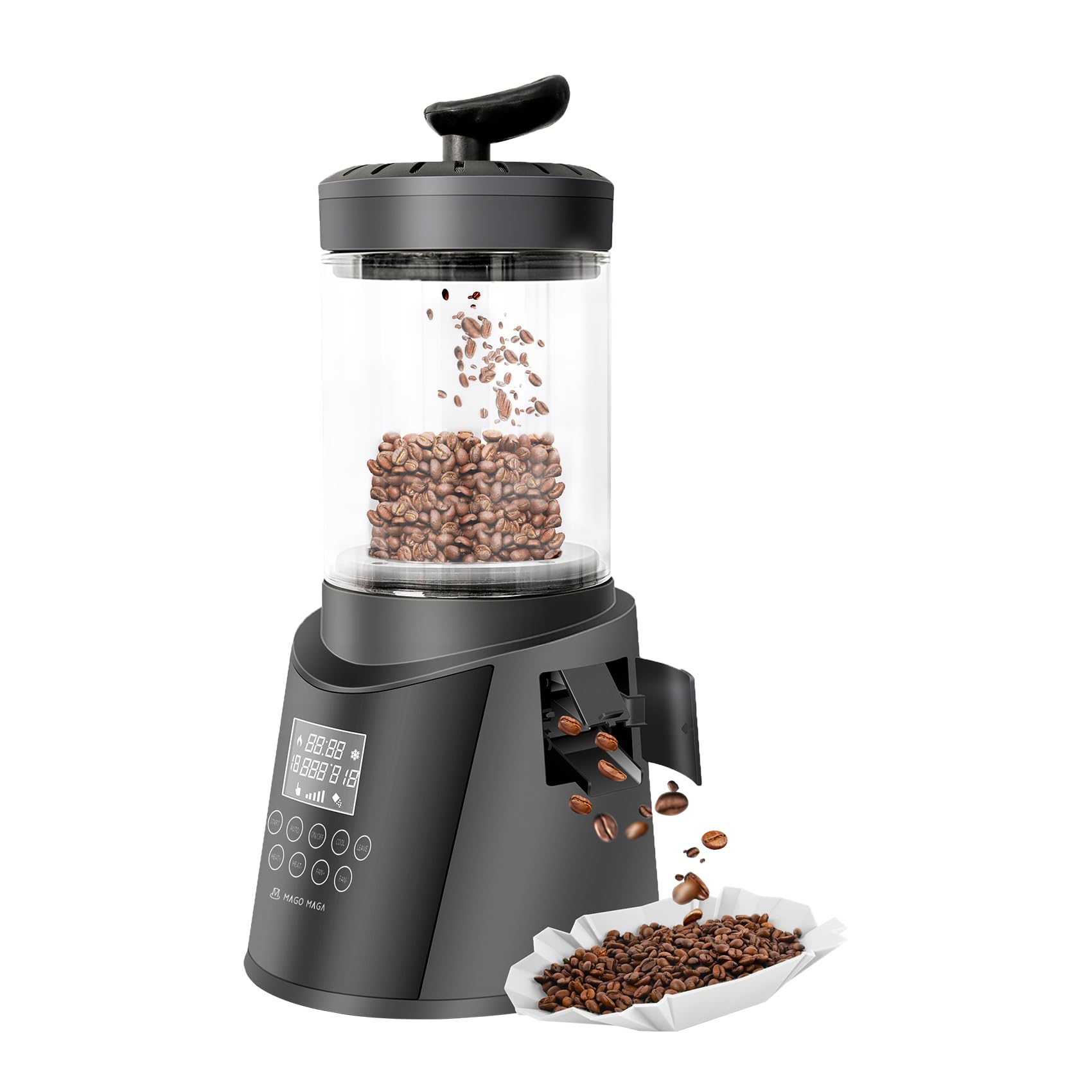
4. MAGO MAGA Roma Pro Smart Home Coffee Bean Roaster
The 2025 SCA award-winner that makes push-button roasting feel like a cheat code.
The Roma Pro won the SCA Best New Product Award in 2025 for good reason: it combines a hot-air fluid bed system with an automatic mode that works for most green beans, so you can press a button and walk away. The 300-gram capacity is enough for a week of lattes for one person, and the transparent viewing window and auto-cooling cycle handle the whole process. Buyers rave about the automatic mode — one reviewer, a total beginner, described it as “completely hands-off” — you select a roast level (F1 for light, F2 for medium-dark), and about 15 minutes later you have evenly roasted, cooled beans ready for the grinder. The ultra-low smoke chaff collector and CE/ETL certifications mean you can run it indoors without setting off the smoke alarm. A reviewer who broke both glass tubes reported that customer service sent replacements quickly, which is a good sign for long-term ownership.
The catch is that the automatic mode works best for regular beans; decaf green beans need the manual mode for good results. Some buyers report that the 300g profile struggles with a full 300g load, recommending you drop to about 250g for more even roasts. The manual mode is there if you want to tweak temperature, fan, and time, but the controls are not as responsive as a pro-level gas rig. A more experienced reviewer described the automatic profiles as simply turning the heat to maximum and adjusting the fan — effective but a bit slow. If you want the convenience of preset roasting with the option to go manual later, the Roma Pro is the easiest path to consistently good coffee without hovering.
The Hands-Free Appeal
- Auto mode delivers consistent roasts with a single button press — perfect for beginners
- 300g batch covers a week of daily lattes for one person
- Ultra-low smoke due to hot-air design and efficient chaff collector
- CE and ETL certified for safe indoor use
The Feature Trade-Offs
- Full 300g load can produce uneven roasts — best at ~250g
- Auto mode is basic (max heat + fan adjust) — not a true programmatic profile
- Decaf beans require manual mode for acceptable results
Ideal for the busy enthusiast who wants great roasted coffee without studying roast curves — press auto, wait 15 minutes, enjoy.
Not the pick if: you plan to roast decaf regularly or want total manual precision over every stage of the bean’s development.
5. DYVEE KAKA-G400 Coffee Roaster Gas Burner

A solid gas-powered drum that batches out 5 pounds of coffee per hour on the patio.
The KAKA-G400 is built around a 304 stainless steel frame and a quartz glass drum, which lets you watch the beans tumble and color-change without opening anything. The recommended batch is 200 to 300 grams, though the drum can hold up to 400 grams at a time. One buyer mentioned they made 30 pounds of coffee with it, running 400g batches at a pace of 5 pounds per hour. The gas burner (your own propane or gas stove) gives you instant temperature control: turn the flame up for a fast dark roast in under 13 minutes, or throttle it back for a slower medium roast around 10 minutes. The wooden handle stays cool enough to grip during the dump, and the 12V motor runs the drum rotation safely. A reviewer described the resulting flavor as “delicious dark chocolate” from a 20-minute roast on a gas stove.
The downsides are real, though. Small beans can slip into the drum’s tubes and burn, creating smoke that taints the batch. The included thermometer is slow to react and the mounting point is poorly designed, so many owners swap it for an instant-read gun. The glass drum is fragile — one owner warns you should wash it in a plastic bowl, not the sink. Chaff escapes through the drum’s vent slots, making this strictly an outdoor machine unless you want a mess on your counter. The price is mid-range for a gas roaster, but the bulk and the need for a separate burner mean this is a commitment. For someone who already owns a propane burner and wants to experiment with gas roasting at a lower entry cost, the KAKA-G400 is a solid starting point.
The Gas Advantages
- 400g capacity with a fast output (5 lbs/hr) for weekly bulk roasting
- Quartz glass drum provides full visibility of the roast
- Stainless steel frame and wooden handle are built to last
- Responsive gas heat for precise roast profiling
The Outdoor-Only Reality
- Small beans can get stuck in drum slots and burn — requires pre-sorting
- Chaff escapes through vent slots, creating a mess indoors
- Thermometer is slow and poorly positioned — plan to buy an infrared gun
- Glass drum is fragile and must be hand-washed carefully
Go for this if: you already have a propane burner and want the most affordable entry into gas drum roasting with good batch capacity.
Pass if: you need a plug-and-play machine or plan to roast indoors — this one demands a patio and extra gear.
6. JIAWANSHUN Electric Coffee Roaster Machine 500g

The 1200W drum that roasts up to half a kilo per batch for under ninety bucks.
This is a whites-of-the-eye budget option for people who know they want to roast 500g at a time and are willing to learn the machine’s quirks. The 1200W heating element can hit up to 240°C, and the automatic mixing rod rotates the beans at a uniform speed. The transparent glass lid with four vent holes lets you watch the color change, and the honeycomb non-stick bottom wipes clean with a damp cloth. One review stands out: a buyer reported “550+ roasts across three units,” meaning they burned through the heating element on earlier models but kept buying them because the price is low enough to treat as consumable hardware. The recommended batch is 300 to 500g (less than 300g roasts unevenly). You can also use it for peanuts, popcorn, and other nuts, which makes it a multi-purpose appliance.
The catch is durability. Multiple reviews mention heating element failures after a few years, and the stirring rod can catch smaller beans, causing jams and reversed rotation. You will need an infrared thermometer because the built-in temperature control is not perfectly accurate — reviewers recommend a welding blanket to retain heat. At 1200 watts, it pulls 50% more power than the GIVEROO 800W model, but the machine is 13 inches deep compared to the GIVEROO’s 12.6 inches. Smoke is a factor; you need to run it under a range hood or outdoors. For the price, though, you get a massive 500g capacity that competing drum roasters charge three times as much for. If you are on a tight budget and want to roast big batches, this machine will teach you the basics — even if you might replace it in a couple of years.
The Bang-for-Buck Batch Size
- 500g capacity at an entry-level price — roasts coffee, nuts, popcorn
- 1200W heating element provides fast heat-up and dark roast capability
- Transparent glass lid with honeycomb non-stick pan for easy cleaning
- Versatile: works for all kinds of beans and grains, not just coffee
The Known Wear Issues
- Heating element has a limited lifespan — some owners are on their third unit
- Stirring rod jams on small beans — requires pre-sorting and manual clearing
- Inaccurate temperature reading — you will need an additional infrared thermometer
- Produces significant smoke — must be used under a hood or outdoors
Best for: the budget-conscious buyer who wants a massive 500g capacity for weekly bulk roasting and does not mind replacing a unit every few years.
skip it if: you want a roaster that will last a decade or you prefer the evenness of a fluid-bed machine.
7. JIAWANSHUN Coffee Roaster Upgraded Electric 1.1lb

Adds a built-in timer to the 500g drum design — still requires learning its personality.
This upgraded version of the JIAWANSHUN 500g adds a timer to the adjustable temperature control (0-240°C), giving you one more variable to lock in repeatable roasts. It runs at the same 1200W as the base model, but the extra timer means you can set it and listen for first crack without watching a stopwatch. The machine is shorter and deeper than the non-timer version: 13 x 13 x 7 inches. One reviewer documented a precise outdoor roast: 300g Uganda at 230°C for 26 minutes, and 300g decaf Sumatra at 210°C for 24 minutes, both roasted outside at 55°F. Another owner mixed 150g of each bean type for a 24-minute roast hitting 415°F on the bean surface, getting consistent results. The glass lid and honeycomb interior make cleanup easy, and the adjustable temperature lets you go from light to dark with the same machine.
The design flaw both roasters share is the stirring blade. On this model, the blade ends about 4° off the correct position, which causes small beans to jam and reverse the motor. One buyer was on their second unit after the previous BarWell roaster died from a bad heating coil crimp after 8 months. The dimensions here are significantly different from the non-timer JIAWANSHUN: at 13 x 13 x 7 inches it is roughly 2.0x deeper and wider than the 6.6 x 14 x 6.6 inch base model, so check your counter space. If you want a timer for consistency and are willing to work around the stirring arm issue by pre-sorting your beans, this is a cost-effective way to get a 500g drum with one more feature than its sibling.
The Timer Advantage
- Built-in timer plus adjustable 0-240°C temperature for repeatable roast profiles
- Large 500g capacity with a compact footprint (13 x 13 x 7 inches)
- Transparent glass lid and honeycomb non-stick interior for easy monitoring and cleaning
- Multi-functional — roasts coffee, nuts, seeds, and popcorn
The Persistent Flaws
- Stirring blade design can jam on small beans, causing motor reversal and shutdown
- Warranty only covers three months — some units fail from heating coil issues within a year
- Larger footprint than the base 500g model — measure your counter first
- Noisy operation and strong smell during roasting
Choose this if: you want a timer for hands-off timing and a 500g capacity, and you are comfortable sorting beans to avoid jams.
Stick with the base model if: you plan to use an external timer or do not mind the smaller footprint.
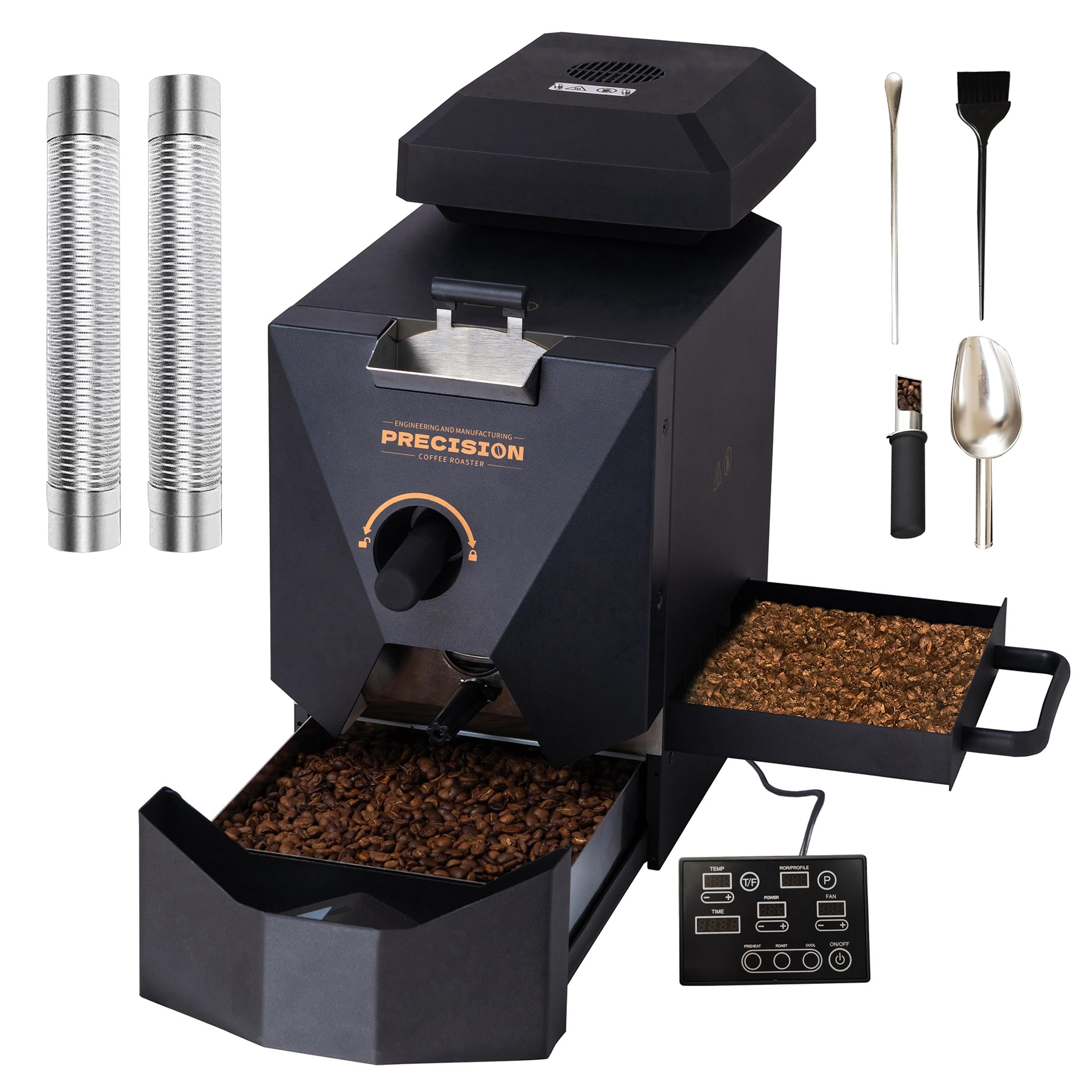
8. Precision PKF-500 Electric Coffee Roaster 1lb
A smoke-filtering drum with touchscreen presets that is designed to be an indoor-friendly option.
The Precision PKF-500 is designed to be the electric drum roaster you can run in your kitchen without fumigating the house. It includes a smoke filter and a 2-chimney vent pipe system that routes smoke and chaff out of the machine, which addresses the biggest complaint against drum roasters. The touchscreen interface combines automatic, assisted, and manual modes — you can pick a pre-set profile or tweak temperature, fan speed, and time on the fly. The 453g (1-pound) capacity is the largest on this list, and the sample spoon lets you pull a few beans mid-roast to check color without opening the lid. One reviewer who roasted a half-pound batch of Haiti Marra Blanc on the auto setting described the result as “light, smooth, non-acidic,” and praised the sturdy stainless steel build. Another owner, comparing it to the popular “Skywalker” design, said it was better built and cost about a third of what competing half-pound roasters go for.
The downsides are significant. The exhaust can leak moisture onto the circuit board, causing the machine to lose control mid-roast. One owner reported heat buildup that forced a mid-cycle shutdown; customer support was helpful but the fix was not permanent — the issue resolved only when the user started letting the machine cool down between multiple batches. The keypad and programming logic drew harsh criticism from another owner, who called the touchscreen “worse than bad” and warned of fire risk if you cannot get the machine to stop. The manual is poorly translated from Chinese, so you will need to search YouTube for setup videos. For the price of a premium machine, the reliability concerns are hard to ignore, but if you get a good unit, the smoke filter and large capacity make it a rare indoor-friendly drum roaster.
The Indoor-Friendly Design
- Smoke filter and vent pipe system reduce odor for indoor use (unlike most drum roasters)
- 453g (1 lb) capacity — the largest single-batch potential on this list
- Touchscreen with auto, assisted, and manual modes for all skill levels
- Sample spoon port to check bean color without interrupting the roast
The Reliability Concerns
- Exhaust moisture can leak onto the circuit board, causing control failure
- Heat buildup may force mid-roach shutdowns — needs cool-down between consecutive batches
- Poorly translated manual and confusing keypad programming — steep learning curve
- One customer observed a fire risk scenario due to unresponsive controls
Worth the risk for: the buyer who prioritizes indoor operation above all else and is willing to troubleshoot the electronics in exchange for the largest batch capacity.
Look elsewhere if: you need a plug-and-play experience or want a machine with a proven track record of reliability.
9. GIVEROO 500g Coffee Bean Roaster Machine with Timer

An 800W drum that needs large batches to avoid unevenness, but works for entry-level roasters.
The GIVEROO is the least powerful electric roaster on the list at 800 watts, which means it roasts 50% slower than the 1200W JIAWANSHUN models. The trade-off is a lower price and a machine that is slightly quieter in operation. The 500-gram capacity comes with an important rule: you must put more than 400g of beans in at a time to avoid uneven roasts. The transparent glass cover and 0-240°C adjustment let you see the beans, and the automatic auger system keeps them moving. A reviewer who roasted a 375g batch for espresso found it failed to reach a proper Italian roast after 35-40 minutes, and they noticed brown residue stuck to the base and Teflon flaking off. Another buyer who uses a 450g batch at 240°C with a 3-minute preheat and 23-minute roast time reports consistent results. The consensus is that this machine works best for light roasts — pushing it to dark or espresso levels can cause issues.
The stirring rod has the same jam problem as the JIAWANSHUN machines: small beans can catch on the ends of the rotating bar, causing the motor to reverse and eventually shut down. The manufacturer acknowledges this in the product description and recommends sifting out small or defective beans beforehand. A first-time roaster said the machine made the process “as easy as possible” and praised the quick cleanup. For 800W power, a 500g capacity, and a price that undercuts most competitors, the GIVEROO is a solid entry point for someone who plans to roast light to medium coffees in large batches and is willing to pre-sort their green beans.
The Easy Entry Point
- 500g capacity at a low price — good for bulk light to medium roasts
- Transparent glass lid and 0-240°C temperature adjustment for visual monitoring
- Automatic auger system keeps beans moving for consistent results
- Quiet operation compared to higher-wattage drum roasters
The Performance Limitations
- 800W heating element makes dark roasts difficult — struggles past medium
- Requires 400g+ batches to avoid unevenness — less flexible for small trials
- Stirring rod jams on small beans, causing automatic shutdown
- Teflon coating can flake off with heavy use
A good starter if: you plan to roast large batches of light to medium coffee and are on a tight budget.
Not the one if: you want to experiment with small 100g batches or you need a machine that can reliably hit dark espresso roasts.
Understanding the Specs
Fluid Bed vs Drum
Fluid bed roasters (also called hot-air or air roasters) blow hot air up through the beans, suspending them in midair so they tumble and heat evenly without oil buildup on the chamber walls. This is the fastest method — a batch finishes in 6 to 15 minutes — and you get a very clean, bright flavor profile. Drum roasters spin beans in a heated metal or glass drum. They take longer (18 to 35 minutes) and the drum’s contact with the beans creates a more caramelized, traditional coffee flavor. The trade-off is that drum roasters produce more smoke because chaff can burn against the hot surface, so they usually need outdoor or well-ventilated use.
Batch Capacity and How It Affects You
Capacity is measured in grams of green (unroasted) coffee beans. A 120g batch makes roughly 100g of roasted coffee, which is about 7 to 14 cups of brewed coffee depending on how strong you like it. A 300g batch lasts a solo drinker a full week. A 500g batch is weekly volume for a household of two to four daily coffee drinkers. Important: most machines have a recommended range — for example, a 500g roaster may work best between 300g and 500g. Using less than the minimum can lead to uneven roasts because the machine’s heating element and drum design expect a certain bean mass.
Wattage and Heat Up
Electric drum roasters list their wattage, which tells you how fast the heating element can reach and maintain temperature. 800W machines heat up slower and struggle to reach true dark/espresso roast temperatures, especially in cold ambient conditions. 1200W machines heat faster and can hold high heat for longer, making dark roasts more achievable. Fluid bed roasters use a combination of heat (power level) and fan speed to control the roast, so wattage alone does not tell the full story — a fluid bed’s design is more about the air velocity to keep beans suspended.
Smoke and Chaff Management
During roasting, coffee beans release chaff — the thin, papery skin that peels off the bean — and smoke from the chemical reactions inside the bean (the Maillard reaction and development). Fluid bed roasters blow the chaff into a collection basket, which is easy to empty. Drum roasters trap chaff inside the drum, where it can burn and create extra smoke. If you plan to roast indoors, look for a machine that has an explicit smoke filter or a vent pipe system (the Precision PKF-500 and the MAGO MAGA Roma Pro are the only two on this list that claim ultra-low smoke or filtered smoke). Every other drum machine on this list will require outdoor or stove-hood use.
FAQ
Is home-roasted coffee really fresher than store-bought whole beans?
Can I roast coffee indoors or do I need to go outside?
How long does a typical home coffee roasting session take?
Will a 500g batch size work for a single person?
What is the difference between light, medium, and dark roast in terms of temperature?
Can I roast other things like peanuts or popcorn in a coffee roaster?
Why do some coffee roasters need a separate gas burner?
How do I avoid uneven roasts with a drum machine?
Can I use a home coffee roaster for decaffeinated beans?
How important is the chaff collection system?
Final Thoughts: The Verdict
For most people, the best coffee roaster for home is the Fresh Roast SR800 because it combines a fast fluid-bed design with real-time manual control and the largest hot-air capacity on the list — enough for a household. If you want a more affordable entry without sacrificing quality, the Fresh Roast SR540 gives you the same even-roast technology at a smaller batch size. For gas enthusiasts who want the most authentic drum-roasted flavor, the KALDI WIDE is the overbuilt, electronics-free choice that will outlast everything else on this list, provided you have the outdoor setup to run it.
How We Picked
We do not accept paid placement. Every pick is matched to a real buyer and a real use-case; we do not hands-on test units.
Sources & Methodology
Specifications: manufacturer listings and product documentation. Review insights: verified customer reviews, as of July 2026. Pricing: not shown on this page (it changes often); check the current price via the retailer link.
As an Amazon Associate, WellFizz earns from qualifying purchases. This does not affect which products we feature.
Related Guides

Mo Maruf
I created WellFizz to bridge the gap between vague wellness advice and actionable solutions. My mission is simple: to decode the research and give you practical tools you can actually use.
Beyond the data, I am a passionate traveler. I believe that stepping away from the screen to explore new environments is essential for mental clarity and physical vitality.