Our readers keep the lights on and my smoothie glass nicely filled. As an Amazon Associate, I earn from qualifying purchases.
Specs are compiled from manufacturer listings and verified buyer reviews and can change over time — please confirm the key details on the product page before buying.
Buying a compact mirrorless camera today is less about finding something small and more about choosing which set of trade-offs you can live with. The goal is a compact mirrorless camera that fits in a day bag, outperforms a phone, and offers room to grow without breaking your budget. This guide sorts through the real specs and user experiences to find which models actually deliver on that promise.
I’m Mohammad Maruf — the founder and writer behind WellFizz. This guide is built by comparing the manufacturers’ published specifications and the patterns across verified customer reviews, so you get each pick’s real strengths and trade-offs instead of marketing spin.
You want a lightweight camera that delivers professional-grade image quality. Here is your straight-to-the-point breakdown of the best compact mirrorless camera options that prove small cameras do not have to mean small results.
Our Picks at a Glance


How To Choose The Best Compact Mirrorless Camera
Choosing a compact mirrorless camera means balancing sensor size, autofocus speed, and ergonomics. Here is what to look for when shopping.
Sensor Size and Megapixels
The sensor determines low-light performance and depth of field. APS-C sensors (found in most Sony, Nikon, Canon, and Fujifilm models) are larger than Micro Four Thirds sensors (used by Panasonic and Olympus). A larger sensor generally gives you better low-light performance and more control over background blur. Megapixels determine how much detail you can capture and how large you can print. A 24MP sensor is plenty for most users, while 32.5MP and 40.2MP sensors offer extra cropping flexibility.
Autofocus System
Autofocus speed and accuracy often decide which camera buyers choose. Phase-detection autofocus (PDAF) is faster and more reliable for tracking moving subjects than contrast-detection alone. Look for the number of autofocus points — more points mean better coverage across the frame. Sony’s Real-Time Eye AF and Canon’s Dual Pixel CMOS AF set the bar for subject detection, while Fujifilm now uses AI-powered tracking for animals and vehicles.
Image Stabilization
In-body image stabilization (IBIS) lets you shoot at slower shutter speeds without blur, especially in low light. Some cameras rely on lens-based stabilization (OIS), which is good but less versatile. A camera with 5-axis IBIS and 5-7 stops of compensation is ideal for handheld video and dim conditions. Not all compact models have it, so check this spec if you shoot a lot without a tripod.
Video Capabilities
4K video is standard, but quality varies: some cameras oversample from 6K for sharper footage, while others crop the sensor. Some cameras oversample from a higher resolution (like 6K) for sharper 4K output, while others crop the sensor, reducing your field of view. Check for recording time limits — several models stop at 30 minutes. If you vlog, a flip-out or vari-angle touchscreen is essential. A headphone jack is rare in compact bodies, but a microphone input is common.
Quick Comparison
| Model | Best For | Megapixels | Autofocus Points | IBIS | Amazon |
|---|---|---|---|---|---|
| Sony Alpha a6400★ Best Overall | Fastest Autofocus | 24.2 MP | 425 phase/425 contrast | No | Amazon |
| Fujifilm X-T5Also Great | Best Overall | 40.2 MP | AI Tracking | Yes, 7 stops | Amazon |
| Canon EOS R7Action Ready | Action & Wildlife | 32.5 MP | 651 | Yes, 5-axis | Amazon |
| Fujifilm X-T30 III | Style & Portability | 26.1 MP | AI Tracking | No | Amazon |
| Sony Alpha ZV-E10 | Vlogging | 24.2 MP | 425 | No | Amazon |
| Canon EOS R50 | Beginners | 24.2 MP | 99 | No | Amazon |
| Panasonic LUMIX G85 | IBIS Value | 16 MP | 49 | Yes, 5-axis | Amazon |
| Nikon Z 50 | Nikon System Entry | 20.9 MP | 209 | No | Amazon |
| Nikon Z 30 | Streaming & Vlogging | 20.9 MP | 209 | No | Amazon |
| Panasonic LUMIX G100 | Audio-First Video | 20.3 MP | 49 | Hybrid I.S. | Amazon |
In‑Depth Reviews
1. Sony Alpha a6400
Our pick — over 4.5★ from 600+ verified ratings; the strongest balance of quality and price.
A 0.02 second autofocus beast that locks onto subjects with 425 phase-detection points.
The Sony Alpha a6400 is an APS-C powerhouse built around a 24.2MP sensor and what Sony calls the world’s fastest AF at 0.02 seconds with Real-Time AF and object tracking. It deploys 425 phase-detection and 425 contrast-detection points covering 84% of the sensor, so the camera can find and track a moving subject across most of the frame. This makes it a great choice for wildlife and action photographers. Shoppers say the autofocus is “amazing” and note it works brilliantly in low-light video under, which is rare for this price tier.
The camera shoots up to 11fps continuous shooting with raw files, and it can make time-lapse movies or slow/quick-motion videos without post-processing. The tiltable LCD screen flips up 180 degrees for vlogging and self-portraits. The Sony E-mount system also gives you access to a wide range of Sony and third-party lenses. The main trade-off is that the a6400 lacks in-body image stabilization, so you depend on lens-based stabilization or a tripod. Some buyers also note the touchscreen implementation is poor compared to competitors, and the 4K video rolling shutter can be heavy. There is no headphone jack either.
Blazing Fast AF
- 425 phase-detection and 425 contrast-detection AF points
- 0.02 sec AF with Real-Time Eye and object tracking
- 11fps continuous shooting with 24.2MP raw files
Where It Falls Short
- No in-body image stabilization — needs stabilized lenses
- Poor touchscreen implementation and no headphone jack
- Terrible rolling shutter in 4K video mode
The speed specialist: Grab the a6400 if fast, accurate autofocus is your top priority and you shoot a mix of stills and video where subject tracking matters most.
Reality check: The 4K rolling shutter makes fast pans or moving subjects look wobbly, and the poor touchscreen means menu navigation stays slow.
2. Fujifilm X-T5
The high-resolution king that keeps the classic dials alive in a compact body.
The X-T5 packs a class-leading 40.2MP X-Trans 5 HR CMOS sensor into a compact body with tactile manual dials. Those top dials for ISO, shutter speed, and exposure compensation let you set your shot without even turning the power on, which a lot of shooters find faster than digging through menus. The 40 MP sensor captures enough detail to crop aggressively or print large, and buyers report the image quality even with older lenses is fantastic.
Video is no afterthought here either — you can record internally at 6.2K/30p in 4:2:2 10-bit color, plus a 4K HQ mode that oversamples the 6.2K footage for superior sharpness. The five-axis IBIS gives you up to seven stops of compensation, so you can shoot handheld in dim light without a tripod. Owners mention that the battery life is strongly improved over the X-T4, with the NP-W235 battery allowing up to 680 frames per charge. The catch is the price of entry, and some users find the body slightly smaller than the X-T4, needing an add-on grip for larger hands.
Class-Leading Specs
- 40.2MP sensor for exceptional cropping and print detail
- 7-stop IBIS for sharp handheld shots in low light
- Retro dials make shutter speed, ISO, and exposure quick to set
Real-World Limits
- Premium price reflects the high-end sensor and build
- Body is compact but feels light; larger hands may need a grip
- Autofocus is best in Fuji line but still not top-tier vs Sony/Canon
The one to beat: Choose the X-T5 if you want the best image quality in a compact mirrorless body and you value physical controls over touchscreen-heavy operation.
Watch for: The electronic viewfinder is detailed at 3.69 million dots, but the 0.8x magnification may feel smaller than some competitors.
3. Canon EOS R7
A 32.5 MP sports animal that chews through action with 15 fps mechanical burst.
The Canon EOS R7 is built for action photographers tracking birds, sports, or vehicles. It packs a 32.5-megapixel APS-C CMOS sensor with Dual Pixel CMOS AF that uses up to 651 AF zones covering approximately 100% width and height of the frame, so focus tracking is both wide and sticky. You get a 15 fps mechanical shutter and a 30 fps electronic shutter with a RAW Burst Mode that captures half a second before you fully press the button. Customers note the autofocus is excellent for wildlife and birding, with one noting it works “perfectly for birding” when paired with a telephoto.
The five-axis in-body image stabilization system (IBIS) with coordinated control IS gives you shake-free images and video even without a tripod. Video is professional-grade 4K with Movie Servo AF for continuous subject tracking. The body is compact and lightweight with a comfortable grip, making it easy to carry all day. A key trade-off is the lens investment — the R7 uses the RF mount, and you will likely need an adapter for older EF lenses. It also lacks a built-in flash, but the hotshoe covers external options.
Built for Speed
- 32.5MP sensor with 651 AF zones for fast, precise tracking
- 15 fps mechanical and 30 fps electronic burst modes
- 5-axis IBIS with coordinated control for steady video and photos
Things to Consider
- No built-in flash — relies on hotshoe accessories
- RF lenses are premium; an adapter is needed for older EF glass
- Body-only purchase requires a separate lens investment
For the action shooter: This is your camera if sports, wildlife, or any fast-paced subject is your main focus, and you want a compact body that does not slow you down.
Honest limit: The dual card slots accept UHS-II cards, but fast buffer clearing depends on using the fastest V90 cards.
4. Panasonic LUMIX G85

A weather-sealed workhorse with class-leading dual stabilization that punches above its price.
The Panasonic LUMIX G85 is built around a 16-megapixel Micro Four Thirds sensor with no low-pass filter, which gives you a noticeable boost in fine detail. What makes the G85 a standout is the dual image stabilization: the 5-axis in-body system works together with the lens-based Power O.I.S. to produce clear handheld shots even in low light, and it functions in both photo and 4K video recording. Reviewers consistently praise the IBIS, with one calling it “outstanding” and noting how it eliminates shake when recording handheld.
The camera body is built with magnesium alloy and weather sealing, so light rain or dust is not a dealbreaker on a hike. You get a 3-inch tilt and touch LCD and an OLED live viewfinder (2360K dots). The kit lens is a 12-60mm Power O.I.S. lens, which covers wide to standard telephoto. A common buyer note is that the 16MP sensor limits cropping compared to 24MP APS-C competitors, and the autofocus can be sluggish in low light for 4K video. The G85 lacks a headphone jack, so if you need audio monitoring, you will need an external recorder.
Stabilization Powerhouse
- 5-axis in-body IBIS plus lens OIS for exceptional handheld stability
- Weather-sealed magnesium alloy body for outdoor use
- 4K video and 4K Photo mode with post-focus capability
Trade-Offs
- 16MP sensor limits cropping vs 24MP and 32MP APS-C sensors
- Autofocus can hunt in low light for 4K video
- No headphone jack for audio monitoring
Best value stable shooter: Grab the G85 if you want a sturdy, weather-sealed body with top-tier IBIS at a mid-range price, and you are happy with a 16MP Micro Four Thirds sensor.
skip it if: You want the highest resolution stills or need reliable phase-detection autofocus for fast-moving subjects.
5. Fujifilm X-T30 III
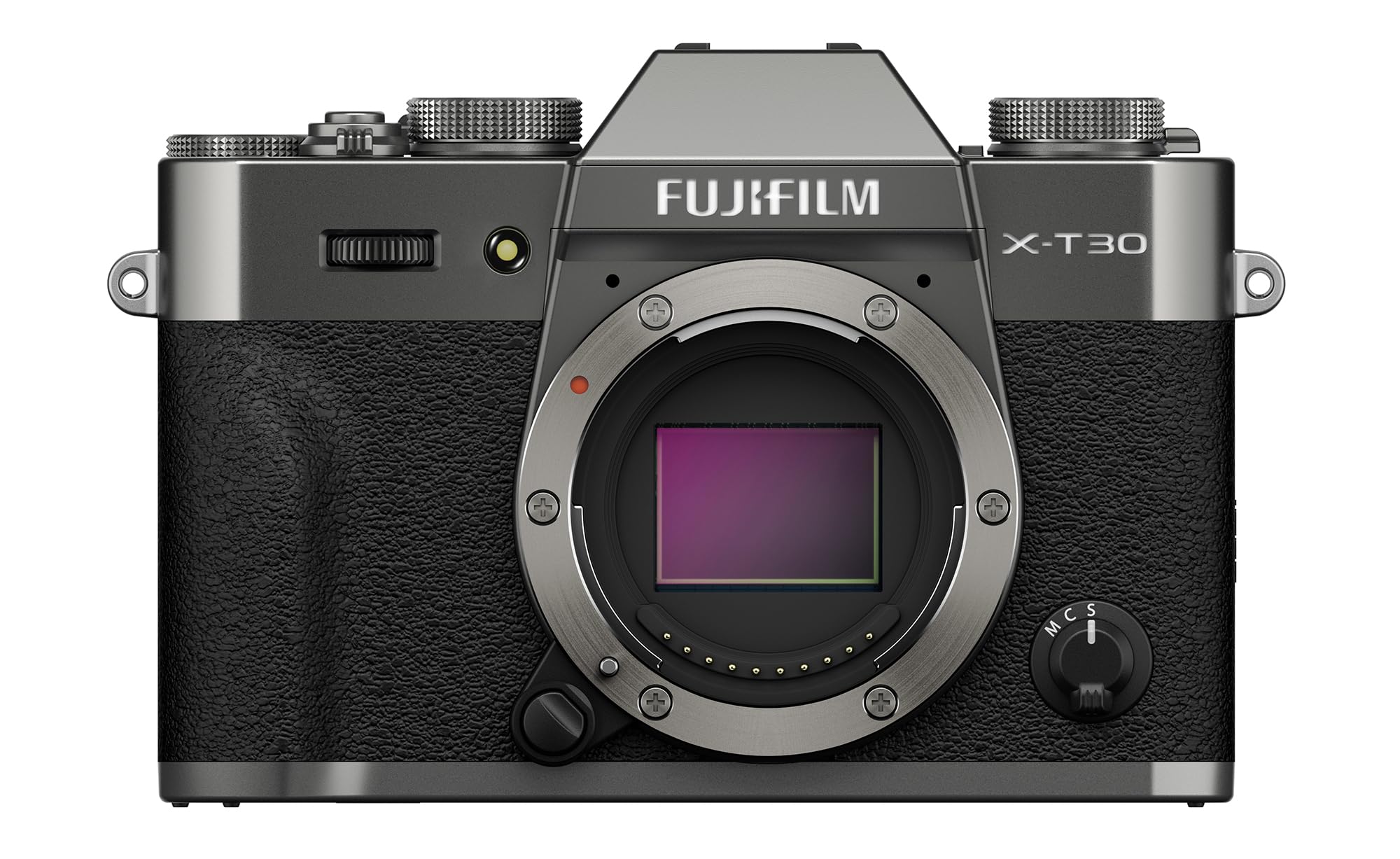
A compact style icon that makes every day shooting feel creative with built-in film simulations.
The Fujifilm X-T30 III is the camera for people who want to enjoy the process of taking photos again. It packs 20 built-in Film Simulations — including classics like Classic Chrome and Acros — so your JPEGs come out of the camera looking like they have already been edited, without needing to sit in front of software. The body is remarkably compact, making it easy to slip into a jacket pocket or small bag, and the timeless design attracts as much attention as the photos it produces. Buyers describe it as “perfect for street photography and travel shots.”
Under the hood, the X-T30 III uses AI-powered subject detection autofocus, which can intelligently track animals, birds, cars, and more. It is built for ease of use with an Auto mode that a beginner can hand to anyone in the family, but still offers full manual controls for when you want to dial in your settings. The 4:3 aspect ratio sensor and 10-bit color depth give you rich files for editing. One real-world limit is the lack of in-body image stabilization, so you will want a stabilized lens or a tripod in dim light. Also, the small body may feel cramped if you have large hands without an add-on grip.
Creative and Compact
- 20 Film Simulations deliver ready-to-share JPEGs with no editing
- AI-powered autofocus tracks animals, birds, and vehicles
- Extremely compact body for everyday carry
Limitations to Note
- No in-body image stabilization — relies on lens stabilization
- Small grip may not suit larger hands without a separate attachment
- No built-in flash; relies on hotshoe accessories
The creative daily companion: Pick the X-T30 III if you love photography as a creative outlet and want a camera that feels inspiring to carry and use everywhere.
Reality check: Without IBIS, you may need to push your ISO higher or use a tripod in low-light situations compared to stabilized competitors.
6. Sony Alpha ZV-E10
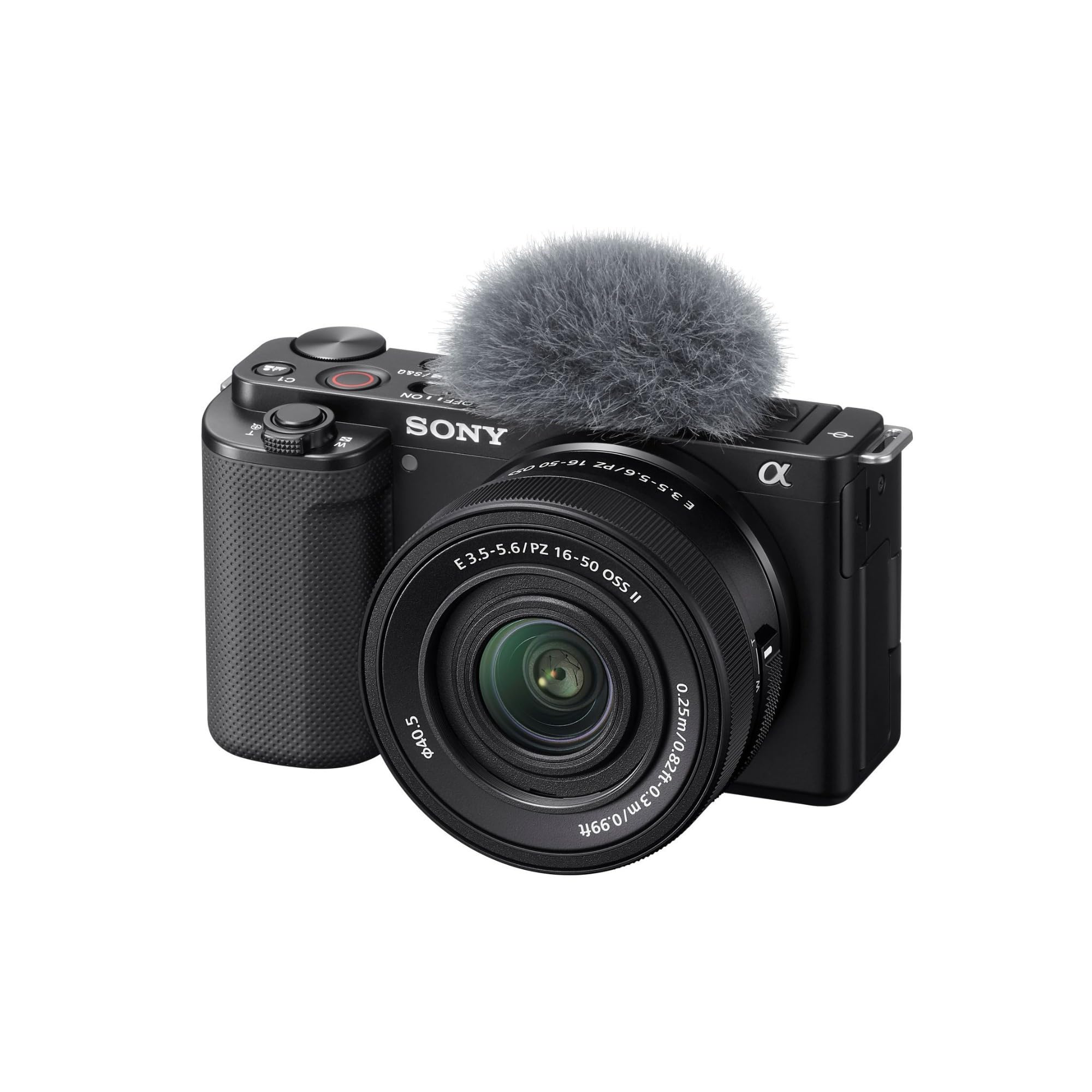
A vlogging-focused Sony with 425 af points and a clever product showcase mode.
The Sony Alpha ZV-E10 is designed for content creators who need reliable autofocus while talking to the camera. It uses a 24.2MP APS-C Exmor CMOS sensor with a fast BIONZ X processor, and it records 4K Movie oversampled from 6K with full pixel readout and no pixel binning, so your 4K footage retains more detail than cameras that simply crop a 4K readout. The autofocus system has 425 phase-detection points and includes a Product Showcase Setting that transitions focus from your face to an object you hold up — perfect for unboxing or review videos. Reviewers point out the camera is “easy to get started” with lots of versatility in the presets.
The Background Defocus button lets you toggle a defocused background on and off instantly with one press. You can live stream over a single USB cable without needing a capture card. The built-in media includes both the camera body and a Sony E PZ 16-50mm F3.5-5.6 OSS II kit lens. A noticeable gap is the lack of in-body image stabilization, so you will rely on the lens OSS or a gimbal for smooth walking shots. It also does not have a viewfinder, which some photographers miss when shooting in bright sunlight outdoors.
Creator-Focused Features
- 425 AF points for smooth, reliable face and object tracking
- 4K oversampled from 6K for sharper video detail
- Product Showcase Setting and Background Defocus button
Missing Pieces
- No in-body image stabilization
- No viewfinder — relies solely on the rear screen
- Kit lens aperture is slow (f/3.5-5.6) for low light
The vlogger’s pick: Choose the ZV-E10 if video content is your priority and you want one of the best AF systems for talking-head style footage.
Honest catch: In bright outdoor conditions when the sun washes out the screen, the lack of a viewfinder becomes a real problem.
7. Canon EOS R50
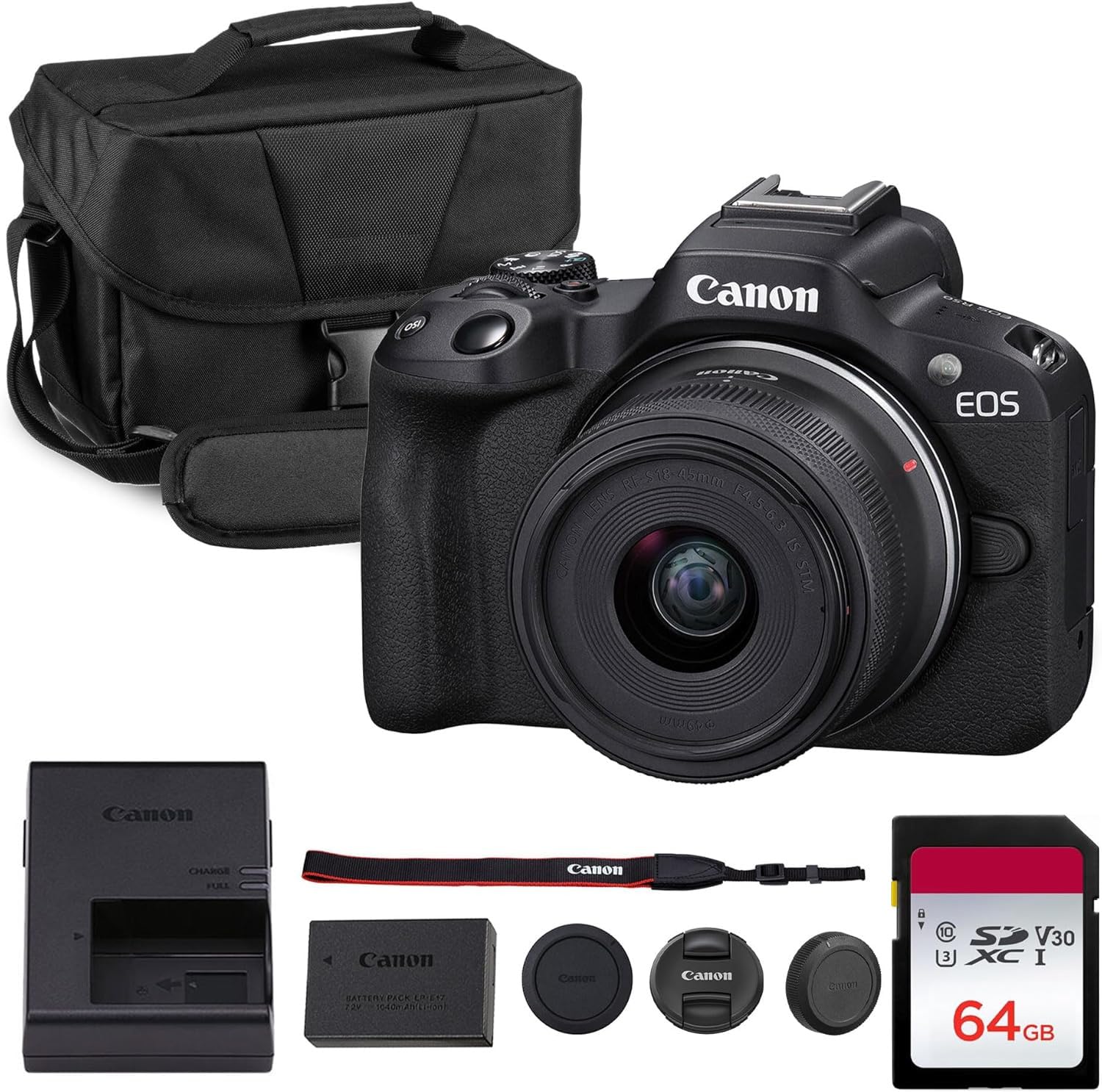
A beginner-friendly R50 with Dual Pixel AF and vari-angle touchscreen for creative content.
The Canon EOS R50 is designed specifically for beginners and vloggers who want great quality without complexity. It packs an APS-C sensor that oversamples 4K video for sharp footage, backed by Canon’s Dual Pixel CMOS AF II with 99 autofocus points. The autofocus includes reliable subject tracking with face and eye detection — which buyers confirm is “fast autofocus” with good image quality for the price. The vari-angle touchscreen flips out to the side, making it much easier to frame yourself when vlogging or shooting over your head compared to a simple flip-up screen.
The kit includes a compact 18-45mm f/4.5-6.3 IS STM zoom lens that covers wide to standard focal lengths, plus a 64GB UHS-I SDXC memory card and a shoulder bag. Creative Assist provides in-camera guides and vertical video mode for social media content without diving into manual settings. A common buyer note is that the camera lacks in-body stabilization, so your lens will need to have image stabilization for smooth handheld video. The buffer also fills quickly during continuous shooting, so it is not ideal for fast action sequences. The camera has no built-in flash and relies entirely on the hotshoe.
Beginner tune
- Oversampled 4K with reliable Dual Pixel AF II and face/eye tracking
- Vari-angle touchscreen for easy selfie framing and vlogging
- Comes with kit lens, memory card, and bag for immediate use
Compromises
- No in-body stabilization; relies on lens OIS
- Buffer fills quickly in continuous shooting mode
- No built-in flash; hotshoe only
The perfect starter: Pick the R50 if you are new to mirrorless cameras and want a model that makes high-quality photos and 4K video easy from day one.
pass on it if: You shoot fast action sports or need the flexibility of in-body stabilization — the small buffer and lack of IBIS will frustrate you.
8. Nikon Z 50

A solid, compact entry into the Nikon Z system with a 20.9 MP sensor and 209 AF points.
The Nikon Z 50 is Nikon’s first DX-format mirrorless camera, and it uses a large 55 millimeter lens mount — the same size as the full-frame Z cameras — which allows for advantages in image quality and low-light performance. The 20.9 MP sensor supports sturdy 4K UHD video features, and the 209 autofocus points provide good coverage across the frame with both contrast and phase detection. Buyers report it is “compact (585g), good EVF, UHS-1 SD slot,” and they appreciate the decent low-light performance for a DX sensor. The selfie flip-down touch LCD screen is great for self-portraits and blogging.
The camera has built-in Wi-Fi and Bluetooth for simple pairing to a smartphone. It is compatible with Nikkor Z lenses and older F-mount lenses using the FTZ Mount Adapter (sold separately). The kit includes a 16-50mm wide-angle zoom lens. A key trade-off is the use of MicroUSB instead of the modern USB-C standard, which means slower data transfer and charging. The new EN-EL25 battery has decent life, but the camera lacks in-body image stabilization, so lens VR is your only stabilization option. The flip-down screen also requires a tripod to use if you want to attach an external microphone.
Solid Nikon Quality
- Large 55mm lens mount for improved light gathering
- 209 AF points with contrast and phase detection
- Compact at 585g with good EVF and functional selfie screen
Dated Connectivity
- MicroUSB port instead of USB-C for charging and data
- No in-body image stabilization
- Flip-down screen design blocks tripod microphone
Nikon loyalist entry: Grab the Z 50 if you already own Nikon F-mount lenses or plan to invest in the Z system, and you want a compact body with a big mount.
Honest limit: The MicroUSB port in a camera at this price point feels dated, and the flip-down screen is less practical for video shooting compared to side-flip designs.
9. Panasonic LUMIX G100

A compact camera that prioritizes audio with a built-in tracking microphone for clear sound.
The Panasonic LUMIX G100 stands out for its advanced 360-degree sound system — a high-performance built-in microphone with tracking that auto-adjusts to record clearly whether you are inside, outside, in a crowd, or one-on-one. This is a rare feature in this price bracket and makes the G100 a strong option for video creators who do not want to buy a separate microphone immediately. The camera uses a Micro Four Thirds interchangeable lens system and includes a 12-32mm wide-angle lens. It shoots 4K 24p and 30p video in addition to 4K Photo mode. Owners mention it is “user friendly” and “light weight” with “great color tones.”
The G100 has an iA (intelligent auto) mode for quick point-and-shoot results, and manual modes when you want to take full control. The Micro Four Thirds system is compatible with all LUMIX lenses. It can also easily connect to a computer as a webcam for crisp, professional-looking livestreams and calls. The autofocus uses contrast detection with 49 AF points — a significant gap versus the Sony a6400’s 425 points, which means it will struggle more with fast-moving subjects. One buyer’s specific complaint is that “4K video recording time is very limited and stops at max.” So if you plan to record long continuous 4K footage, this may be a dealbreaker.
Audio Advantage
- Built-in tracking microphone with 360-degree sound recording
- Compact and lightweight body with Micro Four Thirds lens options
- iA mode for easy shooting plus full manual controls
Limitations to Note
- 4K video recording has a hard time limit that stops recording
- Only 49 contrast-detection AF points for slower focusing
- 8-bit color depth limits video grading flexibility
For audio-conscious vloggers: Choose the G100 if you want a camera with excellent built-in audio tracking and a compact form for one-handed recording.
The catch: The contrast-only AF with 49 points feels sluggish compared to nearly every other camera on this list, and the 4K recording limit is real.
10. Nikon Z 30

Nikon’s most compact mirrorless body, built for streaming and vlogging with USB-C power.
The Nikon Z 30 is Nikon’s most compact and lightweight mirrorless camera, designed specifically for creators, vloggers, and streamers. It delivers pro-grade 4K video with autofocus that includes eye tracking for people and pets, beautifully blurred backgrounds, and strong low-light performance. The 209 autofocus points with hybrid AF keep subjects sharp. Customers note “great picture quality” and compatibility with both Z and F-mount lenses through the FTZ adapter, making it a versatile addition for Nikon shooters.
Vlogger essentials include a flip-out touchscreen selfie monitor, a built-in stereo microphone with adjustable sensitivity, a red REC light, and a smartphone app for remote camera control. For streaming, it offers plug-and-play webcam operation with smooth Full HD 60p streaming over USB-C and 4K 30p streaming over HDMI — plus constant power delivery over USB-C, so you never have to worry about battery life during a long stream. One honest review notes that “there is no viewfinder,” meaning you must frame everything from the rear screen. This is fine indoors but can be a struggle outside in bright conditions. It also has no in-body stabilization, so you will rely on lens VR.
Streaming Ready
- USB-C power and data for constant, uninterrupted streaming
- 209 AF points with eye tracking for people and pets
- Flip-out touchscreen for easy selfie framing
Missing Essentials
- No viewfinder — only rear screen for composition
- No in-body image stabilization
- Crop sensor limits low-light performance at high ISOs
For the streamer: Pick the Z 30 if your main use is live streaming and vlogging, and the lack of a viewfinder does not bother you.
Reality check: Without a viewfinder, shooting outdoors in strong sunlight becomes frustrating, and the cropped sensor means low-light footage will be noisier than APS-C competitors.
Understanding the Specs
Autofocus Points
The number of autofocus (AF) points tells you how much of the frame the camera can use to lock focus. More points mean the camera can track a subject that moves across the frame without losing it. Cameras with 425 phase-detection points (like the Sony a6400 and ZV-E10) can focus on a bird flying across the sky and stay sharp. Cameras with 49 points (like the Panasonic G100 and G85) work fine for still subjects but will struggle to keep a moving target in focus.
In-Body Image Stabilization (IBIS)
IBIS is a small mechanism inside the camera that shifts the sensor to counteract your hand shake. A camera with 5-axis IBIS (like the Canon R7 or Panasonic G85) can give you 5 to 7 stops of compensation, which means you can shoot at a shutter speed 5 to 7 steps slower than normal without blur. If a camera lacks IBIS, you must rely on a stabilized lens or a tripod for sharp handheld shots in low light. For video shooters, IBIS is even more important — it smooths out walking motion better than lens stabilization alone.
Megapixels and Sensor Size
Megapixels (MP) determine the resolution of your image. A 24.2MP sensor (used in the Sony a6400 and ZV-E10) produces images that can be printed at 16×24 inches at 200dpi. The 40.2MP sensor in the Fujifilm X-T5 can print at 24×36 inches or allow heavy cropping. The sensor size — APS-C vs Micro Four Thirds — affects low-light performance and depth of field. APS-C sensors are physically larger, so individual pixels are bigger and gather more light, which reduces noise at high ISO settings. Micro Four Thirds sensors (like in the Panasonic G85 and G100) are smaller, which means you get more depth of field at the same aperture, useful for vlogging where you want everything in focus.
4K Video Quality and Crops
Not all 4K is equal. Some cameras oversample from 6K (like the Sony ZV-E10 and Canon R50), which means the sensor captures a 6K image and downscales it to 4K, producing sharper footage with more detail and less noise. Other cameras use the full sensor width with no pixel binning, which also produces good quality. Some cameras crop the sensor when shooting 4K, reducing your field of view and making your lens feel tighter. Checking the recording limits is essential: several cameras (like the Panasonic G100) stop 4K recording after a set time due to thermal limits, which can interrupt a long interview or event.
FAQ
Which compact mirrorless camera has the best autofocus?
What is the difference between APS-C and Micro Four Thirds sensors?
Do I need in-body image stabilization?
Can I use my old DSLR lenses on a compact mirrorless camera?
Is the Fujifilm X-T5 worth the premium over the X-T30 III?
Which compact mirrorless camera is best for beginners?
How long does 4K video recording last on these cameras?
<
Can I use these cameras as webcams for streaming?
What is the best lens to buy with my first compact mirrorless camera?
Final Thoughts: The Verdict
For most people, the best compact mirrorless camera winner is the Fujifilm X-T5 because its 40.2MP sensor, 7-stop IBIS, and classic dials deliver the highest image quality in a compact body. If you want blazing-fast autofocus for action and wildlife, grab the Canon EOS R7 for its 32.5MP sensor, 15 fps burst, and subject tracking. And for the best balance of performance and price for vlogging, the Sony Alpha a6400 gives you 425 AF points and 24.2MP at a mid-range price point.
How We Picked
We do not accept paid placement. Every pick is matched to a real buyer and a real use-case; we do not hands-on test units.
Sources & Methodology
Specifications: manufacturer listings and product documentation. Review insights: verified customer reviews, as of July 2026. Pricing: not shown on this page (it changes often); check the current price via the retailer link.
As an Amazon Associate, WellFizz earns from qualifying purchases. This does not affect which products we feature.
Related Guides

Mo Maruf
I created WellFizz to bridge the gap between vague wellness advice and actionable solutions. My mission is simple: to decode the research and give you practical tools you can actually use.
Beyond the data, I am a passionate traveler. I believe that stepping away from the screen to explore new environments is essential for mental clarity and physical vitality.