Active Daily Care Eat Smart Health Hacks Recommended
About Contact The Library

7 Best Computer Cases For Airflow | Six Mesh Cases That Breathe

Our readers keep the lights on and my smoothie glass nicely filled. As an Amazon Associate, I earn from qualifying purchases.

Specs are compiled from manufacturer listings and verified buyer reviews and can change over time — please confirm the key details on the product page before buying.

A PC case that traps hot air around your components will slow them down fast. You need a chassis where the front panel is actual mesh, where the fans move serious air, and where nothing blocks cool air from reaching your CPU and GPU. This guide compares seven real computer cases for airflow so you can pick the one that keeps your hardware running fast and stable, even under heavy gaming.

I’m Mohammad Maruf — the founder and writer behind WellFizz. This guide is built by comparing the manufacturers’ published specifications and the patterns across verified customer reviews, so you get each pick’s real strengths and trade-offs instead of marketing spin.

These cases are used by thousands of buyers to keep components cool. Each model strikes a different balance between fan count, build quality, and price, so you can match the right chassis to your exact needs.
Our Picks at a Glance

MUSETEX Y6
Best OverallMUSETEX Y64.7★980 ratingsSeven pre-installed infinity mirror fans make this a lighting powerhouse. No other case on this list ships with seven pre-installed fans.Check Price on Amazon
NZXT H9 Flow (2025)
Premium ChoiceNZXT H9 Flow (2025)4.8★420 ratingsA massive dual-chamber that turns cable management into a joy.Check Price on Amazon

How To Choose The Best Computer Cases For Airflow

The most important thing to know is that not every case with a fan opening moves much air. A case with a solid glass front panel looks clean, but it starves your intake fans — they can only pull air through tiny side gaps. The cases here all use mesh or heavily perforated steel fronts that let air pass through with almost no resistance.

Fan Count and Fan Type

Six or seven pre-installed fans sounds impressive, but pay attention to whether they are PWM (pulse-width modulation, which lets the motherboard control speed) or DC (direct current, which runs at a fixed speed). PWM fans let you control speed precisely through the motherboard, so the case can run near-silent at idle and ramp up when things get hot. DC fans are usually cheaper and run at a fixed speed unless you manually switch them. A few high-quality PWM fans often outperform more fixed-speed fans because you can tune them for the right balance of noise and airflow.

Radiator and GPU Clearance

If you plan on liquid cooling, you need a case that fits a 360mm or 420mm radiator (a liquid cooler radiator that is 360 or 420 millimeters long) at the top or front. The same goes for large triple-fan graphics cards — look at the maximum GPU (graphics card) length in the specifications. Most mid-towers handle up to 360mm, but some go as far as 420mm. Measure your components before buying; nothing is more frustrating than a radiator that hits the motherboard VRM (voltage regulator module) heatsinks.

Quick Comparison

Model Best For Fans Included Max GPU Length Max Radiator Amazon
MUSETEX Y6★ Best Overall Maximum pre-installed fans at a low price 7 Infinity Mirror PWM ARGB 410mm 360mm Amazon
NZXT H9 FlowPremium Choice Premium dual-chamber cooling 4 (3x140mm + 1x120mm) 420mm Amazon
Antec Flux Wood Style meets high airflow 5 PWM 420mm Amazon
CORSAIR 4000D RS Frame Modular customization 3 RS PWM Multiple 360mm Amazon
LIAN LI LANCOOL 207 Innovative GPU-focused airflow 4 (2x140mm ARGB + 2x120mm PWM) 410mm 360mm Amazon
Lian Li Vector V100 Mid-range all-rounder with great cable management 4 ARGB PWM 420mm 360mm Amazon
Montech X3 Mesh Budget build with massive fan count 6 (3x140mm + 3x120mm) 305mm Amazon

In‑Depth Reviews

★ Best Overall

1. MUSETEX Y6

Our pick — over 4.5★ from 950+ verified ratings; the strongest balance of quality and price.

7 Infinity Fans270° Glass

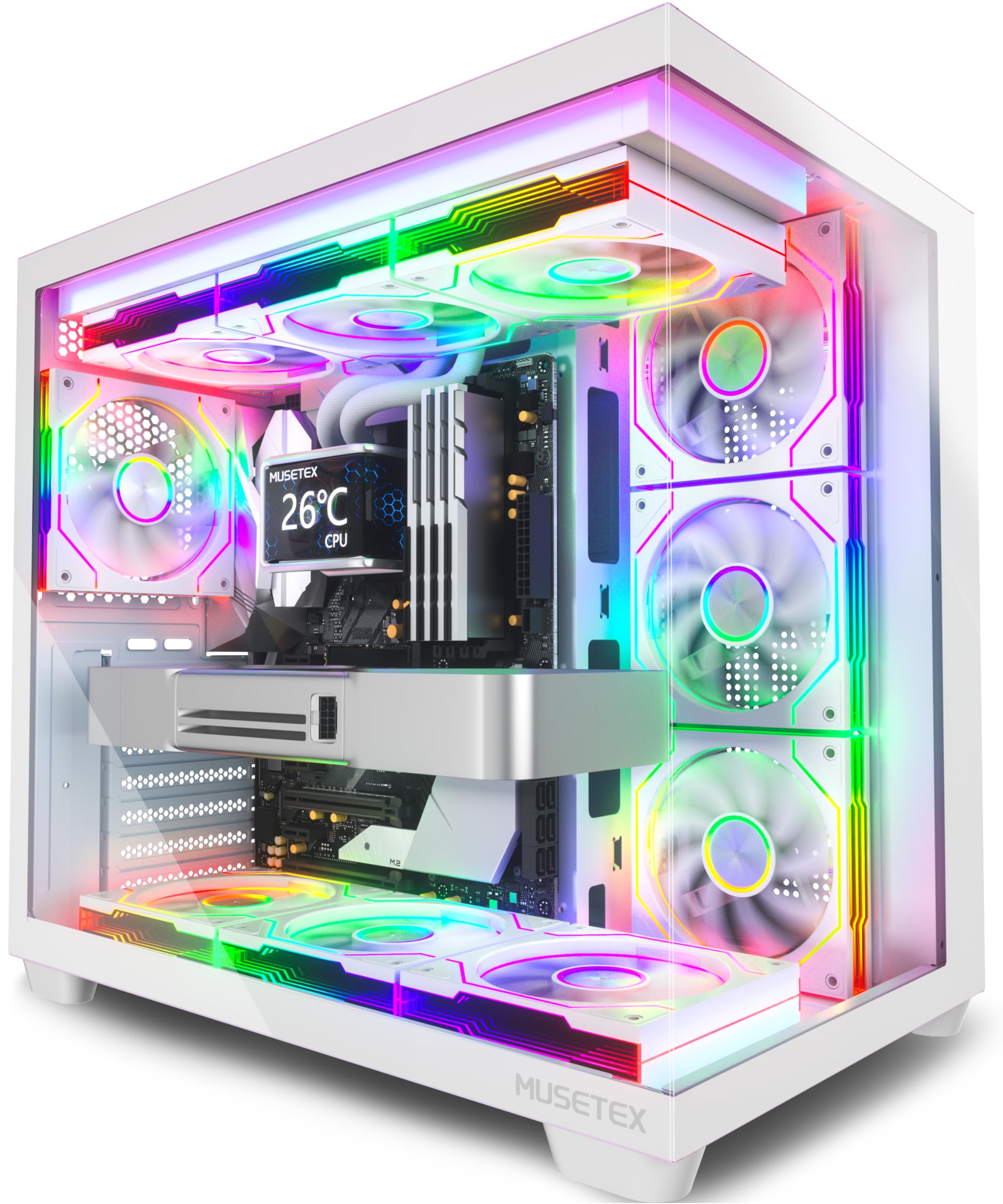
Seven pre-installed infinity mirror fans make this a lighting powerhouse.

No other case on this list ships with seven pre-installed fans. The MUSETEX Y6 includes three reverse-blade fans on the side, three more on the bottom, and a standard fan at the rear — all 120mm PWM (pulse-width modulation) ARGB fans with infinity mirror centers that create smooth rainbow light bands. The 270° fully transparent tempered glass panels give you a panoramic view of the entire interior. The case supports 360mm radiators on top and GPUs (graphics cards) up to 410mm, which is enough room for almost any modern graphics card.

Shoppers say that the Y6 exceeded expectations with its spacious interior and strong airflow. One customer observed that the pre-installed fans, easy cable management, and great looks make this an incredible value. The bottom fans are reverse-blade, so they pull air in without showing the ugly hub side, keeping the view clean. The case fits ATX, Micro-ATX, and Mini-ITX motherboards, and the I/O (input/output) includes a USB-C port. At 14.64 pounds (about 6.64 kg), it weighs 6.64 kg versus the LANCOOL 207 at 9.05 kg, making it easier to handle during installation.

The trade-off is that the fans are ribboned with what appears to be a 2-pin connector, meaning you cannot set each fan a different color independently without a separate controller. But if you want a case that looks fantastic from the start and stays cool, this is a strong choice.

Fan Count Advantage

  • 7 pre-installed ARGB fans save you – in extra fan purchases
  • Reverse-blade fans on side and bottom keep the view tidy
  • 270° tempered glass shows off every component

Customization Catch

  • Fans are ribboned — you cannot set each fan a different color independently
  • Limited cable routing space for ATX motherboards on the bottom edge

Great for: builders who want maximum fan count and RGB lighting at a price that beats buying fans separately.

Not ideal if: you need individual per-fan lighting control or you are planning a complex water loop.

Premium Choice

2. NZXT H9 Flow (2025)

420mm RadiatorDual Chamber

A massive dual-chamber that turns cable management into a joy.

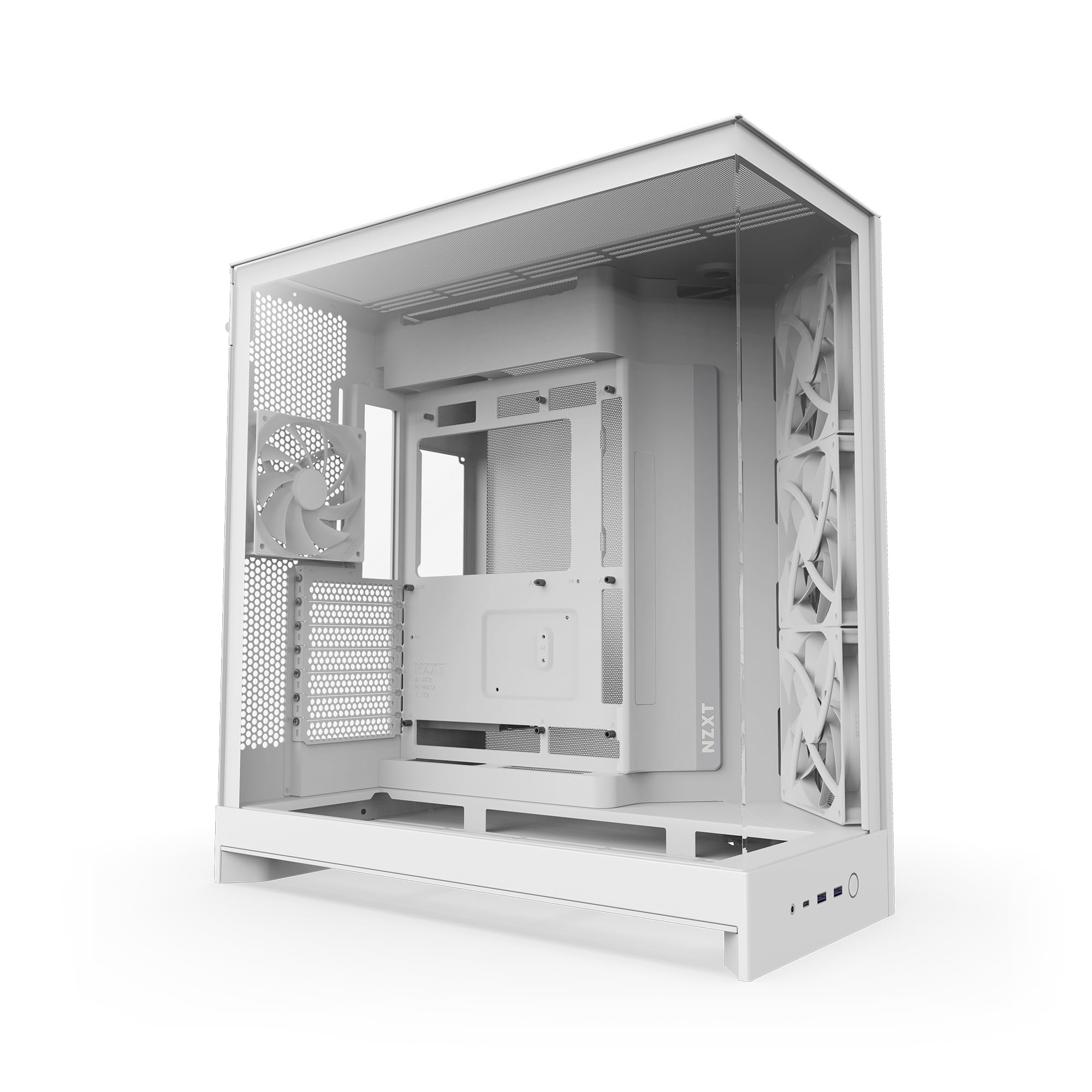
The NZXT H9 Flow separates your main components from the power supply and drives in a second chamber, so the main compartment stays wide open for air to move freely around your CPU and GPU (graphics card). It comes with three F140Q 140mm fans in the front and one F120Q 120mm fan in the rear, giving you a strong starting setup. The case supports up to ten fans total — nine 140mm plus one 120mm — so you can add more if you want extreme cooling.

Buyers report that the case is large, but they mean it in a good way — one reviewer called it “such a great pc building experience.” The panoramic tempered glass panels let you show off the build from every angle. It fits a 420mm radiator (a liquid cooler radiator that is 420 millimeters long) at the top or the front, and it is back-connect ready for ASUS BTF or MSI Project Zero motherboards that hide all the cables behind the board. The 12.5-kilogram weight tells you this is a sturdy chassis that won’t flex.

This case is ideal if you are building a high-end water-cooling loop or a top-tier gaming rig with a huge GPU. The only real trade-off is the size — it takes up a lot of desk space, so measure your area carefully before buying.

Dual-Chamber Payoff

  • Separate PSU (power supply unit) chamber improves thermal separation and cable hiding
  • Supports up to nine 140mm fans for massive airflow
  • Panoramic tempered glass for a clean showcase

Space Consideration

  • Very large case — takes up significant desk or floor space
  • Some units may have stripped screws

Reach for it when: you want the most room to build a high-end water-loop or a flagship GPU without airflow bottlenecks.

Look elsewhere if: desk space is tight or you prefer a more compact mid-tower.

Style Pick

3. Antec Flux Wood

5 PWM FansWood Accent

A walnut-trimmed case that cools as good as it looks.

The Antec Flux Wood stands out with five pre-installed PWM (pulse-width modulation) fans, which let the motherboard control their speed for quiet idle and strong cooling under load. It includes three P12 PWM at the front, one P12R PWM reverse fan in the power supply chamber, and one P14 PWM at the rear. That means you get positive air pressure (more intake than exhaust, which keeps dust out) right from the start. The multi-directional vent design creates a dedicated airflow channel that keeps air moving efficiently from the front mesh to the top and rear exhausts.

Owners mention that the case is well-built and that the 5 included fans keep the system cool even under heavy gaming. One reviewer noted they loved how easy it is to remove all the panels and put them back in place snuggly. It supports up to nine fans total, and you can install a 420mm radiator at the front alongside a 280mm at the top, or go with a 360mm at the top and front simultaneously. The side panel is tempered glass, the dust filter at the bottom protects the power supply, and it supports back-connect motherboards from ASUS and MSI.

Unlike the NZXT H9 Flow above, the Antec Flux is slightly more compact and lighter at 9.27 kilograms, compared to the NZXT H9 Flow at 12.5 kg, making it easier to move around. The one minor catch some buyers mention is that the fan hub is powered by a SATA cable (a standard data/power cable for drives), not a direct motherboard header, which is a small inconvenience in a case that otherwise feels premium.

Build & Look

  • Real walnut wood front panel adds class
  • 5 pre-installed PWM fans provide great airflow
  • Large radiator support for serious cooling loops

Minor Quirk

  • Fan hub is SATA-powered rather than motherboard-powered
  • Wood finish may not match all setups

Grab it for: a build where you want premium looks and high airflow without paying a premium for the NZXT name.

Leave it if: you prefer all-black or all-white metal and glass with no natural wood accents.

Best Value

4. CORSAIR 4000D RS Frame

InfiniRailModular

A modular case that evolves with your cooling needs.

The CORSAIR 4000D RS Frame ships with three pre-installed RS PWM (pulse-width modulation) fans at the front, which support Zero RPM mode — that means they can stop spinning entirely at low loads for near-silent operation. The steel front panel uses a 3D Y-pattern perforation that gives a low-resistance path for air while still looking clean.

The standout feature here is the InfiniRail fan mounting system. Instead of fixed fan positions, you slide a steel rail to mount fans anywhere from 120mm up to 200mm in the front, or 140mm in the roof. This gives you the freedom to aim airflow exactly where your hottest components sit. The internal side panel near the motherboard can double as a cable cover for a clean look, or you can remove it and mount additional fans on the side for even more cooling potential.

Customers note that the case handles high-end CPUs with AIO (all-in-one liquid) coolers and triple-fan GPUs very well. One buyer mentioned that while the fans are serviceable and quiet-ish, the modular design is what makes this case worth the money. It is 8.2 kilograms, compared to the NZXT H9 Flow at 12.5 kg and the Antec Flux Wood at 9.27 kg, and supports multiple 360mm radiators. If you like the idea of upgrading the front I/O (input/output ports) or swapping the motherboard tray later, this is the only case on the list that can grow with you — unlike the fixed layouts of the Antec or NZXT.

Modular Magic

  • InfiniRail lets you position fans anywhere for targeted cooling
  • FRAME system lets you upgrade components later
  • 3D Y-pattern front panel breathes well

Cable Consideration

  • Only comes with 3 fans — you will likely want to add more
  • Side panel as cable cover may limit some fan mounting options

Choose this if: you value customization and want a case that can change as your hardware evolves.

Stick with others if: you want a case with all the fans needed straight from the factory.

Innovation Star

5. LIAN LI LANCOOL 207

GPU Bottom Fans410mm GPU

Two dedicated fans blow directly under your GPU for targeted cooling.

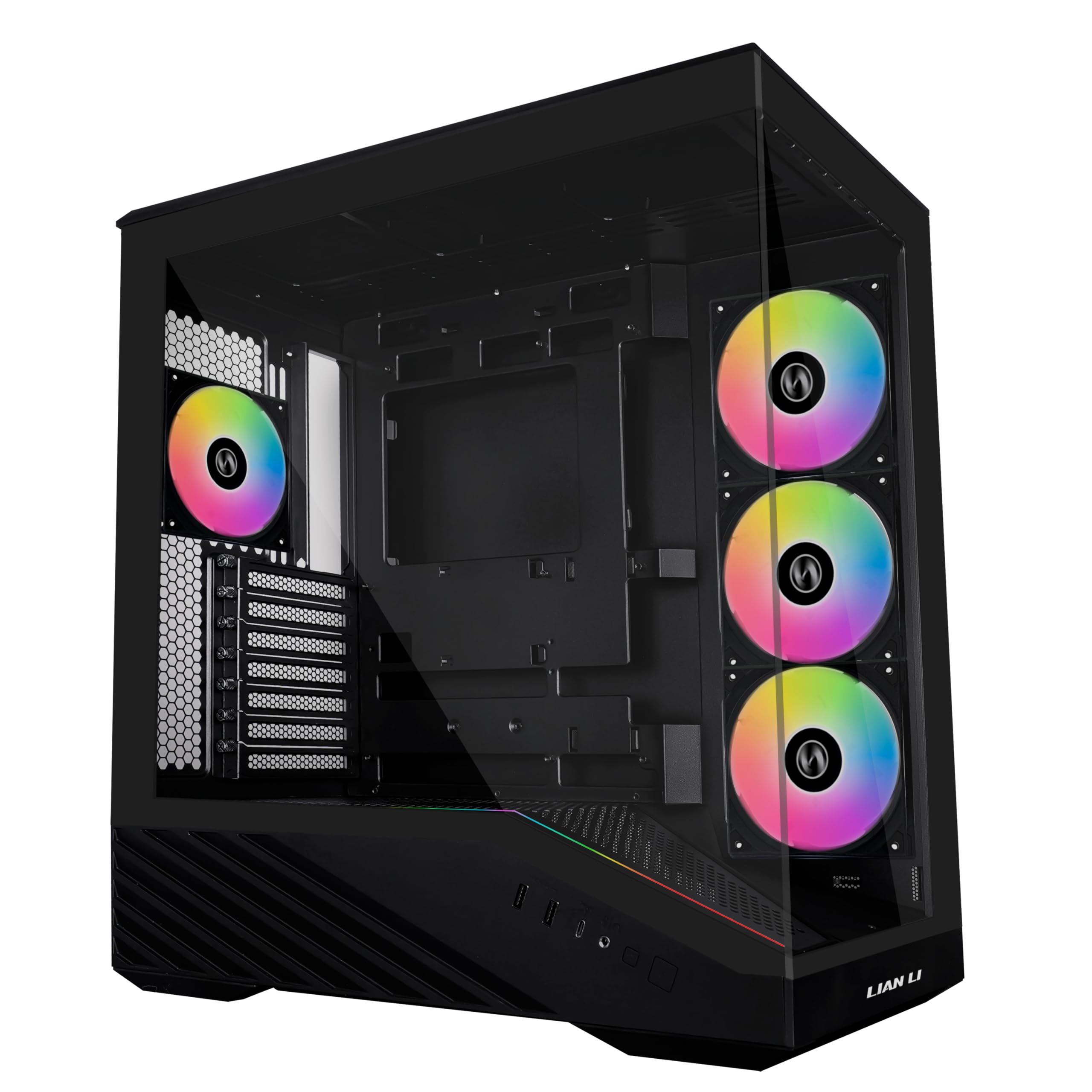
Lian Li re-engineered the ATX layout here. The LANCOOL 207 is technically an M-ATX chassis (a case for Micro-ATX motherboards), but it supports full ATX motherboards by shifting the motherboard tray upward. That offset creates space for two pre-installed 120mm PWM (pulse-width modulation) fans on the bottom, positioned directly under the graphics card. This is a smart design because GPUs are often the hottest component in a gaming PC, and those bottom fans feed fresh air straight into the GPU’s own fans.

The front fans are two 140mm ARGB units with an infinity mirror center, spinning up to 1900 RPM (revolutions per minute). They are thick at 30mm (instead of the standard 25mm), which means they push more air per revolution than standard fans. The front, top, and bottom all have large mesh panels for unrestricted intake. Reviewers point out that CPU and GPU temperatures dropped noticeably compared to their previous cases. One owner reported the case “absolutely nails airflow” and that the build quality feels premium despite the mid-range price.

Unlike the MUSETEX Y6, which has seven fans but fewer larger radiators, the LANCOOL 207 supports a 360mm radiator on top and GPUs (graphics cards) up to 410mm in length. The included GPU anti-sag bracket keeps your big card level. The only noise you may hear is a slight humming from the front fans at higher speeds, which some buyers fixed by adding rubber gaskets. At 19.95 pounds (about 9.05 kg), it is one of the heavier cases here, but the steel frame feels solid.

Cooling Innovation

  • Bottom fans blow directly on GPU for targeted thermal improvement
  • 30mm thick 140mm front fans move more air
  • GPU anti-sag bracket is pre-installed and adjustable

Noise Trade-off

  • Front fans can produce a humming noise at higher speeds
  • Cable management channel is tight — flat cables help

Pick it for: the most thermally efficient design if you own a high-power GPU that runs hot.

Avoid it if: you are very sensitive to fan hum and do not want to add rubber gaskets.

Well-Rounded

6. Lian Li Vector V100

420mm GPUTool-Less

A mid-tower that holds a 420mm GPU while keeping cable management tidy.

The Lian Li Vector V100 comes with four pre-installed PWM (pulse-width modulation) ARGB fans: three 120mm intake fans at the front and one 120mm exhaust at the rear. They use hydraulic bearings and have a maximum airflow of 61.47 CFM (cubic feet per minute, a measure of how much air a fan moves) at 1800 RPM (revolutions per minute), with a noise level between 26.5 and 30.8 dBA (a measure of sound level). That is quieter than many stock fans. The case also includes an integrated 26-LED ARGB strip for full-spectrum lighting control through the motherboard.

The big deal here is the support for GPUs (graphics cards) up to 420mm in length, which is more than even the NZXT H9 Flow supports. CPUs can be up to 178mm tall, and you can mount a 360mm radiator on top. The side panels are tool-less — just pop them off for quick access. Buyers report that cable management is built-in and so good that one reviewer called it “a dream to build in.” The bottom of the case has extra room for non-modular power supply cables.

At 8200 grams (8.2 kg), the V100 is 8.2 kg versus the Montech X3 Mesh at 5.42 kg, which reflects its sturdy construction. The main trade-off buyers mention is sound isolation — because the design is so open for airflow, you hear your components more than you would in a dampened case. But if you prioritize airflow above all else, the V100 delivers while also giving you space for the largest graphics cards on the market.

Room to Spare

  • Supports GPUs up to 420mm — fits any consumer card on the market
  • Tool-less side panels make building and maintenance fast
  • Excellent cable management with pre-wired routing

Sound Trade-off

  • Open design means less noise dampening
  • Runs wires inside the body for front fans — you may want to re-route them for looks

Ideal if: you are buying a massive flagship GPU and want a straightforward, high-airflow case with good cable management.

Pass if: noise isolation is more important to you than maximum GPU clearance.

Budget Champ

7. Montech X3 Mesh

6 Fixed Fans4 Bays

Six fans and a mesh front at a price that is hard to argue with.

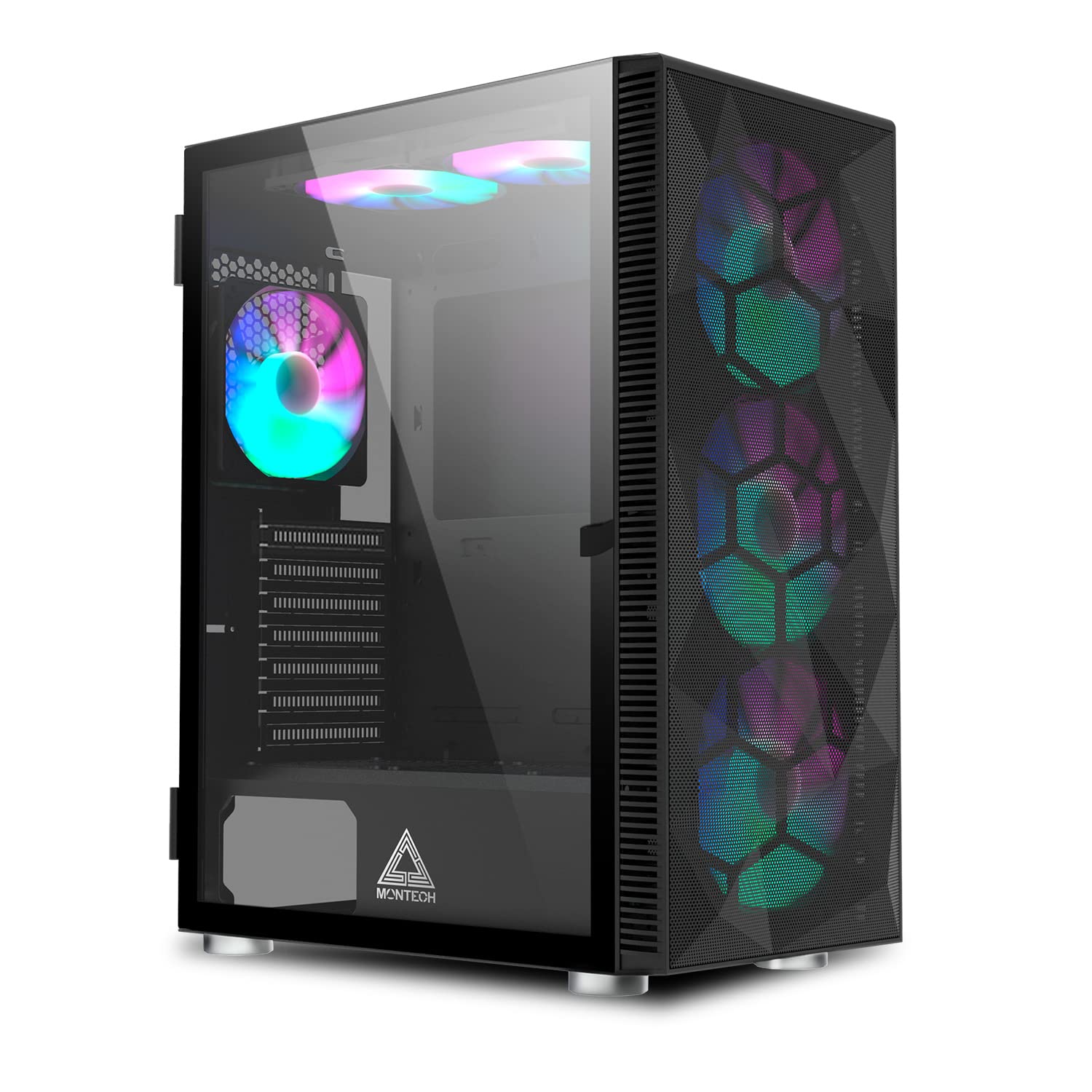
The Montech X3 Mesh packs three 140mm fans at the front and three 120mm fans at the rear and top — six fans total — for a very low entry price. The three front 140mm fans provide massive air intake, and the mesh front panel keeps the path clear. The fans are fixed RGB (red-green-blue lighting that you cannot change), meaning you cannot change the lighting pattern, but you can turn them on or off with the press of a button on the top. Owners mention that the six fans keep components cool even during intense gaming sessions, with one reviewer calling it “an absolute beast for PC gaming cases.”

The tempered glass side panel swivels open like a door instead of sliding off, which makes accessing your components convenient without removing the panel entirely. At 5420 grams (5.42 kg), the X3 is noticeably lighter than the Lian Li Vector V100 (8200 grams) — so it is easy to move around and work with. The cable management is manageable despite the budget price, and customers note that the fans are quiet enough not to be annoying. The case supports ATX, Micro-ATX, and Mini-ITX motherboards, with four internal bays for drives.

One limitation is that the fans are fixed-speed DC (direct current) types, not PWM (pulse-width modulation), so you cannot control their speed through the motherboard. They run at a constant speed, which is less flexible than the MUSETEX or Lian Li options. Also, the maximum GPU (graphics card) length is 305mm, which is shorter than the 410mm or 420mm supported by the other cases here. If you are using a smaller card or a standard-size GPU, the X3 works fine — but for large triple-fan cards, you will need one of the larger cases above.

Value Highlights

  • Six fans included at a budget-friendly price
  • Triple 140mm front fans create strong positive air pressure
  • Lightweight (5420g) — easy to move and build in

Its Limits

  • Fixed-speed fans — no PWM speed control
  • Maximum GPU length of 305mm limits large cards
  • Some units may ship with a non-working fan

Buy it for: an affordable build with a smaller or standard-size GPU where you want solid cooling and a minimal budget spend.

skip it if: you plan on using a large triple-fan graphics card or want full PWM fan control.

Understanding the Specs

Front Panel Design

The front panel is the main intake area for cool air. A mesh or heavily perforated steel front panel lets air flow freely with minimal resistance. Solid glass or metal front panels restrict the intake, forcing fans to pull air through tiny side gaps. All the cases in this guide use mesh or perforated fronts so cold air can reach your components without obstruction.

Fan Type and PWM

PWM (pulse-width modulation) fans let the motherboard control the fan speed precisely based on temperature. That means the case can run near-silent at idle and speed up when your CPU and GPU heat up under load. DC (direct current) fans, also called 3-pin fans, run at a fixed speed unless you use a manual fan controller. PWM fans are more flexible and typically quieter in a well-controlled build.

GPU and Radiator Clearance

This tells you the maximum length of the graphics card and the maximum radiator size the case can fit. A 360mm radiator (a liquid cooler radiator that is 360 millimeters long) is the standard for mid-tower cases, while 420mm radiators require a larger chassis. GPU (graphics card) clearance above 350mm fits nearly all modern triple-fan cards; anything under 300mm may limit your choice of high-end GPUs. Always measure your components before purchasing to avoid a tight squeeze.

Internal Bays and Storage

Internal bays count tells you how many hard drives you can mount. Most users with an M.2 SSD (a small, fast solid-state drive that connects directly to the motherboard) only need one or two bays. If you use multiple 3.5-inch HDDs (hard disk drives) for bulk storage, look for cases with four or more bays. The numbers in the table range from 2 to 10, with the NZXT H9 Flow offering the most room for drives.

FAQ

Do I need a mesh front panel for good airflow, or can I use a solid glass front with side vents?
A mesh front panel gives you the most direct path for cool air to enter the case. Solid glass or metal fronts with small side gaps restrict the intake, causing higher fan speeds and more noise for the same airflow. If airflow is your priority, always choose a mesh front.
How many fans do I actually need for a mid-tower gaming PC?
A minimum of two to three fans is enough for a standard build: two intake at the front and one exhaust at the rear. Most mid-tower cases come with three to seven fans pre-installed. the balance for cooling and noise is usually three to four quality PWM (pulse-width modulation) fans that you can control through the motherboard.
What is the difference between a 140mm fan and a 120mm fan?
A 140mm fan moves more air at the same speed because it has a larger blade area. It also tends to be quieter because it achieves the same airflow at a lower RPM (revolutions per minute). The trade-off is that 140mm fans need a bigger mounting space and may not fit in some cases designed only for 120mm fans.
Will a 360mm radiator fit in all these cases?
No. The MUSETEX Y6, Lian Li Vector V100, CORSAIR 4000D RS, LIAN LI LANCOOL 207, and Antec Flux Wood all support 360mm radiators (liquid cooler radiators that are 360 millimeters long) at the top. The NZXT H9 Flow supports a 420mm radiator. The Montech X3 Mesh does not list specific clearances for a 360mm radiator. Always confirm the radiator clearance before buying.
How do I know if my GPU will fit in a specific case?
Check the case’s maximum GPU (graphics card) length in the technical specifications. Then measure your graphics card from the rear bracket to the front edge of the cooler. Compare those two numbers, leaving at least 10-20mm of clearance for easy installation. Most high-end cards are between 300mm and 350mm long.
What is the difference between PWM and DC fans?
PWM (4-pin) fans get a speed control signal from the motherboard, so you can set different speeds for different temperature thresholds. DC (3-pin) fans change speed only by adjusting voltage, which is less precise and may not work with all motherboard fan controls. PWM is the better choice for custom fan curves.
Can I reuse my old power supply from my previous build in a new case?
Yes, as long as the new case supports the physical size of your PSU (power supply unit). Standard ATX power supplies fit all the cases in this list. If you have a large or non-modular PSU, check the maximum PSU length — most cases support up to 160-230mm. The LIAN LI LANCOOL 207 positions the PSU at the front with a short adapter cable, so check compatibility there.
Do these cases come with dust filters?
Most do. The Lian Li Vector V100 lists a dust filter as a feature. The Antec Flux Wood has a bottom dust filter that protects the PSU. The NZXT H9 Flow uses perforated steel panels that act as filters. The CORSAIR 4000D RS includes magnetic dust filters. Check the specific product description for dust filter details before buying.
Is a dual-chamber design better for airflow than a standard layout?
A dual-chamber design separates the power supply and drives from the main compartment, which keeps heat-generating components apart. This can improve overall thermal performance and makes cable management much cleaner because you hide all the PSU cables in the second chamber. The NZXT H9 Flow is the only true dual-chamber case in this list.
What is the best case for a build budget under?
The Montech X3 Mesh is your best option in that range. It comes with six fans and a mesh front at a very low entry price. The trade-off is that the fans are fixed-speed and the max GPU (graphics card) length is 305mm, so it works best with smaller or mid-range graphics cards. For a budget-focused build, it offers outstanding value.

Final Thoughts: The Verdict

If you want one dependable pick, the best computer cases for airflow winner is the NZXT H9 Flow because its dual-chamber design, 420mm radiator support, and panoramic glass give you both high performance and a clean build. If you want a case with the most innovative GPU-focused cooling, grab the LIAN LI LANCOOL 207. And for a budget-friendly option that still includes six fans, the Montech X3 Mesh is tough to top.

How We Picked

We do not accept paid placement. Every pick is matched to a real buyer and a real use-case; we do not hands-on test units.

Sources & Methodology

Specifications: manufacturer listings and product documentation. Review insights: verified customer reviews, as of July 2026. Pricing: not shown on this page (it changes often); check the current price via the retailer link.

As an Amazon Associate, WellFizz earns from qualifying purchases. This does not affect which products we feature.

Related Guides

Mo Maruf
Founder & Lead Editor

Mo Maruf

I created WellFizz to bridge the gap between vague wellness advice and actionable solutions. My mission is simple: to decode the research and give you practical tools you can actually use.

Beyond the data, I am a passionate traveler. I believe that stepping away from the screen to explore new environments is essential for mental clarity and physical vitality.

Please use a real email you check. If it's fake or mistyped, your message won't reach us and we can't reply — wrong addresses are rejected automatically.