Our readers keep the lights on and my smoothie glass nicely filled. As an Amazon Associate, I earn from qualifying purchases.
Specs are compiled from manufacturer listings and verified buyer reviews and can change over time — please confirm the key details on the product page before buying.
Finding a phone for an older loved one often depends on one question: will they actually use it? Many senior-friendly phones claim to be simple, but the real test is whether the buttons are big enough to see, the volume is loud enough to hear, and the setup is easy enough that you aren’t spending your weekend as tech support. This guide looks at the best communication devices for seniors, focusing on what matters most — clear audio, large keys, simple dialing, and reliable connections.
I’m Mohammad Maruf — the founder and writer behind WellFizz. This guide is built by comparing the manufacturers’ published specifications and the patterns across verified customer reviews, so you get each pick’s real strengths and trade-offs instead of marketing spin.
if you need a flip cell phone with a charging dock or a corded landline with picture speed dial, the communication devices for seniors in this roundup are chosen for their practical, everyday usability.
Our Picks at a Glance

How To Choose The Best Communication Devices For Seniors
Buying a phone for an older relative is different from buying one for yourself. The right choice depends on their hearing, vision, dexterity, and whether they prefer a corded landline or a mobile flip phone. Here are the key factors to consider.
Amplification and Audio Quality
For seniors with hearing loss, the volume boost is the single most critical spec. Some phones offer up to 40dB or 26dB of amplification, which makes a huge difference in daily use. Look for phones with adjustable ringer volume and handset tone controls so voices sound natural, not distorted. An extra-loud ringer, measured in dB like 90dB or 85dB, ensures calls aren’t missed in another room.
Dialing and Buttons
Large, high-contrast buttons are essential for those with reduced eyesight or shaky hands. Photo speed-dial keys are the gold standard for memory support — a button with a picture of the person they are calling eliminates the need to remember a number. For flip phones, look for backlit physical keypads with tactile feedback to reduce dialing errors.
Carrier and Connection Type
Landline phones simply plug into a standard phone jack and work without batteries. For cell phones, carrier compatibility is vital. Many open up senior flip phones work only with T-Mobile and its virtual operators (like Mint Mobile, Straight Talk), not with CDMA carriers like Verizon. Some phones, like the Lively Jitterbug, are locked to a specific service that must be activated separately, so you are tied to that plan.
Quick Comparison
| Model | Best For | Amplification | Type | Special Dialing | Amazon |
|---|---|---|---|---|---|
| artfone G6★ Best Overall | 4G flip phone with hearing aid mode | Hearing Enhancement Mode | 4G open up flip | Speed dial A/B keys + SOS button | Amazon |
| VTech SN1127Also Great | Memory support + loud ringer | 40dB boost | Corded landline | 8 photo speed-dial keys | Amazon |
| Serene Innovations HD40P | Dementia + hearing loss | 26dB boost, 85dB ringer | Corded landline | 9 photo speed-dial buttons | Amazon |
| Clarity P300 | Mild to moderate hearing loss | 26dB boost | Corded landline | 9 one-touch memory buttons | Amazon |
| Lively Jitterbug Smart4 | Simpler smartphone experience | Real-time call captioning | Locked 4G smartphone | Urgent Response button | Amazon |
| artfone G3 | Budget flip with long talk time | Extra-loud speaker | 4G open up flip | SOS button + speed dial A/B keys | Amazon |
| Excelltel EX-LD-828 | Budget corded with picture keys | Amplified volume (undisclosed dB) | Corded landline | 10 picture keys (one-touch) | Amazon |
In‑Depth Reviews
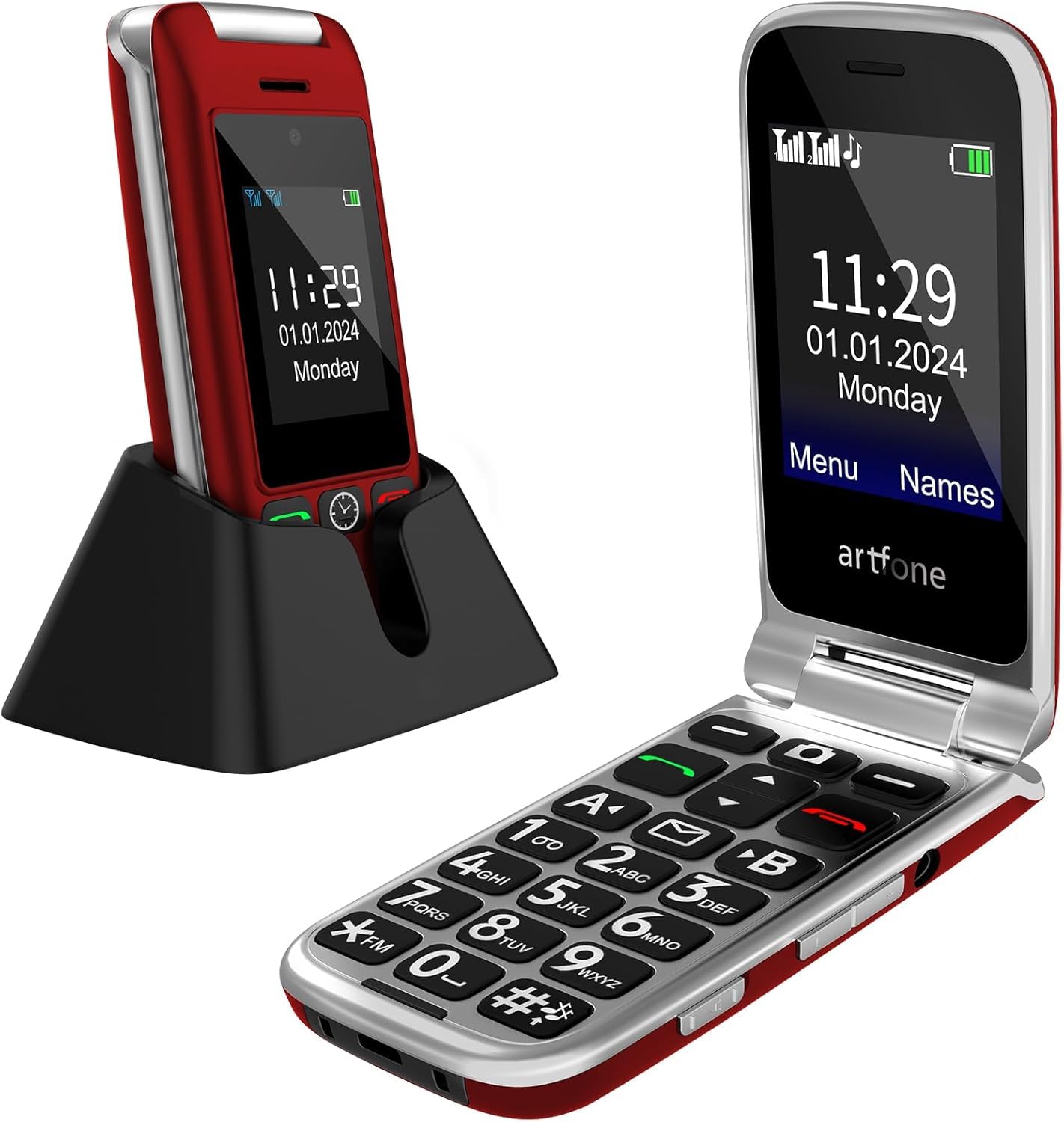
1. artfone G6 Flip Phone for Seniors, 4G open up Basic Phone
Our pick — over 4★ from 700+ verified ratings; the strongest balance of quality and price.
A 4G flip phone with a built-in hearing aid mode and a loud speaker for clear calls.
The artfone G6 is the most senior-focused flip phone in this roundup. It has a 2.4-inch inner screen and a 1.8-inch outer display so you can check the time and caller ID without flipping it open. What makes it unique is the Hearing Enhancement Mode — long press the camera button after connecting earphones or hearing aids, and the microphone captures and amplifies surrounding voices in real time for face-to-face conversations. That is a feature you will not find on the artfone G3 or any landline phone.
It runs on 4G LTE and is compatible with T-Mobile and its virtual operators (it will not work on Verizon or AT&T). The 1300mAh battery provides decent daily life — though one reviewer noted “the battery life is pretty good for a flip 4g phone but not as strong as flip phones in the past.” At 0.69 kilograms, it is actually the same weight as the Excelltel landline phone, which is surprisingly light for a flip. The SOS button on the back dials up to five pre-set contacts in an emergency.
Handiest feature: The dedicated one-button time announcement — hold the volume + key for 3 seconds and it speaks the time aloud, which visually impaired users appreciate.
Ideal for: A senior who wants a mobile phone but finds smartphones overwhelming — the dual screens and hearing enhancement make it more accessible than most flips.
Oversight: It only works with T-Mobile-based carriers, so check coverage before buying. The camera is a basic 0.3MP, but that is not its selling point.
2. VTech SN1127 Amplified Corded Senior Phone with Answering Machine
A landline built for memory support with a ringer loud enough to hear across the house.
If your senior relies on a landline and struggles with remembering numbers, the VTech SN1127 is the strongest option here. It pairs a 90dB extra-loud ringer with a bright flashing visual alert so a missed call is nearly impossible. The standout feature is the 8 photo speed-dial keys — you print a small photo, cut it to size, and slide it into the clear button cover for one-touch calling to the people in that picture. Buyers report it is “perfect for elderly with memory/hearing issues,” and one reviewer in assisted living found it ideal for a neurodivergent child as well.
The handset boosts incoming volume up to 40dB, which is the highest amplification in this roundup for a landline. It works during power outages and includes a full-duplex speakerphone for hands-free conversations. At 1.08 kilograms, it is noticeably heavier than the Excelltel corded phone (0.69 kilograms), but that weight comes from a sturdy design that sits solidly on a desk. Unlike the Clarity P300, the VTech has an integrated digital answering machine so you don’t miss messages.
Why it works
- 40dB audio booster makes voices loud enough for significant hearing loss.
- 8 photo speed-dial keys support memory-impaired users.
- 90dB ringer plus visual flashing light ensures calls are seen and heard.
- Corded design works during power outages.
Watch out for
- No Caller ID display — owners mention the Amazon listing claims it, but the unit lacks it.
- Speaker clarity could be better, according to some reviewers.
Best for: Seniors with memory loss or hearing issues who want a feature-rich landline with photo dialing and an answering machine.
Look elsewhere if: You need Caller ID on the base — this model omits it, and some buyers found that frustrating.
3. Serene Innovations Amplified Big Button Landline Phone (HD40P)

A purpose-built landline for dementia and hearing loss with nine one-touch picture buttons.
This phone has a specific job: to make calling simple for someone who might not remember names or numbers but will recognize a face. The HD40P offers nine large speed-dial buttons where you can either insert a photo of the person or write their name in big letters. The handset volume and tone are adjustable using two large sliders on top of the base, giving you fine control over how voices sound. An 85dB ringer — about as loud as a lawn mower, per the maker — cuts through household noise.
Unlike the VTech or Clarity models, this phone runs entirely off the phone line with no batteries needed. One buyer with a blind father and a mother with dementia noted it was the best they had found for their specific needs. A key trade-off is that some units have developed static or a squealing sound over time, as a few owners reported. The speakerphone button lets you answer without picking up the handset, which is helpful for someone with limited hand strength.
what separates it: Nine photo buttons (more than the VTech’s eight) plus sliding tone controls make it the most adjustable landline for cognitive and hearing challenges.
Reach for this if: The senior has dementia, aphasia, or severe hearing loss and benefits from visual + auditory cues.
The catch: Some units have developed static or become stuck on speakerphone — though buyer reviews mention good replacement service.
4. Clarity P300 Landline Phone with Sound Amplification
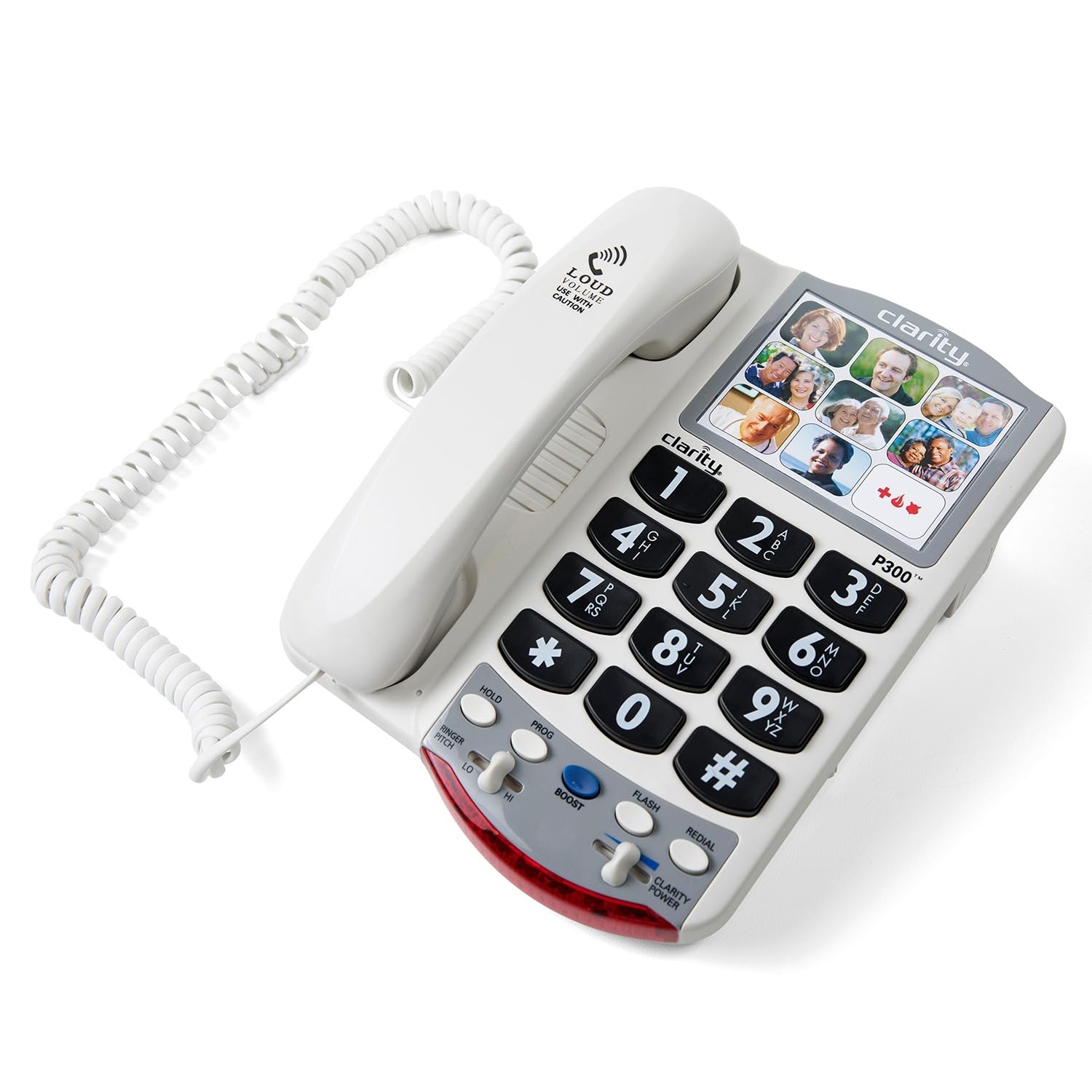
An amplified landline with clear sound that helps seniors with mild to moderate hearing loss.
The Clarity P300 focuses on one thing: making conversations loud and clear without distortion. It boosts incoming sound up to 26dB, and unlike some amplified phones that get fuzzy at max volume, customers note the Clarity stays crisp. One buyer shared: “I can finally have a normal phone conversation with my elderly dad, who is extremely hard of hearing and refuses to get hearing aids. He says the sound is loud and clear.”
The phone lets you adjust both the ringer pitch and handset volume independently, so you can tune it to match the user’s specific hearing curve. The large buttons are easy to press, and you can store up to 9 numbers for one-touch dialing via a card insert that you can label with names or photos. It comes with a 25-foot telephone line cord, giving flexibility in placement. Unlike the Serene Innovations phone above, this one has no photo buttons — just a labeled card — so it is better suited for mild cognitive decline rather than full dementia support.
Real feedback: Buyers with 90+ year old parents who refuse hearing aids say this is the only phone that works for them.
Choose this if: The senior wears hearing aids or has mild to moderate loss and needs a simple, reliable amplified phone without extra frills.
skip it if: They need photo-based speed dialing — the Clarity uses a name card, not individual picture buttons. Also, memory is lost during a power failure.
5. Lively Jitterbug Smart4 for Seniors

A simplified smartphone with a large screen and a team ready to help with rides or health concerns.
If your senior is ready to move beyond a flip phone but finds a standard smartphone too complicated, the Jitterbug Smart4 offers a middle ground. It has a bigger 6.7-inch screen with an easy-to-navigate menu, voice calling, real-time call captioning, and an Urgent Response button that connects to Lively’s support team. The phone itself is a 4G device with a 5000mAh battery — the largest battery capacity in this roundup — giving up to 37 hours of talk time and 24 hours of average life. It has an 8MP front-facing camera and a 13MP rear camera, so it is actually capable for video calls.
The catch is that this phone works exclusively with Lively’s own phone service, which requires activation and a monthly plan. A reviewer noted there is no traditional speed dial and that dialing a contact took five steps, which frustrated them enough to return the phone. The Lively team is available 24/7 to assist with the phone, arranging a ride, or a health concern. Unlike the open up artfone G6 or G3, you cannot take this phone to any carrier — you are locked into Lively’s ecosystem.
Best for
- Very large 6.7″ screen with simple menu for seniors with vision challenges.
- 5000mAh battery offers excellent talk time (37 hours).
- 24/7 access to Lively’s caring team for help with the phone, rides, or emergencies.
- Real-time call captioning helps those with hearing loss.
Watch out for
- Only works with Lively’s service — no switching carriers.
- No traditional speed dialing; some found the calling process takes too many steps.
- Cell plan charges may not be refunded if you return the phone, as one buyer experienced.
Reach for this if: The senior needs a smartphone-like device with a large screen and wants access to a help team for non-urgent support.
Look elsewhere if: They want speed dialing or the ability to switch carriers — the locked service and multi-step calling can be dealbreakers.
6. artfone G3 Flip Phone open up for Seniors
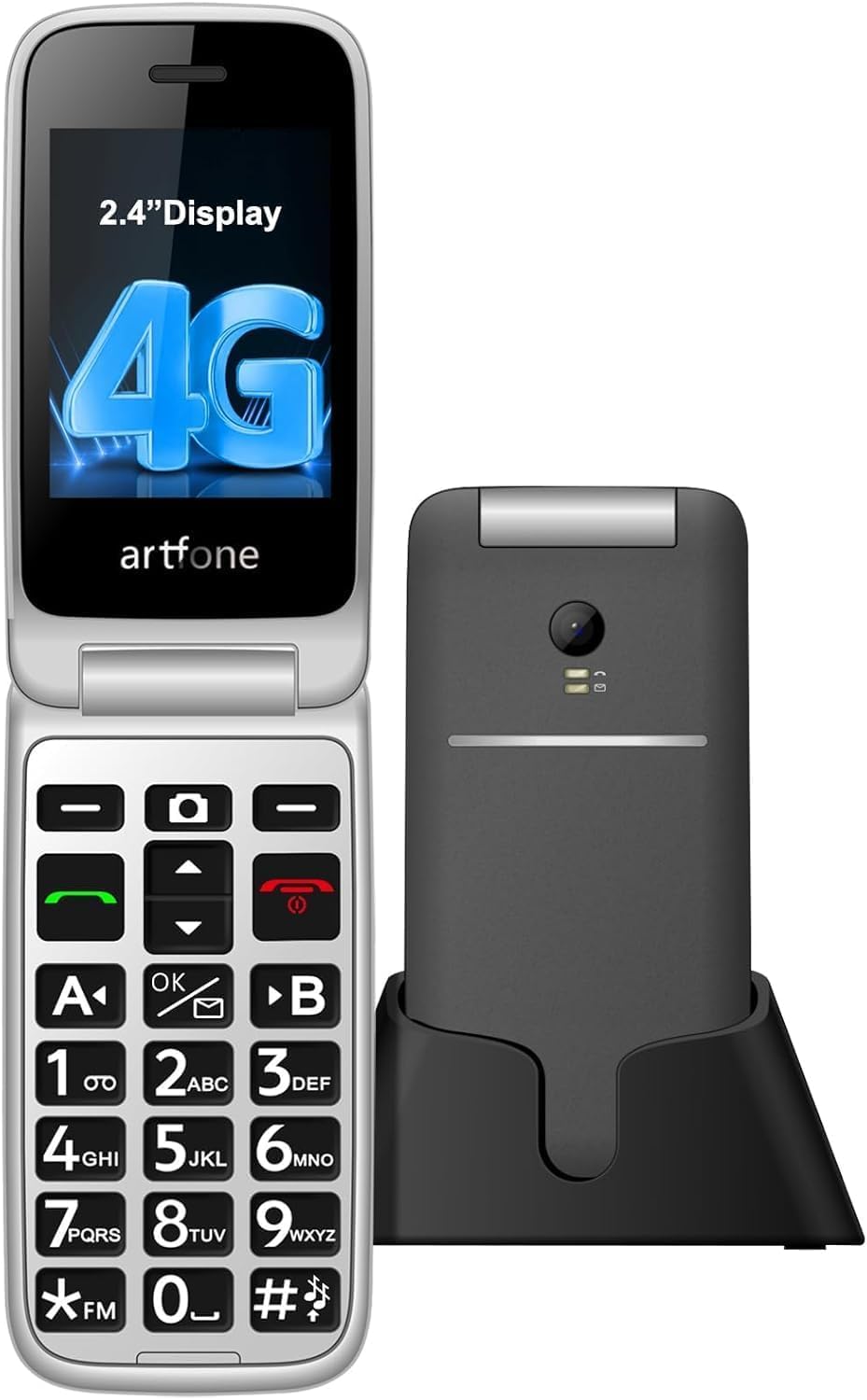
A reliable 4G flip phone that pairs a charging dock with an SOS button for safety.
The artfone G3 is the more affordable sibling of the G6 and the most-reviewed senior flip phone in this list with over 8,000 ratings. It shares the core DNA: a 2.4-inch color LCD screen, 21 large backlit buttons, T9 predictive text, and an SOS that cycles through up to five contacts. The 1300mAh battery offers 7-8 hours of talk time, and it comes with both a USB-C cable and a charging dock, so the phone is always topped up and easy to grab.
Compared to the G6, the G3 lacks the dual-screen setup and the hearing enhancement mode — it has a single 2.4-inch display. The phone is compatible with T-Mobile and its virtual operators (not Verizon). Reviewers point out the plastic body feels a bit cheap, but it is lightweight and tough enough for daily use. One reviewer whose wife used the phone in Italy noted that artfone offered to send a European version, calling the customer service “the best ever.” The extra-loud speaker ensures calls are clear, and the one-touch time announcement is a useful accessibility addition.
What it does best: The charging dock makes it easy for seniors to keep the phone charged — just drop it in, no cables to fumble with.
Best for: A budget-conscious buyer who wants a basic, no-fuss flip phone with an SOS button and carrier flexibility on T-Mobile networks.
Not ideal if: They need a hearing aid mode or dual screens — the G6 offers those extras for a small premium.
7. Excelltel Big Button Phone for Seniors, Corded Landline with 10 Picture Keys
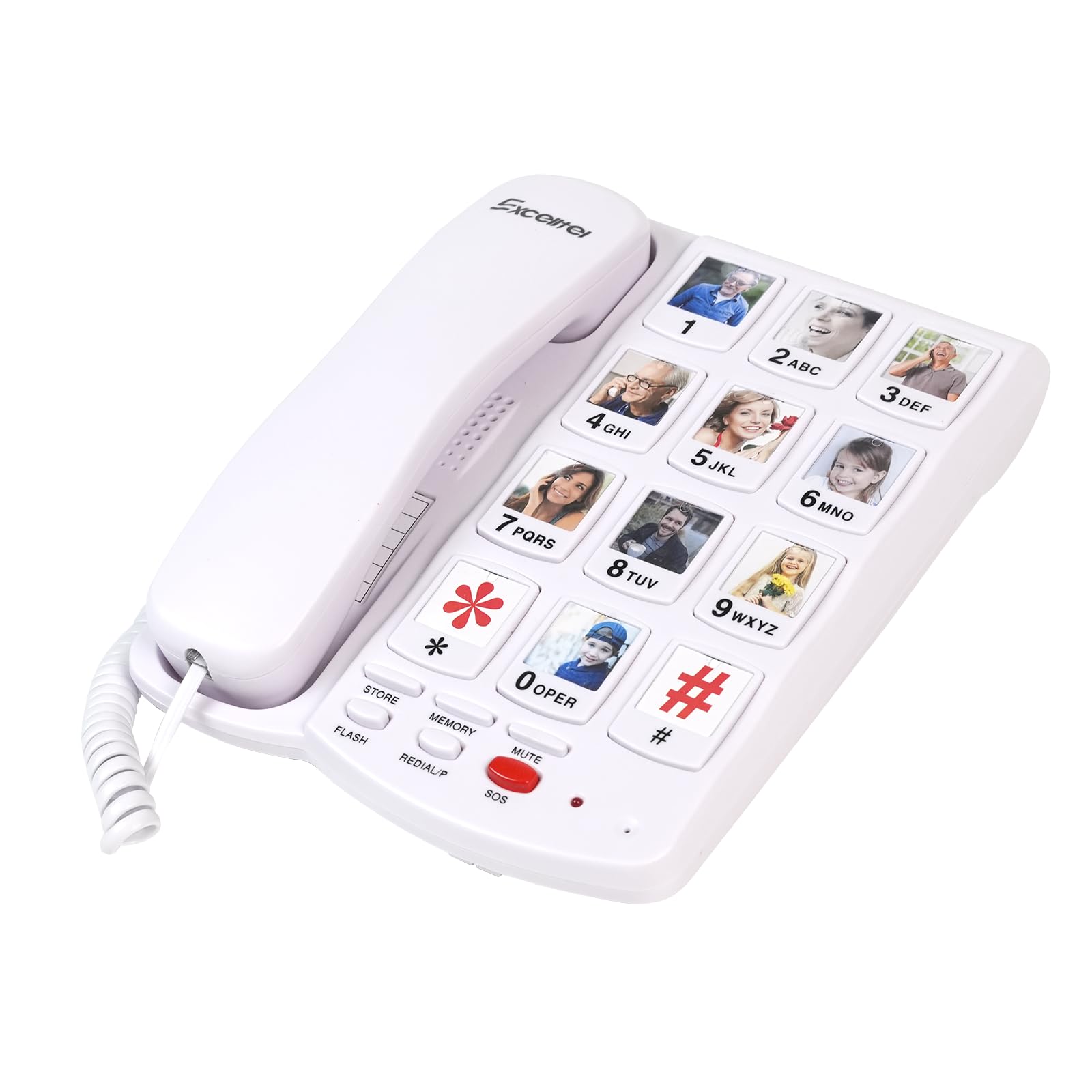
A lightweight corded landline with ten photo-specific speed-dial keys for assisted living.
This Excelltel phone is the most affordable option in the roundup and the lightest landline at just 0.69 kilograms — compared to the VTech SN1127’s 1.08 kilograms. It has ten picture keys for one-touch dialing, which is more than any other corded phone here. Shoppers say it is “excellent for sister in assisted living with dementia” and that the large, easy-to-read buttons and speaker option are valuable features. The phone is made from ABS plastic and runs off a standard PSTN phone jack.
The main trade-offs are noticeable. There is no Caller ID, and the ringer has drawn criticism — one reviewer called it “awful” and “far too loud” with a non-standard ring tone. Another buyer complained of a slight echo when using the speakerphone. Some users also found that the fake sample photos in the speed-dial slots are difficult to remove. Despite these complaints, many families found it an invaluable tool for connecting a loved one with dementia to familiar faces.
Strengths
- 10 photo keys make it the most visual speed-dial landline — perfect for memory support.
- Very lightweight at 0.69 kilograms, easy to move or place on a bedside table.
- Speakerphone option allows hands-free calls without holding the handset.
Weaknesses
- Ringer sound described as “awful” and “far too loud” with no normal ring tone.
- Speakerphone has a tinny echo, per buyer feedback.
- No Caller ID.
Best for: Families on a tight budget who need a simple, photo-based landline for a loved one in a care facility.
pass on it if: The ringer quality and speaker echo will be a dealbreaker; the VTech SN1127 or Serene Innovations HD40P offer better audio for a higher price.
Understanding the Specs
Amplification (dB)
Measured in decibels (dB), this tells you how much louder the phone can make the caller’s voice. A 40dB boost, like on the VTech SN1127, is extremely loud and suitable for significant hearing loss. A 26dB boost, like on the Clarity P300, is good for mild to moderate loss. The higher the number, the louder the maximum volume. Some phones, like the artfone G6, offer a hearing enhancement mode that works with earphones or hearing aids.
Photo Speed-Dial / One-Touch Buttons
These are large buttons where you insert a physical photo of the person (or write their name) so the senior just presses the face of the person they want to call. The number of buttons varies: the Excelltel has 10, the Serene Innovations has 9, and the VTech has 8. This feature is critical for seniors with dementia or memory loss who recognize faces but not names or numbers. Some phones, like the Clarity P300, use a name card instead of individual photo slots.
Carrier Compatibility (Cell Phones)
open up senior flip phones (like the artfone G6 and G3) are 4G LTE devices that work with T-Mobile and its network resellers (Mint Mobile, Straight Talk, Red Pocket GSMT). They do NOT work with CDMA carriers like Verizon, Boost, or PagePlus. The Lively Jitterbug works only with Lively’s own service and requires a monthly plan. Always check carrier coverage before buying a cell phone for a senior.
Ringer Volume and Visual Alerts
Extra-loud ringers are measured in dB — a 90dB ringer (VTech) is about as loud as a blender, while an 85dB ringer (Serene Innovations) is similar to a lawn mower. Some phones also include a flashing light to alert the user visually, which is vital for seniors with severe hearing loss. Without a visual alert, a loud ringer may still be missed if the phone is in another room.
FAQ
Will these corded landline phones work during a power outage?
Can I use the artfone G6 or G3 on Verizon or AT&T?
How loud is a 90dB ringer compared to an 85dB ringer?
Do these phones have Caller ID?
What is the difference between a photo speed-dial button and a memory button?
How long does the battery last on the artfone flip phones?
Is the Lively Jitterbug Smart4 a good choice if my senior already has a smartphone?
Can I use a hearing aid with the Clarity P300?
Do these phones have a speakerphone function?
Final Thoughts: The Verdict
Across the board, the best communication device for seniors is the VTech SN1127 because it combines the highest audio amplification with photo speed-dial keys and a 90dB ringer in a corded package that works during outages. If you need a mobile phone for on-the-go use, the artfone G6 is the strongest flip choice with its hearing enhancement mode and dual screens. And for a premium landline tailored to dementia care, the Serene Innovations HD40P offers nine photo buttons and adjustable tone sliders that no other model matches.
How We Picked
We do not accept paid placement. Every pick is matched to a real buyer and a real use-case; we do not hands-on test units.
Sources & Methodology
Specifications: manufacturer listings and product documentation. Review insights: verified customer reviews, as of July 2026. Pricing: not shown on this page (it changes often); check the current price via the retailer link.
As an Amazon Associate, WellFizz earns from qualifying purchases. This does not affect which products we feature.
Related Guides

Mo Maruf
I created WellFizz to bridge the gap between vague wellness advice and actionable solutions. My mission is simple: to decode the research and give you practical tools you can actually use.
Beyond the data, I am a passionate traveler. I believe that stepping away from the screen to explore new environments is essential for mental clarity and physical vitality.