Our readers keep the lights on and my smoothie glass nicely filled. As an Amazon Associate, I earn from qualifying purchases.
Specs are compiled from manufacturer listings and verified buyer reviews and can change over time — please confirm the key details on the product page before buying.
You reach into a tight corner behind the sink, and the only tool that will fit is a multi-tool. The real question is which cordless model has the vibration control to keep your hands from going numb and enough run time to finish the job before the battery dies, all without tethering you to an outlet. That is exactly what this guide is built to answer — we cut through the marketing to show you which pick actually delivers.
I’m Mohammad Maruf — the founder and writer behind WellFizz. This guide is built by comparing the manufacturers’ published specifications and the patterns across verified customer reviews, so you get each pick’s real strengths and trade-offs instead of marketing spin.
Whether you are cutting door jambs for new flooring or sanding drywall patches, this breakdown of the best cordless multi tool options will help you match the right machine to your real-world workload.
Our Picks at a Glance


How To Choose The Best Cordless Multi Tool
A cordless oscillating multi-tool cuts, sands, scrapes, and grinds in spots no other power tool can reach. But not all of them are built the same — here are the specs that separate a frustrating tool from a reliable one.
Motor Type — Brushless vs Brushed
A brushless motor uses electronics to control power, which means less friction, less heat, and more runtime from the same battery. The RYOBI PBLMT50B, for instance, uses a brushless motor to deliver longer runtime and more power compared to its brushed siblings. For heavy or frequent use, brushless is worth the premium.
Oscillations Per Minute (OPM) and Oscillation Angle
OPM tells you how fast the blade moves back and forth — higher numbers mean faster cutting in most materials. Entry-level tools start around 10,000 OPM, while premium models reach 20,000 OPM. The oscillation angle (measured in degrees) also matters: a wider angle like 3.9 degrees moves the blade further per swing, so it cuts faster than a narrower 3.6 degree angle, even at the same OPM.
Battery System and Runtime
If you already own tools from a brand (CRAFTSMAN V20, RYOBI ONE+, Milwaukee M12 or M18), buying a bare tool saves money because you can share batteries. Pay attention to the included battery’s amp-hour (Ah) rating — a 1.5 Ah battery drains fast under heavy cutting, while a 2.0 Ah or 4.0 Ah pack gives you noticeably more work time.
Blade Change System
Tool-free blade changes let you swap a cutting blade for a sanding pad in seconds without hunting for an Allen wrench. Most modern multi-tools have a lever or a cam-lock system. Some older models still require a hex key, which is a hassle when you are up on a ladder or working in a tight space.
Quick Comparison
| Model | Best For | Max OPM | Weight | Oscillation Angle | Amazon |
|---|---|---|---|---|---|
| CRAFTSMAN V20 Kit (CMCE501D1)★ Best Overall | Best value kit with battery | — | 2.4 kg | — | Amazon |
| Milwaukee M12 2526-20Pro Speed | Low vibration + pro speed | 20,000 | — | 3.9° | Amazon |
| Milwaukee M18 2626-21CP | Heavy-duty jobsite durability | 18,000 | 6.37 lbs | — | Amazon |
| RYOBI PBLMT50B | Brushless power + runtime | 20,000 | 2.14 lbs | 3.6° | Amazon |
| CRAFTSMAN CMCE500B | Tight-space cutting (bare tool) | 18,000 | 2.6 lbs | — | Amazon |
| Worx WX696L | Budget-friendly with accessories | 20,000 | 2.78 lbs | — | Amazon |
| RYOBI RMT18-0 One+ | Entry-level entry into Ryobi ecosystem | 20,000 | 0.9 kg | — | Amazon |
In‑Depth Reviews
1. CRAFTSMAN V20 Oscillating Tool Kit (CMCE501D1)
Our pick — over 4.5★ from 850+ verified ratings; the strongest balance of quality and price.
The everything-in-the-box kit that actually keeps going job after job.
This CRAFTSMAN kit includes the tool, a 2.0 Ah battery, a charger, two blades, a sanding platen with four sheets of sandpaper, and a storage bag — so you have everything to start cutting and sanding immediately. It weighs 2.4 kilograms (about 5.3 pounds) with the battery, which is noticeably heavier than the RYOBI RMT18-0 at 0.9 kilograms, but the extra heft comes with the included battery and accessories.
Owners mention the “strong little battery last long enough to do multiple things before needing a charge,” which is solid for a 2.0 Ah pack. The tool features a variable speed dial, a tool-free universal attachment system for quick blade swaps, and an LED work light. It is also compatible with CRAFTSMAN’s VERSATRACK wall organization system (clip sold separately).
The catch: at 5.12 x 6.38 x 9.06 inches, the dimensions are larger than many competitors, so it may not fit into the tightest tool bag pockets.
Why it wins the kit category
- Full kit: tool, 2.0 Ah battery, charger, blades, sanding pad, and bag all included
- Tool-free blade changes and variable speed dial for control
- Compatible with the entire V20* platform and VERSATRACK system
The honest trade-off
- Heavier than bare-tool competitors at 2.4 kg — a 2.7x gap vs the RYOBI RMT18-0
- Larger dimensions (5.12 x 6.38 x 9.06 inches) may not fit every tool bag
Who this is for: the buyer who wants one box with everything needed to start working immediately, no separate battery or charger purchase required.
Who should think twice: anyone who already owns CRAFTSMAN V20 batteries and just needs the bare tool for a lighter carry.
2. Milwaukee M12 2526-20 Brushless Oscillating Multi-Tool
The 12V bruiser that out-cuts bigger platforms with half the shake.
Milwaukee claims this tool delivers “one of the fastest 12V cutting speeds” and the “lowest vibration of any all-in-one tool” — and the specs back it up. It runs 10,000 to 20,000 OPM with a 3.9 degree oscillation angle, which is wider than the 3.6 degree angle on the brushless RYOBI PBLMT50B, so it takes bigger bites per swing.
Buyers report it cuts through a 2×4 in seconds even with a worn blade, and the vibration-isolating design keeps your hands noticeably fresher on long cuts. The tool has a 12-setting speed dial, a built-in LED, and a tool-free blade change that requires no hex key. It is a bare tool (no battery or charger), so you need an existing M12 battery system.
One trade-off mentioned by reviewers: on high power, the battery drains fast — especially when cutting through deck screws. You will want a higher-capacity M12 battery for serious work.
What lifts it above the rest
- Fastest cutting speed in a 12V platform — 20,000 OPM with a 3.9° angle
- Lowest vibration of any all-in-one multi-tool, per Milwaukee’s design
- Tool-free blade change means no lost Allen wrenches
What you should know
- Bare tool — you need your own M12 battery and charger
- Heavy use on high power drains even a 4.0 Ah battery quickly
Reach for this if: you already own M12 tools and want the fastest cuts with the least vibration possible.
Look elsewhere if: you need a full kit with battery and charger right from the start.
3. Milwaukee M18 Multi-Tool with 1.5Ah Battery (2626-21CP)
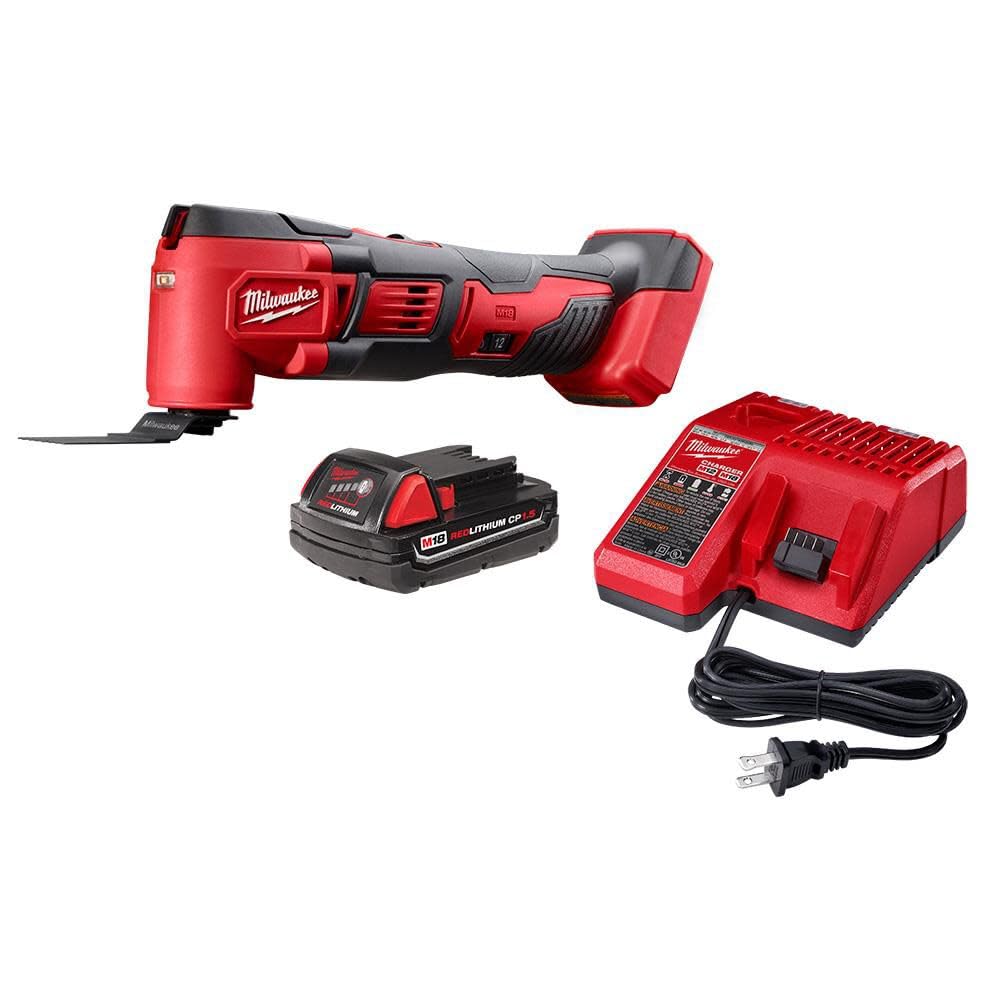
The 18V workhorse with a metal gear case built to survive drop after drop.
This M18 multi-tool (model 2626-20) runs 11,000 to 18,000 OPM with constant power technology, which means it maintains speed under load rather than bogging down when you push into a stubborn nail. It comes as a kit with a 1.5 Ah REDLITHIUM battery, so you can use it right away if you have an M18 charger.
Customers note it “cuts paneling, baseboard, insulation board well” and that the tool-free blade change is a huge convenience on a jobsite. The all-metal gear case provides added durability, and the built-in LED illuminates dark work spaces like under sinks or inside cabinets. At 6.37 pounds with the included battery, it is the heaviest multi-tool on this list.
One reviewer noted that the 1.5 Ah battery runs well for light-to-medium tasks, but they recommend buying assorted blades because the included one may not match every material you cut.
Built for the rough stuff
- All-metal gear case for serious jobsite durability
- Constant power technology keeps speed steady even under load
- Tool-free blade changes and built-in LED
Heads up
- Heaviest pick at 6.37 lbs — tiring for overhead or prolonged use
- 1.5 Ah battery drains fast on high-speed cutting; a larger battery may unbalance the tool
Grab this if: you work on a jobsite where the tool gets knocked around and you need M18 battery compatibility.
Pass if: you prefer a lighter tool for detail work or do not already own M18 batteries.
4. RYOBI PBLMT50B ONE+ HP 18-Volt Brushless Cordless Multi-Tool

The brushless upgrade that stretches every battery charge further than the competition.
You cut up to 30% faster than brushed Ryobi models because this RYOBI uses a brushless motor (no physical brushes, so less friction and heat) on the ONE+ battery platform. It delivers up to 20,000 OPM (oscillations per minute) with a 3.6-degree oscillation angle (the side-to-side swing of the blade), so you zip through trim and drywall. At 2.14 pounds, it is the lightest of the high-power picks here — a 30% weight reduction compared to the Worx WX696L at 2.78 pounds, so your arm tires less during long cuts.
Reviewers point out “excellent battery life (4Ah at 50% after project)” — meaning a single charge on a 4.0 Ah battery still had half its power left after a full cutting job. The compact tool head fits into tight spaces, and the quick-release blade system (no Allen bolts) makes swapping accessories fast. It is a bare tool, so you need your own RYOBI ONE+ battery and charger.
One thing to note: the minimum speed is 20,000 OPM — there is no lower speed setting for delicate work, unlike some competitors that dial down to 10,000 or even 5,000 OPM.
Runtime champ
- Brushless motor gives longer runtime and more power than brushed models
- Lightest high-performance pick at 2.14 lbs
- Clean, straight cuts reported by multiple buyers
One limitation
- Single speed range around 20,000 OPM — no lower speed for delicate sanding or scraping
- Bare tool only — battery and charger not included
Best for: the DIYer or pro who already owns RYOBI ONE+ batteries and wants brushless efficiency without stepping up to a higher-priced platform.
Consider elsewhere if: you need a variable speed dial that goes down to 5,000 or 10,000 OPM for fine control.
5. CRAFTSMAN V20* Oscillating Tool Cordless, Tool Only (CMCE500B)

The tight-space specialist buyers call essential for sink holes and notch cuts.
You get a wider speed range than the brushless RYOBI PBLMT50B — this CRAFTSMAN bare tool runs from 8,000 to 18,000 OPM (oscillations per minute), so you dial it way down for careful plunge cuts into drywall or crank it up for demolition. At 2.6 pounds, it is lighter than the Worx WX696L by 0.18 pounds, and shoppers say it as “excellent for tight spaces (sink hole, notch cutting)” with a well-balanced, low-vibration feel.
It comes with a wood blade, a bi-metal blade, a sanding platen with multiple grits of sandpaper, and a scraper — all in the box. The tool-free universal attachment system lets you swap blades without tools, and the contoured overmolded handle gives a comfortable grip during longer cuts.
One honest buyer note: the charging is slow, so if you have a big project, you will want a second battery on the charger while you work. It is a bare tool, so you need a V20 battery and charger.
Where it shines
- Wide speed range from 8,000 to 18,000 OPM for versatile control
- Well-balanced with low vibration per multiple buyer reviews
- Includes several blades, sanding platen, and scraper
The slower side
- Slow charging — buyers recommend having two batteries for large projects
- Bare tool: battery and charger sold separately
Ideal for: homeowners who already own CRAFTSMAN V20 tools and need a compact, low-vibration oscillating tool for detailed cuts.
Not ideal for: daily professional use — buyers report it is not built for pro-grade abuse.
6. Worx WX696L 20V Power Share Sonicrafter Cordless Oscillating Multi-Tool

The budget-friendly kit that plays nice with blades from nearly every other brand.
This Worx kit includes the tool, a 2.0 Ah battery, a 0.4A charger, a wood blade, a sanding pad with 20 sheets, and a carry bag — everything you need in one box. It offers two speeds (5,000 and 20,000 OPM), giving you a genuine low-speed option for delicate sanding that the brushless RYOBI PBLMT50B lacks. Its Universal Fit System accepts blades from most major brands, so you are not locked into one ecosystem.
Owners mention it is effective for undercutting door trim and LVP flooring, and the onboard blade-changing wrench (stored right on the tool) means you will never lose it. However, one reviewer measured that the 1.5 Ah battery lasts only about 15 minutes under heavy use and recommends stepping up to a 2.0 Ah or larger battery. At 2.78 pounds, it is heavier than the CRAFTSMAN CMCE500B by 0.18 pounds.
Why it stands out
- Two-speed dial includes a true 5,000 OPM low setting for delicate work
- Universal Fit System works with blades from most major brands
- Full kit with battery, charger, blade, sanding pad, and carry bag
Know before you buy
- 1.5 Ah battery lasts ~15 min under heavy use — budget for a larger battery
- Heavier than some bare-tool competitors at 2.78 lbs
Go for it if: you want a complete kit at a friendly price and appreciate the wide blade compatibility.
Think twice if: you plan to do extended heavy cutting without stopping to swap batteries.
7. RYOBI RMT18-0 18V ONE+ Cordless Multi-Tool (Bare Tool)

The featherlight gateway into the ONE+ ecosystem for the weekend warrior.
At 0.9 kilograms (just under 2 pounds), this is by far the lightest multi-tool on the list — a 2.7x weight gap vs the CRAFTSMAN V20 kit at 2.4 kilograms. It runs from 10,000 to 20,000 OPM with a 6-position variable speed wheel, and the universal accessory adaptor makes it compatible with any brand of blades. A built-in LED lights up your work area, and the quick-change attachments let you switch between cutting and sanding without hassle.
One buyer wrote, “A contractor showed me how to use one of these so I got my own.” The tool is ideal for plunging into drywall, cutting wood, plastic, and metal, or sanding fine details. It is a bare tool (no battery or charger), so you need a RYOBI ONE+ battery to run it.
The main trade-off: at the lower end, some buyers found that the included attachment kit did not match the unit they received, which is a packaging inconsistency worth checking before you open everything.
Lightest in class
- Only 0.9 kg — easy on the wrist for extended overhead or detail work
- Variable speed from 10,000 to 20,000 OPM for versatile control
- Universal accessory adaptor works with any brand of blades
One thing to check
- Some customers note the included attachments do not fit older model units
- Bare tool — battery and charger not included
Perfect for: someone just entering the RYOBI ONE+ system who wants the lightest possible oscillating tool for moderate DIY tasks.
Look elsewhere if: you need maximum cutting speed or already own heavier batteries that would overbalance this lightweight tool.
Understanding the Specs
Oscillations Per Minute (OPM)
OPM tells you how many times the blade swings back and forth in one minute. More OPM means you cut through wood, drywall, or metal faster. Entry-level tools start around 10,000 OPM, while premium models reach 20,000 OPM. Match the speed to the material — lower speeds for plastic and soft metals, higher speeds for wood and demolition.
Oscillation Angle (Degrees)
This is the arc the blade travels in each swing. A wider angle — like 3.9 degrees on the Milwaukee M12 — moves the blade further per cycle, so it removes material faster than a 3.6 degree angle at the same OPM. For fast cutting, look for a wider angle; for precision sanding, a narrower angle gives more control.
Amp-Hour (Ah) Rating
The battery’s amp-hour (Ah) rating is its fuel tank — a 2.0 Ah battery holds roughly twice the energy of a 1.0 Ah pack. For a multi-tool, which drains power fast, a 2.0 Ah battery is the practical minimum. The Worx WX696L ships with one, and reviewers point out it gives about 15 minutes of heavy use before needing a charge.
Tool-Free Blade Change
A lever or cam-lock mechanism that lets you swap blades without any hex key or Allen wrench. This is a huge time-saver when you are on a ladder or in a tight space. Most modern multi-tools include it, but always double-check — some budget models still require a separate wrench stored on the tool body.
FAQ
Will any oscillating multi-tool blade fit my cordless model?
What is the difference between 12V and 18V cordless multi-tools?
Can I use a multi-tool to cut metal?
How long does a cordless multi-tool battery last?
Is a brushless motor worth the extra cost in a multi-tool?
What does OPM stand for and why does it matter?
Can I sand with a cordless multi-tool?
What is the difference between a brushless and brushed motor?
Final Thoughts: The Verdict
If you want one dependable pick, the best cordless multi tool winner is the CRAFTSMAN V20 Kit (CMCE501D1) because it delivers a complete ready-to-work kit — tool, battery, charger, blades, and sanding platen — at a price that undercuts premium bare-tool options. If you already own RYOBI ONE+ batteries and want brushless efficiency, grab the RYOBI PBLMT50B. And for pros who need the fastest cuts and lowest vibration in a 12V platform, the Milwaukee M12 2526-20 is the top pick.
How We Picked
We do not accept paid placement. Every pick is matched to a real buyer and a real use-case; we do not hands-on test units.
Sources & Methodology
Specifications: manufacturer listings and product documentation. Review insights: verified customer reviews, as of July 2026. Pricing: not shown on this page (it changes often); check the current price via the retailer link.
As an Amazon Associate, WellFizz earns from qualifying purchases. This does not affect which products we feature.
Related Guides

Mo Maruf
I created WellFizz to bridge the gap between vague wellness advice and actionable solutions. My mission is simple: to decode the research and give you practical tools you can actually use.
Beyond the data, I am a passionate traveler. I believe that stepping away from the screen to explore new environments is essential for mental clarity and physical vitality.