Our readers keep the lights on and my smoothie glass nicely filled. As an Amazon Associate, I earn from qualifying purchases.
Specs are compiled from manufacturer listings and verified buyer reviews and can change over time — please confirm the key details on the product page before buying.
You are shivering at 2 AM in the backcountry. That is the moment you realise your sleeping bag’s temperature rating is just a number on a tag. The difference between a warm night and a miserable one depends on how well the bag traps heat, how much it weighs in your pack, and whether that warmth rating is honest. This guide compares six bags built for serious cold-weather backpacking, so you know exactly which one fits your trip.
I’m Mohammad Maruf — the founder and writer behind WellFizz. This guide is built by comparing the manufacturers’ published specifications and the patterns across verified customer reviews, so you get each pick’s real strengths and trade-offs instead of marketing spin.
This roundup of the best cold weather backpacking sleeping bag options gives you honest, spec-by-spec comparisons so you can buy with confidence.
Quick Picks
- Naturehike 0 Degree RDS Down Mummy Sleeping Bag — Best Overall
- Western Mountaineering 10 Degree Versalite — Premium Pick
- Down Sleeping Bag with Pillow for Backpacking — Best Value
- Down Sleeping Bag for Adults — Top Performer
- 0 Degree Sleeping Bag for Adults 650 Fill Power — Warmth Champion
- Kelty Cosmic Synthetic Fill 0 Degree — Damp-Weather Specialist
How To Choose The Best Cold Weather Backpacking Sleeping Bag
Choosing a sleeping bag for cold-weather backpacking is more than just looking at a temperature number on the tag. You need to balance how warm you stay with how much weight you carry and how well the bag handles damp conditions. Here are the key factors serious backpackers weigh before buying.
Insulation Type: Down vs. Synthetic
Down fill (usually goose or duck) gives you the best warmth-to-weight ratio — you get more loft for less weight, and it packs down smaller. This makes down the first choice for backpackers counting every ounce. The catch is that down loses almost all its insulating power when wet. Synthetic fill, like the Cirroloft used in the Kelty Cosmic, keeps you warm even when damp and dries faster, but it is heavier and bulkier for the same warmth. If you backpack in wet climates or sleep in a tent with condensation, synthetic is a safer bet. If you want the lightest pack possible for dry cold, go with down.
Temperature Ratings: Comfort vs. Limit
Not all temperature ratings are created equal. An ISO-tested (International Organization for Standardization tested) comfort rating tells you the lowest temperature at which a standard adult woman can sleep comfortably without shivering. The limit rating is for a man and allows for some heat loss. Many budget bags only list a survival rating or a single number like “0°F”, which could mean you freeze unless you wear all your layers. The Kelty Cosmic, for example, has an ISO comfort rating of 18°F despite being labeled a 0°F bag, so always check the fine print.
Weight and Packed Size
Every gram matters on a multi-day trip. A bag like the Naturehike 0 Degree weighs just 1.9 pounds and is incredibly compressible, while the Kelty Cosmic Synthetic weighs 5.9 pounds — a 3.1x difference. Your sleeping bag is often the bulkiest item in your pack after the tent, so look at both the weight and the compressed size in liters. An integrated compression sack, like the one on the Kelty, helps reduce volume, but a down bag will always win on packability.
Fit and Shape
Mummy-shaped bags hug your body closely, reducing the air volume your body has to heat, which makes them far more efficient in cold weather. The trade-off is less room to move around. Some mummy bags, like the QEZER 0°F, offer a wider trapezoidal footbox (a foot-shaped section at the bottom) so you can wiggle your toes without suffocating. A rectangular bag is roomier but wastes heat. For true cold-weather backpacking, a mummy cut is almost mandatory.
Features That Keep You Warm
A draft collar (an insulated ring around the neck) prevents warm air from escaping when you shift at night. A full-length draft tube (an insulated strip behind the zipper) blocks cold spots. A zipper baffle or wind blocking strip, like the one on the Naturehike, seals the gap where heat typically leaks. Even a small internal pocket for your phone keeps it warm so the battery doesn’t die. These details separate a comfortable bag from a cold one.
Quick Comparison
| Model | Best For | Fill Type | Weight | Comfort Rating | Amazon |
|---|---|---|---|---|---|
| Western Mountaineering Versalite 10°F | Ultralight premium performance | Goose down | 2 lbs | 10°F | Amazon |
| Naturehike 0°F RDS Down | Best overall value | 650-fill duck down | 1.9 lbs | 18.86°F | Amazon |
| QEZER 0°F 600FP Down | Roomy fit for tall people | 600-fill duck down | 4.74 lbs | 0°F-18°F | Amazon |
| QEZER 0°F 650FP Down (Spacious) | Warmth for winter RTT camping | Down | 4.54 lbs | 0°F | Amazon |
| Kelty Cosmic Synthetic 0°F | Damp-weather reliability | Cirroloft synthetic | 5.9 lbs | 18°F (ISO tested) | Amazon |
| SYWSKW 0°F Down with Pillow | Budget-friendly complete system | 680-fill duck down | 2.6 lbs | 0°F | Amazon |
In‑Depth Reviews
1. Naturehike 0 Degree RDS Down Mummy Sleeping Bag for Adults, 650 Fill Power
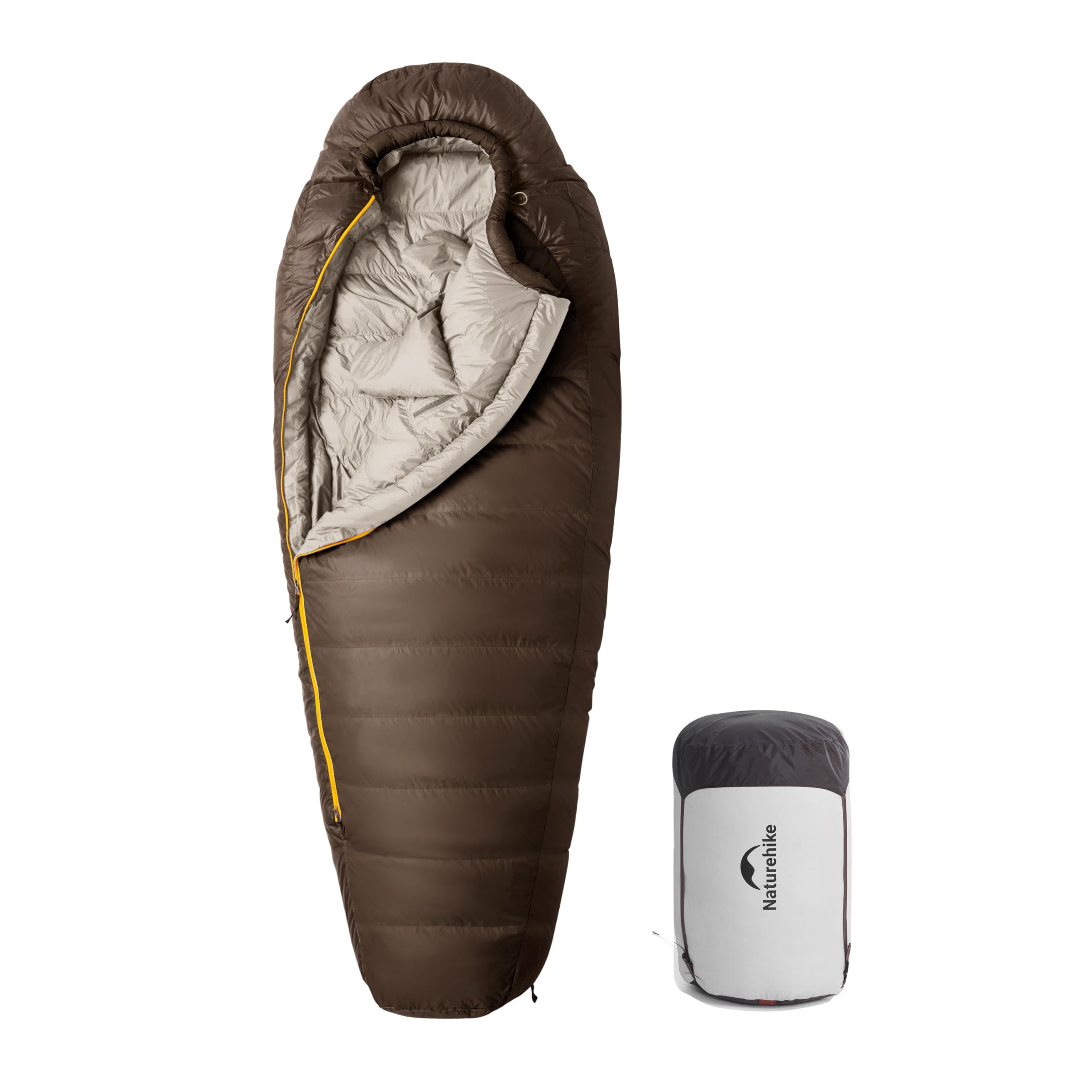
The featherweight down bag that brings premium warmth without the premium price tag.
This bag keeps you warm without weighing you down, hitting the balance of value and performance. At 1.9 pounds, it is a full 3.1x lighter than the Kelty Cosmic Synthetic (which weighs 5.9 pounds), yet packs enough 650-fill RDS-certified (Responsible Down Standard) duck down to keep you comfortable down to 18.86°F. The C-shaped wrapped design puts 60% of the down on top of your body, which is exactly where you need it for heat retention. One reviewer noted testing it at 25°F and finding it warm and cozy.
Buyers consistently praise the U-neck collar (a draft collar shaped like the letter U) and dual wind baffles for sealing in heat where mummy bags usually leak. The YKK (Yoshida Kogyo Kabushikigaisha) two-way zipper runs smooth with anti-snag guards, and the 3D footbox (a foot-shaped section at the bottom) gives your toes room to move without creating cold spots. Unlike the SYWSKW bag that measures compact at 11.8″L x 7.08″W, the Naturehike stores down to 13.4″L x 6.3″W — impressively small for a 0-degree bag.
The only real trade-off is that down loses its insulating power when wet, so you need to be diligent about keeping it dry. Also, the SP400 model’s comfort rating of 38.84°F is too warm for deep cold, so stick with the SP700 or SP1000 for true winter backpacking.
Why It Wins
- Weighs just 1.9 lbs — among the lightest 0°F bags available
- RDS-certified 650-fill down with traceable origin
- U-neck collar and wind baffles stop drafts effectively
- 3D footbox and spacious fit praised by buyers
Watch For
- Down loses insulation when wet; must stay dry
- SP400 model is too warm (38.84°F comfort) for true cold weather
Reach for this if: You want an ultralight winter bag with honest warmth — it outperforms the Kelty Cosmic Synthetic on weight and packability for dry-cold trips.
Look elsewhere if: You sleep damp or often camp in rain — synthetic insulation handles moisture better.
2. Western Mountaineering 10 Degree Versalite Sleeping Bag

The thru-hiker’s gold standard that keeps you warm night after night for years.
This bag is the benchmark for serious long-distance backpackers. It delivers reliable warmth with a 10°F temperature rating and a 6-inch loft (the thickness of the air-trapping layer) of 95% goose down — one buyer described it as “retains loft after 500+ nights.” At just 2 pounds total weight, it is only 0.1 lb heavier than the Naturehike but uses a more premium down fill (20 oz of down fill) and continuous baffles (uninterrupted chambers for the down) spaced at 5.25 inches for even loft distribution. The full-length #5 YKK zipper and full down collar keep heat locked in even when temperatures dip into the teens.
Unlike the Kelty Cosmic Synthetic which is bulky at half a 55L pack, the Versalite packs down remarkably small for its warmth level. The ExtremeLite face fabric feels soft but durable, and the bag was built for the Appalachian Trail — that kind of real-world pedigree means every baffle and stitch was refined for long-term abuse. One minor caveat: a buyer noted the advertised weight is off by about 2 ounces, so expect closer to 2.1 lbs total.
This is a buy-it-for-life piece of gear. The premium price reflects not just the high-fill down but the made-in-USA craftsmanship.
What Makes It Elite
- Retains loft after 500+ nights according to long-term user
- 2 lbs total weight with 20 oz down fill
- Continuous baffles for even warmth distribution
- Full down collar prevents neck drafts
Heads Up
- Premium price is a major investment
- Actual weight may run 2 oz over advertised spec
For the committed: If you plan to log hundreds of trail nights and want one bag to last a decade, this is it. The Naturehike gives you 90% of the performance at a lower price, but the Versalite is built to outlast everything else.
3. Down Sleeping Bag with Pillow for Backpacking, 15℉ 5℉ 0℉ Wide Down Sleeping Bag (680FP)
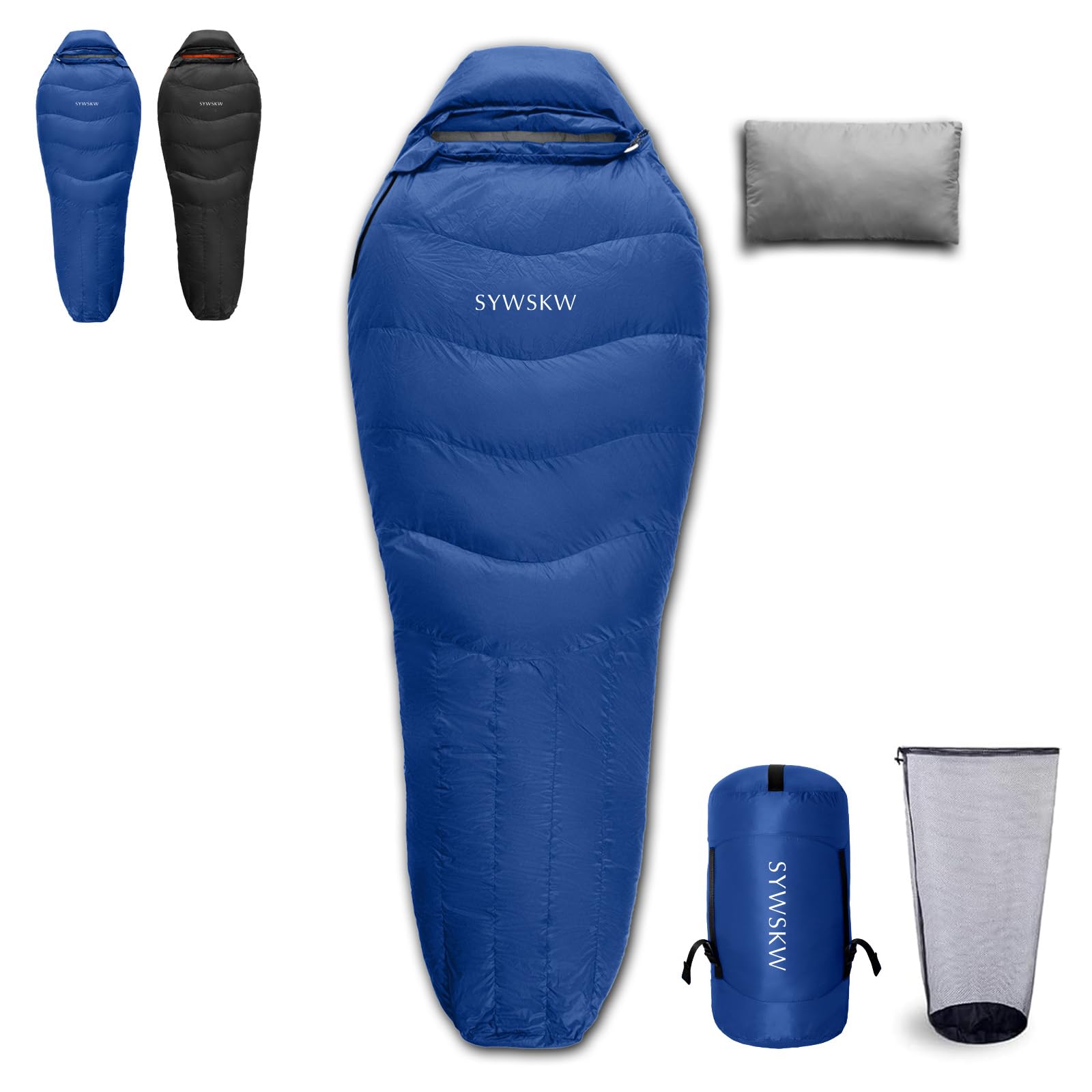
A complete sleep system that packs tiny and includes a detachable pillow.
This bag from SYWSKW keeps things simple and affordable. It uses 680-fill duck down — 13% more loft per ounce than the QEZER’s 600-fill — and compresses down to just 7.08″ x 11.8″ when packed, the most compact packed size here and a 6.3x size gap compared to the Kelty Cosmic Synthetic’s 17″ x 11″ stuffed shape. At 2.6 pounds, it splits the difference between the ultralight Naturehike and the heavier synthetic bags. The integrated 80g detachable pillow is a genuinely useful addition for backpackers who hate carrying a separate camp pillow.
Buyers confirm it is very warm — one buyer mentioned it kept them toasty at 45°F without thermal layers, while another warned it “can cause sweating in 40s°F”. That warmth comes at a small cost: the zipper can snag material, and the bag is sized generously (86.6″ L x 33.5″ W) so shorter sleepers might find it overly roomy.
If you are an occasional winter camper or motorcycle backpacker who needs a compact, warm bag without a huge outlay, this is a smart choice.
Why It Works
- Packs to smallest size among all picks (7.08″ x 11.8″)
- Detachable pillow eliminates need for separate camp pillow
- 680-fill down offers excellent loft for the weight
Know Before You Buy
- Zipper can snag fabric
- Very warm — may be too hot for mild cold (40s°F)
Perfect for occasional trips: Budget-conscious backpackers who want a compact bag that keeps them warm and includes a built-in pillow. Seasoned thru-hikers who demand bombproof zippers and tighter fit should look at the Naturehike instead.
4. Down Sleeping Bag for Adults, 0°F 10°F 15°F 20°F 600 Fill Power Mummy Lightweight (QEZER)
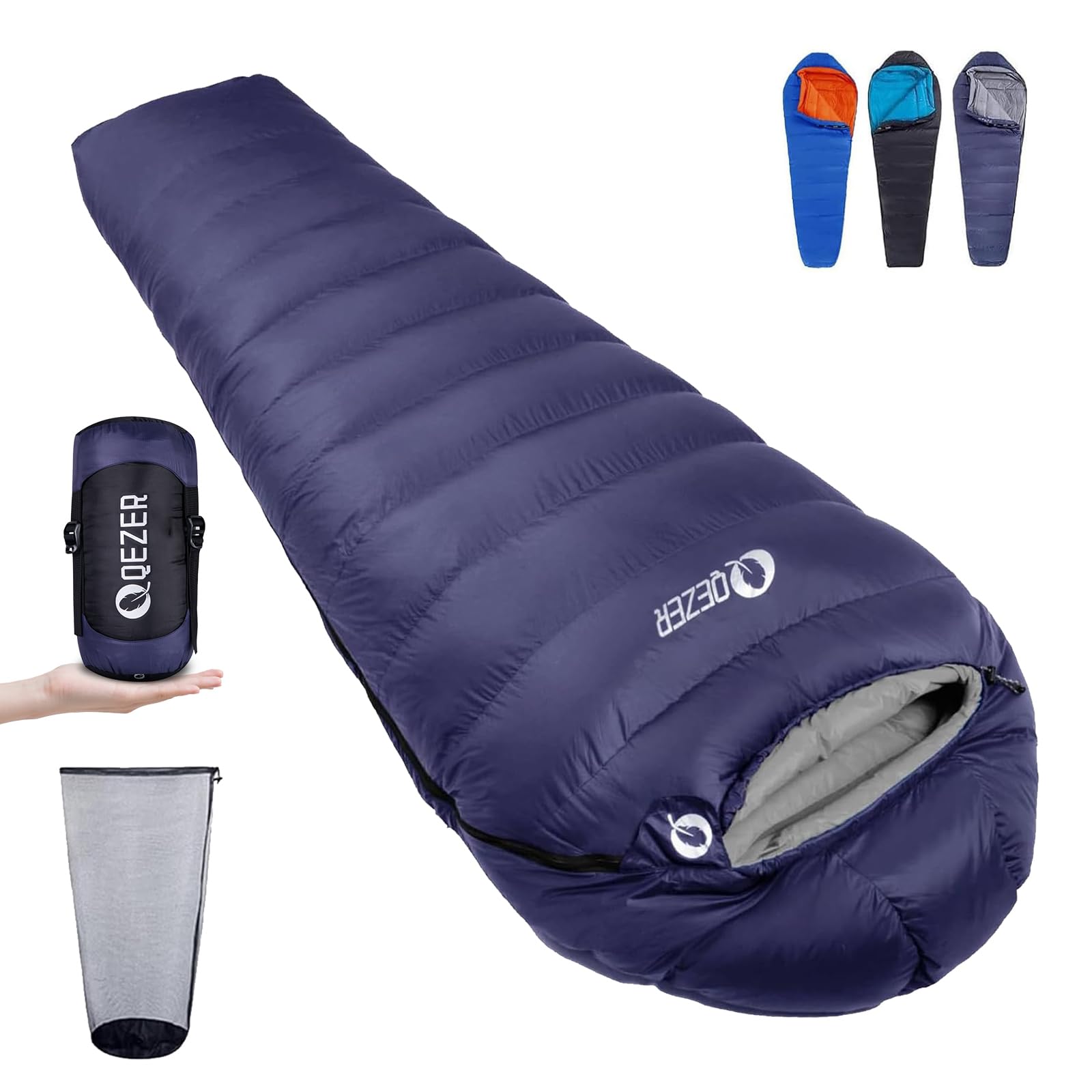
A roomy mummy bag that fits tall sleepers and doubles as a two-person quilt.
This QEZER bag offers a spacious 84.65″ x 31.89″ interior, making it a great fit for people up to 6’5″ who feel cramped in standard mummy bags. The 600-fill power down (3.3 lbs of fill) keeps you warm with a comfortable temperature range of 0°F-18°F. One reviewer took it on a multi-day backpacking trip in the Colorado mountains above 8,000 feet and found it warm despite constant snow and freezing rain. The trapezoidal footbox (a foot-shaped section at the bottom) is a thoughtful design touch that stops your toes from feeling pinched.
The bag is noticeably heavier than the Naturehike at 4.74 lbs, but it offers a unique feature: left and right zippers that allow two bags to zip together into one double sleeping bag. Perfect for couples who want to stay warm together without buying a specialized two-person bag. One owner reported the free inner mesh bag ripped on first use, but the outer compression sack held up fine.
If you prioritise a spacious, comfortable fit and the flexibility to pair with a partner’s bag, this is a strong mid-range pick.
Standout Features
- Extra spacious (84.65″ x 31.89″) fits tall sleepers
- Left/right zippers allow two bags to couple together
- Trapezoidal footbox for toe wiggling room
Considerations
- Weighs 4.74 lbs — heavier than ultralight competitors
- Inner mesh storage bag prone to tearing
Best for tall couples: If you need extra length and the ability to couple with another bag, this delivers. Thru-hikers counting ounces should pick the Naturehike instead.
5. 0 Degree Sleeping Bag for Adults 650 Fill Power Down Sleeping Bag for Cold Weather -20F / 0F (QEZER Upgraded)
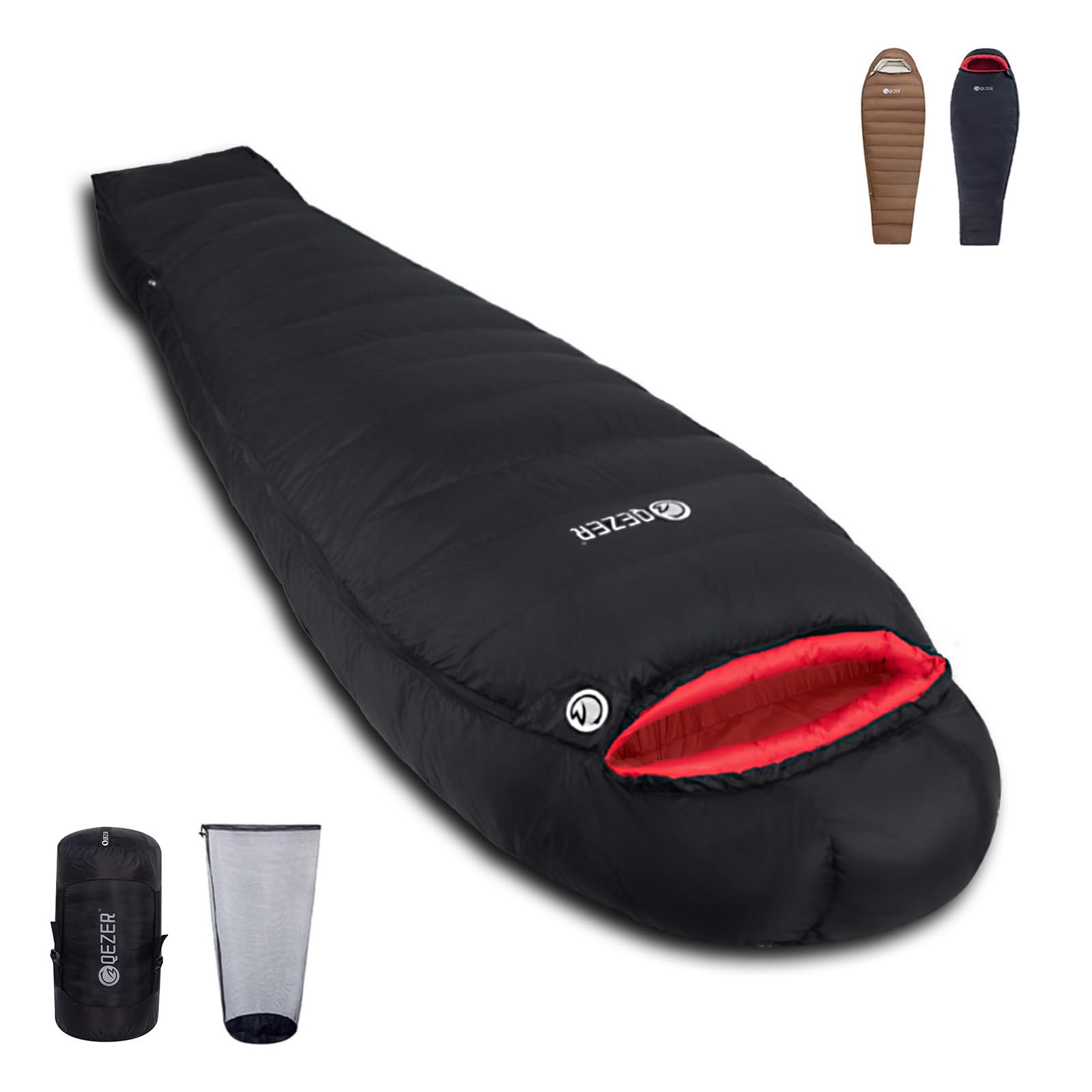
A saddle-neck design and ergonomic footbox that keep you warm when temps hit the low teens.
QEZER’s upgraded 0°F bag packs 650-fill power down into a generous 88.58″ x 32.28″ shell, making it the longest bag in the lineup — ideal for anyone up to 6’7″. The unique saddle-shaped neck collar wraps around your throat to block the #1 heat loss point on any sleeping bag. One customer observed sleeping in a roof-top tent across the country in winter without a heater, and said “temps were in the low teens, didn’t matter!”
At 4.54 pounds, it is lighter than the 4.74 lb QEZER 600FP bag, and the 650-fill down (vs 600-fill) gives better loft per ounce. The ergonomic footbox is shaped to give your feet natural sleeping position without creating dead air space. One long-term user who slept in it for approximately 60 nights said it is holding up very well, though a couple of feathers started escaping after 5 months.
The weight and bulk (17.32″ x 10.24″ packed) make it better for car camping or shorter backpacking trips where every gram isn’t critical. For deep winter car camping or RTT (roof-top tent) use, this is a fantastic warm and comfortable bag.
Why It Stands Out
- Saddle-shaped neck collar seals heat at the neck
- 650-fill down for better loft than 600FP alternatives
- Longest length (88.58″) fits very tall sleepers
Minor Flaws
- Feathers may escape after several months of use
- Bulky packed size for ultralight backpacking
Grab it for: Winter car camping, roof-top tent adventures, or very tall backpackers who need extra length. skip it if you need an ultralight bag for multi-day treks — the Naturehike or Western Mountaineering weigh half as much.
6. Kelty Cosmic Synthetic Fill 0 Degree Backpacking Sleeping Bag, Regular
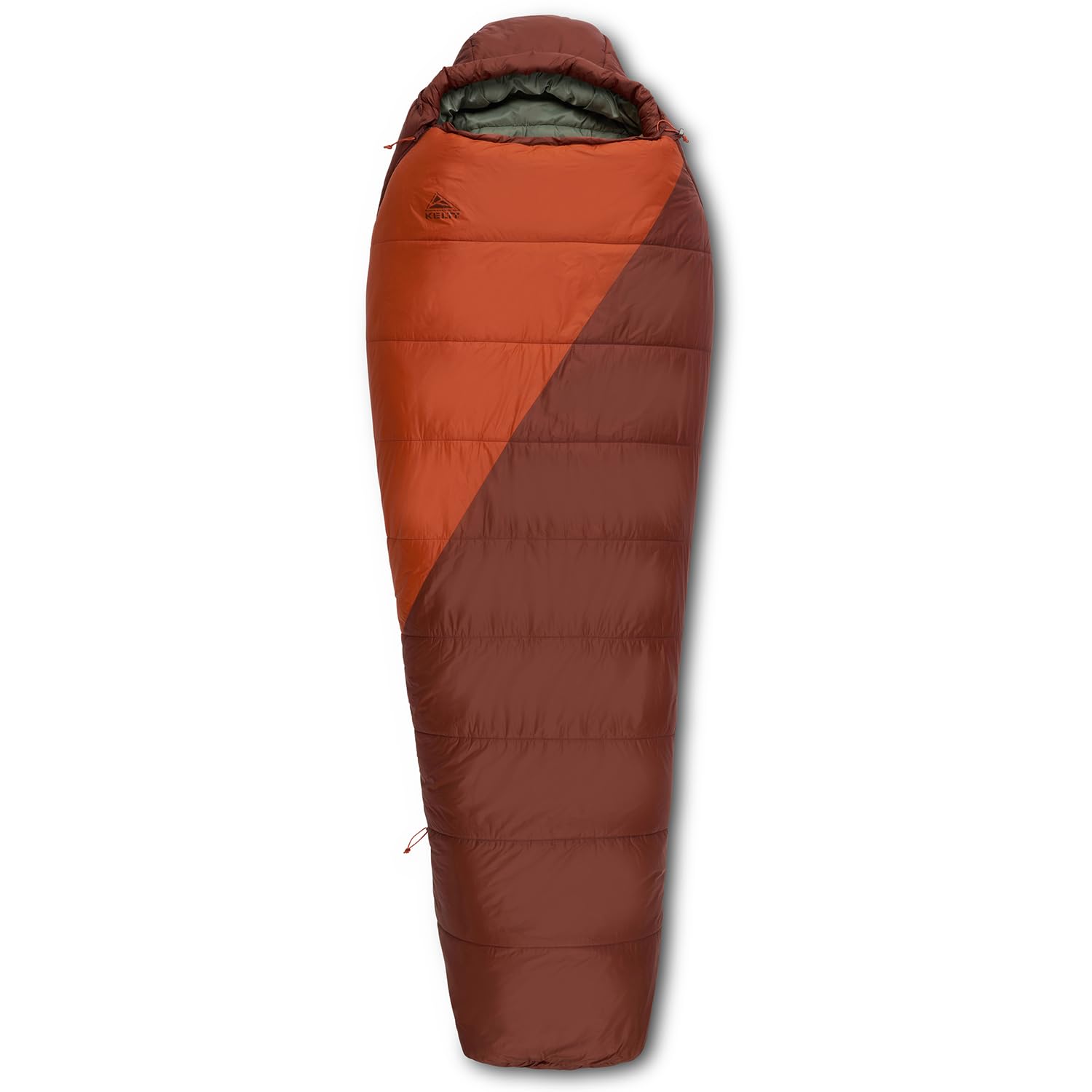
The synthetic bag that doesn’t quit when the weather turns damp and cold.
When wet conditions are part of the forecast, the Kelty Cosmic Synthetic is the smart choice. Unlike the down bags in this lineup that lose insulation when wet, the Cirroloft synthetic fill (a polyester-based insulation that traps air even when damp) continues to trap warm air even when damp. This bag has an ISO-tested comfort temperature of 18°F, and buyers confirm it is very warm — one scout leader said “I stay warm and cozy in this bag” during regular cold-weather camping. The 74″L x 30″W regular size fits sleepers up to 6’6″.
The obvious trade-off is weight and bulk. At 5.9 pounds, it is 3.1x heavier than the Naturehike 1.9 lb down bag, and one user highlighted it fills half of a 55L pack. The zipper can snag near the bicep area and lacks a Velcro keeper, so some users report it unzips slightly overnight. However, the PFAS-free DWR-treated (per- and polyfluoroalkyl substances-free durable water repellent treated) 20D recycled nylon outer fabric is a nice sustainability touch.
If you backpack in damp-cold environments, this bag’s reliable warmth in wet conditions makes the extra bulk worthwhile. For dry-cold trips, a down bag is more efficient.
Why It Matters
- Stays warm even when damp — unlike down bags
- ISO-tested 18°F comfort rating is honest and accurate
- Durable synthetic fill with PFAS-free DWR shell
Hard Truth
- 5.9 lbs is very heavy for backpacking
- Fills half a 55L pack — bulky for long treks
- Zipper can snag and may unzip during the night
Choose this for: Wet-cold climates where damp conditions are the norm, or for car/base camping. Not for light-and-fast backpackers who prioritise pack weight — the Naturehike is 3.1x lighter for dry trips.
Understanding the Specs
Fill Power
This number (like 650FP or 600FP) measures how many cubic inches one ounce of down fills. A higher number means more loft for the same weight — 650FP down traps more warm air per ounce than 600FP down. The Naturehike and the SYWSKW bag both use 650-680FP down, which offers a better warmth-to-weight ratio than the 600FP QEZER bags. For backpacking, aiming for 650FP or higher gets you the most warmth for the least weight.
Temperature Rating vs. Comfort Rating
The number on the tag (like “0°F”) is often the limit or survival rating — the temperature at which you can survive but won’t necessarily sleep comfortably. The comfort rating is the lowest temperature at which a typical sleeper can rest without shivering. The Kelty Cosmic has a 0°F tag but an ISO-tested comfort rating of 18°F. For reliable warmth, look for an ISO or EN-rated comfort temperature, not just the headline number. Most budget bags only list a single rating, so you’ll have to gauge from reviews.
Mummy Shape vs. Rectangular
Mummy bags taper at the feet and hug the body, reducing the air volume your body has to heat. This makes them 20-30% more thermally efficient than rectangular bags. The trade-off is less room to move around. The QEZER 0°F bag (84.65″ x 31.89″) is a wider mummy that offers more space than a traditional tight mummy. For cold-weather backpacking, mummy is almost always the right shape.
Draft Collar and Draft Tube
A draft collar is an insulated tube that cinches around your neck to prevent warm air from escaping when you move. A draft tube runs the full length of the zipper on the inside, blocking cold spots that form along the zipper track. The Naturehike uses both a U-neck collar and a wind blocking strip. These features add a few ounces but dramatically improve real-world warmth. If you’re a side sleeper who moves around, prioritise a bag with a good draft collar.
FAQ
What temperature sleeping bag do I need for cold weather backpacking?
Is a down sleeping bag better than synthetic for cold weather?
Can I use a 0°F sleeping bag in warmer weather?
How do I store a down sleeping bag to keep it fluffy?
What is a draft collar and why does it matter?
Can two mummy sleeping bags be zipped together?
How much does a sleeping bag add to my pack weight?
Will a mummy bag fit a tall person (6’2″ or taller)?
How do I wash a down sleeping bag?
What is the difference between a 650-fill and 600-fill down bag?
Final Thoughts: The Verdict
For most buyers, the best cold weather backpacking sleeping bag winner is the Naturehike 0°F RDS Down because it delivers ultralight weight (1.9 lbs), honest warmth (18.86°F comfort rating), and RDS-certified 650-fill down at a price that undercuts premium brands. If you want the absolute lightest and most durable bag for years of hard use, grab the Western Mountaineering Versalite 10°F. And for damp-weather reliability or budget-conscious trips, the Kelty Cosmic Synthetic 0°F or the SYWSKW Down with Pillow are smart picks that won’t let you down.
How We Picked
We do not accept paid placement. Every pick is matched to a real buyer and a real use-case; we do not hands-on test units.
Sources & Methodology
Specifications: manufacturer listings and product documentation. Review insights: verified customer reviews, as of July 2026. Pricing: not shown on this page (it changes often); check the current price via the retailer link.
As an Amazon Associate, WellFizz earns from qualifying purchases. This does not affect which products we feature.
Related Guides

Mo Maruf
I created WellFizz to bridge the gap between vague wellness advice and actionable solutions. My mission is simple: to decode the research and give you practical tools you can actually use.
Beyond the data, I am a passionate traveler. I believe that stepping away from the screen to explore new environments is essential for mental clarity and physical vitality.