Our readers keep the lights on and my smoothie glass nicely filled. As an Amazon Associate, I earn from qualifying purchases.
Specs are compiled from manufacturer listings and verified buyer reviews and can change over time — please confirm the key details on the product page before buying.
Heavy legs, sore calves, and fatigue that lingers into your next workout — that is the feeling a good pair of compression socks can fix. They improve circulation (your blood flow), so your legs feel lighter during activity and recover faster afterward. The key is matching the squeeze level to your sport and body. This guide compares seven options using manufacturer specs and patterns across verified customer reviews to help you pick the right pair.
I’m Mohammad Maruf — the founder and writer behind WellFizz. This guide is built by comparing the manufacturers’ published specifications and the patterns across verified customer reviews, so you get each pick’s real strengths and trade-offs instead of marketing spin.
Understanding what sets each pair apart makes a real difference in finding the best compression socks for sports.
Quick Picks
- CHARMKING Compression Socks for Women & Men — Best Value
- Physix Gear Compression Socks 20-30 mmHg — Top Performer
- Benirap Breathable Compression Socks 20-30 mmHg — Comfort Champion
- TENYSAF Compression Crew Running Socks (3 Pairs) — Best for Running
- Feetures Compression Knee High Socks (1 Pair) — Premium Fit
- Swiftwick Aspire Quarter Crew Running & — Elite Performer
- Zensah Tech+ Compression Socks (1 Pair) — Durable Specialist
How To Choose The Best Compression Socks For Sports
Picking the right pair goes beyond color or price. The key factors are compression level, material, and fit — each one affects how your legs feel during and after a workout.
Compression Level (mmHg) — How Much Squeeze You Need
Compression is measured in millimeters of mercury (mmHg), a unit that indicates pressure. For most sports, 15-20 mmHg gives good daily support that eases tiredness and mild swelling. If you push hard — long runs, heavy lifts, or all-day standing — the 20-30 mmHg range delivers a stronger squeeze that helps with shin splints (pain along the shin bone) and faster recovery. Always check the rating; a “firm” label is not the same as a precise mmHg number.
Material and Breathability — Keeping Your Feet Cool
Sports socks need to wick moisture away fast to stop blisters and overheating. Look for blends of nylon, polyester, spandex, or specialized synthetics that dry quickly. Some premium socks add olefin (a moisture-pulling synthetic fiber) for extra sweat transport. Avoid thick cotton blends — they trap sweat and can cause chafing on long sessions.
Fit and Length — Ankle to Knee Coverage
Graduated compression socks should be tightest at the ankle and loosen as they go up the calf. Knee-high length is the most common for sports use, supporting the entire lower leg. Pay attention to sizing charts that measure your calf circumference and shoe size. A sock that is too tight at the top band can dig in, while one that is too loose will slide down and lose its benefit.
Quick Comparison
| Model | Best For | Compression Level | Material | Pairs Included | Amazon |
|---|---|---|---|---|---|
| CHARMKING (8 Pairs) | Everyday comfort & value | 15-20 mmHg | Nylon/Polyester/Spandex | 8 | Amazon |
| Physix Gear (20-30 mmHg) | Firm all-day support | 20-30 mmHg | High-quality Nylon/Spandex | 1 | Amazon |
| Benirap Breathable | Active recovery & travel | 20-30 mmHg | Silky Nylon/Spandex | 2 | Amazon |
| TENYSAF Compression Crew | Running & court sports | Firm (not specified) | Nylon+Polyester+Spandex | 3 | Amazon |
| Feetures Knee High | Premium graduated fit | Graduated (not specified) | Lightweight Nylon/Spandex | 1 | Amazon |
| Swiftwick Aspire Quarter Crew | High-performance running & cycling | Firm | 69% Nylon, 27% Olefin, 4% Spandex | 1 | Amazon |
| Zensah Tech+ | Durable shin splint relief | Graduated (not specified) | 82% Polyamide, 18% Elastane | 1 | Amazon |
In Depth Reviews
1. CHARMKING Compression Socks for Women & Men (8 Pairs)

A massive eight-pair bundle that delivers consistent, all-day support while staying affordable.
If you want to fill your sock drawer with compression pairs without spending much, this is the choice. The 15-20 mmHg rating (the lightest compression range) is ideal for daily wear, commuting, or a casual run, but it will not give you the firm squeeze needed for heavy competition. The fabric is a stretchy nylon, polyester, and spandex blend. Buyers report it “compares well with the other brands I’ve tried, and surprisingly comfortable when worn all day.” The value is clear: 8 pairs versus the 2 pairs you get with the Benirap option.
The socks are knee-high and machine washable, and they come in fun colors and patterns that make them feel less clinical. One buyer with larger calves noted the top band does not dig in, which is a common complaint on tighter compression wear.
For sports requiring serious lower-leg support — like long-distance trail running or heavy plyometrics (jump training) — you may want a higher mmHg rating. These are better as your everyday recovery and work sock.
Why It Stands Out
- 8 pairs at a very budget-friendly price point
- Comfortable 15-20 mmHg level for extended wear
- Buyers praise the stretch and lack of digging
What to Consider
- Lighter compression may not be enough for intense sports recovery
- Not as breathable as premium moisture-wicking blends
Smart Value Pick: Buy these if you need multiple pairs for daily comfort, travel, or light activity — you get a full rotation at a steal.
Performance Caveat: If you specifically need 20-30 mmHg for shin splints or hard training, look at the Physix Gear or Benirap options instead.
2. Physix Gear Compression Socks 20-30 mmHg

A snag-free fit with the strong 20-30 mmHg compression that athletes and nurses both swear by.
These socks hit the balance of firm compression without being unbearable to put on. The 20-30 mmHg rating is the standard for serious athletic recovery and shin splint support — tighter than the CHARMKING’s 15-20 mmHg by a noticeable margin. Owners mention they “provide excellent support without feeling overly tight.” The material is a durable high-quality nylon and spandex blend that holds up well after multiple washes, and the top band stays put without leaving deep rings on your calf.
Compared to the CHARMKING, the Physix Gear gives you that extra squeeze (20-30 mmHg vs 15-20 mmHg), which makes a real difference if you are tackling long runs, standing shifts, or flights where swelling is a concern. The socks go right up to the knee, and the arch support adds a layer of comfort that the lighter-weight Benirap does not emphasize. One reviewer noted the socks “gave my legs new life” during a physically demanding job, while another noted they are a bit hard to get on at first — a trade-off that often comes with stronger compression.
The deep colors and patterns are stylish enough for daily wear, and the price sits in the mid-range. These come as a single pair, so the up-front cost is higher than a multi-pack.
Core Strengths
- 20-30 mmHg compression provides real therapeutic support
- Breathable and durable fabric
- Excellent arch and heel targeting
Minor Challenges
- Firm compression makes initial putting-on a struggle for some
- Single pair — you will need to buy multiple for a rotation
Reliable Workhorse: Reach for these when you need consistent, proven 20-30 mmHg support for sports, long shifts, or heavy travel days.
Wardrobe Note: Since it is one pair, consider pairing with a multi-pack like the CHARMKING for your everyday rotation.
3. Benirap Breathable Compression Socks 20-30 mmHg (2 Pairs)
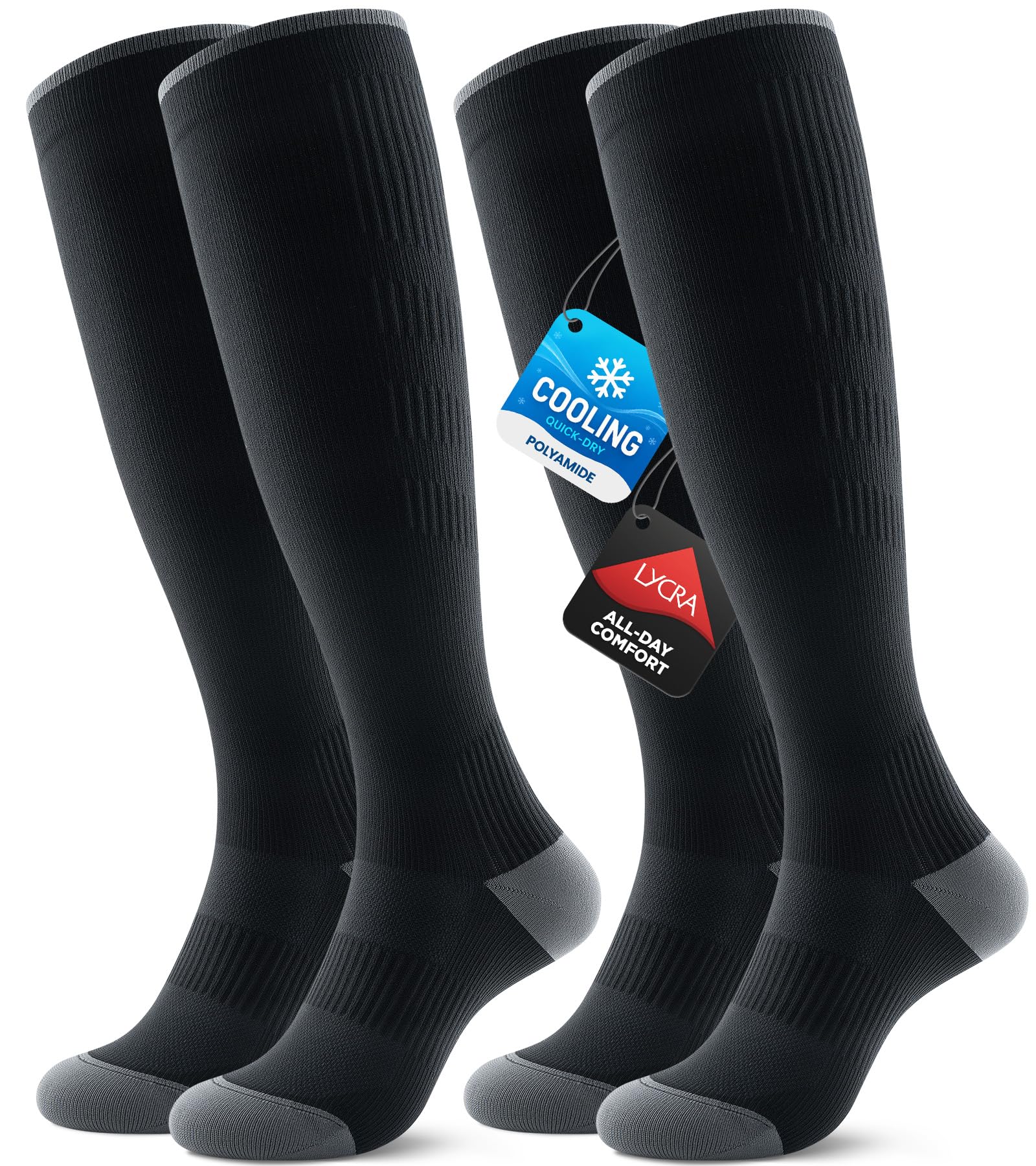
Silky-textured 20-30 mmHg socks that customers note are surprisingly easy to slide on.
The biggest complaint with firm compression socks is the battle to get them on. The Benirap socks solve that with a soft, almost silky fabric that reviewers point out “were easy to put on and off.” Despite the smooth feel, they still deliver 20-30 mmHg graduated compression — the same strong level as the Physix Gear — which makes them a solid pick for active recovery, travel, and daily training. The 3.53-ounce weight (per the package dimensions) keeps them light for packing.
These come as 2 pairs, giving you a small rotation at a mid-range price. Unlike the TENYSAF socks, which are designed more for running with cushion, the Benirap focuses on a slim, close fit that stays put without leaving marks on the skin. The fabric blend is breathable, so your legs do not overheat during long wear. A verified buyer mentioned they felt comfortable all day with “no noticeable friction or irritation.” One catch: the 180-day guarantee offers some protection, but some reviewers noted the size S-M may fit snugger than expected if your calves are on the larger side.
For the 20-30 mmHg level, this is one of the more wearable options, and the two-pair format is handy for alternating during a training week.
What Works
- Silky material slides on easier than most 20-30 mmHg socks
- Breathable and does not leave marks
- Two pairs for rotation at a fair price
What to Watch
- Sizing runs slightly small — measure your calf carefully
- Silky fabric may feel less durable over many washes
Best for Comfort Seekers: Grab these if you want 20-30 mmHg performance but hate the struggle of putting on stiff compression socks.
skip it if: You need a cushioned sole for high-impact running — the TENYSAF or Swiftwick are better suited.
4. TENYSAF Compression Crew Running Socks (3 Pairs)

A three-pack built for the road with a snug, blister-free fit that runners genuinely love.
These are not your average tube socks. The TENYSAF socks are designed specifically for running, with a firm compression fit that prevents slipping inside the shoe. A cross-country runner’s parent said their son “loves these socks” and noted they “don’t slip (so no blisters).” The crew height (mid-calf) is perfect for pairing with shorts, and the material blend of nylon, polyester, and spandex provides decent moisture-wicking for heat and humidity.
Unlike the Benirap or Physix Gear, these do not advertise an exact mmHg number; instead, the brand focuses on a “firm” compression feel that prioritizes stability over deep therapeutic squeeze. This makes them a great middle-ground pick for sports like running, basketball, and hiking where you want support without the full restriction of a 20-30 mmHg clinical sock. One smart design touch: each sock is marked with an “R” and “L” for left and right foot, giving you a contoured fit that is rare at this price point with 3 pairs included.
The trade-off is the firmness — it works great for activity but may feel constricting if you plan to wear them all day sitting. Also, one buyer mentioned a quality-control hiccup where a blue pair came with two right socks, so check your pack upon arrival.
Performance Edge
- Left/right foot design for a precise anatomical fit
- Blisters are rare thanks to the non-slip grip
- Great value with 3 pairs in the box
Considerations
- Compression level is firm but not precisely specified in mmHg
- Occasional packaging error reported by a buyer
Runner’s Choice: Pick these if your main sport is running or court sports and you want a 3-pack of durable, form-fitting socks that stay put.
Heads Up: If you need a specific 20-30 mmHg rating for medical recovery, go with the Physix Gear or Benirap.
5. Feetures Compression Knee High Socks (1 Pair)
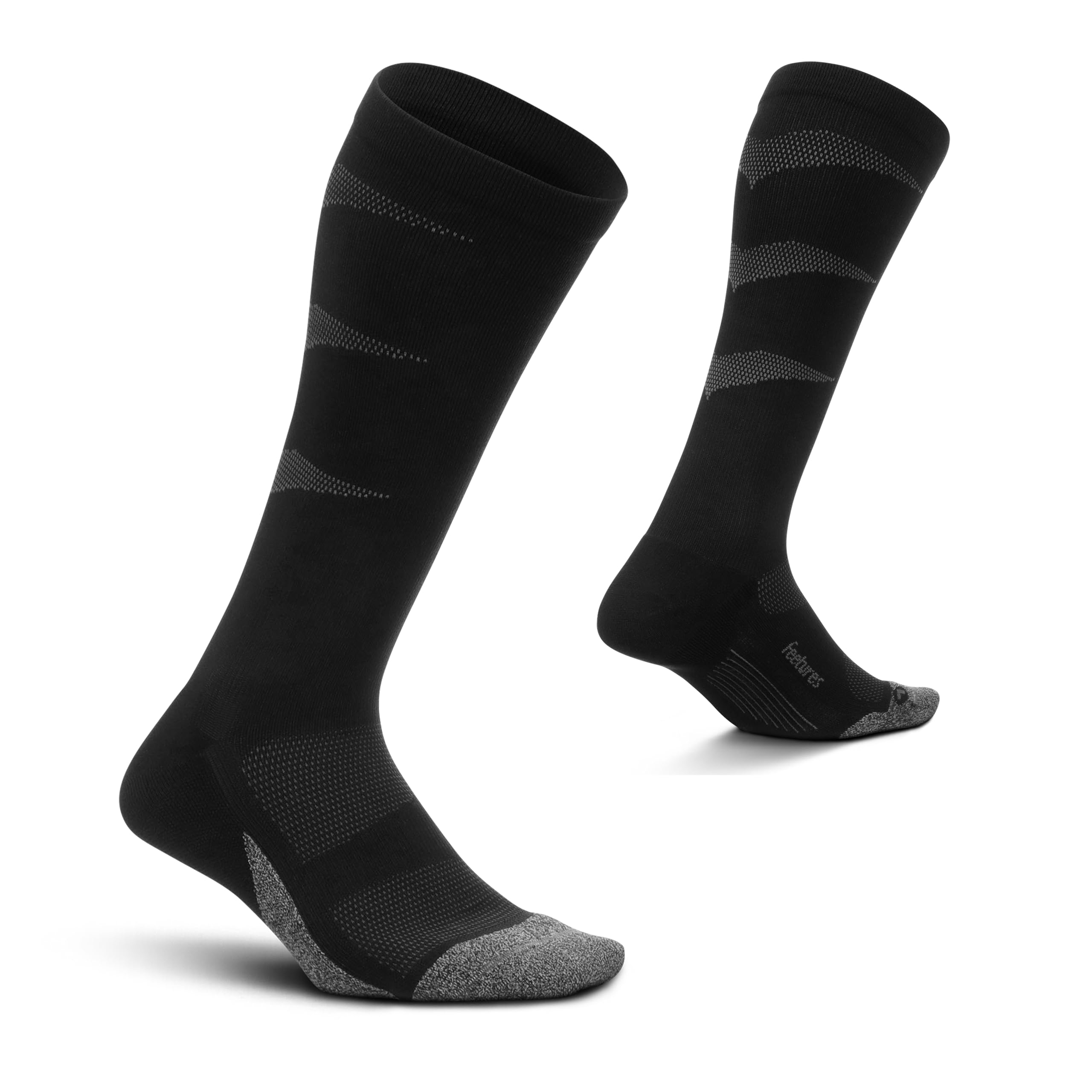
A lightweight, nearly invisible construction that delivers graduated compression without overheating.
Feetures uses a “targeted compression” approach — the sock is tightest where you need it (around the ankle and calf) and looser in between, with a lighter-weight material than most competitors. Shoppers say they “do not have a big indentation around my calves” after removal, and the fabric feels cooler than thicker cotton blends you might be used to. This makes the Feetures a go-to for travel, hiking, and any day you need compression but do not want your legs cooking.
There is a notable trade-off: the fit is lean. Multiple reviewers with average builds (5’6″, 140 lbs) found them “WAY too tight” — so if you have fuller calves, check the sizing chart closely or consider the more forgiving CHARMKING. The construction is premium and well-made, and the graduated design improves circulation during long periods of standing or sitting. Unlike the Zensah which is made for hardcore durability, the Feetures are about a lighter, more flexible feel that packs easily.
At a premium price for a single pair, these are an investment in quality fabric and fit, but the sizing pickiness means they are not for everyone.
Why It Shines
- Very lightweight and breathable material
- Graduated compression reduces uncomfortable indent lines
- Excellent for warm weather and travel
The Catch
- Runs very snug — not ideal for larger calves
- Single pair at a high price point
Warm-Weather Winner: Go with Feetures if you want a premium, airy compression sock for hiking, flying, or all-day wear when heat is a factor.
Measure First: This is not a grab-and-go pick — you need to confirm your calf circumference against the size chart to avoid an uncomfortably tight fit.
6. Swiftwick Aspire Quarter Crew Running & Cycling Socks (1 Pair)
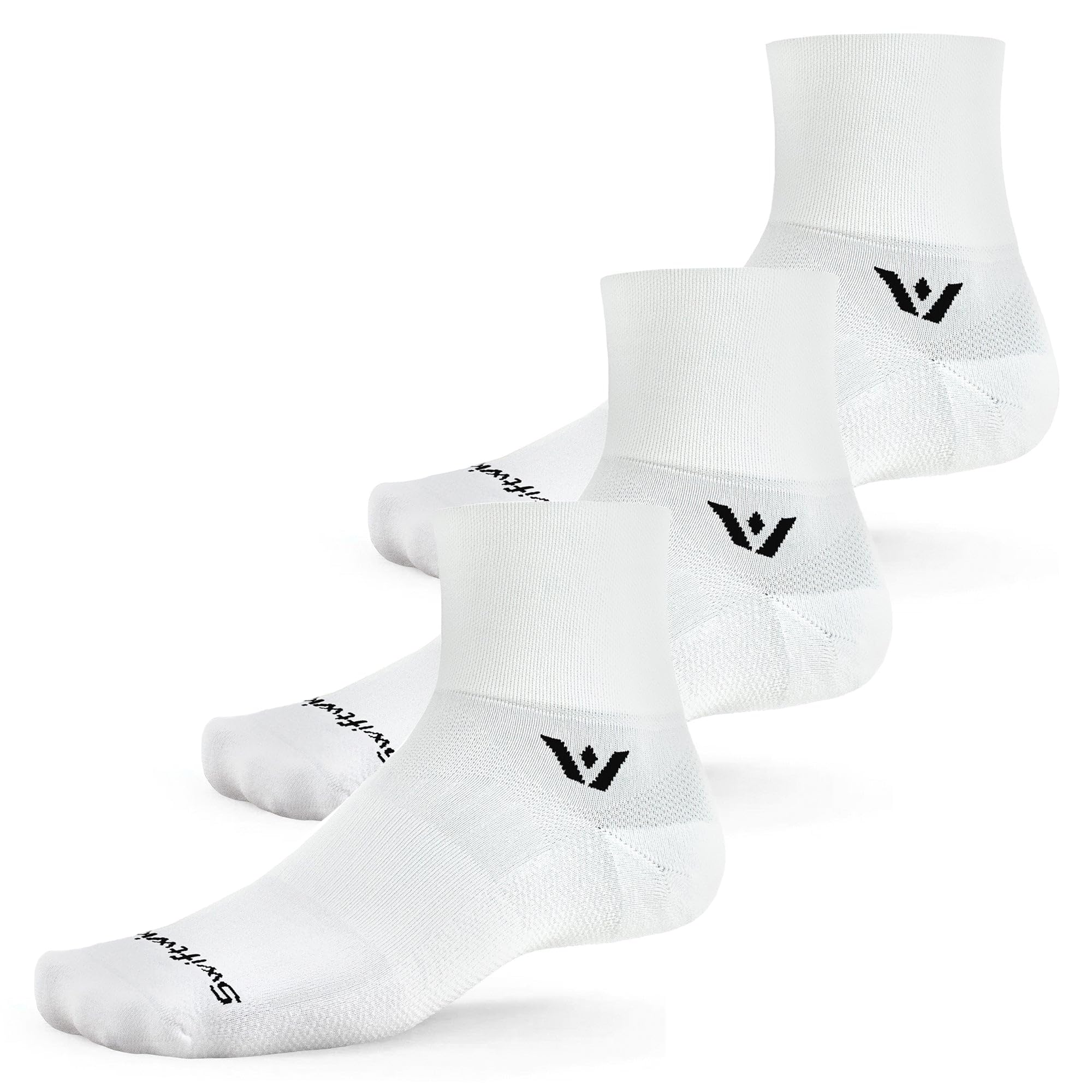
A featherweight 1.6-ounce sock with firm compression and a smooth toe for zero-blister performance.
The Swiftwick Aspire is engineered for endurance. At just 1.6 ounces, it is one of the lightest compression socks on the market, making it ideal for runners and cyclists who count every gram. The fabric blend is 69% Nylon, 27% Olefin, and 4% Spandex — the olefin actively pulls moisture away from the skin. The “Quarter Crew” height sits around the ankle, offering a lower profile than the knee-high models above, which some athletes prefer for freedom of movement.
Buyers who log serious miles — including ultramarathon distances — say the socks last “years even” before the elastic gives out. The Y-shaped heel and smooth toe box create a friction-free environment that eliminates hot spots during long efforts. Unlike the Feetures, which focuses on lightweight material, Swiftwick focuses on firm compression (listed as “Firm” on the package) plus a contoured fit that does not bunch or slip. One owner reported the size chart is precise — a women’s 8.5 fit perfectly, so follow the guide closely.
The downside is price and availability: this is a single pair at a premium, and the quarter-crew height means no calf coverage for those who need it.
Performance Highlights
- Ultra-light 1.6 oz — barely feel them on
- smooth toe and Y-heel eliminate rubbing
- Firm compression reduces fatigue during long runs
Trade-offs
- Quarter-crew height offers no calf compression
- High price for a single pair
Competition Kit: Buy these if you race or train seriously in running or cycling and want the lightest, most technical compression sock that stays cool and dry.
Skip If: You need full knee-high compression for shin splints or recovery — the Zensah or Physix Gear will serve you better.
7. Zensah Tech+ Compression Socks (1 Pair)
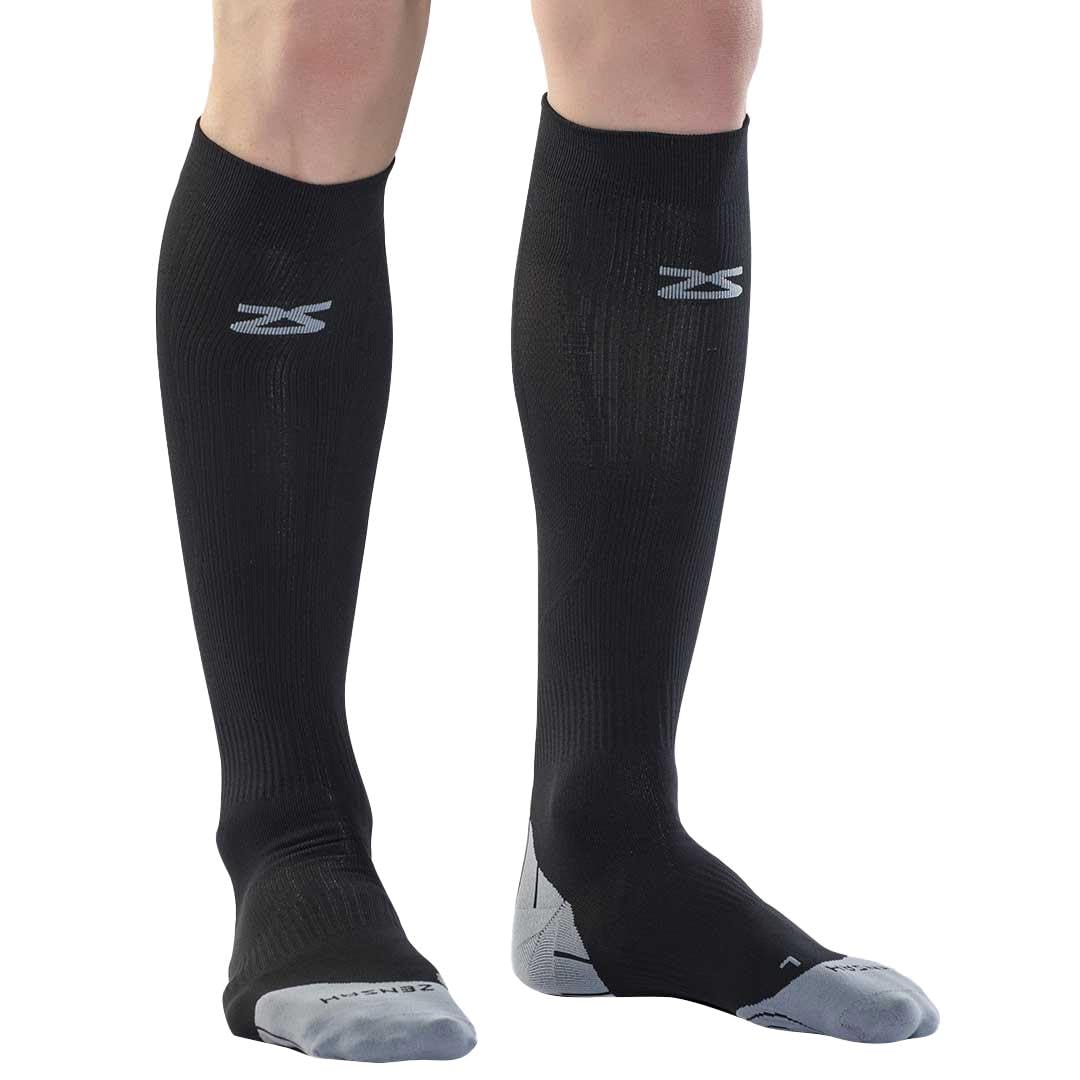
Built in Italy with a dense 200-needle construction that survives 100-plus runs without a hole.
If durability is your top concern, the Zensah Tech+ is the last sock you will buy for a long time. Made in Italy from 82% Polyamide and 18% Elastane, the 200-needle count engineering makes the fabric denser and stronger than standard compression socks. Buyers report wearing them for “100+ runs, no holes” and that they “lasts years without issues.” The graduated compression here means it is tightest at the ankle and looser up the calf — to push blood flow back up. The smooth toe prevents blisters, and the anatomical left/right fit keeps everything aligned.
These are thicker and more substantial than the Swiftwick or Feetures, with a padded foot area that offers extra comfort for high-impact activities. Reviewers specifically call out relief from shin splints (pain along the shin bone), which is a major selling point for runners. The trade-off is that they are tight to put on — one customer observed the “inside-out method” helps — and the top band can dig into the calf if not positioned correctly. A long-time buyer noted the newer version has a narrower band than older models.
At the highest price in the roundup for a single pair, you are paying for premium construction and longevity. The limited color selection is a minor gripe.
Long-Term Value
- Extremely durable 200-needle Italian construction
- True graduated compression with shin splint relief
- smooth toe and padded foot for comfort
Before You Buy
- Hard to put on — requires practice or a technique
- Top band can be less forgiving on fuller calves
Investment Pick: Reach for these if you want a sock that outlasts cheaper alternatives and provides reliable shin splint support run after run. One pair can last over a year of heavy use.
Consider The Fit: If you have larger calves or struggle with dexterity, the struggle to get them on may be a dealbreaker — look at the Benirap for easier entry.
Understanding the Specs
Graduated Compression (mmHg)
This is the force the sock applies to your leg, measured in millimeters of mercury (mmHg). It is highest at the ankle and gradually loosens as it moves up the calf. This design helps push blood back up toward your heart, reducing swelling and fatigue. For sports, 15-20 mmHg is light support for daily comfort, while 20-30 mmHg is firm enough for recovery and preventing shin splints (pain along the shin bone). The rating is the only reliable way to compare strength across brands — marketing terms like “firm” are not standardized.
Material and Moisture Wicking
What the sock is made of directly affects how your skin feels during a workout. Nylon blends add stretch and durability. Spandex provides the compression. Olefin (polypropylene) is a high-performance synthetic that actively pulls sweat away from the skin — you see this in brands like Swiftwick. Polyester and polyamide are common durable options. Avoid heavy cotton blends for sports, as they absorb sweat and can cause blisters and chafing on long runs. Moisture-wicking breathability is the key to staying dry and comfortable.
FAQ
What does 20-30 mmHg mean and do I need it for sports?
Can I wear compression socks while running a marathon?
How tight should compression socks feel?
Will compression socks help with shin splints?
How do I wash compression socks to make them last?
What is the difference between knee-high and crew-length compression socks?
How many pairs of compression socks do I actually need?
How do I know what size to buy?
Final Thoughts: The Verdict
If you want one dependable pick, the best compression socks for sports winner is the Physix Gear Compression Socks 20-30 mmHg because it blends reliable firm compression with a durable, comfortable design that works for running, standing, or travel without a premium price tag. If you want the sheer value of building a full sock rotation, grab the CHARMKING 8-Pair Pack. And for the athlete who needs the lightest, most technical performance sock for race day, the Swiftwick Aspire Quarter Crew delivers the firm compression and 1.6-ounce weight that serious runners and cyclists choose.
How We Picked
We do not accept paid placement. Every pick is matched to a real buyer and a real use-case; we do not hands-on test units.
Sources & Methodology
Specifications: manufacturer listings and product documentation. Review insights: verified customer reviews, as of July 2026. Pricing: not shown on this page (it changes often); check the current price via the retailer link.
As an Amazon Associate, WellFizz earns from qualifying purchases. This does not affect which products we feature.
Related Guides

Mo Maruf
I created WellFizz to bridge the gap between vague wellness advice and actionable solutions. My mission is simple: to decode the research and give you practical tools you can actually use.
Beyond the data, I am a passionate traveler. I believe that stepping away from the screen to explore new environments is essential for mental clarity and physical vitality.