Our readers keep the lights on and my smoothie glass nicely filled. As an Amazon Associate, I earn from qualifying purchases.
Specs are compiled from manufacturer listings and verified buyer reviews and can change over time — please confirm the key details on the product page before buying.
You are done with your phone’s limits — you want real zoom reach, a larger sensor that captures light in dim scenes, and full control over aperture and shutter speed, all in a jacket-pocket size. The catch is that some models prioritize video over stills, while others focus every ounce of engineering on pure image quality, so choosing the wrong one leaves you stuck with gimbal features you never use or a lens that cannot zoom far enough. This guide cuts through the noise to match you with the exact compact camera that fits your photography style — street, travel, vlogging, or everyday carry — based on real specs and verified buyer feedback.
I’m Mohammad Maruf — the founder and writer behind WellFizz. This guide is built by comparing the manufacturers’ published specifications and the patterns across verified customer reviews, so you get each pick’s real strengths and trade-offs instead of marketing spin.
Every review below focuses on the specs that matter for photographers — sensor size, autofocus speed, optical zoom, and battery life — so you can confidently pick the best compact camera for photography without wasting hours cross-referencing product pages.
How To Choose The Best Compact Camera For Photography
Picking a compact camera is different from buying a phone or a laptop because the lens, sensor, and autofocus system together determine what you can actually capture. Below are the three specs that separate a capable camera from a frustrating one.
Sensor Size: 1-Inch or Larger Is the Baseline
The sensor is the part that turns light into your image. A 1-inch sensor collects significantly more light than the tiny 1/2.3-inch sensors found in budget point-and-shoots, which means you get cleaner shots in low light, smoother background blur (the “bokeh” effect), and richer color detail. Every camera in this guide uses a 1-inch or larger sensor, so you skip the entry-level compromise.
Autofocus: Phase Detection Versus Contrast Detection
Phase-detection autofocus (PDAF) is what allows a camera to lock onto a moving subject quickly and keep tracking it as you recompose. Cameras with a high number of phase-detection points — 315 or 425, for example — cover more of the frame, so your subject stays sharp even when it is not dead center. Contrast detection alone is slower and tends to “hunt” in low light, which causes you to miss the decisive moment.
Optical Zoom: Know the 35mm Equivalent Range
Optical zoom is the lens physically moving to magnify the scene, so you keep full resolution at every focal length. Digital zoom simply crops and enlarges pixels, which ruins detail. When you see a spec like “24-200mm,” the first number is the wide-angle field of view and the second is how far it reaches — more range lets you shoot everything from landscapes to distant wildlife without swapping lenses.
Quick Comparison
| Model | Best For | Sensor Resolution | Optical Zoom | Autofocus Points | Amazon |
|---|---|---|---|---|---|
| Fujifilm X100VI | Everyday carry & street | 40.2 MP | Fixed 23mm f/2 | 425 | Amazon |
| Sony RX100 VII | All-in-one zoom versatility | 20.1 MP | 24-200mm f/2.8-4.5 | 425 | Amazon |
| Sony RX100 V | High-speed action & burst | 20.1 MP | 24-70mm f/1.8-2.8 | 315 | Amazon |
| DJI Osmo Pocket 3 | Vlogging with gimbal stability | 9.4 MP | Fixed wide-angle | — | Amazon |
| Xtra Muse | Budget-friendly gimbal video | — | Fixed wide-angle | — | Amazon |
| Canon G7 X Mark III | Vlogging & social sharing | 20.1 MP | 4.2x optical zoom | — | Amazon |
In‑Depth Reviews
1. Fujifilm X100VI Digital Camera – Silver

The fixed-lens icon that makes you fall in love with shooting again.
The X100VI earns its spot for image quality because its 40.2MP sensor — a 40.2 X-Trans CMOS 5 HR sensor — at 40.2 MP versus the 20.1 MP Sony RX100 VII, so you can crop aggressively and still print large, sharp images. In-body image stabilization (IBIS — a mechanism that shifts the sensor to counter hand shake) gives you up to 6.0 stops of correction, meaning handheld shots in dim interiors stay sharp without raising your ISO (light sensitivity) to noisy levels. The built-in 4-stop internal ND filter (neutral density — it acts like sunglasses for the lens) lets you use a wide aperture in bright sun for that classic blurred-background look, so your street portraits pop against a creamy backdrop.
Reviewers consistently praise the “Fujifilm vibe” — the 20 Film Simulation modes, including REALA ACE, produce stunning JPEGs straight out of camera, which means less time editing. The fixed 23mm f/2 lens (35mm equivalent — roughly the field of view of your natural eye) is a versatile choice for street and travel, but the lack of optical zoom is a real trade-off: you zoom by physically walking closer. Buyers report the battery life is poor and the rear screen lacks the tilt range of Fujifilm’s X-T series, and autofocus can be inconsistent in low contrast scenes. If you value deliberate composition and gorgeous color science over zoom range, this is the camera that professional photographers carry for fun.
The Creative Engine
- Massive 40.2MP sensor resolves fine detail even in heavy crops
- 6-stop IBIS enables sharp handheld low-light shots (reviewers confirm)
- 20 Film Simulation modes deliver gorgeous JPEGs without editing
The Fixed-Lens Reality
- Fixed 23mm f/2 lens means no optical zoom — you zoom with your feet
- Inconsistent autofocus in low contrast scenes, per multiple buyer reviews
- Battery life is poor; plan for a spare on full-day shoots
Best for the purist: If you want a camera that encourages intentional shooting with gorgeous out-of-camera color and enough resolution to crop like a zoom, the X100VI is class-leading in its class.
The one caveat: The fixed lens will frustrate anyone who needs a telephoto reach — owners mention you need a UV filter for lens protection and there is no weather sealing from the start.
2. Sony RX100 VII Premium Compact Camera with 1.0-Type Stacked CMOS Sensor (DSCRX100M7), Black
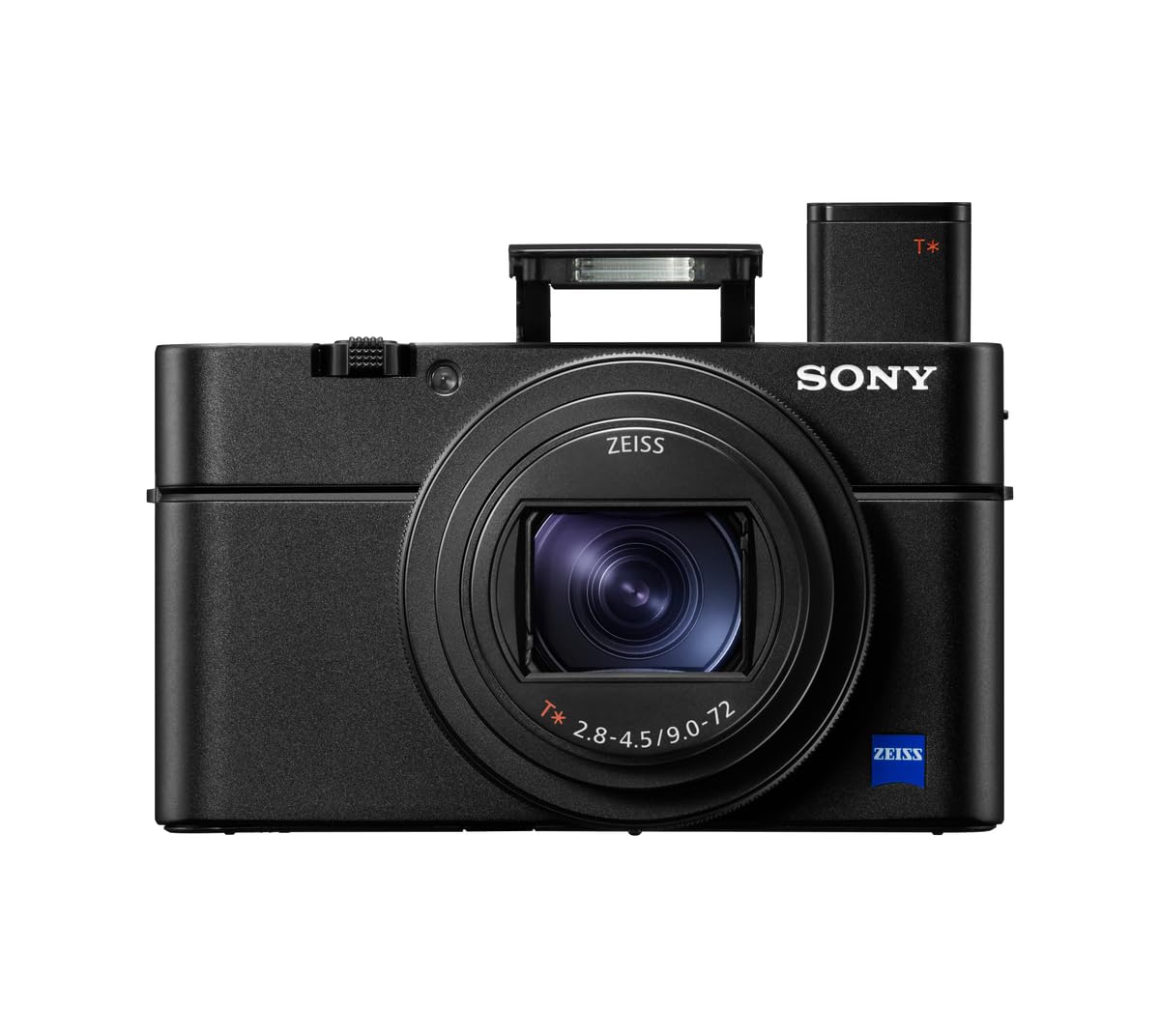
The pocket superzoom packing 24-200mm reach and pro-grade autofocus.
The RX100 VII earns its spot as the zoom champion because its Zeiss Vario-Sonnar T* 24-200mm f/2.8-4.5 lens delivers an 8.3x optical zoom range in a body smaller than most sunglasses cases. That range lets you go from wide cityscapes (24mm) to tight compressed portraits (200mm) without moving your feet, unlike the Fujifilm X100VI which forces you to walk closer. The 20.1MP 1.0-Type stacked CMOS sensor (the stacked design means data reads off the sensor faster, reducing rolling shutter) pairs with 357 focal-plane phase-detection AF points (PDAF — tiny sensors that measure distance instantly) plus 425 contrast-detection points. This hybrid autofocus locks onto eyes — human for both stills and movies, animal for stills — with the speed of a much larger mirrorless camera, so your child running across a field stays in focus.
The stacked sensor enables up to 20 fps blackout-free continuous shooting, meaning you can track a bird in flight without losing the subject in a black viewfinder. 4K video comes with HLG (Hybrid Log-Gamma, a standard for high dynamic range playback) and S-Log3 profiles for serious color grading, plus active mode image stabilization. Customers note the body can feel slippery and the menu system is dense, but the Zeiss lens is praised as “amazing” and “quite sharp.” At 20.1 MP effective still resolution, it holds a 2.1x gap over the 9.4 MP DJI Osmo Pocket 3 for pure still photography — so if you print or crop, the RX100 VII wins decisively.
The Reach Advantage
- 24-200mm optical zoom covers ultra-wide to telephoto in one pocket camera
- Hybrid AF with 357 phase-detection + 425 contrast-detection points for lightning-fast eye tracking
- 20 fps blackout-free shooting with real-time tracking for action scenes
The Handling Trade-Offs
- Slippery metal body; buyers recommend an aftermarket grip
- Dense menu system takes time to learn and navigate quickly
- Small body means the power and shutter buttons are very close — accidental shut-offs happen
Perfect for versatile travelers: You get a 24-200mm zoom and pro-level autofocus in a true pocket-size body, so you never miss a shot while carrying a heavy camera bag.
The honest trade-off: The menu complexity and small button layout will frustrate shooters who prefer tactile dials and a larger grip — plan for a learning curve.
3. Sony Cyber-Shot DSC-RX100 V 20.1 MP Digital Still Camera with 3″ OLED, flip Screen, WiFi, and 1” Sensor DSCRX100M5/B

24 frames per second of continuous autofocus in a shirt-pocket body.
The RX100 V earns its spot for speed because it shoots 24fps (frames per second — 24 still images every second) with full autofocus and auto-exposure tracking, and it can sustain that burst for up to 150 images, per buyer reports. at 24fps versus the RX100 VII’s 20fps, making it the better choice for capturing a soccer goal or a dog leaping for a frisbee. The 20.1MP 1-inch Exmor RS stacked CMOS sensor with DRAM (Dynamic Random Access Memory — a tiny buffer that lets data read out extremely fast) pairs with a system the brand claims is the “world’s fastest” 0.05-second hybrid AF, using 315 phase-detection points. That comprehensive coverage means reviewers point out it captures sharp action even when the subject is off-center. The lens is a Zeiss 24-70mm f/1.8-2.8, which is one full stop brighter than the RX100 VII at the wide end — f/1.8 vs f/2.8 — so you get better low-light performance and shallower depth of field at 24mm for blurred backgrounds in dim scenes.
The retractable Tru-Finder EVF (electronic viewfinder — a tiny OLED screen you hold to your eye) with Zeiss T* coating gives you a bright eye-level view, which is rare in compact cameras. 4K video uses direct pixel readout with no pixel binning (meaning every pixel is used, so video is sharper), and super slow-motion up to 960 fps is available for creative effects. Where it falls short vs the RX100 VII is zoom range — 70mm max vs 200mm — so you will need to move closer for distant subjects. Buyers caution that battery life is around 250 shots and there is no in-body charger, which is annoying for longer days out.
Blazing Performance
- 24fps continuous shooting with AF/AE tracking for 150 frames — excellent for action
- Bright f/1.8-2.8 lens outperforms many rivals in low-light scenarios
- 315 phase-detection AF points with 0.05-second lock speed
The Short-Reach Reality
- 24-70mm zoom maxes out early; cannot reach distant subjects
- Poor battery life (~250 shots per buyer reviews) with no separate charger included
- Tiny body with tiny buttons makes menu navigation fiddly for larger hands
Built for action shooters: The 24fps burst rate and bright f/1.8 lens make it the best pocket camera for capturing fast-moving subjects indoors or in low light.
The real frustration: The 70mm max reach means you cannot get close to distant action without cropping heavily, and the battery needs a midday recharge on heavy shooting days.
4. DJI Osmo Pocket 3 Creator Combo, 1” CMOS, 4K Resolution/120fps Vlog Camera, 3-Axis Stabilization, Face/Object Tracking, Mic Included for Clear Sound, Digital Camera for YouTube
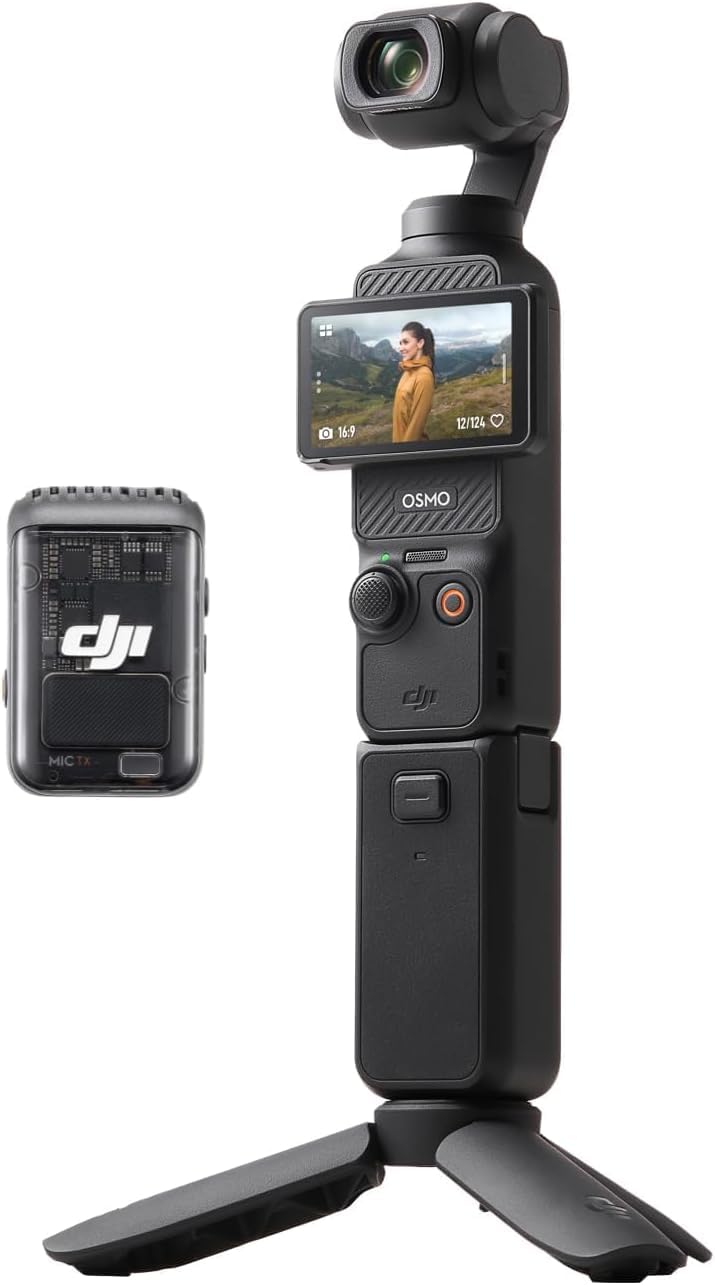
Gimbal-stabilized video that turns shaky walking shots into smooth cinema.
The Osmo Pocket 3 earns its spot for video stability because its advanced 3-axis mechanical gimbal (a motorized handle that keeps the sensor level in three directions) eliminates all walking shake, according to multiple buyer reviews, while the RX100 series relies on electronic stabilization that can warp the image. The 1-inch CMOS sensor and 4K/120fps recording (4,000-pixel-wide video at 120 frames per second, so slow-motion looks fluid) make it a capable stills companion for hybrid creators. The 2-inch rotatable touchscreen flips for horizontal or vertical framing — a huge convenience for creating content for both YouTube and social media reels without rotating the camera in post.
Its active tracking (ActiveTrack 6.0) keeps the subject center-frame automatically, even when you spin or jump, which is excellent for solo vloggers or solo timelapse creators. The Creator Combo includes a DJI Mic 2 transmitter, battery handle, mini tripod, and wide-angle lens — shoppers say the included mic “performs excellently” and that the bundle adds real value. The battery averages 166 minutes, compared to the Xtra Muse’s 161 minutes. But its fixed wide-angle lens means no zoom, and the 9.4 MP effective still resolution lags far behind the 20.1 MP Sony RX100 VII so it is not the best choice if you primarily shoot photos and plan to print or crop heavily.
Stability First
- 3-axis mechanical gimbal eliminates all walking shake, per multiple buyer reviews
- Rotating 2-inch touchscreen for instant vertical/horizontal switch
- 166-minute battery with included battery handle for extended shooting
The Still-Photo Compromise
- Fixed wide-angle lens — no optical zoom for distant subjects
- 9.4 MP effective still resolution is low for large prints or heavy crops
- Designed for video first; stills shooting feels secondary
Ideal for hybrid creators: If you need smooth 4K/120fps video and do not mind sacrificing zoom and still resolution, this Creator Combo packs everything including a wireless mic and tripod.
Not a primary stills camera: The 9.4 MP resolution and fixed lens make it a poor choice if your priority is high-resolution photography — keep it for video-first projects.
5. Xtra Muse, Vlogging Camera with 1” CMOS & 4K/120fps Videos, Pocket Camera with 3-Axis Gimbal Stabilizer, Fast Focusing, Face/Object Tracking, Digital Video Camera for Photography, Digital Camera

Pocket-sized 4K smoothness that undercuts the DJI price.
The Xtra Muse earns its spot as the budget gimbal because it offers the same core formula as the DJI Osmo Pocket 3 — a 1-inch CMOS sensor, 4K/120fps recording, and a 3-axis gimbal stabilizer — at a lower price, making it the entry point for smooth video without the DJI premium. The 2-inch touchscreen lets you switch between horizontal and vertical shooting, and the Master Follow feature keeps you center-frame even on a tripod. For photographers who want color-grading flexibility, the 10-bit X-Log color mode captures up to one billion colors, giving you more latitude in post-production to recover highlights and shadows, especially for sunrise and sunset scenes.
Buyers report the camera performs similarly to the DJI Pocket 3 with sharp, vibrant video and fast autofocus, noting that DJI accessories fit and DJI mics connect easily. The honest catch is battery life: owners mention the battery lasts about 2 hours, and one reviewer noted it is “fixable with external USB battery.” It also trails the DJI Pocket 3 on battery longevity — 161 minutes vs 166 minutes. For pure still photography, it lacks a dedicated photo-first mode found on the Sony RX100 series, so think of it as a video-first camera that also records high-quality stills.
Value-Packed Stabilization
- 1-inch sensor and 4K/120fps with 3-axis gimbal at a lower price than the DJI
- 10-bit X-Log color for professional-grade post-production grading
- DJI accessories and mics work with it, expanding its ecosystem
The Power Limitation
- Battery lasts about 2 hours, per multiple buyer reviews; needs external USB battery for long days
- Lags behind DJI Pocket 3 on battery life (161 min vs 166 min)
- Not a dedicated stills camera — photo features are secondary to video
Good for budget-conscious vloggers: You get DJI-like gimbal smoothness and 10-bit color for less money, with the flexibility of using DJI accessories.
The realistic limitation: The sub-2-hour battery means you must pack a USB power bank for any full-day event, and stills shooters should look at the Sony RX100 series instead.
6. Canon PowerShot G7 X Mark III Digital Camera Bundle, 20.1MP 1-Inch Sensor, 4.2X Optical Zoom, 4K UHD Video, Wi-Fi & Bluetooth, Vlogging & Travel Camera with Bag and 64GB Card
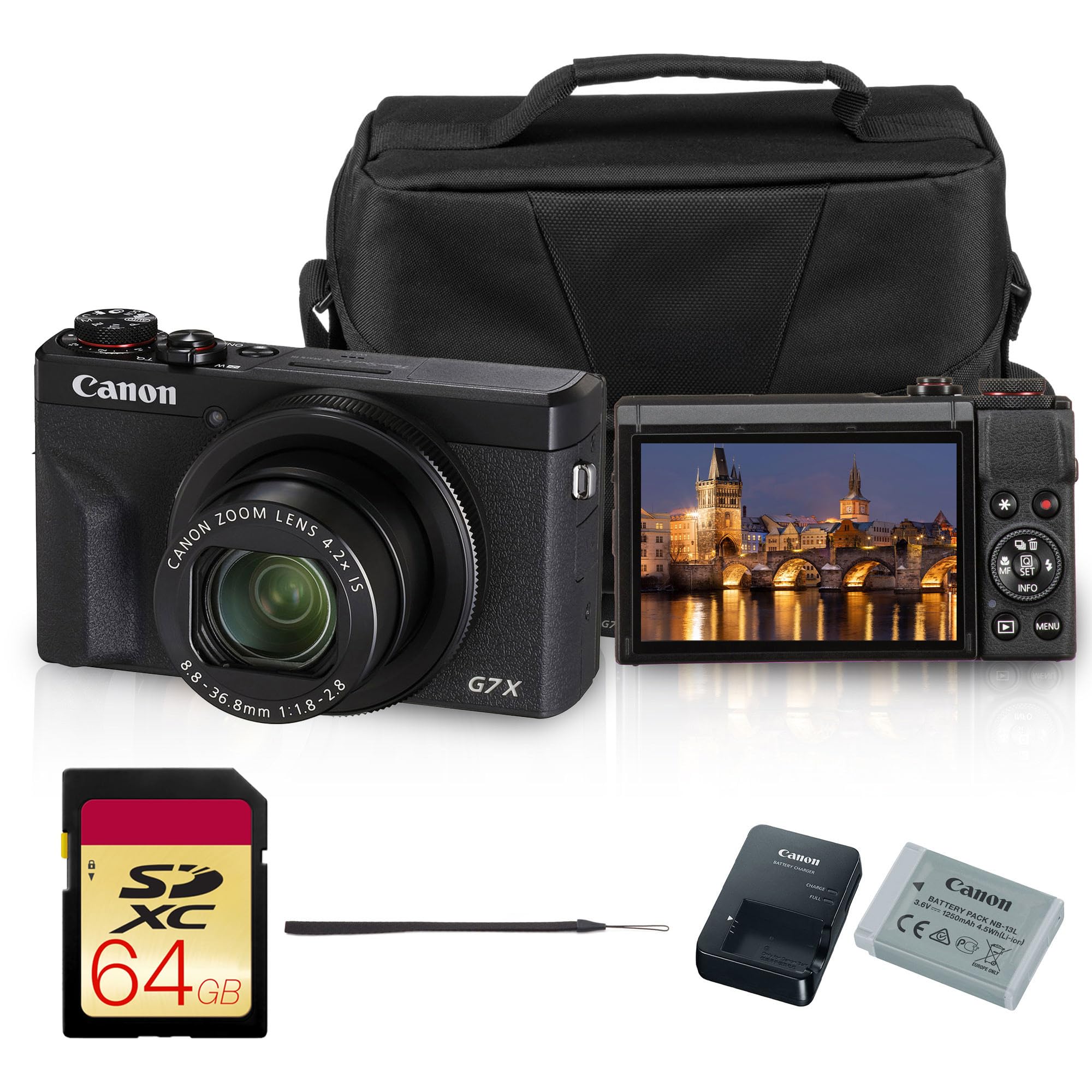
The social-media-ready compact that pairs a 20.1MP sensor with one-touch sharing.
The Canon G7 X Mark III earns its spot as the creator favorite because it delivers full-sensor-width 4K video (no crop, so your wide shots stay wide) and a flip-up touchscreen for self-framing, paired with instant Wi-Fi and Bluetooth transfers to your phone — the fastest path from capture to social post among these cameras. The 20.1MP 1-inch sensor and 4.2x optical zoom lens capture vibrant, detailed images even in low light, and the flip-up touchscreen makes it easy to frame yourself for vlogs or selfies. The external microphone input means you can plug in a proper mic for clean audio without complex adapters, which buyers appreciate for YouTube content.
Built-in Wi-Fi and Bluetooth pair with the Canon Camera Connect app to transfer photos instantly to your phone, so you can post to social media without digging out a cable. Reviewers describe the image quality as “incredible” and say the camera takes “the best photos.” The bundle includes a shoulder bag and 64GB memory card, so you are ready to shoot from the start. However, the camera has no built-in flash, which limits indoor shooting without an external unit, and the battery capacity is 1250 mAh — buyers who shoot heavily should carry a spare. Unlike the Sony RX100 VII, the G7 X Mark III lacks a phase-detection autofocus system as dense as 357 points, so tracking fast movement is less reliable.
Share-Ready Workflow
- Full-sensor-width 4K video with no crop and flip-up screen for vlogging
- Built-in Wi-Fi and Bluetooth for fast photo transfers to your phone
- External mic input for clean audio without adapters
Missing Flash & Focus Density
- No built-in flash — requires an external unit for dim interiors
- Autofocus system is less dense than Sony’s 357-point phase detection; action tracking is less reliable
- 1250 mAh battery means midday charging on heavy shooting days
Best for social creators: The quick Wi-Fi sharing, flip screen, and mic input make it a no-fuss tool for daily vlogging and Instagram-ready stills.
The catch for action shooters: Without fast phase-detection AF points and without a flash, it struggles with fast-moving subjects and low-light indoor shots from the start.
Understanding the Specs
Sensor Resolution (Megapixels)
More megapixels (MP — millions of tiny light-capturing dots on the sensor) allow you to print larger photos and crop tighter without losing sharp details. The Fujifilm X100VI packs 40.2 MP, which is double the resolution of the 20.1 MP Sony RX100 VII and Canon G7 X Mark III, making it the best pick for large prints or heavy crops. The DJI Osmo Pocket 3 sits at 9.4 MP, which is fine for social media but limits print size and cropping flexibility. For pure still photography, higher MP gives you more creative room in post-processing.
Optical Zoom vs Fixed Lens
Optical zoom physically moves glass elements to magnify the scene, keeping full resolution at every focal length. The Sony RX100 VII offers a 24-200mm range, letting you go from wide cityscapes to tight portraits without moving. The Fujifilm X100VI uses a fixed 23mm f/2 lens, which means you cannot zoom in — you must physically walk closer. A zoom lens gives you flexibility; a fixed lens often delivers sharper images with wider apertures, but forces you to compose by moving. Your choice depends on whether you prefer convenience or ultimate optical quality.
Autofocus Points and Type
Phase-detection autofocus (PDAF — points that physically split incoming light to measure distance instantly) locks focus faster than contrast detection that simply looks for contrast peaks. More PDAF points means broader coverage across the frame, so moving subjects stay sharp even when they are not in the center. The Sony RX100 VII and Fujifilm X100VI each have 425 total autofocus points (the Sony using 357 phase-detection plus 425 contrast-detection), giving them excellent subject tracking. The Canon G7 X Mark III lacks published phase-detection point counts, which typically means slower tracking for fast action.
Battery Life (CIPA Standard)
The CIPA standard (Camera & Imaging Products Association — an industry test that measures how many shots a fully charged battery can take under controlled conditions) gives a consistent comparison. The DJI Osmo Pocket 3 averages 166 minutes of video recording, while the Xtra Muse averages 161 minutes — a difference of 5 minutes. The Sony RX100 V is rated for up to 330 still shots (about 165 minutes of video). In real-world use, buying a spare battery is wise for any compact camera if you shoot for more than a few hours at a time. Buyers consistently report that actual battery life falls short of marketing claims, especially when using Wi-Fi, screen brightness, or continuous autofocus.
FAQ
Will a compact camera with a 1-inch sensor outperform my smartphone camera?
What does the 35mm equivalent focal length mean for a compact camera?
Is the Fujifilm X100VI good for video as well as photography?
Can I use the Sony RX100 V for vlogging?
How important is in-body image stabilization (IBIS) in a compact camera?
What memory card speed do I need for 4K video and burst shooting?
Does the Canon G7 X Mark III overheat during 4K recording?
Which compact camera has the longest battery life?
Can I attach an external microphone to these compact cameras?
Is a gimbal camera like the DJI Osmo Pocket 3 good for photography?
Final Thoughts: The Verdict
For most buyers, the compact camera for photography winner is the Sony RX100 VII because it offers a versatile 24-200mm zoom range, 20.1 MP resolution, and a hybrid autofocus system with 425 points that locks onto subjects faster than any competitor in its class. If you want a fixed-lens camera with the highest resolution and gorgeous film simulations straight out of camera, grab the Fujifilm X100VI. And for action and burst shooting where every millisecond counts, the standout is the Sony RX100 V with its 24fps continuous shooting and bright f/1.8-2.8 lens.
How We Picked
We do not accept paid placement. Every pick is matched to a real buyer and a real use-case; we do not hands-on test units.
Sources & Methodology
Specifications: manufacturer listings and product documentation. Review insights: verified customer reviews, as of July 2026. Pricing: not shown on this page (it changes often); check the current price via the retailer link.
As an Amazon Associate, WellFizz earns from qualifying purchases. This does not affect which products we feature.
Related Guides

Mo Maruf
I created WellFizz to bridge the gap between vague wellness advice and actionable solutions. My mission is simple: to decode the research and give you practical tools you can actually use.
Beyond the data, I am a passionate traveler. I believe that stepping away from the screen to explore new environments is essential for mental clarity and physical vitality.