Our readers keep the lights on and my smoothie glass nicely filled. As an Amazon Associate, I earn from qualifying purchases.
Specs are compiled from manufacturer listings and verified buyer reviews and can change over time — please confirm the key details on the product page before buying.
If you want heart rate data you can actually trust for hard intervals, cycling, or strength work, a chest strap is the only real option — wrist-based optical sensors (which shine a light through your skin to estimate blood flow) simply cannot match the beat-for-beat precision you get from a strap pressed against your ribs. The choice used to be simple: pay Polar money or take your chances. But a few smart options now deliver readings you can rely on without the premium price tag.
I’m Mohammad Maruf — the writer behind WellFizz. This guide compares the manufacturers’ published specifications and patterns from verified customer reviews, so you get each pick’s real strengths and trade-offs instead of marketing spin.
Whether you train on a Peloton, chase KOMs (King of the Mountain segments on a cycling app) on gravel, or just want honest data without replacing batteries every month, this roundup of the best chest strap heart rate monitor options breaks down which strap actually earns a spot on your torso and which specs separate a reliable partner from a frustrating gadget.
Quick Picks
- Polar H10 Heart Rate Monitor Chest Strap — Gold Standard
- Powr Labs Bluetooth and ANT+ Heart Rate Monitor — Sprint Battery King
- Magene H603 Chest Strap Heart Rate Monitor — Split-Design Bargain
- COOSPO Heart Rate Monitor Chest Strap H9Z — Rechargeable Tri-Band
- FITCENT Rechargeable Heart Rate Monitor Chest — Wireless Charging
- SUUNTO Smart Heart Rate Belt — Ecosystem Fit
How To Choose The Best Chest Strap Heart Rate Monitor
The three specs that separate a trusty strap from a paperweight are accuracy, connectivity, and battery life. Here is what to look for in each.
Accuracy at the core: ECG (electrocardiogram) vs optical
Chest straps use electrical (ECG) sensors that read the heart’s electrical signal directly, same as a medical ECG (a test that records the electrical activity of your heart). That gives you beat-by-beat data during hard efforts, unlike an optical wrist sensor that guesses from blood flow and often lags or misses beats during intervals. If your training zone matters, a chest strap is non-negotiable.
Connectivity: Bluetooth, ANT+, and 5.3 kHz
Bluetooth pairs with your phone and most indoor equipment like Peloton or Zwift. ANT+ is the standard for bike computers (Garmin, Wahoo, Suunto) and many gym machines. A few high-end treadmills still use a non-coded 5.3 kHz signal. The best straps support Bluetooth and ANT+ simultaneously so you can broadcast to a head unit and a phone app at the same time.
Battery life: replaceable coin cell vs rechargeable
A replaceable CR2025 or CR2032 battery (like the Polar H10 uses) lasts roughly 400 hours of use. A rechargeable battery saves you from buying disposables but adds a charging habit — most rechargeable models need topping up every 20–30 hours of use. Pick the style that fits your routine.
Quick Comparison
| Model | Best For | Battery Life | Connectivity | Water Rating | Amazon |
|---|---|---|---|---|---|
| Polar H10 | Gold-standard accuracy | 400 hours (CR2025) | Bluetooth + ANT+ + 5 kHz | Waterproof to 30m | Amazon |
| Powr Labs | All-day wear + longest battery | 8760 hours (replaceable) | Bluetooth + ANT+ | IPX67 | Amazon |
| Magene H603 | Budget split-strap versatility | 1000 hours (replaceable) | Bluetooth + ANT+ | IP67 | Amazon |
| COOSPO H9Z | Rechargeable simplicity | Rechargeable (12+ hours per charge) | Bluetooth 5.0 + ANT+ | IP67 | Amazon |
| FITCENT | Wireless charging + 5.3 kHz | 30 days per charge | Bluetooth 5.0 + ANT+ + 5.3 kHz | IP68 (10m) | Amazon |
| SUUNTO Smart Heart Rate Belt | Suunto ecosystem pairing | 500 hours (Lithium-Ion) | Bluetooth | Not listed | Amazon |
In‑Depth Reviews
1. Polar H10 Heart Rate Monitor Chest Strap
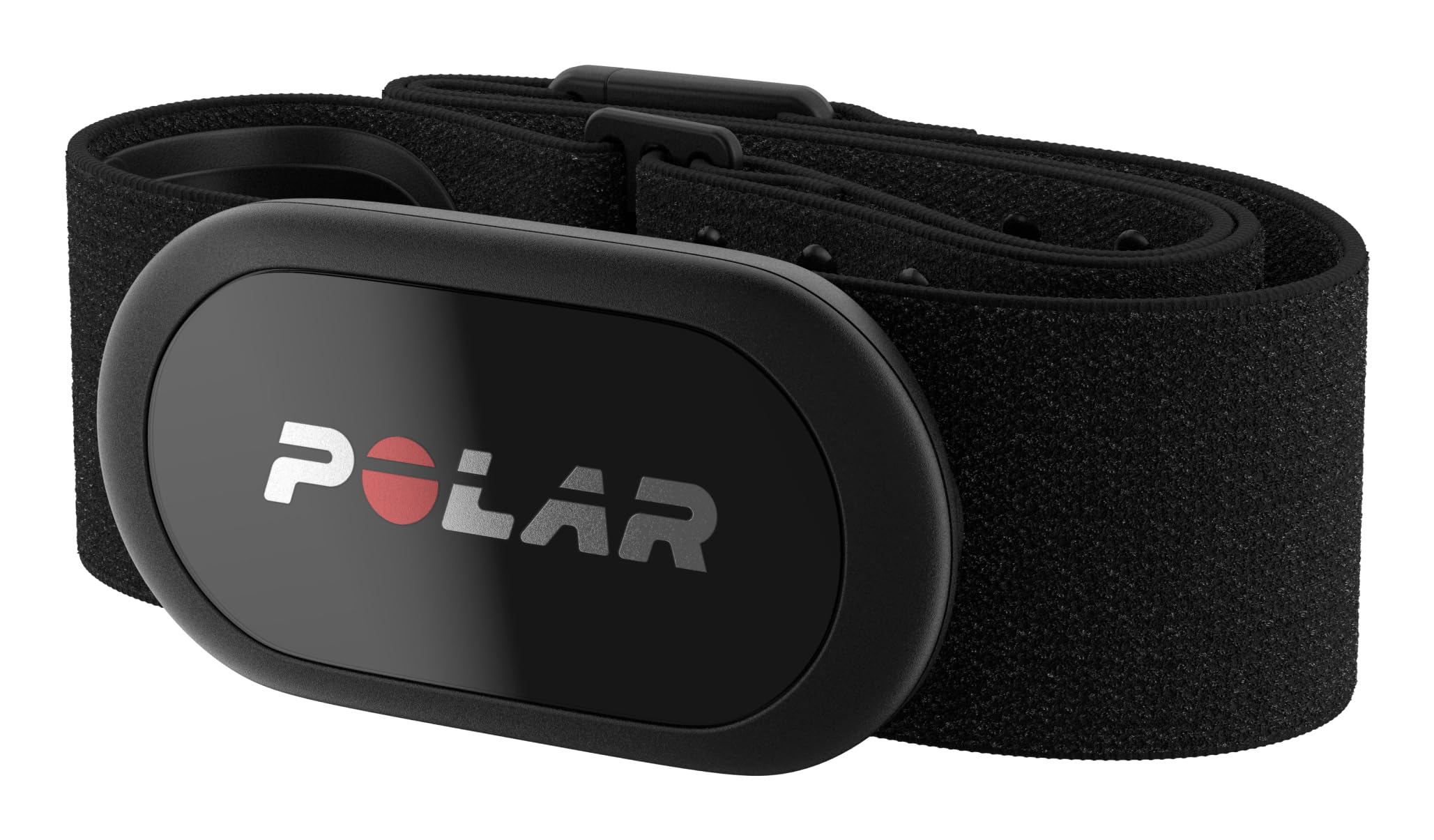
The clinical reference that every other chest strap is measured against.
Your heart rate data is only useful if it is trustworthy, and the Polar H10 is widely recognized as the most accurate heart rate sensor in Polar’s history. It delivers ECG-grade (electrocardiogram-grade — reading your heart’s electrical signal directly) readings — one reviewer noted it achieved 92.9% accuracy running, 99.3% on the bike, and 95.6% overall — because it reads your heart’s electrical signal directly rather than guessing from blood flow. That precision matters when you are doing intervals or strength work where a wrist-based monitor would lag behind.
Connectivity covers every base you might need: Bluetooth, ANT+, and 5 kHz, with the ability to run two Bluetooth connections simultaneously plus ANT+ at the same time. The included Polar Pro Chest Strap uses silicone dots and a secure buckle to stay put even during a sweaty session, and the sensor pod is waterproof to 30 meters. The CR2025 battery lasts about 400 hours, which means you replace it roughly once a year with consistent use. Unlike the Powr Labs strap that lasts an extreme 8760 hours, the H10 trades that lifespan for proven accuracy that athletes and labs rely on.
At a total weight of 60 grams (the pod alone is 12 grams), you barely notice it during a ride or run. Buyers consistently say it is more accurate than any wrist tracker for cycling intervals and weight training, and it pairs quickly with both a bike computer and a phone app. The main drawback — aside from the premium price — is that the included strap may be too small for a chest circumference over 42 inches, requiring an XXXL strap that Polar only sells directly. A few fans also mention that the battery cover uses a simple slot design that is easy to open but can pop loose if bumped.
What earns its reputation
- ECG accuracy that beats any optical wrist sensor in intervals and steady-state work
- Triple connectivity (Bluetooth + ANT+ + 5 kHz) with dual-Bluetooth capability
- Internal memory stores one full training session without a phone
- Replaceable CR2025 battery eliminates charging cables
What to watch for
- Strap may be too short for larger chests; XXXL only from Polar directly
- Battery life claimed at 400h, but some buyers report faster drain after a year
- Premium price significantly higher than most competitors
Reach for this when: you need lab-level accuracy for structured training or racing and you are willing to pay for it.
Look elsewhere if: you want a rechargeable strap or you have a larger chest that the standard strap might not fit.
2. Powr Labs Bluetooth and ANT+ Heart Rate Monitor Chest Strap

A strap you can wear daily and forget about for a year.
Powr Labs built this strap around a simple insight: the best sensor is the one that never runs out of power. With a battery average life of 8760 hours — that is a full year of continuous use — it leaves every other strap in the dust. The Magene H603, by comparison, runs 1000 hours, and the Polar H10 hits 400 hours. The soft, smooth fabric strap adjusts from 24 to 61 inches and is designed to be comfortable enough for all-day wear without chafing, which is a real benefit if you track heart rate variability (HRV — the variation in time between your heartbeats, a sign of recovery) or want continuous data outside your workouts.
Dual Bluetooth and ANT+ connectivity syncs with everything from a Garmin Fenix 7x and Peloton Bike to over 400 fitness apps, including Zwift, Strava, and Wahoo. The IPX67 rating means it is fully sweat-proof, rain-proof, and even swim-safe under a wetsuit. Owners mention that the battery lasts roughly a year with daily use — one buyer mentioned ~99.7% success over 1000 uses. Pairing is straightforward as long as you put the strap on before you try to connect it, which is a small detail that trips up some users.
Clinical ±1 BPM accuracy is the claim here, and the reviews generally support that during steady-state and moderate efforts. Unlike the COOSPO H9Z which uses a rechargeable battery that needs a cable every 12+ hours, the Powr Labs runs on a premium replaceable battery that ships already in the strap. The catch: a few customers note inconsistent pairing with Peloton specifically, and one review described an initial defective sensor that the company replaced quickly. This is the mid-range option that gives you Polar-like confidence on battery life.
Real-world endurance: You can wear this every day for about a year before opening the battery compartment, which is class-leading in this list.
One honest limit: Pairing can be finicky with certain equipment (especially Peloton) and may require you to delete the monitor from your phone’s Bluetooth list first.
Best for: anyone who wants to wear a strap daily — for HRV tracking, all-day monitoring, or just not thinking about charging.
Not ideal if: you need the absolute gold-standard accuracy of the Polar H10 for critical race data or you prefer a rechargeable battery.
3. Magene H603 Chest Strap Heart Rate Monitor

A budget-friendly strap with ANT+ and Bluetooth connectivity.
The Magene H603 uses a split chest strap design — the sensor pod detaches from the strap — which makes washing the fabric part easy and allows you to replace either component separately. It runs on a replaceable battery that lasts 1000 hours (about 2.5 years at 1 hour per day, 4 times per week, according to the maker’s lab test). That is a 8.8x gap (8760 divided by 1000) from the Powr Labs’ 8760-hour battery, but still long enough that most people will replace the battery only once or twice during the strap’s life.
Connectivity covers both ANT+ and Bluetooth with the ability to record to an ANT+ device and a Bluetooth app simultaneously — so you can capture data on your Garmin Edge 530 while also showing live HR on your phone via Strava. Reviewers point out that the H603 pairs quickly with bike computers, trainers, and phones without dropouts. One review highlighted accurate HR for MTB (mountain bike) rides and easy pairing with phone plus Strava, replacing a Fitbit that missed data and needed constant charging. A red LED on the sensor flashes when it is ready to use so you know it is working before you start moving.
The IP67 (dust-tight and waterproof in 1 meter of water for 30 minutes) rating means it handles sweat and rain without issue. Unlike the FITCENT strap which offers wireless charging, the H603 uses a standard coin cell, which some people prefer because there is no cable to lose. Four colorful shell options mean you can match the strap to your bike or kit, which is a nice touch at this price. The catch: one long-term buyer reported that after a few months the unit started transmitting incorrect heart rate data (double or triple the actual value), and getting warranty support required shipping the unit to China, which cost. That is a risk you accept at this budget tier that you do not take with the Polar H10 or Powr Labs.
Smart budget features
- Split strap design makes washing easy and extends strap life
- Dual ANT+ and Bluetooth recording with no dropouts
- 1000-hour battery — low-maintenance for months
- Red LED confirms connection and readiness
Reality check
- Warranty support requires shipping to China, potentially costing
- A small number of units fail after months and produce wildly inaccurate HR data
- No rechargeable battery option — you must replace the coin cell
Grab it for: the lowest-cost entry to dual ANT+ and Bluetooth HR monitoring with a long-lasting replaceable battery.
skip it if: you want a North America-based warranty or you prefer a rechargeable strap that does not need a coin cell.
4. COOSPO Heart Rate Monitor Chest Strap H9Z

A rechargeable strap that skips disposable batteries without skimping on accuracy.
The COOSPO H9Z replaces the coin cell with a built-in lithium-ion battery that gives you over 12 hours of use per charge. That means you plug it in roughly every two weeks of regular training, which is more convenient than hunting for a CR2025 at the drugstore but does add a charging habit. The sensor pod measures just 58.42 mm by 25.4 mm by 10.16 mm and weighs 90 grams with the nylon and ABS strap, so it sits flat and stays put compared to a bulkier unit like the FITCENT.
Bluetooth 5.0 and ANT+ provide smooth pairing with your phone, bike computer, or smartwatch. Shoppers say accurate HR data with no dropouts and that the breathable strap stays comfortable during long sessions. One reviewer switched from an Apple Watch optical sensor and said the H9Z is faster to respond and more accurate for calorie tracking. The connectivity is stable enough to pair simultaneously with a phone running Strava and a Garmin head unit, similar to what the Magene H603 offers but with the added convenience of USB charging.
Unlike the FITCENT H9Z’s wireless charging dock, the H9Z uses a direct charge cable included in the box. The IP67 rating protects against sweat and rain, though the manufacturer explicitly says not to use it for swimming. The main reliability concern: a handful of reviews report the unit failing to turn on after just three uses, and because there is no physical power button, you cannot force a reset. The auto on/off mechanism uses moisture detection, which works most of the time but can be temperamental if the sensor is not wet enough. That is a trade-off you do not get with a coin-cell strap that just always has power.
Why it stands out: Rechargeable battery means zero ongoing cost for coin cells, and Bluetooth 5.0 gives you a stable, modern connection that pairs quickly every time.
The honest trade-off: The auto on/off system is not perfectly reliable — if the sensor does not detect moisture right away, it may not start, and there is no manual power button to override it.
Ideal for: athletes who want a rechargeable strap with Bluetooth 5.0 stability and a compact pod that does not bulge under a jersey.
Consider the Polar or Powr Labs instead if: you train in a dry environment where the sensor may not activate, or you prefer the simplicity of a coin cell that always works.
5. FITCENT Rechargeable Heart Rate Monitor Chest Strap

A strap that charges without cables and talks to your treadmill in its own language.
The FITCENT strap stands apart because it includes 5.3 kHz connectivity alongside Bluetooth 5.0 and ANT+. That 5.3 kHz signal speaks directly to older gym treadmills and equipment that do not speak Bluetooth — a feature most straps in this price range skip entirely. It also uses a wireless charging dock: you drop the sensor pod onto the included pad and it gets a full charge in about 1.5 hours, supporting one hour of daily training for up to 30 days. That is roughly 30 hours of total use before you need to dock it again.
The IP68 rating (dust-tight and can be submerged in over 1 meter of water) is the highest water protection on this list — the sensor can be submerged up to 10 meters underwater, which means it survives even a heavy rain ride or a full sweat session without any worry. The strap is made from skin-friendly polyester and is adjustable, but buyers report that the buckle design is different from typical straps and can be fiddly to fasten at first. Reviewers who use it with DDP Yoga, Peloton, and Zwift report accurate readings and easy syncing once connected.
Compared to the COOSPO H9Z, which also uses a rechargeable battery, the FITCENT wins on water resistance (IP68 vs IP67) and charging convenience (wireless vs cable). But it loses on reliability reports: some owners mention the unit failed to pair with any device — including a Peloton Bike+ — and required a return. Others note that the 5.3 kHz signal is weaker than on premium straps like the Polar H10, so it works fine for Bluetooth but may drop the gym-link connection at longer distances. The strap uses a soft, comfortable fabric, and the company has a reputation for responsive customer service, quickly replacing lost chargers and defective units.
Unique strengths
- Wireless charging dock means no USB cable to lose or break
- 5.3 kHz connectivity works with older treadmills and gym equipment
- IP68 rating — submersion to 10 meters, best water protection here
- Comfortable skin-friendly strap with adjustable fit
Watch out for
- Some units fail to pair at all, requiring a return or replacement
- 5.3 kHz signal is weaker than on premium straps like Polar H10
- Strap buckle design takes getting used to and may not feel secure initially
Choose this for: gym users with older equipment that needs 5.3 kHz, and anyone who hates managing USB charging cables.
Skip if: you need rock-solid first-time pairing reliability — the Polar H10 or Powr Labs are safer bets for that.
6. SUUNTO Smart Heart Rate Belt

A natural partner for Suunto watch owners who want easy app integration.
If you already own a Suunto watch, this belt is the obvious companion — it pairs smoothly with the Suunto app and gives you precise heart rate data during sports where wrist-based measurements are unreliable, like strength training or paddling. The belt uses a mesh material and weighs very little at 0.98 by 0.59 by 4.72 inches, so it is comfortable enough for long training sessions. It runs on a rechargeable lithium-ion battery that lasts 500 hours, which splits the difference between a short-lived rechargeable and a long-life coin cell.
Connectivity is limited to Bluetooth — there is no ANT+ support, which is a real limitation if you use a Garmin or Wahoo bike computer that relies on ANT+ for stable connections. Buyers who use it with Suunto watches report flawless setup and high-quality build. One reviewer called it “my best ever chest band” and another noted “high quality and connection is flawless.” The belt is compatible with other Bluetooth-enabled devices and apps as well, but the smooth experience is clearly designed around the Suunto ecosystem.
The catch is accuracy — a worrying number of owners on Suunto forums report that the sensor is “horribly inaccurate,” not reading at first and then spiking too high during effort. One review specifically warned: “Get the Polar H10 — it pairs with the Suunto watches and is super accurate.” That feedback is hard to ignore. Unlike the Polar H10 which earns widespread trust across all users, the Suunto belt has a polarized reputation: dedicated Suunto fans love it, but others find it unreliable for serious training. The premium price also puts it above the Powr Labs and Magene options without offering clear accuracy or connectivity advantages — unless you specifically want the Suunto app integration.
Who it suits: Suunto watch owners who want a simple, first-party strap that pairs instantly with the Suunto app and needs no ANT+ support.
Honest caution: Multiple forum posts and reviews describe this strap as inaccurate for serious interval training — if reliable data is your priority, the Polar H10 is a safer choice even with a Suunto watch.
Grab it for: casual Suunto users who value easy app pairing and comfortable mesh fabric over absolute accuracy.
Look at the Polar H10 or Powr Labs instead if: you need ANT+ connectivity for a bike computer or you want accurate HR data during high-intensity work.
Understanding the Specs
Battery Type: Coin Cell vs Rechargeable
A replaceable coin cell (CR2025 or CR2032) like the one in the Polar H10 gives you roughly 400 hours of use before you swap it for a few dollars. A rechargeable battery, like the FITCENT or COOSPO H9Z uses, adds the convenience of not buying disposables but forces you to charge after roughly every 20–30 hours of use. Replaceable cells are simpler and never leave you hunting for a cable mid-workout, but they do create electronic waste over time.
ANT+ vs Bluetooth vs 5.3 kHz
Bluetooth connects to your phone and most modern gym equipment — every strap here supports it. ANT+ is the standard for bike computers (Garmin, Wahoo, Bryton) and is essential if you want to see HR on a handlebar-mounted screen. A few straps, like the FITCENT, also offer 5.3 kHz, which is an older analog signal that some treadmills still use. If you only train on a Peloton or run with your phone, Bluetooth alone is enough. If you ride with a bike computer, you need ANT+.
Water Resistance: IP67 vs IP68
IP67 means the sensor is fully protected against dust and can survive being submerged in up to 1 meter of water for 30 minutes — enough for sweat and rain. IP68 (found on the FITCENT) goes further: it can sit under 10 meters of water, making it safe for swimming under a wetsuit. The Polar H10 is rated to 30 meters, which is even more than IP68. If you only sweat, IP67 is plenty. If you swim laps with a strap, look for IP68 or a dedicated 30m rating.
Split Strap vs Integrated Design
A split strap design, like the Magene H603 uses, lets you detach the sensor pod from the fabric strap. That makes washing the strap easy and lets you replace just the strap without buying a whole new sensor — the strap is the part that wears out first. An integrated design (most others here) has the sensor permanently attached to the strap, so if the elastic goes, you replace the whole unit. Split straps are more cost-effective long term if you train daily in sweat-drenched conditions.
FAQ
Can I use a chest strap heart rate monitor without a watch or phone nearby?
Will a chest strap heart rate monitor work on a Peloton?
How do I clean a chest strap heart rate monitor without damaging the sensor?
Can I use a chest strap heart rate monitor for swimming?
Do I need to wet a chest strap heart rate monitor before wearing it?
How does a chest strap compare to an Apple Watch or other wrist-based heart rate monitor?
Can I connect two chest straps to one device or one strap to two devices?
What does a flashing red or green LED mean on a chest strap?
Can I replace just the strap or do I need to buy a whole new sensor?
Why does my chest strap heart rate monitor show erratic numbers sometimes?
Final Thoughts: The Verdict
Across the board, the chest strap heart rate monitor winner is the Polar H10 because it delivers the most trusted ECG (electrocardiogram) accuracy across running, cycling, and strength training, with triple connectivity that covers every device you might own. If you want a strap that you never have to think about charging for a full year and still get extremely reliable data, grab the Powr Labs. And for a budget-friendly entry that still gives you dual ANT+ and Bluetooth recording with a split strap design that is easy to wash, the standout is the Magene H603 at roughly half the Polar’s price.
How We Picked
We do not accept paid placement. Every pick is matched to a real buyer and a real use-case; we do not hands-on test units.
Sources & Methodology
Specifications: manufacturer listings and product documentation. Review insights: verified customer reviews, as of July 2026. Pricing: not shown on this page (it changes often); check the current price via the retailer link.
As an Amazon Associate, WellFizz earns from qualifying purchases. This does not affect which products we feature.
Related Guides

Mo Maruf
I created WellFizz to bridge the gap between vague wellness advice and actionable solutions. My mission is simple: to decode the research and give you practical tools you can actually use.
Beyond the data, I am a passionate traveler. I believe that stepping away from the screen to explore new environments is essential for mental clarity and physical vitality.