Our readers keep the lights on and my smoothie glass nicely filled. As an Amazon Associate, I earn from qualifying purchases.
Specs are compiled from manufacturer listings and verified buyer reviews and can change over time — please confirm the key details on the product page before buying.
The right caulk stops that process cold by sealing the joint so it stays flexible, not brittle. This guide compares four different concrete caulks by their real specs — cure time, elasticity, and volume — so you pick the one that matches your exact repair.
I’m Mohammad Maruf — the founder and writer behind WellFizz. This guide is built by comparing the manufacturers’ published specifications and the patterns across verified customer reviews, so you get each pick’s real strengths and trade-offs instead of marketing spin.
Whether you are patching a driveway, sealing a foundation, or fixing a chimney, the right concrete caulk lives or dies on how fast it cures and how much it flexes with the concrete underneath.
Quick Picks
- SIKA Sikaflex-1A Joint Sealant — Best Overall
- GE Sealants General Electric GE5020 Concrete — Fastest Cure
- DCP Donseal PU440 Polyurethane Concrete Sealant — Extreme-Temp Polyurethane
- Meuvcol Self Leveling Concrete Crack Filler — Budget-Friendly Volume
How To Choose The Best Concrete Caulk
Picking the right concrete caulk starts with two questions: how fast do you need it to cure, and how much does the joint move. A sidewalk slab expands and contracts with temperature — a rigid filler will crack right out. A chimney crack that just needs sealing can use a faster-setting product. Here is what to look at before you buy.
Cure Time vs. Work Time
Some caulks are tack-free in 3 hours and fully cured in under a day. Others take 24 to 48 hours to fully set, and some even require a full week. If you are sealing a driveway you need to park on tomorrow, a fast-cure product matters. If you are patching a basement crack and can leave it alone, a slower cure gives you more working time to tool the joint smooth.
Elasticity and Joint Movement
A good concrete caulk stretches with the concrete rather than tearing apart. Look for a published joint-movement rating — ±25% or ±35% means the caulk can compress and expand that much without losing its bond. For wide expansion joints in driveways or patios, higher elasticity prevents re-cracking.
Material Chemistry
Polyurethane caulks bond well to damp or green concrete and stay flexible in extreme temperatures. Silicone caulks cure fast and adhere to stone and mortar but may not be paintable. Rubber-based fillers self-level in gaps but can be messier to apply. Your substrate and whether you plan to paint over the repair will steer your choice.
Quick Comparison
| Model | Best For | Full Cure Time | Liquid Volume | Item Weight | Amazon |
|---|---|---|---|---|---|
| SIKA Sikaflex-1A | Fast-cure small joints & damp concrete | 1 Week | 10.1 fl oz | 16 oz | Amazon |
| GE Silicone II Concrete & Masonry | Ultra-fast cure for masonry & stone | 3 Hours | 9.8 fl oz | 10.1 oz | Amazon |
| DCP Donseal PU440 2 Pack | Extreme-temperature polyurethane bond | — | 10.1 fl oz each | — | Amazon |
| Meuvcol Self Leveling Crack Filler | Big driveway & slab cracks on a budget | 24-48 Hours | 17.6 fl oz | 17.6 oz | Amazon |
In‑Depth Reviews
1. SIKA Sikaflex-1A Joint Sealant
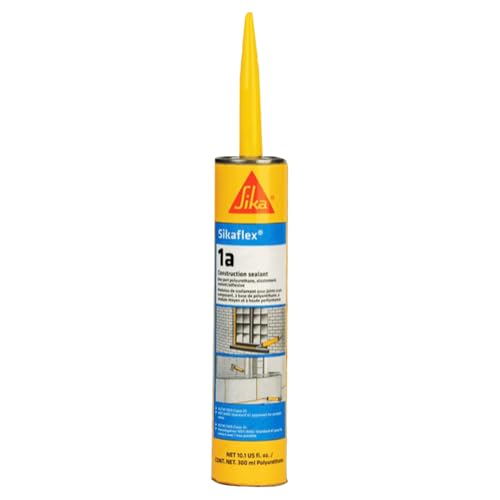
The pro-grade polyurethane that bonds to damp concrete and handles a week-long cure.
This is a premium polyurethane adhesive formulated for joints where the maximum depth is 1/2-inch or less — think window frames, door reglets, flashing, and narrow control joints in a slab. Its urethane base resists weathering and aging, and it maintains an elasticity that accommodates ±35% joint movement, meaning the caulk stretches and compresses with temperature swings without tearing.
The trade-off is the cure schedule: tack-free in 3 hours, but full cure takes a week. You cannot rush it. One reviewer noted, “Sealant takes about 24 to 48 hours to fully dry and cure” — meaning it is dry to the touch quickly but not load-bearing for days. The 10.1 fl oz cartridge pairs with a standard caulk gun, and it meets ASTM C920 and NSF/ANSI Standard 61 for potable water contact, so it is safe near drinking-water pipes.
Unlike the GE silicone that cures in 3 hours flat, the Sikaflex takes far longer — a full week vs. 3 hours — but it compensates with superior elasticity and damp-concrete adhesion that the silicone cannot match. It also weighs 16 ounces, a bit heftier than the GE’s 10.1 ounces, reflecting the denser polyurethane compound.
Smart buy for: Homeowners who want a bonded, flexible repair on small joints and are patient enough to let it cure a full week before exposing it to heavy use or weather.
Who it fits: DIYers sealing door frames, windows, or narrow slab joints where long-term flexibility matters more than a same-day finish.
One real limit: The 7-day full cure time means you cannot walk on or pressure-wash the area for a full week — plan your project around that window.
2. GE Sealants General Electric GE5020 Concrete and Masonry Silicone II
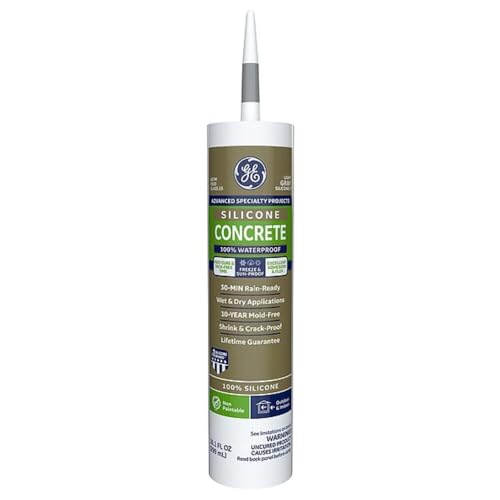
The silicone that cures in 3 hours — 8 times faster than the slowest polyurethane fillers.
If you need a repair you can use the same day, this is your caulk. Its full cure time is just 3 hours, a massive speed advantage over the 24-48 hours of the Meuvcol crack filler or the full week of the Sikaflex-1A. One buyer mentioned it “filled cracks in 30-year-old leaking chimney” — and that the repair held with no leaks for months. The light gray color is often described as matching existing mortar nearly perfectly, though one owner reported it dried more like a light beige or cream rather than the promised gray.
The GE is a silicone formula, which means excellent adhesion to stone and mortar but it is not paintable — buyers report tire marks turning it black on driveways. At 9.8 fluid ounces and a lightweight 10.1 ounces overall, it is the most compact tube in this lineup, but it also holds 80% less volume than the 17.6 fl oz Meuvcol crack filler, so plan accordingly for longer cracks. Its typical uses are sidewalks, driveways, patios, masonry steps, and above-ground foundations.
When you grab it: For small-area repairs on masonry or stone where you need to finish the job the same afternoon — chimney caps, tuckpointing gaps, or stair cracks.
Reach for this if: Speed is your top priority — you can apply and safely walk past the repair the same day thanks to that 3-hour full cure.
Look elsewhere if: You plan to paint over the caulk or you need a large volume of filler — the 9.8 fl oz tube runs out fast on long driveway cracks, and the silicone finish is not paint-friendly.
3. DCP Donseal PU440 Polyurethane Concrete Sealant 2 Pack
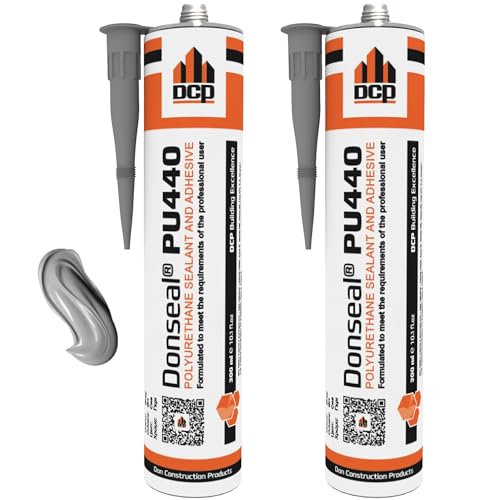
A two-pack polyurethane that handles -22°F to 175°F and accepts paint once cured.
This is the only polyurethane in the lineup that comes as a two-pack, giving you 20.2 total fluid ounces across two 10.1 fl oz cartridges. Its operating temperature range of -22°F to 175°F makes it a serious contender for driveways and sidewalks in climates with deep freezes and scorching summers — the moisture-cure process forms an elastic material that moves with the concrete. It also bonds to concrete, wood, gypsum, aluminum, steel, and ceramic, so it is the most substrate-versatile sealant here.
One buyer who “filled concrete driveway cracks well” called it good value with a fine look, but noted it “required muscle to extrude from tube” — a common gripe with thicker polyurethanes. Another reviewer said the tube itself was unusable and had to scrape the sealant into a separate applicator, though the sealant itself performed great on basement cracks. A real strength: once cured, PU440 accepts both latex and water-based paints, which the GE silicone cannot do. However, quality control is a risk — a buyer reported that 4 out of 5 tubes arrived dried up, so check the expiration date printed on the packaging before you start.
Unlike the Sikaflex-1A which cures over a week, the Donseal uses a moisture-cure process, though no specific full-cure time is published in the data. Compared to the GE silicone at 3 hours, this is clearly a longer-set product, but it wins on paintability and temperature range.
Best use: Outdoor expansion joints on driveways or sidewalks in extreme climates where you want the option to paint the repair to match the surrounding concrete.
Who should pick it: A homeowner sealing a large driveway or sidewalk joint who needs a paint-ready polyurethane that stays flexible from deep winter freezes up to hot summer pavement.
The main catch: Tube quality is inconsistent — buy close to the printed expiration date and inspect each cartridge before starting your project.
4. Meuvcol Self Leveling Concrete Crack Filler
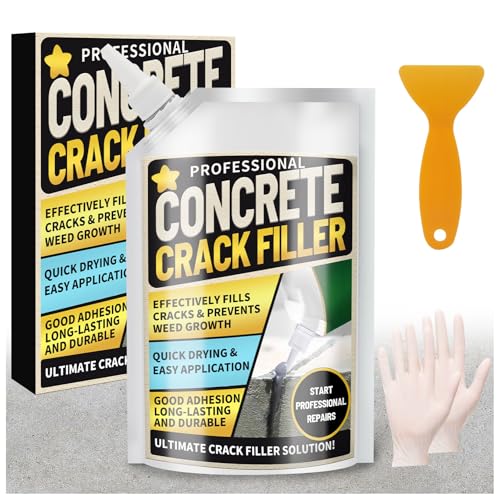
The biggest tube in the lineup — 17.6 ounces — with gloves and scrapers included.
It comes as a cream-form rubber compound that includes gloves and a plastic scraper in the package. One buyer “filled multiple wall-to-wall basement floor cracks” and reported enough product for three cracks with some leftover. Another described it as super easy to use, noting the pouch controls flow better than a tube and causes less hand strain, with no strong smell.
The full cure time is 24 to 48 hours — faster than the Sikaflex’s week but slower than the GE’s 3 hours. There is a catch in the reviews: several owners mention it is not truly self-leveling despite the name, and that it dries glossy rather than matte. One reviewer called it “too gooey, sticky, stringy, inconsistent” and abandoned it for a different product. Another used tape to get clean lines and advised removing it before the filler sets. The 17.6 fl oz pouch is a solid choice for budget-conscious repairs on bigger horizontal cracks, but be ready for a messier application than a standard caulk gun cartridge.
Compared to the Donseal PU440, the Meuvcol offers nearly the same volume in a single pouch versus two cartridges, and its rubber formula is less likely to require a strong hand to extrude. But it lacks the extreme temperature range (-22°F to 175°F on the Donseal) and the paintability of a polyurethane.
Ideal for: Filling wide, shallow cracks on garage floors, basements, or patios where a glossy finish is acceptable and you want a quick grab-and-go kit with tools included.
Stick with it for: A one-stop kit for multiple smaller cracks — the included gloves and scrapers save a hardware store run, and the high volume stretches further than any single cartridge here.
skip it if: You need a true self-leveling flow, you hate glossy finishes, or your crack is a long, deep channel — some reviewers found it too sticky to spread evenly over long gaps.
Understanding the Specs
Full Cure Time
This is how long you must wait before the caulk reaches its full strength and can handle foot traffic, water exposure, or heavy loads. A 3-hour cure (like the GE silicone) means you can use the area the same day. A 24-to-48-hour cure (like the Meuvcol filler) means you wait one to two days. A full-week cure (like the Sikaflex-1A) means you plan your project several days ahead — do not park on that driveway crack until the week is up.
Joint Movement Capacity
Concrete expands and contracts with temperature changes. The ±35% rating on the Sikaflex means the cured caulk can stretch or compress by 35% of the joint width without pulling away from the edges. For wide expansion joints — say a 1/2-inch gap between driveway slabs — higher movement capacity prevents the sealant from cracking or debonding during seasonal shifts. A caulk with no published movement rating is a gamble on outdoor joints.
FAQ
Can I apply concrete caulk to damp concrete?
How long does concrete caulk take to dry before I can walk on it?
What is the difference between silicone and polyurethane concrete caulk?
Can I paint over concrete caulk?
How much concrete caulk do I need for a driveway crack?
Will concrete caulk stop water from leaking through a basement wall crack?
Can I use concrete caulk in freezing weather?
Why does my concrete caulk look glossy after it dries?
Is concrete caulk the same as concrete crack filler?
How do I remove old concrete caulk before applying new sealant?
Final Thoughts: The Verdict
If you want one dependable pick, the concrete caulk winner is the SIKA Sikaflex-1A because its polyurethane bond works on damp concrete, handles ±35% joint movement, and meets potable-water safety standards — a reliable all-around performer even if you must wait a week for full cure. If you need a same-day fix on a chimney or stair crack, grab the GE Silicone II for its 3-hour cure time. And for a large driveway joint in an extreme climate with paintability, the DCP Donseal PU440 two-pack offers the best temperature range and post-cure painting flexibility.
How We Picked
We do not accept paid placement. Every pick is matched to a real buyer and a real use-case; we do not hands-on test units.
Sources & Methodology
Specifications: manufacturer listings and product documentation. Review insights: verified customer reviews, as of July 2026. Pricing: not shown on this page (it changes often); check the current price via the retailer link.
As an Amazon Associate, WellFizz earns from qualifying purchases. This does not affect which products we feature.
Related Guides

Mo Maruf
I created WellFizz to bridge the gap between vague wellness advice and actionable solutions. My mission is simple: to decode the research and give you practical tools you can actually use.
Beyond the data, I am a passionate traveler. I believe that stepping away from the screen to explore new environments is essential for mental clarity and physical vitality.