Our readers keep the lights on and my smoothie glass nicely filled. As an Amazon Associate, I earn from qualifying purchases.
Specs are compiled from manufacturer listings and verified buyer reviews and can change over time — please confirm the key details on the product page before buying.
You need to drive fasteners in cramped cabinets, between studs, or under a sink—and a full-size impact driver simply will not fit. The difference between a tool that saves you twenty minutes on every job and one that leaves you frustrated depends on head length, torque delivery, and how the motor handles a bind-up. This guide pinpoints the exact models worth your money and explains why a shorter barrel matters more than raw power for most real-world work.
I’m Mohammad Maruf — the founder and writer behind WellFizz. This guide is built by comparing the manufacturers’ published specifications and the patterns across verified customer reviews, so you get each pick’s real strengths and trade-offs instead of marketing spin.
Whether you are a finish carpenter fitting cabinets or a DIYer assembling a deck, choosing the best compact impact driver means matching tool length, torque, and battery system to your actual work envelope. compact impact driver models from Milwaukee, Makita, and Bosch all deliver serious torque in a tool head shorter than a dollar bill.
Quick Picks
- Milwaukee M12 Fuel 1/4 HEX Impact Driver Kit — Top Performer
- Makita XDT18ZB 18V LXT Sub-Compact Brushless — Best Value
- CRAFTSMAN V20 Brushless RP Compact Impact — Compact Champion
- Bosch PS42-02 12V Max EC Brushless Impact — Travel Favorite
How To Choose The Best Compact Impact Driver
The mistake most buyers make is chasing the highest torque number and ignoring the physical length of the tool. When you are working inside a cabinet box, between wall studs, or underneath a vehicle dash, a difference of one inch in tool head length determines whether the screwdriver bit reaches the fastener at all. Here are the three specs that actually define a compact impact driver worth buying.
Head length and maneuverability
A true compact impact driver keeps the tool head (the part from the nose to the back of the motor housing) under about 5.5 inches. The shorter that number, the more angles you can reach without binding the bit against a neighboring stud or panel. Tools like the Milwaukee M12 Fuel measure just 5 inches, while the CRAFTSMAN V20 squeezes in at 5.02 inches—both short enough to fit between standard 16-inch-center studs.
Torque and drive modes
Midsize compact impact drivers typically land between 975 and 1,500 in-lbs of torque. For driving 3-inch deck screws into softwood, even 975 in-lbs (the Bosch spec) is plenty. For ½-inch lag bolts or timber locks, you want something north of 1,300 in-lbs. Multi-mode drive control—like the 4-Mode Drive Control on the Milwaukee or the Assist Mode (A-mode) on the Makita—helps prevent cam-out by starting the fastener slowly, then applying full power once the screw bites.
Battery system and runtime
Compact drivers run on either 12V (Bosch, Milwaukee M12) or 18V/20V (Makita LXT, CRAFTSMAN V20) platforms. The 12V models are lighter and smaller but trade off top-end torque for everyday comfort. The 18V/20V models carry a bit more weight in the battery but can drive more fasteners per charge—the CRAFTSMAN V20 claims up to 294 3-inch deck screws per 2.0Ah battery, which covers most of a weekend deck project.
Quick Comparison
| Model | Best For | Head Length | Max Torque | Tool Weight | Amazon |
|---|---|---|---|---|---|
| Milwaukee M12 Fuel | Heavy-duty tight-space driving | 5 in | 1,500 in-lbs | 2.0 lbs est. | Amazon |
| Makita XDT18ZB | All-day production assembly | 5.25 in | 1,460 in-lbs (est.) | 2.16 lbs | Amazon |
| CRAFTSMAN V20 | Budget-friendly home renovation | 5.02 in | — | — | Amazon |
| Bosch PS42-02 | Travel and everyday carry | 5.5 in | 975 in-lbs | 2.2 lbs | Amazon |
In-Depth Reviews
1. Milwaukee M12 Fuel 1/4 HEX Impact Driver Kit
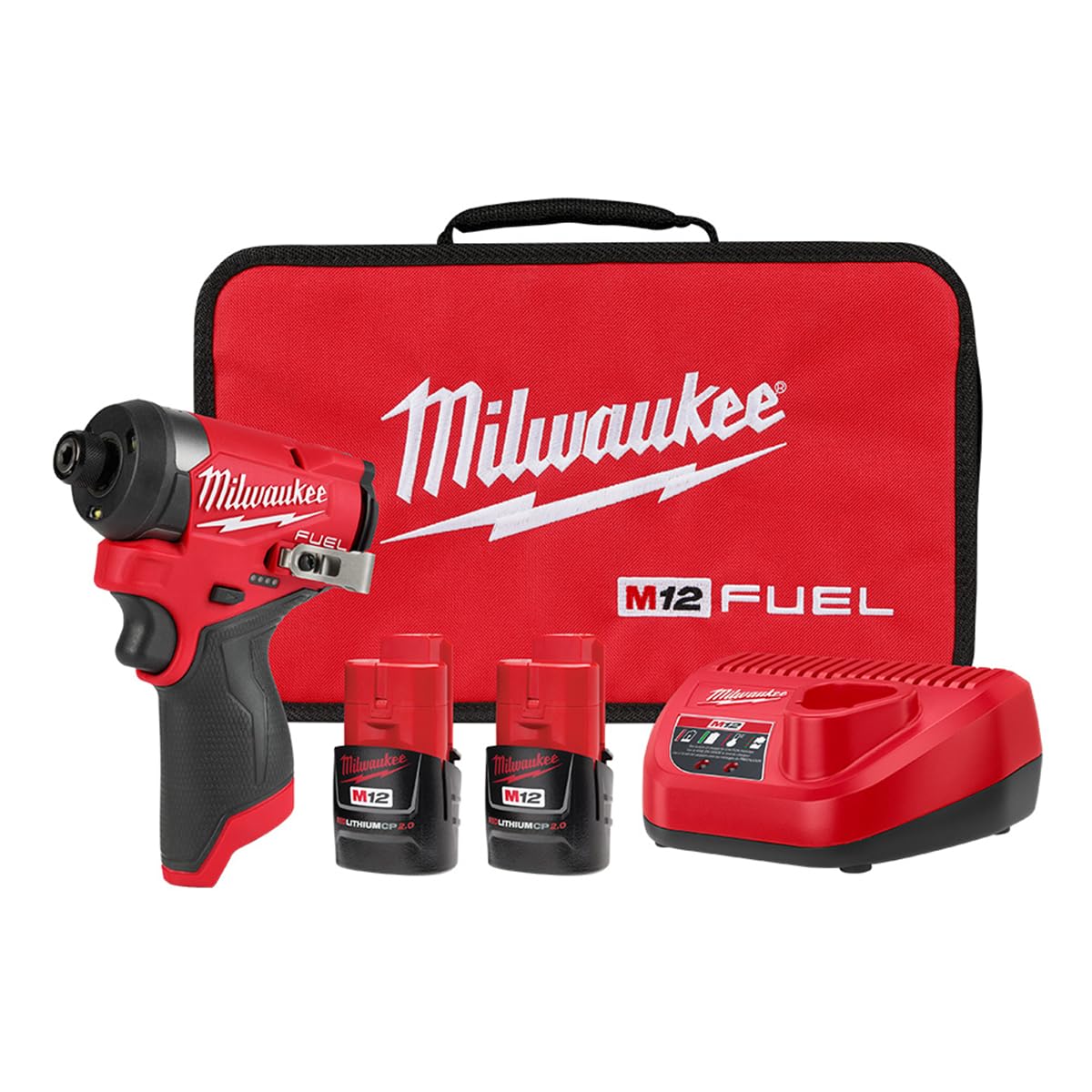
It drives timber-lock bolts without struggling, yet its head is shorter than the Bosch PS42-02.
This is the one you reach for when “compact” cannot mean “compromise.” The Milwaukee M12 Fuel delivers up to 1,500 in-lbs of torque—more than many full-size 18V models—in a tool head that measures just 5 inches long. That short nose makes it the tightest-fit option among the picks here, and buyers report it drove large lag screws into old studs on one charge without needing a battery change. The Tri-LED arrangement lights up the workspace so you can see exactly where the bit is going, and the 4-Mode Drive Control includes a dedicated self-tapping screw mode that lets you dial in the power curve for sheet-metal work.
It comes as a kit with two M12 batteries, a charger, and a tool case, which is convenient if you are starting fresh on the M12 platform. The metal drilling capacity lists at 0.25 inches, so it is not built for heavy-hole-making—it is a fastener driver through and through. Unlike the Makita below (which is tool-only), this kit gives you everything to start working immediately.
Torque-to-size ratio: At 1,500 in-lbs and a 5-inch head, the M12 Fuel beats every other compact here on raw twisting force while staying shorter than the Bosch by half an inch.
The honest limit: It is heavier on the scale than a pure 12V unit, and the kit price sits at a premium level; if you only drive 3-inch deck screws into softwood, the Bosch below will do the same job for less money.
Grab it if: You need to drive large lag bolts, timber locks, or structural screws in spaces where a 6-inch head will not fit.
skip it if: Your work is almost entirely light-duty cabinet assembly and you want the lightest possible carry.
2. Makita XDT18ZB 18V LXT Sub-Compact Brushless Impact Driver

At 2.16 pounds, it is one of the lightest 18V impact drivers you can buy, and its Assist Mode stops cam-out cold.
At only 2.16 pounds (battery not included) and with a 5.25-inch head, the Makita XDT18ZB is one of the lightest 18V impact drivers on the market. That matters when you are driving fasteners overhead or holding the tool in one position for a full workday. The variable-speed trigger gives you 0-3,000 RPM and 0-4,100 impacts per minute (IPM), but the standout feature here is Assist Mode (A-mode). It starts the fastener at low speed until the screw bites into the material, then ramps to full power—a concrete help in preventing the bit from slipping out of the screw head (cam-out) or cross-threading. Owners mention it is “compact, lightweight, reasonably priced” and one reviewer uses it daily on a production line for a couple of hours of assembly work.
This is a tool-only purchase (no battery or charger included), so you either already own Makita 18V LXT batteries or you need to factor those into the total cost. It does also come with a bright front light for dark workspaces and the trigger modulation is precise enough for delicate work like installing cabinet hinges. Compared to the Milwaukee above, the Makita lands on the lighter end of torque while still being “surprisingly powerful”—one owner reports removing 120 ft-lb wheel bolts with it occasionally, though it is loud doing so.
What works
- Assist Mode eliminates screw cam-out on initial contact
- Narrow, longer motor housing reaches into tight gaps
- Lightest sub-compact in the 18V class at 2.16 lbs
What holds it back
- Tool-only—no battery, no charger in the box
- Less powerful than Makita’s own top-tier 18V model
Best for: Production-line assembly, cabinet installers, and anyone who already owns Makita 18V batteries and wants the lightest daily driver in the class.
Look elsewhere if: You need a brand-new battery system included in the box—the kit price of the CRAFTSMAN or the Bosch may suit you better.
3. CRAFTSMAN V20 Brushless RP Compact Impact Driver Kit (CMCF811D1)
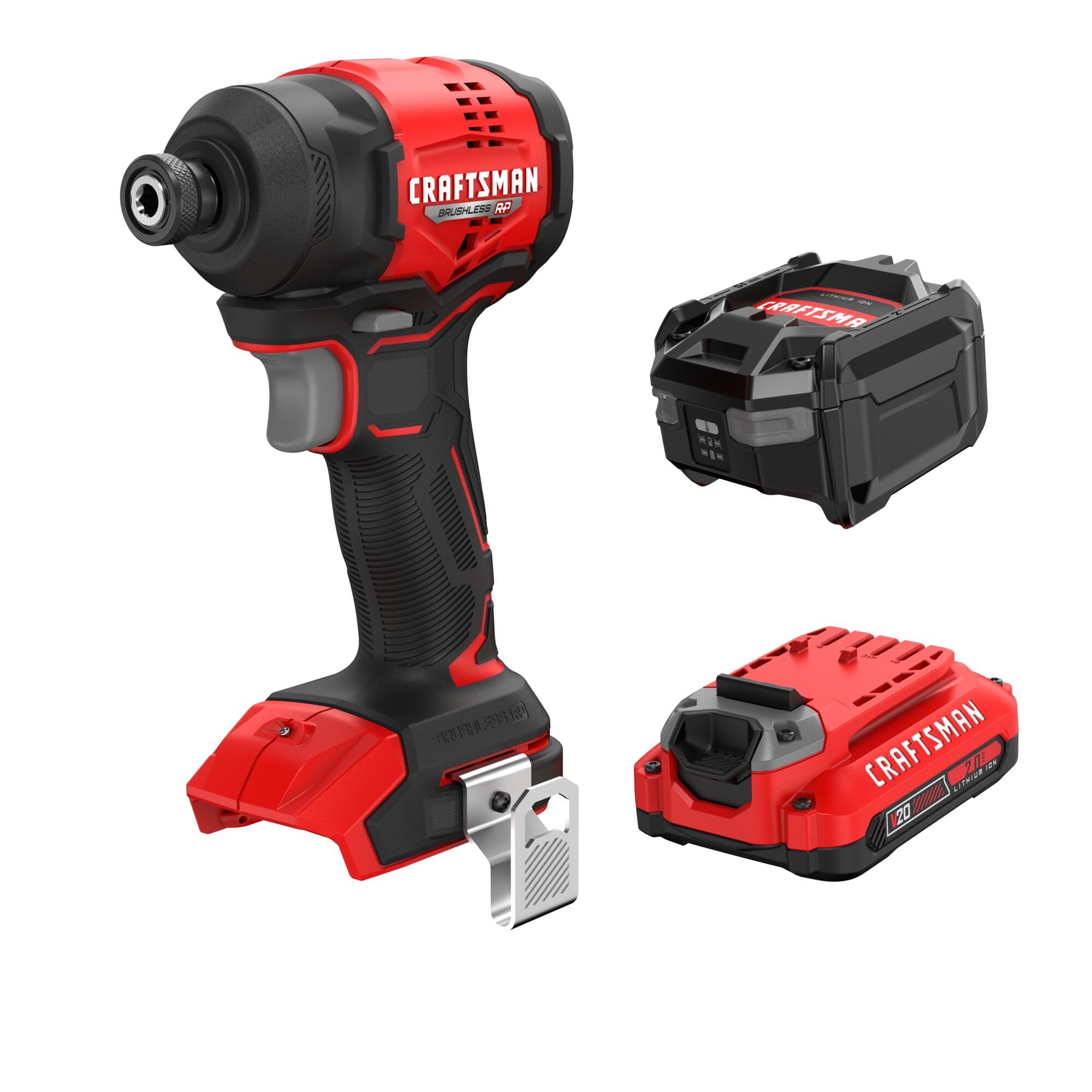
Its 5.02-inch head is the shortest in this group, even beating the Milwaukee M12 Fuel by a hair.
The CRAFTSMAN V20 RP Compact Impact Driver surprised us by having the shortest head of any tool in this group at just 5.02 inches—even shorter than the Milwaukee M12 Fuel by a hair. That is impressive for an 18V-class driver. The brushless motor delivers efficient driving and extended runtime per charge. CRAFTSMAN rates it for 294 3-inch deck screws per charge on the included 2.0Ah battery, which is enough to fasten most of a small deck in one go. Customers note that one owner “replaced my dewalt 20v impact” with this unit and it “hasn’t skipped a beat,” which speaks to its reliability for everyday tasks.
It comes as a full kit with a charger and one 2.0Ah battery, plus an onboard LED to light up the work area. The tool is VERSATRACK compatible, so you can clip it onto a wall organizer (the clips are sold separately). The rubberized grip surface helps you hold on, and the aluminum and plastic construction keeps the weight manageable.
Value angle: You get a full kit (tool, battery, charger) at an entry-level price point, with a head length that beats every other pick here—ideal for the homeowner who needs to drive hundreds of screws in tight stud bays.
The trade-off: Torque is lower than both the Milwaukee and the Makita; you will struggle with ½-inch lags or dense hardwood without a pilot hole.
Reach for this if: You are a weekend warrior building a deck, assembling furniture, or renovating rooms on a budget and want the shortest tool head available.
Pass if: You need professional-level torque for large-diameter fasteners every day—step up to the Milwaukee.
4. Bosch PS42-02 12V Max EC Brushless Impact Driver Kit
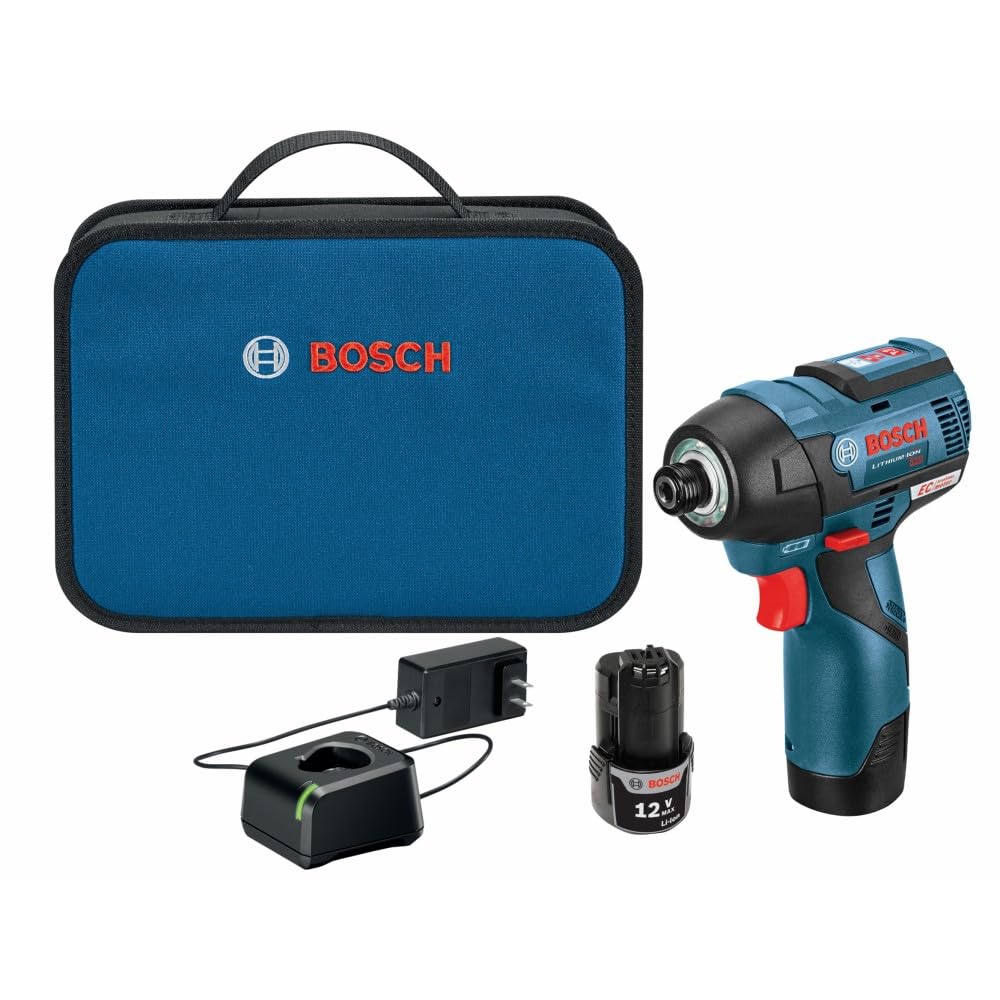
At just 2.2 pounds, it is the lightest kit here, and its 975 in-lbs handle 85% of everyday fastening jobs.
At just 2.2 pounds and with a head length of 5.5 inches, the Bosch PS42-02 is the lightest kit in this roundup. Bosch’s EC brushless motor delivers 975 in-lbs of max torque, and the tool completes 85 percent of most fastening applications—a realistic admission that does the math for you. Two speed settings (0-1,200 and 0-2,600 RPM) give you low-speed precision for cabinet screws and a higher gear for decking. A reviewer noted it “drives 3″ screws into 2×6 lumber easily,” and another said it survived multiple drops from a 12-foot ladder without breaking. The three-LED light ring provides shadow-free illumination in dark corners. The kit includes a tool bag and a rugged belt clip for storage.
Where the Bosch falls short is at the very top end of torque. At 975 in-lbs, it cannot drive ½-inch lag bolts even with a pilot hole—a limitation the Milwaukee M12 Fuel (1,500 in-lbs) handles without hesitation. So this is a tool for everyday cabinet work, furniture assembly, and light framing, not for structural timber construction. The Bosch 12V platform also means you cannot swap batteries with a 18V lineup if you own other heavy-duty tools. But for pure compactness and carry-friendly design, especially if you travel to job sites, this is the smallest efficient package in the list.
Strong points
- Lighter and more compact than the Milwaukee M12 Fuel, according to a professional reviewer
- Brushless motor with two speed settings for precision control
- Belt clip and padded tool bag included for job-site portability
Weak points
- At 975 in-lbs versus the Milwaukee’s 1,500 in-lbs, it cannot drive ½” lags
- 12V battery platform limits tool compatibility with 18V systems
Take this if: You need a go-anywhere driver for quick jobs—installing blinds, building shelves, assembling furniture—and want the lightest possible kit with a bag.
pass on it if: You regularly drive large lag bolts or timber screws into dense wood; the extra cost of the Milwaukee M12 Fuel will save you hours of struggle.
Understanding the Specs
Torque (in-lbs)
Torque is the twisting force the tool applies to the fastener. Measured in inch-pounds (in-lbs), it tells you how hard the impact mechanism can crank a screw before it stalls. For 3-inch deck screws into softwood, 975 in-lbs is plenty. For ½-inch structural lag bolts into hardwood studs, you want at least 1,300 in-lbs. Higher torque also means more battery drain, so the most powerful driver is not always the right choice for light, all-day work.
Head Length (inches)
This is the distance from the nose of the collet to the back of the tool body. A shorter head lets you fit the driver between standard wall studs (16 inches on center), inside cabinets, or between joists. Every half-inch you shave off the head length opens up another 10-15% of fastener positions you can actually reach without switching to a right-angle attachment. Look for tools with a head length under 5.5 inches if tight-space work is your primary need.
Brushless Motor
A brushless motor replaces the carbon brushes and commutator of a traditional motor with an electronic controller. That means less friction, less heat, and more of the battery’s energy going toward turning the bit rather than generating wasted heat. Brushless motors typically deliver 30-50% more runtime per charge than brushed motors of the same class, and they rarely need maintenance over the life of the tool.
Impacts Per Minute (IPM)
IPM measures how many times the internal hammer-and-anvil mechanism strikes the fastener in one minute. Higher IPM numbers mean faster driving in harder materials because the tool delivers more frequent impact events to overcome resistance. Variable-speed triggers that let you adjust both RPM and IPM give you control: low IPM for delicate work like installing cabinet hinges without snapping the screw head, high IPM for sinking long screws into dense framing lumber.
FAQ
What is the difference between a compact impact driver and a full-size impact driver?
Can a compact impact driver drive 3-inch deck screws?
Is 975 in-lbs of torque enough for most jobs?
Should I buy a 12V or an 18V compact impact driver?
What does “Assist Mode” or “A-Mode” do on a Makita impact driver?
Can I use a compact impact driver to remove lug nuts or wheel bolts?
Why would I need 4-Mode Drive Control on an impact driver?
How long do compact impact driver batteries last on a single charge?
Is a brushless impact driver worth the extra cost over a brushed model?
Final Thoughts: The Verdict
For the majority of shoppers, the best compact impact driver is the Milwaukee M12 Fuel because it packs 1,500 in-lbs of torque into a 5-inch head—the best torque-to-size ratio in this group—with 4-Mode Drive Control that adapts to any fastener type. If you want the lightest sub-compact for all-day assembly work and already own 18V batteries, grab the Makita XDT18ZB with its Assist Mode that prevents cam-out. And for the shortest tool head at a budget-friendly price with a full kit included, the standout is the CRAFTSMAN V20, which squeezes into the tightest spots at just 5.02 inches of head length.
How We Picked
We do not accept paid placement. Every pick is matched to a real buyer and a real use-case; we do not hands-on test units.
Sources & Methodology
Specifications: manufacturer listings and product documentation. Review insights: verified customer reviews, as of July 2026. Pricing: not shown on this page (it changes often); check the current price via the retailer link.
As an Amazon Associate, WellFizz earns from qualifying purchases. This does not affect which products we feature.
Related Guides

Mo Maruf
I created WellFizz to bridge the gap between vague wellness advice and actionable solutions. My mission is simple: to decode the research and give you practical tools you can actually use.
Beyond the data, I am a passionate traveler. I believe that stepping away from the screen to explore new environments is essential for mental clarity and physical vitality.