Our readers keep the lights on and my smoothie glass nicely filled. As an Amazon Associate, I earn from qualifying purchases.
Specs are compiled from manufacturer listings and verified buyer reviews and can change over time — please confirm the key details on the product page before buying.
You manage a commercial lot, a big apartment complex, or a snow-removal route. The difference between a spreader that works every time and one that fails mid-storm is measured in overtime hours and frustrated tenants. This guide compares four capable commercial walk-behind salt spreaders by their real-world build quality, hopper capacity, and durability, so you know exactly where your money goes.
I’m Mohammad Maruf — the founder and writer behind WellFizz. This guide is built by comparing the manufacturers’ published specifications and the patterns across verified customer reviews, so you get each pick’s real strengths and trade-offs instead of marketing spin.
Getting a commercial walk behind salt spreader that handles daily grinding — and does not leave you stranded — matters more than any brochure promise.
Quick Picks
- Chapin USA 82400B — Top Performer
- Chapin 88800B SaltPro — Premium Pick
- Buyers Products 3039632R Grounds Keeper — Best Value
- Global Industrial 640788 — Budget Champion
How To Choose The Best Commercial Walk Behind Salt Spreader
Not every spreader sold as “commercial” survives a full winter of daily use. You need to look past the paint job and focus on the moving parts that do the work.
Look for an Enclosed, Grease-Fitted Gearbox
Salt and moisture destroy open gears. An enclosed gearbox (a sealed case that protects the metal gears) with a grease fitting (a small nozzle where you pump in grease) keeps metal gears spinning smoothly by pushing corrosive salt and snow away — a feature that separates spreaders that last from those that lock up mid-season. A spiked auger (a rotating rod with spikes) that breaks up clumps also helps prevent jamming at the gate opening (the slot where salt exits), which is a common failure point with wet bulk salt.
Check the Frame and Handle Sturdiness
A carbon steel frame with a powder coating (a baked-on protective paint layer) resists rust better than bare metal. But the handle is where many commercial spreaders fail — if the handlebars are thin or the linkage (the connecting rods) is all plastic, you will lose control when pushing a full hopper over a curb. A rigid, welded frame with a solid T-handle gives you the leverage to navigate uneven icy ground without the spreader tipping forward.
Match the Tire Size to Your Terrain
12-inch pneumatic tires (air-filled tires) handle most lots, but 14-inch tires offer better flotation on deep snow and soft gravel. Larger tires also give you more stability when the hopper is full, reducing the chance of the spreader tipping over on an angled parking lot. Always get pneumatic tires for commercial use — solid tires do not provide enough grip on ice.
Quick Comparison
| Model | Best For | Hopper Capacity | Tire Size | Item Weight | Amazon |
|---|---|---|---|---|---|
| Chapin USA 82400B | Heavy commercial use | 100 lbs | 14 inch | 40.1 lbs | Amazon |
| Chapin 88800B SaltPro | Contractor-grade durability | 100 lbs | 12 inch | 38.7 lbs | Amazon |
| Buyers Products 3039632R | Multi-season value | 100 lbs | — | — | Amazon |
| Global Industrial 640788 | Budget-conscious buyers | 100 lbs (1.5 Cu. Ft.) | 13 inch | 38 lbs | Amazon |
In‑Depth Reviews
1. Chapin USA 82400B

The 14-inch tires stop it from tipping on deep snow — a full two inches bigger than the Chapin 88800B’s tires for better stability.
This is the spreader commercial snow teams reach for when light-duty units break. It uses a 14-inch pneumatic tire (air-filled tire) — two inches larger than the Chapin 88800B’s 12-inch tires — giving you more stable footing on deep snow and uneven lots. The huge gate opening (the slot where salt exits) lets wet bulk salt fall through without clumping, a problem that buyers report plagues every other spreader they have used. One reviewer who salts for FedEx noted that this spreader “puts out way more” salt than anything else, easily reaching under a semi-trailer on each side at maximum output.
The downside is weight and balance. At 40.1 pounds, this is noticeably heavier than the Global Industrial model by over 2 pounds. Some commercial users say the handlebars twist when you try to go over a curb even half-loaded, and the spreader can tip forward if you push hard. The hopper holds a full 100 pounds, and the stainless steel frame resists rust, but the included T-handle feels flimsy to some operators running 18 locations in one night. It is made in the USA with global materials and backed by Chapin’s limited lifetime warranty.
Built for Real Salt
- 100-pound poly hopper (plastic container) with large gate opening handles wet bulk salt without clogging.
- 14-inch wide-tread pneumatic tires roll smoothly over icy, uneven ground.
- Stainless steel frame and enclosed gearbox with grease fitting for weather protection.
- Backed by Chapin’s limited lifetime warranty and US-based customer service.
Heavy to Handle
- At 40.1 pounds, it is heavy to lift in and out of a truck repeatedly.
- Handle bars can twist and spreader may tip forward when going over curbs half-loaded.
- Some units arrived missing the gearbox assembly, requiring a call to customer service.
Reach for this if: you manage commercial lots and routinely spread wet bulk salt — the large opening solves the clogging issue that stops smaller spreaders cold.
Look elsewhere if: you need a spreader you can toss in and out of a truck quickly without help from a second person.
2. Chapin 88800B SaltPro
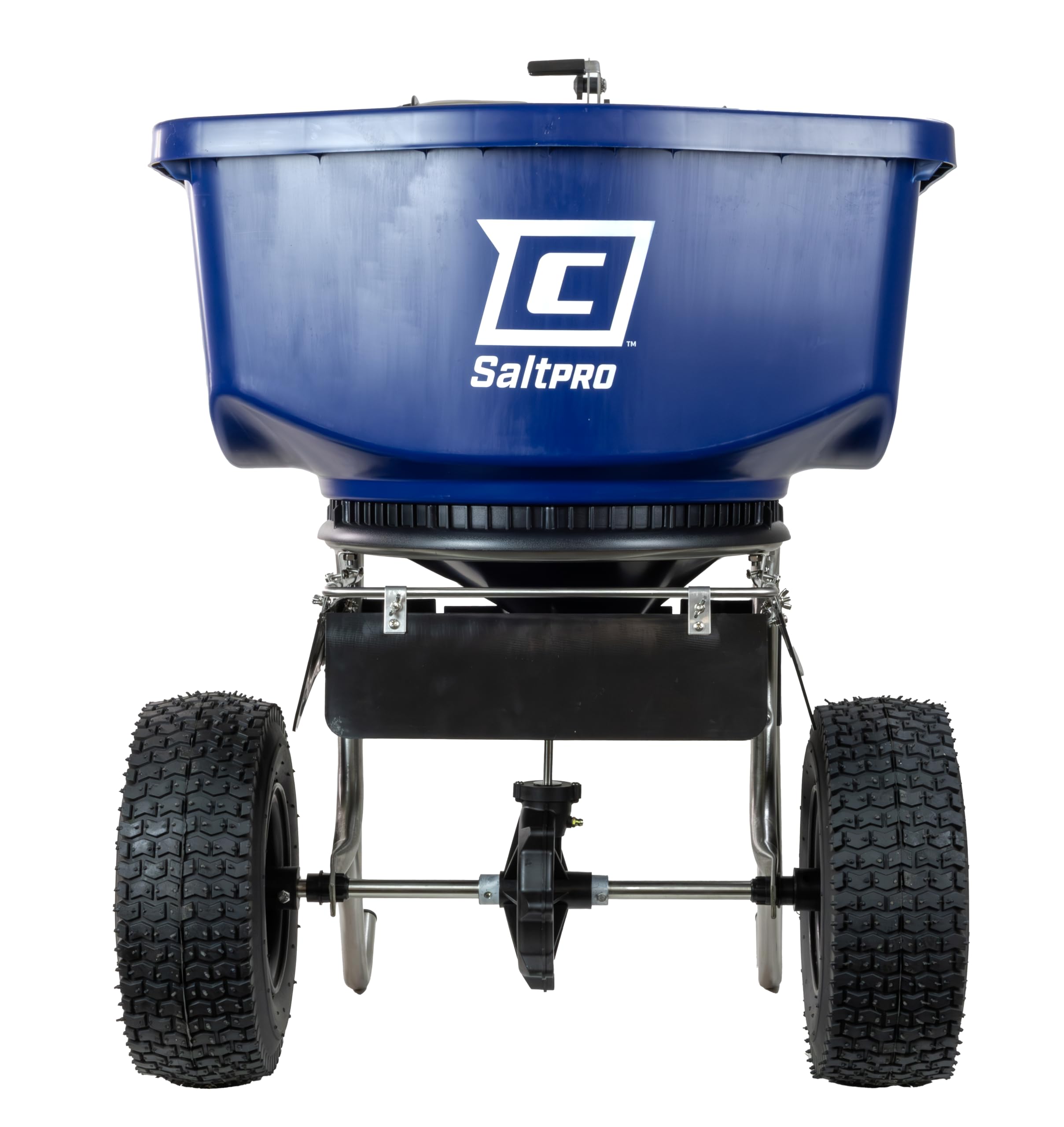
The spiked auger (a rotating rod with spikes) crushes clumps before they jam the gate — a feature the Buyers Products 3039632R lacks entirely.
Built with stainless steel tube construction and a rugged spiked auger that breaks up salt clumps before they reach the gate, this spreader is designed for contractors who are tired of jams. The 12-inch wide tread pneumatic tires (air-filled tires) provide traction over snow and ice, and the enclosed gear system (sealed gear case) with a grease fitting (a small nozzle for injecting grease) keeps weather out of the moving parts. The adjustable front and side baffles (movable panels that direct salt flow) let you dial in your spread pattern — so you can keep salt off garden beds or piles of shoveled snow. It is recommended for rock salt, ice melt, halite (a natural crystalline salt), potassium chloride, magnesium chloride, and calcium chloride.
That said, the gearbox (the metal case containing the gears) has a known vulnerability. One reviewer noted that the gearbox fails to spin when the hopper is full, especially with more than half an inch of snow on the ground and a full load — the wheel slides and the gearbox stops turning. Another owner warned that the auger lock nut (a fastener that holds the auger in place) unthreads when reversing with salt in the hopper, causing the auger to fall off. Buyers recommend replacing the lock nut with one from a hardware store and using thread locker (a glue-like compound that prevents loosening). This spreader is backed by Chapin’s 2-year limited warranty.
Why It Stands Out
- Stainless steel construction resists corrosion from rock salt and ice melt.
- Spiked auger breaks up clumps so material flows smoothly through the gate.
- Adjustable front and side baffles give you precise control over the 24-foot spread pattern (how far the salt is thrown).
- Enclosed gear system with grease fitting keeps weather and salt away from gears.
Watch Out For
- Gearbox can stop spinning when hopper is full and ground has more than half an inch of snow.
- Auger lock nut unthreads when reversing; needs replacement with a thread-locked nut.
- At 38.7 pounds, it is still heavy for frequent loading and unloading.
The Auger Advantage: if your salt tends to clump from moisture or sitting in bulk bins, the spiked auger on this model will save you from constantly poking the hopper with a stick.
The Gearbox Caveat: In heavy wet snow with a full hopper, the gearbox may stall — consider this spreader if you mostly spread on dry pavement or in lighter snow conditions.
3. Buyers Products 3039632R Grounds Keeper

One buyer reports putting 200 pounds of grass seed and three bags of fertilizer through it without a single issue — that is a multi-season track record.
This spreader covers all four seasons — you can run salt and ice melt through the 100-pound poly hopper (plastic container) in winter, then switch to grass seed and fertilizer the rest of the year. It features an enclosed gearbox with alloy gears powered by axle motion, and a fully welded carbon steel frame with powder coating to fight rust. The adjustable deflectors (movable panels that control where material lands) give you a spread coverage of up to 24 feet, and the included hopper screen (a mesh filter) and nylon rain cover keep materials protected. One buyer mentioned putting down “200 pounds of grass seed and three bags of fertilizer” without a single issue.
The downsides show up in the control system and packaging. Multiple reviews mention that the adjustment lever (the handle that controls how fast material feeds out) has too many linkages and is difficult to dial in accurately. The plastic thumb nut (a small tightening knob) broke on one unit the moment the feed setting was locked down. Another buyer found the handle stem had pierced the side of the box during shipping due to poor internal packaging. The rod that adjusts the hopper feed arrived rusted for some owners. It is a versatile spreader, but the plastic parts and linkage complexity can frustrate users who need quick, precise adjustments.
Versatile Value
- 100-pound hopper works with salt, fertilizer, and grass seed across all seasons.
- Fully welded carbon steel frame with powder coating resists corrosion.
- Enclosed gearbox with alloy gears and axle motion drive is durable.
- Spread coverage up to 24 feet with adjustable deflectors.
Frustrating Controls
- Adjustment lever has too many linkages — hard to get a consistent spread rate.
- Plastic thumb nut on the feed lock broke under normal tightening pressure.
- Packaging during shipping can be poor, leading to damaged hoppers or bent handles.
Best for multi-purpose use: If you want one spreader to salt in winter and seed/fertilize the rest of the year without switching machines, this is the most cost-effective pick.
skip it if: you need a precise, immediately intuitive spread-rate adjustment or you plan to run it every single winter day without inspecting the linkages.
4. Global Industrial 640788

Its 13-inch tires are an inch bigger than the Chapin 88800B’s tires, but the hairpin clip (a small retaining pin) is the weak link that fails.
If you only need a spreader for a few light storms each season or have a small lot, this Global Industrial model hits a lower price point while still carrying a 100-pound capacity. It has 13-inch diameter pneumatic tires (air-filled tires) — larger than the Chapin 88800B’s 12-inch tires — and a metal wire screen inside the hopper designed to prevent jamming. The durable plastic hopper cover keeps rain and snow out, and the flow regulator gives you basic control over how much material comes out.
The catch is durability. One owner reported that “the hairpin clip at the bottom of the hopper that agitates the salt sheared off on the third use.” That is a major failure because the agitator (a moving part that shakes salt toward the disc) is what keeps salt moving toward the spreader disc — without it, you get uneven coverage at best. Another buyer found parts missing from the box on arrival. While some owners say it spreads rock salt as expected, others note that the spread pattern (where the salt lands) is less even compared to a standard Scott’s spreader. At 38 pounds, it is the lightest of the group by several ounces, but that lightness may come at the cost of frame rigidity.
Budget Entry
- 100-pound / 1.5 cubic foot capacity handles a decent load of salt or fertilizer.
- 13-inch pneumatic tires provide smoother rolling than smaller-wheeled spreaders.
- Metal wire screen inside the hopper helps prevent jamming from salt lumps.
Reliability Worries
- Hairpin clip that agitates the salt can shear off in as few as three uses.
- Some units arrived with missing assembly parts.
- Spread pattern is less even than residential-grade Scott’s spreaders according to owners.
Consider it if: your budget is tight and you only need a spreader for a handful of salting sessions each season, not daily commercial use.
Steer clear if: you need a machine that will survive a full month of daily winter commercial routes — the agitator clip failure is a known weak point.
Understanding the Specs
Enclosed Gearbox
An enclosed gearbox (a sealed case that protects metal gears) keeps salt, snow, and moisture out. A grease fitting (a small nozzle) lets you pump in fresh grease so gears keep running smoothly. Without an enclosed gearbox, water and salt get inside and corrode the metal parts, causing the spreader to stop spinning — usually in the worst part of a storm.
Spiked Auger
A spiked auger is a rotating rod with spikes that sits in the bottom of the hopper. It breaks up clumps of rock salt or ice melt so they can flow through the gate opening (the slot where salt exits) without jamming. Wet salt and bulk salt in particular tend to form hard lumps — the auger crushes those lumps before they get stuck, saving you from stopping to poke the hopper by hand.
Pneumatic Tire Size
Pneumatic tires are air-filled tires that give you grip on ice and snow. Tire diameter (12-inch, 13-inch, 14-inch) affects how easily the spreader rolls over uneven ground, deep snow, and curbs. Bigger tires also help with stability when the hopper is full — the spreader is less likely to tip forward or sideways on angled parking lots.
Adjustable Baffles
Baffles are movable panels on the front and sides of the spreader that direct where the salt lands. Moving them changes the spread pattern from a wide broadcast to a narrower, more controlled stream. This prevents you from throwing salt into flower beds, onto grass that needs to stay healthy, or into piles of snow you just cleared.
FAQ
Will a 100-pound hopper spreader cover a typical commercial lot in one fill?
Can I use a walk-behind salt spreader for fertilizer and grass seed?
Why do some spreaders have a spiked auger and others do not?
How long does a commercial walk-behind salt spreader typically last?
What size tires do I need for a commercial salt spreader?
Can a walk-behind spreader handle wet or bulk rock salt?
What is the difference between a broadcast and drop spreader for salt?
Why does the gearbox stop spinning on some spreaders?
Is a walk-behind spreader better than a tow-behind for commercial use?
Final Thoughts: The Verdict
The commercial walk behind salt spreader winner for most buyers is the Chapin USA 82400B because its 14-inch tires, stainless steel frame, and large gate opening handle wet bulk salt better than any other model here. For a rugged stainless build with adjustable baffles at a slightly lower weight (38.7 pounds), choose the Chapin 88800B SaltPro. And for a spreader that pulls double duty seeding and salting on a reasonable budget, the Buyers Products 3039632R Grounds Keeper covers the most ground for the money.
How We Picked
We do not accept paid placement. Every pick is matched to a real buyer and a real use-case; we do not hands-on test units.
Sources & Methodology
Specifications: manufacturer listings and product documentation. Review insights: verified customer reviews, as of July 2026. Pricing: not shown on this page (it changes often); check the current price via the retailer link.
As an Amazon Associate, WellFizz earns from qualifying purchases. This does not affect which products we feature.
Related Guides

Mo Maruf
I created WellFizz to bridge the gap between vague wellness advice and actionable solutions. My mission is simple: to decode the research and give you practical tools you can actually use.
Beyond the data, I am a passionate traveler. I believe that stepping away from the screen to explore new environments is essential for mental clarity and physical vitality.