Our readers keep the lights on and my smoothie glass nicely filled. As an Amazon Associate, I earn from qualifying purchases.
Specs are compiled from manufacturer listings and verified buyer reviews and can change over time — please confirm the key details on the product page before buying.
You want a hearing aid that people simply will not notice. A completely-in-canal (CIC) model — a tiny device that sits deep inside your ear canal — delivers total invisibility while still giving you clear sound for mild to moderate hearing loss. The real challenge is finding one that fits your ear canal comfortably, does not whistle, and lasts through your day.
I’m Mohammad Maruf — the founder and writer behind WellFizz. This guide is built by comparing the manufacturers’ published specifications and the patterns across verified customer reviews, so you get each pick’s real strengths and trade-offs instead of marketing spin.
Here is how to pick the right pair of cic hearing aids for your daily routine. You will focus on battery life, charge speed, ear tip options, and how well it handles noise — so you do not end up with a device that amplifies everything or hurts after an hour.
Quick Picks
- Nova Hearing Aids for Seniors Adults — Best Overall
- EARGO Eargo SE Self-Fitting Hearing Aids — Tech-Savvy Pick
- Vivtone Supermini Hearing Aids — Best Value
- Nano Hearing Aids First Ear Plus CIC — Simple & Reliable
How To Choose The Best CIC Hearing Aids
Picking the right CIC hearing aid depends on four things: battery life between charges, how fast the battery charges back up, the number of ear tip sizes for a secure fit, and whether the device handles noise without whistling. CICs are smaller than behind-the-ear models, so battery size is limited — you need to pick a pair whose runtime matches your daily routine.
Battery Life and Charging Speed
A CIC hearing aid’s battery dictates when you need to take it out. Look for at least 16 hours per charge so it lasts a full waking day, and check the charge time — anything under 2 hours means you can top up during a short break or overnight. Some models include a charging case that holds multiple extra charges, giving you days away from a wall outlet.
Fit and Ear Tip Selection
Since CIC aids sit inside your ear canal, a poor fit causes discomfort and feedback whistling. More ear tip sizes means a better chance of a pain-free seal. Look for at least three sizes in different shapes — the best kits offer 8 or 9 pairs of tips so almost any ear canal finds a match.
Sound Processing and Noise Handling
Not all CIC devices are true hearing aids. Some are simple amplifiers that boost every sound equally, including background noise. Real hearing aids use a digital sound processor with multiple channels (like 16-channel processing) to separate speech from noise. Two program modes — one for quiet, one for noisy environments — give you control without needing a phone app.
Quick Comparison
| Model | Best For | Battery Life Per Charge | Charge Time | Ear Tip Sizes | Amazon |
|---|---|---|---|---|---|
| Nova Hearing Aids (iBstone) | All-day invisible comfort | 20 hours | 1.5 hours | 9 pairs (3 shapes) | Amazon |
| Vivtone Supermini | Small size, first-time users | 16 hours | 2 hours | 4 sizes (XS to L) | Amazon |
| Nano First Ear Plus CIC | Dual program simplicity | 18 hours | — | 3 dome sizes | Amazon |
| EARGO Eargo SE | App self-fitting & support | 16 hours | — | 3 Trumpet eartip sizes | Amazon |
In-Depth Reviews
1. Nova Hearing Aids for Seniors Adults (iBstone Nova)
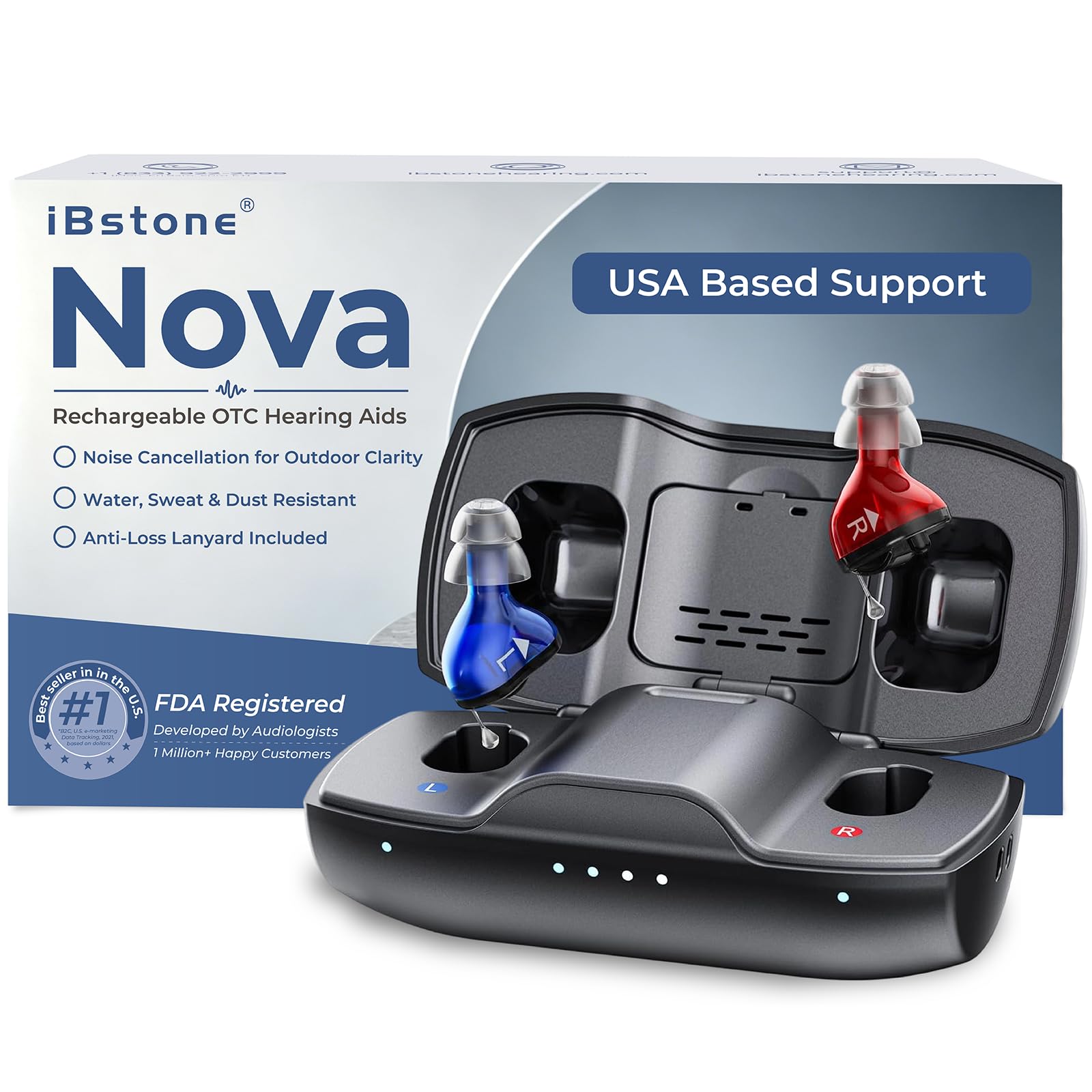
You get 20 hours of use from a 1.5-hour charge — that is 4 more hours per charge than the Vivtone Supermini, which gives you 16 hours after 2 hours plugged in. The charging case holds four extra full charges, giving you 100 hours total, enough for five days away from a wall socket. Each aid weighs only 1.4g, so you may forget you are wearing them after a few hours.
Buyers report that the lowest volume setting already improves hearing significantly, a strong sign for first-time users who worry about things being too loud. The kit includes 9 pairs of ear tips in three shapes — the most of any pick here — so almost any ear canal should find a pain-free seal. An anti-feedback chip (which stops the whistling sound instantly) suppresses feedback in milliseconds, even at high volume, solving a problem common with cheaper amplifiers.
The trade-off is that some reviewers found the volume control a bit cumbersome to adjust while wearing. But the package also includes a charging case with a built-in drying system (an automatic dehumidifier) for overnight maintenance, plus a gift box.
Senior-friendly rechargeable
- Fastest charge time (1.5 hours) of any pick
- Longest per-charge battery life (20 hours)
- 9 pairs of ear tips in 3 shapes for the best fit odds
Limited volume control
- Some users find the on-device volume control awkward during wear
- Better for mild to moderate loss; not for profound loss
Daily companion: If you want maximum runtime between charges and the smallest chance of an uncomfortable fit, this is the most complete package in the mid-range.
Heads-up: The volume dial is not as refined as an app-based control, so expect a small learning curve for exact adjustments.
2. EARGO Eargo SE Self-Fitting Hearing Aids

This aid tunes itself to your ears using a mobile app — no clinic visit required.
It is the only pick that uses the Sound Match feature in a mobile app to tailor device settings to each ear individually. That saves you time and the cost of an audiologist visit. The CIC design is small, and each unit weighs only 0.04 ounces. The charging case holds up to five full charge cycles, so you can travel for days without hunting for an outlet. The battery delivers up to 16 hours per charge, which is shorter than the Nova’s 20 hours but still covers a full day.
Owners mention that in their first noisy restaurant test, family members were stunned they did not need to say “sorry, what?” — the user stopped lip-reading entirely. Another reviewer, a 69-year-old with six grandkids, said this was the first hearing aid they stuck with after giving up on other brands. One notable limitation: the Eargo SE does not stream music or take phone calls, so it is purely for hearing speech and ambient sound.
The premium price reflects the FDA clearance (the U.S. Food and Drug Administration has reviewed it) and the award-winning customer support, which includes a free online class called Eargo 101 led by hearing experts. Some users reported that the companion app drains phone battery due to constant background activity, and one reviewer found the charger unreliable after day five. Still, for anyone who wants a modern, self-programmed device without stepping into a clinic, this is the only option on this list that does that.
Smartphone app control
- Self-fitting via app — no clinic visit required
- FDA-cleared for mild to moderate hearing loss
- Virtually invisible CIC design at 0.04 oz
Premium price tag
- Does not stream music or take phone calls
- Some users experienced app-related phone battery drain
App-lovers: Reach for this if you want to fine-tune your hearing settings from your phone and skip the audiologist — the Sound Match feature is genuinely useful for personalizing both ears.
Heads-up: If streaming music or taking calls through your hearing aid is a must, look elsewhere — this unit sticks to the basics of clear hearing and noise reduction.
3. Vivtone Supermini Hearing Aids
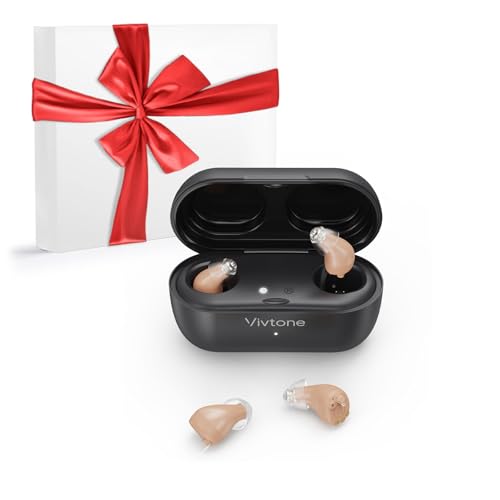
This is the smallest CIC on the shelf, and it packs real 16-channel processing.
The maker claims it is 30% smaller than most other CIC devices, which makes it a strong option if you have a narrow or sensitive ear canal or wear glasses and masks. It uses a 16-channel digital sound processing chip (the chip splits sound into 16 frequency bands for better separation). This is a big step up from analog amplifiers that simply boost all sound. Customers note that volume level 1 is sufficient for daily use, and level 7 is too loud — meaning there is plenty of headroom for different environments.
The auto on/off function is a convenient touch: when you take the aids out of the charging case, they turn on automatically, and after 10 minutes of use, they remember your volume and mode settings. The charging case provides about one week of standby power before needing a recharge itself. At 2 hours for a full charge, the Vivtone is slower than the Nova (1.5 hours) and delivers 16 hours per charge versus the Nova’s 20 hours — a meaningful gap if you tend to forget to charge overnight.
Some reviewers noted that sound can seem tinny and high-pitched at higher volumes, and the mode setting for noisy environments had minimal effect for them. The controls are accessed via five button taps, which works but is less intuitive than a simple dial. Customer service is reachable by phone, email, or text, which is a plus if you need real human support.
Ultra-compact design
- Smallest CIC design, ideal for glasses and mask wearers
- 16-channel digital processing for better sound separation
- Auto on/off and memory function for easy daily use
Short battery life
- Shorter battery life (16 hrs) and slower charge (2 hrs) vs the Nova
- Only 4 ear tip sizes — fewer fit options than the competition
Space-saver: Pick this if you need the absolute smallest CIC device and value digital sound processing over battery runtime — it is easier to hide than almost anything else on the market.
Heads-up: If you are sensitive to tinny sound or need more than a few tip sizes to find your fit, the Nova is a safer bet for only a bit more money.
4. Nano Hearing Aids First Ear Plus CIC
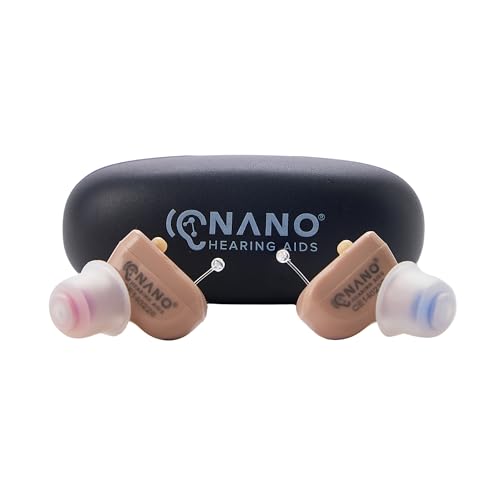
This is the no-fuss entry point with two clear modes — quiet or conversation.
It offers a simple switch between a quiet setting and a conversation setting. The omnidirectional microphone (picks up sound from all directions) and noise-reduction technology deliver up to 18 hours of battery life per charge, placing it between the Nova (20 hours) and the Vivtone (16 hours) in runtime. The charging case offers three full recharges, so you can go several days without plugging in. The automatic on/off feature is simple: take them out of the case, they turn on; put them back, they turn off and start charging.
Reviewers point out that the device works well for sensitive hearing, blocks noise effectively, and adjusts levels automatically. One reviewer noted the aids were “eye-opening,” helping them hear lost sounds they had forgotten about. The CIC design comes with three dome sizes or ear-tips to choose from. However, multiple reviewers noted that the volume controls are not synced — lowering the volume requires cycling through higher levels, which can be frustrating. Some users with small ear canals experienced initial discomfort and found the fit slightly visible.
There is no Bluetooth or frequency-specific shaping, so this is a basic device for basic needs. The included components are straightforward: hearing aids, charging case, and cable — no app, no smartphone pairing. For someone who wants to plug and play, that simplicity is exactly the point.
No app needed
- Simple two-mode system (quiet / conversation) — no app needed
- Solid 18-hour battery life per charge
- Automatic on/off via charging case for fuss-free use
Fixed settings
- Volume controls not synced; requires cycling for adjustment
- Amplifies all sounds equally — can be overwhelming in very loud places
App-free simplicity: Reach for this if you do not want to fiddle with a phone or learn a digital interface — the two-mode switch covers 90% of daily situations.
Heads-up: If you need precise volume matching between ears or find yourself in constantly shifting noise levels, the lack of synced controls and frequency shaping will test your patience.
Understanding the Specs
Battery Life and Charge Time
These two numbers determine how often you need to take the aids out and plug them in. Battery life per charge (measured in hours) tells you how long they run after a full charge — look for 16 hours minimum so they last your whole waking day. Charge time (measured in hours) is how long they need to be in the case to reach full power; under 2 hours is ideal because you can top up during a short break. A charging case that holds multiple extra charges extends your total time away from a wall outlet to several days.
Sound Processing Channels
The number of channels in a digital sound processor (like 16-channel) refers to how many frequency bands the aid can analyze separately. More channels generally means better separation between speech and background noise. A 16-channel device can isolate the frequency of a human voice from the hum of a fan or TV better than a basic 2-channel amplifier. This is the main spec that separates a real hearing aid from a simple sound booster.
Fit and Ear Tip Selection
Since CIC aids go entirely inside your ear canal, the number and variety of ear tips or domes included matters a lot. More sizes (like 9 pairs in 3 shapes) increase the chance of a snug, pain-free seal. A poor seal causes the device to whistle (feedback) or fall out. Look for at least 3 sizes, but prefer kits with 8 or 9 pairs for the best fit odds. Some kits also include different shapes (round, tulip, open) to match different canal shapes.
Program Modes and Noise Management
Multiple program modes let you switch between settings tune for quiet rooms and noisy environments. Some devices use a dedicated button or tap to toggle between modes. Noise reduction technology (often labeled as background noise cancellation) actively filters out steady sounds like air conditioning or traffic while preserving speech frequencies. The best systems suppress feedback (whistling) in milliseconds, which is critical for CIC designs where the microphone sits very close to the speaker.
FAQ
Will CIC hearing aids work for severe hearing loss?
Are CIC hearing aids truly invisible?
How long do CIC hearing aid batteries last before needing replacement?
Can I wear CIC hearing aids while running or exercising?
Do CIC hearing aids whistle or produce feedback?
How do I clean CIC hearing aids?
What is the difference between CIC and ITE hearing aids?
Can I sleep with CIC hearing aids in my ears?
Why do some CIC hearing aids sound tinny or high-pitched?
Are OTC hearing aids as good as prescription ones?
Final Thoughts: The Verdict
Across the board, the cic hearing aids winner is the Nova Hearing Aids by iBstone because it delivers the longest battery life (20 hours) with the fastest charge time (1.5 hours), plus a generous 9-pair ear tip selection for a comfortable, feedback-free fit. If you want self-fitting convenience and app control, grab the EARGO Eargo SE. And for the smallest physical footprint paired with genuine digital sound processing at a lower entry point, the Vivtone Supermini is a smart choice that hides even behind the smallest frames and masks.
How We Picked
We do not accept paid placement. Every pick is matched to a real buyer and a real use-case; we do not hands-on test units.
Sources & Methodology
Specifications: manufacturer listings and product documentation. Review insights: verified customer reviews, as of July 2026. Pricing: not shown on this page (it changes often); check the current price via the retailer link.
As an Amazon Associate, WellFizz earns from qualifying purchases. This does not affect which products we feature.
Related Guides

Mo Maruf
I created WellFizz to bridge the gap between vague wellness advice and actionable solutions. My mission is simple: to decode the research and give you practical tools you can actually use.
Beyond the data, I am a passionate traveler. I believe that stepping away from the screen to explore new environments is essential for mental clarity and physical vitality.