Our readers keep the lights on and my smoothie glass nicely filled. As an Amazon Associate, I earn from qualifying purchases.
Specs are compiled from manufacturer listings and verified buyer reviews and can change over time — please confirm the key details on the product page before buying.
Theft on a construction site is not a maybe—it is a when. A single overnight visit can empty a trailer of tools, copper wire, or expensive equipment, setting your project back weeks and thousands of dollars. The cameras here are built to survive rain, dust, and freezing temps, send alerts straight to your phone, and keep watch without a power cord or Wi-Fi, so you can see your site from anywhere.
I am Mohammad Maruf—the founder of WellFizz. This guide uses the manufacturers’ published specs and patterns from verified customer reviews, so you get real strengths and trade-offs, not marketing spin.
Whether your site is in a remote canyon or inside a roofless concrete shell, these construction site security cameras use 4G LTE cellular (a mobile phone network connection) or dual-band Wi-Fi (both 2.4 GHz and 5 GHz bands) to beam alerts and clear footage to your phone, with solar panels the maker claims keep them running for months.
Quick Picks
- Tapo 4K Outdoor Pan/Tilt Wireless Security — Best Overall
- TACTACAM – Defend 360 Cellular Security Camera — Premium Pick
- Vosker VKX Construction Pack Solar 4G LTE — Best Battery Life
- Vosker V150 Construction Pack Solar 4G LTE — Compact Survivor
- SEHMUA 4G LTE Solar Security Camera (2-Pack) — Budget Champion
- TACTACAM Defend Cellular Security Camera 2-Pack — Pro Bundle
How To Choose The Best Construction Site Security Cameras
Choosing a camera for a construction site means ignoring suburban-home marketing and focusing on three things: a connection that works through rebar and concrete, power that does not rely on an outlet, and a body that laughs off rain, mud, and midday sun.
Connectivity: 4G LTE vs. Standard Wi-Fi
An unfinished building with metal studs and concrete walls is a nightmare for a typical home Wi-Fi signal. The most reliable construction cameras use a built-in 4G LTE cellular modem with a SIM card (a small card from a phone carrier) included. They connect directly to the mobile network, so your site just needs to be inside a cell coverage area, not near a router. Dual-band Wi-Fi (2.4 GHz and 5 GHz bands) works on sites that do have an internet connection, but 4G LTE gives you freedom to place the camera where it sees the most activity without worrying about the signal dropping.
Power Source: Solar Panel and Battery Capacity
A camera that runs out of power after three overcast days is useless on a busy site. Look for models with a dedicated solar panel—at least 6W is a good baseline—paired with a rechargeable battery of 10,000 mAh (milliamp-hours) or more. The best setups use a remote solar panel on a cable, so you can put the panel in the sun and the camera in the shade. The maker claims some premium models can last up to 6 months on a single charge with careful settings.
Weatherproofing and Durability (IP Rating)
Construction sites are dusty, wet, and often freezing. You need at least an IP65 rating: the ‘6’ means the camera is fully protected against dust (like sand and concrete dust) getting inside, and the ‘5’ means it is protected against low-pressure water jets from any direction. That covers rain, hosing off mud, and windblown grit. Cameras with rugged antenna housings also survive accidental knocks from machinery.
Video Quality and Night Vision
You need resolution high enough to read a license plate or identify a face from across a yard. The effective minimum for construction work is 2K (about 2560×1440 pixels), though 4K (3840×2160 pixels) gives you sharper detail for zooming in later. For nighttime, infrared night vision (using invisible IR light) with a range of at least 80 to 100 feet (25 to 30 meters) ensures you catch after-hours prowlers. Some cameras now offer color night vision using a spotlight, which helps identify clothing and vehicle color.
Quick Comparison
| Model | Best For | Resolution | Connectivity | Battery / Power | Amazon |
|---|---|---|---|---|---|
| Tapo C660 KIT | High-res monitoring with live video | 4K UHD (8 MP) | Dual-Band Wi-Fi (2.4 & 5 GHz) | 10,000 mAh battery + solar panel | Amazon |
| TACTACAM Defend 360 | Complete 360° cellular surveillance | 4K UHD photos / 1080p video | 4G LTE cellular (eSIM) | 10,000 mAh battery + integrated solar | Amazon |
| Vosker VKX Construction Pack | Longest battery life for off-grid sites | 1080p HD | 4G LTE cellular (SIM included) | 14,000 mAh battery + frameless solar | Amazon |
| Vosker V150 | Budget entry to cellular security | HD photos (day) / IR night (80 ft) | 4G LTE cellular (SIM included) | 10,000 mAh battery + integrated solar | Amazon |
| SEHMUA 4G LTE Solar | Two-camera budget value for open sites | 2K | 4G LTE cellular (SIM built-in) | Battery + 6W solar panel | Amazon |
| TACTACAM Defend 2-Pack | Two-camera premium bundle for large job sites | 4K UHD photos / 1080p video | 4G LTE cellular (eSIM) | External solar panels + battery-ready | Amazon |
In-Depth Reviews
1. Tapo 4K Outdoor Pan/Tilt Wireless Security Camera C660 KIT
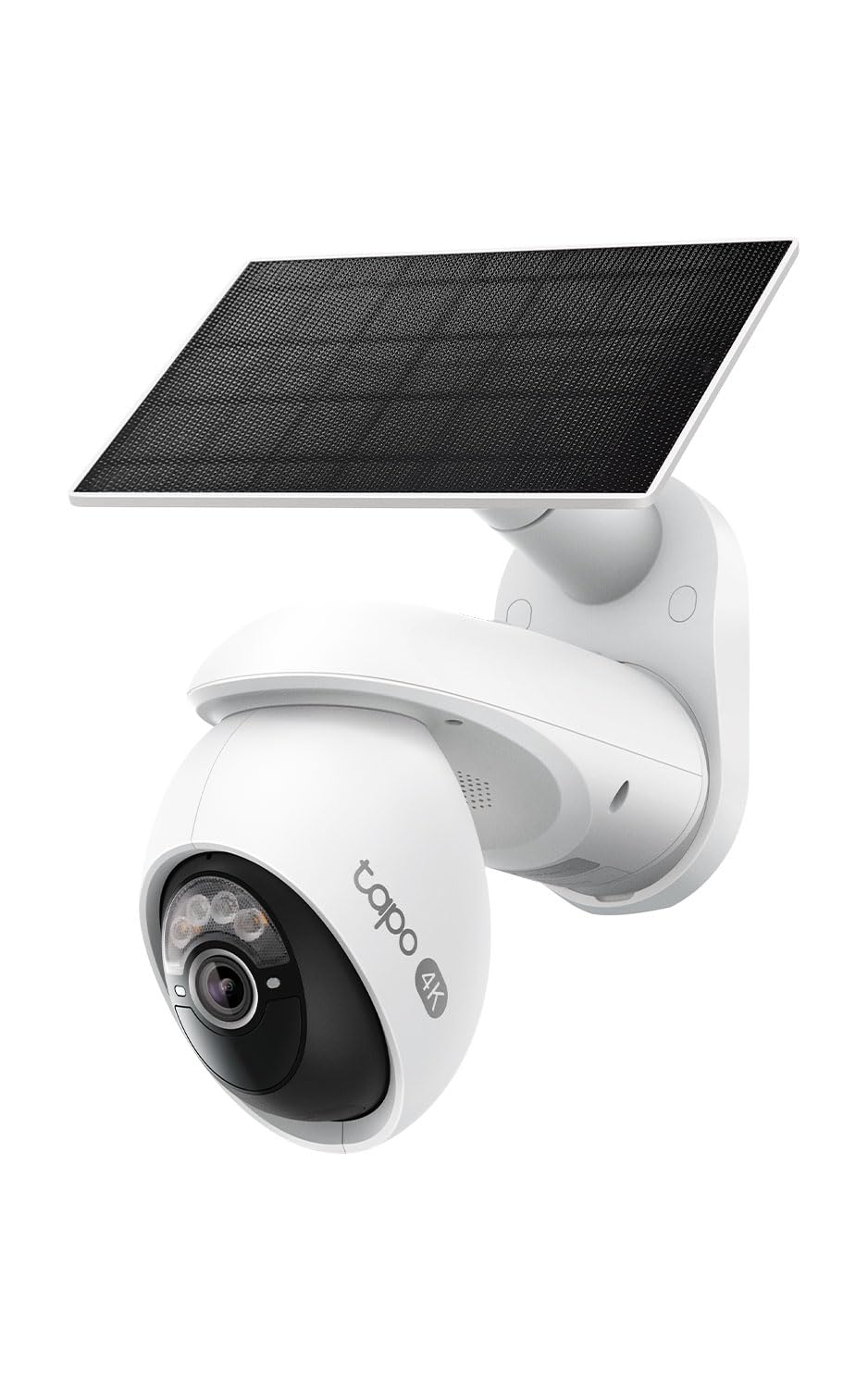
You get the sharpest video in this guide, plus a solar panel that keeps a 4K pan-tilt camera running indefinitely without a monthly fee.
If your construction site has a decent Wi-Fi connection, this is the single most capable camera here. It captures 4K Ultra HD resolution (8 MP, or 8 million pixels effective still resolution)—that is 4 times the detail of standard 1080p. You can zoom in on a license plate or a face in the footage after the fact. The motorized head gives you 360 degrees of horizontal coverage and 98 degrees of vertical tilt, and it tracks moving subjects automatically across that whole range, so a person walking across the yard stays in frame.
The solar setup is genuinely useful: buyers report that 45 minutes of direct sunlight on the solar panel powers the camera for a full day. The 10,000 mAh (milliamp-hour) backup battery handles cloudy stretches, and the USB cable lets you place the panel up to 13 feet away from the camera for optimal sun exposure. Unlike the SEHMUA unit, which tops out at 128GB microSD, the Tapo supports a microSD card up to 512GBso you can keep weeks of 4K footage locally without a subscription.
Person, vehicle, and pet detection is built in with no monthly fees. The IP65 weatherproof rating (dust-tight and rain-protected) means it handles mud and rain. The catch? It runs on Wi-Fi only (dual-band 2.4 and 5 GHz), so it will not work on a site with no internet connection. One reviewer noted that in 24/7 continuous capture mode, battery life drops significantly, suggesting the panel may not keep up with the camera’s most intensive use.
Why It Leads
- 4K UHD resolution captures fine detail from across a site, like a logo on a truck door.
- 360° pan and 98° tilt with auto motion tracking covers a huge area without moving the camera.
- No subscription required for on-device AI detection (person/vehicle/pet).
- Supports microSD cards up to 512GB for local storage.
The Trade-offs
- Wi-Fi only—no 4G LTE for off-grid or metal-building sites.
- 24/7 continuous capture mode may drain battery faster than the solar panel can recharge.
Best for: sites with existing Wi-Fi where you want the best possible video detail and total area coverage without paying monthly sensor fees.
skip it if: your construction site has no internet connection—you need a 4G LTE model instead.
2. TACTACAM – Defend 360 Cellular Security Camera

This camera gives you full 360-degree pan, tilt, and zoom control from your phone, even on a site with no Wi-Fi at all.
Where the Tapo needs Wi-Fi, the Defend 360 connects over 4G LTE with an automatic eSIM (a built-in programmable SIM card inside the camera), so it works on any remote construction site that has cellular coverage. You get full 360° pan, tilt, and zoom control through the DEFEND App, letting you sweep the entire yard from your phone without climbing a ladder. It captures 4K UHD photos (ultra-high-definition stills at 3840×2160 pixels) and 1080p video, and the low-glow IR flash provides a 75-foot (23-meter) detection range at night.
The built-in 10,000 mAh rechargeable battery paired with an integrated solar panel aims for set-and-forget operation. One buyer mentioned the camera worked flawlessly in remote Montana, calling the photo quality and motion sensitivity “top notch” compared to cheaper Wi-Fi cameras. The unit weighs 1.4 pounds and measures 3.8 x 3.8 x 6.4 inches, making it compact enough to mount on a post or bracket near a storage container. Like the Vosker VKX, this unit requires a data plan—but unlike the Vosker, it gives you live pan/tilt control rather than just photo alerts.
Connected coverage: 4K photos and live 360° PTZ control from anywhere with cell service, with 75 feet of night detection and IP65 weather resistance.
The catch: critical functions—including live 360° view and video recording—sit behind a monthly subscription, and one owner found the motion sensor unreliable for fast-moving vehicles.
Reach for this if: you need to remotely steer a camera across your entire site from a phone, in a location with no Wi-Fi but good cellular signal.
Look elsewhere if: you want a single upfront cost with no recurring subscription—the Tapo C660 is a better no-fee option if you have Wi-Fi.
3. Vosker VKX Construction Pack Solar 4G LTE Security Camera
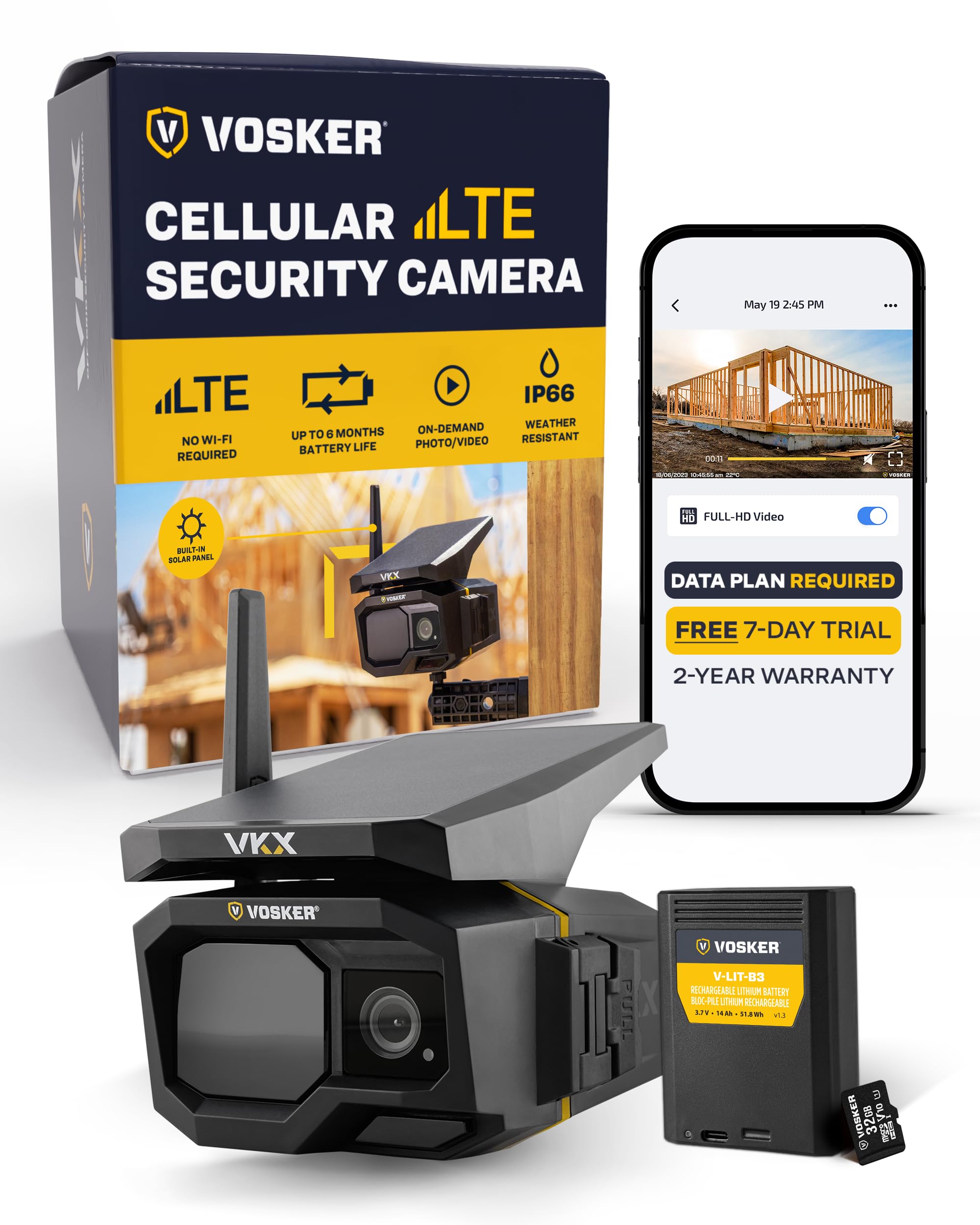
A 14,000 mAh battery (compared to the Tapo and TACTACAM’s 10,000 mAh) keeps this camera watching for up to 6 months on a remote site, according to the maker.
The VKX packs a 14,000 mAh swappable battery—that is 14,000 mAh capacity versus the Tapo and TACTACAM’s 10,000 mAh—paired with a frameless solar panel, and the maker claims up to 6 months of autonomy. That matters when your site is hours away and a dead camera leaves your equipment blind. It detects motion up to 100 feet (30 meters) and sends instant photo alerts or 15-second video clips on demand, with 1080p HD daytime video and infrared night vision out to the same 100-foot range.
Unlike the SEHMUA unit which records in 2K, the VKX sticks to 1080p (1920×1080 pixels), but it compensates with a wider 90° angle of view and a built-in deterrent light that signals its presence. It includes a 32GB microSD card and two pre-activated SIM cards in the box, plus GPS tracking for location monitoring. One owner reported the solar panel “maintains full charge” and that motion detection was accurate for vehicles, people, and animals. The main drawback is the mandatory data plan after the 7-day free trial—and one owner reported the camera stopped transmitting after a week and needed a physical reset, with battery needing monthly charging when the solar panel struggled.
What Stands Out
- Largest battery capacity in the guide at 14,000 mAh for extended off-grid autonomy.
- Swappable front-access battery and USB-C port for flexible power management.
- Deterrent light signals the camera’s presence to scare off intruders.
- Includes 32GB microSD card and SIM cards—ready from the start.
What to Watch
- Requires a monthly data subscription after the 7-day trial.
- Video output is 1080p HD, not 4K like the Tapo or TACTACAM.
- One reviewer experienced a transmission failure after one week.
Ideal for: long-term, unattended sites where battery life is the top priority and you want photo/video alerts over a 100-foot range.
pass on it if: you need 4K resolution for reading plates from a distance—the Tapo C660 is sharper.
4. Vosker V150 Construction Pack Solar 4G LTE Security Camera
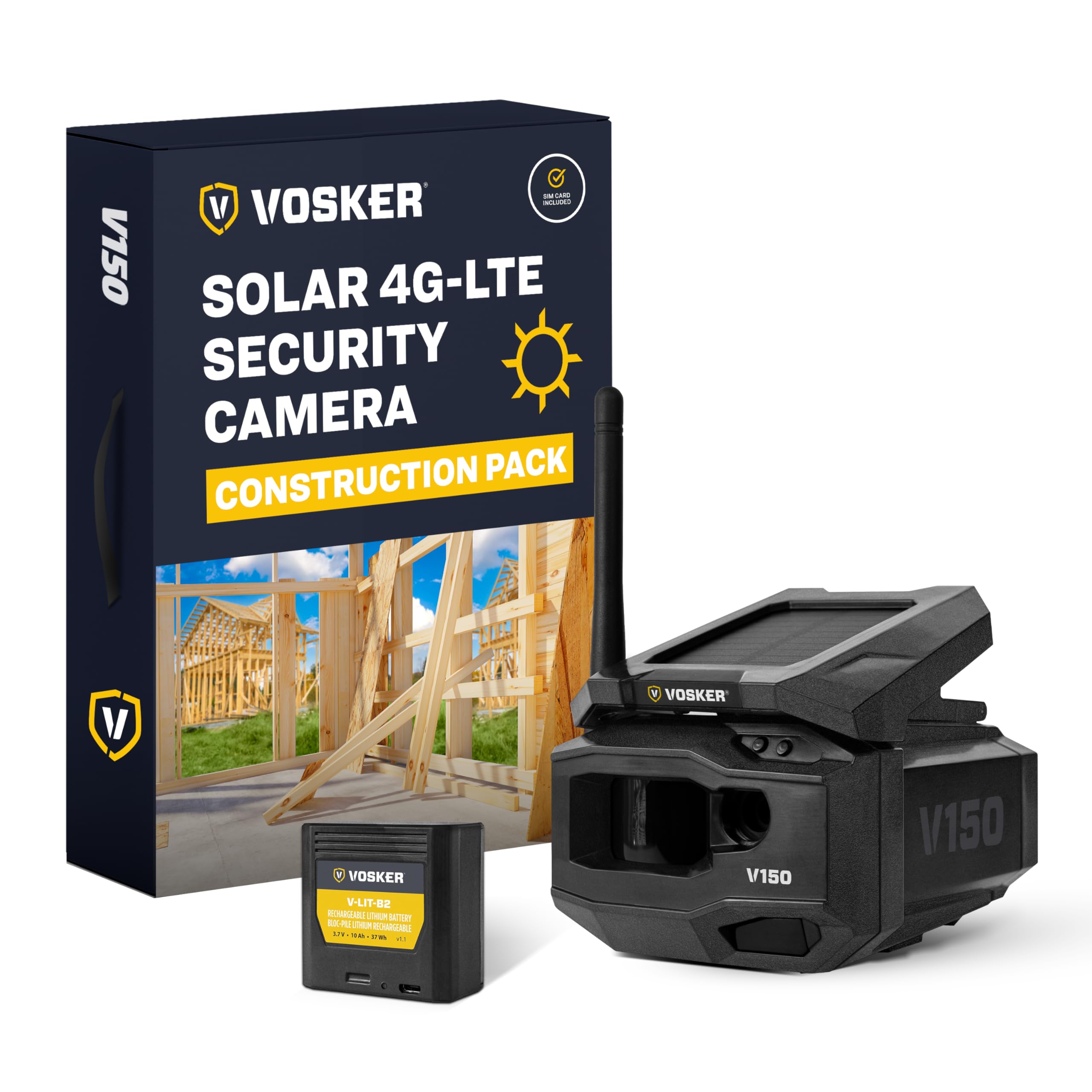
This rugged, all-in-one cellular camera sends photo alerts from sites with no power and no Wi-Fi, but its 43° lens is narrow—you will see less of the site than the SEHMUA’s 355° pan.
The V150 is the entry-level option in the Vosker lineup, and it shares the same DNA as the VKX but with a smaller 10,000 mAh battery and a narrower 43° field of view. It uses 4G LTE with a pre-activated SIM card (a phone-network chip) included, so you mount it, power it on, and start getting motion-triggered photo alerts on the Vosker app. It detects activity up to 90 feet (27 meters) and has infrared night vision out to 80 feet (24 meters)—shorter than the VKX’s 100-foot range but sufficient for a fenced-in material storage area or the entrance to a single trailer.
Daytime HD photos are clear, though owners note nighttime infrared images can be blurry at distance. One long-term user said it ran reliably for 6 months in cold conditions, and another called it “ideal for remote, off-grid locations.” The camera comes with a 16GB microSD card for backup storage, plus GPS tracking for jobsite location. The data plan requirement is the same as the larger VKX, and the fixed 43° angle means you will see less of the site than the SEHMUA’s 355° pan or the Tapo’s motorized head. It is a simple, durable photo-alert camera—not a live-view PTZ solution.
No-fuss off-grid alerting: sends HD photo alerts via 4G LTE when motion is detected up to 90 feet, with a 10,000 mAh battery and built-in solar panel.
The catch: the 43° lens is narrow—you will need multiple cameras to cover a wide yard—and the data plan adds ongoing cost.
Works for: monitoring a single entry point or storage container on a remote site where Wi-Fi and power are both absent.
Not for: covering a wide open yard or needing live pan/tilt control—the TACTACAM Defend 360 is better for large areas.
5. SEHMUA 4G LTE Solar Security Camera (2-Pack)
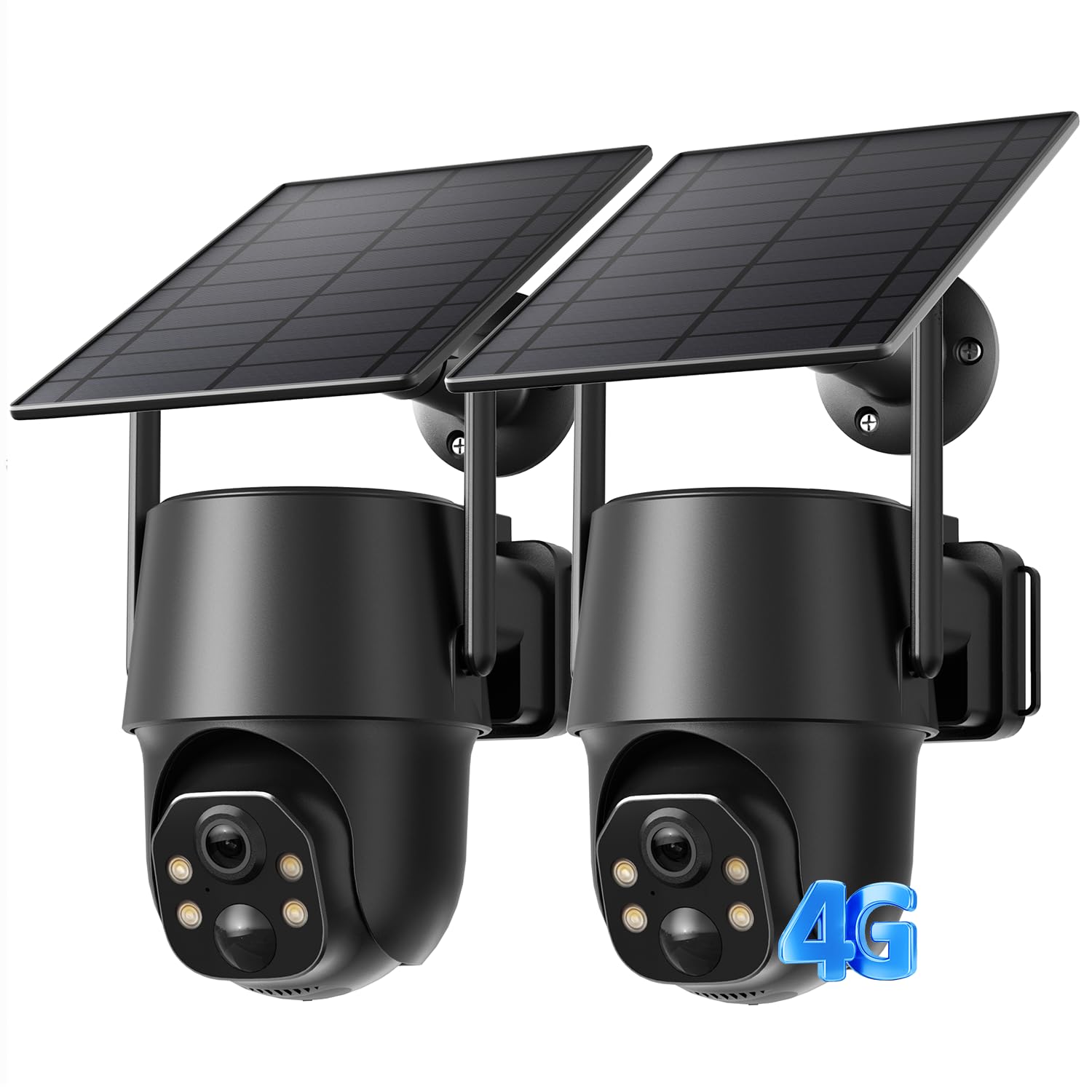
Two cellular cameras in one box let you cover both ends of a site for the price of one premium unit—but the data plan costs double.
This is the only 2-pack in the lineup, making it an immediate value play for covering both ends of a job site. Each unit runs on 4G LTE via a built-in SIM card (no physical SIM to insert) and includes a 6W solar panel, so you are off-grid from the moment you mount it.
Owners mention the camera has worked “perfect for off-grid gate security” after 14 months of use, and the app (Ubox) sends instant alerts with 2-way talk capability. The built-in SIM does lock you into SEHMUA’s data plans, and the maximum microSD card support is 128GB—a 4-times gap versus the Tapo’s 512GB. The 2K (2560×1440 pixel) resolution delivers more detail than the Vosker V150 at a similar entry-level budget, though one customer observed the field of view felt a bit narrow and wished the lens was wider.
Value Edge
- Two cameras in the box for nearly the price of one competitor unit.
- 2K resolution offers sharper detail than 1080p rivals in this price tier.
- 355° pan and 90° tilt with 2-way audio gives solid coverage.
- Built-in SIM means zero setup beyond mounting and powering.
Budget Compromises
- 128GB max microSD is small compared to the Tapo’s 512GB.
- Data plan is billed per-camera, so the 2-pack costs twice as much monthly.
- One user highlighted the lens felt too narrow for a wide field of view.
Best for: budget-conscious buyers who need two cameras to cover separate site entrances and can accept a smaller local storage limit.
Better to avoid if: you need high-resolution zoom-in detail—the 2K image is good but not 4K-sharp for identifying faces at a distance.
6. TACTACAM Defend Cellular Security Camera 2-Pack Bundle
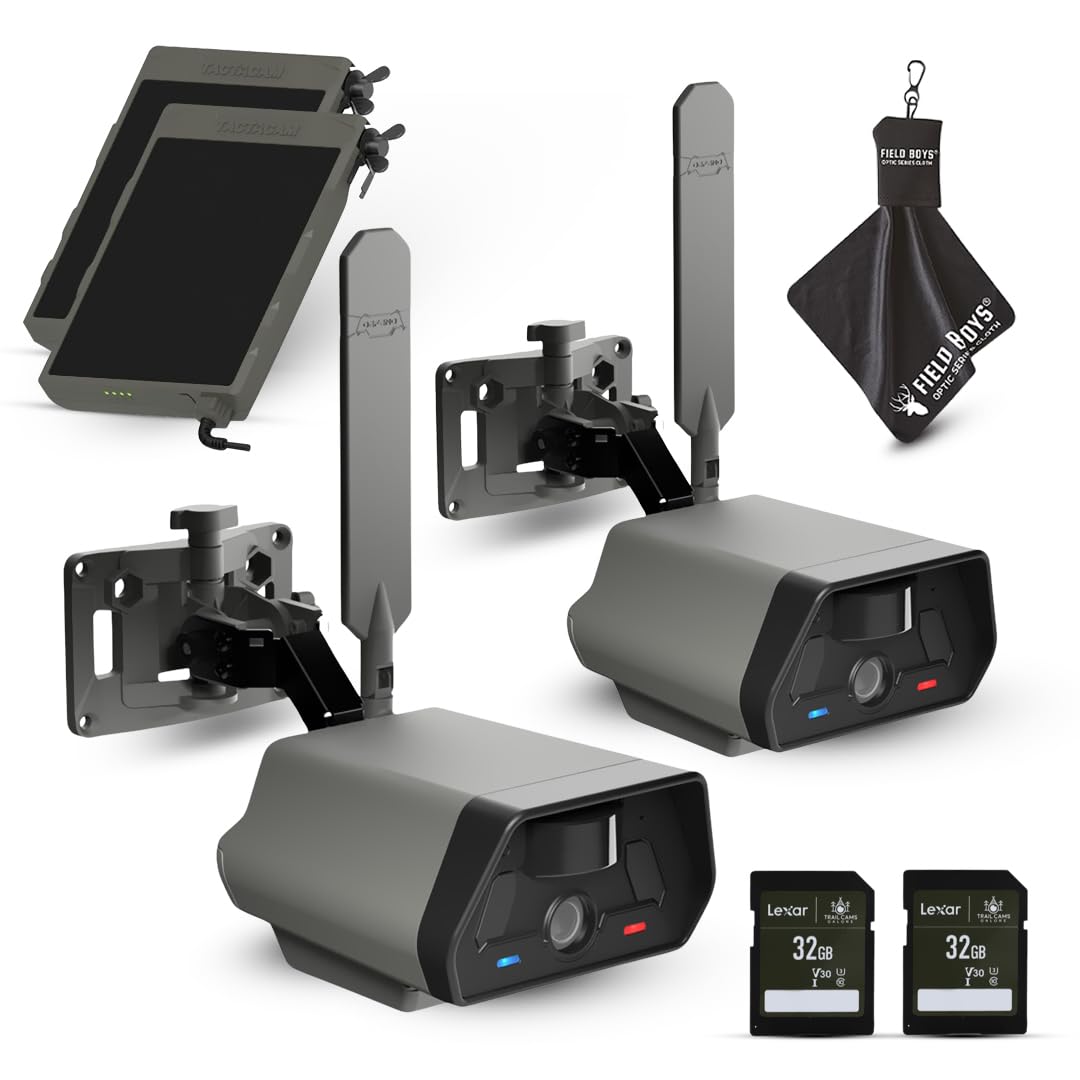
You get two complete cameras with separate solar panels for independent placement on large sites, but it is the most expensive option here and motion sensitivity has mixed reviews.
This bundle takes the core TACTACAM Defend camera—the same 4K UHD photo / 1080p video and 4G LTE eSIM cellular engine—and gives you two of them, each with its own solar panel and a 32GB Lexar SD card. The 0.4-second trigger speed is designed to catch fast-moving vehicles, and the low-light IR reaches 100 feet (30 meters) at night. The cameras are weather-resistant for rain, snow, and extreme temperatures, and the Defend plans start at a monthly fee per camera with no contract. The bundle includes a microfiber cleaning cloth, according to the maker.
Unlike the SEHMUA 2-pack which uses a single-sku kit price, this TACTACAM bundle is the most expensive option here, but it gives you two fully independent cameras with separate solar panels so you can place them far apart on a large site. One shopper added the unit works well for property security, though a separate reviewer reported that the motion sensor failed to detect a truck 50% of the time and customer service was unhelpful with Amazon purchases. If you only need one camera, the standalone Defend 360 (pick #2) is cheaper and adds PTZ control; this bundle is for sites that need two fixed wide-angle cameras covering separate zones.
Two-zone surveillance: two complete 4K photo/1080p video cellular cameras with separate solar panels and 32GB cards, all in one box.
The catch: at the highest price in this guide, and with mixed motion-sensitivity reports, it is worth testing the first camera before buying the bundle.
Best for: large job sites that need coverage in two distant zones with minimal setup time and no running cables.
Consider one camera first if: you are unsure about the Defend platform’s motion sensitivity in your specific environment—start with the solo Defend 360.
Understanding the Specs
Resolution: 2K vs 4K vs 1080p
Resolution is measured in vertical lines of pixels. Standard HD is 1080p (1920×1080 pixels), which is the minimum for identifying a person but can look soft when you zoom in on a license plate from 60 feet away. 2K (around 2560×1440 pixels) gives you about 1.8 times more pixels than 1080p, adding visible sharpness for mid-range identification. 4K Ultra HD (3840×2160 pixels, or 8 million pixels total) delivers 4 times the pixels of 1080p—enough to read a contractor’s logo on a truck door from across a yard. On a construction site, more resolution means you can place the camera farther from the action and still get usable evidence.
mAh and Solar Autonomy
Battery capacity is measured in milliamp-hours (mAh). A 10,000 mAh battery is the baseline for a full-day security camera; 14,000 mAh (like the Vosker VKX) gives you extra reserve for overcast weeks. But raw capacity is only half the story—the solar panel’s wattage (6W is typical) and whether the panel is integrated or remote matter more. A remote panel on a cable lets you put it in the sun while the camera stays in the shade of a porta-potty or wall, dramatically improving real-world autonomy in winter months when the sun is low.
FAQ
Do construction site security cameras work without Wi-Fi?
How long does the battery last on a solar-powered construction camera?
Can these cameras record video continuously or only on motion?
How fast does the camera trigger when something moves on site?
What does IP65 weatherproofing actually mean for a construction camera?
Is there a monthly fee for construction site cellular cameras?
Can I use a construction security camera inside a metal building or storage container?
How much storage do I need for a construction site camera?
Will the police accept footage from a solar construction camera as evidence?
Final Thoughts: The Verdict
Across the board, the construction site security cameras winner is the Tapo C660 KIT because it delivers 4K resolution, 360-degree motion tracking, and solar-powered indefinite runtime in a single package—all without a monthly subscription. If you need complete cellular surveillance with remote pan/tilt control from outside cell range, grab the TACTACAM Defend 360. And for off-grid sites that need the longest possible battery life and a deterrent light, the Vosker VKX Construction Pack is the rugged workhorse that keeps watching when you cannot visit for months.
How We Picked
We do not accept paid placement. Every pick is matched to a real buyer and a real use-case; we do not hands-on test units.
Sources & Methodology
Specifications: manufacturer listings and product documentation. Review insights: verified customer reviews, as of July 2026. Pricing: not shown on this page (it changes often); check the current price via the retailer link.
As an Amazon Associate, WellFizz earns from qualifying purchases. This does not affect which products we feature.
Related Guides

Mo Maruf
I created WellFizz to bridge the gap between vague wellness advice and actionable solutions. My mission is simple: to decode the research and give you practical tools you can actually use.
Beyond the data, I am a passionate traveler. I believe that stepping away from the screen to explore new environments is essential for mental clarity and physical vitality.