Our readers keep the lights on and my smoothie glass nicely filled. As an Amazon Associate, I earn from qualifying purchases.
Specs are compiled from manufacturer listings and verified buyer reviews and can change over time — please confirm the key details on the product page before buying.
Switching from a phone to a compact travel camera means gaining optical zoom, better image quality, and longer reach without extra gear. The top picks combine long optical zoom with a jacket-pocket body, letting you capture distant details and wide scenes instantly.
I’m Mohammad Maruf — the founder and writer behind WellFizz. This guide is built by comparing the manufacturers’ published specifications and the patterns across verified customer reviews, so you get each pick’s real strengths and trade-offs instead of marketing spin.
Whether you are hiking through national parks or exploring city streets, these picks cover the essential ground for any photographer who wants more than a phone can deliver — this is your guide to the best affordable compact camera for travel that balances zoom, size, and daily usability.
Quick Picks
- Panasonic LUMIX TZ/ZS99 Point and Shoot Camera — Best Overall
- Kodak PIXPRO Astro Zoom AZ528-BK 16 MP Digital — Extreme Reach
- Canon PowerShot ELPH 360 HS A Digital Camera — Everyday Companion
- Canon PowerShot V10 Compact Vlogging Camera — Vlogger Choice
- Canon PowerShot ELPH 190 Digital Camera w/ 10x — Simple & Solid
How To Choose The Best Affordable Compact Camera For Travel
Choosing the right travel camera means prioritizing specs that matter on the go. Here is what to look for.
Optical Zoom Range
Optical zoom is the primary reason to choose a compact camera over a phone. Optical zoom uses the lens glass to magnify the image without losing quality, unlike digital zoom which just crops and blurs the picture. A 10x to 52x optical zoom range lets you pull in distant subjects — a mountain peak, a street performer, or an animal in the wild — while keeping the detail sharp.
Image Stabilization
At maximum zoom, even tiny hand movements look like big shakes in the viewfinder. Optical Image Stabilization (OIS) uses moving lens elements inside the camera to counteract that shake, so your handheld telephoto shots come out crisp rather than blurry. Look for built-in OIS if you plan to shoot at the long end of the zoom.
Sensor and Megapixels
The sensor is the part of the camera that captures light. A larger sensor (like a 1-inch type) generally performs better in low light than a smaller 1/2.3-inch sensor found in most budget compacts. Megapixels determine the maximum print and crop size — 16 to 20 MP is plenty for standard travel prints and social media sharing.
Video Capabilities
Most travel cameras now record 1080p or 4K video. If you plan to capture moving memories, 1080p Full HD is a solid baseline. 4K video gives you more detail and room to crop, but it also produces larger files and requires a faster memory card.
Connectivity
Built-in Wi-Fi or Bluetooth lets you transfer photos to your phone for quick posting without a computer. Some cameras also let you use your phone as a remote shutter, which is handy for group shots or steady long-exposure night scenes.
Quick Comparison
| Model | Best For | Optical Zoom | Sensor / Megapixels | Video | Amazon |
|---|---|---|---|---|---|
| Panasonic LUMIX TZ/ZS99 | Long-zoom travelers wanting 4K quality | 30x | 20.3 MP / 1/2.3″ | 4K 30p | Amazon |
| Kodak PIXPRO Astro Zoom AZ528 | Extreme reach on a budget | 52x | 16 MP BSI CMOS / 1/2.3″ | 1080p Full HD | Amazon |
| Canon PowerShot ELPH 360 HS | Everyday pocket simplicity | 12x | 20.2 MP CMOS / 1/2.3″ | 1080p 30fps | Amazon |
| Canon PowerShot V10 | Vloggers and video-first creators | Fixed wide-angle (19mm) | 15.2 MP / 1″ CMOS | 4K 30fps | Amazon |
| Canon PowerShot ELPH 190 | Simple point-and-shoot family use | 10x | 20.0 MP CCD | 720p HD | Amazon |
In‑Depth Reviews
1. Panasonic LUMIX TZ/ZS99 Point and Shoot Camera

A pocket-sized zoom powerhouse that doesn’t compromise on quality.
This is the camera that covers nearly everything you will encounter on a trip. Its 24-720mm Leica lens (the 35mm equivalent range) with 30x optical zoom and 60x Intelligent Zoom reaches from a wide cityscape to a distant stage performer without you needing to move a step. You get 4K video and 4K Photo at 30fps, so you can pull a sharp still frame out of a video clip. Buyers report it handles well for beginners and pros alike, and the tiltable 1,840k-dot touchscreen helps compose shots from awkward angles. Note the battery weighs 44 grams, while the Canon PowerShot V10’s battery is 22 grams, but that extra mass supports longer shooting sessions.
The 10-bit color depth (bit depth, a measure of how many color shades each pixel can show) produces smoother color gradations than the 8-bit sensors found in most budget compacts. One reviewer mentions the camera is “heavy, not pocketable, but photos are worth it,” confirming that the zoom range comes with some heft — though it still slips into a jacket pocket. The lack of a built-in flash (the specification says no flash) means you will rely on ambient light or the camera’s high-ISO performance in dim settings.
Why it earns the top spot
- 30x Leica optical zoom reaches 720mm, giving you the longest reach of the premium picks here.
- 4K video and 4K Photo at 30fps let you grab stills from moving footage.
- Bluetooth v5.0 and a dedicated Send Image button make phone transfers quick.
The honest trade-offs
- No built-in flash, so low-light handheld shots are a challenge — one reviewer called nearly unusable.
- Autofocus with 19 points can struggle in fast-moving scenes compared to the 49-point V10.
Reach for it if: you want one camera that goes from wide-angle landscapes to tight concert zoom without swapping lenses, and you value 4K video quality in a jacket-pocket size.
Look elsewhere if: you need a built-in flash for nighttime party snaps or you want a lighter all-day carry — this is the heaviest battery in the list at 44g.
2. Kodak PIXPRO Astro Zoom AZ528-BK 16 MP Digital Camera
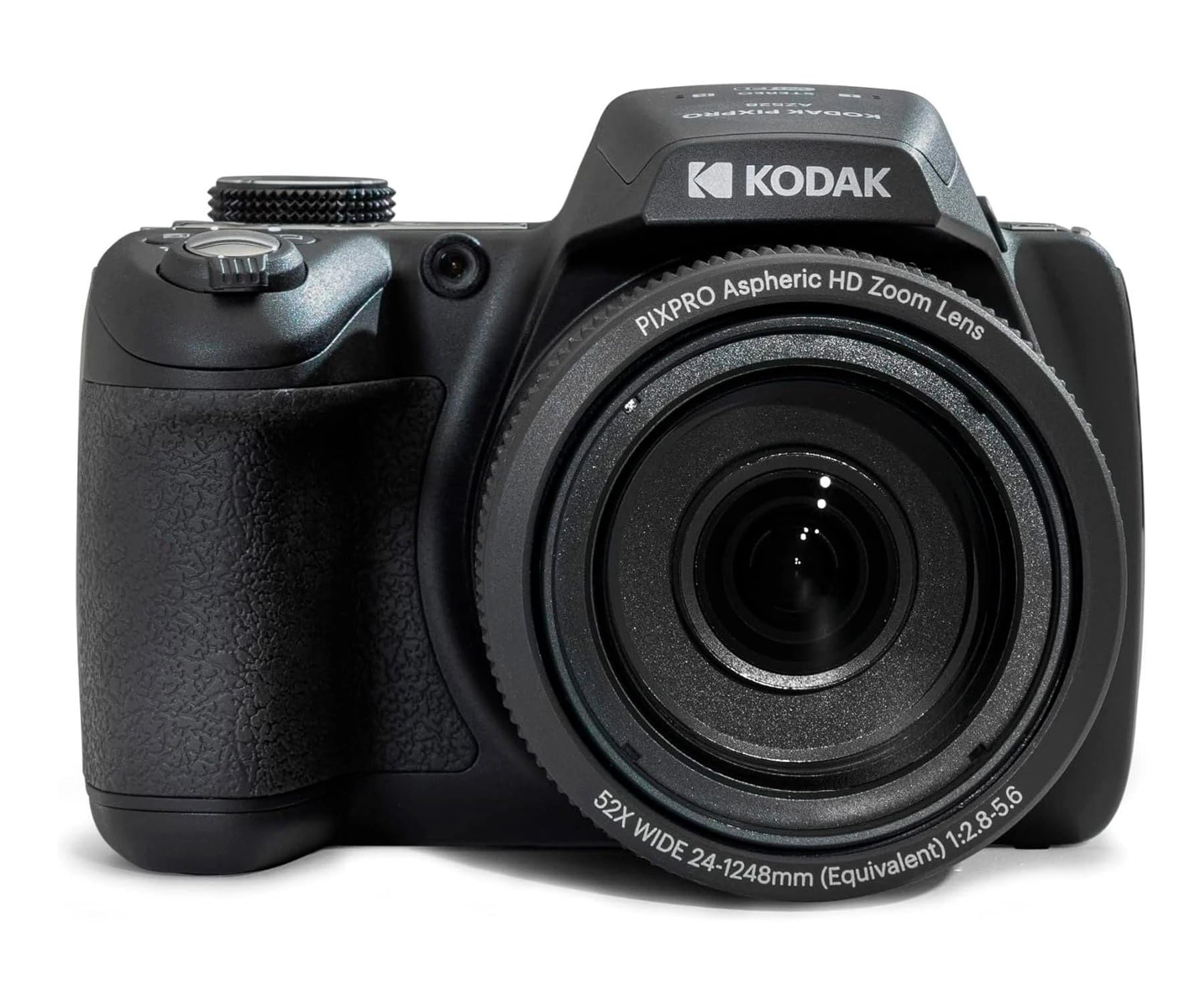
The budget zoom king brings distant subjects into clear view.
If your travel goal is wildlife, birding, or stadium sports, this is the camera that has 52x optical zoom versus 12x. That 24mm wide-angle lens also captures sweeping group shots and broad landscapes. The 16-megapixel BSI CMOS sensor (a backside-illuminated sensor that gathers more light in dim conditions than traditional sensors) works with built-in optical image stabilization to keep handheld telephoto frames steady. You record 1080p Full HD video, and the 6-frames-per-second burst mode catches fast action sequences. One reviewer notes, “When you have it zoomed in, you have to have steady hands or it is very blurry,” which is fair — the OIS helps, but at maximum zoom, a tripod or bracing against something solid makes a noticeable difference.
The Wi-Fi connectivity lets you wirelessly transfer photos to your phone and use the phone as a remote viewfinder. The camera accepts SD cards up to 512GB (a full day of shooting without worrying about space), and the rechargeable lithium-ion battery supports extended field sessions. Owners mention the camera is “easy to use” and “lightweight,” and several note the low price for the zoom range. The 25 autofocus points use contrast detection (a method where the camera adjusts focus until the image is most contrast-rich), which is slower than hybrid systems but works reliably in good light.
The standout perk
- 52x optical zoom is the longest in this list by a wide margin — compared to the ELPH 360 HS’s 12x.
- Built-in Wi-Fi lets you transfer and share photos on the go without a computer.
- Affordable entry point into long-reach photography.
What to expect
- Steady hands or support needed at maximum zoom — a tripod helps significantly.
- Contrast-detect autofocus with 25 points is adequate but not as snappy as hybrid systems.
Pick this for: wildlife, birding, or any travel where you need to pull distant subjects close without spending premium money — it is the budget-friendly extreme-zoom champion.
Pass if: you shoot mostly indoors or in low light, where the contrast-detect AF struggles, or you want 4K video instead of 1080p.
3. Canon PowerShot ELPH 360 HS A Digital Camera (Silver)
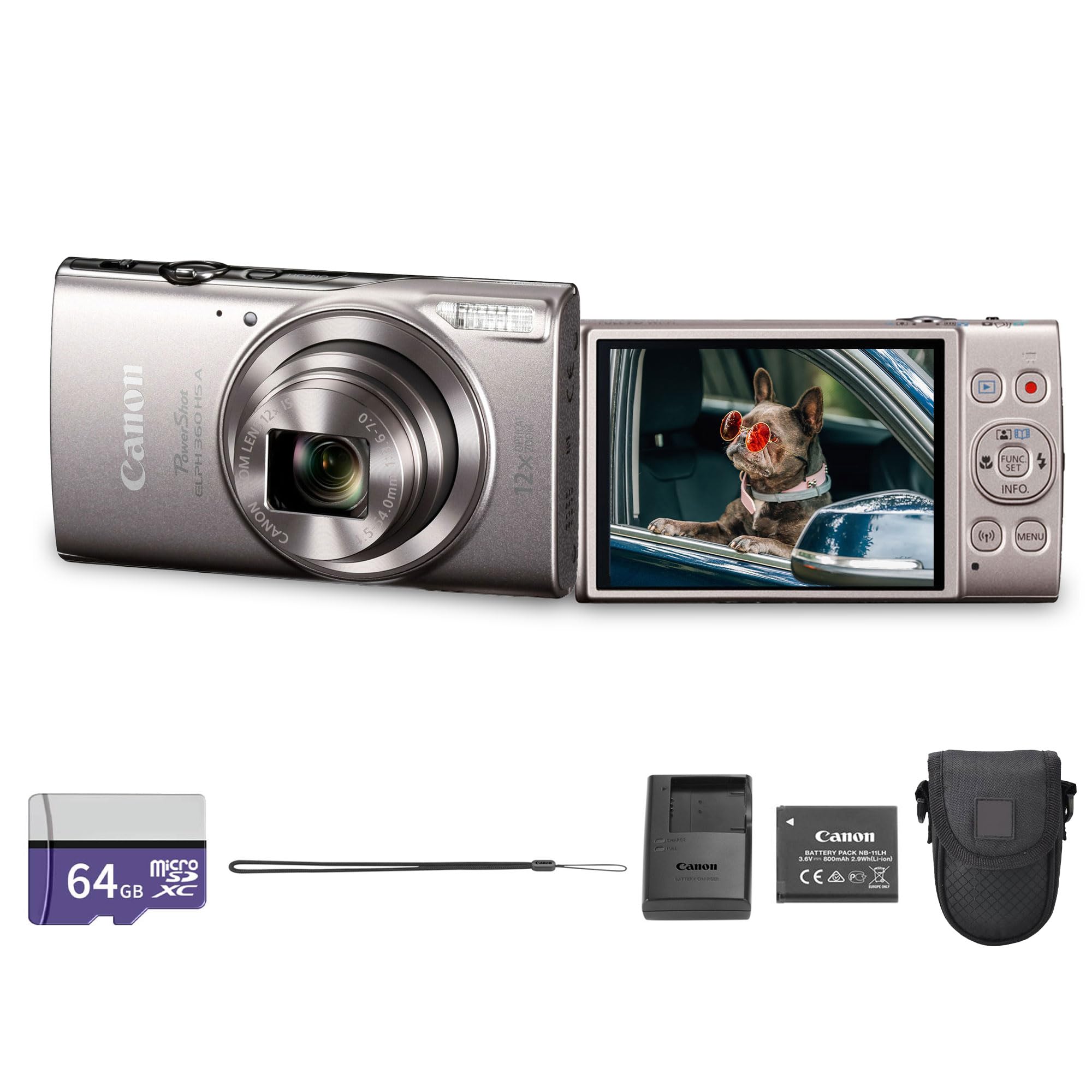
A true pocket camera that trades extreme zoom for pure everyday simplicity.
This Canon is the classic point-and-shoot refined. Its 20.2-megapixel CMOS sensor offers more pixels than the Canon PowerShot V10’s 15.2-megapixel sensor, meaning you have more detail to crop and print at larger sizes. The 12x optical zoom covers a 25-300mm equivalent focal range, which customers note is great for both wide landscapes and close-ups. The DIGIC 4+ processor (the camera’s image-processing brain that handles color, noise reduction, and speed) enables Full HD 1080p video at 30fps and continuous shooting at 7.2 frames per second. One reviewer noted, “The picture quality is great, and the camera is easy to use,” and many mention it replaces a smartphone for travel because it is genuinely compact. The Intelligent IS (a smart stabilization system that picks the right steadying mode from multiple options) adapts to your movement automatically, so handheld shots stay crisp.
The 3.0-inch 461k-dot LCD screen (the number of tiny dots that make up the display; more dots mean a sharper image for composing and reviewing photos) and built-in Wi-Fi with NFC make framing and sharing straightforward. Creative features like Hybrid Auto, Creative Shot, and Story Highlights let you build highlight reels without post-processing. The one common frustration reviewers point out is that setting the manual controls takes some learning — it is a camera that rewards reading the manual. The lithium-ion battery holds a capacity of 800 milliamp hours, enough for a full day of casual shooting.
What you gain
- 20.2 MP sensor with more resolution than the V10 for bigger prints and more cropping room.
- 12x optical zoom with Intelligent IS for steady handheld shots at the telephoto end.
- Compact and pocketable — shoppers say they take it everywhere instead of their phone.
Where it falls short
- The 12x zoom is far less than the 52x on the Kodak or the 30x on the Panasonic, so faraway subjects stay small.
- No 4K video — tops out at Full HD 1080p.
Snag it if: your main requirement is a camera that slips into any pocket, gives better photos than a phone, and offers a useful 12x zoom without any fuss or extra weight.
skip it if: you need to capture distant wildlife or sports where 12x is not enough reach, or you insist on 4K video in your travel cam.
4. Canon PowerShot V10 Compact Vlogging Camera, Black

The vlogging specialist that trades zoom for a big sensor and front-facing screen.
This is the one to reach for if video content — not still photography — is your main travel output. The 1-inch CMOS sensor (a physically larger sensor than the 1/2.3-inch sensors in the other picks here) at 15.2 megapixels gathers significantly more light, giving you better low-light performance than the Kodak or the ELPH 360 HS. It shoots 4K video at up to 30fps and Full HD at up to 60fps, with 14 movie color filters to set the mood directly in-camera. The 49 autofocus points (using contrast detection) give you more focusing points than the Panasonic ZS99’s 19 points, making face-tracking for self-recording more precise. The built-in stereo microphones plus a third microphone that cancels background noise mean your audio matches the video quality without needing an external mic.
The fixed 19mm wide-angle lens (35mm equivalent) is perfect for selfie-style vlogging and tight interior shots, but there is no optical zoom — so distant subjects like a castle tower or a parade float will require you to walk closer. The retractable front-facing flip screen makes composing video of yourself straightforward, and the built-in stand folds forward or backward for hands-free recording on a table. The entire battery weighs just 22 grams, while the Panasonic ZS99’s battery weighs 44 grams, making this the lightest carry of the group. Buyers appreciate the pocketable size but note the lack of zoom limits its versatility for general travel photography.
Its biggest strengths
- 1-inch sensor offers better low-light performance and image quality than 1/2.3-inch sensors.
- 49 autofocus points make face-tracking more responsive — more points than the ZS99.
- Lightest battery in the list at 22g — the ZS99’s battery is 44g.
Where it disappoints
- Fixed 19mm lens means zero zoom — you cannot pull in distant subjects.
- 15.2 MP sensor offers fewer pixels than the ELPH 360 HS (20.2 MP) for still photography.
Best for: vloggers, travel-streamers, or anyone who prioritizes 4K video and audio quality over long-reach photography and wants the lightest possible carry.
Not for: traditional travel photographers who want to zoom in on faraway landmarks — the lack of any optical zoom is a dealbreaker.
5. Canon PowerShot ELPH 190 Digital Camera w/ 10x Optical Zoom (Blue)

A basic, reliable point-and-shoot that captures shots without fuss.
For straightforward travel photography, the ELPH 190 delivers simplicity and reliability. Its 10x optical zoom with Optical Image Stabilizer covers a 24-240mm equivalent range — enough for wide group shots and moderate close-ups. The 20.0-megapixel CCD sensor (a Charge-Coupled Device sensor, an older but very dependable sensor type known for producing clean, sharp images in good light) paired with the DIGIC 4+ image processor produces crisp, colorful photos. The camera records 720p HD video, which is a step down from the 1080p and 4K video found on the other picks here, but still usable for casual clips. Buyers report it produces “stunning” images and that the long battery life allows for hundreds of shots before needing a recharge.
Built-in Wi-Fi and NFC (Near Field Communication, a tap-to-connect system for instant pairing) make transferring photos to your phone or computer quick — one buyer mentioned the wireless upload “works great” once you set it up correctly. Smart AUTO mode automatically picks the right settings for the scene, so you never have to think about aperture or shutter speed. A Help Button explains each setting if you want to learn. The camera’s small size (3.75 x 2.24 x 0.93 inches) fits easily in a pocket or pouch, and the blue color adds a pop of personality. The 10x zoom is the shortest range in this list, but for everyday documentation of family trips and city walks, it covers the essentials without weighing you down.
Why it appeals
- 20 MP CCD sensor captures sharp, colorful photos with reliable image processing.
- Built-in Wi-Fi and NFC for fast, wireless photo sharing on the go.
- Excellent battery life reported by multiple buyers for full-day outings.
Its limitations
- Only 10x optical zoom — the shortest range among the picks, limiting distant subjects.
- Video maxes out at 720p HD, a step down from the 1080p and 4K options.
Grab it if: you want the simplest possible travel camera that delivers great stills, has long battery life, and fits in a pocket without any learning curve.
Look elsewhere if: you need more zoom reach than 10x, want 1080p or 4K video, or shoot a lot in low light where a CCD sensor lags behind a BSI CMOS.
Understanding the Specs
Optical Zoom vs. Digital Zoom
Optical zoom uses the camera’s lens glass to physically magnify the image before it hits the sensor — this keeps every pixel sharp. Digital zoom crops the image and enlarges the center with software, which drops resolution fast. When comparing cameras, the optical zoom number (10x, 12x, 30x, 52x) tells you the real reach. Ignore digital zoom numbers entirely; they just make the spec sheet look bigger.
Sensor Size and Type
Sensor size is measured by diagonal inches — a 1-inch sensor is physically larger than a 1/2.3-inch sensor. Larger sensors capture more light, which means better low-light photos and shallower depth-of-field (that blurry-background look). Sensor type also matters: BSI CMOS sensors are more light-efficient than standard CMOS or older CCD sensors, so they perform better in dim conditions. Most compact travel cameras use a 1/2.3-inch sensor, but premium models like the Canon PowerShot V10 use a 1-inch sensor for a noticeable quality bump.
Image Stabilization (IS)
Optical Image Stabilization physically moves a lens element to cancel out your hand shake. This is essential for sharp shots at full zoom because even small movements are magnified. Some cameras also offer digital stabilization, which crops the image to steady it — useful for video but reduces the field of view. For stills, always prioritize optical stabilization over digital.
Autofocus Points
Autofocus points are the zones on the sensor that the camera uses to lock focus. More points (49 versus 19, for example) give the camera more options to track a moving subject or to focus on a specific area of the frame. Hybrid autofocus (phase detection + contrast detection) is faster and more accurate than pure contrast detection, making it better for action shots and video.
FAQ
Will a compact camera produce better photos than my smartphone?
How much optical zoom do I really need for travel?
Is 4K video important in a compact travel camera?
Can I use a compact camera for vlogging while traveling?
How do I transfer photos from a compact camera to my phone?
What does the lens equivalent focal length (e.g. 24-720mm) mean?
Do all compact cameras come with a built-in flash?
How do I choose the right memory card for my travel camera?
Final Thoughts: The Verdict
For most people, the affordable compact camera for travel winner is the Panasonic LUMIX TZ/ZS99 because it combines a powerful 30x Leica zoom with 4K video and a truly pocketable body — the best all-rounder for travelers who want reach and quality without a backpack of lenses. If you need extreme zoom on a budget, grab the Kodak PIXPRO Astro Zoom AZ528 for its 52x optical reach. And for vloggers and video-first creators, the Canon PowerShot V10 offers top-tier 4K video and a front-facing screen in the lightest possible package.
How We Picked
We do not accept paid placement. Every pick is matched to a real buyer and a real use-case; we do not hands-on test units.
Sources & Methodology
Specifications: manufacturer listings and product documentation. Review insights: verified customer reviews, as of July 2026. Pricing: not shown on this page (it changes often); check the current price via the retailer link.
As an Amazon Associate, WellFizz earns from qualifying purchases. This does not affect which products we feature.
Related Guides

Mo Maruf
I created WellFizz to bridge the gap between vague wellness advice and actionable solutions. My mission is simple: to decode the research and give you practical tools you can actually use.
Beyond the data, I am a passionate traveler. I believe that stepping away from the screen to explore new environments is essential for mental clarity and physical vitality.