Our readers keep the lights on and my smoothie glass nicely filled. As an Amazon Associate, I earn from qualifying purchases.
Specs are compiled from manufacturer listings and verified buyer reviews and can change over time — please confirm the key details on the product page before buying.
A cracked driveway, broken patio slab, or garage floor gap turns into a weed-filled, water-damaged mess if left unsealed. The difference between a repair that lasts and one that flakes out in six months depends on picking the right sealant, consistency, and surface match. This guide cuts through the confusion to show you exactly which concrete joint sealant will hold up through the seasons.
I’m Mohammad Maruf — the founder and writer behind WellFizz. This guide is built by comparing the manufacturers’ published specifications and the patterns across verified customer reviews, so you get each pick’s real strengths and trade-offs instead of marketing spin.
Whether you are patching a sidewalk expansion joint or filling a driveway crack that keeps coming back, finding the best concrete joint sealant means comparing the adhesion chemistry, weather resistance, and consistency that match your specific surface and climate.
Quick Picks
- Concrete Crack Filler, 1.5LB High Elasticity — Best Overall
- DCP Donseal PU440 Polyurethane Sealant — Premium Pick
- Magic Crack Filler 2.5LB Concrete Slab Gray — Best Value
- Bluestar Flexible Concrete Crack Filler — Versatile Pick
- ConSandtrate Concrete Crack Filler – Tan – 2 LB — Niche Pick
- Gray 1.4 LB Magic Crack Filler Bottle — Budget Champion
How To Choose The Best Concrete Joint Sealant
Pick the wrong sealant and you will be reapplying before the next frost. The right sealant bonds tight, flexes with ground movement, and keeps water out. Here are the three factors that matter most.
Crack Size and Joint Type
Hairline cracks under 1/8 inch need a thin liquid that wicks deep, like a polymerized concrete that flows into the gap. Wide cracks over one inch require a thicker, self-leveling paste that stays put while curing. For expansion joints, where concrete panels shift independently, you want a non-sag polyurethane caulk that stays flexible without running out of the joint.
Climate and UV Exposure
Freeze-thaw cycles shatter rigid fillers. In cold climates, choose a sealant that stays elastic down to -22°F so it expands and contracts with the concrete without cracking. Direct sun demands UV resistance—latex and polyurethane formulas hold up better here than plain cement-based mixes, which can chalk and fade within a season.
Adhesion Chemistry
MS polymer (a modern rubber-like sealant that sticks to damp concrete without primer) forms a strong bond to damp concrete and stays rubbery, making it a top choice for driveways and patios that take foot and vehicle traffic. Polyurethane sticks aggressively to vertical walls but is messy to tool. Water-activated granular powders are the easiest to apply—pour, brush, spray—but work best on horizontal cracks smaller than a half inch, where they self-level without extra mixing.
Quick Comparison
| Model | Best For | Material | Weight | Set Time | Amazon |
|---|---|---|---|---|---|
| Concrete Crack Filler (LUVBOATE) | Wide driveway cracks & self-leveling | MS Polymer | 24.7 Oz | 24–48 hours | Amazon |
| Donseal PU440 | Vertical joints & extreme weather | Polyurethane | 40.4 Fl Oz (pack of 2) | Longer dry time | Amazon |
| Magic Crack Filler 2.5LB | No-mess dry powder for slabs | Synthetic Rubber | 2.5 Lbs | Next day | Amazon |
| Bluestar Flexible Crack Filler | DIY latex for 1-inch cracks | Latex | 16 Oz | 15–20 min to set | Amazon |
| ConSandtrate Crack Filler | Narrow cracks & easy water activation | Polymerized Concrete | 2 Lbs | Spray & set | Amazon |
| Gray Magic Crack Filler 1.4LB | Budget-friendly quick patch | Concrete / Granulated | 1.4 Lbs | Spray & set | Amazon |
In‑Depth Reviews
1. Concrete Crack Filler, 1.5LB High Elasticity Self Leveling Cement Crack Filler (LUVBOATE)

Stays flexible after curing like rubber so it handles ground movement without gaping—that is the MS polymer (a modern, primer-free bonding rubber) doing the work.
The MS polymer chemistry (a modern hybrid sealant that bonds to damp concrete without primer) in this LUVBOATE filler makes it hold tight on flat slabs while staying elastic after it hardens. You get a waterproof barrier that resists UV rays and extreme temperatures (which means sun-baked patios and wet basements are both fair game). At 24.7 ounces versus the 16-ounce Bluestar option — a real edge if you are filling a long driveway crack that keeps widening. Because the formula is self-leveling (it flows flat on its own), you squeeze it into a dry, clean crack, smooth it with a tool, and let it sit for 24-48 hours to fully cure. Buyers report that one crack was wide enough to need multiple applications, but the sealant dried quickly between coats and stayed durable after the final cure. One catch: this only works on horizontal surfaces — it will run off a vertical wall — so keep it for flat slab work only.
What gives it the edge
- Self-leveling design saves smoothing effort on horizontal cracks
- Strong adhesion and weather resistance for high-traffic areas
- Versatile across concrete, brick, tile, metal, and wood surfaces
The real-world catch
- Only for horizontal use—slopes and vertical joints need a non-sag product
- Color match is not exact; gray differs slightly from cured concrete
Best for: Homeowners with wide driveway or sidewalk cracks who want a flexible, waterproof seal that lasts through freeze-thaw cycles.
Not for you if: You need to fill vertical wall cracks or expansion joints—pick a non-sag polyurethane instead.
2. DCP Donseal PU440 Polyurethane Sealant for Concrete – 2 Pack
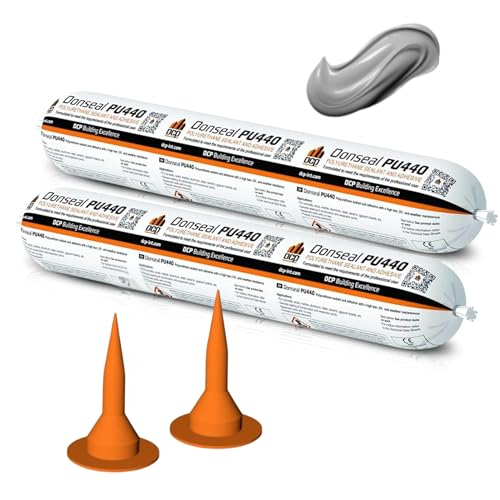
Stays put on a vertical basement wall without slumping — that is the non-sag polyurethane formula gripping in place.
Unlike the self-leveling LUVBOATE option, this Donseal is a non-sag, polyurethane-based (a tough, sticky sealant that cures by reacting with air humidity) joint filler that holds its shape on vertical surfaces. So you can seal basement walls or foundation cracks without the material sliding down. Each sausage pack holds 20.2 fluid ounces, and the box includes 20 nozzles plus two sausage caulks — enough spares for a long weekend job. After curing, it forms a dense rubber that stays flexible across an extreme temperature swing from -22°F to 175°F (so it handles freeze-thaw ground heave without cracking). Owners mention that it adheres well to joint walls, but caution that it is very sticky and hard to tool for a perfectly smooth finish. One reviewer noted it sets to the touch sooner than other polyurethane products they have used but takes longer to dry through. Because this material is water resistant and paintable, you can match it to your interior or exterior color.
Why professionals reach for it
- Non-sag formula stays in place on vertical and overhead applications
- Wide service temperature range handles freeze-thaw climates
- Paintable after curing to blend with surrounding surfaces
The trade-off
- Very sticky application makes a clean finish hard to achieve
- Longer overall dry time compared to some latex-based fillers
Reach for this if: You need to seal expansion joints or vertical cracks in a cold climate and want a dense, flexible bond that resists temperatures down to -22°F.
Look elsewhere if: You want a quick, no-tool application — this requires a sausage gun and patience with the tooling process.
3. Magic Crack Filler 2.5LB Concrete Slab Gray
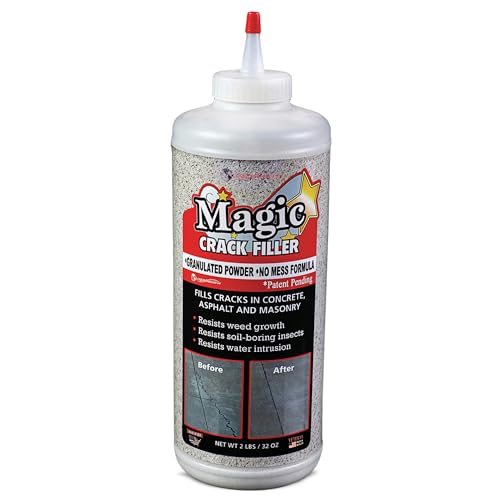
No squeeze tube, no sticky fingers—just pour dry granules into the crack, spray water, and it hardens overnight.
If you hate messy squeeze tubes, this powder formula is your solution. You simply clean the crack, pour the granulated synthetic rubber compound (a dry, sand-like material that activates with water) into the gap, tap it level, and spray with water. The material hardens, bonding to the edges of the concrete. Customers note that after drying overnight, the filler blended well with raw concrete color and was barely noticeable. One buyer mentioned that the color was slightly different from new concrete, but the main goal — stopping water from freezing inside the crack — was achieved. Because the granules fit cracks as fine as hairline and as wide as a road map, you do not need a second product for different crack sizes. One thing to know: reviewers mention that the bottle goes fast if you are filling large gaps, so buy the size that matches your job extent.
Why it is a smart buy
- Dry powder application means zero mixing and minimal cleanup
- Works on hairline to wide cracks without needing multiple tools
- Self-levels when sprayed with water for a flush finish
Watch out for
- Color match is not perfect — slightly different from fresh concrete
- Expensive for the volume if you have a large job with deep cracks
Who will love it: DIY homeowners tackling a concrete slab, sidewalk, or patio with multiple crack sizes who want a fast, no-mess application that yields a professional-looking finish.
Who should pass: Those sealing expansion joints that need a flexible, non-sag polyurethane rather than a rigid granular fill.
4. Bluestar Flexible Concrete Crack Filler (Gray) – 16 fl. oz.

A latex paste reinforced with sand that fills cracks up to one inch wide and stays flexible through hot and cold weather.
This Bluestar is a latex-based paste (a water-cleanup, flexible filler) reinforced with sand, designed for DIY repairs on driveways, sidewalks, patios, and garage floors. It comes in two shades of gray to help you match your existing concrete, and the flexible formula expands and contracts with crack movement in both hot and cold weather. Unlike the water-activated powders, this one applies wet and thick — you squeeze it along the crack, wait about 15-20 minutes until it skins over, then flatten it with a putty knife for a smooth finish. Reviewers point out that the filler works as advertised for larger cracks, but note that the color match can be poor against old concrete. One owner reported that some filler fell out after 6 months due to poor adhesion, and that the material itself cracks after a year. On the positive side, shoppers say it is easy to apply, dries quickly, and works well layered over 3-5 days for deep cracks. The 16-ounce bottle is noticeably smaller than the 24.7-ounce LUVBOATE option, so budget for multiple bottles if you have a long driveway.
What works well
- Fills cracks up to one inch wide with a flexible, waterproof seal
- Easy application and cleanup with water
- Two gray shade options for better color matching
The durability question
- Some adhesion failures reported after 6 months in real use
- Thick paste does not flow into cracks under 1/8 inch easily
Its best use: Quick fix for medium-to-wide cracks where you want a fast-drying latex that cleans up with water and stays flexible through seasonal temperature swings.
Where it falls short: If you need a long-term adhesion on old, dusty concrete or a perfect color match, you may need a different chemistry or staining step.
5. ConSandtrate Concrete Crack Filler – Tan – 2 LB
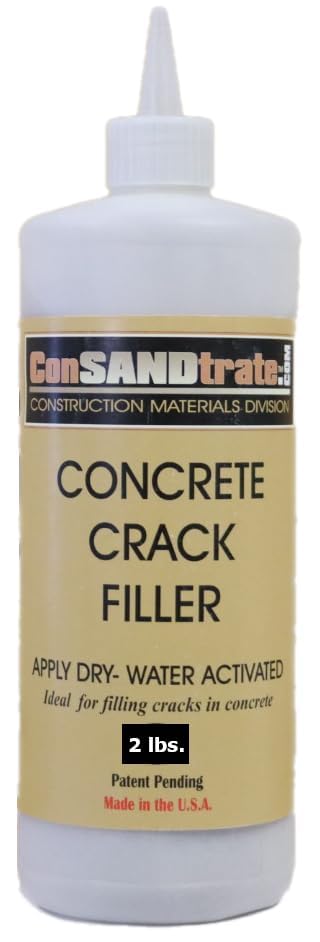
Self-healing polymers reactivate when wet to fill tiny gaps again without you lifting a finger.
The unique selling point here is the self-healing feature — the polymerized concrete (a cement-like powder mixed with reactive polymers) blend reacts to moisture and reinstates itself when wet, which helps reseal tiny gaps that might form over time. You simply pour the material into the crack, brush off the excess, and spray with water. No mixing, no troweling, no special tools. The bottle measures 2 x 2 x 8 inches, versus the Bluestar’s 3 x 3 x 8 inches, so it takes up less shelf space but gives you a similar weight of material. Buyers report that this filler lasts over a year in freeze-thaw climates but requires annual touch-ups to maintain the seal. One customer observed that the color initially matched their brown concrete but turned grey after drying. Several users mentioned that it works well for narrow cracks with fine grain application, flowing easily when applied with the tapered nozzle, then brushing off the excess before misting.
What is unique here
- Self-healing polymers reactivate when wet to reseal small gaps
- Water-activated application is quick and low-mess
- Good for narrow cracks that need fine grain flow
The honest limits
- Color may shift after drying — not a guaranteed match
- Dries slightly soft, not hard like concrete, and needs yearly touch-ups
Grab it for: Small, narrow cracks where you value an easy pour-and-spray application and the self-healing feature helps extend the repair life.
Skip it for: Deep or wide cracks that need a thick, structural fill — this works best on hairline to moderate gaps.
6. Gray 1.4 LB Magic Crack Filler Bottle – Easy, No-Mess Crack Repair
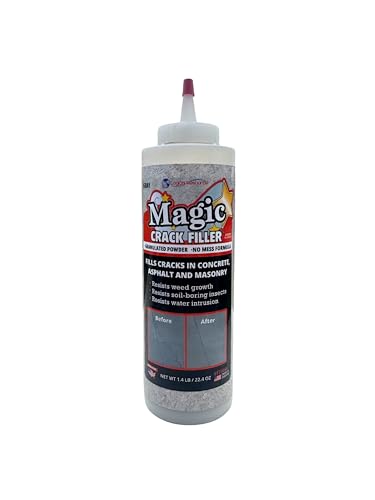
The 1.5-pound entry-level powder that hardens into a weather-resistant patch for small cracks without any mixing.
This is the smaller sibling in the Magic Crack Filler line, a 1.5-pound bottle of granulated concrete powder that activates with water. It is designed for quick DIY repairs on concrete, masonry, and asphalt surfaces like driveways, walkways, and patios. The process is identical to the larger 2.5-pound version: pour, sweep into the crack, spray water, and let it set. Reviewers consistently call it easy to use, noting that it fills cracks well and dries solid and clean. Owners mention that the filler held up through weather and regular use with no cracking or peeling, and that the color is a very good blend with existing concrete. However, one reviewer pointed out that while it improves the appearance, the filler is still visible and does not blend smoothly — it is not an invisible fix. Another noted that the long-term durability is uncertain beyond a season or two. For the price, this is a solid choice if you have a handful of small cracks and want a no-mess solution that works immediately.
The appeal at this price
- Very easy application with no mixing or special tools needed
- Weather-resistant bond that holds up through rain and heat
- Made in the USA by a veteran-owned business
Where corners are cut
- Color does not blend invisibly — patch is still noticeable
- Bottle goes fast if you have more than a few small cracks
Right for: Budget-conscious homeowners with a few small cracks who want a reliable, weather-resistant patch with minimal effort and cost.
Wrong for: Large or deep cracks that need a flexible, structural seal—you want the 2.5LB version or an MS polymer paste.
Understanding the Specs
MS Polymer vs Polyurethane
MS polymer is a modern hybrid sealant that bonds strongly to damp concrete without a primer and stays flexible like rubber after curing — ideal for horizontal surfaces that see foot traffic. Polyurethane is tougher and sticks to vertical walls, but it is sticky to apply and takes longer to fully cure. Choose MS polymer for driveways and walkways; choose polyurethane for expansion joints and foundation walls.
Self-Leveling vs Non-Sag
Self-leveling sealants are thin liquids that flow into a crack and smooth themselves out — perfect for flat slabs but useless on a slope. Non-sag formulas are thicker pastes that stay where you put them, even on vertical surfaces. If you are filling a horizontal driveway crack, self-leveling saves you tooling time. If you are sealing a basement wall joint, you must use a non-sag caulk.
Water Activity and Set Time
Water-activated powders require you to spray the filled crack with water, which triggers a chemical hardening reaction. They are the easiest to apply — pour, level, spray — but they set rigid and work best on cracks under 1/2 inch wide. Paste and liquid sealants cure by evaporation or humidity reaction, taking 24 to 48 hours to fully harden. The trade-off is that pastes bond more flexibly and can handle wider, deeper gaps than powders.
Temperature Range and Weather Resistance
Check the service temperature range if you live in a freeze-thaw zone. A polyurethane sealant rated from -22°F to 175°F will stay elastic when the ground freezes and heaves, while a latex filler may stiffen and crack at lower temperatures. UV resistance also matters for exposed patios — polyurethane and MS polymer hold up longer under direct sun than standard latex or cement-based fillers.
FAQ
Can I apply concrete joint sealant over old, crumbling filler?
Will a self-leveling sealant work on a sloped driveway?
How long does concrete joint sealant last before needing reapplication?
Can I paint over a cured concrete joint sealant?
What crack width is too large for a water-activated granular filler?
Is it safe to use concrete joint sealant around plants or grass?
What is the difference between a crack filler and an expansion joint filler?
How do I keep a polyurethane sealant from being so sticky to tool?
Final Thoughts: The Verdict
For the majority of shoppers, the best concrete joint sealant winner is the LUVBOATE Concrete Crack Filler because its MS polymer chemistry delivers the ideal balance of flexibility, adhesion, and easy self-leveling application for the widest range of driveway and patio cracks. If you need to seal vertical expansion joints in a cold climate, grab the DCP Donseal PU440 for its non-sag formula and extreme temperature tolerance. And for a fast, no-mess repair on multiple small cracks, the standout is the Magic Crack Filler 2.5LB — pour, spray, and you are done.
How We Picked
We do not accept paid placement. Every pick is matched to a real buyer and a real use-case; we do not hands-on test units.
Sources & Methodology
Specifications: manufacturer listings and product documentation. Review insights: verified customer reviews, as of July 2026. Pricing: not shown on this page (it changes often); check the current price via the retailer link.
As an Amazon Associate, WellFizz earns from qualifying purchases. This does not affect which products we feature.
Related Guides

Mo Maruf
I created WellFizz to bridge the gap between vague wellness advice and actionable solutions. My mission is simple: to decode the research and give you practical tools you can actually use.
Beyond the data, I am a passionate traveler. I believe that stepping away from the screen to explore new environments is essential for mental clarity and physical vitality.