Our readers keep the lights on and my smoothie glass nicely filled. As an Amazon Associate, I earn from qualifying purchases.
Specs are compiled from manufacturer listings and verified buyer reviews and can change over time — please confirm the key details on the product page before buying.
A chitarra pasta cutter sounds simple — you press dough across metal strings and get perfect noodles. But the moment you open a box with loose wires or strings that snap on the first use, you realize not all of these tools are built the same. This guide sorts the sturdy Italian-made boards from the ones that will frustrate you, so you can start kneading and cutting without the headache.
I’m Mohammad Maruf — the founder and writer behind WellFizz. This guide is built by comparing the manufacturers’ published specifications and the patterns across verified customer reviews, so you get each pick’s real strengths and trade-offs instead of marketing spin.
The key is finding a board with evenly tensioned stainless steel strings, a smooth beechwood surface, and dual cutting widths. That is exactly what this review of the best chitarra pasta cutter options on the market delivers, so you can make homemade spaghetti and fettuccine that holds sauce like it should.
Quick Picks
- Chitarra Pasta Maker with Rolling Pin by Verve CULTURE — Best Overall
- SiliFine Chitarra Cutter Italian Pasta — Most Versatile
- Calder A4982241 Spaghetti Alla Chitarra Maker, Brown — Classic Rustic
- Eppicotispai “Chitarra” Pasta Cutter — Compact Pick
- Cooking on Mars Chitarra Pasta Cutter — Budget Entry
How To Choose The Best Chitarra Pasta Cutter
A chitarra looks like a simple wooden frame, but its performance depends entirely on details you cannot see in a product photo. Here are the three things that separate a great cutter from a frustrating one.
String Material and Tension
The strings are what do the cutting. Stainless steel is the standard — it resists rust and holds tension well. Look for models that let you tighten the wires by turning bolts (most do). Avoid any board where the strings are fixed permanently loose or feel flimsy, because dough will just push through rather than slicing cleanly.
Dual-Sided Cutting
Most chitarra boards have two sets of strings. One side uses narrow spacing (around 2mm to 3mm) for thin spaghetti, and the other side uses wider spacing (around 5mm to 6mm) for fettuccine or tagliatelle. A dual-sided board effectively gives you two tools in one, so you can switch between pasta shapes without owning a second cutter.
Wood Quality and Dimensions
Beechwood is the traditional choice — it is hard, dense, and resists absorbing moisture from the dough. Cheaper models sometimes use pine, which can warp or crack over time. Also consider the board’s length. A board around 17 to 20 inches long gives you enough room to roll out a full sheet of pasta without the dough hanging off the edge.
Quick Comparison
| Model | Best For | Cutting Widths | Item Weight | Dimensions | Amazon |
|---|---|---|---|---|---|
| Verve CULTURE Chitarra | Premium dual-action cutter | 3mm / 6mm | 3.4 Pounds | 20″ x 9.25″ x 4″ | Amazon |
| SiliFine Chitarra Cutter | Two pasta shapes from one board | 2mm / 5mm | 3.5 Pounds | 17.32″ x 10.63″ x 3.15″ | Amazon |
| Calder Spaghetti Alla Chitarra | Traditional rustic build | 3mm / 6mm | 2.3 Pounds | 17.63″ x 8.75″ x 3.63″ | Amazon |
| Eppicotispai Chitarra | Smaller footprint for tight kitchens | Not specified | 2 Pounds | 16″ x 8″ x 14″ | Amazon |
| Cooking on Mars Chitarra | Budget-friendly entry point | 2mm / 5mm | 2.7 Pounds | 14.57″ x 7.87″ x 3.35″ | Amazon |
In‑Depth Reviews
1. Chitarra Pasta Maker with Rolling Pin by Verve CULTURE

The chitarra that gives you square-edged noodles for sauce that really clings.
This board is built for the cook who wants a big, sturdy surface and the option to cut two pasta widths. The Verve CULTURE board measures 20 inches long by 9.25 inches wide — notably 37% larger than the Cooking on Mars board (14.57″ x 7.87″), giving you more room to roll out a full sheet of dough. The 2-millimeter maximum sheet thickness is the thinner end of the range, which helps your pasta cook through evenly and feel delicate rather than doughy.
Buyers report that the dual pasta cutter creates unique square-edged noodles for better sauce adhesion. That squared-off shape gives sauces like carbonara or bolognese something to grab onto. The board is made of natural wood with stainless steel strings, and it comes packed in a drawstring muslin bag for storage. It weighs 3.4 pounds, so it sits steady on your counter while you press down.
The catch? A few buyers mention slight rocking if the wood expands in humidity, and one review notes the bag was missing on arrival. The board is also heavier than lighter options like the Eppicotispai (3.4 pounds vs 2 pounds), so it is less portable if you plan to move it in and out of a cabinet often.
What Stands Out
- Largest work surface of any board here (20″ x 9.25″)
- Square-edged noodles improve sauce grip, per buyer feedback
- Includes a drawstring storage bag for gifting or tucking away
Consider This
- Some boards may rock slightly due to wood expansion
- Storage bag missing for some buyers
- Heavier than smaller chitarra boards
Pick this if: You want the largest, most traditional chitarra board with square-edged noodles that hold sauce better than standard round spaghetti.
Think twice if: Counter space is tight — the 20-inch length needs a dedicated spot, and the weight makes it less convenient to store away.
2. SiliFine Chitarra Cutter Italian Pasta with Rolling Pin Guitar Board Making Tool
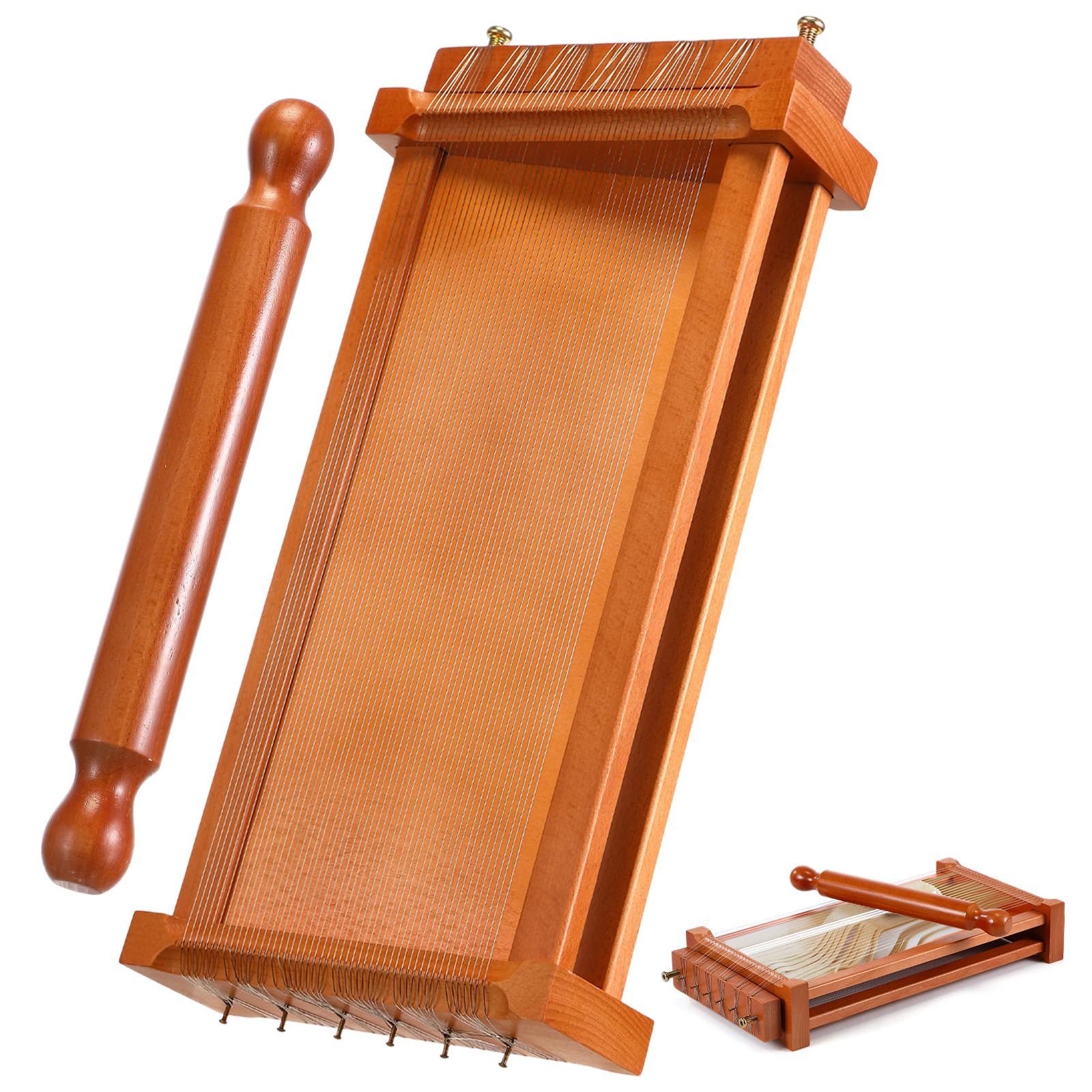
Two pasta shapes from one board — square Tonnarello on one side, fettuccine on the other.
The SiliFine board stands out because it is designed for two distinctly different cuts, not just spaghetti and fettuccine. One side uses strings spaced at 0.08 inches (about 2mm) to cut square Tonnarello pasta, while the other side spaces the strings at 0.2 inches (about 5mm) for fettuccine. That is a genuine versatility advantage over single-width boards.
You get two pasta shapes from one tool: owners mention the dual-sided design cuts both square pasta and wider fettuccine. The board is 17.32 inches long by 10.63 inches wide, with a wire cutting area of 16.5 by 6.5 inches — enough room to cut a full sheet of dough without shifting it. A 12.2-inch rolling pin is included, so you do not need to buy one separately.
One thing to note: if the strings arrive loose, you can tighten them by carefully turning the bolts, but overtightening can cause breakage. A few buyers mention difficulty finding replacement cords later, so treat the strings gently during cleaning. The instructions also recommend wiping clean with an unsaturated cloth or brush — no soaking.
Best for shape explorers: This board lets you experiment with Tonnarello (square spaghetti) and fettuccine from one tool, making it a creative pick for home cooks who love Italian variety.
Reach for this if: You want the flexibility to cut two distinctly different pasta shapes — square spaghetti and wide fettuccine — without buying a second board.
Look elsewhere if: You prefer a lighter, more portable tool. At 3.5 pounds it is the heaviest board here, and the lack of easy-to-find replacement strings may bother you long-term.
3. Calder A4982241 Spaghetti Alla Chitarra Maker, Brown

An authentic Italian chitarra that produces two pasta widths — once you adjust the wires.
The Calder chitarra has a rustic, old-school feel, made of beechwood with stainless steel wires. It cuts 3mm spaghetti on one side and 6mm noodles on the other, giving you the same basic dual-width feature as the premium picks above. The board measures 17.63 inches by 8.75 inches and weighs 2.3 pounds, which splits the difference between the heavier SiliFine (3.5 pounds) and the lighter Eppicotispai (2 pounds). Note that this model does not come with a rolling pin — you will need to use your own.
Customers note mixed experiences. One satisfied user says after a minor wire adjustment it works like a charm and produces fantastic pasta in two widths. Another mentions the wires snapped on first use, and a different review describes the strings arriving as a hopeless tangled rat’s nest. The consistency seems to depend on how the wires were tensioned during manufacturing — some boards are ready to go, others need careful tuning or replacement.
The lack of included instructions is a recurring complaint. If you are comfortable tightening and possibly rethreading wires, this board can produce great pasta at a mid-range price. But if you want a tool that works perfectly from the start, you may want to spend a little more on the Verve or SiliFine.
For the tinkerer: This board rewards someone who does not mind a 10-minute wire adjustment session. Once set, it cuts clean pasta — but expect to tighten the wires after the first use, as the manufacturer notes.
Choose this if: You are comfortable adjusting and rethreading wires yourself and want an authentic Italian-made board at a mid-range price point.
Avoid if: You want the wires to work perfectly from the moment you open the box. The tangling issue reported by multiple buyers is a real gamble.
4. Eppicotispai “Chitarra” Pasta Cutter with 32cm/12.5-Inch Rolling Pin

A smaller, 2-pound board that fits neatly into a tight kitchen cabinet.
If your counter space is limited, the Eppicotispai chitarra is the most compact option here. It measures 16 inches long by 8 inches wide and weighs just 2 pounds — meaning it is 1.5 pounds lighter than the Verve CULTURE board (3.4 pounds). Made in Italy from beechwood with stainless steel wires, it comes with a 12.5-inch rolling pin included, so you have everything you need in one box. The traditional string setup produces a cutting action similar to a kitchen guitar.
Buyers generally appreciate the sturdy hardwood build and find it easy to tension and release the wires. One review notes that it makes uniform spaghetti quickly and is very easy to clean as long as the dough is not too wet. But a common gripe is that the middle strings won’t tighten enough, causing dough to not cut through cleanly in that area. That specific issue — the central strings staying loose — is a design limitation that can leave you with uneven noodles unless you find a workaround.
The board is 100% made in Italy and imported by Tomson Hospitality, giving it an authentic pedigree. However, at this price it sits close to the Calder board, and the middle-string problem gives the edge to models with more even tension across the full width.
What Fits Well
- Smallest and lightest board (2 pounds) — ideal for small kitchens
- Includes a 12.5-inch rolling pin so you do not need to buy one separately
- Sturdy beechwood construction with easy wire tensioning
The Limitation
- Middle strings often fail to tighten enough, leaving uneven cuts
- Smaller cutting surface may not fit a full pasta sheet in one pass
A good fit for: Anyone with very limited counter space who wants a lightweight, authentic Italian chitarra with a rolling pin included and does not mind checking the middle strings.
A miss for: Cooks who want perfectly even spaghetti across the full width of the board — the middle-string slack issue is a known and unresolved complaint.
5. Cooking on Mars Chitarra Pasta Cutter, Made in Italy, Beechwood and 18/8 Stainless Steel

An affordable entry into chitarra pasta making — with the widest sheet thickness allowance.
The Cooking on Mars board is the most budget-friendly pick in this lineup, made in Italy from natural beechwood with 18/8 stainless steel strings. It cuts 62 square spaghetti strands (2mm) on the narrow side and 32 tagliatelle strands (5mm) on the wider side. The maximum sheet thickness is 5 millimeters — that is a 2.5x wider gap compared to the Verve CULTURE board (2 millimeters), which means you can work with thicker dough sheets if you prefer a heartier pasta texture.
Buyers are split. Some love the two cutting sides and say the wood and construction are wonderful. One user specifically says the fit is perfect for a shorter person. But a significant number report issues — one review says the strings arrived tangled, another calls the wires “junk” and says they are too thin, and a third says the cutting strings were falling off. The strings can be retightened by turning the bolts, but over-tightening could cause breakage.
At 14.57 inches long and 7.87 inches wide, this is the smallest board here — 37% smaller than the Verve CULTURE (20″ x 9.25″). That compact size may suit a very small kitchen, but the narrower cutting area means you will have to cut your dough sheets down to fit. The mixed reviews on wire quality suggest this is a board where you might need to replace or re-tension the strings right away.
Thick dough friendly: With a 5-millimeter maximum sheet thickness, this board lets you roll pasta thicker than most competitors — good if you like a chewier, more rustic noodle.
Consider this if: Your budget is tight and you want to try chitarra pasta making without a big investment. The 5-millimeter sheet allowance is a genuine advantage for thicker dough.
skip it if: You want reliable wires from the start — the quality control reports on string tension and tangling are too frequent to ignore.
Understanding the Specs
Cutting Widths (mm)
This is the spacing between the metal strings on each side of the board. A narrower spacing (like 2mm or 3mm) cuts thin spaghetti strands, while wider spacing (5mm or 6mm) cuts fettuccine or tagliatelle. Most chitarra boards have two sides so you can switch between shapes. If a spec lists “3mm / 6mm,” it means one side cuts 3mm noodles and the other side cuts 6mm noodles.
Maximum Sheet Thickness
This tells you how thick your rolled-out dough can be before the strings cannot cut through cleanly. A 2-millimeter maximum is the most common and produces a delicate, restaurant-style pasta. A 5-millimeter maximum lets you work with thicker, chewier dough, but you need to ensure your dough is evenly rolled so the thickest part stays within the limit.
FAQ
Does a chitarra pasta cutter work with gluten-free dough?
How do I tighten the wires on a chitarra board?
Can I wash a chitarra pasta cutter in the dishwasher?
What is the difference between a chitarra and a regular pasta machine?
Does a 2mm or 5mm cutting width make a big difference in the final pasta?
How thick should I roll my pasta dough before using a chitarra?
Can a chitarra cutter cut lasagna noodles or ribbon cookies?
How long does a beechwood chitarra board typically last?
Is a heavier chitarra board better than a lighter one?
What pasta shapes can I make with a chitarra other than spaghetti?
Final Thoughts: The Verdict
For most people, the best chitarra pasta cutter winner is the Verve CULTURE Chitarra because its large 20-inch board, dual cutting widths, and square-edged noodles give you the real traditional experience with consistent sauce-holding results. If you want the flexibility of two distinct pasta shapes including square Tonnarello, grab the SiliFine Chitarra Cutter. And for a budget-friendly entry that still comes from Italy, the Cooking on Mars Chitarra gets you started with a 5-millimeter dough allowance, just be ready to check the wire tension immediately.
How We Picked
We do not accept paid placement. Every pick is matched to a real buyer and a real use-case; we do not hands-on test units.
Sources & Methodology
Specifications: manufacturer listings and product documentation. Review insights: verified customer reviews, as of July 2026. Pricing: not shown on this page (it changes often); check the current price via the retailer link.
As an Amazon Associate, WellFizz earns from qualifying purchases. This does not affect which products we feature.
Related Guides

Mo Maruf
I created WellFizz to bridge the gap between vague wellness advice and actionable solutions. My mission is simple: to decode the research and give you practical tools you can actually use.
Beyond the data, I am a passionate traveler. I believe that stepping away from the screen to explore new environments is essential for mental clarity and physical vitality.