Our readers keep the lights on and my smoothie glass nicely filled. As an Amazon Associate, I earn from qualifying purchases.
Specs are compiled from manufacturer listings and verified buyer reviews and can change over time — please confirm the key details on the product page before buying.
A cheap wood router should save you money, not cost you time fighting a tool that stalls on a pine board or burns out mid-project. The real trick is knowing which budget models pack enough motor and precision to handle real work without empty promises. This guide compares six routers under the premium price point, focusing on the specs and real owner experiences that separate a genuine value from a frustrating paperweight.
I’m Mohammad Maruf — the founder and writer behind WellFizz. This guide is built by comparing the manufacturers’ published specifications and the patterns across verified customer reviews, so you get each pick’s real strengths and trade-offs instead of marketing spin.
Whether you are trimming countertops, mortising door hinges, or rounding edges on a DIY shelf, today’s best cheap wood router choices deliver surprising capability for the money when you know which numbers matter most.
Quick Picks
- DOBETTER DBTR700 — Best Overall
- TWOWIN 0700 — Pro Kit
- AVID POWER MW104 — Bright Cuts
- Lotos ER001 — Plunge Pick
- TwoWin 3701 — Budget Starter
- WEN RT1460 — Beginner Ease
How To Choose The Best Cheap Wood Router
Buying a budget router is about picking the right trade-offs. A few key specs tell you whether a sub-70 dollar tool will handle your project or leave you frustrated. Focus on these three areas first.
Motor Strength: Amps and Horsepower
A router’s motor is measured in amps and horsepower (HP). Most cheap wood routers land around 6 amps and 1.25 HP. That is enough for trimming laminate, rounding edges on pine, and mortising softwood hinges — so you can shape a shelf edge without the bit slowing down. If you plan to cut dense hardwoods like oak regularly, look for the 6.5-amp models — the extra half-amp makes a noticeable difference in keeping the bit spinning under load without bogging down.
Variable Speed vs Single Speed
A variable-speed dial (typically ranging from 10,000 RPM to 32,000 RPM, meaning revolutions per minute) lets you slow the bit down for hardwoods so the friction does not burn the wood, and speed it up for softwoods and laminates for a clean shear. A single-speed router works fine for simple light tasks, but variable speed gives you the flexibility to handle different materials without ruining the workpiece.
Fixed Base vs Plunge Base
Most budget routers come as a fixed base, meaning you set the depth before the cut. That works well for edge profiling and trimming — like rounding over a countertop edge. If you need to cut mortises or slots in the middle of a board — like cutting hinge pockets — a plunge base lets you lower the bit into the wood mid-surface. At this price point, the Lotos ER001 is the only model that offers a plunge base, making it a standout for door work.
Quick Comparison
| Model | Best For | Motor Power | Max Speed | Base Type | Amazon |
|---|---|---|---|---|---|
| DOBETTER DBTR700 | Best Overall Performance | 6.5 Amp / 1.25 HP | 32,000 RPM | Fixed | Amazon |
| TWOWIN 0700 | Best Accessory Kit | 6.5 Amp / 1.25 HP | 30,000 RPM | Fixed | Amazon |
| AVID POWER MW104 | Best LED Visibility | 6.5 Amp / 1.25 HP | 32,000 RPM | Fixed | Amazon |
| LOTOS ER001 | Best Plunge Router Pick | 9.95 Amp / 1.6 HP | 30,000 RPM | Plunge | Amazon |
| TwoWin 3701 | Best Budget Starter Kit | 6.5 Amp / 1.25 HP | 30,000 RPM | Fixed | Amazon |
| WEN RT1460 | Best for Beginners | 6 Amp / — | 30,000 RPM | Fixed | Amazon |
In‑Depth Reviews
1. DOBETTER DBTR700
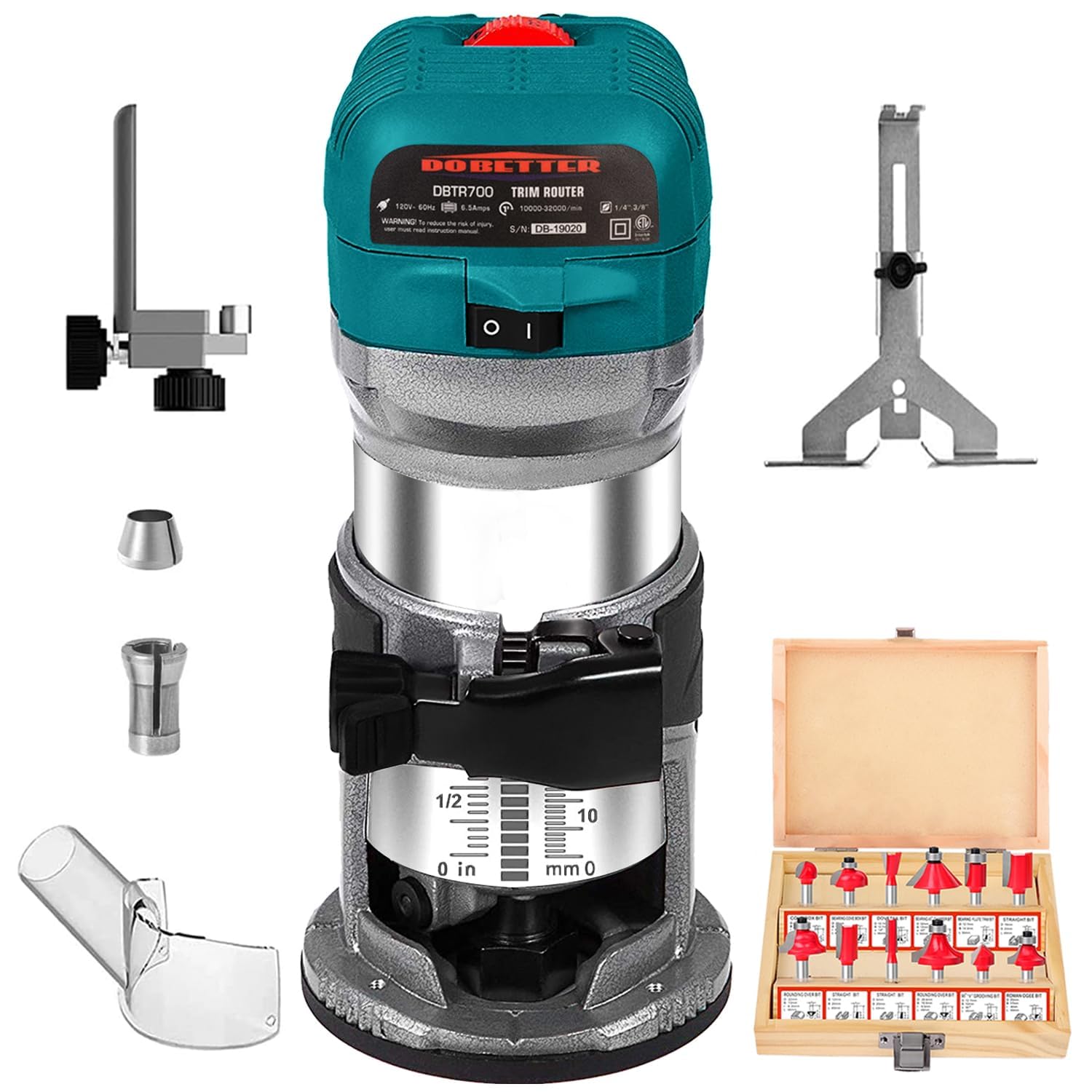
The DOBETTER DBTR700 hits 32,000 RPM with less vibration than the TwoWin 3701, so your cuts stay clean on hardwoods and laminates.
The DOBETTER DBTR700 stands out in this group for its top-end speed of 32,000 RPM — that is 2,000 RPM faster than the TWOWIN 0700’s max of 30,000 RPM. Combined with a 6.5-amp motor (which measures how much electrical current it draws for cutting force) and 1.25 HP, this gives you cleaner cuts on hardwoods and laminates when you dial it up. The six variable speeds range from 10,000 RPM to that peak 32,000 RPM, so you can drop the speed to prevent burning on oak then crank it back up for a smooth pass on a pine shelf — the lower speed reduces heat, the higher speed shears the material clean.
Buyers report that the “powerful 6.5-amp motor, compact, minimal vibration” makes it a favorite for both CNC use and manual trimming. The rack-and-pinion depth adjustment system (a gear-and-bar mechanism that moves the base up and down precisely) is accurate, with clear inch and millimeter scales, and the soft-start feature (which ramps the motor up gradually) keeps the tool from jerking when you pull the trigger. The kit includes 12 router bits, an edge guide, a roller guide, a dust hood, and a carrying bag. Owners mention that the included bits are decent for softwood but swapping in quality bits noticeably improves performance on denser material — one owner mentioned using it for speaker cutouts with good results.
High-speed edge runner: The 32,000 RPM max, variable speed range, and 6.5-amp motor make this the most versatile performer in the cheap router bracket, especially if you work with varied materials.
Bit-change friction: Some users report the bit-change screw is awkwardly placed and requires removing the base for easy access — a minor inconvenience for the money.
Who it fits: Any DIYer who wants the highest speed ceiling and lowest vibration in this price tier — it handles everything from edge rounding to freehand sign carving without bogging.
One honest trade-off: The included bits are usable for softwood but should be replaced with quality carbide bits for serious hardwood work; one reviewer’s bit bearings failed quickly on a guitar body.
2. TWOWIN 0700

The TWOWIN 0700 gives you 15 bits and three collet sizes (6mm, 6.35mm, 8mm) to start hinge mortising right away — a better turnkey package than the DOBETTER DBTR700.
The TWOWIN 0700 matches the DOBETTER on motor specs at 6.5 amps and 1.25 HP, but maxes out at 30,000 RPM — still plenty for most trim work. What sets this model apart is the accessories bundle: 15 router bits, three collet sizes (6mm, 6.35mm, and 8mm — the collet is the chuck that grips the bit’s shank), a dust hood, a straight guide, a trimming guide, ten sandpapers, and spare carbon brushes. That range of collets means you are not locked into a single shank diameter, which gives you more bit options right from the start — for example, you can use European-standard 6mm bits alongside standard 1/4-inch bits.
One buyer specifically noted, “I purchased the Twowin 0700C to use with a Hingemate 350 door mortising kit,” and reported that the router performed well for 12 hinge mortises. Another reviewer appreciated that the rubberized handle reduces fatigue during longer sessions. The soft-start feature minimizes the starting torque, so the router does not jump on startup — a genuine safety benefit at this price. The cooling fan uses high-strength plastic blades that run quieter than metal fans on many competitors. That said, reviewers consistently note the unit gets hot after 4 to 8 minutes of continuous moderate load, so plan brief cooling breaks during extended runs.
Mortise-ready package: The three-collet system, dust hood, and 15-bit set make this the best turnkey solution for door hinge work and cabinet trimming, saving you the cost of buying accessories separately.
Heat buildup: Not designed for prolonged heavy cuts — budget routers naturally heat up, and this one is best for intermittent project work rather than all-day production.
Reach for this if: You need a router specifically for mortising hinges or trimming countertops and want every accessory included so you can start working immediately.
Look elsewhere if: Your work involves heavy shaping or dense hardwood for more than 10 minutes at a stretch — the heat buildup may slow you down.
3. AVID POWER MW104

Dual LEDs on the AVID POWER MW104 light the cut path so you see exactly where the bit goes — the only router in this list that helps you see in dark cabinets.
The AVID POWER MW104 is the only router in this roundup with integrated illumination — dual bright LED lights that shine directly on the cutting path. That is a genuine advantage if you have ever tried to follow a layout line under a dim workbench or inside a cabinet. It shares the same 6.5-amp, 1.25 HP motor as the DOBETTER and tops out at 32,000 RPM with variable speeds from 10,000 RPM. The aluminum body and base give it a solid feel at 4.4 pounds, and the quick-lock system lets you change depth or remove the base quickly.
Customers note that the router “ran 30 minutes flawlessly, stayed cool” during CNC use — a notable contrast to the heat complaints on competing models like the TwoWin 3701. Another reviewer called it “compact, lightweight, quiet” and highlighted the warranty: when an axle issue arose, the company sent a brand-new replacement. The kit includes five router bits, an edge guide, a roller guide, 1/4-inch and 3/8-inch collets, and spare carbon brushes. One important warning from a buyer: the included bits can be dangerous — guide bearings disintegrated within 30 seconds on a guitar body. Use your own quality carbide bits from the start.
Visibility advantage: Dual LEDs illuminate the cut line far better than any competitor in this price range — a huge help for freehand routing in tight or dark spaces.
Bit caveat: The included bits are not reliable for precision work; budget for a separate set of quality bits and treat the included ones as backups or rough-use only.
Best for: Anyone who routes in low-light conditions — installing cabinets under counters, trimming laminate in closets, or working in a dim garage — the LEDs remove guesswork.
One thing to know: The bundled bits are a weak point; replace them immediately with a trusted carbide set for clean, safe cuts on hardwood.
4. Lotos ER001

The Lotos ER001 is the only plunge base in this group, and its 9.95-amp motor delivers 1.6 HP — more than 50% extra power over the 6.5-amp fixed-base routers here.
The Lotos ER001 is a different beast from the fixed-base palm routers above. Its plunge base lets you lower the bit into the middle of a board for mortises (rectangular slots for door hinges), dadoes (grooves across the grain), and template-guided work — something none of the fixed-base models can do. It is also significantly more powerful: the motor draws 9.95 amps and delivers 1.6 HP, versus the 6.5-amp / 1.25 HP standard on the DOBETTER and TWOWIN models. That extra grunt shows up when you are sinking a 1/2-inch straight bit into oak for a deep hinge mortise. The variable speed runs from 16,000 RPM to 30,000 RPM.
Reviewers point out that the ER001 delivers “plenty of power” for hardwood work and that the 2-inch plunge depth handles cabinetry well. The 7-stop turret (a rotating dial with preset stops) combined with macro and micro depth adjustments gives you repeatable, precise depth settings without guessing. One owner said, “I’m just a hobbyist and have used this to round edges, mortise hinges, and cut trenches in wood. Does everything well.” The aluminum body adds heft — it is noticeably heavier than the palm routers — but that weight also helps dampen vibration during deep cuts. The included dust collector hookup keeps the work area clean, though some users mentioned the small adjustment knobs can feel tight on the fingers.
Plunge for precision: If you need to cut hinge mortises, stopped dados, or follow a template, this is the only affordable option in the group — and the 9.95-amp motor makes it feel like a far more expensive tool.
Heavier and slower: At a higher weight and with a larger body, it is less comfortable for one-handed edge trimming; it is best as a two-handed router for precision work.
Get this for: Cabinetry work, door hinge installation, and any project requiring plunge cuts — the micro-adjustment and 2-inch depth capacity are genuinely useful here.
skip it if: You only need a lightweight trim router for laminate edges and simple profiling — a fixed-base palm router will be easier and cheaper.
5. TwoWin 3701

The TwoWin 3701 costs less than the DOBETTER DBTR700 but includes 15 usable tungsten carbide bits, so you do not need a separate bit purchase for your first project.
The TwoWin 3701 is the entry-level price leader of this group, but it does not feel like a toy. Its 800W motor (roughly 6.5 amps) delivers 1.25 HP and spins up to 30,000 RPM — the same motor class as many more expensive trim routers. The model uses a fixed base with a transparent plastic plate that gives you a clear view of the cutting edge, helpful for following a line. It comes with a wooden organizer that holds all 15 included tungsten carbide bits (tungsten carbide is a very hard, durable material that stays sharp longer than steel), plus a straight guide, trimming guide, wrenches, and spare carbon brushes.
Shoppers say that the “Router performed well for 12 hinge mortises” and that the bits are “super sharp and cut well.” Another owner said it works well for small projects and they “still have all my digits” — a lighthearted nod to the tool being safe and manageable for beginners. The 3.54-inch wide base is small, which helps with tight areas but requires careful leveling on a jig. The tool weighs 77 ounces (about 4.8 pounds), giving it a sturdy feel. One honest note from a reviewer: the router gets hot after 4-8 minutes of light to medium load, so treat it as an intermittent-use tool rather than one for hours of production.
Sharp starting point: The included tungsten carbide bits are actually usable right from the start — a rarity at this price — and the wooden case keeps everything organized.
Small footprint: The compact 3.5-inch base works great for detailed work but demands extra attention when leveling on a larger jig.
Ideal if: You are a beginner or occasional DIYer who needs one affordable kit to handle edge trimming, hinge mortising, and slot cutting without buying extra bits.
One trade-off: The base is small and the router heats up after several minutes of moderate cutting; take breaks on longer jobs and you will be fine.
6. WEN RT1460

The WEN RT1460 ramps up gently with its soft-start motor, so a first-time user feels in control — unlike the DOBETTER DBTR700, which can jerk at startup if you are not ready.
The WEN RT1460 is slightly less powerful on paper than the DOBETTER and TWOWIN models — it runs a 6-amp motor versus their 6.5-amp units, which works out to about an 8% difference in amperage. The variable speed dial goes from 12,000 RPM to 30,000 RPM, and the soft-start feature ramps the motor up gradually rather than jerking the tool at startup — a genuine comfort point for someone who has never held a router before. Many buyers noted exactly this: one owner who had “never used a router in my life” reported that the RT1460 “made it easy to learn and use.”
Buyers consistently say the WEN has “plenty of power for hardwood, lower noise than larger routers.” The adjustable base offers 1-5/8 inches of travel with a 1-inch scale marked in 1/16-inch increments, and the transparent base plate gives a clear view of the cut line. The kit includes a guide fence for straight cuts and a trim guide for curved work. Unlike some of the bundled kits above, the RT1460 does not include router bits or a carry case — you will need to supply your own bits. It weighs 2.55 kilograms (about 5.6 pounds), making it the heaviest fixed-base option here, but that mass helps with stability on the work surface.
Gentle start for rookies: The soft-start motor and lower vibration make this the most approachable router for a first-time buyer — you will feel in control from the moment you pull the trigger.
No bits included: You must buy router bits separately, which adds cost and requires a separate purchase before you can start; factor that into the total cost.
Reach for this if: You are brand-new to woodworking and want a tool that feels predictable and safe — the soft start and lower noise make learning less intimidating.
One honest caveat: At 6 amps, it has slightly less power than the 6.5-amp models above, so you may notice it bog down sooner in dense hardwood; for trimming and light work, it is perfectly capable.
Understanding the Specs
Amperage and Horsepower
Amperage tells you how much electrical current the motor draws — more amps generally means more cutting force without stalling, so you do not have to stop mid-cut to let the motor cool. In this category, 6 amps is the baseline for light trimming, while 6.5 amps gives you a meaningful edge for hardwoods. Horsepower (HP) is a related measure of the motor’s output; most cheap routers fall between 1.25 HP and 1.6 HP. A higher HP rating, like the Lotos ER001’s 1.6 HP, translates to more torque for deeper cuts without bogging down — that means you can cut a deeper hinge mortise in one pass instead of two.
Variable Speed Range
A variable speed dial (typically 10,000–32,000 RPM) lets you match the bit’s rotation speed to the material. Lower speeds around 10-12,000 RPM prevent the bit from burning hardwoods like oak or maple — the slower spin generates less friction heat. Higher speeds near 30-32,000 RPM produce clean, chip-free edges on softwoods, plywood, and laminates — the faster spin shears the fibers instead of tearing them. A router with a wide speed range is more versatile because you can dial in the right RPM for each project rather than accepting a one-speed-fits-all compromise.
Fixed Base vs Plunge Base
A fixed base locks the router at a single depth; you set it before the cut and it stays there. That is perfect for edge profiling, laminate trimming, and round-overs because the bit never moves mid-cut. A plunge base lets you lower the bit into the wood after the motor is running, which is essential for cutting mortises, stopped dadoes, or following a template — the bit starts above the surface and sinks into the wood. Most budget routers are fixed-base, which keeps them lighter and simpler, but for door hinge work, a plunge base like the one on the Lotos ER001 saves you the effort of drilling starter holes.
Collet Size
The collet is the chuck that grips the router bit’s shank (the smooth, cylindrical part of the bit that fits inside the router). The standard size for trim routers and most cheap wood routers is a 1/4-inch collet — it fits the vast majority of bits sold for light-duty work. Some models include a 3/8-inch collet as well, which lets you use larger bits if needed. A few kits, like the TWOWIN 0700, offer three different collets (6mm, 6.35mm, 8mm) giving you more flexibility. Stick with 1/4-inch shank bits unless you have a specific reason to use larger ones.
FAQ
Can a cheap wood router handle hardwood like oak or maple?
What is the difference between a fixed base and a plunge base router?
Will these routers fit a router table?
How long do cheap wood routers typically last under regular use?
Can I use 1/2-inch shank bits with these routers?
Which router is best for cutting hinge mortises on doors?
Are the included router bits any good, or should I buy separate ones?
Why does my budget router get hot so quickly?
What does soft start mean and why does it matter?
Can I use these routers for CNC applications?
Final Thoughts: The Verdict
For most buyers, the cheap wood router winner is the DOBETTER DBTR700 because it combines the highest 32,000 RPM speed with a 6.5-amp motor, six variable speeds, and precise rack-and-pinion depth adjustment at a price that undercuts many competitors with the same spec sheet. If you want a complete kit that saves you from buying accessories separately — especially for hinge mortising with your own jig — grab the TWOWIN 0700 with its three collets, 15 bits, and dust hood. And for the only plunge base option in this bracket, pick the Lotos ER001 with its 9.95-amp motor and 1.6 HP that cuts like a router costing twice as much.
How We Picked
We do not accept paid placement. Every pick is matched to a real buyer and a real use-case; we do not hands-on test units.
Sources & Methodology
Specifications: manufacturer listings and product documentation. Review insights: verified customer reviews, as of July 2026. Pricing: not shown on this page (it changes often); check the current price via the retailer link.
As an Amazon Associate, WellFizz earns from qualifying purchases. This does not affect which products we feature.
Related Guides

Mo Maruf
I created WellFizz to bridge the gap between vague wellness advice and actionable solutions. My mission is simple: to decode the research and give you practical tools you can actually use.
Beyond the data, I am a passionate traveler. I believe that stepping away from the screen to explore new environments is essential for mental clarity and physical vitality.