Our readers keep the lights on and my smoothie glass nicely filled. As an Amazon Associate, I earn from qualifying purchases.
Specs are compiled from manufacturer listings and verified buyer reviews and can change over time — please confirm the key details on the product page before buying.
That orange check-engine glow on your dash is a guessing game you should not have to pay a mechanic just to start. A cheap scan tool cuts through the mystery by reading the exact fault code your car’s computer is throwing, so you know whether it is a loose gas cap or something that truly needs a shop visit. This guide breaks down seven budget-friendly code readers that turn a cryptic dashboard light into a clear, fixable answer — and tells you which one fits your skill level and car type.
I’m Mohammad Maruf — the founder and writer behind WellFizz. This guide is built by comparing the manufacturers’ published specifications and the patterns across verified customer reviews, so you get each pick’s real strengths and trade-offs instead of marketing spin.
Whether you are a DIY weekend wrench or just want confidence before a smog check, the cheap scan tool you choose decides how much you fix yourself versus how much you hand to a pro — and this guide shows you exactly where each model draws that line.
Quick Picks
- VDIAGTOOL VD30 Pro Car Code Reader — Best Overall
- 2026 Enhanced Universal OBD2 Scanner by UJS — Smart Value
- TOPDON AL400 OBD2 Scanner — Quick Diagnoser
- Autel AL329 OBD2 Scanner — Emissions Ready
- FIXD Bluetooth OBD2 Scanner — App-Powered Pick
- AUTOPHIX OM126P OBD2 Scanner — Beginner’s Choice
- ANCEL AD310 Classic Enhanced OBD II Scanner — Budget Classic
How To Choose The Best Cheap Scan Tool
Not every budget code reader does the same job. Some simply pull a number and leave you to Google it, while others explain the fault on the screen and even graph live sensor data. Here are the three specs that actually separate a useful tool from a frustrating one.
OBD2 Protocol Support and Vehicle Year Coverage
Every car sold in the U.S. after 1996 uses OBD2 (On-Board Diagnostics, generation 2, the standard system that lets you plug in a scanner), but the communication protocol under the hood varies. A scanner that only handles the basic CAN (Controller Area Network, the modern standard) might miss older cars using KWP2000 or J1850 protocols. Look for a model that explicitly lists support for all five major protocols — KWP2000, J1850 VPW, ISO9141, J1850 PWM, and CAN — so it works on your 1998 pickup and your neighbor’s 2010 sedan alike.
Live Data Graphing vs. Static Code Reading
A basic code reader shows you a fault number and a short description. A scanner with live data streaming shows you what the engine sensors are actually doing in real time — RPM, coolant temperature, fuel trim, oxygen sensor voltage — often in a simple graph. This is the difference between knowing you have a misfire code and seeing exactly which cylinder’s oxygen reading drops. If you plan to do your own repairs, live data pays for itself in the first hour.
I/M Readiness and Smog Check Preparation
Many cheap scan tools skip this, but it is the single most useful feature if you live in a state with emissions testing. An I/M Readiness test checks whether your car’s onboard monitors (catalyst, EVAP, oxygen sensor, misfire) have completed their self-checks since the last time the battery was disconnected or codes were cleared. A scanner with a dedicated I/M button tells you instantly — green, yellow, or red — whether you will pass inspection or need to drive a few more cycles first.
Quick Comparison
| Model | Best For | Screen Size | Live Data | I/M Readiness | Amazon |
|---|---|---|---|---|---|
| VDIAGTOOL VD30 Pro | Data-Focused DIYers | 2.8″ | 4-in-1 Graph | Dedicated Hotkey | Amazon |
| 2026 Enhanced UJS Safescan | Quick Code Check | 2.8″ | Real-Time Stream | Yes | Amazon |
| Autel AL329 | Emissions Pre-Check | 2.4″ | Graph, Record, Playback | One-Click Key | Amazon |
| TOPDON AL400 | Ease of Use | 2.4″ | Graph Stream | One-Click | Amazon |
| AUTOPHIX OM126P | Smog Check Prep | 2.4″ | Live Data Stream | I/M Readiness Test | Amazon |
| ANCEL AD310 | Basic No-Frills Reading | 2.4″ | Read Live Data | I/M Monitor Readiness | Amazon |
| FIXD Bluetooth Scanner | Phone-Based Diagnostics | Phone Screen | Unlimited Scans on App | App-Dependent | Amazon |
In‑Depth Reviews
1. VDIAGTOOL VD30 Pro Car Code Reader
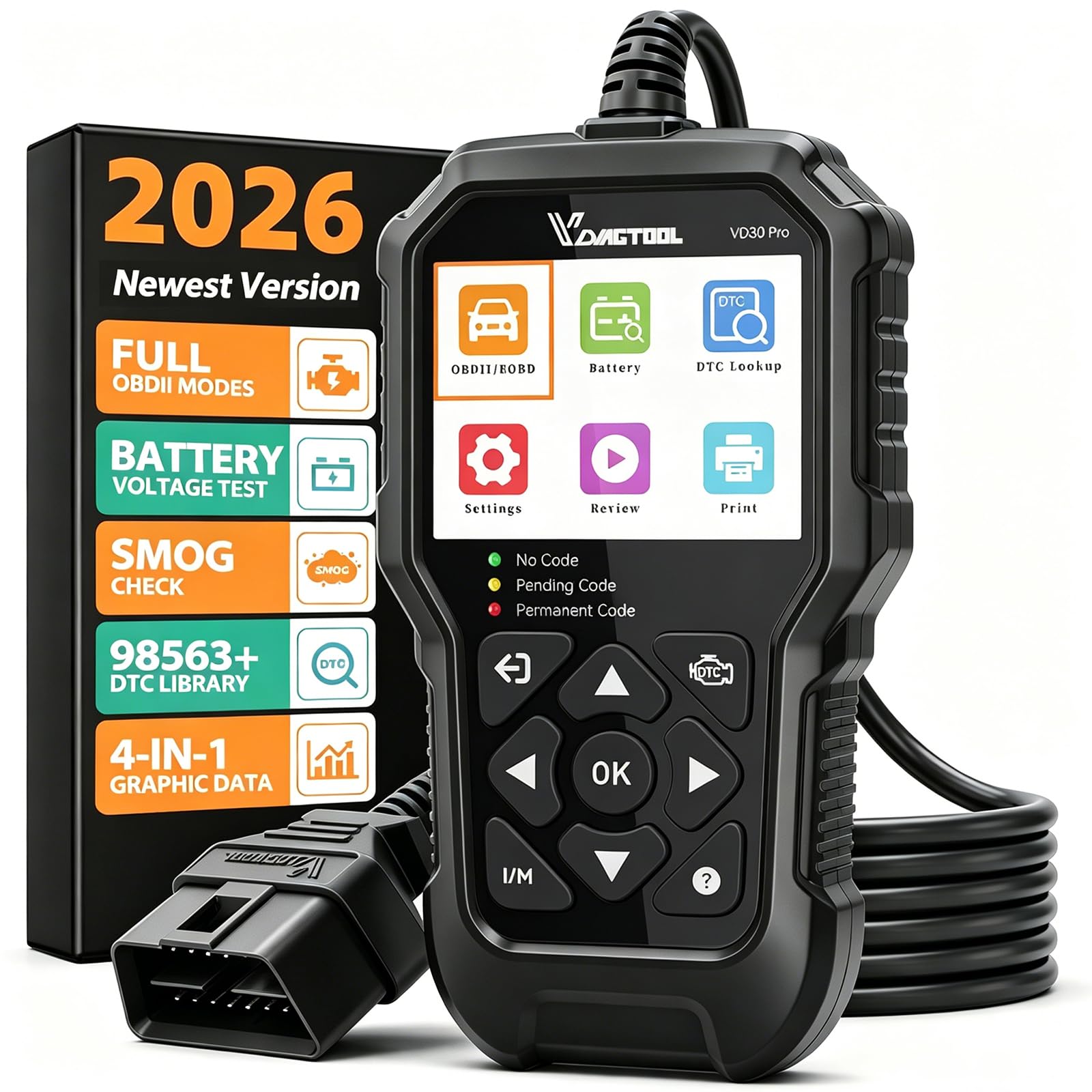
The budget king that graphs live data like tools costing four times as much.
If you want to see exactly what your engine sensors are doing — not just a fault number — this is the one. The VD30 Pro runs all 10 essential OBD2 tests and displays live data in a 4-in-1 graph, so you can watch coolant temperature, oxygen sensor voltage, RPM, and fuel trim all at once on a 2.8-inch color screen. That graphing ability alone pulls it well ahead of basic readers that only show a code and a line of text.
One reviewer noted it “diagnosed acceleration loss; confirmed by mobile mechanic; saved dealer diagnostic fee” — a concrete example of the tool paying for itself on the first use. The built-in library holds over 98,000 DTC definitions (Diagnostic Trouble Codes, the standardized codes cars use to report faults), which means you get a plain-English explanation right on the screen without reaching for your phone. Unlike the FIXD scanner reviewed later, the VD30 Pro does not require a subscription to open up basic features; everything is on-device and free after purchase.
It ships ready to scan and receives lifetime free updates via USB on a Windows PC. The only catch is system coverage — it handles engine codes and emissions-related systems but does not support ABS (Anti-lock Brake System), SRS (Supplemental Restraint System / airbags), or TPMS (Tire Pressure Monitoring System) diagnostics. For a pure engine-focused DIY tool at this price, that trade-off is fair.
What It Delivers
- 4-in-1 live data graphing helps spot intermittent faults visually.
- Over 98,000 built-in DTCs explain codes in plain English on the screen.
- Dedicated one-click I/M Readiness hotkey for quick smog check prep.
What It Skips
- No ABS, SRS, or TPMS diagnostics — engine and emissions only.
- Data playback and printing require a USB connection to a computer.
Best reach for: DIYers who want graphing live data and on-screen code definitions without ever paying a subscription fee.
Worth noting: If you need to diagnose airbag or ABS faults, you will need a higher-tier tool — this one sticks strictly to engine and emissions systems.
2. 2026 Enhanced Universal OBD2 Scanner by UJS
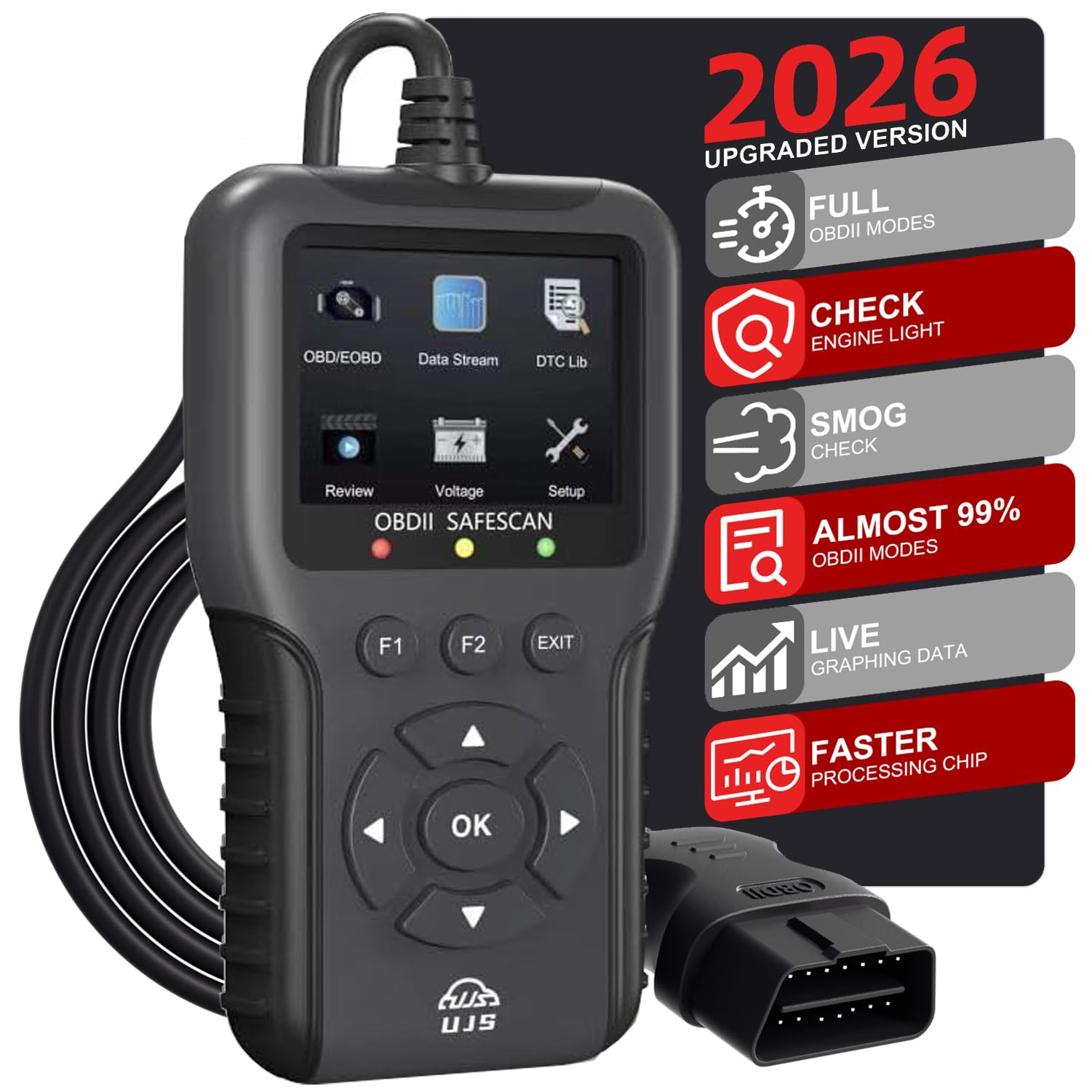
A glove-box-sized reader that prints diagnostic reports from the driver seat.
This UJS scanner stands out for a feature almost no other budget tool offers: cloud printing. It can generate a professional diagnostic report and send it to a local or cloud-connected printer with one click, which is a huge time-saver if you need to share codes with a remote mechanic or keep a maintenance log. The 2.8-inch HD color screen has adjustable brightness, and the red/green/yellow status indicators give an instant health read without interpreting a single number.
Buyers report that it “quickly read my check engine code and gave me the info I needed to proceed with a repair at home,” and the 65,000-plus built-in DTC lookup (a library of fault-code definitions stored on the device) means you rarely need a smartphone mid-diagnosis. It supports all 9 standard OBDII protocols — including KWP2000, J1850 VPW, ISO9141, J1850 PWM, and CAN — so it covers 1996-plus U.S. vehicles and 2000-plus European and Asian cars. The big differentiator versus the ANCEL AD310 below is the faster scanning time (a full engine health scan in about 60 seconds) and that cloud-print capability.
The trade-off is that, like the VDIAGTOOL above, it only reads engine fault codes and does not touch ABS, SRS, or transmission systems. Also, the customizable F1/F2 shortcut keys are nice but take a minute to learn if you are used to simpler menus.
Standout Perks
- Cloud printing and local printer support for sharing diagnostic reports.
- 2.8″ HD color screen with adjustable brightness and instant status LEDs.
- Customizable F1/F2 shortcut keys for one-tap code reading.
Consider This
- Engine diagnostics only — no ABS, SRS, or transmission system coverage.
- No graphing live data; it streams text-based real-time data instead.
Ideal for: Car owners who want to print a professional-looking report after a quick scan and keep a paper trail of repairs.
A limitation: If you need to see sensor trends in a graph, the VDIAGTOOL VD30 Pro above is a better choice for roughly the same money.
3. TOPDON AL400 OBD2 Scanner

A code reader that tells you the fault and the urgency without asking you to interpret a single number.
TOPDON built the AL400 around the idea that most people just want a green light, not a data sheet. The front of the unit has three LEDs — red for a permanent DTC (Diagnostic Trouble Code, a hard fault that is currently active), yellow for a pending code (a problem that has been detected but not yet conclusive), and green for no faults. You can glance at it from across the garage and know your car’s engine health status without reading a screen. The 2.4-inch color display is legible in direct sunlight and in a dark garage, which buyers appreciated.
It runs all 10 OBDII functions, including EVAP (Evaporative Emission System, which checks for fuel-vapor leaks) and O2 sensor tests, and live data streams in graph format. One buyer mentioned it was a bit slow on initial connection, but called it “a device” in terms of accuracy for a fraction of the cost. At 7.8 ounces, it is light enough to keep in the glove box without noticing it. Compared to the Autel AL329 below, the AL400 uses the same one-click I/M readiness approach but has a slightly smaller screen at 2.4 inches versus the Autel’s 2.4-inch equivalent — essentially identical, though the AL400 weighs less.
The catch: the management software for firmware updates gave some buyers trouble, with one user reporting it could not connect to the server. Since the unit ships ready to scan and the core OBD protocols rarely change, this matters less for day-to-day use, but it is worth knowing if you want the latest updates.
Why It Works
- Red/yellow/green LED indicators give instant engine health at a glance.
- Runs all 10 OBDII functions including EVAP and O2 sensor tests.
- Lightweight at 7.8 oz — easy to stash in any glove box.
One Drawback
- Management software had connectivity issues for some buyers.
- Uses mini-USB for updates, which is less common than USB-C.
Perfect for: Someone who wants a simple visual health check and does not want to read a manual to figure out their scanner.
Trade-off: The slow connection speed mentioned by reviewers might frustrate you if you are used to instant-on tools like the UJS Safescan above.
4. Autel AL329 OBD2 Scanner

A dedicated smog-check shortcut that turns a stressful inspection into a five-second confirmation.
Autel’s AL329 is built around one job: getting your car ready for an emissions test without surprises. The patented One-Click I/M Readiness Key instantly checks all your emission monitors (misfire, fuel, catalyst, EVAP) and lights up green, yellow, or red with an audible tone — no submenus, no scrolling. For anyone living in a state with annual inspections, that single button is worth the price of the tool.
Beyond the I/M shortcut, it reads and clears codes, retrieves VIN (Vehicle Identification Number, the car’s unique ID that tells the scanner what model it is talking to), CALID (Calibration ID, the software version of the engine computer), and CVN (Calibration Verification Number, a checksum that confirms the software is original). It can graph, record, and playback live data — a feature set that puts it closer to the VDIAGTOOL VD30 Pro than the basic ANCEL AD310 below. One buyer called it a “perfect emissions precheck before state inspection,” and another has owned it twice, keeping one in each family car.
The downside: at 0.68 pounds it is not the lightest reader here, and the screen resolution at 220×176 is lower than the 320×240 on the VDIAGTOOL. Live data is present but small, so it is better suited for a quick pass/fail check than deep sensor analysis.
Smart Features
- Patented one-click I/M Readiness button for instant emissions check.
- Graph, record, and playback live data for intermittent fault tracking.
- Lifetime free online updates via Mac or Windows computer.
Small Screen Trade
- Screen resolution is 220×176, making live data graphs less detailed.
- Heavier than some competitors at 0.68 lbs.
Choose this if: Your number-one priority is passing a state smog check without any guesswork — the I/M hotkey is the fastest way to confirm readiness.
skip it if: You need a larger, sharper display for detailed live-data analysis; the VDIAGTOOL VD30 Pro is clearer for that use.
5. FIXD Bluetooth OBD2 Scanner
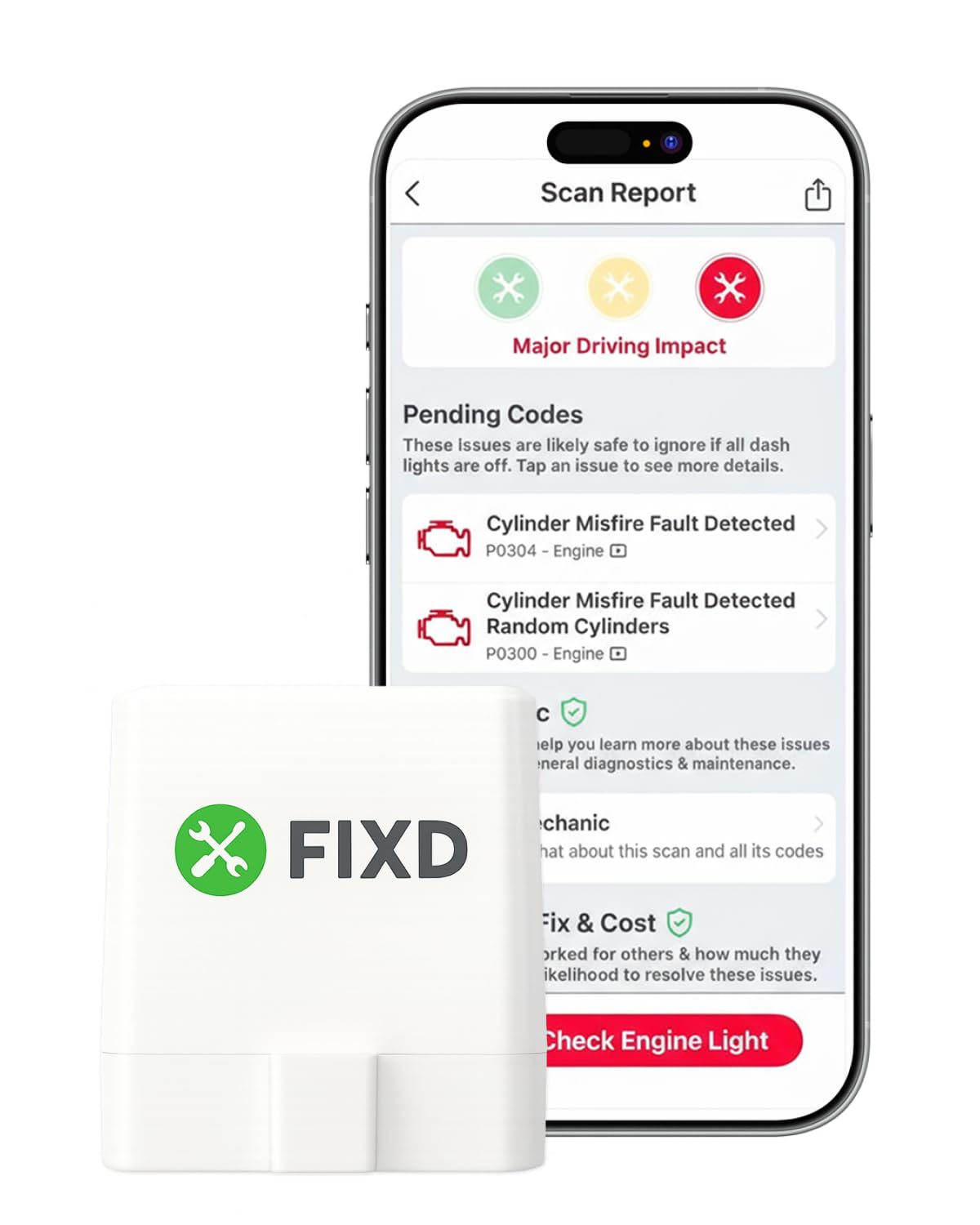
A tiny Bluetooth sensor that turns your phone into a dashboard-smart mechanic.
FIXD takes a totally different approach from the handheld readers above. The sensor itself is smaller than a matchbox (1.5 x 0.5 x 1.75 inches) and stays plugged into your OBD2 port permanently — it communicates with your phone via Bluetooth so you can scan codes, see explanations, and track maintenance reminders all inside the free app. The app color-codes issues by severity (green, yellow, red) and covers more than 39,000 issues across thousands of vehicles.
One buyer successfully diagnosed a misfire on cylinder seven in their truck, and the app gave them possible causes and cost estimates. Another mentioned it “saved dealer diagnostic fee” on an acceleration-loss issue, though that same story appeared under the VDIAGTOOL above — the value proposition is similar, but the experience is completely different because FIXD relies entirely on your phone rather than a built-in screen. The sensor is lightweight at 0.06 pounds, making it the most discreet option here.
The major catch is the subscription model. The free app covers basic scans, but full features — repair estimates, live mechanic support, and advanced insights — cost per year after a 14-day free trial. Without the subscription, some users found the app’s functionality limited, and there were reports of connectivity issues with certain vehicles (like a 2002 Chevrolet Camaro SS that simply would not pair). If you want a one-time purchase with no ongoing costs, the standalone readers above are a better fit.
App Advantages
- Wireless Bluetooth scanning — no cable to stretch across the cabin.
- App provides color-coded severity and repair estimates with subscription.
- Stays hidden under the dash; always ready without retrieving a tool.
Subscription Catch
- Full functionality requires a /year subscription after 14-day trial.
- Reported compatibility issues with some older or less common vehicles.
Best for: Tech-savvy drivers who prefer managing car health from a phone app and want a permanent plug-in sensor they can forget about.
Honest warning: If you do not want to pay a yearly fee, the VDIAGTOOL VD30 Pro or the Autel AL329 give you everything on the device for a single payment.
6. AUTOPHIX OM126P OBD2 Scanner

A Project-Farm-vetted scanner that turns complex diagnostics into simple, on-screen answers.
If you want a tool that is recommended by a trusted third-party tester (Project Farm on YouTube) and used by over 3 million people, the OM126P is about as safe a bet as it gets. It works with 99% of U.S. vehicles after 1996, plus most European models from 2002 onward and Asian cars from 2008, and the built-in DTC Lookup (a feature that shows you what each fault code means right on the screen) means beginners never have to pull out a phone to decode a cryptic “P0420.” The 2.4-inch screen shows live data like RPM, coolant temperature, airflow, and fuel system status in simple numbers, not complex graphs.
Owners mention that it is “easy to use and gave accurate results,” and that it helped clear a check engine light for an intermittent issue. The I/M Readiness test marks each monitor with a check mark so you know exactly whether your car’s emission systems are ready for a smog check. Compared to the ANCEL AD310 below, this one has a more detailed live-data display and broader vehicle coverage, especially for Asian models from 2008 onward.
The limitation is that it is strictly a code reader with live data — it does not graph sensor trends the way the VDIAGTOOL VD30 Pro does. For a beginner who just wants to know what a code means and whether the car will pass inspection, that is perfectly fine. For someone tracking a recurring misfire, the graphing tools are more useful.
Newbie-Friendly
- Recommended by Project Farm with over 3 million users trusting it.
- Built-in DTC Lookup explains codes in plain English without a phone.
- I/M Readiness test marks each monitor with a clear check mark.
Missing Feature
- No live data graphing — shows numerical values only.
- Asian vehicle coverage starts at 2008, which may miss some older imports.
Perfect for: A first-time scan tool buyer who wants a trusted, simple device that answers “what is the code and can I pass smog?” without any extra steps.
Caveat: If you want to see sensor behavior visually as a graph rather than just numbers, step up to the VDIAGTOOL VD30 Pro.
7. ANCEL AD310 Classic Enhanced OBD II Scanner

The no-surprises code reader that has been a best-seller for years for a simple reason: it just works.
The ANCEL AD310 is among the most recognized names in the budget scan-tool space, partly because YouTuber and mechanic Scotty Kilmer recommends it. It is a deliberately simple device — it reads and clears emission-related engine codes, checks I/M monitor readiness, and shows live data and freeze frame data on a 2.4-inch screen. There is no graphing, no cloud printing, no smartphone app. What you get is a rugged, proven tool with a thick 2.5-foot cable that can take a fall onto concrete without breaking. It weighs 12 ounces and measures 8.9 x 6.9 x 1.4 inches — not the most compact, but built to last.
Buyers consistently call it “simple to use” and “accurate,” with one noting it worked on a 2015 Equinox without any compatibility issues. It supports all five OBDII protocols — KWP2000, J1850 VPW, ISO9141, J1850 PWM, and CAN — so it covers 1996 U.S. cars and 2000 European/Asian models. One caveat some users hit: the AD310 will not clear codes on certain vehicles, and the native resolution of 128×64 is noticeably lower than the 320×240 on the VDIAGTOOL VD30 Pro. It is also strictly for emission-related faults — if the issue does not affect the emission system, the scanner may not even read it.
For pure code reading and clearing at the lowest possible complexity, this is still a solid choice. But against newer competitors like the AUTOPHIX OM126P that offer a built-in DTC lookup and broader vehicle coverage for a similar price, the AD310’s age shows.
Trusted Simplicity
- Recommended by Scotty Kilmer, giving it a strong reputation for reliability.
- Thick 2.5-foot cable is durable and survives drops in the garage.
- Supports all five OBDII protocols for broad vehicle compatibility.
Showing Its Age
- Low 128×64 screen resolution makes live data harder to read.
- Some users report it fails to clear codes on certain vehicle models.
- No on-screen DTC lookup — you have to look up codes yourself.
Reach for this if: You want the most straightforward, battle-tested code reader that has been proven reliable over years — no frills, no learning curve.
Look elsewhere if: You care about screen clarity or want on-screen code explanations; the AUTOPHIX OM126P or VDIAGTOOL VD30 Pro are better modern alternatives for a few dollars more.
Understanding the Specs
DTC Lookup — Built-In Code Definition
A DTC Lookup (Diagnostic Trouble Code lookup) is a library stored on the scanner itself that translates a code like “P0302” into plain English — in this case, “cylinder two misfire detected.” Without it, you need to stop what you are doing, pull out your phone, and Google the code. A built-in lookup saves you that step, which is especially valuable when you are under the hood in a dimly lit driveway without cell service. The best budget options in this guide carry anywhere from 65,000 to over 98,000 definitions.
I/M Readiness — Smog Check Predictor
I/M stands for Inspection and Maintenance, which is the emissions-testing program used in most U.S. states. An I/M Readiness test checks whether your car’s onboard diagnostic monitors — like the catalyst monitor (which checks the catalytic converter’s efficiency), the EVAP monitor (which looks for fuel-vapor leaks), and the oxygen sensor monitor — have completed their self-checks since the last time the battery was disconnected or codes were cleared. If any monitor is marked “not ready,” your car will automatically fail a smog test, even if there is no active check-engine light. A scanner with a dedicated I/M button gives you a pass/fail verdict in seconds.
FAQ
Will a cheap scan tool work on my 1998 Toyota Camry?
Can a cheap OBD2 scanner clear my airbag light or ABS light?
Do I need a subscription to use a budget scan tool?
What does I/M Readiness mean and why does it matter?
Will a cheap scan tool drain my car battery while plugged in?
What is live data streaming and do I really need it?
How often do I need to update the scanner’s software?
What is a DTC and why does a larger DTC library matter?
Can I use a cheap scan tool on a diesel vehicle?
Which cheap scan tool is best for checking a used car before buying it?
Final Thoughts: The Verdict
Across the board, the cheap scan tool winner is the VDIAGTOOL VD30 Pro because it packs live data graphing, a massive built-in DTC library, and a dedicated I/M Readiness hotkey into a device with no ongoing fees — it is the best balance of diagnostic depth and affordability on this list. If you want a simpler, app-based experience and do not mind a subscription, grab the FIXD Bluetooth Scanner. And for the most straightforward, battle-tested code reader with zero learning curve, the standout is the ANCEL AD310.
How We Picked
We do not accept paid placement. Every pick is matched to a real buyer and a real use-case; we do not hands-on test units.
Sources & Methodology
Specifications: manufacturer listings and product documentation. Review insights: verified customer reviews, as of July 2026. Pricing: not shown on this page (it changes often); check the current price via the retailer link.
As an Amazon Associate, WellFizz earns from qualifying purchases. This does not affect which products we feature.

Mo Maruf
I created WellFizz to bridge the gap between vague wellness advice and actionable solutions. My mission is simple: to decode the research and give you practical tools you can actually use.
Beyond the data, I am a passionate traveler. I believe that stepping away from the screen to explore new environments is essential for mental clarity and physical vitality.