Our readers keep the lights on and my smoothie glass nicely filled. As an Amazon Associate, I earn from qualifying purchases.
Specs are compiled from manufacturer listings and verified buyer reviews and can change over time — please confirm the key details on the product page before buying.
You want a mechanical keyboard that feels crisp without costing a lot. The challenge is picking a budget model that delivers a satisfying typing punch, not just one that looks the part.
I’m Mohammad Maruf — the founder and writer behind WellFizz. This guide is built by comparing the manufacturers’ published specifications and the patterns across verified customer reviews, so you get each pick’s real strengths and trade-offs instead of marketing spin.
Whether you grind ranked matches, write code at 2 a.m., or just want a keyboard that does not fall apart in six months, finding the right cheap mechanical gaming keyboard depends on understanding the trade-offs in layout size, switch type, and construction quality.
Quick Picks
- RK ROYAL KLUDGE R87 Pro Wired Mechanical Keyboard — Best Overall
- Redragon K580 PRO Wireless RGB Gaming Keyboard — Best Value
- Redragon K552 Mechanical Gaming Keyboard — Budget Champion
- RK ROYAL KLUDGE R98 Pro Wired Mechanical Keyboard — Premium Compact
How To Choose The Best Cheap Mechanical Gaming Keyboard
A few key specs separate a daily driver that feels premium from one you will regret within a month.
Switch Type: Linear vs. Clicky vs. Tactile
A linear switch (like the Redragon Red or RK Creamy switch) moves straight up and down with no bump or click. It is quieter and faster for rapid double-taps in games. A clicky switch has an audible “click” and a tactile bump (a small resistance felt at the actuation point) that some typists love but roommates hate. Most cheap boards ship with one or the other — pick based on whether you value quiet play or audible feedback.
Layout: Full-Size, TKL, 75%, or 96%
A full-size keyboard (104 keys) keeps a separate number pad for data entry or spreadsheet work. A tenkeyless or TKL layout (87-88 keys) drops the numpad to save desk space and bring the mouse closer to your body, which some gamers prefer. A 75% board (88 keys) is a compact TKL with a denser arrangement, while a 96% board (98 keys) squeezes a numpad into a compact frame. The trade-off is always desk space vs. convenience.
Build Quality: Metal Plate vs. Gasket Mount
A metal top plate adds weight and prevents the board from flexing during aggressive key presses. A gasket-mounted keyboard uses foam layers and a suspended plate to absorb vibration, producing a deeper “thocky” sound (a soft, muffled bottom-out sound) and a softer bottom-out feel.
Extra Features Worth Paying For
Hot-swappable sockets let you remove switches with a puller and install new ones without soldering — a huge upgrade path on a cheap board. A programmable volume knob or dedicated media controls save you from alt-tabbing mid-game. QMK/VIA firmware (an open-source firmware that allows custom keymaps and macros) support open up custom keymaps and macros, but not every cheap keyboard includes it.
Quick Comparison
| Model | Best For | Key Count | Switch Type | Connectivity | Amazon |
|---|---|---|---|---|---|
| RK ROYAL KLUDGE R87 Pro | Best Overall — quiet gasket feel & knob | 88 | Linear Creamy (pre-lubed) | USB-C | Amazon |
| Redragon K580 PRO Wireless | Best Value — wireless triple-mode | 104 | Linear Red (hot-swappable) | USB-C, BT 3.0/5.0, 2.4Ghz | Amazon |
| Redragon K552 | Budget Champion — metal-frame linear-switch tank | 87 | Linear Red | USB | Amazon |
| RK ROYAL KLUDGE R98 Pro | Premium Compact — 96% layout with numpad | 98 | Linear Creamy (pre-lubed) | USB-C | Amazon |
In‑Depth Reviews
1. RK ROYAL KLUDGE R87 Pro Wired Mechanical Keyboard

The quiet gasket-mounted board that punches far above its price with a satisfying creamy feel.
Its 5-layer gasket design uses foam layers and a suspended plate to soak up vibration, creating a “thocky” sound (a soft, muffled bottom-out sound) that buyers report is quiet and creamy. The 88-key 75% TKL layout saves desk space while keeping the function row (F1-F12) and arrow keys — a balanced compromise for gamers and coders who do not need a numpad. Owners mention the pre-lubed linear Creamy switches feel premium, with one calling it “the best budget keyboard” and noting the solid build and clean RGB.
A programmable CNC metal volume knob sits in the top right, so you rotate it to adjust volume or press it to mute — one reviewer on Linux found the software finicky but said the hardware works well. Unlike the Redragon K552 which uses a fixed rainbow LED, the R87 Pro offers over 15 RGB lighting effects (lighting patterns like breathing and wave) that you adjust via key combinations without any software. The hot-swappable socket accepts 3/5-pin switches, meaning you can swap in a different switch feel later without soldering. The catch: the grey plastic texture around the edges feels slightly cheap in hand, and one reviewer noted the knob has a mild wobble — minor quibbles on an otherwise standout board.
At roughly 1.62 kg, it carries noticeable heft for a compact keyboard, and the braided USB-C cable detaches for easy cable management. If you want a quiet, gasket-cushioned typing feel with the flexibility to customise switches later, this is the pick.
Where it shines
- Gasket-mount construction with 5 foam layers absorbs noise and vibration for a quiet creamy sound
- Pre-lubed linear Creamy switches feel smooth and premium straight from the start
- QMK/VIA firmware (open-source firmware for custom keymaps and macros) allows full key remapping and macro creation
Where it falls short
- Grey plastic edge texture feels slightly cheaper than its price suggests
- Volume knob has a mild wobble reported by some reviewers
- RGB lighting sits on the switch bottom, so keycap lettering can appear dim in bright rooms
Reach for this if: You want a budget board that already sounds and feels premium — a gasket mount plus pre-lubed switches make it a quiet daily driver for gaming and typing alike.
Look elsewhere if: You need a dedicated number pad or prefer the loud clicky feedback of traditional blue switches; the gasket design intentionally mutes the typing sound.
2. Redragon K580 PRO Wireless RGB Gaming Keyboard

A full-size wireless board with a volume wheel and five macro keys for under sixty dollars.
The K580 Pro is the only board in this lineup with triple-mode connectivity (three ways to connect) — you plug in via USB-C, pair over Bluetooth 3.0 or 5.0, or use the included 2.4 GHz wireless dongle. That flexibility matters if you switch between a desktop, laptop, and tablet during the day. It is a full 104-key layout, so there is a dedicated number pad for data entry, plus a built-in metal volume/backlight wheel in the upper-right corner. Customers note the volume roller feels smooth and tight, calling it a “budget alternative to Corsair K70” and praising the red linear switches for being quieter than Cherry MX Speed switches (a fast linear switch from the standard brand).
Five programmable macro keys (G1-G5) let you record macros on the fly without software — a rare feature at this price. The hot-swappable socket supports 3/5-pin switches, so you can change the switch feel later. One reviewer had an initial unit with key failures, but the replacement came “quickly with excellent customer service.” The catch: the software was flagged by Windows Defender as potentially dangerous, and one reviewer found the documentation to be a single folded paper sheet with no per-key function explanation. Unlike the RK R87 Pro which uses a gasket mount, the K580 Pro uses a plastic case with no foam damping, so the typing sound is louder and more hollow.
RGB lighting on the K580 Pro is fully customizable with per-key color options, and settings save to the onboard memory so your layout travels with the keyboard. If you need wireless freedom and a full numpad with macro keys on a tight budget, this board delivers.
Where it shines
- Triple-mode wireless (USB-C, Bluetooth 3.0/5.0, 2.4 GHz) gives you connection flexibility across multiple devices
- Five on-board macro keys record without any software
- Hot-swappable 3/5-pin socket and a smooth metal volume wheel
Where it falls short
- Plastic case lacks foam padding, so the typing sound is louder than gasket-mounted alternatives
- Software flagged by Windows Defender, and the download site appeared blank for one reviewer
- Documentation is minimal — one folded paper sheet with no per-key function guide
Take it home if: You need a wireless full-size keyboard with macro keys and a volume wheel and do not mind a louder typing sound from the plastic case.
skip it if: You want a quiet, cushioned typing feel; the K580 Pro has no gasket or foam layers for sound dampening.
3. Redragon K552 Mechanical Gaming Keyboard

The cheap metal-frame tank that has been a community staple for years for good reason.
Its 87-key TKL layout ditches the numpad so your mouse sits closer, and the metal top plate gives it a rigidity that plastic-only boards lack. Reviewers consistently praise its solid build — one buyer mentioned it had “identical feel to Cherry MX Blue switches” (clicky switches from the standard brand) and reported their typing speed increased by about 15 WPM after switching. The red linear switches are linear and non-clicky, with smooth keystrokes designed for quieter operation than blue-style switches. A buyer who modded theirs with foam inside the base, cotton in keycaps, and foam feet described the result as a “faint click” that kept the switch feel intact.
The K552 offers 6 dynamic rainbow LED modes (breathing, wave, ripple, and reactive effects) but unlike the RGB on the RK R87 Pro, these are fixed color patterns with no per-key customization. One reviewer found the RGB “distracting” and preferred a static color. You can adjust brightness via keyboard shortcuts, but the lighting resets to default each time the keyboard powers on — a small annoyance. It uses a standard USB cable (not detachable) and is plug-and-play on Windows, macOS, and Linux with no drivers needed. The keycaps are thin ABS with a “gamer” font that some buyers dislike, but multiple reviewers point out they swapped them for PBT keycaps (a more durable, textured plastic).
The K552 has full N-key rollover (every key press registers at once) and anti-ghosting on all 87 keys, so every simultaneous keypress registers correctly during fast gameplay. It lacks hot-swappable sockets, wireless connectivity, and any software customization — it is a plain wired board that does one thing well: feel sturdy and click loudly. If you want a cheap entry into mechanical keyboards that you can modify later (swapping switches, adding foam, changing keycaps), the K552 is a proven starting point.
Why it earned its reputation
- Metal top plate and rubber anti-slip feet create a solid, rigid typing platform that does not flex
- Full N-key rollover and anti-ghosting on all 87 keys for reliable competitive gameplay
- Proven modding community — shoppers say success adding foam, swapping switches, and changing keycaps
Where it shows its age
- Loud switch click and bottom-out noise amplified by the plastic base — not ideal for shared spaces
- Rainbow LED modes are fixed color patterns with no per-key customization and reset on power-on
- Thin ABS keycaps with “gamer” font feel cheaper than PBT alternatives on pricier boards
Ideal for: The first-time mechanical keyboard buyer who wants a durable, budget-priced board with linear switches to learn on and later modify.
Not for: Anyone who needs very quiet typing, RGB per-key control, or a detachable cable — this is a no-frills wired tank with a noticeable typing sound.
4. RK ROYAL KLUDGE R98 Pro Wired Mechanical Keyboard
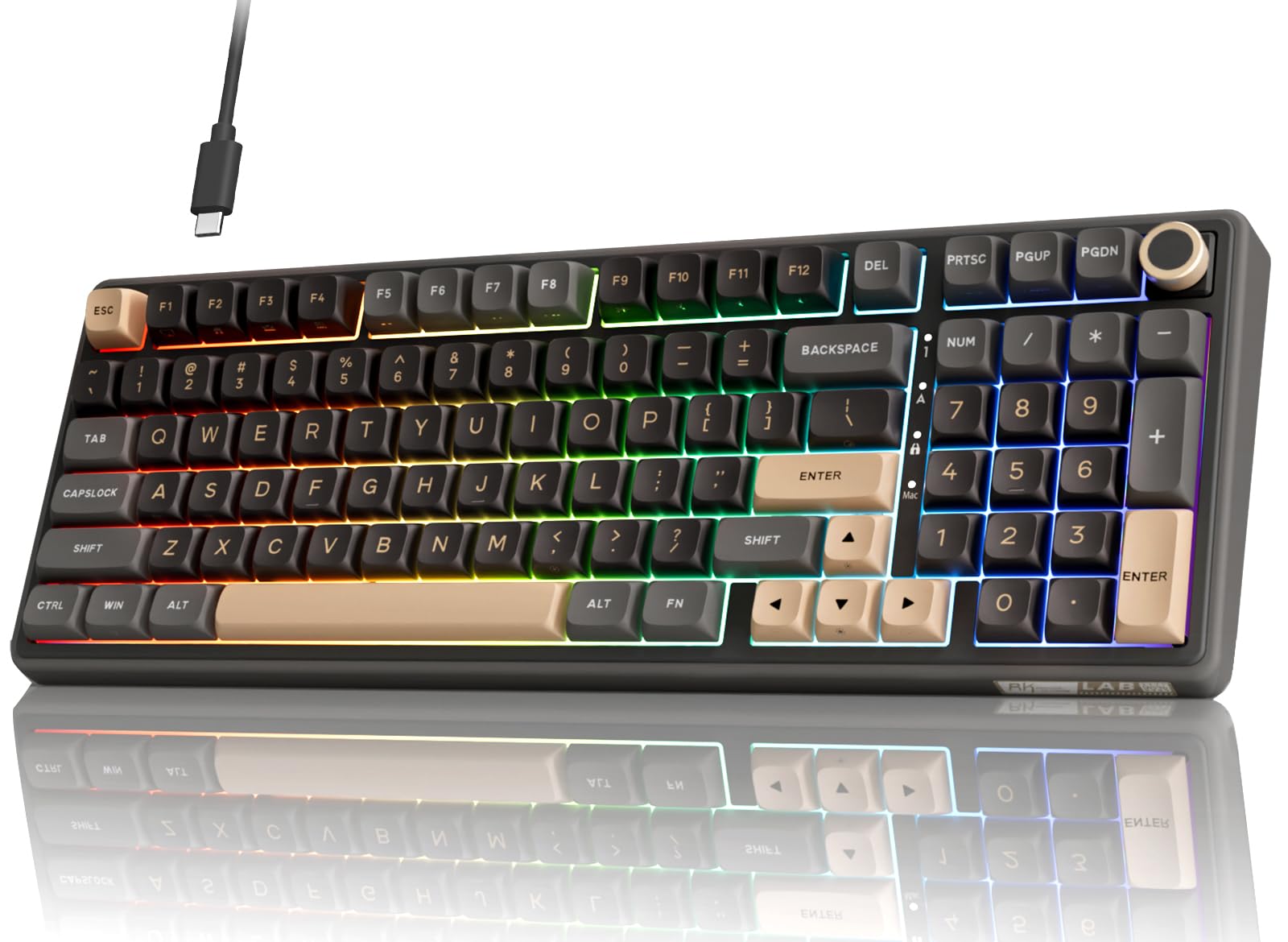
A compact 98-key board that squeezes a numpad into a smaller frame without sacrificing typing comfort.
The R98 Pro uses a 96% layout — 98 keys in a dense arrangement that keeps the number pad and arrow keys while shaving off wasted space compared to the full-size 104-key K580 Pro. It is the only board here with MDA-profile PBT keycaps, which have a sculpted shape that wraps around your fingers and a matte, double-shot surface that resists fading and shine over years of use. The pre-lubed linear Creamy switches are the same type as the R87 Pro’s, and the 5-layer gasket mount with sound-absorbing foam creates the same “thocky” creamy sound — reviewers call the keystrokes “buttery-smooth” and “ultra quiet.” One owner reported the keyboard is “heavy” at 0.8 kg, but that weight comes from solid construction, not flimsy plastic.
A detachable aluminum CNC volume knob sits in the top right, and four indicator lights show Num Lock, Caps Lock, Win Lock, and Mac Mode at a glance — handy if you switch between Windows and macOS. The hot-swappable socket accepts 3/5-pin switches, and the RK online driver lets you remap keys, create macros, and customize RGB lighting. The board packs over 20 RGB modes (full color, monochrome, dynamic modes), though one customer observed the keycap letters look dark in low light because the backlight sits on the switch bottom rather than shining through the legends. The USB-C cable exits on the left side, which a reviewer found causes “cord drag” — a minor layout annoyance compared to a centered port.
Unlike the K580 Pro which includes wireless connectivity, the R98 Pro is wired-only via USB-C. But the combination of gasket mounting, PBT keycaps, and pre-lubed switches delivers a typing feel that rivals keyboards costing twice as much. If you need a mechanical keyboard with a dedicated numpad in a compact footprint and value a quiet, creamy typing experience over wireless freedom, the R98 Pro is the premium choice in this lineup.
Build + feel: The gasket-mounted 5-layer foam design with MDA-profile PBT keycaps and pre-lubed switches produces a creamy, quiet typing sound that buyers describe as “buttery-smooth.” The detachable CNC volume knob and four status indicator lights add convenience absent from cheaper boards.
Grab it for: A cream-of-the-crop typing feel with a space-saving 98-key layout, PBT keycaps, and gasket mounting — ideal if you type all day or game without disturbing others.
Think twice if: You need wireless connectivity, a centered USB-C port, or brighter keycap backlighting; the R98 Pro is wired-only with the cable on the left and lettering that looks dim in low light.
Understanding the Specs
Switch Types: Linear vs. Clicky vs. Tactile
A linear switch (like the Redragon Red or RK Creamy switch) moves straight up and down with no bump — it is quieter and faster for rapid key presses in games. A clicky switch has a physical click sound and a tactile bump (a small resistance felt at the actuation point), which some typists love for feedback but others find loud. A tactile switch has a bump without the audible click. Most cheap mechanical keyboards stick with linear or clicky; which one suits you depends on whether you value quiet speed or audible confirmation.
Layout Sizes: Full-Size, TKL, 75%, and 96%
Your keyboard’s physical footprint is defined by its layout size. A full-size (104 keys) includes a number pad. A TKL or tenkeyless (87-88 keys) drops the numpad to bring the mouse closer. A 75% (88 keys) is a denser TKL that keeps the function row in a compact shell. A 96% (98 keys) crams a numpad into a shorter width. The trade-off is always desk space vs. having dedicated number keys for data entry or spreadsheet work.
Gasket Mount vs. Tray Mount
In a tray mount (used by the Redragon K552), the switch plate screws directly into the plastic case — it is simpler and cheaper, but harder keystrokes transmit vibration to the desk. A gasket mount (used by the RK R87 Pro and R98 Pro) sandwiches the plate between foam layers and rubber gaskets, isolating it from the case. The result is a softer bottom-out feel, less noise, and a deeper “thocky” sound (a soft, muffled bottom-out sound) that many typists prefer.
Hot-Swappable Sockets and N-Key Rollover
A hot-swappable socket lets you pull out a switch with a tool and insert a new one without soldering — you can change the typing feel without buying a whole new keyboard. N-key rollover means every key press is registered simultaneously, so pressing six keys at once in a fighting game does not drop inputs. Both features were once reserved for premium boards but now appear on budget models.
FAQ
Are cheap mechanical keyboards worth buying?
What is the difference between Cherry MX and Redragon red switches?
Will a cheap mechanical keyboard work with a Mac?
How loud is a noisy mechanical keyboard and can I make it quieter?
Is a 75% keyboard better for gaming than a full-size keyboard?
What does hot-swappable mean and why should I care?
Can I use a TKL keyboard without a numpad for data entry?
How long do cheap mechanical keyboards last?
Final Thoughts: The Verdict
For the majority of shoppers, the winning cheap mechanical gaming keyboard is the RK ROYAL KLUDGE R87 Pro because its gasket mount (a suspended plate with foam layers) and pre-lubed creamy switches deliver a quiet, premium typing feel at a budget price. If you need wireless and a full numpad with macro keys, grab the Redragon K580 PRO. For the lowest entry point with a sturdy metal frame you can mod to your liking, get the Redragon K552.
How We Picked
We do not accept paid placement. Every pick is matched to a real buyer and a real use-case; we do not hands-on test units.
Sources & Methodology
Specifications: manufacturer listings and product documentation. Review insights: verified customer reviews, as of July 2026. Pricing: not shown on this page (it changes often); check the current price via the retailer link.
As an Amazon Associate, WellFizz earns from qualifying purchases. This does not affect which products we feature.

Mo Maruf
I created WellFizz to bridge the gap between vague wellness advice and actionable solutions. My mission is simple: to decode the research and give you practical tools you can actually use.
Beyond the data, I am a passionate traveler. I believe that stepping away from the screen to explore new environments is essential for mental clarity and physical vitality.