Our readers keep the lights on and my smoothie glass nicely filled. As an Amazon Associate, I earn from qualifying purchases.
Specs are compiled from manufacturer listings and verified buyer reviews and can change over time — please confirm the key details on the product page before buying.
You do not need a second mortgage to get that perfect, inky black and vibrant color an OLED monitor delivers. The real trick is knowing which budget-friendly OLEDs cut corners you can live with and which ones deliver the true experience without the premium price tag — and that is exactly what this guide lays out, feature by feature.
I’m Mohammad Maruf — the founder and writer behind WellFizz. This guide is built by comparing the manufacturers’ published specifications and the patterns across verified customer reviews, so you get each pick’s real strengths and trade-offs instead of marketing spin.
After digging through the specs and real owner feedback on eight different models, the best cheap oled monitor for most people is the one that balances a fast 240Hz refresh rate with true QD-OLED color without asking for a huge premium.
Quick Picks
- INNOCN 27″ QD-OLED 2780s — Speed Leader
- AOC 27″ QD OLED Q27GAZD — Best Value
- Acer Predator X27U W1bmiipprx — Feature Rich
- Samsung 27″ Odyssey OLED G6 G61SH — Trusted Brand
- LG UltraGear 27GX704A-B — Glossy Perfection
- Alienware AW2725DF Gaming Monitor — E-Sports Ready
- MSI MPG 271QRX QD-OLED — Productivity Pro
- ASUS ROG Strix 27” XG27AQDMG — Premium OLED
How To Choose The Best Cheap OLED Monitor
Dropping from a standard LCD to an OLED monitor is a massive leap in image quality — but the budget end of the market can be a minefield. Knowing which specs to prioritize and which to ignore is the difference between a great deal and a frustrating purchase.
Panel Type: QD-OLED vs WOLED
Nearly every monitor in this range uses either Quantum Dot OLED (QD-OLED) or White OLED (WOLED). QD-OLED delivers richer, more vibrant colors and higher peak brightness, though it can show a slight purple tint on bright surfaces. WOLED typically handles text better and has a more neutral look — the ASUS ROG Strix in this list uses a third-generation WOLED. The difference matters most in brightly lit rooms and for productivity work.
Refresh Rate and Response Time
You will see 240Hz as the baseline here, with a couple of models pushing to 280Hz or 360Hz. For competitive shooters, that extra headroom matters. For single-player games and casual use, 240Hz is already buttery smooth. The 0.03ms response time is standard across nearly every OLED on the market — it is one of the key advantages of the technology itself, so do not pay extra for it.
Hardware Connectivity
HDMI 2.1 is important if you want full-bandwidth 4K 120Hz on consoles like the PS5 or Xbox Series X. Several budget OLEDs come with HDMI 2.0 or HDMI 2.1 with limited bandwidth, so if you plan to use a console, check for “HDMI 2.1 48Gbps” specifically. DisplayPort is standard for PC gaming and handles 1440p at 240Hz without any issues.
Quick Comparison
| Model | Best For | Refresh Rate | Contrast Ratio | Panel Type | Amazon |
|---|---|---|---|---|---|
| INNOCN 27″ QD-OLED 2780s | Speed Seekers | 280Hz | 1,500,000:1 | QD-OLED | Amazon |
| AOC Q27GAZD | Best Value Starter | 240Hz | 1,500,000:1 | QD-OLED | Amazon |
| Acer Predator X27U | Feature Complete | 240Hz | — | QD-OLED | Amazon |
| Samsung Odyssey OLED G6 G61SH | Brand & Build | 240Hz | 1,000,000:1 | QD-OLED | Amazon |
| LG UltraGear 27GX704A-B | Glossy Clarity | 240Hz | 1,500,000:1 | OLED (WOLED) | Amazon |
| Alienware AW2725DF | Ultra-Smooth Gaming | 360Hz | 1,500,000:1 | QD-OLED | Amazon |
| MSI MPG 271QRX | Productivity & Gaming | 360Hz | 1,000,000:1 | QD-OLED | Amazon |
| ASUS ROG Strix XG27AQDMG | Premium Experience | 240Hz | High | WOLED (Gen 3) | Amazon |
In‑Depth Reviews
1. INNOCN 27″ QD-OLED 2780s
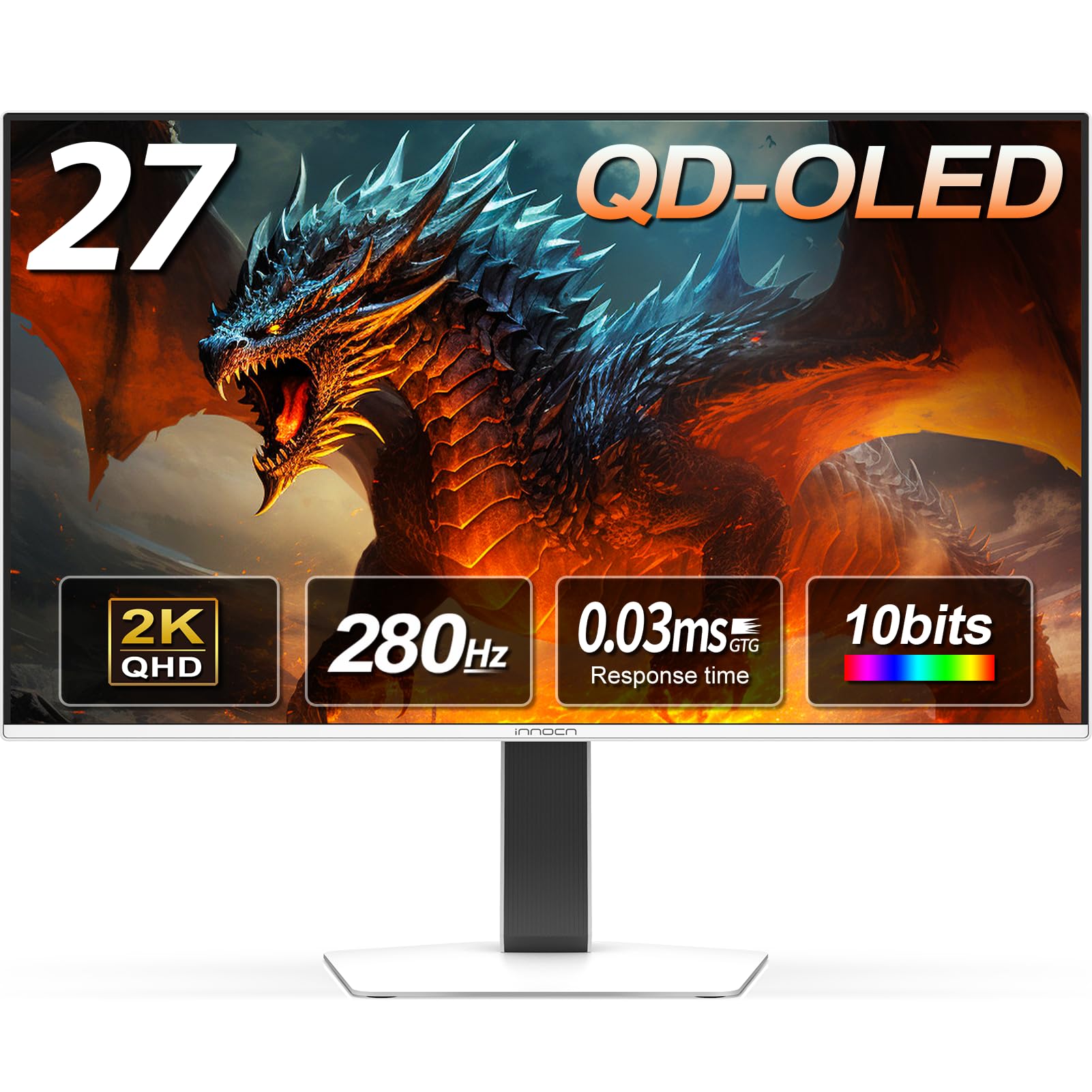
The speed demon that outruns the pack without the premium price tag.
With a 280Hz refresh rate, the INNOCN 27″ QD-OLED 2780s runs at 280Hz versus the 240Hz common on rivals like the AOC Q27GAZD. You feel that difference in fast-paced shooters. The 0.03ms response time (gray-to-gray, a measure of pixel color change speed) means motion stays sharp and ghosting (a trailing blur behind moving objects) is nonexistent. The QD-OLED panel delivers deep blacks and vibrant color, and buyers report it is a “huge difference and improvement” from older VA (vertical alignment) panels, making it a fantastic first OLED.
The HDMI 2.1 port ensures full support for high-refresh-rate gaming from next-gen consoles and PCs, and the fully adjustable stand with height, tilt, and pivot is a welcome addition at this price. The white color scheme stands out, but some buyers noted the actual screen dimensions measure 24″ by 13″, which is slightly smaller than a true 27-inch display. A few also reported a brief black screen (about 15 seconds) after exiting games — something to be aware of if you multitask often.
It is also G-Sync Compatible and supports FreeSync, so screen tearing is off the table regardless of your graphics card. For competitive players who want every frame advantage they can get, this is the one to beat.
The Edge It Has
- Fastest refresh at 280Hz among budget picks
- QD-OLED colors pop vividly
- HDMI 2.1 for modern consoles
- Full height/pivot adjustable stand included
The Catch
- Screen dimension slightly smaller than standard 27″
- Brief black screen reported when exiting games
- White finish may not match all setups
Who wins with this: Competitive gamers who want the highest refresh rate possible without paying for a premium brand badge.
Real limitation: The reported black screen glitch and non-standard sizing could be a dealbreaker for productivity users who value consistency.
2. AOC 27″ QD OLED Q27GAZD
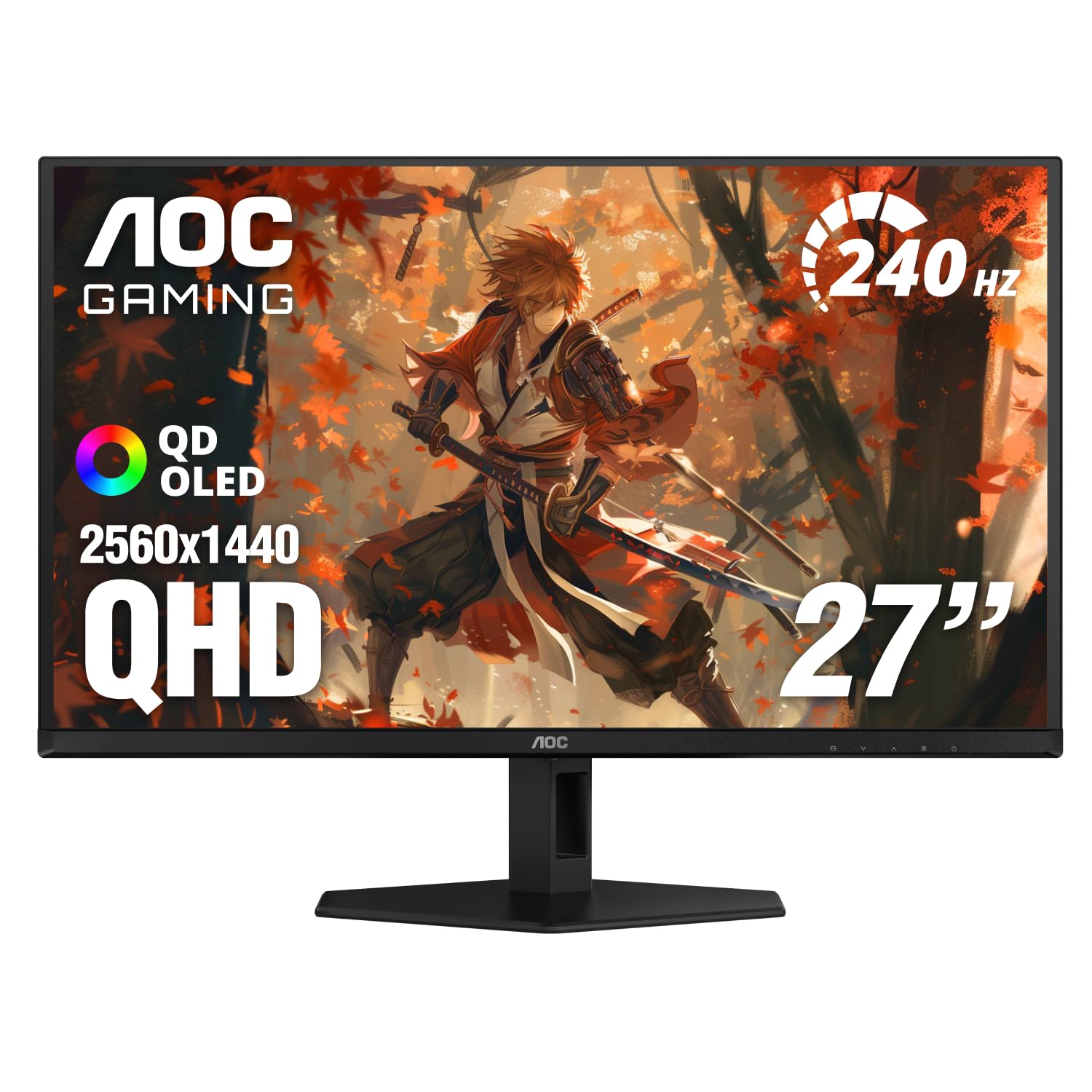
Pure QD-OLED magic at a price that makes you double-check the tag.
The AOC Q27GAZD delivers the core OLED experience — deep contrast and rich color — without the typical premium. Its 240Hz refresh rate and 0.03ms response time give you all the smooth motion you need for competitive gaming, even if the INNOCN above runs at 280Hz versus 240Hz here. The QD-OLED panel covers 147.6% sRGB (a common color space for web and gaming) and 110.2% DCI-P3 (a wider color space used in movies and HDR content), which translates to colors that look punchy and lifelike right from the start.
Owners mention the OLED “with great colors and picture quality” and specifically noted “no text fringing or eye strain after 4 hours” — a common concern with OLED monitors that this model handles well. The main trade-offs are practical: the HDMI port is limited to 165Hz, so you must use DisplayPort to hit the full 240Hz. The stand is basic and the bezels are thicker than expected, but the lightweight frame makes it easy to mount on an arm. A glossy display means reflections are visible in bright or dark scenes, so think about your room lighting.
It also supports Adaptive-Sync (G-Sync Compatible) and HDR400 True Black, so you get deeper blacks and brighter highlights in supported content. For the price, this is the purest value play in the list.
Why it works: The best entry point to true QD-OLED quality with a 240Hz refresh rate and zero text fringing issues — buyers confirm it.
The fine print: HDMI maxes at 165Hz, the stand is cheap, and glossy reflections are a factor; plan on a monitor arm.
Reach for this if: You want the most OLED image quality for your dollar and do not mind a basic stand or using DisplayPort for full refresh rate.
Look elsewhere if: You need an all-inclusive, ready-to-go setup with a premium stand and HDMI 2.1.
3. Acer Predator X27U W1bmiipprx
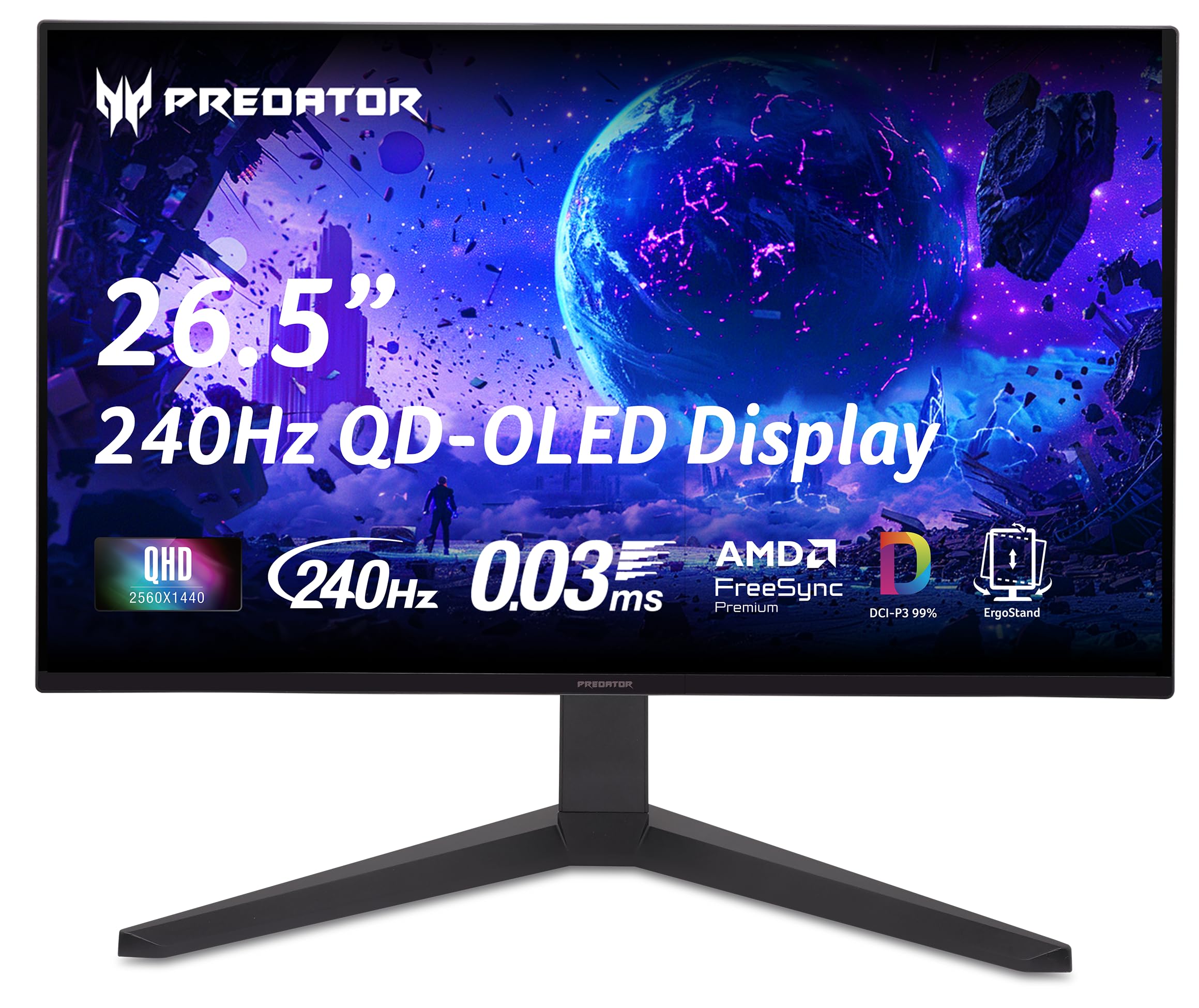
The budget OLED that packs a full ergonomic stand and dual HDMI 2.1.
The Acer Predator X27U gives you a rare thing in the budget tier: a full ergonomic stand with height, tilt, pivot, and swivel adjustment. You pair that with a 26.5″ WQHD QD-OLED display running at 240Hz with a 0.03ms response time. The DCI-P3 99% color gamut and Delta E<2 (color accuracy) mean colors are both vibrant and accurate — something buyers call “absurdly good for the price.” A buyer noted this model has a “cheaper model with inferior panel vs other X27U variants,” but for the price, the QD-OLED colors still beat IPS panels easily.
Connectivity is a standout here with two DisplayPort 1.4 and two HDMI 2.1 ports, giving you full bandwidth for a PS5 or Xbox Series X at 4K 120Hz HDR. The ZeroFrame design minimizes bezels for a more rich look. The built-in speakers are a bonus for a desk without external audio, though they are not going to replace a dedicated setup. Some buyers reported issues with a cracked stand on delivery, so inspect the stand closely when unboxing.
It also includes AMD FreeSync Premium for tear-free gaming and an image retention-refresh feature to protect against burn-in. The plastic build feels less premium than pricier options, but the connection options and ergonomic stand make it a versatile pick.
What It Does Well
- Full ergonomic stand (height, tilt, pivot, swivel)
- Dual HDMI 2.1 for next-gen consoles
- 99% DCI-P3 with accurate Delta E<2 color
- Built-in speakers
What to Watch
- Plastic build feels less premium
- Some reports of cracked stand on arrival
- Brightness is dimmer than some rivals at 100%
Best suited for: Console gamers who need dual HDMI 2.1 and anyone who wants a full adjustable stand without paying extra.
Trade-off to know: The build quality is plastic-heavy and brightness is lower than the competition, so a bright room may be challenging.
4. Samsung 27″ Odyssey OLED G6 G61SH
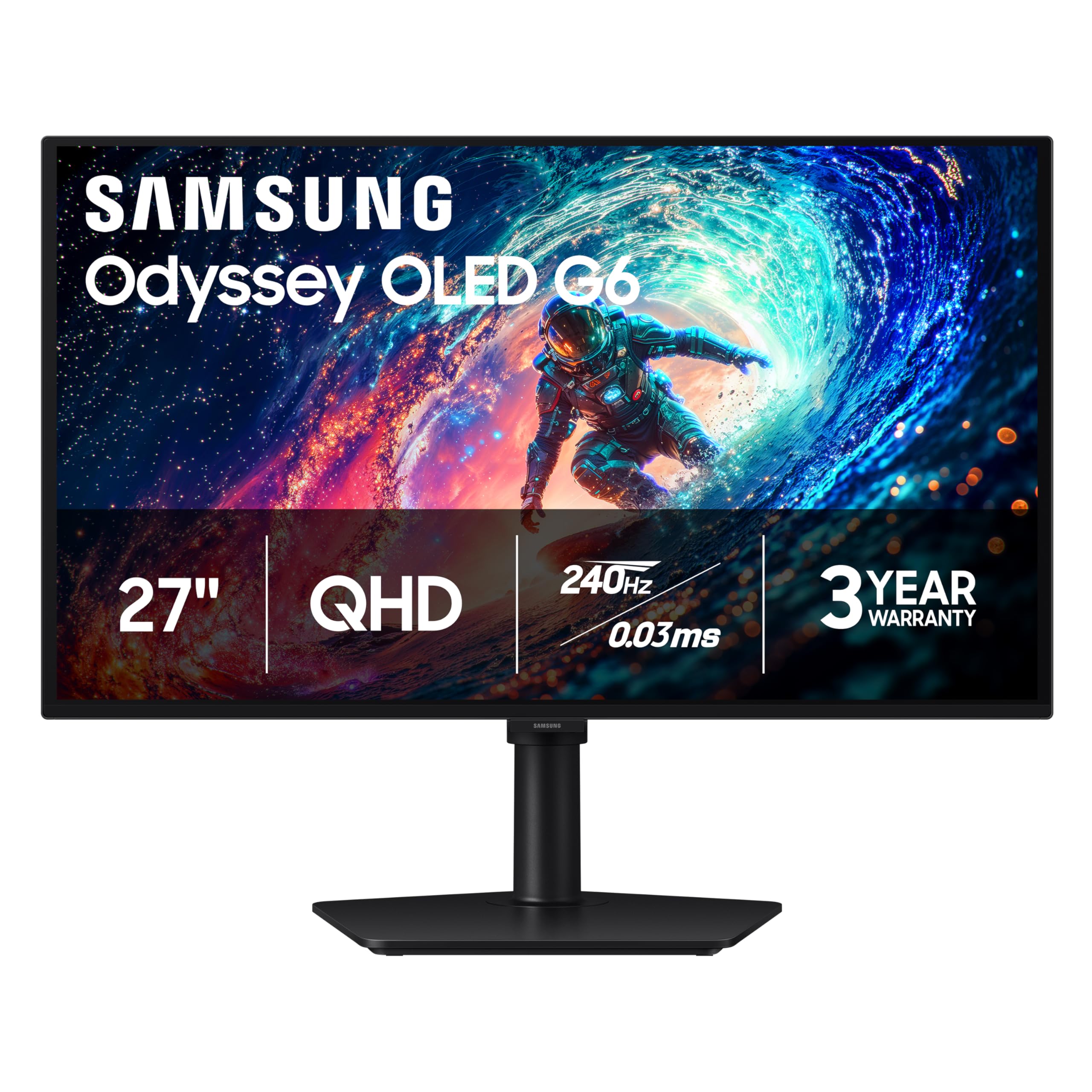
Samsung polish meets OLED value in a well-rounded gaming package.
The Samsung Odyssey OLED G6 G61SH brings the brand’s Glare-Free Technology and Pantone Validation to the budget tier, meaning you get a screen that resists reflections from external light sources and accurately reproduces over 2100 colors plus 110 skin tone shades. Still, buyers upgrading from an LG Ultragear 1440p 144Hz say the “vibrant colors, deep blacks” are a major step up, and the 240Hz refresh rate excels in competitive PvP (player versus player) games like Fortnite, CS2, and Overwatch.
Samsung’s OLED Safeguard technology actively helps prevent burn-in with a thermal modulation system, and the height-adjustable ergonomic stand pivots, tilts, and swivels for the perfect view. It supports both G-Sync and FreeSync Premium, so it works smoothly with any modern GPU. One reviewer noted that dual-monitor setups may cause windows to rearrange when the monitor powers off — the monitor retains power for its “Pixel refresh” cycle, so plugging into an always-on power strip solves it.
Text clarity is slightly worse than a comparable IPS panel, as one buyer pointed out, but “barely an issue” in daily use. The 3-year warranty adds confidence for a long-term investment.
Samsung’s value angle: Glare-Free coating plus Pantone color accuracy mean this monitor works in brighter rooms and for color-sensitive work better than most budget OLEDs.
Honest check: The 1,000,000:1 contrast ratio is lower than the 1,500,000:1 rivals, and text clarity is slightly below IPS levels.
Choose this if: You want a reputable brand with a glare-free screen, a 3-year warranty, and a fully ergonomic stand.
Skip it if: Maximum contrast ratio is your priority — the INNOCN and AOC list 1,500,000:1 versus 1,000,000:1 here.
5. LG UltraGear 27GX704A-B
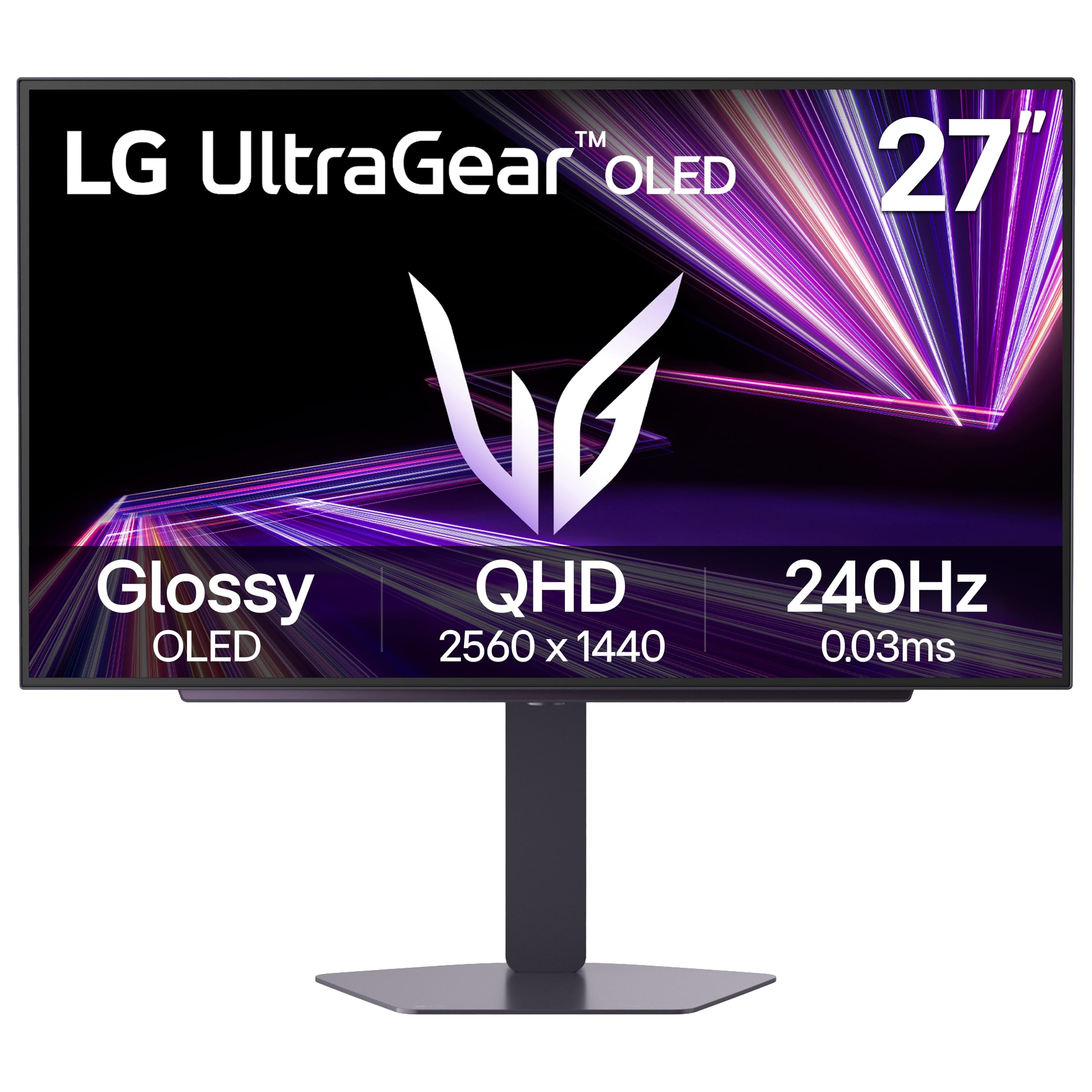
Glossy OLED that makes colors pop without compromise.
The LG UltraGear 27GX704A-B is one of the few budget OLEDs with a glossy finish, which means deeper perceived blacks and more vibrant colors in a controlled lighting environment. It uses a WOLED panel (not QD-OLED) with a 1,500,000:1 contrast ratio, matching the INNOCN and AOC for black depth. The 240Hz refresh rate and 0.03ms response time are standard here, but the VESA DisplayHDR True Black 400 certification and 98.5% DCI-P3 color coverage ensure HDR (High Dynamic Range) content looks punchy.
The stand is fully adjustable — swivel, tilt, height, and pivot — making it a rare complete package. Buyers call it “fantastic” and note it is an “amazing value at ~” for an OLED from a major brand. One buyer compared its colors to the MSI QD-OLED and noted they are “less punchy than MSI QD-OLED but more accurate and easier on the eyes,” which is a meaningful distinction for long sessions. The three UL Certifications (Anti-Glare, Flicker-Free, Low Blue Light) are a nice touch for eye comfort during extended use.
Connectivity is sturdy with dual HDMI 2.1, DP 1.4, and USB 3.2 ports, supporting both NVIDIA G-Sync Compatible and AMD FreeSync Premium Pro. The thin design feels fragile but customers note it is not actually breakable. The glossy reflection is a double-edged sword — great image quality, but avoid placing it opposite a bright window.
What Stands Out
- Glossy OLED for vibrant, deep colors
- Full ergonomic stand included
- Dual HDMI 2.1 plus USB hub
- Three UL certifications for eye comfort
What to Consider
- WOLED less punchy than QD-OLED rivals
- Glossy finish bad in bright, reflective rooms
- Thin design feels delicate
Great for you if: You value color accuracy and eye comfort, and your room has controlled lighting for a glossy screen.
Not ideal if: You want the most saturated QD-OLED colors or work in a brightly lit space with windows behind you.
6. Alienware AW2725DF Gaming Monitor

The 360Hz QD-OLED that turns every frame into a weapon.
The Alienware AW2725DF pushes the refresh rate ceiling to 360Hz versus the 240Hz baseline in this category. That extra motion clarity matters in competitive shooters where you track fast-moving targets. The QD-OLED panel delivers a 1,500,000:1 contrast ratio and VESA DisplayHDR True Black 400, so deep blacks and vibrant highlights coexist in the same scene. The DCI-P3 99.3% color coverage with Delta E<2 accuracy means colors look true-to-life.
Buyers describe it as a “jack of all trades,” noting the deep blacks, vibrant colors, and near-instant response. The included 3-year burn-in warranty from Dell is a major confidence boost for OLED longevity — something cheaper brands do not always offer. The stand offers height, tilt, swivel, and pivot adjustment, though the base is fairly large. One buyer mentioned a “slight purple tint on coating” and that the screen is a “fingerprint magnet,” so a microfiber cloth is a good idea if you touch the screen.
There have been some reports of failure within 30 days and frustrating replacement experiences, so check the warranty terms carefully. For the budget-conscious gamer who wants elite motion clarity, this is the most future-proof pick.
Why It Matters
- 360Hz refresh rate versus 240Hz rivals
- 3-year burn-in warranty included
- DCI-P3 99.3% with Delta E<2 accuracy
- Full ergonomic stand
Be Aware
- Some early failure reports and poor support experiences
- Purple tint on coating noticeable
- Fingerprint magnet on screen surface
Who should grab this: Competitive gamers who want the smoothest possible motion and the safety net of a burn-in warranty.
Who should pass: Those on a tight budget who do not need 360Hz — the added cost goes to speed, not other features.
7. MSI MPG 271QRX QD-OLED

The QD-OLED that handles both your gaming rig and your MacBook.
The MSI MPG 271QRX is one of the few budget OLEDs that includes a KVM (Keyboard, Video, Mouse) switch, allowing you to control multiple devices (like a gaming PC and a MacBook) with one set of peripherals. It runs at 360Hz with a 0.03ms response time on a QD-OLED panel, matching the Alienware for speed. The VESA DisplayHDR True Black 400 certification and Delta E≤2 color accuracy ensure HDR content looks excellent and colors are true to life.
The HDMI 2.1 port delivers full 48 Gbps bandwidth, supporting 4K 120Hz HDR on consoles. For productivity users, a buyer noted a Mac dual-monitor fix: disabling DSC (Display Stream Compression) and locking the DP input to run at 120Hz works perfectly with Apple Silicon Macs, with “perfect blacks, zero eye strain.” MSI OLED Care 2.0 reduces the risk of burn-in, which is a key feature for anyone using the monitor for long work hours.
The stand is adjustable but lacks a full range of motion compared to competitors — only tilt and height adjustment are available, with no pivot or swivel. The rated brightness of 250 nits (a unit of screen luminance) is lower than some rivals, so it may look dim in a bright room. Despite that, it is a strong choice for hybrid productivity and gaming setups.
Standout Features
- Built-in KVM for multi-device control
- 360Hz refresh rate + 0.03ms response
- Full HDMI 2.1 at 48 Gbps
- OLED Care 2.0 anti-burn-in tech
Trade-offs
- Stand lacks pivot and swivel
- Rated brightness only 250 nits
- Smaller adjustment range than rivals
Ideal for: Users who split time between a gaming PC and a work laptop, thanks to the rare built-in KVM.
Not for: Bright-room users or anyone who needs full ergonomic adjustments — the stand is basic and brightness is low.
8. ASUS ROG Strix 27” XG27AQDMG

The premium-feeling OLED that dodges the usual budget compromises.
The ASUS ROG Strix XG27AQDMG uses a 3rd-generation WOLED panel that avoids the “purple blacks in light” issue common to early QD-OLEDs, giving it a more neutral appearance in mixed lighting. It runs at 240Hz with a 0.03ms response time, matching the AOC and LG for smoothness. The glossy finish and 99% DCI-P3 color gamut deliver vibrant colors, and a custom heatsink plus ASUS OLED Care functions reduce the burn-in risk. Buyers call it a “fantastic OLED monitor” and note it is a “massive upgrade from 165Hz 1080p IPS,” with OLED colors, blacks, and contrast that are “incredible.”
ROG-exclusive OLED Anti-flicker technology reduces flicker during refresh-rate fluctuations, and the optional uniform brightness setting ensures consistent luminance levels across the screen — useful for design work. The 3-year warranty includes burn-in coverage, matching Alienware for confidence. The stand is fully adjustable and feels premium, and the port selection includes HDMI, 2x USB 3.2 Gen 1 Type-A, and DisplayPort. One owner reported the auto-dimming feature can be annoying, but turning off all screen saving options solves it.
The main downside is the price — it is the most expensive in this roundup. At this budget, it sits as a premium pick for those who want the most refined OLED experience without stepping up to a true high-end model.
What Justifies the Cost
- Gen 3 WOLED avoids purple tint in light
- Anti-flicker and uniform brightness tech
- 3-year warranty includes burn-in coverage
- Premium stand and build quality
What Holds It Back
- Most expensive pick in this category
- Auto-dimming can be annoying out of box
- No built-in speakers
Worth it for: Users who want the most mature OLED technology (Gen 3 WOLED) with burn-in warranty and premium build, and are willing to pay for it.
pass on it if: You are on a strict budget — the AOC or INNOCN deliver similar gaming performance for much less.
Understanding the Specs
Refresh Rate (Hz)
The number of times per second your monitor refreshes the image. A 240Hz refresh rate means 240 new images every second — this makes fast motion look smooth and blur-free. For competitive games, higher is better (360Hz feels even smoother), but for most people, 240Hz is already a massive step up from standard 60Hz or 144Hz monitors. The 0.03ms response time (GtG, or gray-to-gray, a measurement of how quickly a pixel changes color) tells you how fast a pixel can change from one shade to another — virtually instant, so you see no ghosting (a trailing blur behind moving objects).
Contrast Ratio
This measures the difference between the brightest white and the darkest black a screen can show. OLED monitors excel here because each pixel produces its own light and can turn off completely, creating true blacks. A 1,000,000:1 ratio means white is a million times brighter than black. The top-tier spec here is 1,500,000:1, found on several budget models — that is a meaningful bump in perceived depth and shadow detail compared to the 1,000,000:1 baseline.
Panel Types
QD-OLED (Quantum Dot OLED) uses a blue OLED layer with quantum dots (tiny semiconductor particles that convert blue light to other colors) to produce vibrant colors — it typically looks more saturated and punchy. WOLED (White OLED) starts with a white OLED layer and uses color filters, often resulting in more accurate, neutral colors and better text clarity. Most budget monitors use QD-OLED because it offers higher brightness and color volume, but the ASUS ROG Strix uses a 3rd-gen WOLED that avoids the purple tint issue some early QD-OLEDs had.
HDR Certification
HDR (High Dynamic Range) on OLED monitors is measured differently than on LCDs. VESA DisplayHDR True Black 400 is the standard for OLEDs — it certifies that the monitor can reach 400 nits of peak brightness while maintaining true black levels. This is enough to make HDR content look noticeably better than standard SDR (Standard Dynamic Range) content, with highlights that pop and shadows that stay deep. HDR10 is a basic format; True Black 400 is the higher standard you want.
FAQ
Will a cheap OLED monitor burn in if I use it for work?
Can I use a cheap OLED monitor with a PS5 or Xbox Series X?
Is 240Hz enough or do I need 360Hz?
Does text look bad on budget OLED monitors?
What is the difference between glossy and matte OLED screens?
Can I mount a cheap OLED monitor on an arm?
Which monitor has the best color accuracy for photo editing?
Do these monitors support G-Sync or only FreeSync?
How important is HDR on a budget OLED?
What should I do if the monitor has a dead pixel?
Final Thoughts: The Verdict
For the majority of shoppers, the best cheap oled monitor is the AOC Q27GAZD because it delivers the pure QD-OLED experience — deep blacks, vibrant colors, 240Hz refresh rate — at the lowest price with buyers confirming no text fringing issues. If you want the fastest refresh rate for competitive gaming, grab the INNOCN 2780s at 280Hz. And for a premium feel with a 3-year burn-in warranty, splurge on the Alienware AW2725DF at 360Hz.
How We Picked
We do not accept paid placement. Every pick is matched to a real buyer and a real use-case; we do not hands-on test units.
Sources & Methodology
Specifications: manufacturer listings and product documentation. Review insights: verified customer reviews, as of July 2026. Pricing: not shown on this page (it changes often); check the current price via the retailer link.
As an Amazon Associate, WellFizz earns from qualifying purchases. This does not affect which products we feature.

Mo Maruf
I created WellFizz to bridge the gap between vague wellness advice and actionable solutions. My mission is simple: to decode the research and give you practical tools you can actually use.
Beyond the data, I am a passionate traveler. I believe that stepping away from the screen to explore new environments is essential for mental clarity and physical vitality.