Our readers keep the lights on and my smoothie glass nicely filled. As an Amazon Associate, I earn from qualifying purchases.
Specs are compiled from manufacturer listings and verified buyer reviews and can change over time — please confirm the key details on the product page before buying.
The first chef’s knife you buy can either make cooking feel easy or turn every chop into a struggle. The right one glides through an onion without crushing it, fits your hand securely, and stays sharp longer than you expect — and for beginners, that balance of sharpness, comfort, and price is everything. This guide walks you through seven real options, with the exact specs that matter and honest trade-offs, so you pick the one that actually suits your kitchen.
I’m Mohammad Maruf — the founder and writer behind WellFizz. This guide is built by comparing the manufacturers’ published specifications and the patterns across verified customer reviews, so you get each pick’s real strengths and trade-offs instead of marketing spin.
My focus is on finding a chef’s knife for beginners that delivers genuine performance without demanding a huge investment or specialized sharpening skills right away.
Quick Picks
- Victorinox Fibrox Pro Chef’s Knife, 8 Inch — Best Overall
- WÜSTHOF 8″ Gourmet Chef’s Knife — Premium Pick
- Mercer Culinary M18000 Millennia 8-Inch Chef’s Knife — Best Value
- KEEMAKE 8 Inch Chef Knife — Style Pick
- HOSHANHO 8 Inch Damascus Chef Knife — Premium Damascus
- Sunnecko 8 Inch Chef Knife — Sharp Starter
- KYOKU Shogun Series 8″ Chef Knife — VG-10 Core
How To Choose The Best Chef’s Knife For Beginners
Your first chef’s knife should be sharp enough to make prep enjoyable, tough enough to handle daily use, and comfortable enough that your hand doesn’t cramp after dicing a few onions. Here are the three specs that separate a great starter knife from a frustrating one.
Blade Steel: High-Carbon Stainless Steel Is Your Friend
High-carbon stainless steel holds a sharp edge longer than basic stainless and resists rust better than pure carbon steel. This means you sharpen less often and don’t have to baby the blade after every wash — a big deal when you are still building your knife-care habits.
Handle Shape and Grip: Non-Slip Matters More Than Looks
A slippery handle when your hands are wet is a safety hazard. Look for materials like Santoprene, Fibrox, or textured Pakkawood that give you a secure pinch grip. Beginners benefit most from handles that fill the palm well and don’t force an awkward wrist angle.
Edge Angle: Steeper Isn’t Always Better for a First Knife
Knives sharpened to 8–12 degrees per side cut with almost no effort but need more careful honing and sharpening technique. A 15-degree edge is a practical middle ground — still very sharp but more forgiving when you are learning to use a honing rod.
Quick Comparison
| Model | Best For | Blade Material | Handle Material | Weight | Amazon |
|---|---|---|---|---|---|
| Victorinox Fibrox Pro | Overall beginner pick | High Carbon Stainless Steel | Fibrox (TPE) | 0.05 lbs | Amazon |
| WÜSTHOF Gourmet | Premium brand starter | High Carbon Stainless Steel | Polyoxymethylene (POM) | 240 g | Amazon |
| Mercer Culinary Millennia | Budget-friendly workhorse | High Carbon Steel | Santoprene | 0.29 lbs | Amazon |
| KEEMAKE 8″ Chef Knife | Value with premium feel | High Carbon Stainless Steel | Pakkawood | 8.48 oz | Amazon |
| HOSHANHO Damascus | Eye-catching Damascus steel | 67 Layers Damascus Super Steel | Frosted Glass Fiber G10 | 230 g | Amazon |
| Sunnecko 8 Inch Chef Knife | Sharp Japanese-style edge | High Carbon Stainless Steel | Pakkawood | 0.2 kg | Amazon |
| KYOKU Shogun Series | VG-10 core performance | Alloy Steel (VG-10) | G10 Handle | 1.39 lbs | Amazon |
In‑Depth Reviews
1. Victorinox Fibrox Pro Chef’s Knife, 8 Inch
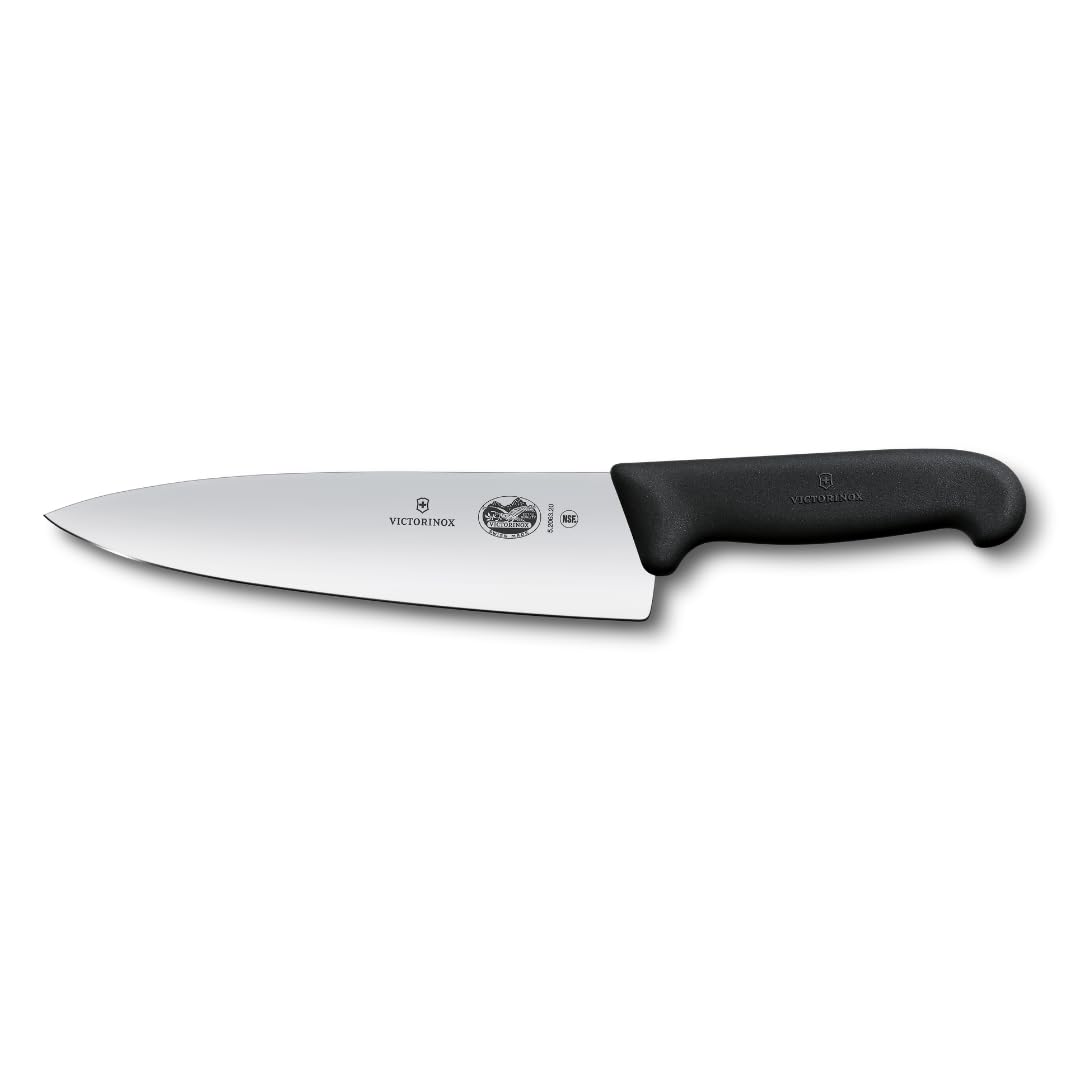
The blade that America’s Test Kitchen has ranked number one under for years — and for good reason.
You get a razor-sharp edge that buyers consistently describe as “scalpel-like” right from the start, and the ergonomic Fibrox handle (a thermoplastic elastomer — a rubber-like material that stays grippy even when wet) prevents slipping during fast prep. The blade is stamped rather than forged, which keeps the weight down to just 0.05 pounds — noticeably lighter than forged options like the WÜSTHOF — so you feel less hand fatigue after dicing a whole bag of onions. One reviewer who has used it daily for over two months noted it still felt exactly as sharp as the day it arrived, which speaks to the edge retention of its high-carbon stainless steel.
The main trade-off is that the edge angle is steeper than traditional European knives, meaning you need an Asian-style sharpener or a whetstone to maintain it properly — a standard pull-through sharpener could ruin the geometry. Buyers also note that while the knife is labeled dishwasher safe, hand-washing is strongly recommended to keep the blade edge in top condition.
Why it wins for beginners
- Extremely sharp from the start with minimal effort required for slicing
- Non-slip Fibrox handle feels secure even with wet hands
- Light weight reduces wrist strain during longer prep sessions
The honest catch
- Steep edge angle requires a specific sharpener type — not all tools work
- Some home cooks find the handle shape less comfortable than thicker grips
Reach for this if: you want a well-reviewed, no-nonsense blade that cuts easily and has the backing of professional test kitchens — it’s the safest bet for a first chef’s knife.
Look elsewhere if: you prefer a heavier, forged blade with a full bolster or you don’t want to think about buying a specific sharpener later.
2. WÜSTHOF 8″ Gourmet Chef’s Knife

A storied German brand that delivers a sharp, well-balanced blade without the weight of a forged knife.
This 8-inch Gourmet series knife uses a laser-cut stamped blade made from high-carbon stainless steel, so you get the corrosion resistance and edge retention WÜSTHOF is famous for, but at a lower weight (240 grams) than their forged Classic line. Buyers report it slices through tomatoes and butternut squash with “razor-sharp” precision straight from the box. The polyoxymethylene (POM) handle — a durable plastic that resists heat, fading, and impact — provides a comfortable grip, though some with smaller hands find the handle slightly thick.
Unlike the Victorinox above, this knife comes from a German brand with a seven-generation history in Solingen, which means you are paying partly for the name and the limited lifetime warranty. The trade-off is that it is not dishwasher safe, so you need to hand-wash it to preserve the blade and handle.
Where it shines
- Excellent out-of-box sharpness right up there with pricier forged models
- Well-balanced feel that makes precise cuts easy for beginners
- Backed by WÜSTHOF’s limited lifetime warranty
Where it falls short
- Handle can feel bulky for cooks with smaller hands
- Stamped construction costs less than forged but some buyers prefer the heft of forged
Grab it for: a beginner who wants a trusted German brand, a sharp blade that holds its edge well, and doesn’t mind hand-washing.
skip it if: you need a dishwasher-safe knife or you want the heavier forged feel of a full-tang chef’s knife.
3. Mercer Culinary M18000 Millennia 8-Inch Chef’s Knife

The budget blade that line cooks actually bring to work — and beginners can afford.
This knife uses a one-piece high-carbon, stain-resistant Japanese steel blade that is stamped rather than forged, keeping the weight at a manageable 0.29 pounds. The handle uses Santoprene for a soft, rubber-like feel and textured finger points that provide slip resistance even when your hands are wet. “I’ve had it a little over a month now and it has been absolutely fabulous in every way,” one verified buyer wrote. It arrives razor-sharp and owners mention it stays sharp for a while with regular honing on a ceramic rod.
The trade-off is that the knife comes with a plastic blade guard that multiple reviewers call “absolutely hideous” — functional but ugly. Some users also mention that the handle shape makes the “pinch grip” (the standard way chefs hold a knife, pinching the blade just above the handle) less natural for those with larger hands, though the reviewer above with normal-sized hands had no issue.
What you get
- Incredible sharpness per dollar — cuts through chicken and salmon with ease
- Comfortable, non-slip handle that performs well when wet
- Japanese steel is easy to sharpen and maintain
The drawbacks
- Included blade guard is described by many as ugly and barely functional
- Handle shape may not suit everyone’s pinch grip preference
Best suited for: a budget-conscious beginner who wants a sharp, no-frills knife that professional cooks also trust.
Not for you if: you want a forged blade with a full tang, or you care about the aesthetic of the storage accessories.
4. KEEMAKE 8 Inch Chef Knife
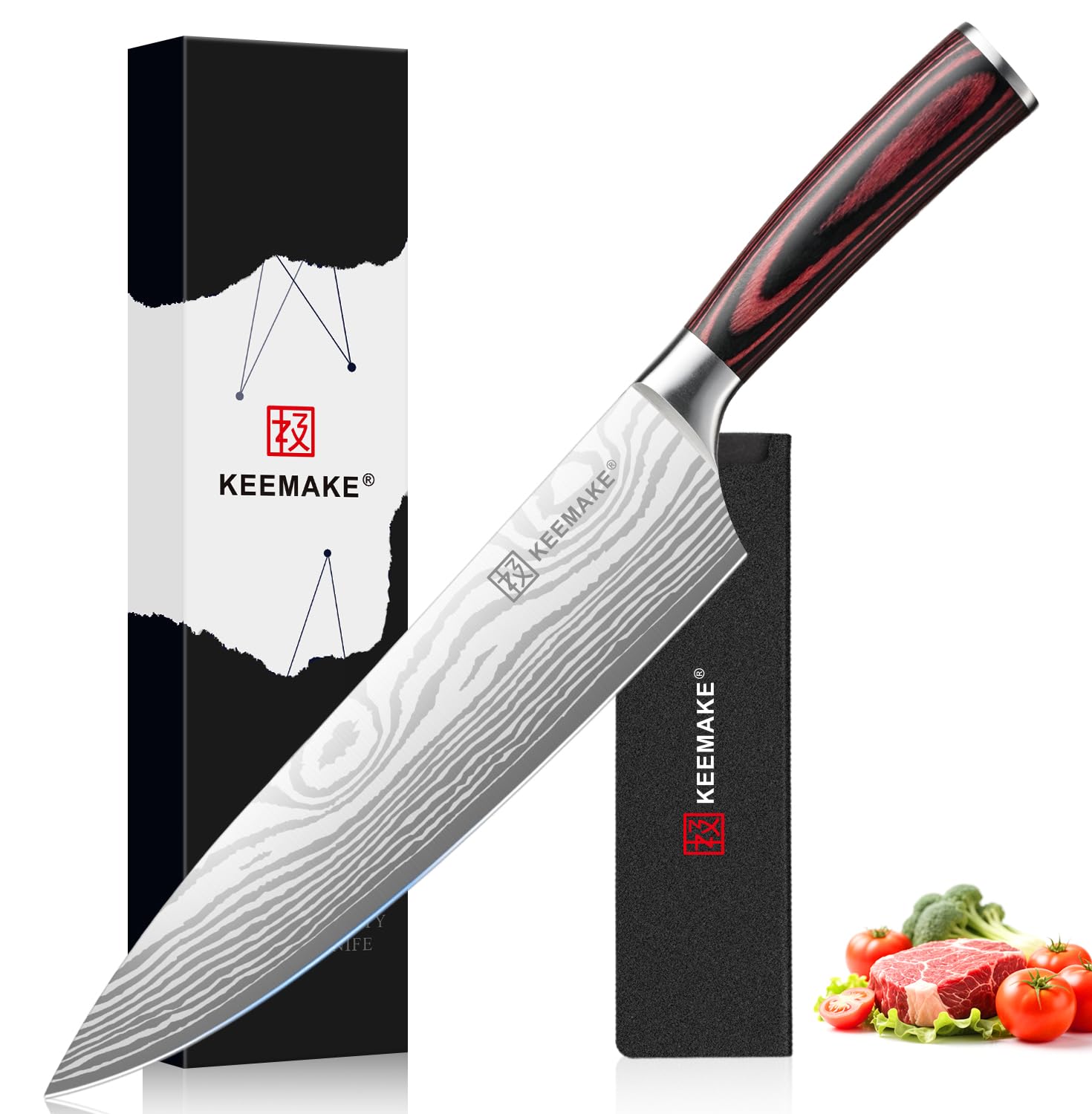
A forged blade with a sharp 8–12 degree edge that one buyer says made her realize what a real knife feels like.
Crafted from 1.4116 high-carbon stainless steel with a hardness of 58±2 HRC (a measure of how well the steel resists deformation — higher numbers mean harder, sharper edges), this forged knife comes hand-sharpened to an 8°–12° edge on each side. The Pakkawood handle — a durable resin-impregnated wood that resists moisture — features a curved design and sloped bolster that promotes a secure pinch grip. One reviewer who had used Cutco for over 20 years wrote that this knife “cuts through delicate tomato skin like through soft butter” and called Cutco “absolutely overhyped and overpriced.” The blade also includes a laser-etched Damascus pattern, though one reviewer noted it is “not true Damascus.”
The honest downside is the weight: at 8.48 ounces, it is heavier than the Victorinox and Mercer options, and one reviewer with small hands found the handle “uncomfortably heavy” at first before getting used to it. Also, the maker lists it as dishwasher safe, but the Pakkawood handle will last much longer with hand-washing.
Standout strengths
- Extremely sharp 8–12 degree edge that glides through meat and vegetables
- Premium feel with forged construction and elegant Pakkawood handle
- Comes in a beautiful gift box with a protective sheath
Honest limitations
- Heavier than many starter knives — may tire smaller hands
- Laser-etched pattern is cosmetic only, not true Damascus layering
Choose this if: you want the look and feel of a premium forged knife without spending over, and you don’t mind a bit of extra weight.
Pass it by if: you have small hands or you prefer a lightweight stamped blade for extended prep sessions.
5. HOSHANHO 8 Inch Damascus Chef Knife

A beautifully patterned blade with a 10Cr15CoMoV steel core that one owner says “usurped” their J.A. Henckels chef knife.
The blade is made of 67 layers of Damascus super steel wrapped around a 10Cr15CoMoV steel core (a high-carbon alloy that after heat treatment reaches a hardness of 62-64 HRC, while the KEEMAKE is listed at 58±2 HRC). The handle is frosted glass fiber G10, a material known for excellent insulation, corrosion resistance, and durability that outlasts wood handles. One buyer who used it for 2-3 weeks said it became their “go-to” knife, noting it handled thin-sliced frozen ginger without fear — something they could not say about pricier knives.
The catch is that some buyers find the handle feels hollow and the knife slightly off-balance. Another reviewer pointed out that at this price point, you should not expect the fit and finish of a handmade knife, but the core cutting performance is “very sharp.” The G10 handle is less tactile than wood or Santoprene, which some beginners may find slippery when wet.
Why it stands out
- Extremely hard 62–64 HRC steel core for superior edge retention
- Beautiful 67-layer Damascus pattern with a unique feather design
- G10 handle resists moisture, corrosion, and wear better than wood
What to watch for
- Some users report the handle feels hollow and the knife is off-balance
- G10 handle can feel less grippy when wet compared to rubberized options
Ideal for: a beginner who wants a visually striking knife with a very hard steel core that stays sharp for long stretches without honing.
Not recommended if: you prefer a balanced, heavier handle feel or you need maximum slip resistance in a wet kitchen.
6. Sunnecko 8 Inch Chef Knife
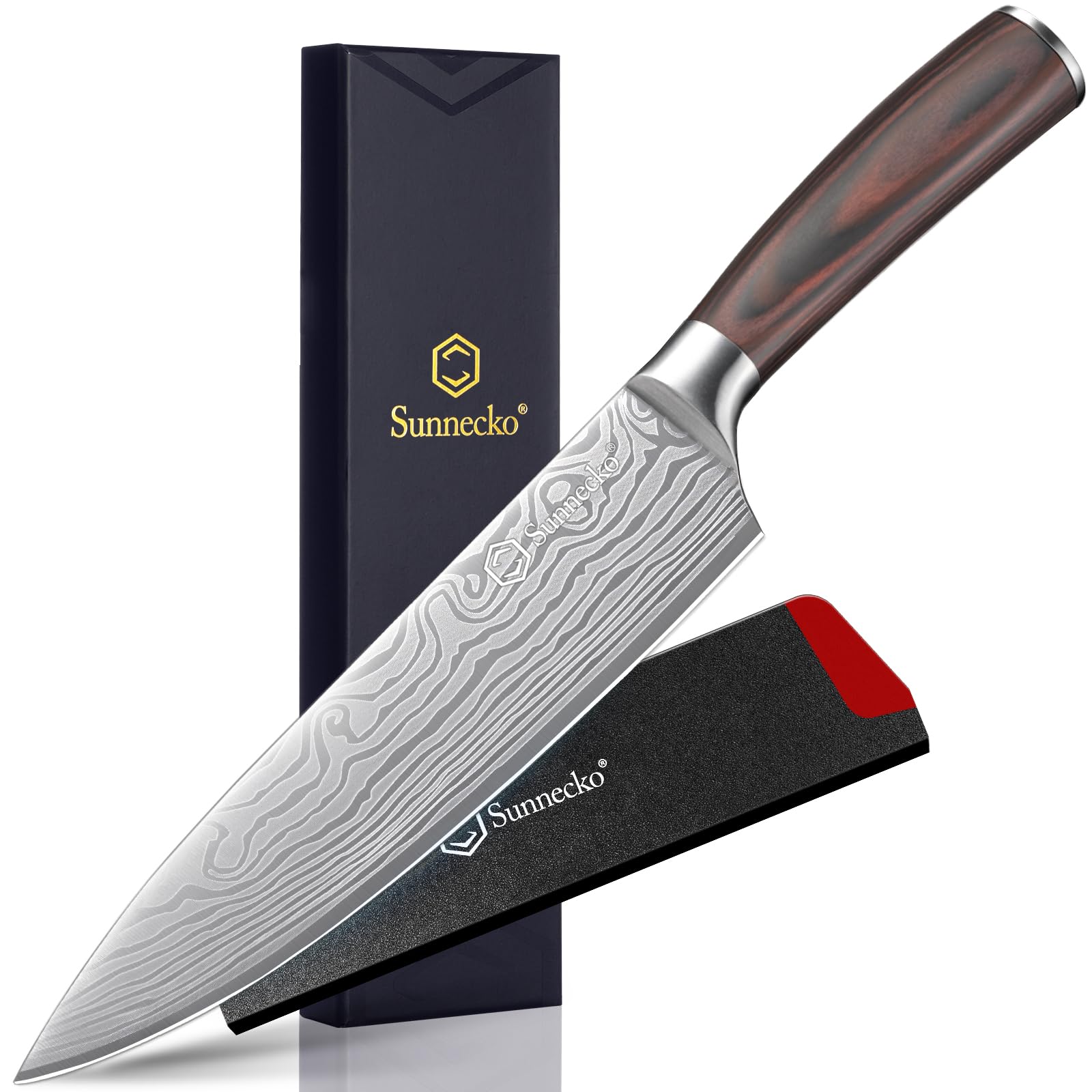
A hand-sharpened 12-15 degree edge that one recipient described as “sharp AF” — and promptly sliced a finger cleaning it.
This forged Japanese-style blade uses high-carbon stainless steel and comes hand-sharpened to a 12-15 degree angle per side, which is a practical middle ground between the aggressive 8-12 degree edges (which cut like lasers but are fragile) and the 20-degree edges common on Western knives. The Pakkawood handle is ergonomically shaped to fit naturally in the hand, and a PVC sheath is included for safe storage. One reviewer who bought it as a Father’s Day gift called it “a good trusted mid range brand chef knife.” Another buyer who used it for camp cooking and home prep described it as “razor sharp” and excellent value for the price.
The main limitation is that at 0.2 kilograms, it is relatively light compared to the KEEMAKE or HOSHANHO, which some users may perceive as less substantial. The blade pattern is laser-etched for aesthetics rather than being a true Damascus forge weld, but at this price point, that is standard. Multiple reviews emphasize that it arrives extremely sharp — “watch your fingers” is a recurring theme.
What works
- Very sharp from the start with a practical 12-15 degree edge angle
- Comfortable Pakkawood handle with non-slip grip even when wet
- Includes a protective PVC sheath for safe drawer storage
What doesn’t
- Lighter weight may feel less substantial than forged alternatives
- Laser-etched pattern is cosmetic, not functional Damascus
Pick this: if you want an affordable, razor-sharp Japanese-style blade with a comfortable wood handle and a sheath included — it’s a confident gift choice.
Skip it: if you dislike light knives or you want a true Damascus pattern rather than a laser-etched design.
7. KYOKU Shogun Series 8″ Chef Knife

Japanese VG-10 steel with a cryogenic treatment and a 8-12 degree Honbazuke edge — this is serious steel for a serious beginner.
The blade is made from Japanese 67-layer Damascus VG-10 steel (VG-10 is a premium stainless alloy known for holding an extremely sharp edge while resisting corrosion) and has been cryogenically treated — a process that involves freezing the blade to sub-zero temperatures to improve the steel’s grain structure and hardness, reaching 58-60 HRC. It is sharpened using the traditional 3-step Honbazuke method to an 8 to 12 degree edge per side, which delivers “exceedingly precise cuts through meat, fish, fruit, vegetables, and more with negligible resistance.” The handle is made from fiberglass G10, which withstands cold, heat, corrosion, and moisture without degrading. One reviewer who used it for a year called it their “favorite knife” and noted it was “sharp enough to cut paper.”
The honest catch is that at 1.39 pounds, it is by far the heaviest knife in this roundup, while the Victorinox is listed at 0.05 pounds. Some users report that the blade does not look exactly like the product photos, with one buyer noting the contrast between dark and light layers was “non-existent” compared to the advertised pattern. The weight makes it less suitable for long prep sessions for beginners not accustomed to heavier blades.
Serious performance
- Premium VG-10 steel core with cryogenic treatment for excellent edge retention
- Traditional Honbazuke sharpening produces a very sharp 8-12 degree edge
- Sturdy G10 handle resists moisture, heat, and cold
Real trade-offs
- Heaviest knife in the guide at 1.39 pounds — fatiguing for long sessions
- Visual pattern may differ significantly from product images
Go for this if: you are a beginner who wants top-tier VG-10 steel from the start and you don’t mind carrying extra weight in your hand.
Avoid it if: you prefer a lighter knife for all-day prep or you care about the visual Damascus pattern matching the online photos exactly.
Understanding the Specs
Hardness (HRC)
HRC stands for Rockwell Hardness scale, a standard way to measure how hard a steel is. A higher number (like 62 HRC) means the blade can take a sharper edge and hold it longer, but it also becomes more brittle and harder to sharpen. A lower number (like 55 HRC) is tougher and easier to sharpen but dulls faster. For a beginner, 58-60 HRC is a balance — sharp enough for easy cutting, tough enough that you won’t chip the edge if you accidentally hit a cutting board hard.
Forged vs Stamped
A forged blade is cut from a solid piece of steel, heated, and hammered into shape, resulting in a denser, heavier, and typically more durable blade. A stamped blade is cut from a large sheet of steel like a cookie cutter, then heat-treated and sharpened; it is lighter, cheaper, and still very functional. Most beginners will not notice a performance difference between a quality stamped blade (like the Victorinox) and a forged blade (like the KEEMAKE) — the real difference is weight, balance, and price.
FAQ
Should a beginner buy a forged or stamped chef’s knife?
What does the edge angle (degrees per side) mean for daily cutting?
How often do I need to sharpen a high-carbon stainless steel chef’s knife?
Can I put my chef’s knife in the dishwasher to save time?
What is Pakkawood and is it better than plastic handles?
Is a heavier chef’s knife better for beginners with smaller hands?
What is the difference between 1.4116 steel and VG-10 steel?
Will a Damascus pattern on the blade affect how the knife cuts?
How long should a beginner expect an 8-inch chef’s knife to last?
What is the best way to store a chef’s knife in a home kitchen?
Final Thoughts: The Verdict
If you want one dependable pick, the chef’s knife for beginners winner is the Victorinox Fibrox Pro because it combines a razor-sharp edge, a non-slip handle, and a light weight at a price that undercuts many competitors — all backed by decades of professional kitchen trust. If you want a forged blade with premium looks and a comfortable Pakkawood handle, grab the KEEMAKE 8″ Chef Knife. And for a budget-friendly workhorse that line cooks also use, the standout is the Mercer Culinary Millennia.
How We Picked
We do not accept paid placement. Every pick is matched to a real buyer and a real use-case; we do not hands-on test units.
Sources & Methodology
Specifications: manufacturer listings and product documentation. Review insights: verified customer reviews, as of July 2026. Pricing: not shown on this page (it changes often); check the current price via the retailer link.
As an Amazon Associate, WellFizz earns from qualifying purchases. This does not affect which products we feature.

Mo Maruf
I created WellFizz to bridge the gap between vague wellness advice and actionable solutions. My mission is simple: to decode the research and give you practical tools you can actually use.
Beyond the data, I am a passionate traveler. I believe that stepping away from the screen to explore new environments is essential for mental clarity and physical vitality.