Our readers keep the lights on and my smoothie glass nicely filled. As an Amazon Associate, I earn from qualifying purchases.
Specs are compiled from manufacturer listings and verified buyer reviews and can change over time — please confirm the key details on the product page before buying.
You want to see galaxies and nebulae without spending half the night messing with star charts, polar alignment (a process to align the telescope with Earth’s rotation axis), and wobbly tripods. The right computerized telescope (a scope with a motorized mount that finds objects for you) handles the finding and tracking so you can focus on the view instead of the setup. This guide walks through the picks that actually deliver on that promise at every price level.
I’m Mohammad Maruf — the founder and writer behind WellFizz. This guide is built by comparing the manufacturers’ published specifications and the patterns across verified customer reviews, so you get each pick’s real strengths and trade-offs instead of marketing spin.
From ultra-portable smart scopes you can toss in a backpack to serious 12-inch light buckets that reveal faint deep-sky wonders, here are the standout models in the market right now for anyone shopping for the computerized telescope that fits their stargazing style and budget.
Quick Picks
- Celestron NexStar 4SE — Best Overall
- Celestron NexStar 8SE — Deep-Sky Champion
- ZWO Seestar S30 Pro — Imaging Powerhouse
- DWARFLAB Dwarf 3 Smart Telescope — Dual-Day Scope
- DWARFLAB Dwarf Mini Smart Telescope — Travel Companion
- Celestron 114LCM Computerized Newtonian Telescope — Budget Starter
- SkyWatcher Flextube 300 SynScan Dobsonian 12-inch — Light Bucket
- Unistellar Odyssey PRO Smart Telescope — Premium All-in-One
How To Choose The Best Computerized Telescope
The main appeal of a computerized telescope is that it finds objects for you. You pick a target from the database (a stored list of celestial objects), and the mount motors swing the scope to it, then track it as it moves across the sky. But features vary a lot across the range, so knowing what to look for before you buy keeps you from ending up with a scope that doesn’t fit how you plan to use it.
Aperture: The Real Light-Gathering Engine
The aperture (the diameter of the main mirror or lens) is the most critical spec. A bigger aperture collects more light, letting you see fainter galaxies, nebulas (clouds of gas and dust in space), and star clusters. Small smart scopes with apertures around 2 inches are fantastic for photographing bright objects, while an 8-inch or 12-inch scope gathers enough light to reveal the spiral arms of galaxies visibly through the eyepiece (the lens you look through).
Mount Type: Alt-Az vs. Equatorial
Most computerized scopes use an Alt-Az (altitude-azimuth) mount (a mount that moves up/down and left/right). This is simple and intuitive. For long-exposure astrophotography, you need an Equatorial (EQ) mount (a mount tilted to align with the Earth’s axis), which rotates to follow the Earth’s spin, keeping a target perfectly steady for minutes at a time. Some smart scopes offer both modes, giving you flexibility.
Smart Scope vs. Traditional Computerized
“Smart” telescopes like the DWARFLAB and ZWO Seestar have a built-in camera and show the image on your phone or tablet. You never look through an eyepiece. This is amazing for sharing views and for shooting deep-sky images with zero experience. Traditional computerized scopes use an eyepiece for direct visual observation (seeing the sky with your own eye), and you can attach a camera later. Which style suits you depends on if you want to capture photos or look directly at the night sky.
Quick Comparison
| Model | Best For | Aperture | Mount Type | Object Database | Amazon |
|---|---|---|---|---|---|
| DWARFLAB Dwarf Mini | Ultra-portable astrophotography | — | Altazimuth & Equatorial | App-based star map | Amazon |
| Celestron 114LCM | Beginner visual stargazing | 114mm | Motorized Altazimuth | 4,000 objects | Amazon |
| DWARFLAB Dwarf 3 | Versatile day/night imaging | — | Altazimuth | App-based star map | Amazon |
| Celestron NexStar 4SE | Compact planetary views | 4″ (102mm) | Altazimuth / EQ (with wedge) | 40,000+ objects | Amazon |
| ZWO Seestar S30 Pro | easy deep-sky imaging | — | Altazimuth | App-based | Amazon |
| Celestron NexStar 8SE | Serious visual & entry astrophotography | 8″ (203mm) | Motorized Alt-Az | 40,000+ objects | Amazon |
| SkyWatcher Flextube 300 | Massive aperture for deep-sky | 12″ (305mm) | Dobsonian (GoTo) | 42,000 objects | Amazon |
| Unistellar Odyssey PRO | Premium all-in-one observing | 85mm | Motorized Alt-Az | 5,000+ object catalog | Amazon |
In‑Depth Reviews
1. Celestron NexStar 4SE

The classic orange tube that combines sharp Maksutov optics (a lens and mirror design that gives crisp images) with a database larger than most casual astronomers will ever exhaust.
The 4-inch (102mm) aperture paired with a long 1325mm focal length (the distance light travels inside before focusing) delivers high-contrast planetary views that punch above the tube’s compact size. You get a fully automated GoTo mount (a motorized setup that points the scope at your chosen target) controlled by the NexStar+ hand control, which holds a 40,000+ object database. SkyAlign technology (a system that uses three bright stars you center in the scope) lets you align by centering any three bright stars without needing to know their names, getting you up and observing in minutes.
Buyers report that the built-in wedge (a tilting plate that turns the Alt-Az mount into an equatorial mode) allows long-exposure astrophotography, making this a rare bridge between visual observing and entry-level imaging. One owner noted that the StarBright XLT coatings (special anti-reflective layers on the glass) significantly boost light transmission (allowing more light to reach the eyepiece) for fainter deep-sky objects, so fainter galaxies look brighter. A common theme across reviews: the 25mm eyepiece gets you started, but you will want additional eyepieces and a Barlow lens (a lens that doubles magnification) to really open up its planetary performance.
Unlike the grab-and-go smart scopes like the ZWO Seestar S30 Pro, this is a traditional telescope with a learning curve, but its versatility for both lunar/planetary viewing and bright deep-sky photography makes it the one setup that grows with you.
Why It Earns Top Billing
- Long 1325mm focal length gives crisp, magnified views of planets and the Moon
- 40,000+ object database with SkyTour feature finds and lists the best targets
- Included wedge enables equatorial alignment for entry-level astrophotography
The Real Catch
- Uses 8 AA batteries which drain quickly and struggle in cold weather, per reviews
- Alignment can fail often; one reviewer noted failure 75% of the time without extra gear
- Budget for around in additional accessories to reach its full potential
Reach for this if: you want a single scope that handles casual planetary viewing now but leaves a clear upgrade path to astrophotography later.
Look elsewhere if: you want instant images on a screen without learning alignment procedures — a smart scope is a better fit for you.
2. Celestron NexStar 8SE
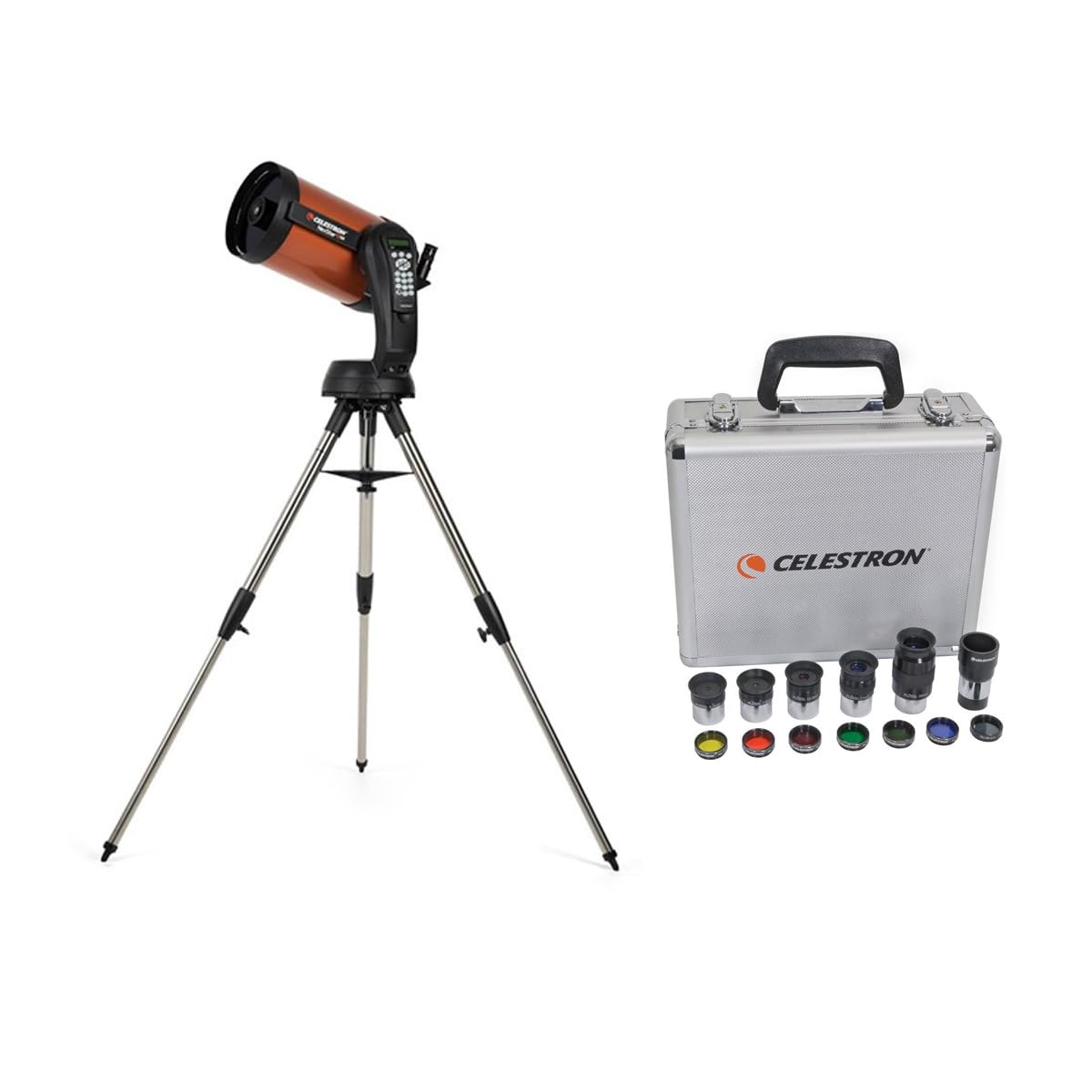
The 8-inch aperture that pulls in enough light to make galaxies look like more than faint smudges.
With a 203mm mirror and a 2032mm focal length at f/10 (a ratio that describes how “fast” the optics are; a slower f-number here means sharper, more forgiving views), the NexStar 8SE is the balance for an amateur who wants serious visual observing without jumping to a monster-sized Dobsonian (a simple, large-aperture mount). The StarBright XLT optical coatings boost light transmission (so dim objects appear brighter in the eyepiece), and the single-fork mount with a 40,000+ object database makes finding targets easy. The included accessory kit with 5 Plossl eyepieces (a common eyepiece design for sharp views), 6 colored planetary filters, and a 2x Barlow lens gives you a versatile arsenal from day one.
Owners mention that the Go-To tracking works flawlessly when properly aligned, holding targets steady enough for video and photography through the eyepiece. One buyer mentioned that the supplied red dot finder (a simple sighting device) is off by about 2 inches in the sky and recommended immediately upgrading to a better finderscope (a small telescope for aiming). Despite being “portable” in the sense that it breaks down, the item weight is 53.4 pounds — a significant load that makes this more of a back-yard observatory scope than a hiking companion.
The 0.64-degree field of view is narrower than the smart scopes like the ZWO Seestar S30 Pro, but the sheer light grasp at this price point reveals clusters and nebulas that smaller scopes cannot touch.
Who this fits: The dedicated hobbyist who wants a single, capable instrument that can double for casual astrophotography (planetary, lunar) and serious deep-sky viewing.
The honest limit: The mount is Alt-Az, not Equatorial, so long-exposure deep-sky photos will show field rotation (the image slowly twists) unless you add an expensive wedge accessory.
3. ZWO Seestar S30 Pro
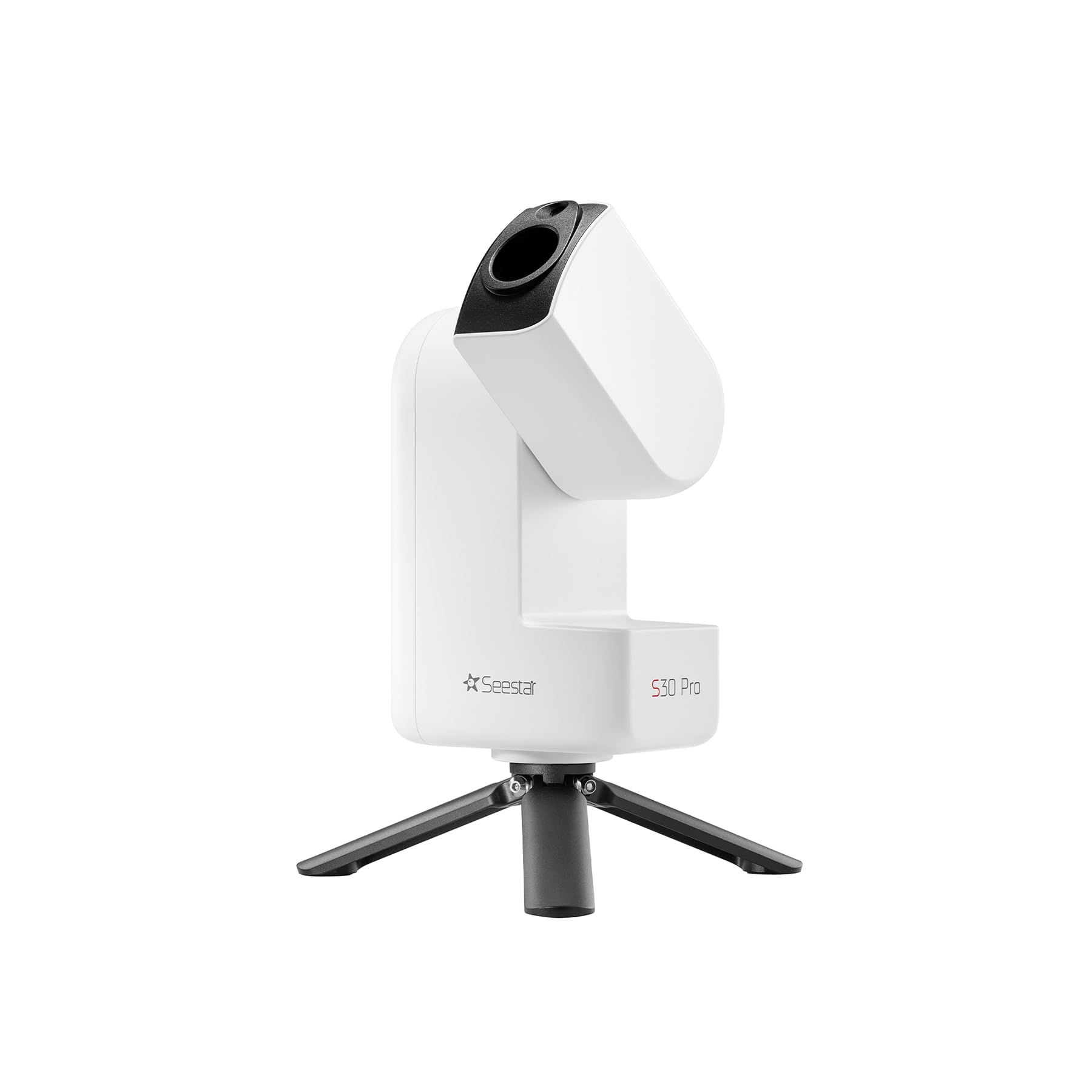
A fully-automated astrophotography rig that captures 8K panoramas while you stay inside and warm.
The S30 Pro is a smart telescope that does everything for you. It uses a 4-element apochromatic lens (a special design that stops colors from bleeding around stars for sharp images) to deliver sharp views, and the dual-camera setup — featuring an IMX585 sensor (the chip that converts light to a digital image) for deep-sky telephoto and an IMX586 for wide-angle landscapes — lets you shoot both nebulae and Milky Way star trails without swapping hardware. The field of view (the area of sky you see in one image) is 4.6 degrees, significantly wider than the NexStar 4SE’s 0.11 degrees, meaning you get sprawling sky panoramas in a single frame.
Customers note that the automatic noise reduction and AI scene recognition (software that identifies and improves the image) make getting a clean result a one-tap affair. The built-in anti-dew protection and the ability to schedule imaging sessions let you run it all night. One owner reported that you must turn off your VPN for the app to connect properly — a small gotcha in an otherwise smooth experience.
Unlike the DWARFLAB Dwarf Mini’s 2.45-degree field of view, the S30 Pro captures a wider view, which helps when framing large objects like the Andromeda Galaxy or a sweeping Milky Way arch.
What You Get
- One-tap Milky Way and star trail modes produce impressive photos with zero editing skill
- Auto tracking with a 4K sensor keeps targets centered during long sessions
- 128GB onboard storage for hundreds of raw images without a laptop
What You Don’t
- It is an electronic-only scope — no eyepiece, so you cannot look directly at the sky
- Relies entirely on app connectivity; a weak Wi-fi signal ruins the session
- Not great for planetary detail — the 160mm focal length is too short for magnified views
Your move if: you want jaw-dropping astrophotographs with minimal setup time and are happy viewing the results on a screen.
skip it if: the magic of putting your eye to an eyepiece and seeing Saturn’s rings directly is why you are buying a telescope.
4. DWARFLAB Dwarf 3 Smart Telescope
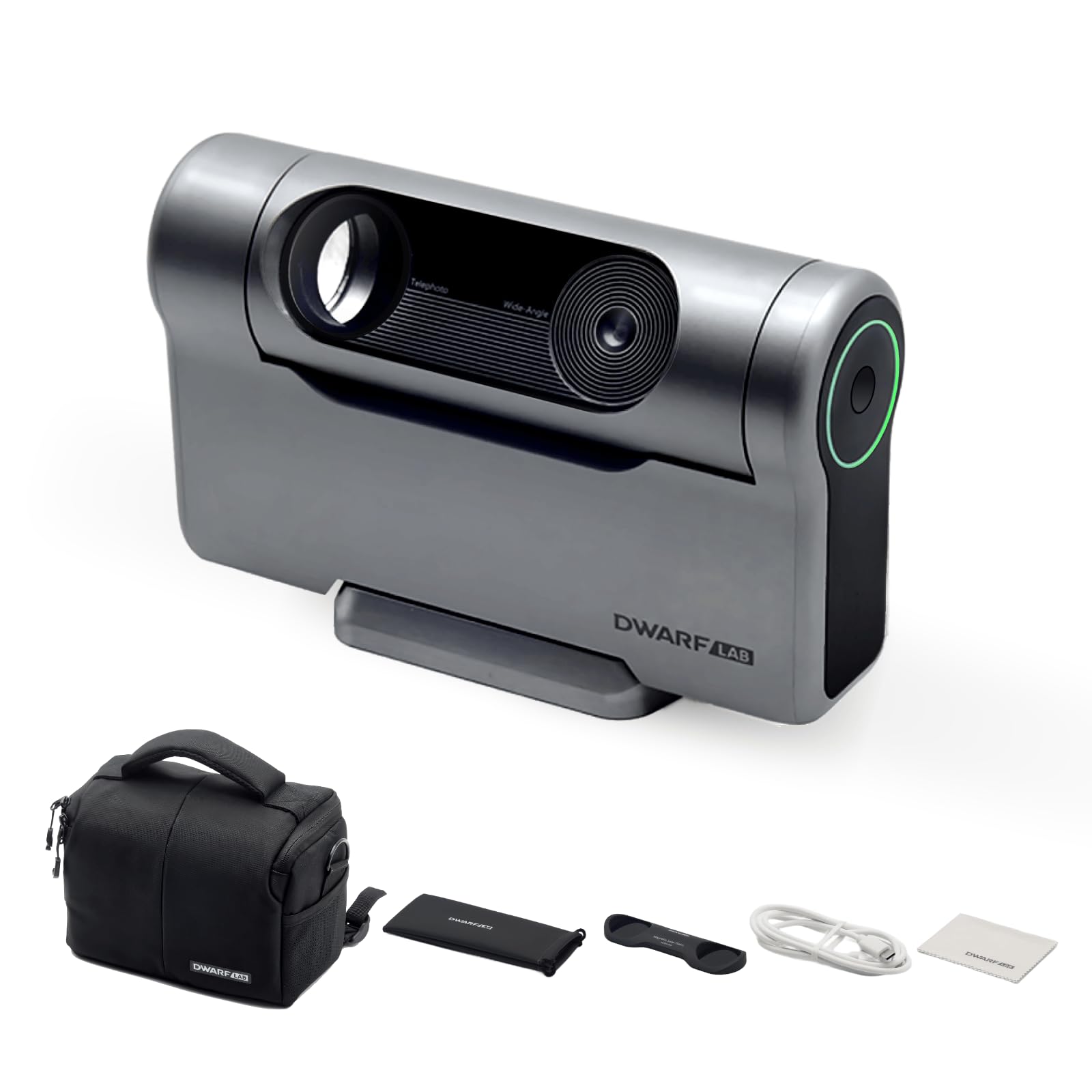
A smart telescope that doubles as a wildlife and landscape camera when the Sun is up.
The Dwarf 3 improves on the earlier model with a dual-lens system — a telephoto for deep-space objects and a wide-angle for capturing the Milky Way or star trails — and it works for daytime photography too. At only 3 pounds and fitting into a standard backpack, it is the most versatile portable imager in this lineup. The item dimensions are 2.56″D x 8.74″W x 5.59″H, making it nearly as pocket-friendly as the DWARFLAB Dwarf Mini but with a larger imaging sensor and auto-focus.
Reviewers point out that the 4K auto-tracking locks onto celestial objects and moving subjects with equal ease. One reviewer described it as “zero astronomy experience needed” and noted that the app handles navigation via geolocation (using your phone’s GPS to find the sky above). A common observation is that the app can sometimes be glitchy with connection and image processing after a power loss, but the image quality remains consistently impressive even under heavy light pollution (city lights that wash out the sky). The included carrying bag and magnetic filters are a nice touch for field use.
The trade-off vs the ZWO Seestar S30 Pro is the lack of an integrated wedge or equatorial mode — the Dwarf 3 relies on its Alt-Az mount, which limits maximum exposure times for deep-space astrophotography.
Best for: Travelers and outdoor adventurers who want one compact device that works for both astrophotography at night and telephoto wildlife shots during the day.
The asterisk: The auto-focus is convenient, but daytime landscape use requires a stable tripod to avoid blur with the long telephoto lens.
5. DWARFLAB Dwarf Mini Smart Telescope
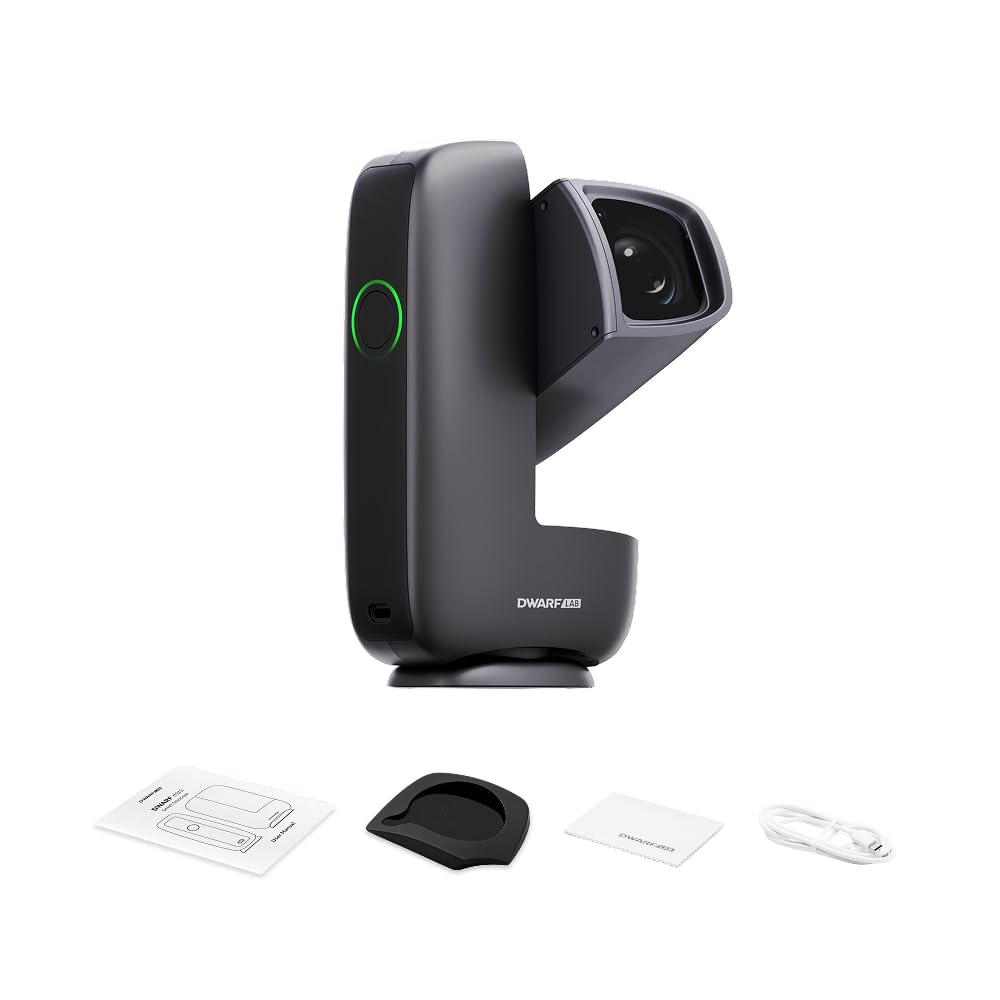
The 1.85-pound scope you can toss in a backpack and still have room for snacks.
The Dwarf Mini is the smallest computerized telescope in this roundup, with dimensions of just 2.39″D x 3.95″W x 7.23″H — a hair bigger than a water bottle. Despite its size, it packs a Sony IMX662 sensor (the chip that turns light into a digital image) with 2.9-micron pixels for low-noise astro shots. The Auto GOTO with 360-degree rotation finds targets quickly, and the equatorial mode supports single-frame exposures up to 90 seconds, which is enough to capture bright nebulas like the Orion Nebula even from a city balcony.
Shoppers say that the app is intuitive and that the ability to schedule targets means you can set it up, walk inside, and check results in the morning. One customer observed that the initial Wi-Fi connection requires you to select your home network in the app settings — a small step that is easy to miss. Another noted that while this scope produces beautiful images of galaxies and nebulae, it is “not for planet viewing” — planets appear as round circles with no detail. It uses a much wider 2.45-degree field of view than the Celestron 114LCM’s 1.44-degree view, making it better for framing large objects but worse for close-ups.
The built-in light pollution filter (a coating that blocks artificial city lights) cuts through city glow effectively, a feature that makes it immediately more useful in suburban settings than a traditional reflector with similar light-gathering power.
Pocket-Sized Perks
- Weighs only 1.85 lb — the most portable computerized telescope available
- Equatorial mode allows 90-second exposures for impressive deep-sky images
- Cloud processing handles image stacking and noise reduction on your phone
Size Trade-Offs
- Small sensor captures zero detail on planets (Jupiter is a featureless white circle)
- Requires a stable tripod; the included mini tripod forces a very low viewing angle
- Some units have dust inside the lens not visible in images but reported by multiple buyers
Grab it for: The ultralight traveler who wants to do deep-sky astrophotography from anywhere without checked luggage.
Pass if: You want to show your kids the rings of Saturn or the bands of Jupiter — this scope cannot do that.
6. Celestron 114LCM Computerized Newtonian Telescope
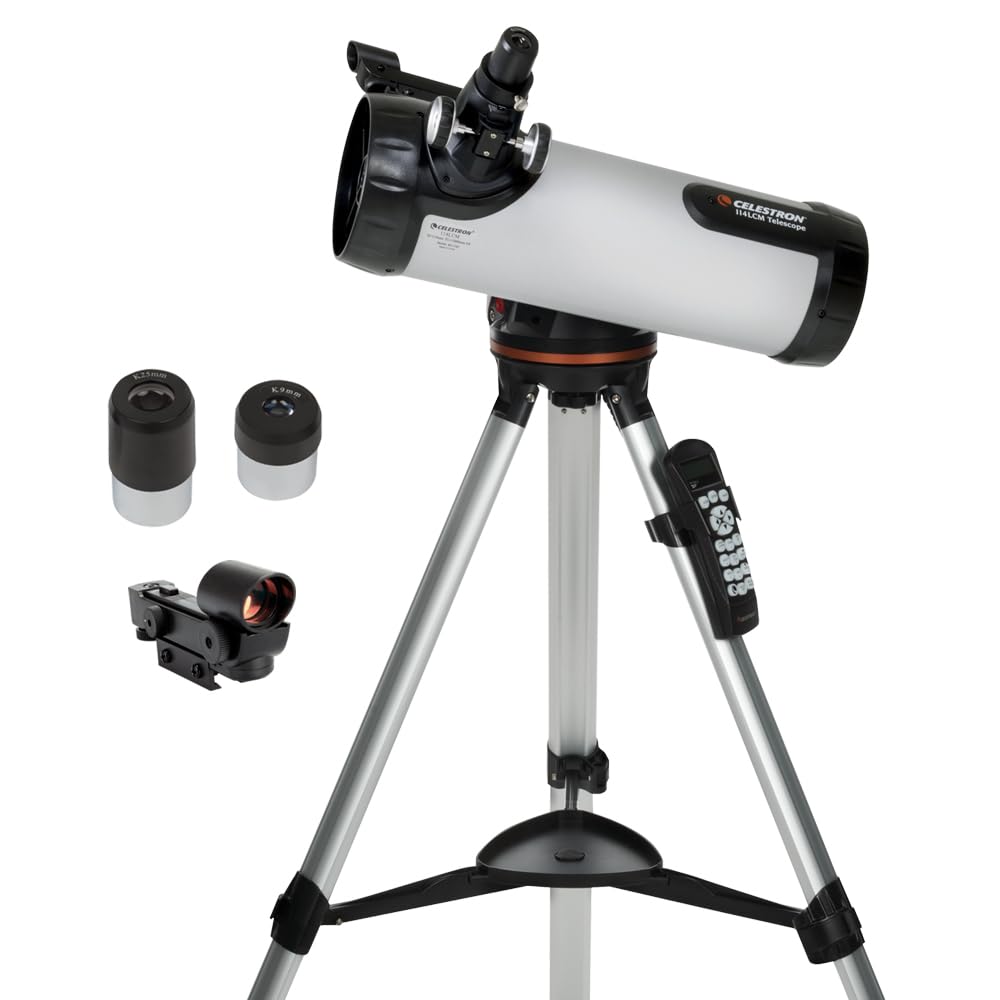
Your first computerized scope that finds 4,000 objects for you so you can skip the star-hop learning curve.
The 114LCM is a Newtonian reflector (a telescope that uses a concave mirror at the bottom of the tube to gather light) on a motorized Altazimuth mount. The 114mm aperture (4.5 inches) is large enough to show you Saturn’s rings and Jupiter’s cloud bands clearly, and the GoTo system with a 4,000-object database lets you press “Sky Tour” and see whatever is best in the sky that night. It comes with a full-height tripod, two eyepieces (25mm and 9mm), and a StarPointer red dot finder — everything a beginner needs to get started immediately.
Buyers report that the automated tracking works well for keeping objects centered, and that the telescope is portable enough to take to dark-sky sites. One experienced user gave a direct warning shared by many: “Drains AA batteries; get rechargeable pack.” The 1.44-degree field of view is narrow enough for lunar and planetary work but limits the ability to frame larger deep-sky objects like the Pleiades (a star cluster). The kit eyepieces are functional but noticeably basic; aftermarket upgrades improve clarity significantly.
Unlike the DWARFLAB Dwarf Mini which photographs faint nebulas automatically, the 114LCM is designed for direct visual observation — you look through the eyepiece, not a screen.
Perfect for: The beginner who wants a “real” telescope with eyepieces and a full mount but does not want to learn manual star charts yet.
The honesty check: Factor in the cost of rechargeable batteries and a better eyepiece set on day one — the stock items are passable, not impressive.
7. SkyWatcher Flextube 300 SynScan Dobsonian 12-inch

The 12-inch mirror that shows you what deep-sky objects actually look like, not just faint hints of them.
The Flextube 300 combines the massive light-gathering power of a Dobsonian mount (a simple, stable base for large scopes) with a computerized GoTo system. The 305mm aperture collects enough light to resolve individual stars in globular clusters (dense groups of stars) and reveal the dust lanes in the Andromeda Galaxy from a dark-sky site. The collapsible tube design keeps the transported size manageable, and the built-in Wi-Fi lets you control it from your phone or tablet. The SynScan hand controller holds a 42,000-object database — enough to keep even experienced observers busy for years.
Owners mention that the views are “awesome” and that the tracking is smooth after a 2-4 minute SynScan alignment. One reviewer, a professional astronomer, noted that the Go-To alignment repeatedly failed with the target 100 feet off, and despite responsive support, the issue could not be resolved — something to monitor. The all-metal gearing using DC servo motors (small electric motors that respond precisely to commands) makes tracking quiet and reliable under normal conditions. The included 25mm and 10mm Plossl eyepieces are functional, and the 2-inch Crayford-style focuser (a smooth-focusing mechanism without the “image shift” of other designs) is a solid upgrade over budget focusers.
At 99.2 pounds (46 pounds for the tube, 53 for the base), this is a permanent or semi-permanent installation — not something you casually take to a friend’s yard. Reviewers warn that the base is made of MDF wood (medium-density fiberboard), a choice that feels cheap for a premium-priced scope.
Why Size Matters
- 12-inch aperture reveals faint galaxies and nebulae that smaller scopes cannot show
- Collapsible tube fits in a compact car like a Toyota Prius
- Built-in Wi-Fi eliminates the need for an external dongle for app control
The Heavy Realities
- Weighs 99.2 pounds — you need a dolly or a dedicated observing spot
- MDF particle-board base feels underwhelming for a premium telescope
- Quality control issues reported: dented secondary mirrors and seized adjustment screws
Your buy-in if: You have a dedicated outdoor setup, a vehicle with cargo space, and you are obsessed with seeing the faintest deep-sky objects in maximum detail.
Walk away if: You plan to travel to dark-sky sites regularly — portability ends at “loads into a Prius” but not much farther.
8. Unistellar Odyssey PRO Smart Telescope

The only smart scope that gives you both an electronic eyepiece and digital imaging in a single smooth package.
The Odyssey PRO is Unistellar’s latest all-in-one, integrating a 85mm f/3.9 optical tube, a digital camera, a motorized Alt-Az mount, and a 5-hour internal battery into a 6.5 kg (14.3 lb) scope with a 2.5 kg tripod. The electronic eyepiece technology (a small screen inside the viewfinder that shows the enhanced digital image) lets you look directly at the sky while also viewing it on your phone or tablet. The 5,000+ object catalog is drawn from a 37-million-star database, and the scope supports RAW/FITS export (unprocessed image file formats) for advanced image processing.
Customers note that the scope goes from power-on to observing in under 2 minutes, with automatic alignment and GoTo that works from city balconies — “amazing views, zero effort” as one described it. The limiting magnitude of 17.2 (a measure of how faint a star the scope can detect) means it can see objects thousands of times dimmer than the naked eye can. The Dynamic Signal Amplification and Multi-Depth technologies (proprietary image processing algorithms that the brand claims enhance images) stack and enhance frames in real-time, delivering bright, clear images of galaxies and nebulas on the spot.
One reviewer who upgraded from a Celestron NexStar 8SE called it “an amazing portable, easy-to-use replacement” despite the high cost. The main limitation is the price, and reviewers point out the app could use better manual controls and star identification features. Unlike the NexStar 8SE which weighs 53.4 pounds, the complete Odyssey PRO setup is light enough to carry one-handed.
Ideal for: The tech-forward family or casual astronomer who wants a premium, turnkey experience that everyone from kids to grandparents can operate immediately.
The big “but”: The price is a multiple of the NexStar 8SE for less raw aperture — you are paying for automation, software, and portability, not raw light-gathering power.
Understanding the Specs
Aperture
The diameter of the main mirror or lens, measured in millimeters or inches. This is the single most important spec — a bigger aperture collects more light, letting you see fainter objects. The Celestron NexStar 8SE has a 203mm aperture, while the SkyWatcher Flextube 300 has a 305mm aperture, meaning the SkyWatcher gathers about twice as much light for revealing dim galaxies and nebulas.
Focal Length
The distance the light travels inside the telescope before it comes to focus, measured in millimeters (e.g., the NexStar 4SE has a 1325mm focal length). A longer focal length generally means higher magnification and a narrower field of view (the area of sky you can see), which is great for close-ups of planets. A shorter focal length gives you a wider view, better for sweeping star fields and large objects like the Andromeda Galaxy.
Mount Type
The base that holds the telescope and moves it to track objects across the sky. Altazimuth (Alt-Az) mounts move up/down and left/right — simple and intuitive for beginners. Equatorial (EQ) mounts are tilted to align with the Earth’s axis, making it easy to track stars for long-exposure photography. Some scopes like the DWARFLAB Dwarf Mini support both modes, giving you flexibility.
GoTo Database
The number of celestial objects stored in the telescope’s hand controller. A database of 4,000 objects (like the Celestron 114LCM) covers all the major sights — planets, bright star clusters, and famous nebulae. A database of 40,000+ objects (like the NexStar 4SE or 8SE) includes many small galaxies, double stars, and faint deep-sky objects that will keep you busy for years.
FAQ
Can a computerized telescope be used without the computer?
How accurate is the GoTo on a budget computerized telescope?
What is the difference between a smart telescope and a traditional computerized telescope?
Do I need to know the night sky to use a GoTo telescope?
Can a smart telescope take photos of planets?
How much extra should I budget for accessories beyond the telescope itself?
Is a “red dot finder” accurate enough for GoTo alignment?
What does “focal ratio” matter for astrophotography?
Can I use a battery pack instead of AA batteries for a computerized scope?
What is the difference between Alt-Az and Equatorial mode for astrophotography?
Final Thoughts: The Verdict
For most people, the computerized telescope winner is the Celestron NexStar 4SE because it combines great planetary optics, a massive 40,000+ object database, and a path to astrophotography in a compact package. If you want easy deep-sky imaging you can share on social media, grab the ZWO Seestar S30 Pro. And for the purest visual experience with the brightest views of faint galaxies and nebulas, the SkyWatcher Flextube 300 is in a class of its own.
How We Picked
We do not accept paid placement. Every pick is matched to a real buyer and a real use-case; we do not hands-on test units.
Sources & Methodology
Specifications: manufacturer listings and product documentation. Review insights: verified customer reviews, as of July 2026. Pricing: not shown on this page (it changes often); check the current price via the retailer link.
As an Amazon Associate, WellFizz earns from qualifying purchases. This does not affect which products we feature.

Mo Maruf
I created WellFizz to bridge the gap between vague wellness advice and actionable solutions. My mission is simple: to decode the research and give you practical tools you can actually use.
Beyond the data, I am a passionate traveler. I believe that stepping away from the screen to explore new environments is essential for mental clarity and physical vitality.