Our readers keep the lights on and my smoothie glass nicely filled. As an Amazon Associate, I earn from qualifying purchases.
Specs are compiled from manufacturer listings and verified buyer reviews and can change over time — please confirm the key details on the product page before buying.
If you are on your feet all day—teaching, nursing, running errands, or just trying to get through a shift without your legs feeling heavy—you already know why compression tights are worth looking into. The right pair does more than squeeze; it supports your circulation so you feel less tired by evening. But between the medical-pressure numbers, the footless versus footed decision, and the worry about them rolling down mid-stride, choosing one can feel like a second job. This guide walks you through exactly what matters and compares three proven options so you can just pick the right one and move on.
I’m Mohammad Maruf — the founder and writer behind WellFizz. This guide is built by comparing the manufacturers’ published specifications and the patterns across verified customer reviews, so you get each pick’s real strengths and trade-offs instead of marketing spin.
We put these three models to the test on comfort, fit, durability, and real-world wear. Whether you are managing varicose veins, recovering from a workout, or just wanting a pair of tights that stays put all day, understanding the difference between 20-30 mmHg ratings and fabric blends is what separates a great buy from a regret. This article reviews the best compression tights for women based on actual specs and user feedback.
Quick Picks
- Absolute Support Compression Leggings 20-30mmHg — Best Overall
- Bewzilove 2-Pair 20-30mmHg Compression Pantyhose — Best Value Two-Pack
- XUANSHOW 20-30mmHg Compression Pantyhose — Budget Pick
How To Choose The Best Compression Tights For Women
Picking your first pair of compression tights depends on three things: how firm the squeeze is, what the fabric is made of, and whether the fit matches your body. Nail those three and you skip the returns pile.
Compression Level (mmHg) — How Tight Is Tight Enough
The number you will see most often is 20-30 mmHg. That stands for millimeters of mercury, which is just a way of measuring how much pressure the garment applies to your legs. For everyday use—standing all day, mild varicose veins, post-workout recovery—20-30 mmHg is the balance. It is firm enough to improve blood flow without making you feel like you are in a medical device. You want this range; lower numbers like 15-20 are too light for real support, and higher ones (30-40) are prescription-level, not for casual wear.
Fabric Composition — Nylon vs Spandex, and Why It Matters
Two materials dominate: nylon and spandex. Nylon gives the fabric structure, durability, and that opaque finish so you can wear them as leggings. Spandex gives the stretch and the compression itself. A good balance is roughly 70% nylon and 30% spandex. If a pair has too little spandex, it will bag out and lose pressure within a few wears. Too much, and it may dig in at the waistband or crotch. Look for that 70/30 range, and check if the fabric is latex-free if you have sensitive skin.
Style: Footless vs. Footed
Nearly all modern compression tights for women come footless, meaning they stop at the ankle. That makes them more versatile: you can wear them under pants, with sneakers, or as leggings without worrying about toe seams bunching. Footed versions are available, but they are less common and harder to fit because your foot and calf lengths are rarely the same. For 9 out of 10 buyers, footless is the smarter choice.
Quick Comparison
| Model | Best For | Compression Level | Material | Size Range | Amazon |
|---|---|---|---|---|---|
| Absolute Support Compression Leggings | Long-lasting daily wear | 20-30 mmHg | 75% Nylon / 25% Spandex | S up to 5XL | Amazon |
| Bewzilove 2-Pair Compression Pantyhose | Best value two-pack | 20-30 mmHg | 70% Nylon / 30% Spandex | S to 2XL | Amazon |
| XUANSHOW Compression Pantyhose | Budget-friendly entry point | 20-30 mmHg | — | S to 2XL | Amazon |
In‑Depth Reviews
1. Absolute Support Compression Leggings 20-30mmHg

The premium pick that blends medical-grade compression with leggings you will actually want to wear.
This pair holds its pressure longer than the XUANSHOW because the fabric uses 75% nylon and 25% spandex, a touch more nylon than the standard 70/30 blend. That means the 20-30 mmHg graduated compression (tightest at the ankle, lighter at the thigh, so it pushes blood upward against gravity) stays effective wash after wash without turning saggy. The footless design lets you wear ankle socks or go barefoot around the house, and the high waist stays put through a full day of movement.
Absolute Support has been making compression garments in Brooklyn since 1997, and they design and test their products in the USA. Buyers report that these leggings maintain their tightness through machine washing and do not pill or thin out the way cheaper options do. The brand offers sizes up to 5XL, with precise waist, thigh, calf, and ankle measurements in the size chart—so you are far less likely to guess wrong than with the S-2XL range of the other models. The fabric is also latex-free, making it a solid choice for anyone with sensitive skin who finds some compression hosiery itchy.
What earns it the top spot
- 75/25 nylon-spandex blend holds compression longer than 70/30 blends
- Sized up to 5XL with detailed measurement chart for better fit
- Latex-free opaque fabric works for sensitive skin and everyday wear
- Machine washable and tested by a US-based brand with 25+ years of experience
The honest trade-off
- Higher upfront cost than the budget options
- No toe-coverage—footless only, which may not suit users who want footed compression
Stick with this if: you wear compression tights daily and need something durable enough to hold its pressure for months—the fabric quality and US-based testing justify the extra cost.
Look elsewhere if: you only need compression for occasional travel or light support, where a cheaper two-pack like the Bewzilove would serve you just fine.
2. Bewzilove 2-Pair 20-30mmHg Compression Pantyhose
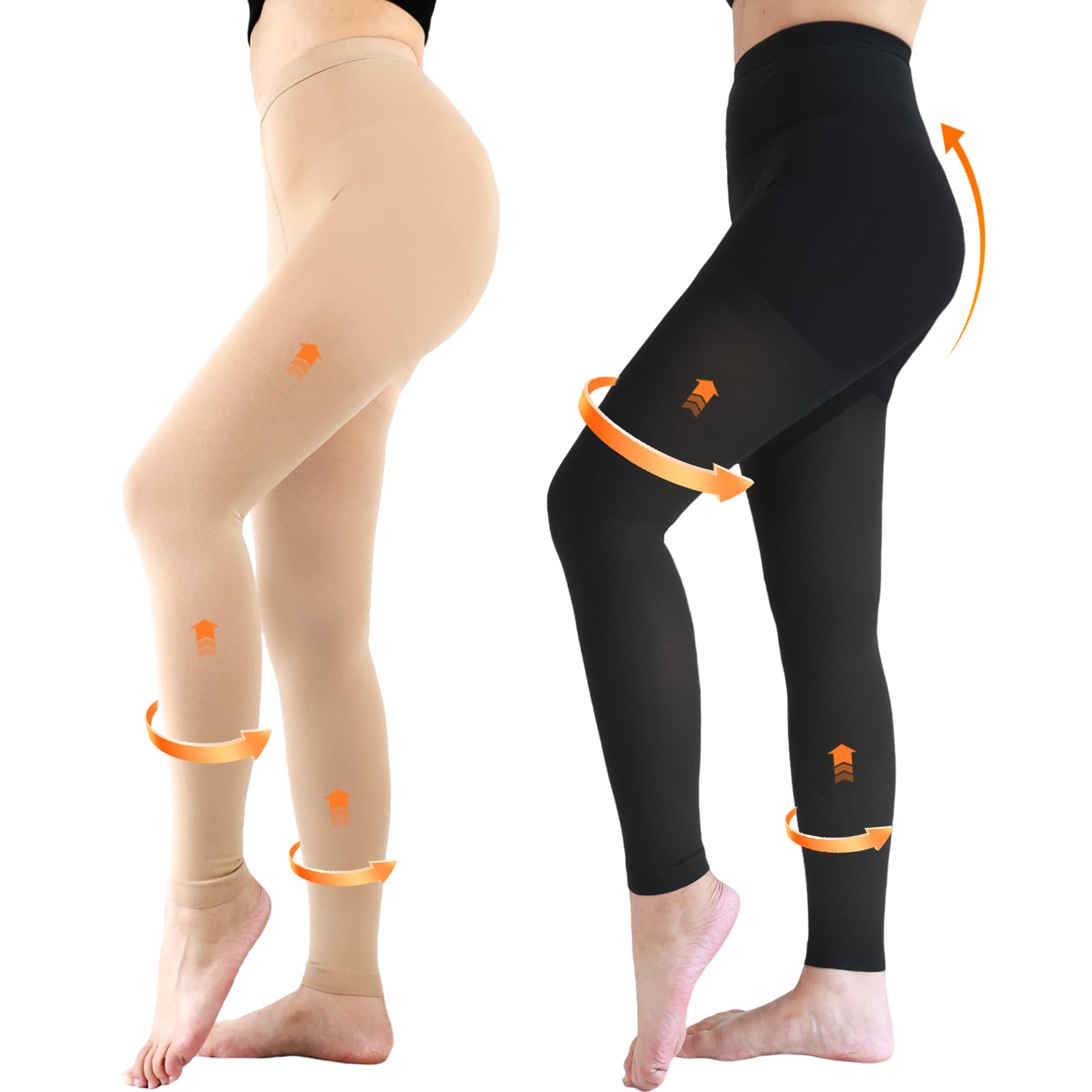
Two pairs of medical-grade compression in a footless style that stays put at the waist.
If you do not want to wash your one pair every single night, the Bewzilove is the practical choice. The compression sits at the same effective 20-30 mmHg level, and the fabric uses 70% nylon with 30% spandex—a stretchier blend than the Absolute Support’s 75/25, making the initial feel a touch more forgiving on the first wear.
The clever waist design is a real plus here: the brand specifically engineered these to prevent slipping at the waist and tearing at the crotch, which are the two most common failure points owners mention with cheaper tights. The footless, open-toe style works with any shoe, and the material is breathable even during long shifts. In terms of support, it is on par with the XUANSHOW pair, but you get the extra pair and the reinforced seams that make it less likely to give out after a few washes.
Two-pair confidence: This is the smart buy if you are just building a rotation—the spare pair halves your laundry cycle and the reinforced design handles the wear better than budget single-pack alternatives.
Grab this if: you want a spare pair ready from day one and you value crotch-seam reinforcement that stops blowouts mid-day.
Pass if: you have very long legs or a waist larger than 2XL—this tops out at 2XL while the Absolute Support goes to 5XL.
3. XUANSHOW 20-30mmHg Compression Pantyhose

A no-frills, single-pair entry into 20-30 mmHg support that gets the basics right.
This is the most straightforward option: one pair, black or beige, footless, sized S to 2XL, with the core 20-30 mmHg graduated compression that matters for circulation and swelling relief. What you give up versus the Bewzilove and Absolute Support is mostly in the details—there is no second pair in the box, no reinforced crotch seam mentioned, and the manufacturer is a generic brand without the 25-year pedigree of Absolute Support. But for a buyer who just needs to try compression tights for the first time without a big investment, this is a risk-free start.
The compression level is the same 20-30 mmHg as the other two, so the therapeutic effect for leg swelling, varicose veins, and standing fatigue is comparable. Where it falls short of the Absolute Support is in long-term durability: buyers notice the fabric relaxes faster than the 75% nylon blend of the premium option. And unlike the Bewzilove, you do not get a spare pair, so you will be washing it daily if you wear it every day. The sizing covers most body types, but the chart is less detailed than the Absolute Support’s five-point measurement guide.
The case for this pair
- Full 20-30 mmHg medical-grade compression at the lowest single-pair cost
- Footless design works under pants, with sneakers, or as leggings
- Simple color choice—black or beige—that pairs with most wardrobe basics
What you trade off
- Only one pair included, so you will need to wash it daily or buy multiples
- Fabric may relax faster than the 75% nylon blend of the Absolute Support
- Less detailed size chart increases the chance of guessing wrong on your first order
Reach for this if: you are new to compression tights and want to test the 20-30 mmHg level with minimal upfront cost.
skip it if: you need a daily-wear rotation or you prefer knowing your tights will maintain their squeeze for many months—the Bewzilove two-pack or the Absolute Support single pair are better long-term buys.
Understanding the Specs
20-30 mmHg Compression
This is the pressure range you will see on most over-the-counter compression tights. It measures how much force the fabric applies to your legs—the number stands for millimeters of mercury, same unit used in blood pressure cuffs. At this level, the tights squeeze just enough to help your veins push blood back up toward your heart, which reduces swelling, heaviness, and fatigue in your legs. It is a solid all-around range for standing all day, flying, managing mild varicose veins, or recovery after exercise. Lower levels (15-20 mmHg) feel like light support pantyhose and are not strong enough for medical benefit; higher levels (30-40 mmHg) require a prescription in most cases.
Graduated Compression
Graduated means the squeeze is tightest at your ankle and gradually loosens as it moves up your leg. This matters because it mirrors the natural direction of blood flow: your veins work hardest at the bottom to push blood up, so the strongest pressure at the ankle gives the most help where you need it. A true graduated compression tight will have a measurable pressure difference between the ankle band and the thigh area. When you see “20-30 mmHg” on a pair, it typically means the ankle compression is at the top of that range and the upper leg is closer to the bottom. That gradient is what actually reduces swelling rather than just squeezing your whole leg evenly.
FAQ
Can I wear 20-30 mmHg compression tights all day?
How do I measure myself for compression tights?
How long do compression tights last before they lose effectiveness?
Are footless compression tights better than footed ones?
Can I sleep in compression tights?
Will compression tights help with varicose veins?
Do compression tights help with cellulite?
What is the difference between compression tights and support pantyhose?
Final Thoughts: The Verdict
For the majority of shoppers, the best compression tights for women winner is the Absolute Support Compression Leggings because the 75% nylon and 25% spandex fabric blend holds its graduated 20-30 mmHg pressure longer than the competition, plus the five-size range up to 5XL and US-based design give you the best combination of durability and fit. If you want two pairs from day one with reinforced seams that resist tearing, grab the Bewzilove 2-Pack. And for a budget-friendly entry into proper compression without a big upfront cost, the XUANSHOW Compression Pantyhose still delivers the same 20-30 mmHg medical-grade support.
How We Picked
We do not accept paid placement. Every pick is matched to a real buyer and a real use-case; we do not hands-on test units.
Sources & Methodology
Specifications: manufacturer listings and product documentation. Review insights: verified customer reviews, as of July 2026. Pricing: not shown on this page (it changes often); check the current price via the retailer link.
As an Amazon Associate, WellFizz earns from qualifying purchases. This does not affect which products we feature.

Mo Maruf
I created WellFizz to bridge the gap between vague wellness advice and actionable solutions. My mission is simple: to decode the research and give you practical tools you can actually use.
Beyond the data, I am a passionate traveler. I believe that stepping away from the screen to explore new environments is essential for mental clarity and physical vitality.