Our readers keep the lights on and my smoothie glass nicely filled. As an Amazon Associate, I earn from qualifying purchases.
Specs are compiled from manufacturer listings and verified buyer reviews and can change over time — please confirm the key details on the product page before buying.
A chop saw that fits a tight budget usually brings a big compromise: either it burns through blades fast or leaves a rough edge you spend 20 minutes grinding down. This guide walks through five affordable models that actually cut metal cleanly without making you pay for features you don’t use. You’ll see which one favors light home work, which can handle heavier rebar, and which cuts everything from wood to steel with one blade.
I’m Mohammad Maruf — the founder and writer behind WellFizz. This guide is built by comparing the manufacturers’ published specifications and the patterns across verified customer reviews, so you get each pick’s real strengths and trade-offs instead of marketing spin.
The goal is to identify a real cheap chop saw that delivers accurate cuts and reliable motor power without demanding a professional budget, helping you pick the right tool for your next project.
Quick Picks
- VEVOR 7-1/4 in Cold Cut Chop Saw — Best Value
- DEWALT 14-Inch Chop Saw (D28730) — Reliable Workhorse
- Evolution Power Tools R355CPS 14-Inch Chop Saw — Multi-Material Master
- VEVOR 14in Abrasive Chop Saw — Budget Abrasive Beast
- VEVOR 14in 2800W Dry Cut Chop Saw — Heavy Cold Cut
How To Choose The Best Cheap Chop Saw
A chop saw is a simple machine, but picking the right one for your budget means knowing which trade-off to accept and which to avoid. Focus on three things before you click buy.
Motor power — how much does it actually need?
For cutting mild steel angle iron or thin-wall tubing, a 1200W to 2300W motor is enough. If you plan to cut thick solid stock or heavy rebar daily, look toward the 2800W range. A weak motor bogs down and forces you to push harder, which makes cuts less square and heats up the material.
Abrasive vs. cold-cut blades — the real difference
An abrasive wheel is cheap upfront but wears down fast and throws hot sparks everywhere. A cold-cut blade (usually carbide-tipped) spins slower, stays cool, and delivers burr-free edges that need almost no cleanup. The trade-off is price: a cold-cut saw costs more at purchase but saves money on replacement blades over time.
Weight and clamping — the hidden stability factor
A 14-pound saw can work fine on thin material, but it will walk across the bench when cutting thicker steel. Heavier saws — in the 47-to-51-pound range — stay planted and produce straighter cuts. Also inspect the vise: a clamp that slips at non-90-degree angles forces you to use a C-clamp, which slows the job.
Quick Comparison
| Model | Best For | Motor Power | Weight | Blade Type | Amazon |
|---|---|---|---|---|---|
| VEVOR 7-1/4 in Cold Cut | Light home steel & miter cuts | 1200 W | 14.44 lbs | Cold-cut carbide | Amazon |
| DEWALT D28730 | Dependable abrasive cutting | 2300 W | — | Abrasive wheel | Amazon |
| Evolution R355CPS | Multi-material (metal, wood, plastic) | 15 Amp motor | 47 lbs | Multi-material TCT | Amazon |
| VEVOR 14in Abrasive | Budget heavy abrasive cutting | 2300 W | 30 lbs | Abrasive wheel | Amazon |
| VEVOR 14in 2800W Cold Cut | Heavy angle iron and solid stock | 2800 W | 51 lbs | Cold-cut carbide | Amazon |
In‑Depth Reviews
1. VEVOR 7-1/4 in Cold Cut Chop Saw
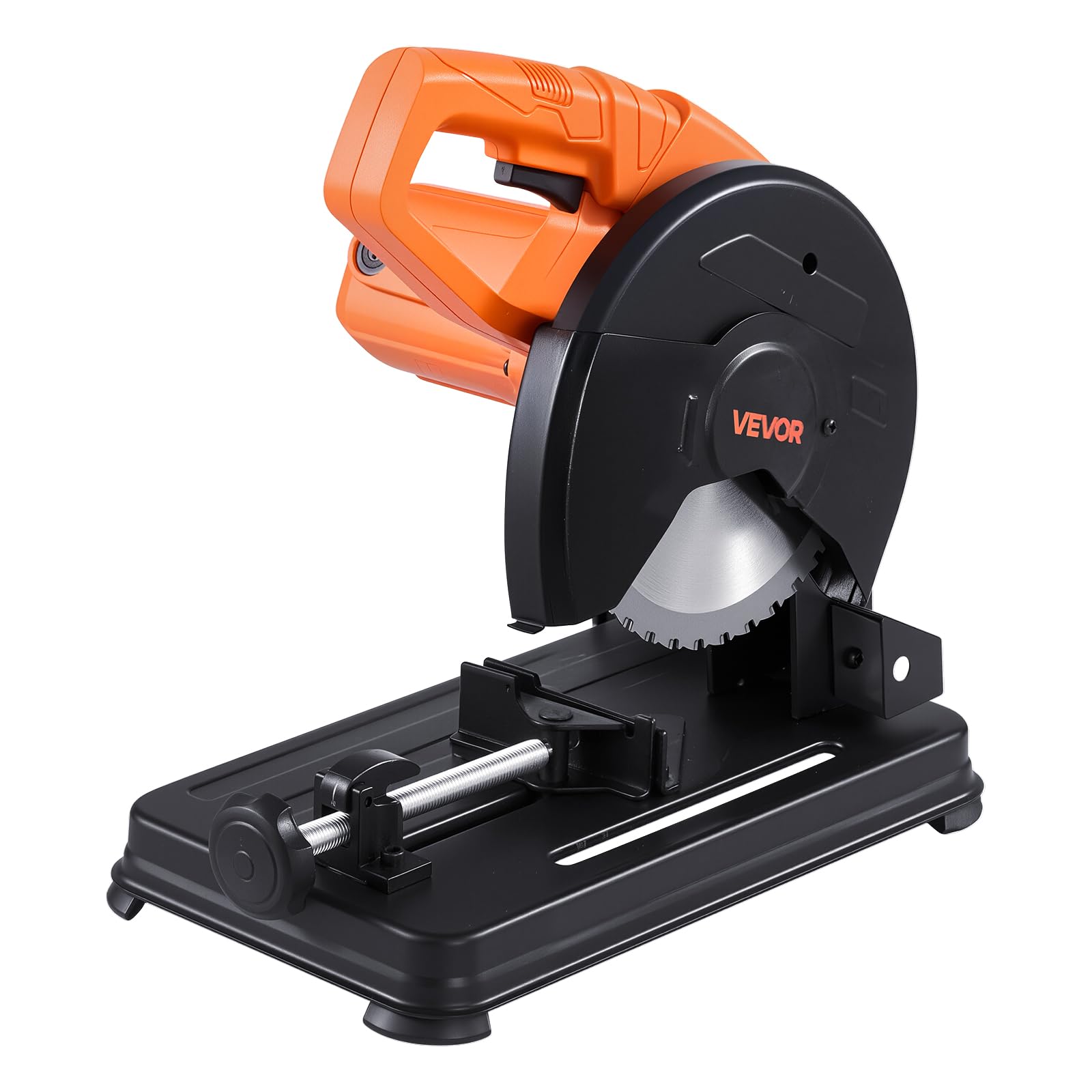
A cold-cut featherweight that handles home steel jobs without the heavy price tag.
This little saw is the lightest of the bunch at just 14.44 pounds, making it easy to carry to the job or stash on a shelf between uses. The 1200 W motor spins a stainless steel cold-cut blade at 4000 RPM, which keeps the steel cool — one buyer notes it “Cuts 2″ square 1/4″ steel, 3/4″ pipe, 2×10 lumber cleanly with minimal burr.” That cooler operation means less edge cleanup compared to a hot abrasive wheel.
The 0-45° adjustable cutting angle helps with miter cuts on angle iron, and the included components — a saw blade, hexagon wrench, and spare rubber feet — get you started right away. Be aware that at this power level, it’s best suited for mild steel up to 1/4-inch wall; the clamp can slip at non-90-degree angles, as some owners mention needing a C-clamp for angled cuts.
The trade-off is that at 1200 W and 14.44 pounds, it lacks the raw torque of the 2800 W VEVOR cold cut saw (which weighs 51 pounds and delivers 1200 RPM), so it’s not designed for continuous heavy solid stock. But for the home hobbyist cutting thin-wall tubing and light angle iron, it delivers clean results at a friendly price.
What it does well
- Cold-cut blade produces minimal burr and cool cuts
- Very portable at 14.44 pounds
- Soft start prevents tripping a 15-amp circuit
Where it falls short
- Clamp slips at miter angles without extra clamping
- 1200 W motor can bog on thick solid stock
- Angle scale sticker may peel over time
Reach for this if: you need a portable, cold-cut saw for occasional home jobs like cutting square tubing, angle iron, and pipe with clean edges.
Look elsewhere if: you regularly cut thick solid steel, heavy rebar, or need a high-torque motor for all-day professional use.
2. DEWALT 14-Inch Chop Saw (D28730)
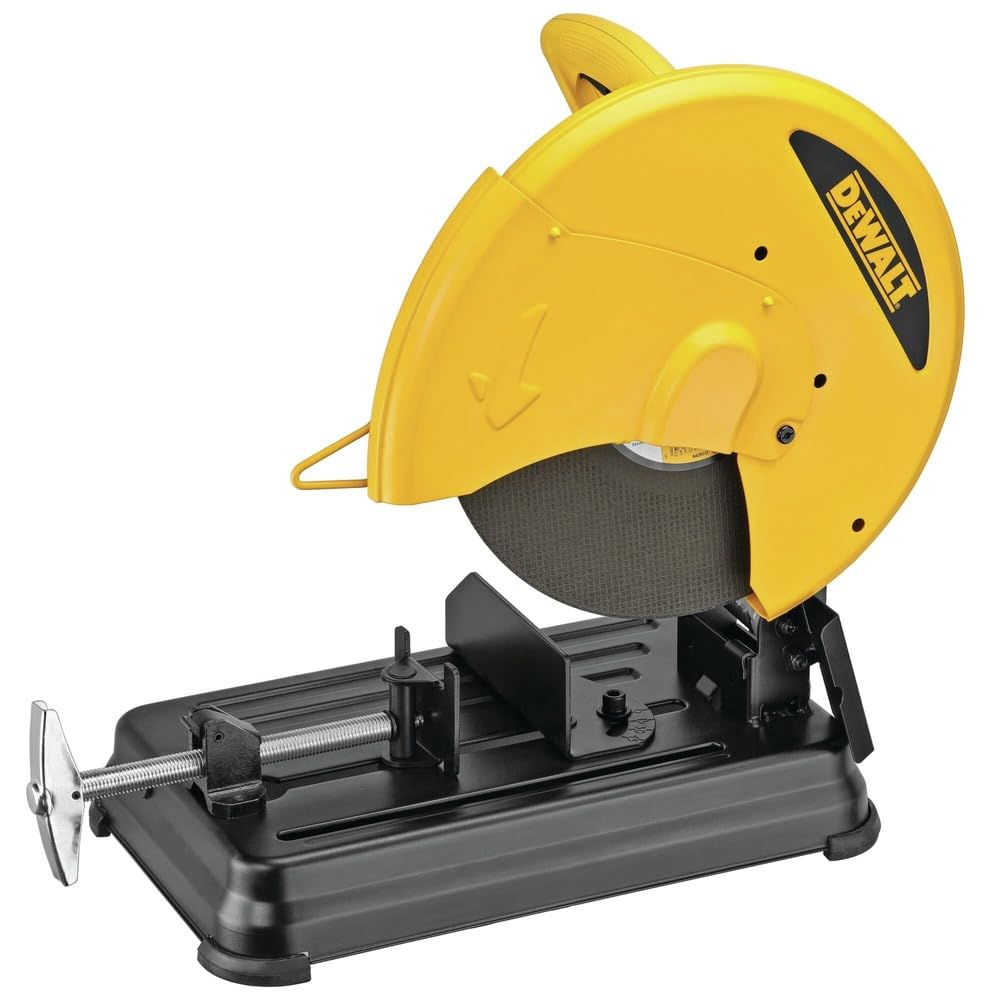
The brand-name abrasive saw that sets the reliability benchmark for budget shops.
DEWALT’s D28730 brings a 2300 W motor with overload protection, a feature that prevents burnout if you push the saw through a heavy cut. The ergonomically designed metal handle reduces fatigue, and the Quick-Lock vise clamps different-size materials fast. Buyers report they have “used it for cutting square steel tubing and very pleased with saw,” and many mention it cuts square right from the start with minimal adjustment.
Unlike the cold-cut VEVOR models, this saw uses a 14-inch abrasive wheel, which throws hot sparks but handles varied stock — rebar, angle iron, aluminum — without needing a special blade. The 45-degree pivoting fence makes angled cuts straightforward, and at roughly 22 inches long and 17 inches tall, it fits a standard workbench without dominating the space.
The catch is that abrasive wheels wear down faster than carbide-tipped blades, creating more dust and heat. And while it outperforms some higher-priced brands (reviewers mention it beats a Milwaukee saw at a lower price), the included wrench is clunky and the fence adjustment uses Allen bolts rather than a quick-release lever.
Why it stands out
- 2300 W motor with overload protection extends lifespan
- Comfortable handle reduces fatigue on longer jobs
- 45-degree pivoting fence for quick angle cuts
What to know
- Abrasive wheel creates hot sparks and wears down over time
- Fence adjustment uses Allen bolts, not a quick-release
- Included wrench feels clunky to use
Who it fits: the buyer who trusts a known brand and wants a basic, durable abrasive saw for general metal cutting in a home or farm shop.
Who should pass: anyone who wants cold, burr-free cuts or needs a saw that also handles wood without changing blades.
3. Evolution Power Tools R355CPS 14-Inch Chop Saw

One blade, four materials — cuts steel, wood, plastic, and composite without swapping.
The Evolution R355CPS is the multi-tasker of this list. Its 15-amp high-torque motor spins a tungsten carbide tipped (TCT) 14-inch blade that cuts mild steel with “virtually no heat, burrs or sparks,” according to the maker, and can also handle wood with embedded nails, composite decking, and plastic.
At 47 pounds, it weighs 47 pounds versus the 14.44-pound VEVOR cold-cut saw, which gives it stability when you push through thicker stock. The included V-block helps secure round material, and the 3-year warranty backs the tool. It can miter cut up to 45 degrees in one direction, so you can cut angles without moving the workpiece.
The clamping system draws some criticism: the clamp handle binds and requires three hands to operate smoothly, and the base can flex when tightened. Unlike the DEWALT, the Evolution only cuts angles in one direction (45-90 degrees) — there is no compound cut ability. Some owners swap the included multi-material blade for a dedicated steel blade to preserve the original for wood and aluminum.
Strengths
- One TCT blade cuts steel, wood, plastic, and composite
- 15-amp motor has a minimum 160-hour motor life
- Cold-cut operation produces minimal burr and no sparks
Weaknesses
- Clamp handle binds and needs three hands to operate
- Base flexes when tightening the vise
- Only cuts angles in one direction (no compound miter)
Buy it for: mixed-material projects — one saw that goes from steel tubing to pressure-treated lumber without a blade swap or a spark shower.
skip it if: you only cut metal and want a simpler, less expensive abrasive saw with a quick-release clamp.
4. VEVOR 14in Abrasive Chop Saw
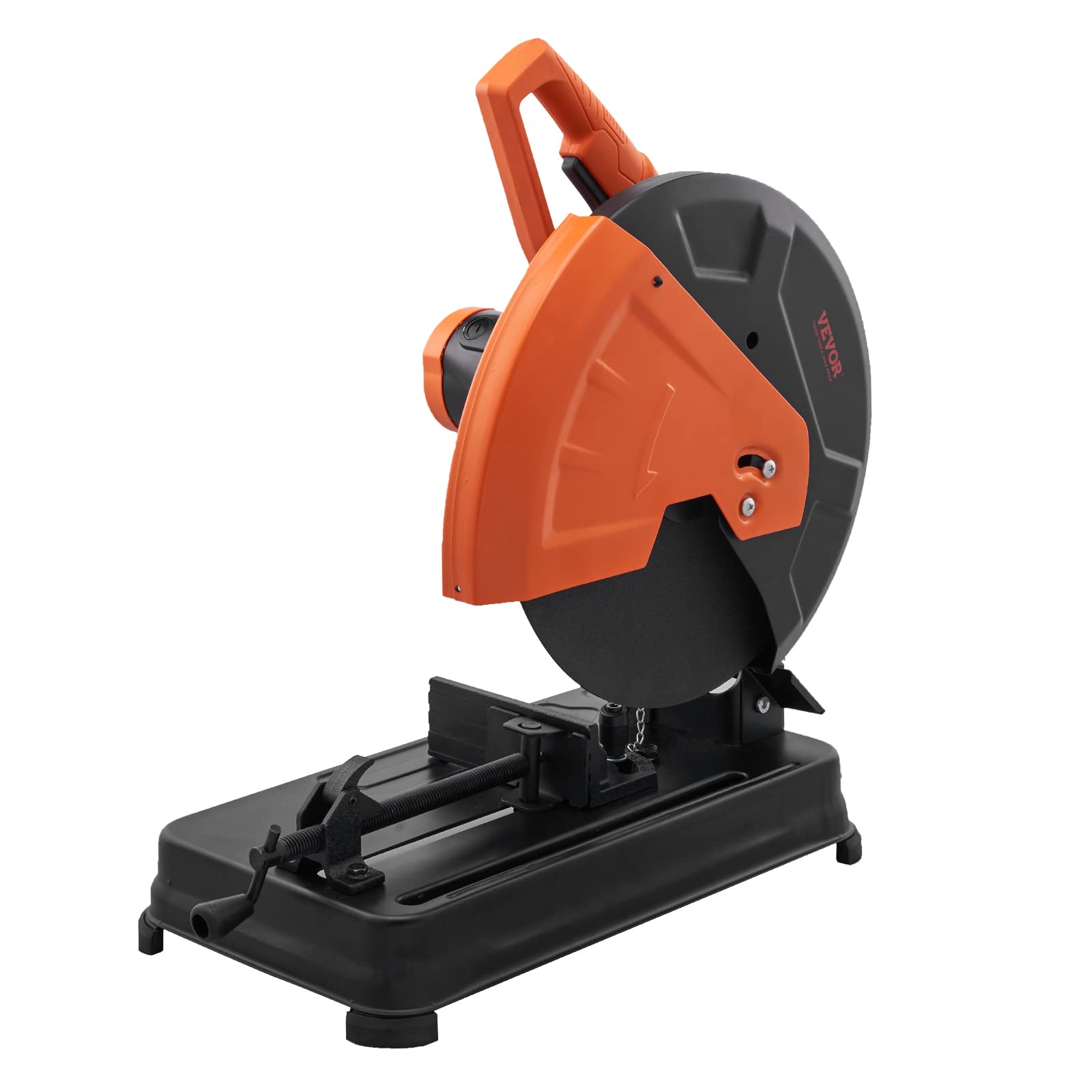
High-speed abrasive cutting for the home shop at a price that leaves room for a better blade.
The VEVOR 14-inch abrasive saw spins at 3600 RPM, versus 1200 RPM for the VEVOR 2800W cold-cut saw, which means faster cuts through rebar and angle iron but with the hot sparks you expect from an abrasive wheel. The 2300 W motor is the same power rating as the DEWALT, and the saw weighs 30 pounds, so it stays planted better than lightweight portables.
Buyers appreciate the value: one reviewer calls it “perfect for the home projects” and notes the same basic design is available under a different label at big-box stores. The miter fence adjusts without a wrench, and the protective spark guard wraps around the blade to shield you from debris. One owner reports cutting “1/2×8″ channel with creative clamping, not fastest but no trouble.”
The downside is that the stock abrasive blade is mediocre — several owners recommend swapping it for a quality aftermarket wheel — and the motor can struggle under sustained pressure on thick wall pipe or solid stock. Also, at 30 pounds versus 14.44 pounds for the VEVOR cold-cut saw, portability takes a hit.
Pros
- High 3600 RPM speed cuts rebar and channel quickly
- 2300 W motor offers solid power for the price
- Tool-less fence adjustment for quick angle changes
Cons
- Stock abrasive blade is low quality
- Motor can bog under sustained pressure on heavy steel
- Heavier and less portable than cold-cut models
Good for: the budget-conscious buyer who needs an abrasive cutoff saw for light-to-medium rebar, channel, and angle iron and plans to upgrade the blade.
Not for: anyone who wants cold, spark-free cuts or who cuts thick solid stock daily — the 2800 W cold-cut VEVOR is the better long-term choice.
5. VEVOR 14in 2800W Dry Cut Chop Saw

The 51-pound cold cut saw that blasts through thick angle iron without heating up the steel.
At 51 pounds and 2800 W, this is the heaviest and most powerful saw in the lineup — 51 pounds versus 14.44 pounds for the VEVOR 7-1/4 cold cut saw, and 2800 W versus 1200 W. The trade-off for that low 1200 RPM speed is control and coolness: the carbide blade stays cool, producing no hot sparks and leaving a clean edge.
The soft-start feature prevents the motor from tripping a 15-amp circuit on startup, and the protective spark guard wraps the blade completely. Buyers also report that the saw cut a 1.5-inch solid square stock to a mirror finish right from the start. The vise uses wave-pattern surfaces for extra grip, and the fence adjusts angle cuts from 0-45 degrees without a wrench.
The main complaints center on the clamping system — it can slip at angles other than 90 degrees, and some users resort to a C-clamp to hold the workpiece securely. The handle design requires pressing a safety stud and trigger simultaneously, which owners say feels awkward. And like other VEVOR models, the angle scale is a sticker that can peel over time.
What it does best
- 2800 W motor powers through thick angle iron and solid stock
- Cold-cut carbide blade leaves mirror-smooth edges
- 51-pound weight provides rock-solid stability
What to watch
- Clamp slips at miter angles without extra clamping
- Awkward safety-and-trigger handle design
- Angle scale is a sticker that can peel
Who it suits: the serious home or farm fabrication shop that cuts thick angle iron, solid square stock, and heavy rebar and wants cool, burr-free edges.
Who should skip it: occasional users who cut only thin-wall tubing — the lighter, cheaper VEVOR 7-1/4 cold cut saw will do the same job at a fraction of the weight and price.
Understanding the Specs
Motor power and RPM
Motor power is measured in watts (W) — the wattage tells you how much force the motor can sustain. A 1200 W motor handles thin-wall tubing and light angle iron without trouble. Step up to 2300 W or 2800 W, and you can push through thicker material without the saw slowing down. RPM (revolutions per minute) is the blade speed: higher RPM (like 3600 or 4000) cuts fast but creates more heat and sparks. Lower RPM (like 1200) runs cooler and cleaner, especially with a carbide-tipped blade. Match the power to the thickness of steel you cut regularly.
Cold cut vs. abrasive blade
A cold-cut blade is typically made of carbide steel and spins slower, so the metal stays cool to the touch right after cutting. It leaves a cleaner edge that usually needs no filing. An abrasive wheel is cheaper but wears out faster and throws a shower of hot sparks. If you work indoors or near flammables, a cold-cut saw is safer and more pleasant. If you cut very hard steel or need maximum speed, an abrasive saw may still be the practical choice for its low upfront cost and fast replacement wheels.
FAQ
Can a cheap chop saw cut stainless steel?
What is the difference between a chop saw and a miter saw?
How long does a cold-cut blade last?
Will a 1200 W chop saw cut 1/4-inch steel tubing?
Is a heavier chop saw better?
Can I cut wood with a chop saw made for metal?
What does a soft start feature do?
Why does my chop saw cut at an angle when I set it to 0 degrees?
Can I use a diamond blade on a chop saw?
What is the best way to clamp material for miter cuts on a chop saw?
Final Thoughts: The Verdict
Across the board, the cheap chop saw winner is the VEVOR 7-1/4 Cold Cut because it delivers clean, cool cuts at a budget-friendly price and is light enough to carry anywhere. If you want a multi-material saw that cuts both wood and metal, grab the Evolution R355CPS. And for heavy work on thick angle iron and solid stock, the standout is the 51-pound stability and 2800 W power of the VEVOR 14-inch 2800W Cold Cut.
How We Picked
We do not accept paid placement. Every pick is matched to a real buyer and a real use-case; we do not hands-on test units.
Sources & Methodology
Specifications: manufacturer listings and product documentation. Review insights: verified customer reviews, as of July 2026. Pricing: not shown on this page (it changes often); check the current price via the retailer link.
As an Amazon Associate, WellFizz earns from qualifying purchases. This does not affect which products we feature.

Mo Maruf
I created WellFizz to bridge the gap between vague wellness advice and actionable solutions. My mission is simple: to decode the research and give you practical tools you can actually use.
Beyond the data, I am a passionate traveler. I believe that stepping away from the screen to explore new environments is essential for mental clarity and physical vitality.