Our readers keep the lights on and my smoothie glass nicely filled. As an Amazon Associate, I earn from qualifying purchases.
Specs are compiled from manufacturer listings and verified buyer reviews and can change over time — please confirm the key details on the product page before buying.
Your breakfast line is only as fast as your toaster. Pick the wrong commercial toaster and you will get burnt bagels, a backed-up counter, or a machine that dies six months in. This guide covers nine top performers — from compact pop-ups (toasters that drop bread into slots and pop it up when done) to conveyor workhorses (toasters that carry bread on a belt through a heated tunnel) — so you match your volume without overpaying.
I’m Mohammad Maruf — the founder and writer behind WellFizz. This guide is built by comparing the manufacturers’ published specifications and the patterns across verified customer reviews, so you get each pick’s real strengths and trade-offs instead of marketing spin.
Whether you run a diner, a food truck, or a bakery, finding the best commercial toaster depends on matching your hourly output to the right build quality and heat control — no guesswork required.
Quick Picks
- SUCISENI Commercial Conveyor Toaster 450 Slices/Hour — Best Overall
- Waring Commercial WCT800RC Heavy-Duty Pop-Up Toaster — Pro Grade
- Winco ECT-300 Commercial Conveyor Toaster — Workhorse Value
- APW Wyott AT Express Radiant Conveyor Toaster — Space Saver
- Waring Commercial WCT708 4-Slot Pop-Up Toaster — Reliable Pop-Up
- SUCISENI TT-300 Commercial Toaster 300 Slices/Hour — Mid-Range Conveyor
- VEVOR 1770W Commercial Conveyor Toaster 450 Slices/Hour — Budget Conveyor
- PYY Commercial Conveyor Toaster 300pcs/h — 300-Slice Entry
- PYY Commercial Conveyor Toaster 150pcs/h — Entry Level Conveyor
How To Choose The Best Commercial Toaster
Picking a commercial toaster is different from grabbing a two-slot for your home counter. You are choosing a machine that must survive hundreds of cycles (complete toasting runs) a day, handle different bread types, and fit your kitchen flow. Here are the three things to lock in first.
Volume: Slices Per Hour
This is the single number that decides your category. A light-duty pop-up like the Waring WCT708 pushes 225 slices per hour (slices per hour — the number of finished pieces in 60 minutes) — fine for a coffee shop with steady but moderate traffic. A conveyor unit like the VEVOR TT-450 hits 450 slices per hour, which handles a full diner breakfast rush. Count your busiest hour and buy for that peak, not the average.
Heat Control: Speeds and Modes
Most commercial toasters offer between 6 and 7 speed settings. The higher the number on a conveyor, the slower the belt moves, so bread spends more time under the heating elements and comes out darker. Some models add mode switches that let you run top heat only (for buns that need a warm crown without a hard bottom) or top-and-bottom together. That flexibility saves you from running bread through twice.
Build Materials and Cleanup
Stainless steel is the standard for a reason: it resists grease buildup, wipes down fast, and holds up to heat. A removable crumb tray (a sliding metal pan that catches burnt crumbs) is non-negotiable — without it, crumbs bake onto the heating elements and create smoke. Conveyor models also use food-grade chains or nets (metal belts that pass food safety standards), which need to be durable enough to handle daily bread delivery without jamming.
Quick Comparison
| Model | Best For | Slices/Hour | Weight | Settings | Amazon |
|---|---|---|---|---|---|
| SUCISENI TT-450 | Premium high-volume conveyor | 450 | — | 7 | Amazon |
| VEVOR TT-450 | Affordable 450-slice conveyor | 450 | — | 7 | Amazon |
| Waring WCT800RC | Heavy-duty pop-up 4-slot | 240 | 16 lbs | — | Amazon |
| Winco ECT-300 | Dual-element conveyor workhorse | 300 | — | 3 | Amazon |
| APW Wyott AT Express | Tight-counter conveyor | 300+ | 14 lbs | — | Amazon |
| SUCISENI TT-300 | Mid-range conveyor with 3 modes | 300 | 30.2 lbs | 7 | Amazon |
| PYY 300pcs/h | Budget 300-slice conveyor | 300 | 41.6 lbs | 7 | Amazon |
| PYY 150pcs/h | Entry-level conveyor | 150 | 37 lbs | 7 | Amazon |
| Waring WCT708 | Compact pop-up 4-slot | 225 | 7.52 lbs | 6 | Amazon |
In-Depth Reviews
1. SUCISENI Commercial Conveyor Toaster 450 Slices/Hour
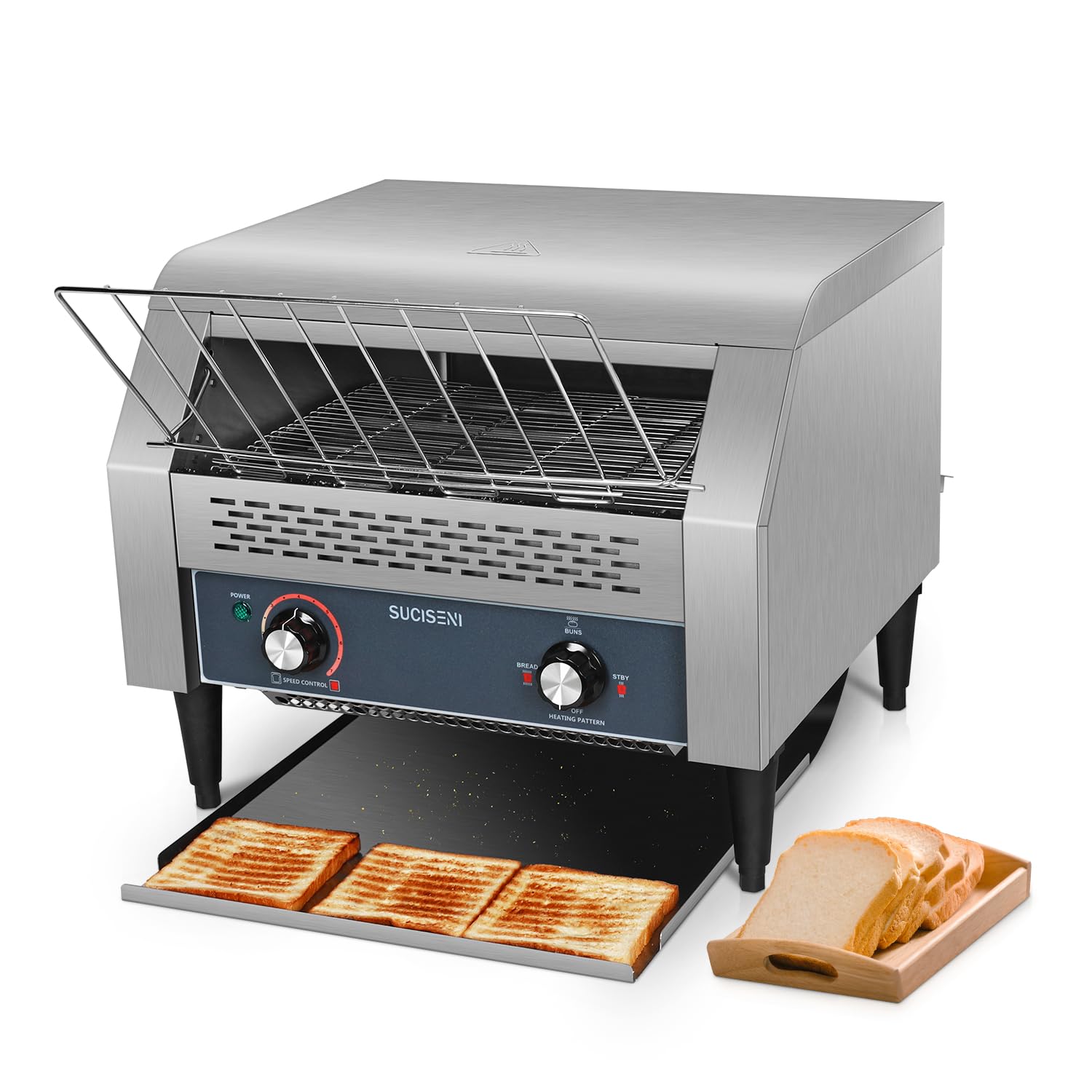
The 450-slice conveyor that combines speed with independent top-and-bottom heat — so you can toast buns without hardening the bottom.
You get proper preheat instructions baked right into the workflow — the maker suggests warming it for 10-15 minutes and testing with 1-2 slices before you run a full batch. That upfront step pays off when you need consistent color across 450 slices per hour. The unit offers 7 speed settings (belt speeds that control how long bread stays under heat, from light to dark), so you can dial in everything from a pale warm bun to a dark crispy croissant without guessing.
Three baking modes (heat element patterns) let you run the upper heating element solo for buns (the BUNS mode) or fire both tubes for standard bread (the BREAD mode). There is also a STBY low-temp mode (standby mode) that keeps both tubes warm without over-baking. The front-and-rear dual outlets (two chutes for catching toast) mean you can position the toaster against a wall and still catch finished toast from either side — a layout flexibility that matters in a cramped kitchen. Buyers who run it in a food trailer say it toasts buns all day without hiccups, and one reviewer who had a heating-element issue after five months reported that the seller responded quickly and sent replacement parts.
Three Heat Modes
- Independent upper/lower heating elements let you match the heat to the bread
- Front and rear chutes for flexible counter placement
- Removable crumb tray keeps cleanup quick
Keep in Mind
- A few buyers received units that did not heat at all from the start
- Heating element crimp fitting (the metal pinch that holds the wire) can fail over time, though seller support is responsive
For a busy kitchen: If you need 450 slices per hour with the flexibility to switch between bun-only toasting and full bread baking, this is the conveyor to buy.
One real caveat: The price puts it above budget conveyors, so it is for operators who plan to run it daily and want a vendor that actually answers support emails.
2. Waring Commercial WCT800RC Heavy-Duty Pop-Up Toaster
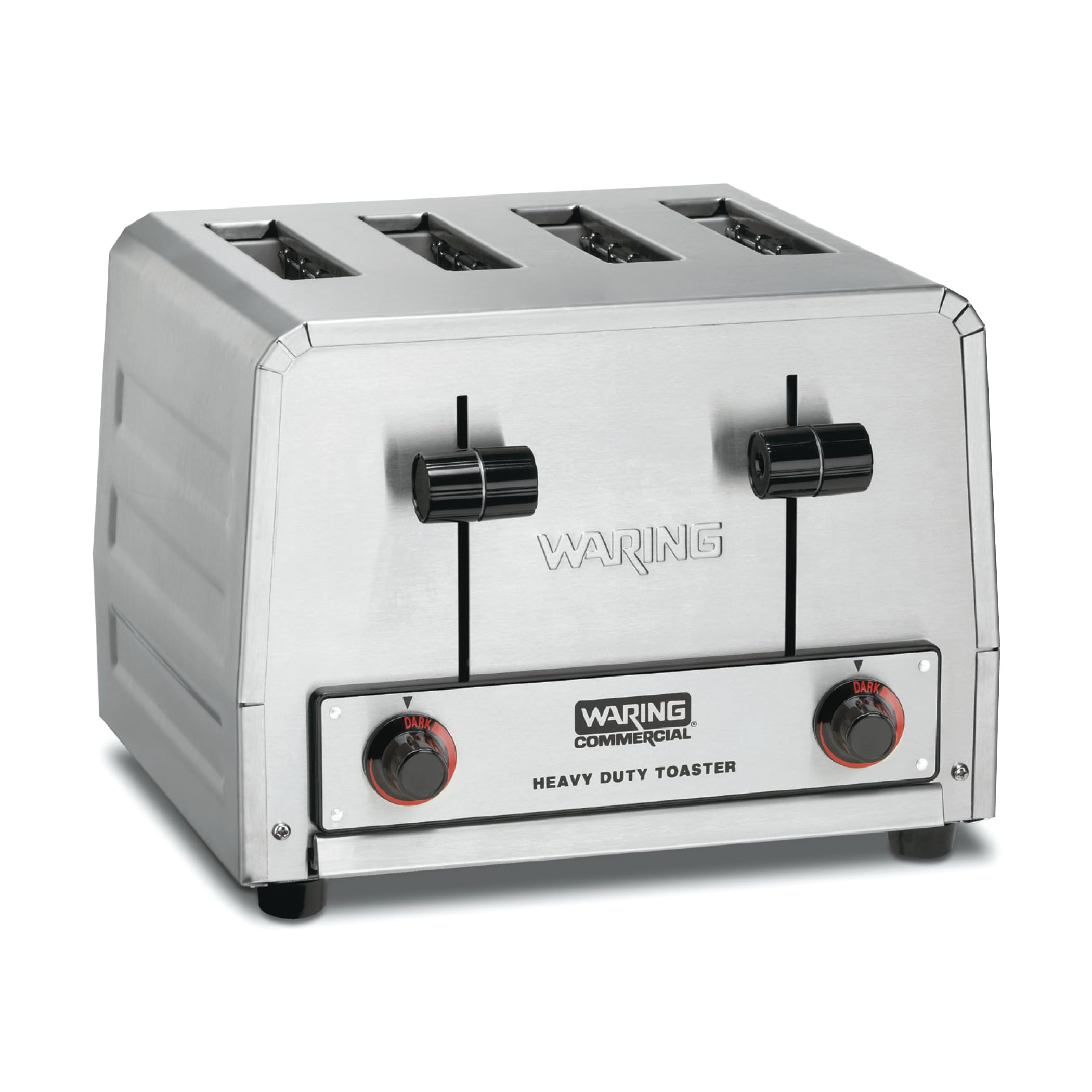
A 4-slot pop-up built like a tank for kitchens that cannot fit a conveyor.
Instead of a conveyor belt, this toaster uses four slots and a carriage lever — familiar to anyone who has used a residential toaster, but scaled up for commercial duty. It pushes 240 slices per hour versus the SUCISENI TT-450’s 450 slices per hour, but it takes up far less counter space at 30 inches deep. The full brushed stainless steel housing holds up to constant use, and the dishwasher-safe crumb tray makes end-of-shift cleanup simple.
The unit is NSF-certified (certified by NSF International for sanitary foodservice-equipment design) and works with regular bread, bagels, Texas toast, and frozen waffles. Buyers who run restaurants note that this brand has served them well for years — one reviewer noted they upgraded from a previous Waring toaster because they needed four slots instead of two. On the other hand, some owners say the toasting cycle feels slow for a busy breakfast line, and a few reported the machine stopped working after a couple of years.
Solid Build
- Brushed stainless steel construction resists dents and grease
- Dishwasher-safe crumb tray for fast cleaning
- Carriage control levers let you start the cycle manually
Watch Out
- At 240 slices per hour, it lags behind conveyor units for high-volume breakfast rushes
- Some buyers report the toaster feels slow for a busy restaurant
Best for small counters: If your kitchen cannot accommodate a 41-pound conveyor but you still need commercial throughput, the WCT800RC fits where a conveyor belt would not.
The trade-off: You trade volume for compactness — this is not the pick for a 300-cover breakfast buffet.
3. Winco ECT-300 Commercial Conveyor Toaster
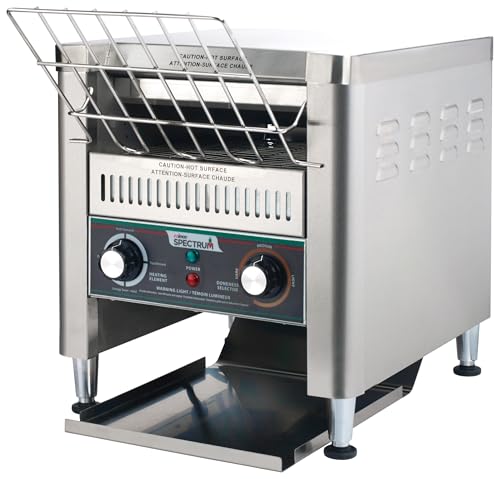
A 300-slice conveyor with independent top and bottom heat for under.
The variable speed dial (a knob that changes belt speed for doneness) lets you dial in doneness without fumbling with multiple knobs. A 3-position dial controls the top and bottom heating elements independently, so you can toast bagels with top heat only or run both elements for standard bread. The stainless steel body and heavy-duty heating elements are built for daily commercial use, and buyers who run fire-department fundraiser breakfasts say it handles 3-plus hours non-stop without tripping breakers — a real improvement over running multiple residential toasters on the same circuit.
One detail that came up in reviews: the main power wiring on some units is not fully isolated, and the lower tray slides over exposed wiring. One buyer solved it by adding a guard, but noted that for the price, the wiring should be better protected from the start. Still, for operators who need 300 slices per hour with the flexibility of dual heating, this is a capable option.
Two Heat Zones
- Independent top and bottom heating elements for bagels and buns
- Variable speed dial for precise doneness control
- Stainless steel build handles daily commercial use
Check Before Buying
- Exposed wiring under the lower tray is a safety concern on some units
- Bulky footprint at 21.65 inches wide
Best for medium-volume kitchens: If you need 300 slices per hour and dual heating control, the Winco hits a solid value point between budget conveyors and premium models.
One honest caution: The wiring quality is inconsistent — inspect yours carefully on arrival.
4. APW Wyott AT Express Radiant Conveyor Toaster

The lightest conveyor toaster on this list at just 14 pounds.
Most conveyor toasters weigh 30 to 40 pounds, but the APW Wyott AT Express comes in at 14 pounds, which is a major advantage if you need to mount it on a mobile cart or squeeze it into a tight counter space. It produces over 300 slices per hour, and the variable speed control lets you adjust the belt speed to match your desired doneness. The radiant heat design (infrared heating elements that project heat directly onto bread) keeps the exterior cool to the touch, which is a safety plus in cramped kitchens.
A unique feature is its ability to keep toast warm until you are ready to serve — the unit holds finished slices so they do not go cold while you finish the rest of the order. Buyers who run food trailers report it works great in tight spaces, and one deli owner confirmed it is still running strong. The main downside is the price tag, which is steep for a 300-slice unit when conveyors with similar output cost half as much.
Compact Design
- Weighs only 14 pounds — easy to move and position
- Keeps toast warm until serving
- Cool-touch exterior for safety in tight spaces
The Catch
- Premium price for a 300-slice output that other conveyors match for less
- Some buyers received units that were broken on arrival
Best for food trailers: If counter space is at a premium and you need to keep toast warm while plating, the AT Express is the lightest conveyor option out there.
The number that stings: At over, you pay a heavy premium for the compact form factor.
5. Waring Commercial WCT708 4-Slot Pop-Up Toaster

The 7.52-pound pop-up that one buyer says lasted 20 years.
It also takes up far less counter space: 4.5 inches deep versus the VEVOR’s 28.9 inches. It also takes up far less counter space: 4.5 inches deep versus the VEVOR’s 28.9 inches, which is a 6.4x difference. That makes it a practical choice for a coffee shop with limited prep space. It pushes 225 slices per hour versus the VEVOR’s 450 slices per hour, but enough for steady, moderate traffic.
The electronic browning control gives you 6 settings to dial in your preferred color, and the 4 extra-wide slots (1-3/8 inches each — that is about 3.5 centimeters) handle bagels and Texas toast without cramming. A built-in defrost function (a setting that thaws frozen bread before toasting) means you can drop frozen waffles straight into the slots without waiting. Reviewers consistently praise the old-school mechanical feel — one owner reported their last Waring toaster lasted over 20 years before one side would not stay down. That said, a more recent buyer said theirs failed after only a few months with the same “won’t stay down” issue, so consistency is not guaranteed.
Proven Design
- Electronic browning control with 6 settings
- Extra-wide 1-3/8-inch slots for bagels and thick bread
- Self-centering bread racks (guides that center bread between heating elements) for even toasting
Watch For
- Some units fail with the same “won’t stay down” latch issue within months
- 225 slices per hour will not keep up with a breakfast rush
Ideal for a low-volume cafe: If you serve a steady trickle of toast and bagels all morning, the WCT708 is compact, familiar, and built from a proven platform.
skip it if: You need more than 225 slices per hour or cannot risk a latch failure during a busy shift.
6. SUCISENI TT-300 Commercial Toaster 300 Slices/Hour

A 300-slice conveyor with three distinct baking patterns and a 1-year warranty.
Instead of just a variable speed dial, this toaster offers three specific baking patterns (heating element modes) controlled by a mode switch. The STBY mode (standby) activates both upper and lower tubes for low-temperature baking, perfect for keeping bread warm without toasting further. The BUNS mode runs only the upper tube at high temperature — ideal for buns that need a browned crown without a crisp bottom. The BREAD mode fires both tubes at high heat for standard toast. On top of that, you get 7 speed settings to fine-tune the belt.
The unit weighs 30.2 pounds and comes with four adjustable-height non-slip feet, so you can level it on an uneven counter. The polished stainless steel surface resists grease buildup, and the rear vents keep the toaster from overheating during long runs. One reviewer who runs a food trailer says it toasts buns all day without issue. After 5 months, the upper heating element failed on one unit due to a faulty crimp fitting (the metal pinch that holds the heating wire), but the seller provided quick support and instructions for a 5-minute fix.
Three Baking Modes
- STBY, BUNS, and BREAD modes give you precise heat control
- 7 speed settings for dialing in doneness
- 1-year warranty with responsive customer support
Potential Issues
- Heating element crimp fitting can fail after months of use
- One buyer mentioned the unit did not heat at all
Best for operators who want options: If you switch between buns and bread throughout the day and need a warranty you can actually use, the TT-300 gives you three dedicated heating profiles.
The trade-off: At 300 slices per hour, it is not the fastest — match it to your actual peak volume, not your dreams.
7. VEVOR 1770W Commercial Conveyor Toaster 450 Slices/Hour

A 450-slice stainless steel conveyor at a budget-friendly price point.
At 41.6 pounds and with a 28.9-inch depth, the VEVOR TT-450 is a substantial piece of equipment. It matches the premium SUCISENI TT-450 in output (450 slices per hour) and settings (7 speed levels), but it costs significantly less. The food-grade 304 stainless steel belt (a belt made from a specific type of stainless steel that passes food safety standards — type 304 is common for kitchen gear) and SUS430 exterior (another stainless steel grade — type 430 — used for the body) are built for durability, and the dual-knob control system — one knob for browning level, one for three heating modes — keeps operation simple.
The catch shows up in the reviews. Buyers consistently report that this toaster does not toast dark enough on a single pass, even on the slowest setting. One owner reported their buns needed two passes through the conveyor to get the desired color. Another received two units in a row that would not toast at all and shut off randomly. If you get a working unit, the throughput is good for the price, but the failure rate in the review data is concerning.
High Output for the Price
- 450 slices per hour matches premium conveyors
- Food-grade 304 stainless steel belt
- 7 browning settings and 3 heating modes
Major Risks
- Frequent reports that it does not toast dark enough in one pass
- Multiple buyers received units that did not work on arrival
Only if you are willing to gamble: The VEVOR offers the specs of a toaster at a lower price, but the inconsistent build quality means you may end up with a machine that does not toast.
pass on it if: You cannot risk downtime — the premium SUCISENI TT-450 is a safer bet for the same output.
8. PYY Commercial Conveyor Toaster 300pcs/h
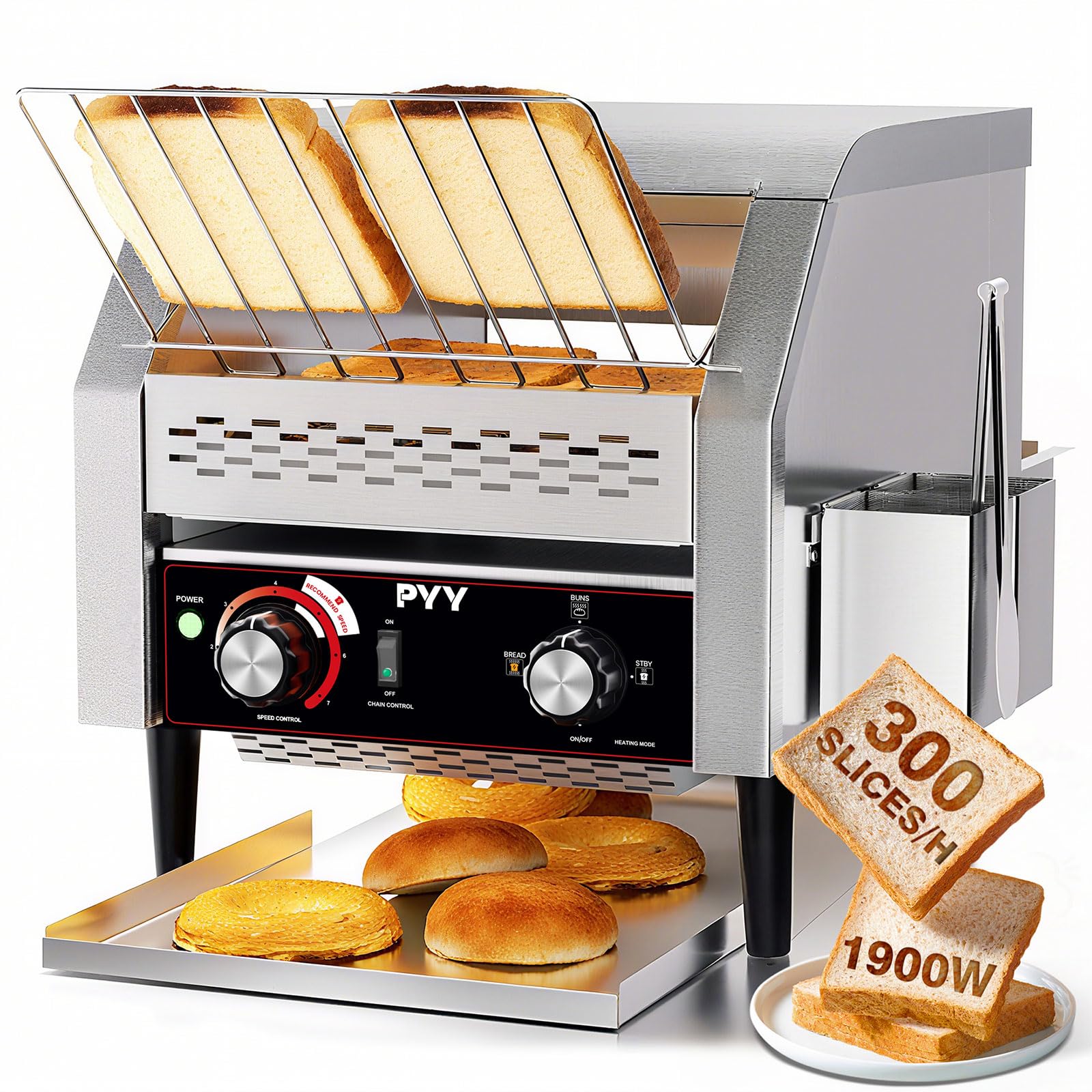
A 300-slice conveyor that delivers 300 slices per hour versus the 150pcs/h PYY model’s 150 slices per hour.
This is the faster sibling in the PYY conveyor lineup, producing 300 slices per hour compared to the 150pcs/h model’s 150. Like its smaller counterpart, it offers 7 speed options and a front/rear output chute so you can position it flexibly on the counter. The heavy-duty stainless steel body and food-grade chain net (a metal web that carries bread through the toaster and meets food safety standards) are designed for daily commercial use, and the removable crumb tray makes cleaning straightforward.
The review pattern is almost identical to the PYY 150pcs/h model: buyers who run it daily in high-volume restaurants say it works well and keeps the breakfast line moving. But there are the same concerning reports — multiple owners mention the heating elements failed after 9 months, though the company responded quickly with replacement parts and repair instructions. One reviewer called it a “SHEIN/TEMU-adjacent company” and warned to “spring for the expensive toaster with a solid brand name behind it.”
Solid Throughput
- 300 slices per hour handles medium-volume kitchens
- 7 speed options for doneness control
- Front and rear output for flexible counter placement
Same Risks as the 150 Model
- Heating elements can fail around the 9-month mark
- Knobs may fall off and customer support can be hard to reach
Works for now: If you need 300 slices per hour on a tight budget and are comfortable replacing heating elements, the PYY 300pcs/h can deliver for under.
The honest warning: The failure rate around 9 months is too common to ignore — budget for a replacement or a repair.
9. PYY Commercial Conveyor Toaster 150pcs/h
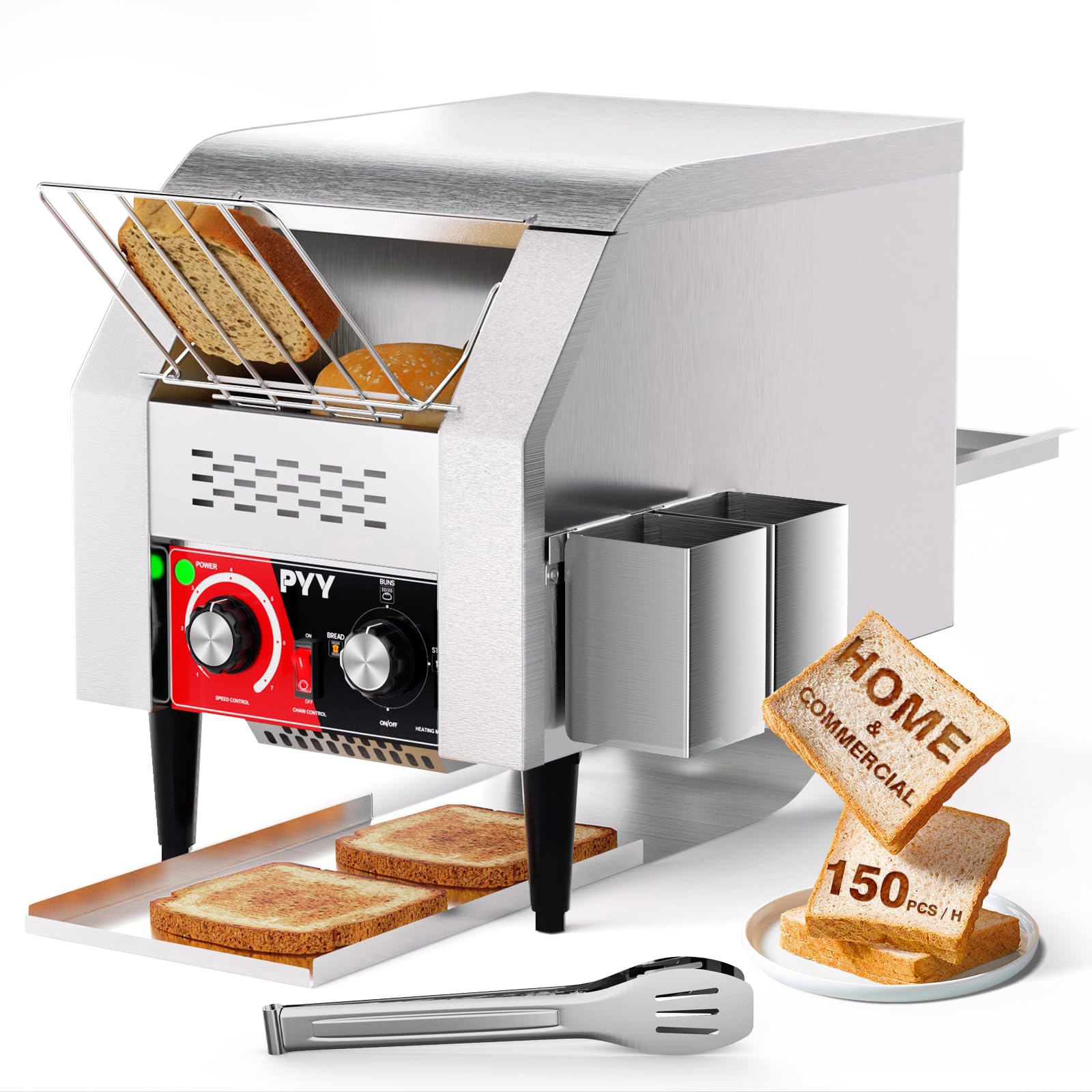
The most affordable conveyor toaster at 150 slices per hour.
If you are moving from a residential pop-up to a conveyor for the first time, this is the cheapest entry point. It does 150 slices per hour — which is actually lower than the Waring WCT708’s 225 slices per hour. The 7 speed settings give you some control over doneness, and the front/back output chute lets you position the toaster where it fits best. The removable crumb tray and stainless steel body make cleaning manageable.
Buyers in high-volume restaurants say it works well when it is running, but the reliability red flags are significant. Multiple reviewers report that the heating elements failed after 9 months — the exact same pattern as the 300pcs/h model. The company did provide quick repair support, but one reviewer could not find any way to contact the company at all and called the build quality “trash.” The toast level also requires regular adjustment on the conveyor, so you cannot just low-maintenance.
Budget Conveyor Entry
- Lowest price among conveyor toasters
- 7 speed options for doneness control
- Front and rear output for flexible placement
Biggest Concerns
- Heating elements commonly fail around 9 months
- Inconsistent toast color requires constant adjustment
Only if the budget is very tight: The PYY 150pcs/h gets you a conveyor for the lowest possible cost, but expect to replace heating elements within the first year.
Better alternative: Spending a bit more on the Waring WCT708 pop-up gets you a more reliable 225 slices per hour in a much smaller footprint.
Understanding the Specs
Slices Per Hour
This is the throughput number that decides whether your toaster keeps up with the rush. It tells you how many finished pieces the machine can output in 60 minutes of continuous operation. A light-duty pop-up like the Waring WCT708 does 225 slices per hour — fine for a cafe with one cook. A conveyor like the SUCISENI TT-450 does 450 slices per hour, which is what you need for a full diner breakfast line. Match this number to your busiest 60-minute window, not your daily average.
Number of Settings
Most commercial toasters offer between 6 and 7 speed settings. In a conveyor toaster, turning the knob to a higher number slows the belt down, so the bread spends more time under the heating elements and comes out darker. In a pop-up toaster, the number controls the cycle duration. The key is range — 7 settings give you more granular control than 6, which matters if you need to nail a specific shade for different bread types throughout the day.
Weight and Dimensions
Commercial toasters range from the 7.52-pound Waring WCT708 (which sits at 4.5 inches deep) to the VEVOR TT-450 (which needs 28.9 inches of counter depth). Weight is a proxy for build density — heavier units tend to have thicker steel and more sturdy heating elements. But weight also affects where you can put the toaster. A 14-pound unit like the APW Wyott AT Express can go on a mobile cart. A 41.6-pound conveyor needs a dedicated spot on a sturdy counter.
FAQ
Should I buy a pop-up toaster or a conveyor toaster for my restaurant?
How many slices per hour do I need for my business?
What is the difference between 6 and 7 speed settings on a toaster?
Can I toast bagels and buns in a commercial conveyor toaster?
How do I clean a commercial conveyor toaster?
How long do commercial toasters usually last?
What does NSF certification mean for a commercial toaster?
Can I use a commercial toaster in my home kitchen?
Why does my conveyor toaster not toast dark enough on the first pass?
What is the difference between a radiant and a convection conveyor toaster?
Final Thoughts: The Verdict
For most buyers, the best commercial toaster winner is the SUCISENI TT-450 because it delivers 450 slices per hour with independent top and bottom heating elements and responsive customer support, all in a polished stainless steel build. If you want a compact pop-up that fits a tight counter and a tighter budget, grab the Waring WCT708. And for a food truck or mobile cart where weight matters most, the APW Wyott AT Express gives you 300-plus slices per hour at just 14 pounds.
How We Picked
We do not accept paid placement. Every pick is matched to a real buyer and a real use-case; we do not hands-on test units.
Sources & Methodology
Specifications: manufacturer listings and product documentation. Review insights: verified customer reviews, as of July 2026. Pricing: not shown on this page (it changes often); check the current price via the retailer link.
As an Amazon Associate, WellFizz earns from qualifying purchases. This does not affect which products we feature.

Mo Maruf
I created WellFizz to bridge the gap between vague wellness advice and actionable solutions. My mission is simple: to decode the research and give you practical tools you can actually use.
Beyond the data, I am a passionate traveler. I believe that stepping away from the screen to explore new environments is essential for mental clarity and physical vitality.