Our readers keep the lights on and my smoothie glass nicely filled. As an Amazon Associate, I earn from qualifying purchases.
Specs are compiled from manufacturer listings and verified buyer reviews and can change over time — please confirm the key details on the product page before buying.
Scrolling through thousands of lines of code is your daily reality. Your monitor determines how many lines you see at once, how sharp the text looks, and whether your eyes last through a full workday without fatigue. A coding screen is different from a gaming or photo-editing display. You need crisp text, a shape that shows more code, and an adjustable stand for hours of comfortable sitting. This guide breaks down six monitors by the specs that actually matter for developers.
I’m Mohammad Maruf — the founder and writer behind WellFizz. This guide is built by comparing the manufacturers’ published specifications and the patterns across verified customer reviews, so you get each pick’s real strengths and trade-offs instead of marketing spin.
The right screen changes how you work. if you want a sharp 4K (3840 x 2160) panel with a unique 3:2 aspect ratio (wider and taller than standard) for more vertical code, or a wide ultrawide (21:9) for side-by-side windows, this roundup of the computer monitor for coding helps you pick the one for your desk and your eyes.
Quick Picks
- BenQ RD280U 28.2” 4K Programming Monitor — Best Overall
- Dell 27 Plus 4K Monitor S2725QS — Smooth Operator
- Samsung 34″ ViewFinity S50GC Ultrawide QHD Monitor — Ultrawide Command
- INNOCN 27″ 4K USB-C Monitor — Mac-Friendly Value
- ASUS ProArt Display 27″ Monitor PA278CV — Color-Conscious Coder
- LG 32UR550K-B 32-inch Ultrafine 4K Monitor — Big Screen Budget
How To Choose The Best Computer Monitor For Coding
Picking a monitor for coding is different from picking one for gaming or photo editing. You need sharp text, a layout that reduces scrolling, and features that protect your eyes during long hours. Here are the three specs to focus on first.
Aspect Ratio: More Vertical or Horizontal Space
A standard 16:9 screen shows a limited number of lines of code at once. A 3:2 aspect ratio (like the BenQ RD280U) gives you about 500 extra vertical pixels (individual points of light that make up the image), letting you see more code without scrolling. An ultrawide 21:9 screen (like the Samsung ViewFinity) lets you place two editor windows side by side on one display. Decide if you want height or width — both save you from constantly switching between tabs.
Resolution and Pixel Density for Crisp Text
For a 27-inch screen, 4K (3840 x 2160) delivers very sharp text, but you will likely need to use scaling (showing the image at 125% or 150% its normal size) so the user interface is not tiny. A 1440p (2560 x 1440) screen at 27 inches needs less scaling and is easier on your graphics card, though text is less razor-sharp. At 32 inches, 4K becomes more comfortable at default scaling. The goal is to avoid blurry fonts — look for a resolution that pairs naturally with your screen size.
Ergonomics and Eye Care
You will be staring at this screen for hours. Look for a stand that allows height adjustment, tilt, and pivot (to rotate the screen into portrait mode for reading long documents or code). Features like a flicker-free backlight and a low blue light mode reduce eye fatigue. Some monitors include an ambient light sensor that automatically adjusts brightness to match the room.
Quick Comparison
| Model | Best For | Resolution | Refresh Rate | Contrast Ratio | Amazon |
|---|---|---|---|---|---|
| BenQ RD280U | Developers who want maximum vertical code lines | 3840 x 2560 (3:2) | 60Hz | 1200:1 | Amazon |
| Dell 27 Plus 4K S2725QS | Smooth scrolling and everyday productivity | 3840 x 2160 (16:9) | 120Hz | 1500:1 | Amazon |
| Samsung ViewFinity S50GC | Side-by-side code windows on one screen | 3440 x 1440 (21:9) | 100Hz | 3000:1 | Amazon |
| INNOCN 27″ 4K USB-C | MacBook users who want single-cable setup | 3840 x 2160 (16:9) | 60Hz | 1000:1 | Amazon |
| ASUS ProArt PA278CV | Budget-friendly color-accurate coding monitor | 2560 x 1440 (16:9) | 75Hz | — | Amazon |
| LG 32UR550K-B | Large 4K screen on a budget | 3840 x 2160 (16:9) | 60Hz | 3000:1 | Amazon |
In‑Depth Reviews
1. BenQ RD280U 28.2” 4K Programming Monitor

The 3:2 aspect ratio (wider and taller than standard) gives you roughly 500 extra vertical pixels so you stop scrolling through long functions.
A unique 3:2 aspect ratio with a 3840 x 2560 resolution makes the BenQ RD280U the only monitor in this list built from the ground up for developers. You see more lines of code on screen than a standard 16:9 panel — one buyer described it as “for nearly 2 decades I have struggled to find a monitor that tune productivity.” The Nano Matte Panel (a special anti-glare coating) cuts glare and reflections, which helps your eyes during all-day sessions. It delivers a high pixel density that makes small text razor-sharp.
The MoonHalo backlight (a warm bias light behind the screen) reduces eye strain in a dark room, a feature buyers praised for late-night coding. The stand offers full height, tilt, and pivot adjustments, and the USB-C port delivers 90 watts of power — enough to charge a MacBook Pro (Apple’s high-performance laptop). The built-in KVM (Keyboard, Video, Mouse switch, which lets you use one keyboard and mouse for two computers) lets you share peripherals between two computers. Buyers report the speakers are poor, and the HDMI 2.0 (High-Definition Multimedia Interface, version 2.0) port only supports 50Hz (image updates per second) at native resolution — you need a DisplayPort (video cable standard) or USB-C cable for the full 60Hz.
Built for Developers
- Unique 3:2 aspect ratio for more vertical code lines
- Sharp 3840 x 2560 resolution with excellent text rendering
- Nano Matte Panel reduces glare effectively
- MoonHalo backlight eases eye strain in dark rooms
- USB-C delivers 90W power delivery and includes a KVM
The Trade-Offs
- Speakers are very weak
- HDMI 2.0 caps at 50Hz at native resolution
- Premium price compared to standard 4K monitors
The Developer’s Choice: If you write code all day and need every extra vertical pixel you can get, this is the single best monitor on the market for your workflow.
Worth Noting: It is a significant investment, and you will need a DisplayPort cable to open up full 60Hz at 3840 x 2560.
2. Dell 27 Plus 4K Monitor S2725QS

A 120Hz refresh rate makes scrolling through code feel noticeably smoother than 60Hz screens.
The Dell S2725QS delivers a sharp 4K (3840 x 2160) picture on a 27-inch IPS (In-Plane Switching, a panel type with wide viewing angles) panel. The standout spec here is the 120Hz refresh rate — 120Hz versus the typical 60Hz monitors in this category — and it makes every scroll and window drag feel fluid. Owners mention it is an “excellent 27″ 4K 120Hz monitor” that is bright, sharp, and affordable. The 1500:1 contrast ratio also comes in at 1500:1 versus 1000:1 on some competitors, giving blacks a bit more depth and making text pop against a dark background.
The stand offers height, pivot, swivel, and tilt adjustments, so you can easily find a comfortable viewing angle. ComfortView Plus reduces harmful blue light emissions to ≤35% without washing out colors. The built-in speakers are better than the previous generation, though they are still not a replacement for dedicated desktop speakers. Some buyers noted slight ghosting in games, but for coding, the response time and smooth motion are a clear win.
Fluid Workflow: The 120Hz panel is a rare and genuine advantage for coding — scrolling through a long file feels easy compared to a 60Hz screen.
Multipurpose Performer: If you also game occasionally or watch video, the FreeSync Premium support (variable refresh rate technology to prevent screen tearing) and 0.03ms response time make this a strong all-around choice, not just a coding tool.
Reach for this if… you want the smoothest scrolling experience for coding and value a monitor that handles light gaming just as well.
Look elsewhere if… you need a 3:2 aspect ratio for maximum vertical code lines — this is a standard 16:9 screen.
3. Samsung 34″ ViewFinity S50GC Ultrawide QHD Monitor

The 21:9 ultrawide screen lets you snap two editor windows side by side without needing a second monitor.
Samsung’s ViewFinity S50GC is a 34-inch VA (Vertical Alignment, a panel type with deeper blacks) panel with a 3440 x 1440 resolution and a 21:9 aspect ratio. For coding, this means you can comfortably place your code editor on one side and a terminal, browser, or documentation on the other — all on a single display. One reviewer noted it is “excellent for text, programming, spreadsheets, videos, and light gaming.” The 100Hz refresh rate is faster than the average, making general navigation feel smooth.
The VA panel delivers a strong 3000:1 contrast ratio, which makes darker UI (user interface) themes look rich and deep. It also supports HDR10 (High Dynamic Range, a standard for better contrast and color) for over 1 billion colors. The monitor includes Picture-in-Picture (PIP, showing one input inside a smaller window) and Picture-by-Picture (PBP, showing two inputs side by side) modes, allowing you to view input from two computers simultaneously. The ambient light sensor adjusts brightness to the room. However, buyers consistently report two drawbacks: the built-in speakers are poor, and the stand is wobbly. A separate monitor arm is a smart upgrade.
Multitasking Machine
- 21:9 ultrawide reduces the need for a dual-monitor setup
- 3000:1 contrast ratio delivers deep blacks for dark-mode coding
- 100Hz refresh rate makes scrolling feel smooth
- PIP/PBP lets you use two computers on one screen
The Catch
- Stand is wobbly and feels cheap
- Built-in speakers are very poor
- Configuration can be frustrating, especially with macOS
Perfect for Side-by-Side Work: If you hate switching between windows and want one big screen for your code, documentation, and tools, this ultrawide is a natural fit.
One Real Annoyance: Some Mac and PC users report trouble hitting the full 100Hz without extra configuration — check compatibility before buying.
4. INNOCN 27″ 4K USB-C Monitor

The USB-C port handles video, data, and 65W laptop charging through a single cable to keep your desk clean.
The INNOCN 27C1U-D is a 27-inch 4K (3840 x 2160) IPS monitor at 60Hz. One of its biggest draws for coding is the USB-C connectivity: a single cable connects your MacBook (Apple’s laptop), drives the 4K display, and handles data. Customers note it “works flawlessly with M2 MacBook Air; charges via USB-C; instant power-on; crisp quality and vibrant colors.” The IPS panel offers 400 nits (a unit of brightness) of brightness and DeltaE (a measure of color accuracy; lower is better) < 2 color accuracy, which is more than enough for code.
The stand supports height, swivel, tilt, and pivot adjustments, including a full 90° rotation for portrait mode — useful for reading long code files or documents. The 1000:1 contrast ratio is average, and the 60Hz refresh rate is standard. A few buyers mentioned the monitor sometimes does not wake properly after the Mac goes to sleep. The built-in speakers are weak, but that is typical at this price point.
Single-Cable Setup: The USB-C port with 65W power delivery makes this a genuinely clean solution for MacBook users who want one cable for everything.
An Honest Value: It does not have the 120Hz refresh rate of the Dell S2725QS or the unique 3:2 aspect ratio of the BenQ RD280U, but it delivers a sharp 4K image and full ergonomic adjustability.
Grab this for… a budget-friendly 4K monitor that integrates smoothly with a MacBook via USB-C and offers a fully adjustable stand.
skip it if… you need a high refresh rate for smooth scrolling or you rely on a bug-free sleep/wake cycle with macOS.
5. ASUS ProArt Display 27″ Monitor PA278CV

The 100% sRGB (a standard color space for screens) and Calman Verified color accuracy mean your code looks clean and your design work stays true.
The PA278CV is a 27-inch QHD (2560 x 1440) IPS monitor from ASUS’s ProArt line, built for color-critical work. While its WQHD resolution is lower than the 4K panels on this list, the trade-off is that text at this size is crisp without needing scaling (no display enlargement required), and the 75Hz refresh rate — which one buyer called “more than acceptable for gaming as well” — is 75Hz rather than the standard 60Hz.
The monitor comes Calman Verified with DeltaE (color accuracy measure) < 2, so colors from the start are very accurate. The USB-C port delivers 65W power delivery, and DisplayPort (video cable standard) daisy-chaining lets you connect up to four displays for a multi-monitor coding setup. The ergonomic stand offers height, tilt, swivel, and pivot adjustments. Some reviewers point out that the 65W power delivery is too low to charge a demanding work laptop under heavy load, but it works fine for most ultrabooks and MacBooks.
Accurate and Adjustable
- Calman Verified DeltaE < 2 for excellent color accuracy
- 100% sRGB and 100% Rec. 709 coverage
- USB-C with 65W power delivery and DP daisy-chaining
- Fully adjustable ergonomic stand with pivot
The Trade-Offs
- QHD (2560 x 1440) is less sharp than 4K competitors
- 65W USB-C may not charge a high-power laptop under load
- 75Hz refresh rate
A Solid Mid-Range Choice: If you want color accuracy for occasional design work alongside coding, and you prefer not to mess with scaling, this monitor is a reliable workhorse.
The One Limitation: At 2560 x 1440 instead of 3840 x 2160, text is clean but not as razor-sharp as on the 4K monitors in this roundup.
6. LG 32UR550K-B 32-inch Ultrafine 4K Monitor
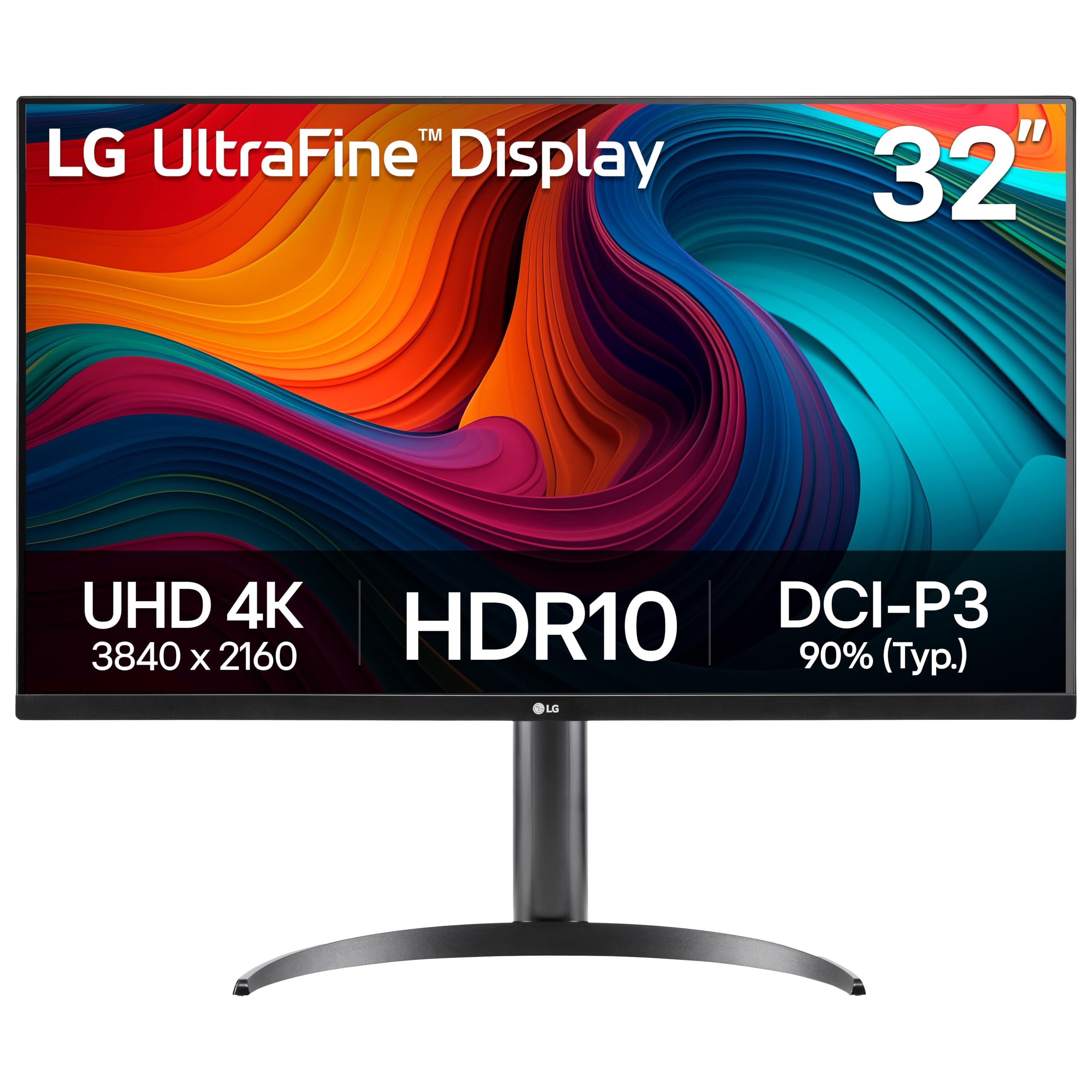
A 32-inch 4K screen at this price gives you a giant canvas for code without the premium markup.
The LG 32UR550K-B is a 32-inch VA panel with a 4K UHD (3840 x 2160) resolution. The larger size means you can fit more lines of code on screen at once and still have room for a terminal or file tree. The VA technology delivers a 3000:1 contrast ratio, which makes dark-mode coding look deep and rich. Shoppers say it is “large, sharp 32″ 4K display” with great colors from the start and easy assembly.
The monitor supports HDR10 and covers up to 90% of the DCI-P3 color space (a wide color standard used in digital cinema), which is useful if you occasionally work with video or images. The stand offers height, tilt, and pivot adjustments, giving you full control over your viewing position. It also includes Dynamic Action Sync and Black Stabilizer features for gaming, though these are secondary for a coding focus. The brightness is rated at 250 cd/m² (candelas per square meter, a unit of brightness), which is lower than some competitors, and a few buyers noted slight yellow non-uniformity on the edges.
Big Canvas, Honest Price: The 32-inch 4K panel gives you a large canvas for code, and the VA contrast ratio makes black backgrounds look great.
The Catch: At 250 nits, the brightness is lower than 350-400 nit competitors, and there is no USB-C port — you will need HDMI or DisplayPort for video.
Best for the Budget-Conscious: If you want a large, sharp 4K monitor for under and do not need USB-C, this LG is tough to top for pure screen space.
pass on it if… you need a bright screen for a very sunny room, or if a single USB-C cable is essential for your laptop setup.
Understanding the Specs
Resolution and Pixels Per Inch (PPI)
Resolution determines how many pixels fit on the screen. For coding, a higher resolution (like 3840 x 2160 “4K”) makes individual characters sharper and reduces the need to scroll to see the edges of your code. But on a 27-inch screen, 4K often requires scaling (125% or 150%) so the user interface is not too small. A 1440p (2560 x 1440) screen at 27 inches looks crisp without any scaling, which is easier on your computer’s graphics processor. The key is matching the resolution to the size so text is clear but readable.
Refresh Rate (Hz) and Smooth Scrolling
Refresh rate is how many times per second the monitor updates the image. A standard office monitor runs at 60Hz. A 100Hz or 120Hz screen updates roughly twice as often, which makes scrolling through long code files feel noticeably smoother and reduces the “stutter” effect your eyes perceive when text moves. This is not critical the way it is for gaming, but if you spend all day scrolling, a higher refresh rate reduces eye fatigue and feels more responsive.
Panel Type: IPS, VA, and Text Clarity
IPS (In-Plane Switching) panels are the most common choice for coding because they offer wide viewing angles and good color accuracy, making text look consistent from any angle. VA (Vertical Alignment) panels offer better contrast ratios (often 3000:1 vs 1000:1 for IPS), which makes black backgrounds look deeper and richer — a plus if you code in dark mode. VA panels can suffer from slightly worse viewing angles, but for a single user sitting directly in front, this is rarely a problem.
USB-C Power Delivery and the Single-Cable Setup
A monitor with USB-C and Power Delivery (PD, a standard for charging devices over USB) lets you connect your laptop with one cable that carries video signal, data, and electrical power to charge the laptop. This keeps your desk clutter-free and means you do not need a separate power brick for your laptop. Common power delivery ratings are 65W (enough for most ultrabooks and MacBooks) and 90W (enough for larger MacBook Pros). If your monitor lacks USB-C, you will need separate cables for power, video, and peripherals.
FAQ
Is a 4K monitor necessary for coding?
Is 60Hz enough for programming or do I need 120Hz?
What aspect ratio is best for coding?
Can I use a gaming monitor for coding?
Does monitor size matter for programming?
What does USB-C Power Delivery do for a coding setup?
Do I need a monitor with a built-in KVM for coding?
Is a curved monitor good for programming?
How important is an adjustable stand for a coding monitor?
Should I buy a monitor with built-in speakers for coding?
Final Thoughts: The Verdict
For most developers, the computer monitor for coding winner is the BenQ RD280U because its unique 3:2 aspect ratio and high resolution give you the most code on screen with exceptional text clarity and eye-care features. If you want a smooth 120Hz scrolling experience that also handles light gaming, grab the Dell S2725QS. And for a huge ultrawide canvas that lets you snap two windows side by side without a second monitor, the standout is the Samsung ViewFinity S50GC.
How We Picked
We do not accept paid placement. Every pick is matched to a real buyer and a real use-case; we do not hands-on test units.
Sources & Methodology
Specifications: manufacturer listings and product documentation. Review insights: verified customer reviews, as of July 2026. Pricing: not shown on this page (it changes often); check the current price via the retailer link.
As an Amazon Associate, WellFizz earns from qualifying purchases. This does not affect which products we feature.

Mo Maruf
I created WellFizz to bridge the gap between vague wellness advice and actionable solutions. My mission is simple: to decode the research and give you practical tools you can actually use.
Beyond the data, I am a passionate traveler. I believe that stepping away from the screen to explore new environments is essential for mental clarity and physical vitality.