Our readers keep the lights on and my smoothie glass nicely filled. As an Amazon Associate, I earn from qualifying purchases.
Specs are compiled from manufacturer listings and verified buyer reviews and can change over time — please confirm the key details on the product page before buying.
If you are climbing regularly, rental shoes are costing you performance and comfort. They slip on holds, they smell, and they never fit your foot shape. The right pair of climbing shoes for men changes how you trust your feet on the wall — from slab smears to overhang heel hooks — and makes every session more productive.
I’m Mohammad Maruf — the founder and writer behind WellFizz. This guide is built by comparing the manufacturers’ published specifications and the patterns across verified customer reviews, so you get each pick’s real strengths and trade-offs instead of marketing spin.
You want climbing shoes that fit well and perform where you climb — whether that is your first V4 (a bouldering grade) or a long trad route (traditional climbing with gear placements). This roundup compares the exact specs and real-world fit notes from buyers so you can pick the right pair.
Quick Picks
- SCARPA Instinct VS Rock Climbing Shoes — Best Overall
- Mad Rock Rover Climbing Shoe — Best Value
- SCARPA Men’s Helix Lace Rock Climbing Shoes — Comfort Pick
- La Sportiva Men’s Finale Rock Climbing Shoes — Progressive All-Rounder
- La Sportiva Mens Tarantulace Rock Climbing Shoes — Budget Champion
- EVOLV Kronos Rock Climbing Shoe — Intermediate Upgrade
- EVOLV Defy Rock Climbing Shoe — Wide-Foot Entry
How To Choose The Best Climbing Shoes For Men
Buying climbing shoes without trying them on is tricky because every brand measures fit differently. You need to understand a few key specs before you add to cart.
Fit and sizing — snug does not mean painful
Climbing shoes should fit very snug with no dead space. A rule of thumb is to downsize 1 to 2 sizes from your street shoe, but that varies by brand. Leather shoes stretch up to half a size; synthetic uppers stretch very little, so buy them feeling tight from day one.
Profile shape — flat vs. downturned
A flat profile (like the La Sportiva Tarantulace) keeps your toes relaxed for all-day wear and slab climbs. A downturned shape (like the SCARPA Instinct VS) curls your toes for more power on steep overhangs. Beginners usually want flat or slightly downturned; advanced climbers often prefer aggressive downturn.
Rubber compound and thickness
A stickier rubber (like Vibram XS Grip 2 or Mad Rock Science Friction 3.0) helps you trust tiny footholds. Thicker soles (4–5mm) last longer and edge better; thinner soles (3.5mm) give more sensitivity and feel for the rock. There is a direct trade-off between durability and sensitivity.
Quick Comparison
| Model | Best For | Rubber | Closure | Profile | Amazon |
|---|---|---|---|---|---|
| Mad Rock Rover | All-around mid-range | Science Friction 3.0 | Hook-and-Loop | Moderate asym | Amazon |
| La Sportiva Tarantulace | Entry-level comfort | 5mm FriXion RS | Laces | Flat, low asym | Amazon |
| EVOLV Defy | Wide-foot beginner | — | Hook-and-Loop | Downturned toe | Amazon |
| SCARPA Helix | Comfort all-day gym | 4mm Vibram XS Edge | Laces | Flat, slight asym | Amazon |
| La Sportiva Finale | Progressive all-rounder | 4mm Vibram XS Edge | Laces | Pointed, no downturn | Amazon |
| EVOLV Kronos | Intermediate all-terrain | TRAX SAS | Dual-strap | Slight camber | Amazon |
| SCARPA Instinct VS | Aggressive bouldering | 3.5mm Vibram XS Edge | Velcro | Moderately downturned | Amazon |
In‑Depth Reviews
1. SCARPA Instinct VS Rock Climbing Shoes

The aggressive shoe that feels like a mountain goat hoof on tiny edges.
This is the shoe you reach for when you stop making excuses and start projecting. The SCARPA Instinct VS uses a moderately downturned profile and a 3.5mm Vibram XS Edge sole that delivers precision on dime-sized holds. The Bi-Tension rand lets you loosen the super-sticky velcro strap to warm up, then cinch it for serious business. Buyers report the edging is incredible and that the heel hooks on a whole different level compared to other aggressive shoes.
Fit is the tricky part. Multiple reviews say you need to size up — one buyer wears a size 9.5 street shoe and found the 10.5 fit perfect, while another with wide feet went all the way to size 44 (his street size) and still found them very tight. The toebox is shaped more around the big toe, which helps if you have curled little toes. Unlike the EVOLV Defy, this shoe is built for overhungs and bouldering, not all-day slab comfort.
At 7.8 oz for half a pair in size 40, it is fairly lightweight for such an aggressive shoe. The trade-off is that the Edge rubber feels less sticky on smears — one reviewer came off the wall unexpectedly on smoothed-off features. If you want one shoe for short, powerful routes and gym bouldering, this is your pick.
Built For Power
- Incredible edging on small holds
- Heel hooking is top-tier — zero dead space
- Durable construction holds up to outdoor use
Not For Everyone
- Sizing is tricky — most buyers need 1-2 sizes up from street shoe
- Edge rubber is less sticky on smears
- Very tight fit; not comfortable for long multi-pitch routes
Grab this for: climbers who want precision on steep overhangs and boulder problems and are willing to wrestle with sizing.
The real catch: it runs extremely tight — expect a painful break-in period and bring a shoe horn.
2. Mad Rock Rover Climbing Shoe

The shoe that gives you performance-grade rubber without the premium price tag.
The Rover uses Mad Rock’s new Science Friction 3.0 compound — a rubber that the maker claims is more durable and higher friction than previous formulas — in a moderate asymmetrical shape that works for both gym sessions and outdoor sport climbs. The compression-molded toe box and improved heel design with added ridges let you catch edges at wider angles. A 1.8mm polyester midsole (the layer between sole and footbed) balances sensitivity and support.
Owners mention that after several months of use they are extremely happy, especially with how the heel performs on hooks. One veteran climber with 25 years of experience says these are the last shoe he will buy for bouldering, sport, and gym climbing. The Rover is noticeably more aggressive than the La Sportiva Tarantulace, so it is better suited for climbers who want to improve their technique rather than beginners still learning balance on slab.
Mad Rock suggests upsizing 1 full size to find your US size, and reviewers with wide feet find the fit almost custom. The hook-and-loop closure makes them easy to slip on and off between routes. The only complaint: sizing inconsistency — one buyer received what appeared to be a women’s 11 when they ordered a men’s 11.
Performance Punch
- Sticky Science Friction 3.0 rubber grips well
- Heel design excels at heel hooks
- Works for wide feet from the start
Know Before You Buy
- Sizing is inconsistent across units
- Not ideal for all-day trad due to moderate asymmetry
- Less sensitive than softer moccasin-style shoes
Reach for this if: you want premium rubber and heel performance for bouldering and sport climbing without paying premium prices.
Look elsewhere if: you need a flat, comfortable shoe for long multi-pitch routes.
3. SCARPA Men’s Helix Lace Rock Climbing Shoes

The flat-last lace-up that stays comfortable for your entire gym session.
If you climb 3-4 times a week and want a shoe you can keep on between routes, the Helix is your match. It uses a flat profile with slight asymmetry and a 4mm Vibram XS Edge sole — the same rubber found on many premium shoes — for reliable edging and durability. The lace closure lets you dial in pressure across the whole foot, which is great for climbers with a narrow heel but wider forefoot.
One reviewer who wears a size 10.5 US running shoe found the 43.5 EU fit perfectly snug but not painful. A real buyer compared the new grey 2026 model against the La Sportiva Tarantulace and found the Helix has more space in the toebox and feels more comfortable, plus higher quality construction made in Romania versus China. That said, some reviewers experienced quick wear — one got only three months climbing 2-4 times per week before the sole wore down. The Tarantulace uses a 5mm FriXion RS sole that is more durable.
At 8.8 oz for half a pair in size 40, the Helix is slightly heavier than the EVOLV Defy but offers a more precise fit through lacing. It is best for beginner to intermediate climbers who prioritize comfort for volume training.
Who it fits: gym climbers who want to leave shoes on for hours without pain. The lace closure allows a custom fit for different foot shapes.
Watch out: the 4mm sole wears faster than thicker options — expect resoling after a few months if you climb 3+ times a week.
Your move: buy these if you climb mostly in the gym and want a comfortable, precise fit you can dial in with laces.
Think twice if: you are a heavy outdoor climber who needs a thicker, longer-wearing sole.
4. La Sportiva Men’s Finale Rock Climbing Shoes

The eco-leather lace-up that molds to your foot without a torturous break-in.
The Finale sits between an entry-level flat shoe and an aggressive bouldering slipper. It has a pointed toe shape with no downturn and low asymmetry (the toe is not twisted), so your toes stay relatively flat while still getting solid edging performance from the 4mm Vibram XS Edge sole. The eco-leather upper stretches about half a size over time, which helps if you are between sizes.
One reviewer with wide feet size 9.5 said the size 9 Finale fit like a glove right from the start because the laces let them customize the pressure. Another climber who wears size 14 street shoes bought size 48 (on the lower side of 14) and found them very snug at first, but after two weeks they broke in and became comfortable enough for entire 2-hour boulder sessions. Customers note that after 1600+ indoor bouldering routes, the shoes finally developed holes at the big toe — impressive durability for the price range.
Unlike the SCARPA Instinct VS, the Finale is not meant for extreme overhangs. It is built for climbers who want one pair that works across slab, vertical, and moderate steep terrain. The only downside: the orange leather can stain your heels for the first few weeks.
Daily Driver
- Leather stretches for a custom fit
- Lace closure gives precise fit for wide/narrow feet
- Durable — lasted over 1600 routes for one reviewer
Limits
- Not aggressive enough for steep bouldering
- Leather stain on heels
- Breaks in slower than synthetic shoes
Solid choice for: climbers improving their technique who want one versatile shoe for gym and outdoor routes without extreme downturn.
skip it if: you need a highly aggressive shoe for steep overhangs and boulder problems.
5. La Sportiva Mens Tarantulace Rock Climbing Shoes

The beginner classic that gives you a solid foundation without hurting your feet.
If you are new to climbing and want a shoe that helps you learn footwork without making you regret every step, the Tarantulace is the standard. It uses a flat profile with zero downturn and low asymmetry, which keeps your toes relaxed — great for slab climbs and all-day gym sessions. The 5mm FriXion RS sole is thick and durable, so it holds up to heavy rental-beating use.
One buyer wears a size 10 street shoe and got a size 9 — they found the fit perfect with toes feeling a little overlapped but otherwise comfortable. Another climber who usually wears 10.5-11 street shoes ended up at size 8.5-9 for the proper snug fit after trying 9.5 and 9. The leather upper will stretch, so many reviewers recommend going 1.5 to 2 sizes down from your street shoe. The lace closure keeps the shoes from slipping or coming untied.
Where the Tarantulace falls short is on steep terrain. Unlike the EVOLV Kronos, which has a slight camber for overhangs, the Tarantulace has no downturn, so you will feel your toes sliding off holds on steeper routes. It is not designed for bouldering or sport climbing above 5.10.
Perfect for: first-time buyers who want a comfortable, durable shoe to learn basic climbing techniques. The thick sole edges reasonably well for the price.
The trade-off: zero downturn means poor performance on overhangs — upgrade when you start projecting harder routes.
Get these if: you are brand new to climbing and want a comfortable, forgiving shoe that lasts.
Pass if: you already climb 5.11 or above and need an aggressive shoe for steep terrain.
6. EVOLV Kronos Rock Climbing Shoe

The shoe that bridges the gap between rental-grade comfort and real climbing performance.
The Kronos is built for climbers who have outgrown beginner flat shoes but are not ready for an aggressive bouldering slipper. It has a slight camber design with a downturned toe that helps on steeper sport routes and boulder problems, yet stays comfortable enough for long slab routes — the maker rates it PSR 4 for versatility. The synthetic upper keeps the shoe from stretching much, and the dual-strap closure ensures a snug fit for the life of the shoe.
Reviewers point out a significant improvement over rentals on slab and vertical terrain. One reviewer who is a street size 13 ordered 13.5 and found them snug without wiggle room but not painfully tight. Another climber noted the TRAX SAS rubber is very grippy, completely changing their experience on slab. The Kronos has a more aggressive profile than the La Sportiva Tarantulace, so it actually works for overhangs, but it is not as downturned as the SCARPA Instinct VS.
The trade-off is that the toe is not very aggressive, so on steep overhangs and boulder problems performance will suffer slightly. Multiple shoppers say the sizing is inconsistent — one tried five different climbing shoes and the Kronos won, but another said sizing is all over the place and warned against buying online without trying on.
the balance
- Great grip on slab and vertical terrain
- Slight downturn helps on moderate overhangs
- Comfortable enough to wear for full sessions
Heads Up
- Sizing varies — most need +0.5 over street shoe
- Not aggressive enough for hard bouldering
- Rubber may wear quickly on heavy use
Pick this if: you are climbing 5.9-5.10 and want a shoe that helps you progress onto steeper routes without sacrificing all-day comfort.
Hold off if: you primarily boulder hard problems — you need a more downturned shoe.
7. EVOLV Defy Rock Climbing Shoe
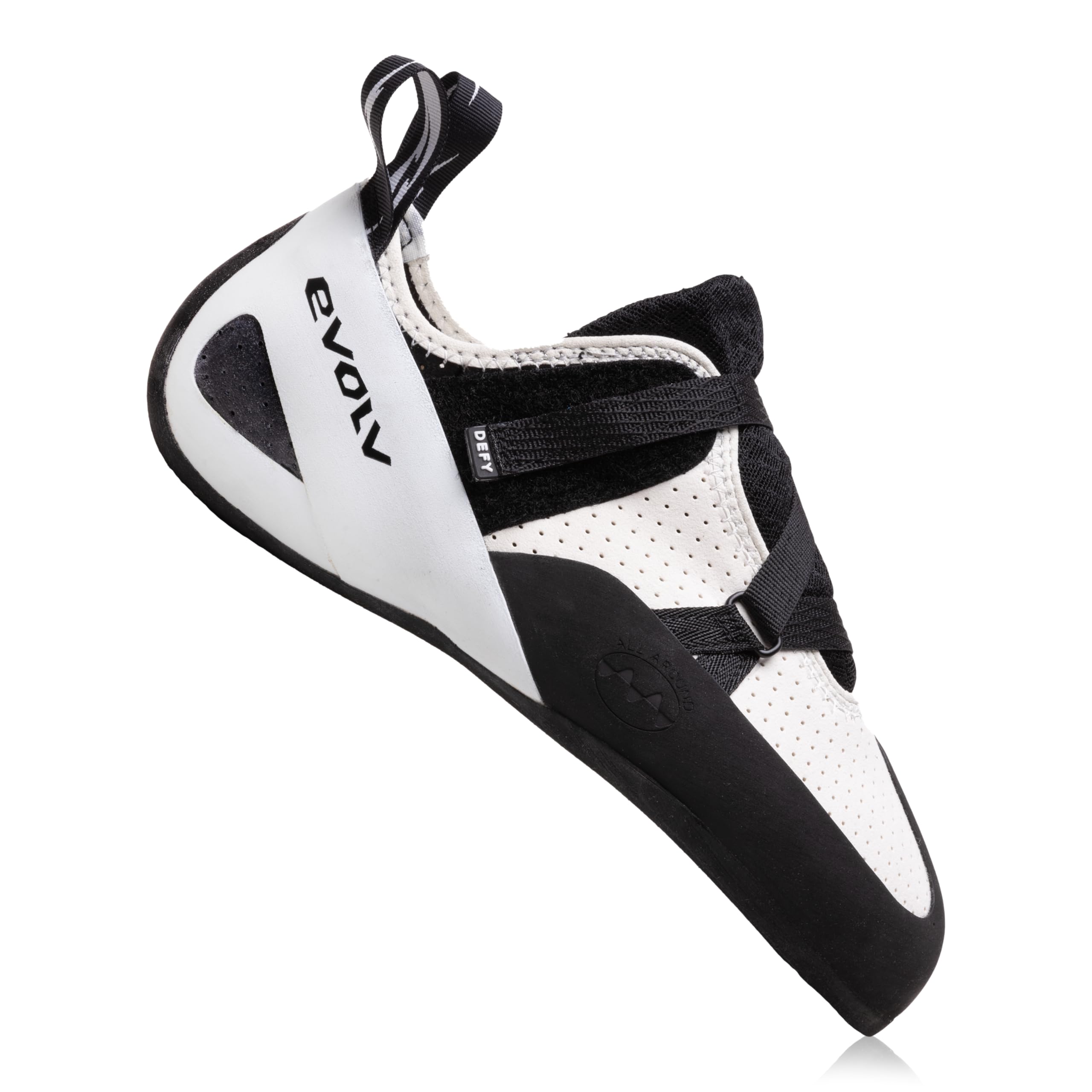
The beginner shoe that finally fits if you have been cursed with wide feet.
If every climbing shoe you try pinches your toes, the EVOLV Defy was designed with extra width in mind. It has a downturned toe for hooking and power transfer, which is unusual for an entry-level shoe. The hook-and-loop closure makes them easy to get on and off — a big plus for gym climbers who take shoes off between routes.
Buyers report that the Defy runs significantly shorter and wider than other brands. One reviewer with wide feet who typically wears a 39.5 in climbing shoes bought a 41 based on reviews and found them nearly perfectly. Multiple owners mention you need to buy two full sizes up from your street shoe — one climber wears a 9.5 street shoe and had to return size 11 for a size 12 to get a proper fit. That is a bigger sizing jump than any other shoe on this list, including the SCARPA Instinct VS.
Unlike the SCARPA Helix which has a flat profile, the Defy has a downturned toe that helps with hooking on steep terrain. However, customers note the soles are quite soft, so if you are looking for an aggressive bouldering shoe, this is not it. The Defy works best for beginner to intermediate climbers with wide feet who want comfort and a slight performance edge over rentals.
The real selling point: its wide toebox accommodates feet that other climbing shoes crush. The downturned toe gives you more hooking power than a flat beginner shoe.
The hard part: sizing up 2+ sizes feels ridiculous but is necessary — measure carefully and use the size chart.
Top pick for: climbers with wide feet who struggle to find any climbing shoe that fits comfortably while still performing.
Avoid if: you have narrow feet — there will be too much dead space inside the shoe.
Understanding the Specs
Rubber Compound
This is the sticky material on the bottom that grips the rock. Softer compounds (like Vibram XS Grip 2 or Science Friction 3.0) feel more secure on small footholds but wear down faster. Harder compounds (like 5mm FriXion RS) last longer but offer less friction on slick surfaces. A 3.5mm sole gives you more feel for the rock; 4–5mm soles are more durable and edge better.
Shoe Profile and Downturn
Flat-profile shoes keep your toes in a natural, relaxed position — better for all-day comfort and slab climbing. Downturned shoes curl your toes downward into a hooking position, transferring more power to the tips for steep overhangs and boulder problems. A moderately downturned shoe is the jack-of-all-trades that works for most climbers.
FAQ
How should climbing shoes fit for men?
What is the difference between flat and downturned climbing shoes?
Will my climbing shoes stretch over time?
How long do climbing shoes last?
Can I resole my climbing shoes?
Should I buy climbing shoes with laces or velcro?
What rubber compound is best for beginners?
Do I need aggressive climbing shoes for bouldering?
Why do climbing shoes hurt my feet?
Can I use climbing shoes for hiking or approach?
Final Thoughts: The Verdict
For most climbers, the best climbing shoes for men is the SCARPA Instinct VS because it gives you class-leading precision on small edges and a heel that stays locked in for heel hooks. If you want budget-friendly all-day comfort for learning, grab the La Sportiva Tarantulace. And for climbers with wide feet who have struggled to find a comfortable performance shoe, the EVOLV Defy is the top pick.
How We Picked
We do not accept paid placement. Every pick is matched to a real buyer and a real use-case; we do not hands-on test units.
Sources & Methodology
Specifications: manufacturer listings and product documentation. Review insights: verified customer reviews, as of July 2026. Pricing: not shown on this page (it changes often); check the current price via the retailer link.
As an Amazon Associate, WellFizz earns from qualifying purchases. This does not affect which products we feature.

Mo Maruf
I created WellFizz to bridge the gap between vague wellness advice and actionable solutions. My mission is simple: to decode the research and give you practical tools you can actually use.
Beyond the data, I am a passionate traveler. I believe that stepping away from the screen to explore new environments is essential for mental clarity and physical vitality.