Our readers keep the lights on and my smoothie glass nicely filled. As an Amazon Associate, I earn from qualifying purchases.
Specs are compiled from manufacturer listings and verified buyer reviews and can change over time — please confirm the key details on the product page before buying.
Forget dragging a heavy air compressor and wrestling with a hose. Modern cordless nailers fire into hardwood as cleanly as pneumatic models, but they let you work anywhere — up a ladder, in a crawlspace, or out on a deck — without a single trip to plug in. This guide breaks down which battery-powered brad and finish nailers actually earn a spot in your toolbox, based on published specs and real owner experiences.
I’m Mohammad Maruf — the founder and writer behind WellFizz. This guide is built by comparing the manufacturers’ published specifications and the patterns across verified customer reviews, so you get each pick’s real strengths and trade-offs instead of marketing spin.
This guide covers eight cordless nailers across a range of power levels, price points, and use cases, from starter kits to pro-focused trim tools.
Quick Picks
- Metabo HPT 18V MultiVolt Compact Cordless Brad Nailer Kit (NT1850DG) — Best Overall
- DEWALT 20V MAX XR Finish Nailer, 16GA (DCN662B) — Pro Grade
- DEWALT ATOMIC 20V MAX 23-Gauge Pin Nailer (DCN623B) — Specialist Pick
- SKIL PWR CORE 20 Brushless 20V 18Ga Brad Nailer Kit (NA1800B-10) — Best Value
- Milwaukee M18 FUEL 18-Volt Brushless Cordless Gen II 18-Gauge Brad Nailer (2746-20) — Top Performer
- Worx Nitro 20V 18GA Cordless Brad Nailer (WX842L) — Smart Buy
- KIMO Brad Nailer Cordless 18-Gauge with 5000 Nails & 2 Batteries (9419) — Best Starter Kit
- WEN 20V Max Cordless 18-Gauge Brad Nailer (20512) — Budget Pick
How To Choose The Best Cordless Nailer
A cordless nailer replaces a loud, tethered pneumatic setup with a battery-powered motor that drives a firing pin. The three main styles are brad nailers (thin 18-gauge nails for trim and molding), pin nailers (ultra-thin 23-gauge headless pins for delicate work), and finish nailers (thicker 16-gauge nails for baseboards and door casings). Your choice depends on the material thickness and how visible you want the nail hole to be.
Firing Mechanism: Motor vs. Spring vs. Flywheel
The internal engine makes a big difference. Some cordless nailers use a brushless motor that spins a flywheel to build energy and then releases it in a burst. Others compress a mechanical spring that unloads when you pull the trigger. Flywheel-style power delivers a harder, more consistent hit into dense wood, while a spring mechanism often means less ramp-up time — the nail fires immediately. If you often work with hardwoods like oak, a higher-tech motor (brushless) or a strong spring is worth prioritizing.
Nail Size and Gauge Range
Nailers accept a specific gauge (thickness) and length range of nails. The “18-gauge” brad nailers use a 1.3mm-thick wire nail, leaving a small hole that fills easily with putty. The “23-gauge” pin nailers use a nearly invisible headless pin — great for delicate trim but less holding power. “16-gauge” finish nailers use a thicker 1.6mm nail, suited for baseboards and stair treads. Look at the spec for the range (like “5/8-inch to 2-inch”) to make sure it covers the materials you work with most.
Shots Per Charge and Battery Compatibility
Marketing numbers for “nails per charge” can vary wildly depending on the nail length and wood density used in the test. Instead of chasing an exact number, check whether the nailer comes with a spare battery or shares batteries with other tools you own. A tool that uses an existing battery platform (like DeWalt 20V MAX, Milwaukee M18, or Worx Power Share) means you can buy the “tool only” version and save money. If you start from scratch, getting two batteries in the box — as seen with the KIMO kit — keeps you working nonstop.
Quick Comparison
| Model | Best For | Nail Gauge | Nail Length Range | Weight | Amazon |
|---|---|---|---|---|---|
| Metabo HPT NT1850DG | Lightweight trim work | 18-Gauge | 5/8″ – 2″ | 5.5 lbs | Amazon |
| DEWALT DCN623B | Delicate 23-gauge pin work | 23-Gauge | 5/8″ – 1-1/2″ | 4.44 lbs | Amazon |
| Milwaukee 2746-20 | Professional daily use | 18-Gauge | – | – | Amazon |
| SKIL NA1800B-10 | USB-C battery convenience | 18-Gauge | 5/8″ – 2-1/8″ | 7.41 lbs | Amazon |
| Worx WX842L | One-battery platform | 18-Gauge | Up to 2″ | 7.06 Pounds | Amazon |
| DEWALT DCN662B | Heavy-duty 16-ga finish work | 16-Gauge | – | 6 lbs | Amazon |
| KIMO 9419 | Best starter kit value | 18-Gauge | 3/4″ – 1-1/4″ | Under 6 lbs | Amazon |
| WEN 20512 | Budget brad nailer | 18-Gauge | 3/4″ – 2″ | 7.84 pounds | Amazon |
In‑Depth Reviews
1. Metabo HPT 18V MultiVolt Compact Cordless Brad Nailer Kit (NT1850DG)
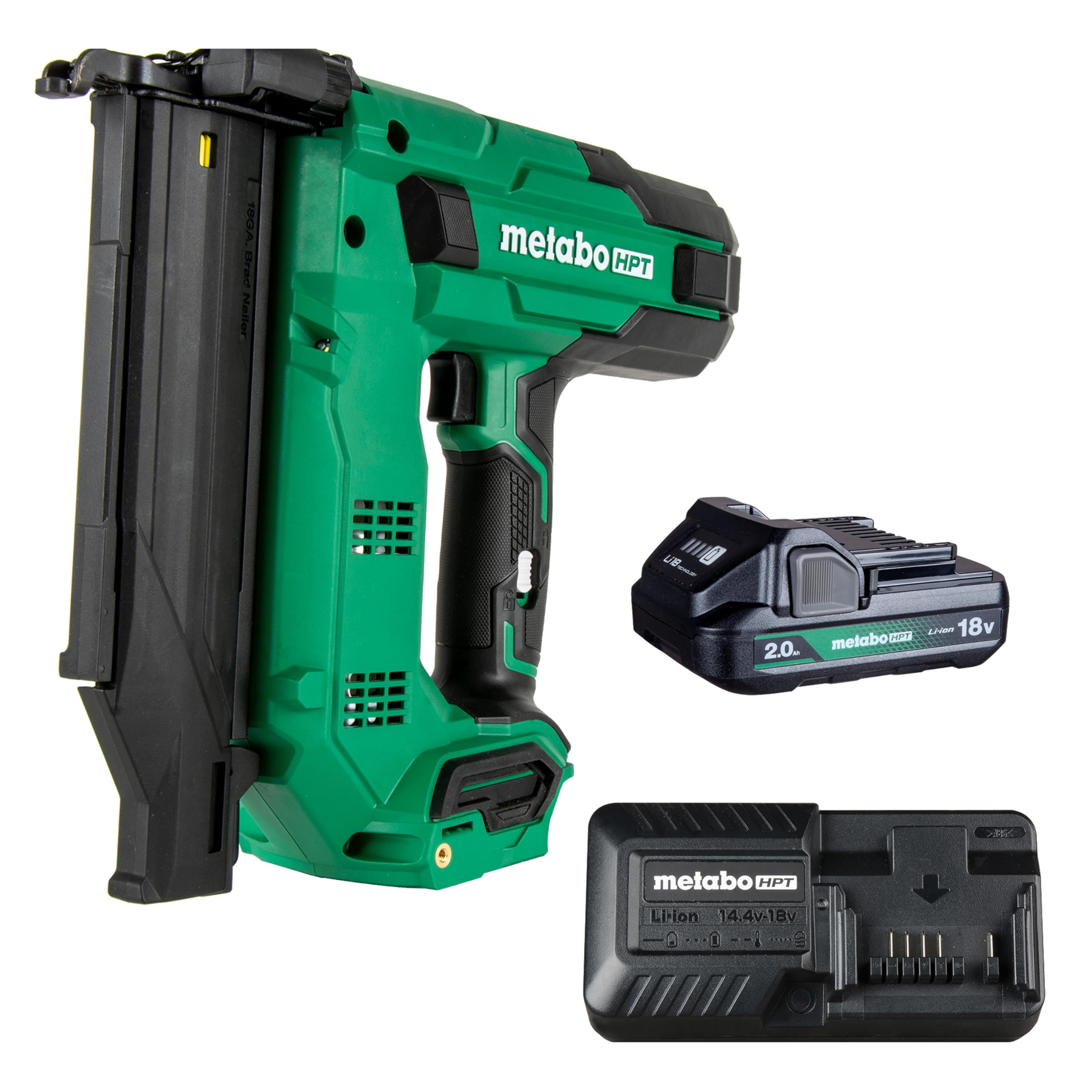
A featherlight 5.5-pound trim nailer that sinks 700 nails per charge with zero ramp-up delay.
Metabo HPT uses a mechanical spring rather than a motor-spinning flywheel, which means the nail fires the instant you squeeze the trigger. There is no waiting for the tool to “wind up” — useful when you are tapping delicate crown molding and need a precise, single hit. The 2.0Ah battery includes a fuel gauge so you know how many shots remain, and buyers report the battery life is genuinely long, getting through a full room of baseboard trim on one charge.
That savings matters when you are working overhead on chair rails or reaching into a tight cabinet. The low center height lets you fit into narrow gaps between studs. Compared to the SKIL NA1800B-10, which relies on a flywheel motor, the Metabo HPT fires more immediately but has a slightly softer recoil, which owners mention makes the tool feel more controllable.
MultiVolt battery system
- No ramp-up time — fires instantly on trigger pull
- Lightest 18-gauge brad nailer here at 5.5 pounds
- Tool-less depth adjustment and bright LED light for dim corners
Heavy for compact
- Single 2.0Ah battery included (no spare in box)
- Mechanical spring design may feel different to users used to flywheel tools
Precision pick: If you value instant trigger response and the lightest weight for overhead or long-day trim work, start here. Look elsewhere if you need a kit with multiple batteries or a tool that works with an existing 20V max battery platform — the Metabo HPT uses its own MultiVolt system.
2. DEWALT 20V MAX XR Finish Nailer, 16GA (DCN662B)
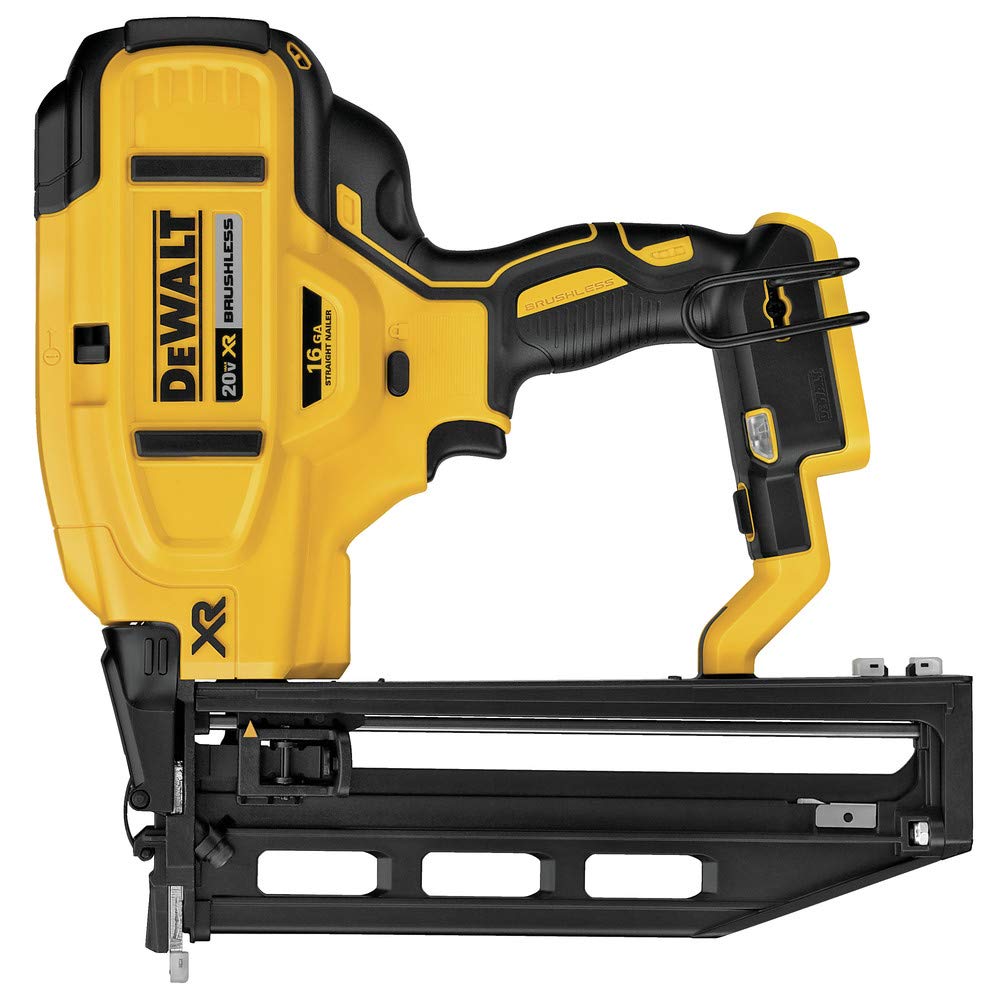
A 16-gauge workhorse that nails baseboards and door casings without a compressor in sight.
The DCN662B is a finish nailer, meaning it uses thicker 16-gauge nails for heavier-duty tasks that 18-gauge brads cannot hold — think stair treads, thick window casings, or solid-wood paneling. Its brushless motor boost runtime and durability, and the tool-free selectable trigger lets you switch between sequential mode (one nail per trigger pull) and contact (bump) mode for rapid nailing. The micro-nose design improves your line of sight so you can place a nail precisely along a beveled edge, and a tool-free depth adjustment dial lets you countersink the nail exactly flush with the wood.
This is a bare-tool purchase — batteries are not included — so it only makes sense if you already own DeWalt 20V MAX batteries. Customers note that it performs like a familiar pro-grade pneumatic tool without the hose drag, and that it works great with existing DeWalt XR batteries. At 6 pounds, it is lighter than the WEN and SKIL brad nailers, which is impressive considering it uses thicker nails and a larger mechanism.
sturdy build quality
- 16-gauge nails provide the strongest hold in this guide
- Micro-nose tip for better nail placement accuracy
- Tool-free trigger switching between sequential and bump fire
No belt hook
- Batteries and charger sold separately
- Overkill for light trim work that an 18-gauge nailer can handle
Strong hold: Reach for this if you are a regular finish carpenter with a stash of DeWalt 20V MAX batteries. skip it if you only need a nailer for thin picture-frame molding — an 18-gauge brad nailer will cost less and leave smaller holes.
3. DEWALT ATOMIC 20V MAX 23-Gauge Pin Nailer (DCN623B)

For invisible pin holes on delicate trim — drives headless 23-gauge pins through hardwood without splitting.
This is not a nailer for structural work. The 23-gauge pin is headless and about as thick as a staple wire, leaving a hole so tiny you often do not need wood filler. Cabinet makers and finish carpenters use pin nailers for holding delicate trim, small moldings, and glue-up joints while the adhesive sets. The DCN623B fires pins from 5/8-inch up to 1-1/2 inches and uses a brushless motor. It has a low-nail lockout system with an LED indicator that tells you when it is time to reload — a handy feature when you are focused on a glue line.
The nailer averages 2,000 shots per charge according to the manufacturer, and buyers confirm the battery lasts longer than they do during a day of cabinet work. It weighs 4.44 pounds, the lightest model in this guide, and has a compact body that fits inside drawers and cabinets. One professional cabinet maker noted it replaced a troublesome Milwaukee cordless pin nailer and has been 100% reliable. At 1-1/2 inches max pin length, it cannot drive through thick baseboards, so this is a secondary tool — a specialist for when you need near-invisible fastening.
Ultra-fine nail gauge
- Leaves nearly invisible holes — no filling needed
- Compact and light at 4.44 pounds for tight spots
- Fits into existing DeWalt 20V battery system
Limited nail sizes
- 23-gauge pins have very low holding strength — not for structural joints
- Maximum pin length of 1.5 inches limits use to thinner materials and trim
Nearly invisible: Add this to your kit if you already own DeWalt 20V batteries and regularly do cabinet trim, picture-frame molding, or delicate glue-up work. pass on it if you need a general-purpose nailer for baseboards or framing — you will want an 18- or 16-gauge model instead.
4. SKIL PWR CORE 20 Brushless 20V 18Ga Brad Nailer Kit (NA1800B-10)
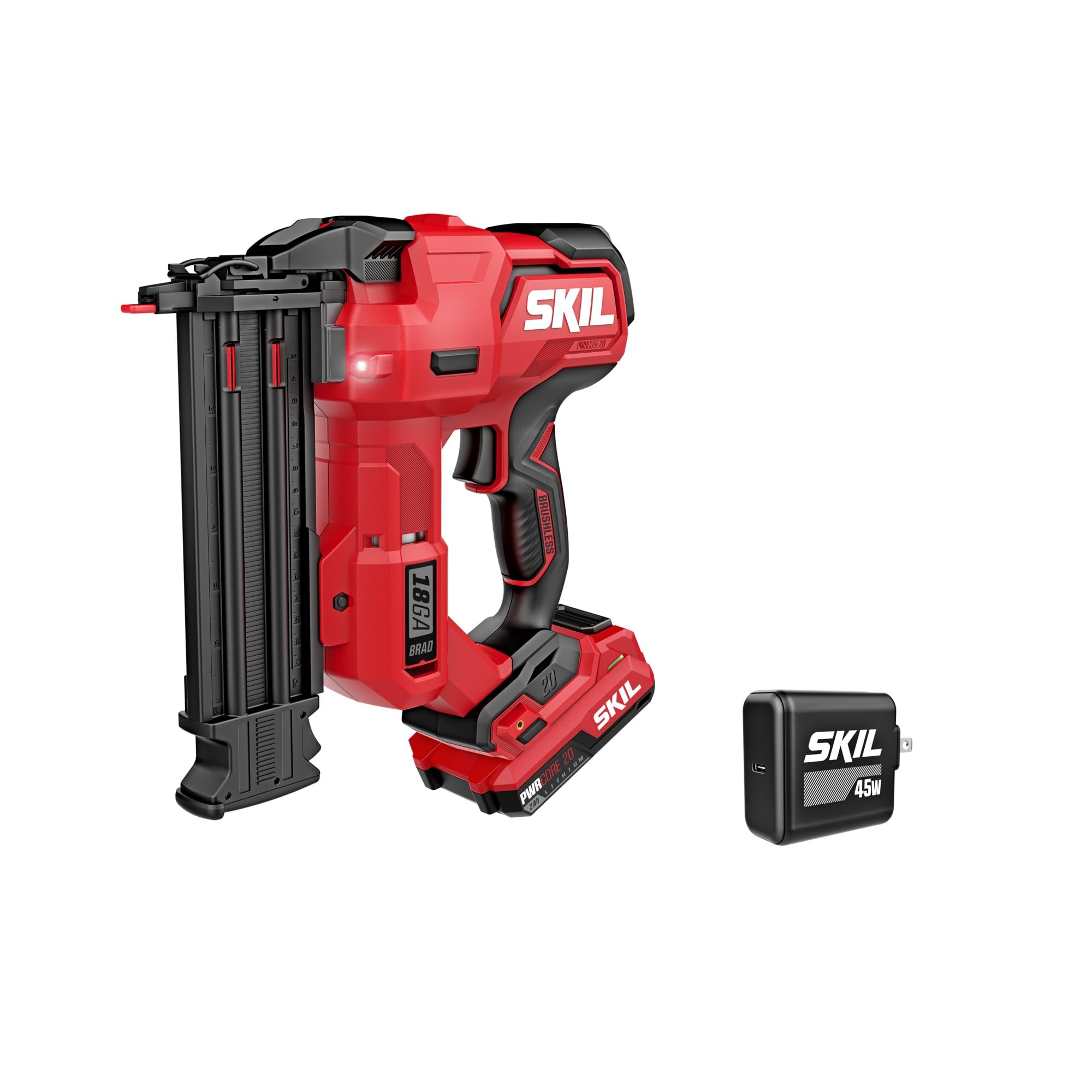
Drives up to 1,000 nails per charge and recharges its battery from any USB-C phone charger.
Of all the nailers here, the SKIL kit stands out because its 2.0Ah battery uses a USB-C port — you can top it off from the included 45W USB-C PD charger, a 12V car charger, or even a power bank. That is a rare flexibility that means you never need to hunt for a proprietary charger. The nailer delivers up to two nails per second, and its dual LED lights illuminate the work area. It also includes a dry-fire lockout that stops the tool from firing when the magazine is empty, protecting the work surface from a blank shot.
Buyers compare its performance to Milwaukee, saying that the quality equals big-name brands at roughly half the cost. The kit ships with 100 nails, a belt clip, and extra no-mar tips to protect trim. It is heavier than the Metabo HPT at 7.41 pounds, but reviewers point out that the brushless motor is smooth and powerful. One buyer fired 3,000 nails after figuring out a minor reloading quirk — the lockout system leaves the last 3–4 nails unfired unless you clear them before adding a fresh strip.
USB-C charging
- USB-C battery charges from phones, cars, or wall outlets
- Drives up to 2 nails per second with brushless motor
- Dry-fire lockout protects work surface
Plastic feel
- Heavier than the Metabo HPT by nearly 2 pounds
- Some jamming at the end of a nail strip — user must clear last 3–4 nails before reloading
USB-C freedom: Grab this kit if you want a portable nailer whose battery can be topped off from your laptop charger or car adapter. Pass it up if you prefer the lighter weight of the Metabo HPT and already have a dedicated tool-charger setup.
5. Milwaukee M18 FUEL 18-Volt Brushless Cordless Gen II 18-Gauge Brad Nailer (2746-20)
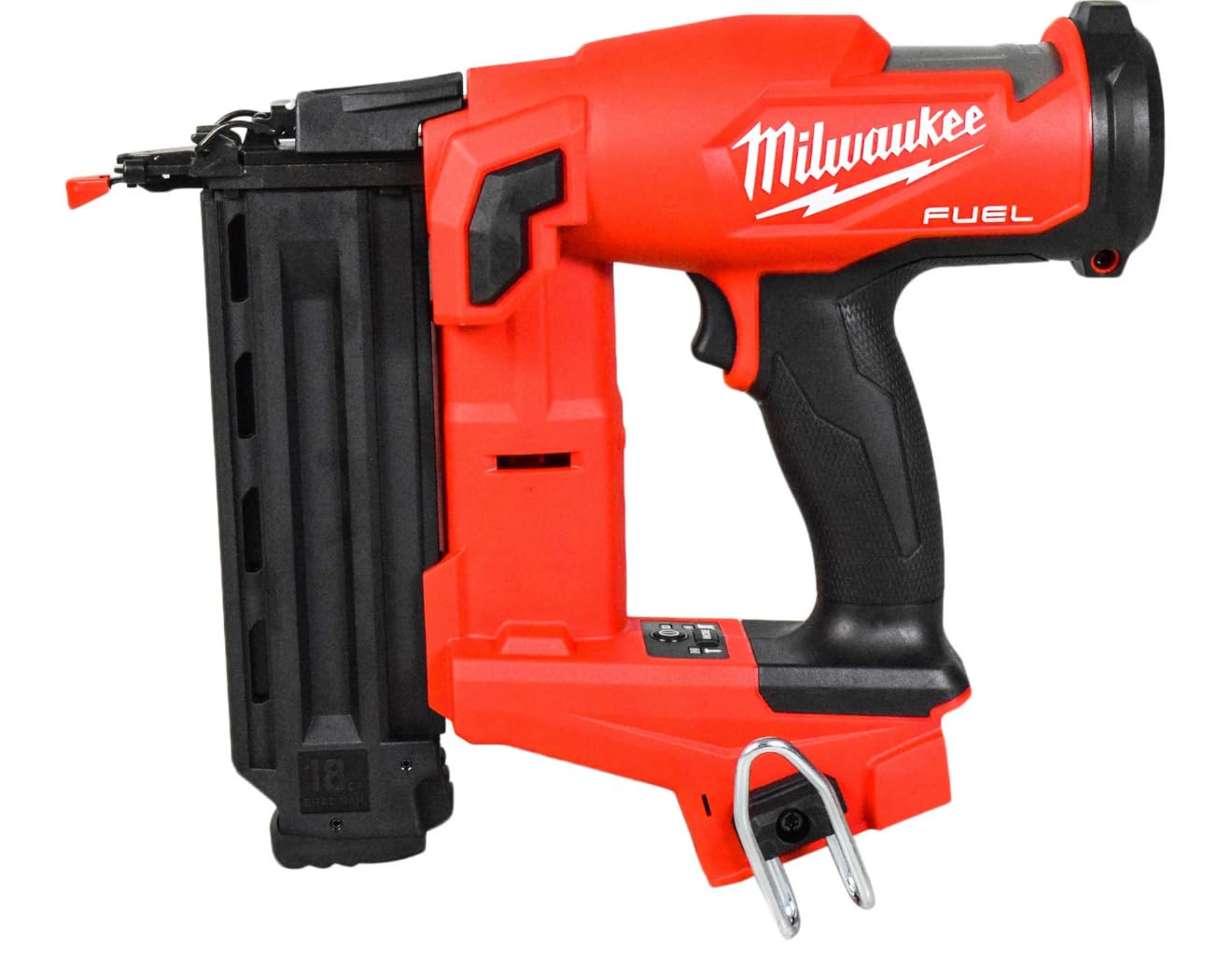
Fired hundreds of brads into solid oak without a single misfire — tough enough for daily pro use.
The Milwaukee 2746-20 is a bare-tool (no battery or charger included) designed for users who already own M18 or M18 FUEL batteries. It is the most expensive nailer on this list by unit price, but it is also the one that reviewers with heavy professional use praise most consistently. One buyer fired hundreds of brads into nearly 2-inch-thick solid oak and said it drove them flush on the highest setting with only a few needing a tap from a nail set. That kind of power density comes from the FUEL brushless motor and the M18 platform.
This nailer is the Gen II version, which means Milwaukee refined the nose geometry and ramp-up speed compared to the first generation. It fires fast and has a reported per-charge count that easily satisfies a full day of trim work. For a non-professional user, the price may feel steep — especially since the battery adds or more to the cost. But if you already run M18 tools, this is the brad nailer that owners of other brands often end up buying after cheaper models jam or fail.
High power output
- Uncompromising power into dense hardwood and oak
- Gen II refinements improve reliability over previous version
- Fits existing Milwaukee M18 battery ecosystem
Expensive kit
- Battery and charger sold separately — adds + to starting cost
- Overpriced for a DIY user who only nails the occasional baseboard
Hardwood ready: This is the nailer to choose if you are a pro or dedicated hobbyist with a stack of M18 batteries and you work with tough hardwoods regularly. Not the right pick if you are starting from scratch and need a complete kit for under.
6. Worx Nitro 20V 18GA Cordless Brad Nailer (WX842L)

A Power Share household battery nailer that shoppers say completed an entire house trim without recharging.
The Worx WX842L uses the same Power Share batteries that run over 140 other Worx tools — from string trimmers to jigsaws — so if you already own Worx gear, this nailer is a natural add-on. It uses NailForce Air Impact Technology (a brushless-driven mechanism) to fire brads up to 2 inches long into hardwood. The firing rate is 80 nails per minute, and the tool has a tool-free jam release and an anti-ejection safety design that keeps nails from flying out when you open the magazine.
At 7.06 Pounds, it is 0.78 pounds lighter than the WEN 20512, though still heavier than the Metabo HPT. The included kit comes with a battery and charger. One reviewer noted that they completed their entire house trim — baseboards, quarter round, and casing — on a single battery charge. Another reviewer noted that the depth adjustment set the nail flush every time and that the tool ran jam-free for an entire siding project. Compared to the KIMO kit below, the Worx has a slightly slower firing rate but offers a much larger compatible-tool ecosystem.
Compatible with Worx
- Shares batteries with 140+ other Worx tools
- Excellent real-world battery life — buyers report completing entire houses on one charge
- Anti-ejection design keeps nails contained during jam clearing
Narrow ecosystem
- Firing rate of 80 nails/min is slower than the KIMO’s 180 nails/min
- Priced above mid-range kits but below pro-grade like Milwaukee
Worx owners: Buy this nailer if you already have Worx Power Share batteries in your garage and want a reliable trim tool without multiplying battery types. Look at the KIMO or SKIL instead if you are starting fresh and want a complete kit with more included accessories.
7. KIMO Brad Nailer Cordless 18-Gauge with 5000 Nails & 2 Batteries (9419)
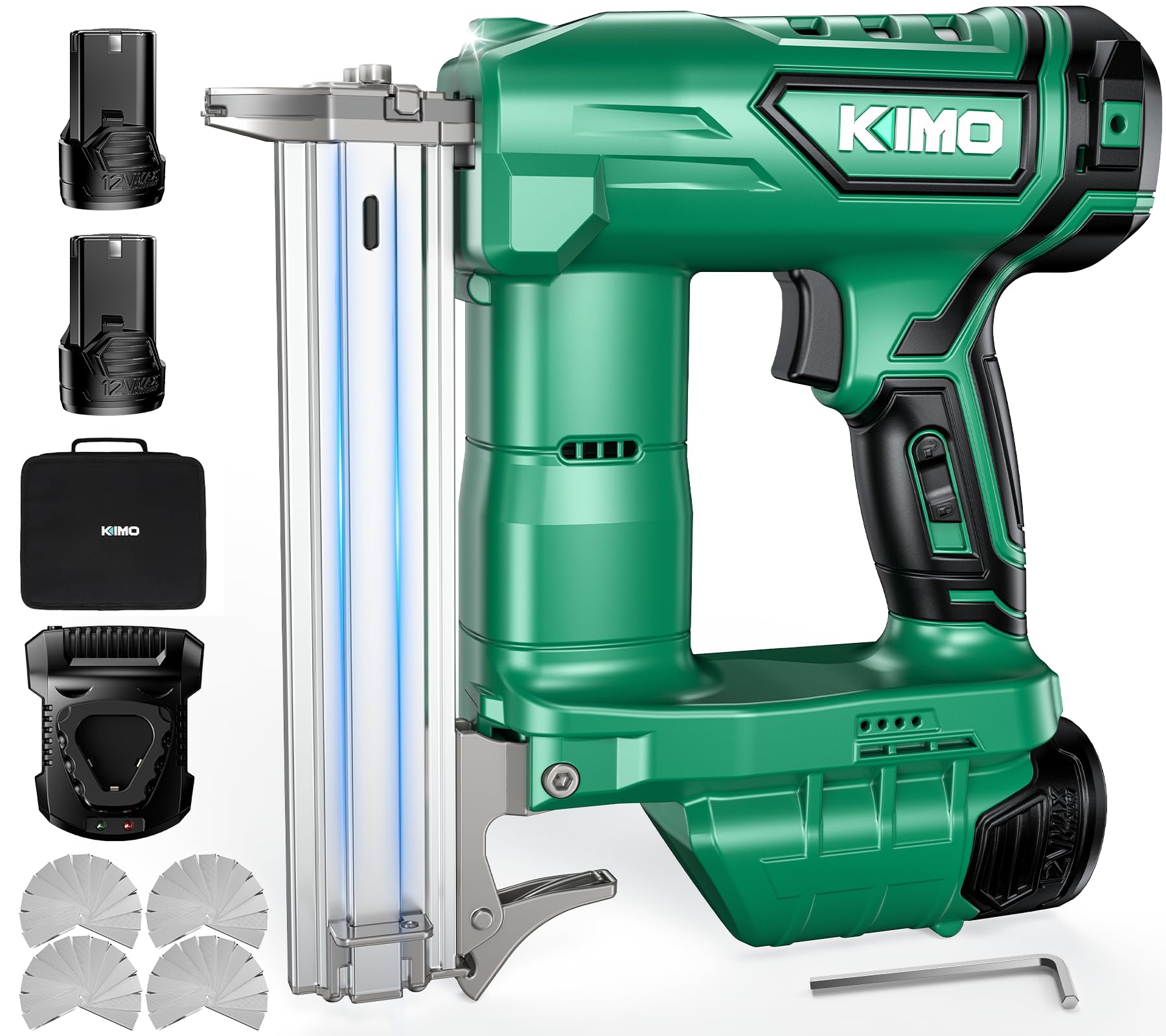
The only kit with two 2.0Ah batteries and 5,000 brad nails in the box — you are ready to build 10 minutes after unboxing.
What the KIMO kit lacks in brand recognition it makes up for in sheer value. You get the nailer, two 2.0Ah batteries, a 60-minute rapid charger, a carrying bag, a belt hook, a hex tool, and 5,000 premium brad nails. The bag alone saves you from buying a separate tool storage case. The nailer itself fires 180 nails per minute and has a tool-free jam release that flips open to clear obstructions. It weighs under 6 pounds (without battery) and the safety nose pin mechanism prevents accidental firing until the tip is depressed against the work surface.
The included nails count is 5,000, while the WEN includes 400. And you get two batteries, while the WEN includes one. One buyer — a 90-year-old with a stroke recovery — reported that the nailer was “lightweight, well-balanced, sharp, easy to handle.” Do take a moment to clean up the review data: the same set of reviews appears to also discuss a hedge trimmer (“cuts grass, weeds, brush, and limbs well”), so ignore those lines — the nailer-specific feedback is consistently positive on weight, balance, and value.
Great starter value
- Unbeatable starter kit: 2 batteries, charger, bag, and 5,000 nails included
- Fast 180 nails/min firing speed versus the Worx at 80 nails/min
- Under 6 pounds and tool-free jam clearance
Unknown longevity
- Battery platform is proprietary to KIMO — not shared with other tools
- Max nail length of 1-1/4 inches is shorter than most competitors (restricts thicker trim)
Start-up champ: Grab this if you want a complete ready-to-nail package from day one with zero extra purchases — two batteries mean you never pause to charge. Look elsewhere if you need to drive nails longer than 1-1/4 inches into thick baseboards or you already own a different battery system you want to stick with.
8. WEN 20V Max Cordless 18-Gauge Brad Nailer (20512)

An affordable brad nailer that surprised buyers with battery life that outlasts some premium-brand models.
The WEN 20512 is the cheapest complete kit in this guide, and it fills a clear niche for the occasional DIYer on a budget. It drives 18-gauge brads from 3/4-inch to 2 inches — a wider range than the KIMO’s 1-1/4-inch max — and includes a Smart LED indicator that tracks battery status, magazine fill, and tool temperature. Loading is easy with a 100-nail-capacity magazine. The kit includes a single 2.0Ah battery and a charger, plus 400 brad nails to get started.
Buyers consistently say “the battery lasts incredibly long,” with one user amazed at the run time compared to other cordless brands they owned. The trade-off is weight: at 7.84 pounds, this is the heaviest nailer on the list — 2.34 pounds heavier than the Metabo HPT. A 51-year-old DIYer commented that it felt slightly heavy but she adapted quickly during a paneling project. A separate reviewer reported a catastrophic jam one month past the return window that made the tool stop firing entirely, noting that for long-term reliability a Milwaukee may be a better bet. For infrequent use, the WEN makes sense.
Affordable price
- Very long battery run time compared to other brands, per multiple buyers
- Accepts 2-inch brads — the longest range of the budget 18-gauge options here
- Smart LED keeps you informed on battery and jam status
Lower torque
- Heaviest model in the guide at 7.84 pounds
- One buyer mentioned a total failure from a jam past the return window
Budget route: Choose WEN if you are a weekend warrior who needs a capable brad nailer for a specific project and does not want to invest in a high-end system. it’s not for you if you can swing the extra – for the SKIL or Worx, which give you better build quality, a lighter platform, and more included accessories.
Understanding the Specs
Nail Gauge — 16 vs 18 vs 23
A gauge number refers to the thickness of the nail wire. Higher gauge numbers mean thinner nails. 18-gauge brad nails are the most common for trim work, cabinet casings, and shoe molding — they leave a small hole that fills easily. 23-gauge pin nails are headless and almost invisible, but have very little holding strength (they are mainly for holding trim while glue dries). 16-gauge nails are thicker and stronger, used for baseboards, door jambs, and any joint that needs real mechanical holding force.
Shots Per Charge — What it really means
Manufacturers usually test with short nails in softwood on a low depth setting to get a high number. A “700 nails per charge” claim often becomes 300–400 nails when you use 2-inch brads in oak with the depth dial turned up. The best real-world indicator is owner feedback — look for patterns like “completed a whole house trim on one battery” rather than the advertised spec. A second battery in the kit is always the safest insurance against running out of power mid-project.
FAQ
Can a cordless nailer drive a nail flush into hardwood like oak?
What is the difference between sequential and contact (bump) fire mode?
Do I need a compressor or air hose for any of these cordless nailers?
Will a 23-gauge pin nailer hold baseboards in place?
How do I clear a jammed nail from a cordless nailer?
Can I use any brand of brad nails in these nailers?
Is a brushless motor important in a cordless nailer?
How do I know which gauge nailer I really need?
Why is my cordless nailer only driving nails partway?
Can I use a 2Ah battery for a full day of nailing?
Final Thoughts: The Verdict
For the majority of shoppers, the best cordless nailer is the Metabo HPT NT1850DG because it gives you instant trigger response and the lightest 5.5-pound body — ideal for a full day of trim work without arm fatigue. If you want a complete ready-to-nail kit with two batteries and 5,000 nails included, grab the KIMO 9419. And for those who need invisible pin holes on delicate cabinet work or moldings, the standout is the compact DEWALT DCN623B 23-gauge pin nailer.
How We Picked
We do not accept paid placement. Every pick is matched to a real buyer and a real use-case; we do not hands-on test units.
Sources & Methodology
Specifications: manufacturer listings and product documentation. Review insights: verified customer reviews, as of July 2026. Pricing: not shown on this page (it changes often); check the current price via the retailer link.
As an Amazon Associate, WellFizz earns from qualifying purchases. This does not affect which products we feature.

Mo Maruf
I created WellFizz to bridge the gap between vague wellness advice and actionable solutions. My mission is simple: to decode the research and give you practical tools you can actually use.
Beyond the data, I am a passionate traveler. I believe that stepping away from the screen to explore new environments is essential for mental clarity and physical vitality.