Our readers keep the lights on and my smoothie glass nicely filled. As an Amazon Associate, I earn from qualifying purchases.
Specs are compiled from manufacturer listings and verified buyer reviews and can change over time — please confirm the key details on the product page before buying.
You want a saw that cuts clean, square corners on your baseboards or crown molding without guesswork. This guide compares four compound miter saws by their published specs and what real buyers report, so you can pick the one that fits the work you actually do.
I’m Mohammad Maruf — the founder and writer behind WellFizz. This guide is built by comparing the manufacturers’ published specifications and the patterns across verified customer reviews, so you get each pick’s real strengths and trade-offs instead of marketing spin.
Trimming a room or framing a deck each demands a different balance of portability, cut accuracy, and blade size. The best compound miter saw for you depends on which of those matters most for your projects.
Quick Picks
- DEWALT DW713 10 In. Portable Compound Miter Saw — Best Overall
- Makita LS1040 10″ Compound Miter Saw — Best for Portability
- DEWALT 20V MAX* 7-1/4-Inch Miter Saw, Cordless (DCS361M1) — Best Cordless Pick
- Genesis GMS1015LC 15-Amp 10-Inch Compound Miter Saw with Laser Guide — Budget Champion
How To Choose The Best Compound Miter Saw
Every saw in this category does the same basic thing — it spins a toothed blade and lets you tilt the head or rotate the table to cut an angle. The differences that matter for your project are blade diameter, motor power, detent stops, and weight. Match those to the materials you cut most often and where you need to carry the saw.
Blade size sets your cutting envelope
A 10-inch blade can cross-cut a 2×12 in one pass and handle wide crown molding nested upright. A 7-1/4-inch blade like the one on the cordless DEWALT DCS361M1 is more compact and cuts through 2×4 lumber and baseboard, but you will need to flip thicker stock for a full cut. Stick with 10 inches if you regularly cut 4×4 posts or 1×12 shelving; go smaller if your jobs are trim and light framing.
Motor amps and RPM define cutting speed
All four saws here run a 15-amp motor, so the raw power is similar across corded models. What changes is the no-load RPM — the Genesis spins at about 4,600 RPM, the Makita matches that, and the DEWALT DW713 runs at 5,000 RPM. Higher RPM generally means a faster, smoother cut through dense grain, especially when you pair it with a sharp carbide blade. The cordless model trades continuous run time for job-site flexibility, so consider your access to power outlets.
Positive miter stops save setup time
Every saw here includes a detent plate with pre-set click-in positions — common angles like 15°, 22.5°, 30°, and 45°. More stops mean less time measuring and locking the table by eye. The Genesis and Makita both offer 9 positive stops, while DEWALT models offer 11, which adds 22.5° left and right for fine trim work.
Quick Comparison
| Model | Best For | Blade Length | Miter / Bevel Range | Weight | Amazon |
|---|---|---|---|---|---|
| DEWALT DW713 | Precision trim work | 10 Inches | 0-50° left/right miter; 3-48° bevel | 35 lbs | Amazon |
| Makita LS1040 | Portable trim saw | 10 Inches | 0-45° left, 0-52° right miter; 0-45° left bevel | 27 lbs | Amazon |
| DEWALT DCS361M1 | Cordless jobsite use | 7.25 Inches | 48° bevel | 31.6 lbs | Amazon |
| Genesis GMS1015LC | Budget home projects | 10 Inches | 0-45° left/right miter; 0-45° left bevel | — | Amazon |
In‑Depth Reviews
1. DEWALT DW713 10 In. Portable Compound Miter Saw
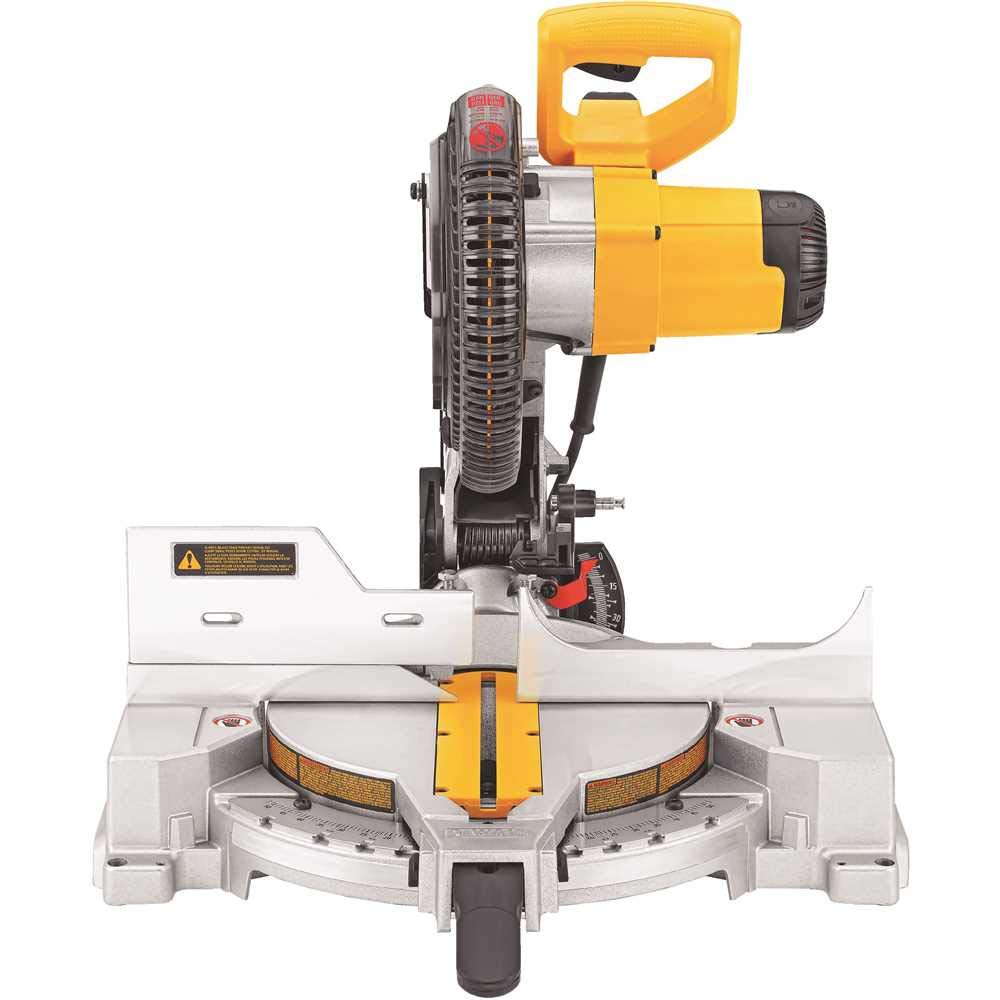
The stationary powerhouse that locks angles and chews through trim all day.
You get a 15-amp motor that spins a 10-inch blade at 5,000 RPM — owners mention that speed delivers “fast, smooth cuts” even through dense hardwood. The stainless steel detent plate gives you 11 positive stops, so you click into common angles without squinting at a scale. The tall sliding fences support crown molding vertically up to 4-1/2 inches, and they slide out of the way when you need to make a bevel cut. At 35 pounds it is noticeably heavier than the Makita LS1040 (27 lbs), but the built-in carrying handle makes moving it between rooms manageable.
The machined-base fence keeps the fence perpendicular to the blade for cut accuracy from the start — several owners say the saw arrived dead-on and stayed accurate after heavy use. The cam miter lock lets you make fine micro-adjustments when you need a custom angle. One trade-off owners point out is the dust bag: it collects some dust, but most users swap it for a shop vac connection and add rubber feet to dampen vibration on the stand.
Unlike the Genesis GMS1015LC which cuts at a 45-degree angle, the DW713 miter cuts 0-50 degrees left and right, giving you extra range for acute corners. The saw bevels 3 degrees to 48 degrees, which covers most crown molding installations. It does not include a laser guide, but the detent system and cam lock mean you rarely need one.
Proof in the Numbers
- 5,000 RPM motor is the fastest in this lineup for clean cuts
- 11 positive miter stops outpace the 9-stop Genesis and Makita
- 35-pound weight feels solid on a stand, but still portable
Real-World Gripes
- No laser guide — you rely on the detent plate for alignment
- Dust bag collects poorly; most users bypass it with a vac
- No right-side material clamp included
Reach for this if: you do trim work every week and want a durable, accurate saw that holds calibration and spins fast.
Look elsewhere if: you need a laser for alignment or you are on a strict budget, since the DW713 sits in the premium tier.
2. Makita LS1040 10″ Compound Miter Saw

The lightweight trim specialist you can carry room-to-room without groaning.
It still runs a 15-amp motor that spins a 10-inch blade at 4,600 RPM, so you get the same cutting width as the larger DEWALT with noticeably less fatigue when you carry it upstairs. The dual post compound pivoting arm gives you a single pivot point, which experienced carpenters point out eliminates the side-to-side play common in sliding miter saws.
The LS1040 cuts miter angles 0-45 degrees left and 0-52 degrees right, giving you an extra 2 degrees of right-hand range compared to the Genesis GMS1015LC (45 degrees each way). You get 9 positive miter stops at common angles including 15, 22.5, 30, and 45 degrees. Bevel cuts go up to 45 degrees to the left, which handles most crown molding work. One owner noted the saw “starts with a bang” — it is not quiet, but the accuracy and weight trade-off makes it worth carrying earplugs.
The included vertical vise holds material firmly, and the saw comes with a 40-tooth micro-polished blade, a socket wrench, a triangular rule, and a dust bag. Unlike the Genesis, the extension wings are sold separately (part 322312-4), so budget an extra if you need support for long boards. The Makita is built predominantly with metal components rather than plastic, which professional carpenters say contributes to its durability.
What Owners Love
- 27 pounds makes it the lightest 10-inch corded saw here
- Single pivot point delivers rock-solid accuracy for trim
- Metal construction feels durable compared to plastic-heavy rivals
What to Consider
- Extension wings cost extra — not included in the box
- No built-in laser guide for alignment
- Bevel only goes left (45°), so some compound cuts require flipping the piece
Best for: carpenters and DIYers who carry their saw from room to room and prioritize precise 90° cuts over sliding capacity.
skip it if: you need extension wings from the start, or you cut wide stock that requires a sliding mechanism.
3. DEWALT 20V MAX* 7-1/4-Inch Miter Saw, Cordless (DCS361M1)
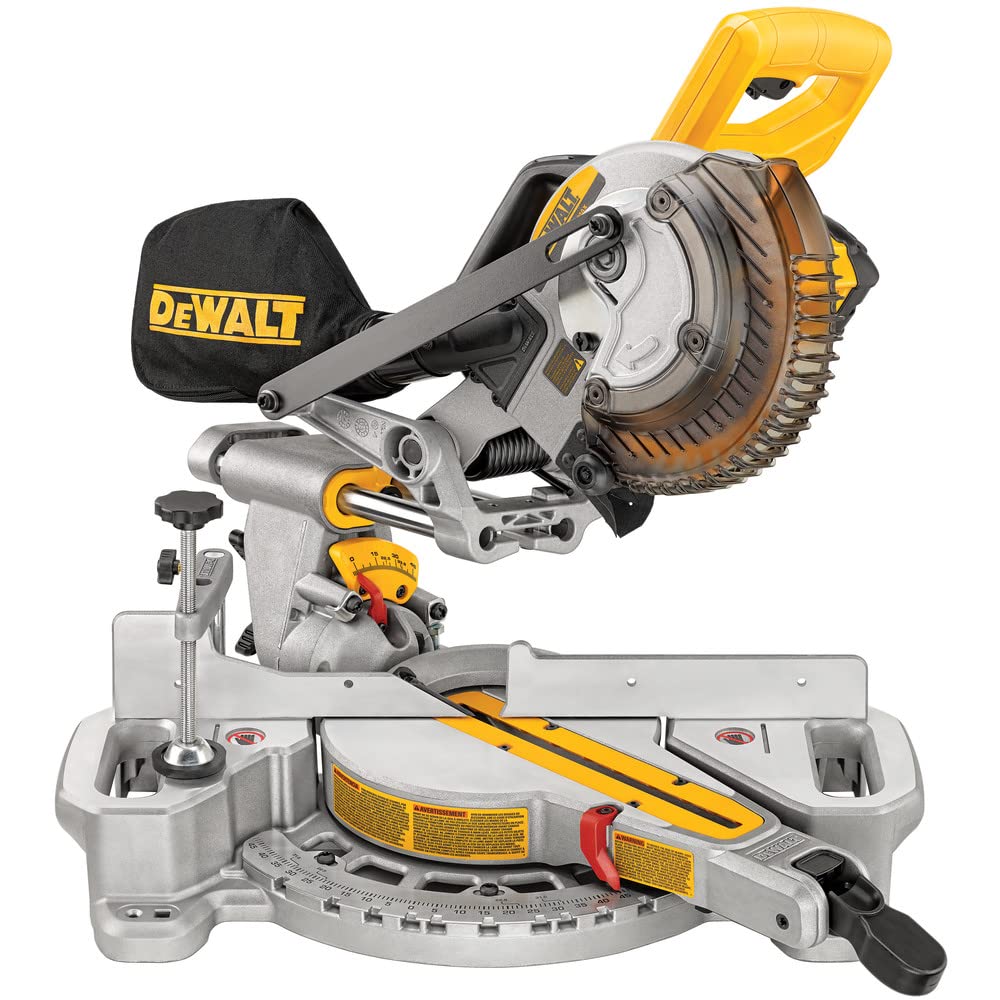
The cordless saw that follows you up a ladder or into a backyard with no extension cord.
You can trim out a room without dragging a cord across the floor because this DEWALT runs on a 20V Max* battery pack (model DCB204). The maker claims it delivers on average 183 cuts of 2×4 Pine or 275 cuts of 3-1/4 pine baseboard per charge. The blade is 7.25 inches versus the 10-inch blades on the Genesis and Makita, so your maximum cut width is narrower: you can cut 2×4 lumber and nested crown molding up to 3-5/8 inches, but wider stock requires two passes.
Customers note the cut line cross-cut positioning system is “super clever” because it gives you adjustment-free cut line indication without a laser. The adjustable stainless steel miter detent plate has 11 positive stops, matching the DW713 for quick angle changes. The saw is compact at 25.25 inches long by 21.12 inches wide by 16.15 inches tall, versus the Genesis GMS1015LC at 19.5 by 16.25 by 15 inches, but it still fits in a car trunk for job-site transport. Several owners note the original blade is rough and recommend swapping it for a 60-tooth Diablo blade for finer cuts.
The DCS361M1 comes with a battery and charger — often the same price as the bare tool at other retailers, according to owners. The cam lock miter handle delivers quick angle positioning, and the large bevel scale is easy to read. One trade-off: the material clamp feels flimsy to some users, though it holds adequately for trim work. Unlike the corded models, you have unlimited portability but finite runtime, so keep a second battery charged if you tackle larger projects.
Why It Works
- 183 cuts per charge on 2×4 Pine — enough for a whole room of framing
- 11 positive miter stops match the premium DEWALT DW713
- Lightweight compact form factor fits tight spaces
The Catch
- 7.25-inch blade limits cut width vs 10-inch models
- Original blade needs upgrading for fine trim work
- Material clamp feels less sturdy than corded saws
Ideal for: job-site carpenters and homeowners without easy access to power outlets or who need a saw that moves with them.
Not your saw if: you regularly cut wide boards like 2×12, since the 7.25-inch blade requires flipping the stock.
4. Genesis GMS1015LC 15-Amp 10-Inch Compound Miter Saw with Laser Guide

The value 10-inch saw that delivers a laser guide and electric brake at a starter price.
This Genesis runs a 15-amp motor and spins a 10-inch carbide blade at roughly the same power as the Makita, but its miter range is 45 degrees left and right, versus the Makita LS1040 at 45 degrees left and 52 degrees right. It has 9 positive miter stops at commonly used angles, so you get repeatable clicks at 15, 22.5, 30, and 45 degrees. One reviewer noted they “used this for cutting trim over the weekend and it’s easy to use and cuts fantastic!”
The integrated laser guide shines a red line along the cut path, which is a feature absent from the more expensive DEWALT DW713 and Makita LS1040. The electric brake stops the blade in seconds, and the arbor lock lets you swap blades quickly. The included 60-tooth carbide blade is decent for trim work, and you also get a hold-down clamp, dust bag, two extension wings, a blade wrench, and two AAA batteries for the laser. Owners mention the dust bag is nearly useless because the saw’s exhaust port angles the dust upward, but a shop vac connected to the standard exhaust port reduces the mess significantly. Multiple users note the saw is “very loud” and requires ear protection.
At 19.5 inches long by 16.25 inches wide by 15 inches tall, this is the most compact 10-inch saw in the lineup, versus the cordless DEWALT DCS361M1 at 25.25 by 21.12 by 16.15 inches. The die-cast aluminum base keeps it portable. Buyers caution this saw is not for metal cutting — the 15-amp motor generates heat that can melt plastic components. For wood projects like baseboards, shelves, and picture frames, it performs well for the price. One owner who describes himself as “a non-carpenter low skill guy” said it was “reasonably priced, good quality” and that the laser line was effective.
Value Highlights
- Laser guide included — skip the add-on alignment tool
- Electric brake stops the blade fast for safety
- Two extension wings included, unlike Makita which sells them separately
Budget Trade-offs
- Cutting angle maxes at 45°, less versatile than the 50-52° competition
- Very loud — ear protection is required per multiple owners
- Dust bag does not work well; you need a shop vac
Great for: beginners and hobbyists who need a 10-inch saw with a laser for occasional home projects on a tight budget.
Pass on it if: you cut dense hardwoods all day or need a quiet saw for an indoor workshop.
Understanding the Specs
Blade Length (10-Inch vs 7-1/4-Inch)
This number tells you the maximum width of material you can cut in one pass. A 10-inch blade cross-cuts a 2×12 board (roughly 11.5 inches wide) without flipping. A 7-1/4-inch blade handles 2×4 lumber and standard baseboard, but you have to flip or make two passes on wider stock. If you trim out rooms with crown molding and base, stick with a 10-inch saw. If you work on job sites where portability and cordless operation matter, a 7-1/4-inch saw saves weight and fits in tighter spaces.
Miter Detent Plate & Positive Stops
The detent plate is a metal disc under the saw table with notches that lock the table at common angles. A positive stop is a click-in angle — usually 15, 22.5, 30, and 45 degrees left and right. More stops (11 vs 9) mean you can set up for standard cuts faster without measuring. The 9-stop plates on the Makita and Genesis cover the essential trim angles; the 11-stop plates on DEWALT add 22.5° on both sides, which is useful for complex crown molding miters.
Amps & No-Load RPM
All four saws here draw 15 amps, which is the standard for corded 10-inch miter saws. What changes is the no-load RPM (how fast the blade spins before you touch wood). The Makita LS1040 and Genesis run at about 4,600 RPM, while the DEWALT DW713 runs at 5,000 RPM. Higher RPM generally means a smoother cut through dense grain with less tear-out, especially when paired with a sharp carbide blade. The cordless DEWALT DCS361M1 is rated at 20V Max and does not publish a no-load RPM, so its cutting speed depends on battery charge and material hardness.
Weight & Portability
You carry a miter saw between your garage and the job, or from room to room in a house. The Makita LS1040 at 27 pounds is the lightest corded 10-inch saw here. The DEWALT DW713 is 35 pounds — noticeably heavier but still manageable with its built-in handle. The Genesis is not listed at a specific weight but is the most compact in dimensions. The cordless DEWALT DCS361M1 weighs 31.6 pounds including the battery. If you move your saw daily, prioritize a lighter model; if it sits on a stand in one spot, extra weight adds stability.
FAQ
What is the difference between a compound miter saw and a sliding compound miter saw?
Can a 7-1/4-inch miter saw cut a 2×4 at 90 degrees?
Do I need a laser guide on my miter saw?
How many positive miter stops do I need?
What size battery does the cordless DEWALT DCS361M1 require?
Can I cut crown molding flat on a compound miter saw?
Is the Genesis GMS1015LC safe for cutting metal?
Why would I choose a non-sliding miter saw over a sliding one?
What does the 9 positive miter stops on the Makita LS1040 mean for my work?
Can I use a 10-inch blade on a 7.25-inch miter saw?
Final Thoughts: The Verdict
Across the board, the best compound miter saw winner is the DEWALT DW713 because its 5,000 RPM motor, 11 positive stops, and sturdy build provide the best balance of speed and accuracy for trim work. If you want uncompromised portability and the lightest 10-inch saw you can carry, grab the Makita LS1040. And for cordless job-site convenience where you need to cut 2x4s and baseboard away from outlets, the DEWALT DCS361M1 is the one to pick.
How We Picked
We do not accept paid placement. Every pick is matched to a real buyer and a real use-case; we do not hands-on test units.
Sources & Methodology
Specifications: manufacturer listings and product documentation. Review insights: verified customer reviews, as of July 2026. Pricing: not shown on this page (it changes often); check the current price via the retailer link.
As an Amazon Associate, WellFizz earns from qualifying purchases. This does not affect which products we feature.

Mo Maruf
I created WellFizz to bridge the gap between vague wellness advice and actionable solutions. My mission is simple: to decode the research and give you practical tools you can actually use.
Beyond the data, I am a passionate traveler. I believe that stepping away from the screen to explore new environments is essential for mental clarity and physical vitality.