Our readers keep the lights on and my smoothie glass nicely filled. As an Amazon Associate, I earn from qualifying purchases.
Specs are compiled from manufacturer listings and verified buyer reviews and can change over time — please confirm the key details on the product page before buying.
If you edit photos, design layouts, or grade video, a color accurate monitor is the difference between guessing and knowing. You want a screen where the red you see on screen matches the red that comes off the printer, and where a shadow in a video clip isn’t hiding crushed blacks. This guide breaks down six monitors that actually deliver on that promise, from a budget-friendly 27-inch workhorse to a 6K behemoth that rivals Apple’s own display.
I’m Mohammad Maruf — the founder and writer behind WellFizz. This guide is built by comparing the manufacturers’ published specifications and the patterns across verified customer reviews, so you get each pick’s real strengths and trade-offs instead of marketing spin.
If you are a professional creative or a serious hobbyist, choosing a color accurate monitor means looking past marketing and diving into real specs like color gamut coverage and Delta E values. That is exactly what this guide does.
Quick Picks
- Dell UltraSharp U2725QE 27 Inch 4K UHD IPS Black Monitor — Best Overall
- ASUS ProArt Display 27” 5K HDR Professional Monitor (PA27JCV) — Pro Grade
- MSI MPG 321URXW QD-OLED 31.5 Inch 4K UHD Gaming Monitor — Gaming Color Beast
- INNOCN 40 Inch 5K 5120 x 2160p Ultrawide Monitor 40C1U — Ultrawide Vision
- ASUS ProArt Display 27″ Monitor PA278CV — Entry-Level Pro
- Kuycon G32P 32’’ UHD 6K (6144 x 3456) Glossy Monitor — Ultra Clarity King
How To Choose The Best Color Accurate Monitor
Finding a monitor that shows true-to-life color isn’t just about a high price tag. The real difference is in the numbers, and knowing which ones actually matter will save you from spending on a screen that still makes your work look wrong.
Delta E — The Grade on Factory Accuracy
Delta E (dE) is the standard measurement of how far a displayed color is from the intended one. A Delta E under 2 is the professional standard: the color difference is so small that the human eye can’t spot it. Look for monitors that advertise a factory-calibrated Delta E < 2, often backed by a Calman Verification report in the box.
Color Gamut — sRGB vs DCI-P3
Color gamut describes the range of colors a monitor can show. sRGB is the standard for web and most office work; 100% sRGB coverage means your screen can display the full web color space. DCI-P3 is a wider gamut used in video production and HDR content, covering richer reds and greens. If you work with video or print, aim for a monitor with at least 99% DCI-P3 coverage alongside full sRGB.
Resolution and Pixel Density
Resolution determines how sharp text and images look. For color-critical work, a higher pixel density (measured in PPI — pixels per inch) reduces eye strain, especially when reading text. A 4K (3840 x 2160) display on a 27-inch panel is a strong baseline. For Mac users, a 5K (5120 x 2880) display is ideal because it allows macOS to render text at a perfect 2x scale, making everything retina-sharp.
Panel Type and Contrast
IPS (In-Plane Switching) panels are the traditional standard for color accuracy because they offer wide viewing angles and consistent brightness across the screen. OLED and QD-OLED (Quantum Dot OLED) panels take this further, with per-pixel lighting that delivers perfect blacks and extremely high contrast, which can make colors appear even more vivid. However, OLED monitors require burn-in management, while IPS screens are generally more durable for static work like code or spreadsheets.
Quick Comparison
| Model | Best For | Resolution | Color Gamut | Brightness | Amazon |
|---|---|---|---|---|---|
| ASUS ProArt PA278CV | Budget color work | 2560 x 1440 | 100% sRGB | 350 cd/m² | Amazon |
| Dell UltraSharp U2725QE | Office & productivity hub | 3840 x 2160 | 99% DCI-P3 | 450 cd/m² | Amazon |
| ASUS ProArt PA27JCV | Mac 5K scaling | 5120 x 2880 | 99% DCI-P3 | 400 cd/m² | Amazon |
| MSI MPG 321URXW QD-OLED | Gaming & HDR content | 3840 x 2160 | 99% DCI-P3 | 1000 cd/m² | Amazon |
| INNOCN 40C1U | Ultrawide productivity | 5120 x 2160 | 106% DCI-P3 | 350 cd/m² | Amazon |
| Kuycon G32P | Ultra-high resolution & clarity | 6144 x 3456 | 99% DCI-P3 | 500 cd/m² | Amazon |
In‑Depth Reviews
1. Dell UltraSharp U2725QE 27 Inch 4K UHD IPS Black Monitor
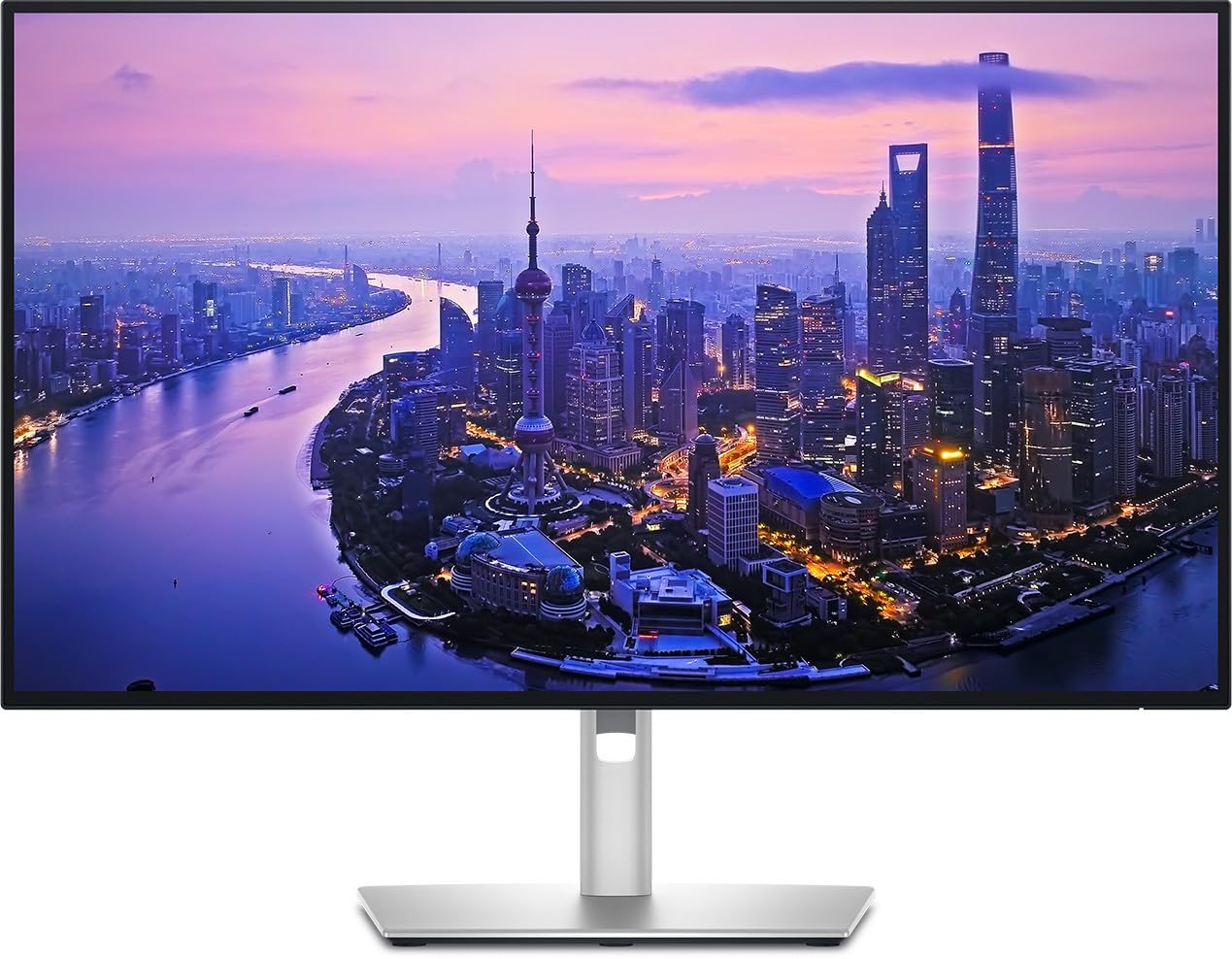
The all-rounder that makes every task look better without making you choose between speed and accuracy.
Your colors will be spot-on because this monitor is factory calibrated to a Delta E (color difference) of less than 1.5 — tighter than the industry standard of under 2 — and it covers 99% of the DCI-P3 wide color gamut at a 4K UHD (3840 x 2160) resolution, so reds and greens in video work come through accurately. It also runs at a smooth 120Hz refresh rate and a 5ms response time, which means scrolling through documents feels fluid, not choppy. One buyer says, “after a couple of weeks, it’s an outstanding monitor, works outstanding as a USBC dock, no whine issues, and love the 4k 120htz refresh.”
You connect everything through a single Thunderbolt 4 cable — that cable carries video, data, and up to 140W of power to charge your laptop. You can also daisy-chain up to two additional 4K monitors without extra wires. The ComfortView Plus feature uses an ambient light sensor to reduce harmful blue light and auto-adjust brightness, so you do not have to fiddle with settings for eye comfort.
What it does best
- Factory calibrated to Delta E < 1.5 — even more accurate than the standard.
- 120Hz refresh rate makes everyday use feel much smoother.
- Thunderbolt 4 with 140W charging handles power and data through one cable.
The trade-offs
- Some Mac users report a compatibility error, requiring them to look at a different Dell model.
- At 450 cd/m² brightness, it is not the brightest option for HDR content.
Who needs this: Anyone who wants a single monitor that handles professional color work, productivity, and casual use without a single compromise.
One real limitation: If you are a Mac user, double-check compatibility before buying, as some buyers have reported a system error that required a return.
2. ASUS ProArt Display 27” 5K HDR Professional Monitor (PA27JCV)

The only affordable 5K monitor that makes Mac text look as sharp as it does on a MacBook.
Your Mac text appears retina-sharp because this 27-inch monitor runs at 5K resolution (5120 x 2880), which gives macOS a perfect 2x scaling factor for crisp UI elements. It covers 99% of DCI-P3 and 100% sRGB with a factory pre-calibrated Delta E (color difference) under 2, and it is Calman Verified. One buyer warns, “the Asus has significant blacklight bleed, especially along the top edges,” which is a real consideration if you work on dark backgrounds.
The USB-C port delivers 96W of power delivery, so a single cable can charge a MacBook Pro. The LuxPixel matte coating reduces reflections without the grainy look that some anti-glare coatings create. While its brightness is 400 cd/m² versus the ASUS ProArt PA278CV’s 350 cd/m², several users mention it is still very bright — one reviewer set theirs to 20 out of 100 for daytime use. The built-in 3-month Adobe Creative Cloud subscription is a nice bonus for new buyers.
Strengths
- 5K resolution creates perfect retina scaling for Mac users.
- Factory pre-calibrated with a Calman Verification report for guaranteed color accuracy.
- 96W USB-C power delivery charges a laptop through a single cable.
Weaknesses
- Significant backlight bleed is common along the top edges, especially visible on dark screens.
- Port selection is limited — no Thunderbolt and fewer USB ports than comparable monitors.
Grab it if: You use a Mac and want retina-sharp text without paying Apple’s Studio Display prices.
A real caveat: If you watch a lot of movies or work in dark mode, the backlight bleed might be a distraction that you cannot unsee.
3. MSI MPG 321URXW QD-OLED 31.5 Inch 4K UHD Gaming Monitor

The monitor that proves you can have both gaming speed and professional color accuracy in one package.
This 31.5-inch monitor delivers a 4K (3840 x 2160) resolution on a QD-OLED (Quantum Dot Organic Light-Emitting Diode) panel, so you get a 99% DCI-P3 color gamut and a Delta E (color difference) under 2 — the same accuracy as the other pro monitors here — but with perfect blacks and a 1,000,000:1 contrast ratio that no IPS panel can match. The 240Hz refresh rate and 0.03ms response time make motion extremely smooth when scrolling through high-resolution files or gaming.
It is VESA DisplayHDR True Black 400 certified, with a peak brightness of 1000 cd/m², so HDR (High Dynamic Range) content looks genuinely vibrant with deep shadows. The USB Type-C port provides 90W power delivery. One reviewer noted that for a dual-monitor Mac setup, you need to disable DSC and lock the DisplayPort input to get both monitors working at 120 Hz. The MSI GI software includes OLED Care 2.0 to prevent burn-in, which is an important feature for longevity.
Why pick this
- QD-OLED panel gives you perfect blacks and infinite contrast with professional color accuracy.
- 240Hz refresh rate makes it the smoothest option in this list.
- 1000 cd/m² peak brightness is ideal for true HDR work.
What to watch out for
- Mac users may need to tweak settings for a dual-monitor setup to work correctly.
- The stand has limited adjustment range, according to some buyers.
Perfect for: A creative who also games and wants one screen that does everything at an elite level.
skip it if: You keep your work static on screen for long periods — OLED burn-in is still a risk despite the software mitigations.
4. INNOCN 40 Inch 5K 5120 x 2160p Ultrawide Monitor 40C1U

A rare flat ultrawide that gives you massive screen space without distorting your design lines.
The INNOCN 40C1U uses a 40-inch, 21:9 aspect ratio flat (non-curved) IPS panel at a 5K resolution of 5120 x 2160, so your design lines stay straight — curved monitors can distort them. It delivers a 106% DCI-P3 color gamut and is factory pre-calibrated to a Delta E (color difference) under 2. One buyer praised it for graphic design and architectural work, saying the flat design preserves straight lines that curved monitors distort. The 100Hz refresh rate keeps scrolling smooth.
Port selection is sturdy with two HDMI 2.1 ports, a DisplayPort 1.4, and a USB Type-C with 65W power delivery. The monitor also includes built-in 4Ω5W speakers, though several buyers report they are of average quality. Owners mention that the horizontal viewing angles are noticeably poor for a flat ultrawide, meaning the edges of the screen look significantly dimmer than the center when you sit straight on. It is a trade-off for getting a flat panel at this price.
What shines
- 106% DCI-P3 coverage is one of the widest color gamuts in this lineup.
- Flat ultrawide design is ideal for graphic designers who need undistorted lines.
- 100Hz refresh rate makes productivity feel fluid.
What falls short
- Poor horizontal viewing angles make the edges dimmer from a normal seated position.
- USB-C switching and sleep/wake behavior can be inconsistent, according to some reviewers.
Best for: Designers and architects who need a massive flat screen without curved distortion and who prioritize color gamut width.
A known issue: The poor viewing angles mean this monitor is best for a single person sitting directly in front of it; sharing your screen with a colleague will not give them the same view.
5. ASUS ProArt Display 27″ Monitor PA278CV

The entry point to professional color that proves accuracy does not require a second mortgage.
This is the most affordable monitor in the list, and it still hits a Calman Verified Delta E (color difference) under 2 with 100% sRGB and 100% Rec. 709 coverage. It is a 27-inch QHD (2560 x 1440) IPS panel with a brightness of 350 cd/m² (candelas per square meter, a measure of screen brightness). While its resolution is lower than the 4K and 5K options, its color fidelity is genuinely pro-grade, making it a legitimate choice for budget-conscious creatives working primarily in sRGB. One buyer called it “perfect monitor for creatives” for Adobe AfterEffects and Photoshop.
The USB-C port provides 65W power delivery, which charges a laptop — though customers note that 65W is “insufficient for work laptop when on” for higher-power machines. It includes an ergonomic stand with height, tilt, swivel, and 90-degree pivot adjustment, plus DisplayPort daisy-chaining for connecting up to four displays. The 75Hz refresh rate is slightly above the standard 60Hz, which helps with light gaming.
What you get
- Calman Verified Delta E < 2 at a price point that is tough to top.
- Fully ergonomic stand with pivot is included, so you do not need an extra arm.
- USB-C with 65W power delivery handles charging and data on one cable.
What you give up
- QHD resolution (2560 x 1440) is noticeably less sharp than the 4K and 5K options above it.
- 65W power delivery may not be enough to keep a demanding work laptop charged while in use.
Reach for this if: You are starting in creative work and need true professional color accuracy without a high investment.
Walk away if: You need 4K sharpness for detailed photo editing or you run a power-hungry laptop that needs more than 65W.
6. Kuycon G32P 32’’ UHD 6K (6144 x 3456) Glossy Monitor

A 6K glossy screen that makes the Apple Pro Display XDR look overpriced — if you can live with the quirks.
Your text appears retina-sharp because this 32-inch panel runs at a native resolution of 6144 x 3456 (6K), delivering 223 PPI (pixels per inch) — the same pixel density as Apple’s Retina standard. It covers 99% sRGB and 99% DCI-P3 with a Delta E (color difference) under 2, and its 2000:1 contrast ratio is higher than typical IPS panels. One reviewer directly compared it to the Apple Pro Display XDR, saying it’s a “spot on match” in visual quality. The USB-C port provides 100W power delivery.
The glossy glass finish — rare in color-accurate monitors — makes colors and contrast look punchier without the grainy anti-glare coating, but reviewers point out that you need to be mindful of reflections in a bright room. The monitor includes a remote control (battery not included). Quality control has been a mixed bag: one buyer mentioned a successful replacement process for a panel defect, while another had a single stuck pixel on their replacement. The lack of an integrated Thunderbolt dock is a common point of comparison against the LG and Dell competitors.
Exceptional qualities
- 6K resolution with 223 PPI gives you a massive, retina-sharp workspace.
- Glossy glass panel delivers richer colors and better contrast than matte alternatives.
- 100W USB-C power delivery supports most laptops on a single cable.
The downsides
- Quality control can be inconsistent, with some units arriving with pixel or panel defects.
- No integrated Thunderbolt dock, so you are limited to the available USB-C/HDMI/DP ports.
- Glossy screen is not ideal for bright, sunlit rooms due to reflections.
Grab it for: Maximum screen real estate and pixel density for detailed work — it is the closest you can get to an Apple Pro Display XDR while staying far below that display’s price.
Be ready for: The possibility of needing to exchange your first unit due to a panel defect, based on several buyer experiences.
Understanding the Specs
Delta E
Delta E (dE) measures the difference between the color your computer tells the monitor to show and the color that actually appears on the screen. A Delta E under 2 means the difference is so tiny that your eye cannot see it. Most professional monitors ship with a calibration report showing their tested Delta E. Look for “Delta E < 2” and a factory calibration certificate as a basic starting point.
Color Gamut (sRGB, DCI-P3)
Color gamut is the range of colors a monitor can produce. sRGB is the baseline standard for the web and most office applications. DCI-P3 is a wider gamut used in digital cinema and HDR content, covering richer reds and greens. When a monitor claims “100% sRGB,” it means it can show the entire sRGB color space. “99% DCI-P3” means it covers nearly the full DCI-P3 space, which is a higher bar.
FAQ
What is the difference between Delta E < 2 and Delta E < 1.5?
Should I get a 4K or 5K monitor for my Mac?
Is an OLED monitor better than an IPS monitor for color accuracy?
How important is the refresh rate on a color accurate monitor?
What does “factory calibrated” mean, and do I still need to calibrate the monitor myself?
Can I use a color accurate monitor for gaming?
What is the difference between sRGB and DCI-P3 color space?
Does a higher refresh rate affect color accuracy?
Should I care about the pixel density (PPI) on a color accurate monitor?
Is a glossy or matte screen better for color accuracy?
Final Thoughts: The Verdict
If you want one dependable pick, the color accurate monitor winner is the Dell UltraSharp U2725QE because it combines a factory-calibrated Delta E under 1.5 with a smooth 120Hz refresh rate, Thunderbolt 4 connectivity, and a sturdy port selection — all without the burn-in concerns of OLED. If you are a Mac user who wants retina-sharp text and can manage some backlight bleed, the ASUS ProArt PA27JCV offers a 5K experience at a price that undercuts Apple. And for the creative who also games, the MSI MPG 321URXW QD-OLED delivers perfect blacks and a blazing 240Hz refresh rate without skimping on professional-grade accuracy.
How We Picked
We do not accept paid placement. Every pick is matched to a real buyer and a real use-case; we do not hands-on test units.
Sources & Methodology
Specifications: manufacturer listings and product documentation. Review insights: verified customer reviews, as of July 2026. Pricing: not shown on this page (it changes often); check the current price via the retailer link.
As an Amazon Associate, WellFizz earns from qualifying purchases. This does not affect which products we feature.

Mo Maruf
I created WellFizz to bridge the gap between vague wellness advice and actionable solutions. My mission is simple: to decode the research and give you practical tools you can actually use.
Beyond the data, I am a passionate traveler. I believe that stepping away from the screen to explore new environments is essential for mental clarity and physical vitality.