Our readers keep the lights on and my smoothie glass nicely filled. As an Amazon Associate, I earn from qualifying purchases.
Specs are compiled from manufacturer listings and verified buyer reviews and can change over time — please confirm the key details on the product page before buying.
Cables clutter your desk, but picking a wireless speaker set shouldn’t. You compare wattage, Bluetooth versions, and driver sizes to find the pair that fits your setup and how you listen. Below are six wireless computer speakers with actual specs like peak power, driver materials, and connection types, so you get the right match without the marketing spin.
I’m Mohammad Maruf, founder and writer at WellFizz. This guide compares each maker’s published specs and patterns across verified customer reviews, so you see the real strengths and trade-offs of each pick.
Every speaker set here connects wirelessly and plugs into a wall or USB for power. These are true computer speakers wireless setups that lift your music, gaming, and calls well above built-in laptop drivers, without tethering you to the desk with cables.
Quick Picks
- Bluedee Computer Speakers with Subwoofer, 2.1 PC Speakers 80W Peak Power — Top Performer
- MEVOSTO DS19 Active Bookshelf Speakers 36W RMS — Best Built
- OHAYO 60W Computer Speakers for Music and Gaming — Best Value
- IBALL·BOX H1 Computer Speakers 60W Powered 2.0 Stereo — Most Connected
- BESTISAN GM07 Computer Gaming Speakers 30W Powered — Compact Style
- Bluedee Computer Speakers for Desktop PC, 20W Peak Power Bluetooth 5.4 — Entry Level
How To Choose The Best Computer Speakers Wireless
The right wireless computer speaker set balances three things: how it connects, how loud it plays, and how it fits your desk. Every set here uses Bluetooth for wireless audio, but the Bluetooth version, total power (in watts), and driver design all affect what you hear. A higher wattage number generally means more volume before the sound distorts. Driver materials like silk dome tweeters versus carbon fiber change the clarity of vocals and treble (the high-pitched sounds like cymbals and sibilance).
Know the Difference Between 2.0 and 2.1 Systems
A 2.0 speaker set has two satellite speakers with no separate subwoofer (a box that plays only low bass). These save desk space and work fine for music, calls, and casual gaming. A 2.1 system adds a dedicated subwoofer. It handles bass frequencies, so the two satellites stay cleaner for mid and high sounds. You get deeper, punchier low end from a 2.1, but it takes up more floor or desk space and needs an extra power connection for the sub.
Bluetooth Version Matters for Latency
Bluetooth 5.4 is the most current standard in this lineup. It offers faster pairing, slightly better range, and improved efficiency compared to 5.3 or older versions. If you watch movies or play games, lower latency (the delay between what happens on screen and what you hear) keeps audio synced with lip movements. Buyers of Bluetooth 5.4 sets report stable connections and quick reconnection when powering up, so you won’t need to pair daily.
Input Versatility Saves You From Cable Switching
Even though these are wireless computer speakers, most also accept wired connections like USB, USB-C, optical, or 3.5mm AUX. That matters if you want to plug into a PC while gaming (zero latency via USB) and also take a Bluetooth call from your phone without unplugging anything. The more input options a speaker has, the fewer times you need to swap cables behind your desk.
Quick Comparison
| Model | Best For | Peak Power | Bluetooth | Driver Size | Amazon |
|---|---|---|---|---|---|
| Bluedee 2.1 Subwoofer | Deep bass gaming | 80W Peak | 5.4 | Subwoofer + Sats | Amazon |
| MEVOSTO DS19 | Full bookshelf sound | 36W RMS | 5.4 | 5 inch woofer | Amazon |
| OHAYO 60W | Clear stereo + bass | 60W (30W x 2) | 5.3 | 0.75″ tweeter + 3″ driver | Amazon |
| IBALL·BOX H1 | Multi-input versatility | 60W | Standard | 3″ woofer + 1″ tweeter | Amazon |
| BESTISAN GM07 | Compact RGB setup | 30W | Standard | — | Amazon |
| Bluedee 2.0 RGB | Budget desk upgrade | 20W Peak | 5.4 | Tweeter + full-range + passive radiator | Amazon |
In-Depth Reviews
1. Bluedee Computer Speakers with Subwoofer, 2.1 PC Speakers 80W Peak Power
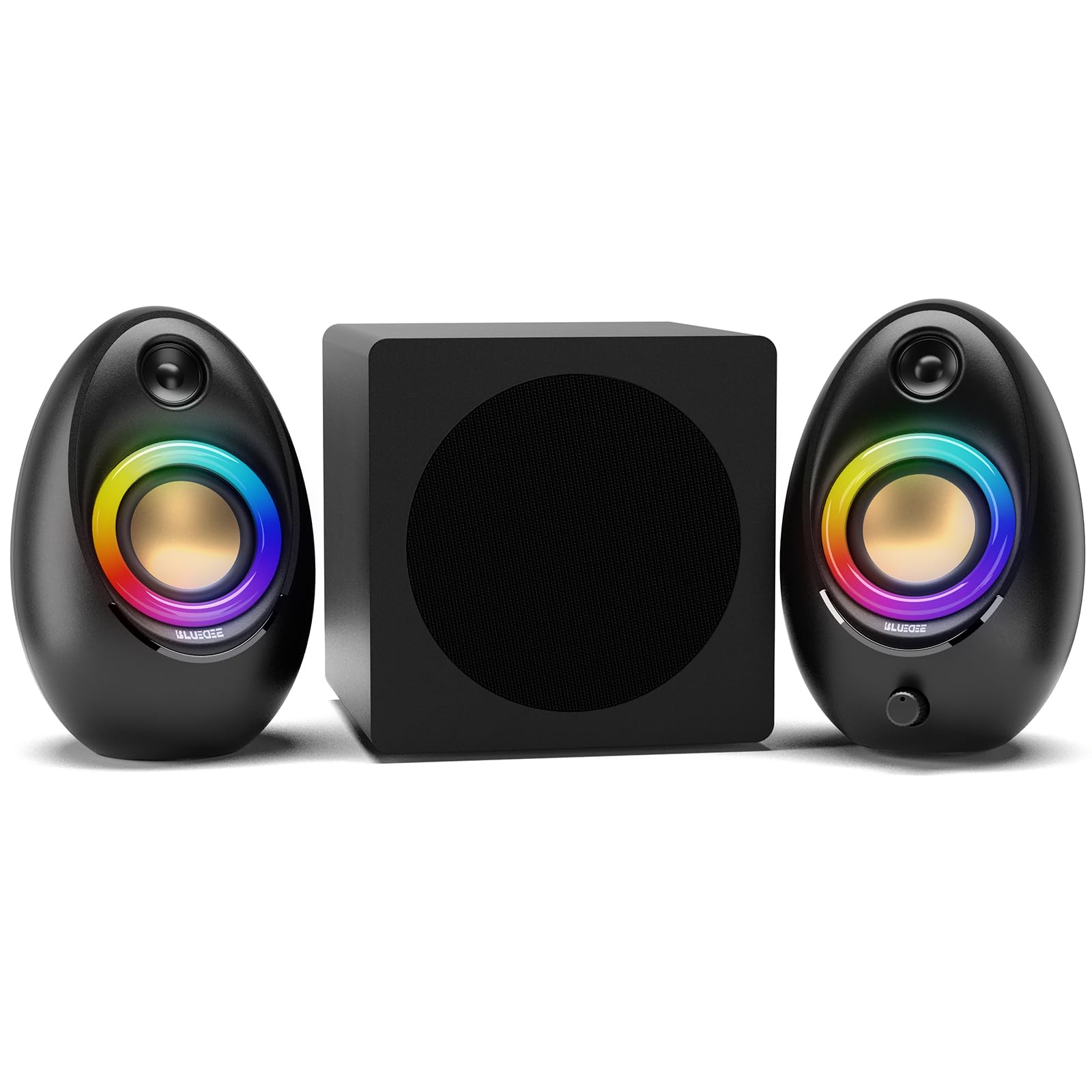
The one that brings theater-style bass to your desktop without a tangled mess of cables.
This is the only 2.1 set in the lineup. You get a dedicated subwoofer (a separate box for low bass) that handles the lowest frequencies so the two satellite speakers stay clean for vocals and treble. The result is deeper, punchier bass during games and movies. Bluedee claims 80W peak power (the maximum wattage in short bursts). Buyers consistently report the subwoofer delivers “deep, punchy bass” that doesn’t muddy the mids (mid-range sounds like voices). Unlike the 2.0 OHAYO or H1 sets that rely on rear ports for bass, this Bluedee physically moves more air with a standalone driver.
Connectivity covers Bluetooth 5.4, USB-A, USB-C, and 3.5mm AUX — the widest set of wired options here, same as the MEVOSTO. Buyers report setup takes about ten minutes, and the sound stays clear even at volumes loud enough to be heard through walls. The all-in-one control knob handles volume, track skipping, lighting modes, and input switching. One reviewer noted the RGB lighting looks modern without being distracting.
The trade-off is the subwoofer takes up floor space near your desk, and the satellites are plastic rather than wood. If you have a cramped desk or apartment walls, the thump from the sub may be more than you need. For anyone who wants true low-end impact from a computer speakers wireless setup, this is the pick.
What Stands Out
- 80W peak power with dedicated subwoofer delivers deep bass without muddying mids
- Bluetooth 5.4 plus USB, USB-C, and AUX covers every connection scenario
- Owners mention setup takes minutes and sound stays clear at high volume
Real Limitations
- Subwoofer adds floor space not needed with compact 2.0 sets
- Enclosure is plastic rather than the wood (MDF) found on OHAYO and MEVOSTO
Best for bass lovers: If movies and gaming with chest-thumping low end are your priority, this 2.1 set beats every 2.0 option in the list.
skip it if: You want a clean, cable-free desk with no subwoofer box near your feet, or you prefer the warmer resonance of a wooden enclosure.
2. MEVOSTO DS19 Active Bookshelf Speakers 36W RMS

Bookshelf-size drivers in a real wood cabinet that genuinely fills a room with clear audio.
This is the only set packing a 5-inch woofer per speaker — larger than the 3-inch drivers in the OHAYO and H1. That size difference means the MEVOSTO produces fuller, more natural bass without needing a subwoofer. The 36W RMS rating (continuous power, not peak marketing watts) means clean, distortion-free sound at comfortable listening levels. One reviewer who has owned them for nearly a year described the sound as “clear and well-balanced: crisp highs, natural mids, surprisingly full bass.”
Bluetooth 5.4 gives stable wireless streaming with a 15-meter range (about 49 feet), which is farther than the 10-meter range (about 33 feet) of the Bluedee sets. Inputs include RCA, AUX, and USB. The USB connection delivers lag-free audio for PC gaming, while Bluetooth has a slight delay that customers note for video. The natural wood finish reduces box resonance and adds warmth to the look of a desk setup — an upgrade over the plastic and MDF enclosures elsewhere.
The catch is these are larger speakers, about 6.1 inches wide and 9.6 inches tall, so they need real desktop or shelf space. One reviewer also noted the bass can be overwhelming past the midpoint of the adjustment dial, and there is no subwoofer output if you want to expand later.
Why It Excels
- 5-inch woofers and real wood cabinet deliver fuller bass than any 3-inch 2.0 set here
- USB audio connection is lag-free for PC gaming, confirmed by reviewers
- Remote control and 10-level bass/treble adjustment add flexible room tuning
The Trade-Off
- Larger footprint requires generous desk space versus compact options like the Bluedee 2.0
- Bluetooth has a slight audio delay reported by buyers for video content
If you want proper bookshelf sound: The MEVOSTO is the most capable full-range 2.0 speaker here, ideal for music listening or desktop setups where a subwoofer won’t fit.
Not the pick if: Your desk is cramped, or you need a built-in subwoofer for deep gaming bass — the Bluedee 2.1 serves that better.
3. OHAYO 60W Computer Speakers for Music and Gaming

Compact wood speakers that deliver 60W of clean power with surprising energy efficiency.
These OHAYO speakers deliver 60W peak power (30W per channel) from an MDF (medium-density fiberboard) wooden enclosure. They use a 0.75-inch carbon fiber silk dome tweeter (a driver for high sounds) and a 3-inch carbon fiber full-range driver. Reviewers point out the sound is clean, clear, and stable with “no static” — and one reviewer measured the power draw at less than 1W at full volume, calling them “very energy efficient.” That 60W peak is three times the power of the Bluedee 2.0 RGB set (20W), meaning you get noticeably louder output before distortion.
The rear bass port (a vent in the cabinet that extends low frequencies) adds low-end depth, but reviewers honestly note the 3-inch drivers can’t match the deep bass of the larger MEVOSTO woofer or the dedicated Bluedee 2.1 subwoofer. Inputs include Bluetooth 5.3, RCA, AUX, and USB — similar to the H1 but without optical input. Separate treble and bass knobs on the front panel let you tune sound directly, a feature shared only by the H1 and MEVOSTO here.
The main limitation is that the speakers produce “good mid and lower-upper range” but lack deep sub-bass, as one reviewer put it. If you listen to bass-heavy hip-hop or play explosion-heavy games, you may want to pair these with a separate subwoofer (there is no sub out).
Strengths
- 60W peak from MDF wood cabinet offers clear loud sound at an aggressive price
- Separate treble and bass knobs let you tune audio by ear without software
- Buyers confirm extremely low power draw (<1W) at high volumes
Weaknesses
- 3-inch drivers can’t match the bass depth of a 2.1 system or 5-inch woofer
- No Bluetooth 5.4, optical input, or subwoofer output for expansion
Best for everyday desktop listening: If you want loud, clear stereo sound from a compact wood set and don’t need earth-shaking bass, this is the best value in the list.
Look elsewhere for: Deep gaming bass, or if you need optical input for a TV or console connection.
4. IBALL·BOX H1 Computer Speakers 60W Powered 2.0 Stereo
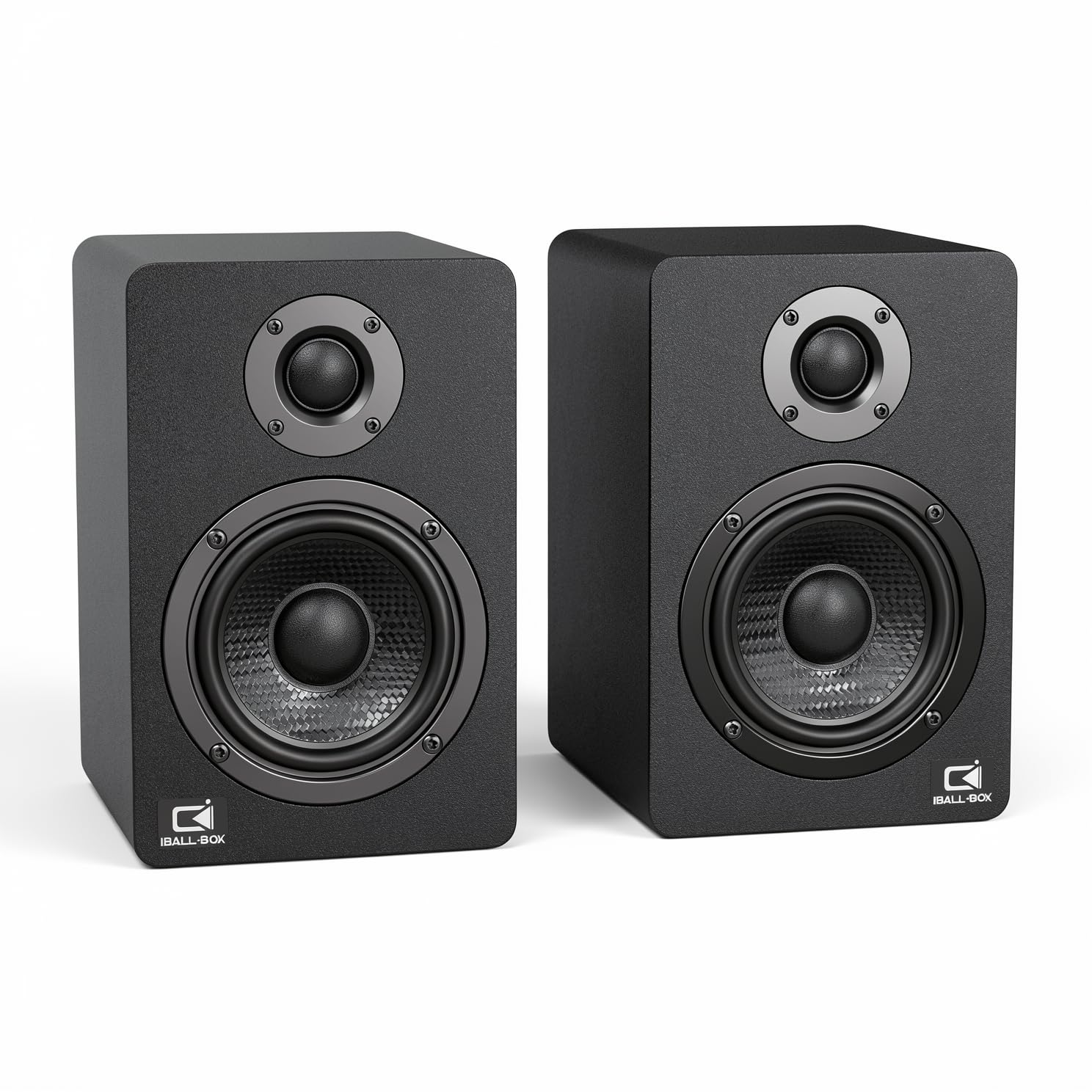
Optical, USB-C, and analog inputs make this the most versatile hub for mixed-device setups.
The H1 stands out for having optical input (which carries digital audio without electrical noise) alongside USB-C, 3.5mm AUX, and Bluetooth — the only set here with optical. That matters if you want to connect a TV, game console, or PC without using its headphone jack. The built-in 24-bit USB-C DAC (a digital-to-analog converter that produces higher-resolution audio than standard computer sound cards) improves clarity on wired sources. One reviewer successfully connected via optical with a clean, easy setup.
Driver specs include dual 3-inch carbon-fiber woofers and dual 1-inch silk-dome tweeters in each speaker, covering 40Hz-20KHz (the range of human hearing) with a signal-to-noise ratio (SNR) of at least 95dB. That means background hiss is very low, so quiet passages in music stay clean. Buyers describe the sound as “filling the room” and outperforming a compact soundbar. The front-panel treble and bass control, plus an input knob with audible confirmation, makes switching between sources simple.
One buyer gave a 1-star review noting the speakers aren’t fully wireless — the satellites still need a wired connection to each other and to power, which is true for every powered speaker in this category. A bigger practical concern is that the H1 is not Bluetooth 5.4, and one buyer mentioned the Bluetooth connection could be more convenient.
Why Pick This One
- Optical input plus USB-C DAC gives you the widest wired versatility of any set here
- Dual tweeters and dual woofers with 95dB SNR keep audio clean at all volumes
- Separate bass and treble knobs with input selector simplify daily use
Consider This
- Satellites are still wired to each other — not a fully cable-free experience
- Bluetooth version is not specified as 5.3 or 5.4 in the data
Great for multi-device desks: If you need optical for a console or TV and USB-C for a monitor, the H1 is the only set that covers both.
Not the right fit if: You want the very latest Bluetooth 5.4 standard, or you prefer a fully wireless connection between the two speaker units.
5. BESTISAN GM07 Computer Gaming Speakers 30W Powered
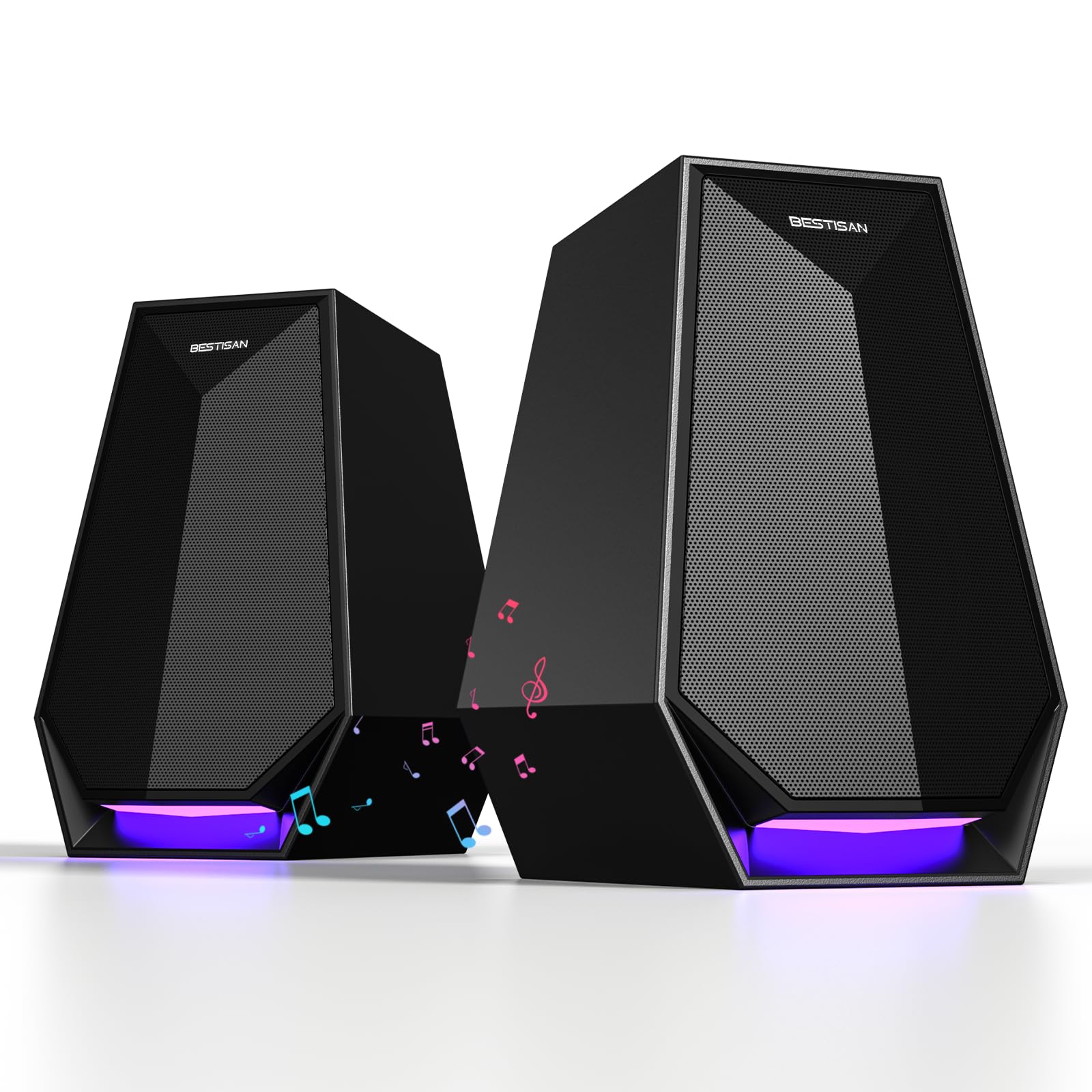
Small footprint and 30W power that slides into a gaming or work desk without taking over.
The BESTISAN GM07 is the most space-efficient powered set here, measuring just 4.53 inches deep, 4.72 inches wide, and 6.77 inches tall per speaker. The 30W drivers deliver enough clear treble and bass for gaming and video calls, but the system is less powerful than the 60W OHAYO or H1 sets. Those extra watts mean more headroom before distortion at high volume — the BESTISAN is best for moderate listening levels.
Inputs include Bluetooth, AUX, and Type-C, covering the basics without optical or USB-C for digital audio. The six customizable LED lighting modes let you switch between a calm glow for work and vibrant cycling for gaming, similar to the Bluedee 2.0 RGB set. Front-panel buttons handle volume, lighting, and input selection.
The biggest gap is the lack of customer reviews in the provided data, so real-world impressions about durability, Bluetooth stability, and long-term performance are not available from buyers. If you want a small, stylish pair with simple controls and enough volume for a quiet room, this fits. For louder, more detailed audio, the OHAYO or H1 deliver more.
Good For
- Compact build saves significant desk space versus larger sets like the MEVOSTO
- Bluetooth plus AUX and Type-C covers most common connections
- Six lighting modes let you match desk RGB without extra software
Limits
- 30W is the lowest peak power in this list — less headroom for loud listening
- No verified buyer reviews in the data to confirm real-world sound or build quality
For the style-conscious shopper: If desk space is tight and you want RGB lighting with a small profile, this fits neatly.
Better options exist if: You want more volume, optical input, or a proven track record of buyer feedback before purchasing.
6. Bluedee Computer Speakers for Desktop PC, 20W Peak Power Bluetooth 5.4
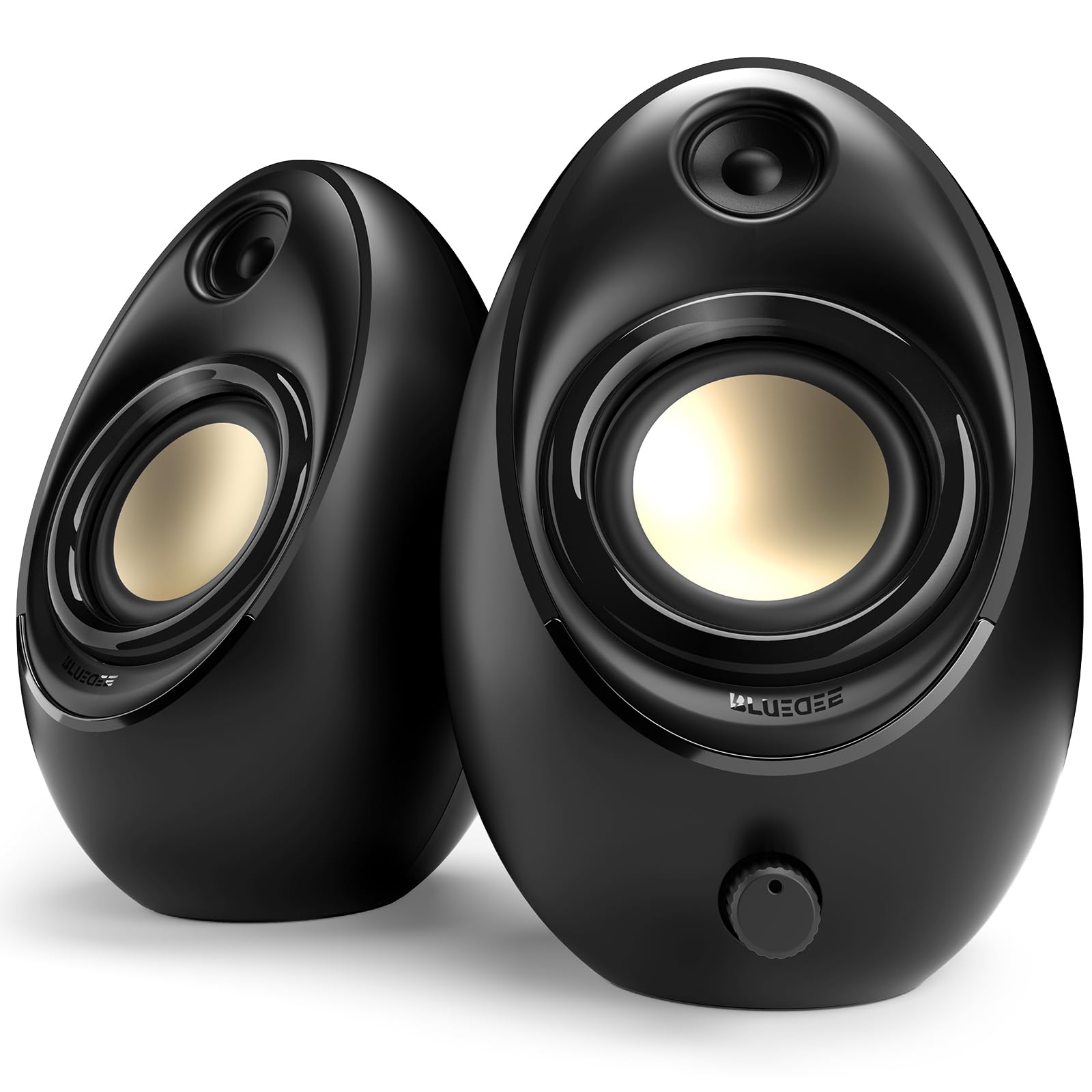
20W peak power and Bluetooth 5.4 that upgrade your desktop audio at the lowest entry cost here.
This Bluedee set is the most affordable wireless option in the lineup. It uses a 20W peak amplifier (maximum short-burst power) to drive two tweeters, two full-range drivers, and two passive radiators (drivers that move air to boost bass without their own power). The passive radiators help produce surprising bass for the size — shoppers say “good bass for size sans subwoofer” and “excellent clear, balanced sound.” The Bluetooth 5.4 connection pairs quickly and stays stable, matching the standard of the more expensive Bluedee 2.1 set.
One reviewer flagged a real desk limitation: the 50-inch inter-speaker cord is too short for setups with dual 24-inch monitors, blocking corners when the speakers sit on either side of both screens. That is a practical constraint you should measure against your desk width before buying. The all-in-one control knob handles volume, playback, lighting effects, and mode switching. The compact design fits into tight desks, and the 8 RGB lighting effects plus an off option let you match any mood.
For casual YouTube, calls, and background music at a close desk distance, this works fine. If you want to fill a room or game loudly, step up to one of the higher-wattage sets.
Why It Sells
- Lowest entry price with Bluetooth 5.4 and capable sound for basic desktop use
- Three driver types (tweeter, full-range, passive radiator) give better bass than plain 2.0 budget sets
- Compact design with 8 RGB effects fits small desks and gaming setups
Watch For
- 50-inch inter-speaker cable too short for dual 24-inch monitors, per buyer reports
- 20W peak is the lowest power — not enough volume for room-filling sound or loud gaming
Perfect for tight budgets: If you need an immediate upgrade from monitor speakers for calls and casual listening, this is the most affordable way in.
Pass if: You want loud, room-filling audio, or you run a dual-monitor setup wider than 50 inches between speaker positions.
Understanding the Specs
Peak Power vs. RMS Power
Peak power (often written as “60W” on the box) is the maximum wattage a speaker can handle in a short burst — think of a drum hit. RMS (continuous power, like “36W RMS”) is the average power it can sustain indefinitely without distortion. When comparing two sets, a higher peak number does not always mean louder clean volume; RMS gives a better picture of realistic loudness. The MEVOSTO is the only set here advertising RMS power, which is a more honest rating for daily listening.
Bluetooth Version and Latency
Bluetooth 5.4 is the newest standard in this list, used by both Bluedee sets and the MEVOSTO. It offers faster pairing, better power efficiency, and slightly improved latency (the delay between what happens on screen and what you hear) over Bluetooth 5.3 (used by OHAYO) or older versions. Lower latency matters most for gaming and video — any Bluetooth speaker will have some delay, which is why many sets include USB or AUX ports for lag-free wired listening when precision matters most.
Driver Materials and Sound Character
The materials in tweeters (high-frequency drivers) and woofers (low-frequency drivers) shape how audio sounds. Silk dome tweeters (used in the H1 and MEVOSTO) produce smooth, non-fatiguing highs — good for long listening sessions. Carbon fiber drivers (used in OHAYO and H1 woofers) are stiffer and lighter, offering quicker response and clearer midrange. The front-facing or rear-firing bass port on many 2.0 sets (like the OHAYO and H1) helps extend low frequencies, but it can’t match the physical air movement of a dedicated subwoofer in a 2.1 system.
Input Versatility: More Is Better
The number of input types a speaker supports determines how many devices you can connect without unplugging. Optical input (only on the H1) is ideal for TVs and consoles because it sends digital audio without electrical noise. USB or USB-C (found on every set except the basic Bluedee 2.0) provides zero-latency audio from a PC. AUX is universal but analog, meaning it can pick up interference from other desk cables. A set with three or more input options, like the H1 or MEVOSTO, makes your desk more flexible and reduces cable-swapping frustration.
FAQ
Will any Bluetooth computer speaker work with my PC or Mac?
What is the difference between a 2.0 and a 2.1 speaker system?
Do I need Bluetooth 5.4 or is 5.3 good enough?
Can I connect these speakers to a TV or game console?
How much desk space do I need for a typical 2.0 set?
Which speaker set is easiest to set up?
How loud are 60W computer speakers?
Do these speakers work with a turntable or record player?
Why do some speakers have a rear bass port?
Can I use these speakers while USB or AUX is connected and still take calls via Bluetooth?
Final Thoughts: The Verdict
If you want one dependable pick, the computer speakers wireless winner is the Bluedee 2.1 Subwoofer because it combines a powerful 80W peak output with a dedicated subwoofer for deep, punchy bass, all while keeping setup simple with Bluetooth 5.4 and multiple wired connections. If you want true bookshelf-quality audio with 5-inch woofers and a real wood cabinet, grab the MEVOSTO DS19. And for a compact, value-driven 2.0 system that still delivers 60W of clean power, pick the OHAYO 60W.
How We Picked
We do not accept paid placement. Every pick is matched to a real buyer and a real use-case; we do not hands-on test units.
Sources & Methodology
Specifications: manufacturer listings and product documentation. Review insights: verified customer reviews, as of July 2026. Pricing: not shown on this page (it changes often); check the current price via the retailer link.
As an Amazon Associate, WellFizz earns from qualifying purchases. This does not affect which products we feature.

Mo Maruf
I created WellFizz to bridge the gap between vague wellness advice and actionable solutions. My mission is simple: to decode the research and give you practical tools you can actually use.
Beyond the data, I am a passionate traveler. I believe that stepping away from the screen to explore new environments is essential for mental clarity and physical vitality.