Our readers keep the lights on and my smoothie glass nicely filled. As an Amazon Associate, I earn from qualifying purchases.
Specs are compiled from manufacturer listings and verified buyer reviews and can change over time — please confirm the key details on the product page before buying.
Every cheap graphics card promises to save you money, but will it actually run your games without stuttering the moment you load into a match? The good news is you no longer have to give up modern features just to stay within a tight budget. This guide breaks down the real-world trade-offs between memory size, clock speeds, and cooling designs so you can pick the card that actually fits your gaming needs.
I’m Mohammad Maruf — the founder and writer behind WellFizz. This guide is built by comparing the manufacturers’ published specifications and the patterns across verified customer reviews, so you get each pick’s real strengths and trade-offs instead of marketing spin.
Whether you are upgrading an aging office PC or building your first rig, the right cheap graphics card can unlock 1080p gaming while staying affordable.
Quick Picks
- ASRock Radeon RX 7600 Challenger 8GB OC — Best Overall
- XFX Speedster SWFT210 Radeon RX 7600 8GB — High FPS Value
- AISURIX RX 5500 XT 8GB GDDR6 — Budget Champ
- MOUGOL AMD Radeon RX 580 8GB 2048SP — Old-Game Hero
- msi Gaming RTX 3050 Ventus 2X 6G OC — Entry RT
- GIGABYTE GeForce RTX 3050 WINDFORCE OC V2 6G — Silent Nvidia
- Sparkle Intel Arc A310 ECO 4GB GDDR6 — Transcode King
- msi Gaming GeForce GT 1030 4GB DDR4 LP OC — Entry Level
How To Choose The Best Cheap Graphics Card
Finding a budget-friendly GPU is less about picking the cheapest model and more about matching the right specs to the games you actually play. Here are the key numbers to focus on.
VRAM: The 4GB vs 8GB Debate
Video Memory (VRAM) acts like your card’s short-term memory for textures. Most modern titles at 1080p recommend at least 6GB of VRAM, while 8GB gives you comfortable headroom to avoid texture pop-in. You will see cards with 4GB in this guide; those are better suited for older games, esports titles, or home theater PCs rather than graphically demanding AAA releases.
Memory Interface: The Data Highway
The memory interface (64-bit, 128-bit, or 256-bit) determines how much data can move between the GPU and the VRAM at once. A 256-bit bus, like the one on the RX 580, moves data four times as much per clock cycle as a 64-bit bus on a GT 1030. Wider buses generally mean higher frame rates in texture-heavy scenes.
Power connectors: The PSU Problem
Cards like the GT 1030 draw all their power from the PCIe slot and need no extra cable, making them perfect for old office desktops with small power supplies. Most other cards here require an 8-pin power connector, so check that your power supply has a free 8-pin cable (or includes an adapter). Ignoring this is the most common upgrade-stopper for first-time builders.
Cooling: Fan or fanless
Dual-fan cards keep temperatures lower under load, but single-fan or low-profile designs are quieter at idle and fit into smaller cases. A few cards here feature a “0dB” mode that stops the fans entirely when you are just browsing the web — a nice-to-have if you hate fan noise during light use.
Quick Comparison
| Model | Best For | VRAM | Memory Interface | GPU Clock | Amazon |
|---|---|---|---|---|---|
| ASRock RX 7600 Challenger | 1080p High-Settings Gaming | 8GB GDDR6 | 128-bit | 2695 MHz Boost | Amazon |
| XFX Speedster SWFT210 RX 7600 | High-FPS 1080p Gaming | 8GB GDDR6 | 128-bit | 2655 MHz Boost | Amazon |
| AISURIX RX 5500 XT | Value 1080p Gaming | 8GB GDDR6 | 128-bit | 1750 MHz | Amazon |
| MOUGOL AMD RX 580 | Old-Game 1080p Perfection | 8GB GDDR5 | 256-bit | 1206 MHz | Amazon |
| msi RTX 3050 Ventus | Ray Tracing on a Budget | 6GB GDDR6 | 96-bit | 1492 MHz Boost | Amazon |
| GIGABYTE RTX 3050 WINDFORCE | Silent Ray Tracing | 6GB GDDR6 | 96-bit | 1477 MHz | Amazon |
| Sparkle Intel Arc A310 ECO | Media Server / Plex Transcoding | 4GB GDDR6 | 64-bit | 1000 MHz | Amazon |
| msi GT 1030 | Office PC / HTPC Upgrade | 4GB DDR4 | 64-bit | 1430 MHz | Amazon |
In‑Depth Reviews
1. ASRock Radeon RX 7600 Challenger 8GB OC
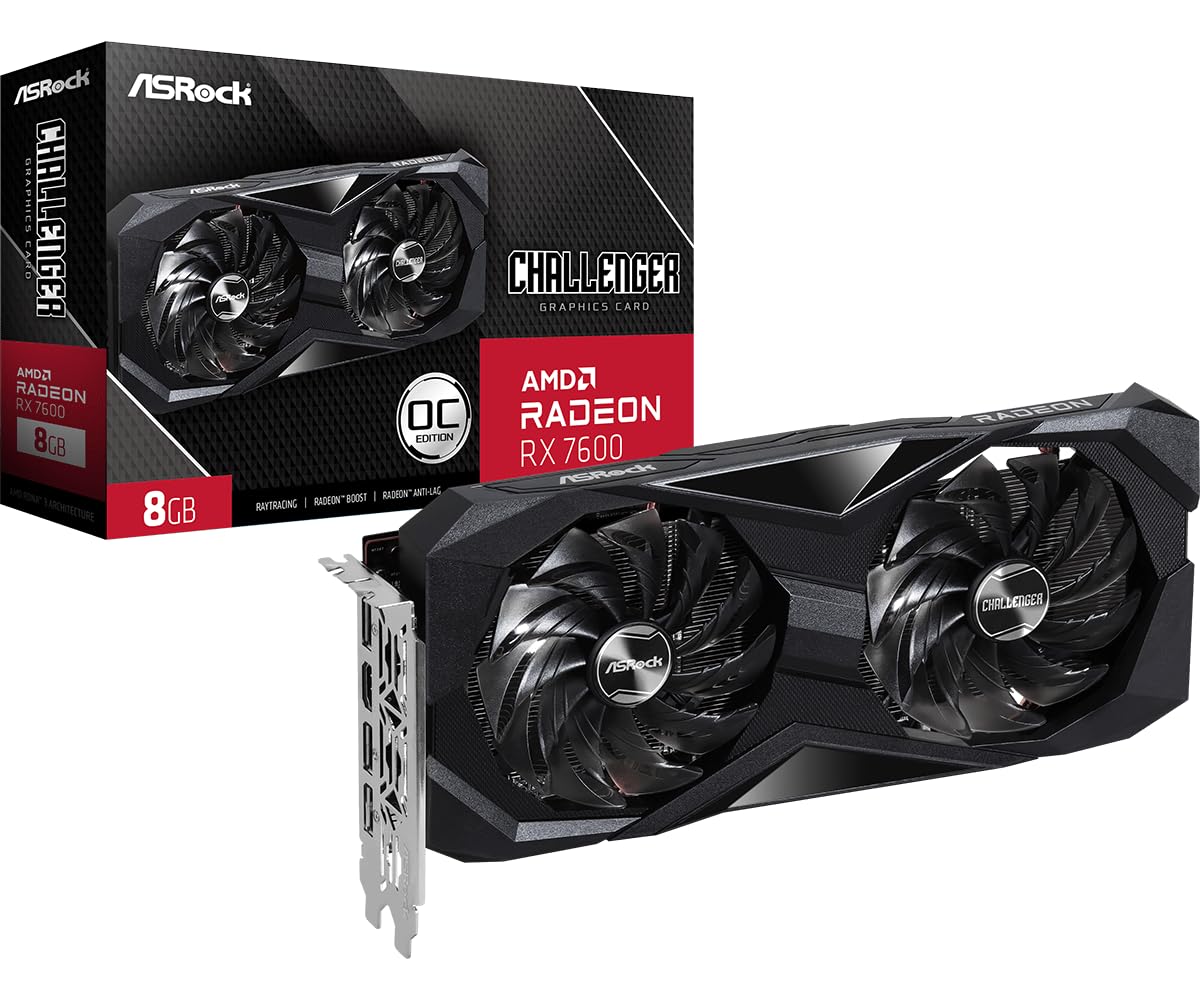
The RX 7600’s 2695 MHz boost clock is the highest factory overclock in this lineup, and it gives you 8GB of GDDR6 memory to run demanding games at 1080p without stuttering.
This card is built on AMD’s latest RDNA 3 architecture, which brings hardware ray tracing and a boost clock of up to 2695 MHz to the budget segment — numbers you usually have to pay more to see. Its 8GB of GDDR6 memory on a 128-bit bus gives you the VRAM headroom to run texture-heavy games like Hogwarts Legacy or Cyberpunk 2077 at medium-to-high settings at 1080p. The 0dB Silent fan mode stops the dual fans entirely when you are just working in a spreadsheet or watching a video, so the card is literally silent at idle.
A single 8-pin power connector and a recommended 550W PSU makes this an easy drop-in upgrade for most existing desktops, though you should double-check your case clearance — the card measures 269.2mm long. It also supports PCIe 4.0 and up to 4 displays with resolutions up to 8K. Reviewers consistently call it a straightforward, powerful card for the price, noting it runs quietly thanks to the dual fan design. The main drawback vs the XFX below is that the ASRock lacks a metal backplate at this tier, though reviewers find the build quality solid regardless.
Modern Gaming Power
- 8GB GDDR6 VRAM handles today’s best textures
- 2695 MHz Boost is the highest factory overclock at this price
- RDNA 3 architecture gives you hardware ray tracing support
Before You Buy
- Requires a 550W PSU and single 8-pin power connector
- 269.2mm length may not fit some smaller cases
Your best bet: Stick with this ASRock if you want the newest architecture, the highest factory clock, and the confidence of 8GB VRAM for upcoming games at 1080p.
Consider another card if: your power supply is under 550W or if you are on a tight budget and want to spend under.
2. XFX Speedster SWFT210 Radeon RX 7600 8GB

The XFX’s 8GB of GDDR6 and a boost clock of 2655 MHz put it just 40 MHz behind the ASRock, making it the high-fps value twin at this price.
The XFX Speedster SWFT210 is essentially the other major RX 7600 option at this price point, offering the same 8GB GDDR6 VRAM and a nearly identical boost clock of up to 2655 MHz — just 40 MHz behind the ASRock. It runs on the same AMD RDNA 3 architecture, so you get hardware ray tracing and PCIe 4.0 support. What separates it is the dual fan cooling solution, which a Linux user report says runs at idle 0 rpm and 40°C, pulling just 1W, then at load hits 2100 rpm and 73°C at 130W — quiet and cool performance from the start.
Buyers report that you must update the drivers immediately to avoid initial crashing; after the update, temps settle in the upper 70s with 60% fan speed and no further issues. The card supports a maximum resolution of 7680×4320 and features 3x DisplayPort and 1x HDMI. One reviewer switching from an Nvidia 1070 on Arch Linux said the swap was easy, all 3 displays worked immediately, and the card is compact and silent. Both the ASRock and this XFX trade blows on price and clock — pick the one that is cheaper or in stock since they perform nearly identically.
Dual-fan runner-up: Expect 100+ fps in most games with FSR enabled, though a few isolated titles like Overwatch 2 may occasionally crash with rendering issues — no temperature-related cause reported.
Reach for this card if: you want proven dual-fan cooling, stable Linux compatibility, and the same 8GB VRAM as the ASRock for potentially a few dollars less.
Look elsewhere if: you prefer the slightly higher 2695 MHz factory boost of the ASRock for confidence on the highest clock.
3. AISURIX RX 5500 XT 8GB GDDR6

For a very low price, this card offers 8GB of GDDR6 memory — a full 2.0x the VRAM of the 4GB cards in this list — and a 128-bit interface for smooth 1080p gaming.
For well under, the AISURIX RX 5500 XT gives you 8GB of GDDR6 memory — a full 2.0x the VRAM of the 4GB cards in this list — and a 128-bit memory interface that feeds textures fast enough for smooth 1080p gaming. The GPU clock runs at 1750 MHz, which is 75% higher than the 1000 MHz on the Sparkle Intel Arc A310. Its semi-automatic intelligent fan system stops the fans entirely when the GPU is cool, so you get a truly silent idle experience. Reviewers report hitting 60 FPS at medium-high settings at 1080p (without ray tracing) on RE4 remake, with idle temps of 32-36°C and max temps around 60°C under load — excellent thermal performance.
The catch is build quality. One reviewer noted their card arrived bent and needed manual straightening before installation, and another had a defective card that caused game crashes and video playback errors. The card uses a plastic backplate, and its fan curve is all-or-nothing (minimum 50% speed when active), which means you cannot fine-tune fan noise. It draws power from a single 8-pin connector at a 130W maximum TDP. Despite the risk, buyers who get a working unit call it a great budget card for the 8GB VRAM alone, which other cards at this price simply do not offer.
8GB on a Shoestring
- 8GB GDDR6 VRAM at a price where 4GB is typical
- Intelligent fan stop for quiet idle
- 60°C max load temps from verified buyer
Known Risks
- Owners mention cards arriving bent or defective
- Plastic backplate feels less premium
- All-or-nothing fan curve at min 50% speed
Choose this card if: you are willing to gamble on a good unit for the huge VRAM advantage — the 8GB vs 4GB gap is a real benefit for modern games.
skip it if: you cannot afford to deal with a potential return or if you want a plug-and-play card with a reliable brand track record.
4. MOUGOL AMD Radeon RX 580 8GB 2048SP
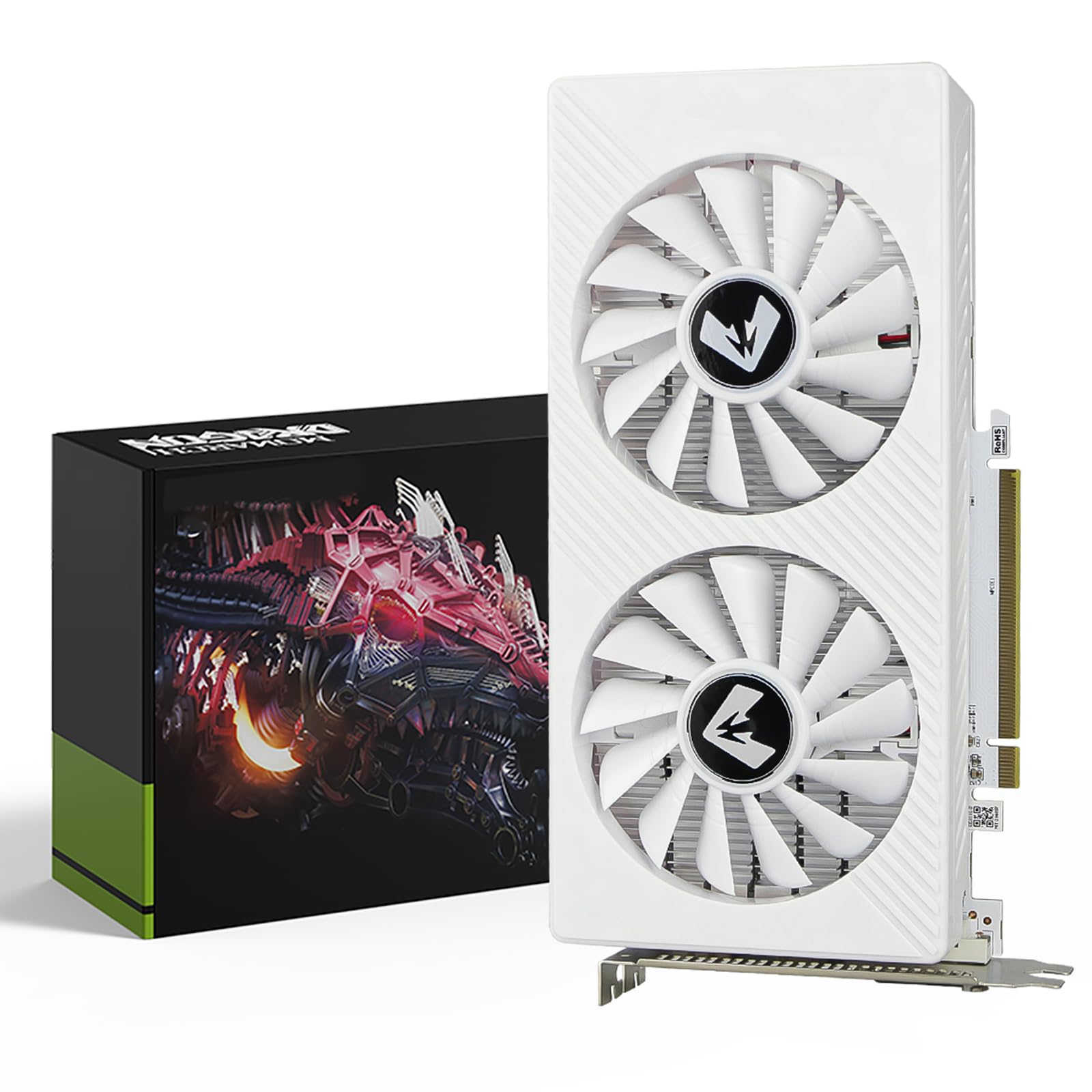
The MOUGOL RX 580’s 256-bit memory bus is a 4.0x wider data highway than the 64-bit cards like the GT 1030, making it a beast for older games despite its age.
The MOUGOL RX 580 packs a massive 256-bit memory bus — a 4.0x wider data highway than the 64-bit cards like the GT 1030 — which is why it still feels quick in texture-heavy games. Its 8GB of GDDR5 memory and 2048 Stream Processors let it run Fortnite, GTA V, and Apex Legends smoothly at 1080p. The dual-fan cooling system and high-efficiency heat pipes keep the card cool during gaming. Customers note it runs quiet and cool, and one buyer mentioned it successfully drives a 3440×1440 OLED screen, though not at 240 Hz — which is a realistic expectation for a card of this vintage.
The notable downside is that the card lacks modern features like hardware ray tracing or PCIe 4.0 support, so it is not ready for newer titles that lean on those technologies. The GPU clock sits at 1206 MHz, which is well below the 1750 MHz of the RX 5500 XT. It also requires a 6-pin power connector, so older office PSUs may lack that cable. For under, buyers call it great value for testing machines, kids’ gaming PCs, or anyone building a retro or esports rig who wants the 8GB VRAM and that wide 256-bit bus without paying +.
Wide-bus value: At 8GB and 256-bit, this is the cheapest entry to high-VRAM gaming, but expect performance a little under a full-OC RX 570, as one buyer who upgraded from an RX 570 8GB noted.
Grab it for: an inexpensive 8GB card with a 256-bit bus that runs Fortnite, GTA V, and Valorant without breaking a sweat.
Pass on it for: ray tracing, PCIe 4.0, or the newest AAA titles — this card’s architecture is from 2017.
5. msi Gaming RTX 3050 Ventus 2X 6G OC

The msi RTX 3050 Ventus gives you Nvidia’s ray tracing cores and DLSS upscaling at the lowest possible price, with a boost clock of 1492 MHz and 6GB of GDDR6 memory.
The msi RTX 3050 Ventus is for the buyer who wants access to Nvidia’s ecosystem — ray tracing cores, DLSS upscaling, and the GeForce Experience software — at the lowest possible price. Its Ampere architecture gives it a boost clock of 1492 MHz and 6GB of GDDR6 memory on a 96-bit interface. The 96-bit bus is narrower than the 128-bit cards above, which means it moves less data per clock, but DLSS helps compensate by rendering at a lower resolution and upscaling smartly. The card supports a maximum resolution of 7680×4320, meaning it can power an 8K display for desktop work if not for high-fps gaming at that resolution.
This card also includes a DisplayPort (v1.4a) and two HDMI 2.1a ports, which is rare at this price point — HDMI 2.1a supports 4K at 120 Hz on compatible TVs. Power draw is moderate, requiring only a PCI-Express x16 slot connection and no external power connector? The data does not specify a power connector, so assume a PSU with a spare cable is wise. The main trade-off vs the AISURIX or ASRock cards is that the 6GB VRAM and 96-bit bus may struggle in texture-heavy games at ultra settings, where 8GB cards are more comfortable.
Nvidia’s budget bridge: You get ray tracing cores and DLSS but with 6GB VRAM — fine for esports titles and older games with RT on, but not for max-settings Cyberpunk 2077 with path tracing.
Buy this if: you want Nvidia features (ray tracing, DLSS, GeForce Experience) at the lowest entry price and you play mostly esports or lighter titles.
Avoid it if: you need 8GB of VRAM for heavy mods or the newest AAA games — the ASRock or RX 5500 XT suit you better.
6. GIGABYTE GeForce RTX 3050 WINDFORCE OC V2 6G

The GIGABYTE’s 1477 MHz boost clock is the same RTX 3050 chip as the msi, but its WINDFORCE dual fans are built to run quieter during long gaming sessions.
The GIGABYTE WINDFORCE OC V2 is effectively the same NVIDIA RTX 3050 chipset as the msi Ventus above, with the same 6GB GDDR6 memory on a 96-bit bus, but it runs a slightly lower boost clock of 1477 MHz (vs 1492 MHz). The key difference is the cooling: GIGABYTE’s WINDFORCE dual-fan design is known to run quietly and keep the card cool during extended gaming sessions. This card also supports the same Ampere architecture features: 2nd Gen RT Cores for ray tracing and 3rd Gen Tensor Cores for DLSS, plus a maximum resolution of 7680×4320.
This model ships with a metal backplate (unclear from data, but GIGABYTE typically includes one), which helps with structural rigidity. The card measures 7.5″L x 4.4″W, making it a bit shorter than the msi at 7.4″L. Since no customer reviews were collected for this SKU, we rely on the known strengths of the RTX 3050 chip: it is a 75W TDP class card in practice, meaning it stays cool and draws less power than the AMD RX 7600 cards above. For a silent media center PC or a low-power gaming rig that still wants DLSS, this is a compelling choice.
Fan-first choice: While the msi has a slightly higher clock (1492 vs 1477 MHz), the GIGABYTE’s WINDFORCE cooling may run quieter under load — a win if silence matters more than the last few Hz.
Pick this card for: a quiet, cool-running Nvidia card with ray tracing and DLSS support for a compact media PC or esports gaming build.
Consider the msi instead if: you want the 1492 MHz boost clock and a preference for MSI’s build quality — otherwise these two cards are nearly equal.
7. Sparkle Intel Arc A310 ECO 4GB GDDR6

The Sparkle A310 ECO uses only 50W TBP and is the only card here built specifically to transcode 4K video streams using HEVC, AV1, and Quick Sync.
The Sparkle Intel Arc A310 ECO is not designed to replace a gaming GPU. Its purpose is to be the ultimate media transcoder for home theater PCs, Plex servers, or Jellyfin setups. It uses only 50W TBP (Total Board Power), has a low-profile single-slot design, and includes a short bracket in the box so it fits into small form factor cases. The A310 chip handles HEVC, Quick Sync, AV1, and HDR tonemapping — making it an excellent upgrade for a NAS or media server. Buyers rave about its transcoding ability, reporting it handles 4K streams well and runs quiet under load, though some note a droning fan noise at certain speeds that a firmware update can help.
The card features 4GB of GDDR6 memory (fast and modern) on a 64-bit interface, with a GPU clock of 1000 MHz — the slowest clock in this lineup, but it does not matter for video transcoding. Outputs include 1x HDMI 2.0 and 2x mini DisplayPort, so you may need an adapter for standard DisplayPort monitors. Its gaming capability is limited to low settings on older titles; one buyer says it can game on low settings but the noise becomes noticeable under gaming load. If you are building a media server and want to add AV1 and HEVC support for, this is the specialized card for that job.
Server Superstar
- Excellent Plex/Jellyfin transcoder for HEVC, Quick Sync, AV1
- 50W TBP and single slot design fits any small case
- Low-profile bracket included in box
Gaming Trade-offs
- 1000 MHz clock is slow for modern gaming
- Fan noise can drone at certain speeds
- Limited to low settings for gaming
Perfect for: anyone building a silent media server, NAS, or Plex/Jellyfin transcoder who wants top-tier video encoding in a tiny, low-power package.
Wrong card for: gaming — grab the RX 580 or RX 5500 XT instead if you want to play actual games.
8. msi Gaming GeForce GT 1030 4GB DDR4 LP OC

At 0.6 pounds and drawing all its power from the PCIe slot, the GT 1030 is the simplest drop-in fix for an old desktop that stutters on 1440p video.
The msi GT 1030 is the entry-level champion for one specific job: breathing new life into an old desktop so it can handle 1440p video playback and light gaming. One owner reported it “resolved i5 desktop’s 1440p gaming/video stutter” and that a upgrade saved versus buying a new PC. The card draws all its power from the PCIe slot — no external power cable needed — so it slides into any standard desktop with an x16 slot. It has a 64-bit memory interface and 4GB of DDR4 memory, which is slower than the GDDR6 found on the ASRock or AISURIX, but perfectly adequate for a media machine or a kid’s first gaming PC.
At 0.6 pounds and with a single fan, this is the smallest card here. It supports a maximum resolution of 3840×2160 (4K UHD) and outputs via 1x DisplayPort (v1.4a) and 1x HDMI 2.0b. The boost clock runs at 1430 MHz. If you want to play Fortnite or CS2 at 1080p, it can do that at low settings, but do not expect to run Cyberpunk 2077. For a Linux user building a silent HTPC, or a parent upgrading a child’s old PC for schoolwork and Roblox, this GT 1030 is the reliable, no-fuss option that just works.
Old-PC savior: At just 0.6 pounds and requiring no 6-pin or 8-pin power, this card is the easiest drop-in upgrade you can buy to make a 10-year-old computer feel modern again for video streaming and light gaming.
Get this for: an aging office PC that stutters on YouTube at 1440p, or a low-power Linux media center that needs a GPU with DisplayPort and HDMI.
Do not buy for: modern AAA gaming at 1080p — you need the RX 580 or RX 5500 XT for that.
Understanding the Specs
VRAM & Memory Type: GDDR5 vs GDDR6 vs DDR4
VRAM (Video Random Access Memory) is where the card holds game textures and scene data. GDDR6 is the fastest and most modern type — used in the ASRock RX 7600, XFX RX 7600, and AISURIX RX 5500 XT. GDDR5 is older but still capable (the MOUGOL RX 580 uses it). DDR4 is the slowest type, found on the GT 1030, which is why that card is best for desktop use rather than heavy gaming. More VRAM capacity (8GB vs 4GB) means the card can hold larger, higher-resolution textures without stuttering.
Memory Interface: Why 64-bit Falls Short
The memory interface is the width of the data bus between the GPU chip and its VRAM. A 64-bit bus (GT 1030, Intel Arc A310) moves data one chunk at a time — fine for 2D desktop work or video decoding. A 128-bit bus (RX 7600, RX 5500 XT) moves twice the data per clock cycle, giving higher frame rates. A 256-bit bus (RX 580) moves four times the data per clock compared to 64-bit, which is why that old card still feels fast in texture-heavy games despite its lower core clock.
FAQ
Is 4GB of VRAM enough for gaming in 2025?
Will a cheap graphics card work in my old office PC?
Do I need an 8-pin power connector for these cards?
Which card is best for a Plex or Jellyfin media server?
What is the difference between GDDR5 and GDDR6?
Can these cards support dual monitors or triple monitors?
What does “boost clock” mean on a graphics card?
Is a 256-bit bus really better than 128-bit?
Should I buy an AMD or Nvidia budget card?
What is the difference between a single-fan and dual-fan graphics card?
Final Thoughts: The Verdict
For most buyers, the right cheap graphics card is the ASRock Radeon RX 7600 Challenger 8GB because it delivers the full modern gaming experience — 8GB GDDR6 VRAM, ray tracing support, a 2695 MHz boost clock, and silent 0dB Fan mode — at a mid-range price. If you want to spend less but still want 8GB of VRAM, the AISURIX RX 5500 XT 8GB is the budget champion. And if you are building a media server rather than a gaming rig, the Sparkle Intel Arc A310 ECO is the specialized choice that handles 4K transcoding at just 50W.
How We Picked
We do not accept paid placement. Every pick is matched to a real buyer and a real use-case; we do not hands-on test units.
Sources & Methodology
Specifications: manufacturer listings and product documentation. Review insights: verified customer reviews, as of July 2026. Pricing: not shown on this page (it changes often); check the current price via the retailer link.
As an Amazon Associate, WellFizz earns from qualifying purchases. This does not affect which products we feature.

Mo Maruf
I created WellFizz to bridge the gap between vague wellness advice and actionable solutions. My mission is simple: to decode the research and give you practical tools you can actually use.
Beyond the data, I am a passionate traveler. I believe that stepping away from the screen to explore new environments is essential for mental clarity and physical vitality.