Our readers keep the lights on and my smoothie glass nicely filled. As an Amazon Associate, I earn from qualifying purchases.
Specs are compiled from manufacturer listings and verified buyer reviews and can change over time — please confirm the key details on the product page before buying.
Finding a monitor that shows your photos the way you intended, without blowing your budget, is the real puzzle. Most cheap screens wash out shadows and shift hues, making you edit blind. This guide cuts through the noise to find the best cheap monitor for photo editing that actually delivers accurate colors.
I’m Mohammad Maruf — the founder and writer behind WellFizz. This guide is built by comparing the manufacturers’ published specifications and the patterns across verified customer reviews, so you get each pick’s real strengths and trade-offs instead of marketing spin.
We looked at IPS panels (a screen technology that keeps colors consistent when you tilt your head) that cover at least 99% of the sRGB color range (the standard color space for web and print) and have a Delta E (a number showing color error) under 2, because those two specs are the foundation of a trustworthy editing display. The result is our list of the best cheap monitor for photo editing you can buy today.
Quick Picks
- ASUS ProArt Display PA278CV — Best Overall
- ViewSonic VP2756-4K — Premium Pick
- ASUS ProArt Display PA279CV — Best Value 4K
- BenQ PD3205U — Big Canvas
- ViewSonic VP2468A — Clean Desk
- ASUS ProArt Display PA247CV — Entry Level
How To Choose The Best Cheap Monitor For Photo Editing
When you are shopping on a tighter budget, you have to know exactly which specs matter and which ones are just marketing fluff. For photo editing, your money should go to the panel, the color accuracy, and the resolution — in that order.
Prioritize the IPS panel over everything else
Without an IPS (In-Plane Switching) panel, colors shift the moment you tilt your head. IPS gives you consistent color from any angle, which is critical when you are zoomed into a detail or showing a draft to someone else. Every monitor on this list uses IPS.
Delta E and sRGB are non-negotiable
Delta E (Delta E) is a number that measures how far a color on your screen is from what it should be. A Delta E under 2 means the difference is invisible to the human eye — that is the standard you want. sRGB (standard Red Green Blue) is the common color space for web and print. Look for at least 99% sRGB coverage so what you see on screen matches what your printer or client sees.
Resolution is about your workflow, not just sharpness
Full HD (1920 x 1080) is fine for basic editing, but 1440p (2560 x 1440) or 4K (3840 x 2160) gives you room to keep toolbars, layers, and reference images on screen without zooming out. The higher the resolution, the more detail you can see in your photo at 100% zoom. Choose based on how much screen real estate your editing process needs.
Factory calibration saves you time and frustration
A monitor that comes with a factory calibration report means it was adjusted at the factory so its colors are accurate right from the start. Without this, you would need to buy a hardware calibrator or edit with slightly off colors. Every pick here includes some form of factory calibration.
Quick Comparison
| Model | Best For | Resolution | Color Accuracy | USB-C Power Delivery | Amazon |
|---|---|---|---|---|---|
| ASUS PA278CV | Best Overall Value | 2560 x 1440 | ΔE < 2, 100% sRGB | 65W | Amazon |
| ViewSonic VP2756-4K | Best for 4K on a Budget | 3840 x 2160 | ΔE < 2, 100% sRGB | 60W | Amazon |
| ASUS PA279CV | Best 4K Feature Set | 3840 x 2160 | ΔE < 2, 100% sRGB | 65W | Amazon |
| BenQ PD3205U | Best for a Large Canvas | 3840 x 2160 | ΔE ≤ 3, 99% sRGB | 90W | Amazon |
| ViewSonic VP2468A | Best for a Clean Desk | 1920 x 1080 | ΔE < 2, 100% sRGB | 65W | Amazon |
| ASUS PA247CV | Best Entry-Level Pick | 1920 x 1080 | ΔE < 2, 100% sRGB | 65W | Amazon |
In‑Depth Reviews
1. ASUS ProArt Display PA278CV

the balance between resolution price and pro-grade color accuracy.
This 27-inch monitor carries a QHD resolution of 2560 x 1440, versus 1920 x 1080 on a standard 1080p screen. That extra space lets you keep your editing tools open while you work on the image, without feeling cramped. It is Calman Verified (third-party color software validation) and factory calibrated to a Delta E (color error) under 2, with 100% sRGB and 100% Rec. 709 (HDTV color standard) coverage, so colors are trustworthy from the moment you plug it in.
The USB-C port delivers 65W of power to your laptop — enough to charge most ultrabooks over a single cable while also sending video and data. You can daisy-chain (connect in series) up to four displays via the DisplayPort connection, which is rare in this price tier. The ergonomic stand includes a 90-degree pivot, so you can flip to portrait mode for editing vertical compositions or coding.
Buyers often note that the factory calibration report takes the guesswork out of setup and that the anti-glare coating helps when working near a window. The honest trade-off here is that while it is sharp, it is not 4K (3840 x 2160); if your workflow demands pixel-level scrutiny at 3840 x 2160, you will want the ViewSonic VP2756-4K below.
What Stands Out
- QHD resolution is sharp and spacious for the price.
- 65W USB-C power delivery keeps your desk clean.
- Calman Verified with Delta E < 2 from the start.
- Built-in USB hub with four USB 3.2 Gen 1 ports.
Keep in Mind
- Not 4K resolution, so fine pixel detail is lower than the 4K models.
- Brightness at 350 cd/m² (candelas per square meter, a measure of brightness) is adequate but not HDR-grade.
Best all-around pick: If you want a spacious, color-accurate display that charges your laptop and keeps your desktop tidy, the PA278CV is the one to buy.
The one real limit: If you need to inspect photos pixel-for-pixel at 4K, the 1440p resolution will feel like a step down.
2. ViewSonic VP2756-4K
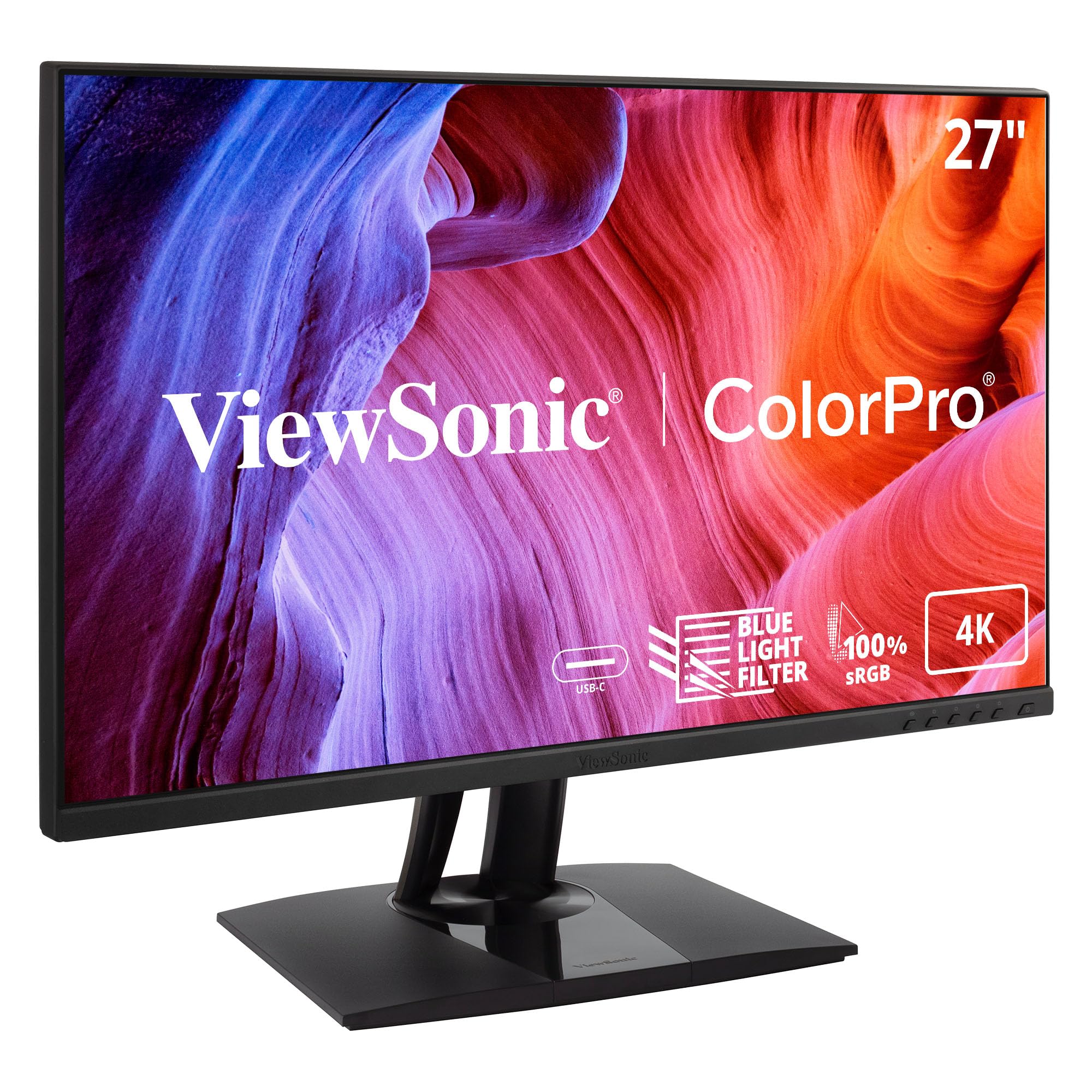
True 4K clarity that does not guess at colors.
This 27-inch 4K UHD (3840 x 2160) monitor gives you over 8 million pixels to work with, so you can zoom into the finest texture in your photo without seeing individual pixels. It is Pantone Validated (certified to accurately show Pantone brand-matching colors), meaning it can reproduce Pantone Matching System colors accurately — a certification that serious print and product photographers rely on. At a brightness of 350 cd/m², versus 250 cd/m² on the ViewSonic VP2468A 24-inch model, it makes highlights pop more.
The USB-C port delivers 60W of power and handles data, audio, and video through one cable. It has a built-in RJ45 Ethernet port (a socket for a wired internet cable), a rare feature that gives you a stable wired network connection when you are transferring large raw files. The ergonomic stand covers tilt, swivel, pivot, and height adjustments.
Reviewers mention that the factory calibration holds up well over time and that the thin bezels make it feel modern and clean in a multi-monitor setup. The catch is that this monitor does not include a built-in KVM switch (a device that lets you use one keyboard and mouse for two computers) like some competitors, so switching between two computers requires manually swapping cables.
Why It Shines
- Native 4K resolution for pixel-level editing precision.
- Pantone Validated with Delta E < 2 accuracy.
- RJ45 Ethernet port for stable file transfers.
- Full ergonomic stand with height, pivot, and swivel.
Trade-offs
- No built-in KVM for sharing the display between two computers.
- 60W USB-C power delivery is slightly lower than some competitors at 65W or 90W.
Reach for this if your photo editing demands native 4K resolution for sharpness and you want professional Pantone certification without the usual premium markup.
Look elsewhere if you run two computers and need a monitor that can switch between them with a single keyboard and mouse.
3. ASUS ProArt Display PA279CV

A 4K ProArt display with the same color DNA as the pricier models.
This 27-inch 4K monitor runs the same color technology as the more expensive ASUS ProArt models: 100% sRGB and 100% Rec. 709 coverage with a factory-calibrated Delta E under 2, verified by Calman. That consistency makes it a safe choice if you want to edit in 4K without worrying about whether your colors drift between batches. It also includes a 3-month Adobe Creative Cloud subscription with purchase, which can offset the initial cost.
The USB-C port provides 65W of power delivery, enough to charge a MacBook Pro or Dell XPS while running the display. The built-in hub offers four USB 3.2 Gen 1 Type-A ports plus a USB-C upstream port, so you can plug in your card reader, mouse, and keyboard directly into the monitor. The stand supports tilt, swivel, pivot, and height adjustments, and the VESA mount pattern (a standard 100 x 100 mm hole pattern for attaching a monitor arm) lets you use an arm if you prefer.
Buyers appreciate the anti-glare screen, which reduces reflections during long editing sessions, and the flicker-free backlight that cuts down on eye strain. The main difference from the pricier PA279CRV is that this model has a slightly lower contrast ratio and peak brightness, but in a typical office or home studio, the difference is minimal.
Sharp and consistent: Native 4K resolution with the same ProArt color calibration as ASUS’s high-end displays — a rare pairing at this price point.
Grab this if you need 4K resolution with proven factory color accuracy and a USB-C hub to simplify your desk.
skip it if you do not need 4K for your editing workflow — the QHD PA278CV saves money and performs similarly on color.
4. BenQ PD3205U

A massive 32-inch canvas that charges your laptop faster than any other on this list.
At 31.5 inches with a 4K resolution of 3840 x 2160, this BenQ monitor offers the most screen real estate in this guide. The IPS panel covers 99% sRGB and 99% Rec. 709, and it is both Calman Verified and Pantone Validated for color accuracy. The Delta E is rated at ≤ 3, which is slightly higher than the ≤ 2 standard of the ASUS models, but the larger screen real estate can be a more important factor for many editors.
The USB-C port delivers 90W of power — the highest of any monitor here — which means even a 16-inch MacBook Pro will charge at its full speed while connected. The built-in KVM switch (keyboard, video, mouse switch) lets you control two computers with a single keyboard and mouse, switching between them at the press of a button on the included Hotkey Puck G2 (a physical control dial). The stand provides tilt, swivel, pivot, and height adjustment for ergonomic comfort.
Reviewers highlight the Uniformity technology built into the AQCOLOR system, which ensures even brightness across the entire screen — useful when you are editing a gradient sky or a large print layout. The main trade-off is the price; it is the most expensive monitor here, so it only makes sense if you actually need the 32-inch size and the 90W charging.
Strengths
- Largest screen at 31.5 inches with 4K resolution.
- 90W USB-C power delivery charges large laptops at full speed.
- Built-in KVM switch with Hotkey Puck G2 for two-computer setups.
- Uniformity technology keeps brightness even across the panel.
Weaknesses
- Delta E ≤ 3 is less strict than the ≤ 2 found on ASUS and ViewSonic models.
- Highest price in the lineup, so only for those who need the extra size.
Best for editors with a large desk: The 32-inch size and 90W USB-C charging make it a powerhouse for photographers who work on a single large display and need to charge a heavy laptop.
Not ideal if color accuracy at the Delta E ≤ 2 level is non-negotiable for your print or product work, or if you are working with a limited budget.
5. ViewSonic VP2468A

A 1080p professional monitor that brings network and charging into one cable.
This 24-inch Full HD (1920 x 1080) monitor is smaller and lower resolution than the others, but it packs pro-level color credentials: 100% sRGB coverage, Pantone Validated certification, and a factory hardware calibration report with Delta E under 2. It covers EBU (European Broadcasting Union color standard), SMPTE-C (Society of Motion Picture and Television Engineers standard), Rec. 709, and even DICOM-SIM (medical imaging color standard) color spaces, making it suitable not just for photo editing but also for medical imaging standards.
The standout feature here is the RJ45 Ethernet port, which works through the USB-C connection to give your laptop a wired network connection with a single cable. Combined with 65W power delivery, this means one USB-C cable handles your display, charging, and internet. The ergonomic stand is fully adjustable with tilt, swivel, pivot, and height adjustment. Buyers report that the flicker-free backlight and blue light filter make a real difference during long editing days.
Compared to the ASUS PA247CV, this ViewSonic offers Pantone validation and the RJ45 port that the ASUS lacks. The trade-off is that at 250 cd/m², the brightness is lower than the 350 cd/m² you get on the VP2756-4K, so it is best suited for a controlled indoor studio environment rather than a bright room.
Advantages
- Pantone Validated with factory calibration report in the box.
- RJ45 Ethernet and 65W USB-C in one cable.
- Full ergonomic stand with pivot for portrait mode.
- Flicker-free and blue light filter for long sessions.
Limitations
- Only 1080p resolution — no space for toolbars and layers side-by-side.
- Brightness at 250 cd/m² is lower than the 4K models.
Perfect for photographers who want a pro-grade 1080p monitor with Pantone validation and a wired internet connection via a single USB-C cable, keeping their desk nearly wire-free.
Not for you if you need higher than 1080p resolution — this is a tool for accurate color, not spacious multi-tasking.
6. ASUS ProArt Display PA247CV

The cheapest way into a Delta E < 2 ProArt monitor with USB-C.
This 24-inch Full HD (1920 x 1080) monitor is the most affordable entry point into ASUS’s ProArt line. It delivers the same color fundamentals as the more expensive models: 100% sRGB and 100% Rec. 709 coverage, a factory-calibrated Delta E under 2, and Calman Verification. If you are editing photos for web or print and do not need the pixel density of 4K, this monitor gives you pro-level color without the premium price.
The USB-C port supports DisplayPort over USB-C with 65W power delivery, letting you connect and charge a compatible laptop through a single cable. Other connectivity includes DisplayPort, HDMI, and a USB 3.1 hub. The anti-glare screen and flicker-free technology help reduce eye fatigue during longer editing sessions. ASUS backs this monitor with a 5-year warranty (3 years plus a 2-year extension upon online registration), which is excellent for an entry-level display.
One buyer pointed out that the contrast ratio of 100,000,000:1 is an extreme figure on paper, though in practice the ASUS IPS panel delivers good depth for a monitor in this range. The limitation is the 1080p resolution; if you plan to work with high-resolution RAW files and keep multiple panels open, you may feel cramped compared to the 1440p or 4K options above.
Why It Works
- Lowest price for a Calman Verified ProArt monitor.
- 65W USB-C power delivery with full connectivity.
- 5-year warranty (3 + 2 years) is best in class for this tier.
- Factory calibration report included for immediate use.
Where It Falls Short
- Only 1080p resolution limits workspace for complex editing.
- No Pantone validation like the ViewSonic VP2468A offers.
Start here if your budget is tight and you need a monitor that is color-accurate from the start, with USB-C charging for your laptop.
Upgrade if you can stretch your budget to the QHD PA278CV for a noticeable jump in screen real estate and sharpness.
Understanding the Specs
Delta E (Color Accuracy)
Delta E (Delta E) is the industry measure of color deviation. A Delta E of 1 means the displayed color is just barely perceptibly different from the intended color. For photo editing, you want a Delta E under 2 — anything higher and you risk editing your photos to look correct on your screen, only to find the prints or client displays look noticeably different. All monitors in this guide are factory calibrated to keep Delta E under 2 (the BenQ PD3205U is rated at ≤ 3, which is still very good but slightly less strict).
sRGB and Rec. 709 Color Gamut
sRGB (standard Red Green Blue) is the most common color space used for web images, social media, and most consumer displays. Rec. 709 is the high-definition television standard. When a monitor covers 100% sRGB and 100% Rec. 709, it can display the full range of colors that these standards define. For photo editing, this means the reds in your sunset shot or the greens in a forest scene will look how you intended on the widest range of devices. Any monitor on this list with 99% or higher coverage is suitable for professional work.
Panel Technology: IPS vs Everything Else
IPS (In-Plane Switching) is the panel technology that gives you wide viewing angles — typically 178 degrees — meaning colors and brightness stay consistent even when you move your head or look at the screen from the side. This is critical for photo editing because a slight tilt of your chair should not change how the image appears. Cheaper TN (Twisted Nematic) or VA (Vertical Alignment) panels shift colors or lose contrast off-axis, which can ruin your editing accuracy. Every monitor on this list uses an IPS panel.
USB-C with Power Delivery
USB-C with Power Delivery (PD) lets you connect your laptop to the monitor with one cable that carries video signal, data, and power. The wattage (e.g. 65W or 90W) tells you how much power the monitor can send to your laptop. A 65W monitor will charge most 13- and 14-inch laptops at full speed. A 90W monitor like the BenQ PD3205U can even charge larger 16-inch laptops at their full charging rate. This feature reduces desk clutter because you do not need a separate power brick for your laptop.
FAQ
Do I need a 4K monitor for photo editing?
What is Delta E and why does it matter for editing?
Can I use any cheap IPS monitor for photo editing?
What does Pantone validation mean for a monitor?
How important is a factory calibration report?
Will a 1080p monitor be enough for Lightroom or Photoshop?
What is USB-C power delivery and how many watts do I need?
Are these monitors good for gaming as well?
Can I connect two monitors to my laptop with these displays?
How long does a factory calibration last?
Final Thoughts: The Verdict
Across the board, the best cheap monitor for photo editing winner is the ASUS ProArt Display PA278CV because it delivers sharp QHD resolution, wide 100% sRGB coverage, and 65W USB-C charging at a price that beats the typical 4K models. If you want the crisp pixel-level detail of 4K for working with high-res RAW files, grab the ViewSonic VP2756-4K. And for the largest canvas with the fastest laptop charging, the standout is the BenQ PD3205U.
How We Picked
We do not accept paid placement. Every pick is matched to a real buyer and a real use-case; we do not hands-on test units.
Sources & Methodology
Specifications: manufacturer listings and product documentation. Review insights: verified customer reviews, as of July 2026. Pricing: not shown on this page (it changes often); check the current price via the retailer link.
As an Amazon Associate, WellFizz earns from qualifying purchases. This does not affect which products we feature.

Mo Maruf
I created WellFizz to bridge the gap between vague wellness advice and actionable solutions. My mission is simple: to decode the research and give you practical tools you can actually use.
Beyond the data, I am a passionate traveler. I believe that stepping away from the screen to explore new environments is essential for mental clarity and physical vitality.