Our readers keep the lights on and my smoothie glass nicely filled. As an Amazon Associate, I earn from qualifying purchases.
Specs are compiled from manufacturer listings and verified buyer reviews and can change over time — please confirm the key details on the product page before buying.
Inconsistent coffee flavor often stems from uneven grind size, not the bean itself. A coffee burr grinder crushes beans between two surfaces for a uniform particle size, which is the most impactful upgrade for better home coffee. This guide covers the best 2025 coffee burr grinders, from electric models to manual options, helping you match a grinder to your brew method without overspending.
I’m Mohammad Maruf — the founder and writer behind WellFizz. This guide is built by comparing the manufacturers’ published specifications and the patterns across verified customer reviews, so you get each pick’s real strengths and trade-offs instead of marketing spin.
Whether you are dialing in espresso or filling a French press, the right coffee burr grinder transforms your daily routine from a guess into a reliable ritual that saves money and delivers cafe-quality results every morning.
Quick Picks
- SHARDOR Conical Burr Espresso Coffee Grinder — Best Overall
- Tuni G1 Conical Burr Coffee Grinder — Top Performer
- AMZCHEF Coffee Grinder CG209 — Best Display
- Aromaster Conical Coffee Bean Grinder — Quiet Operator
- OXO Brew Compact Conical Burr Coffee Grinder — Compact Pick
- TIMEMORE Chestnut C2S Manual Coffee Grinder — Best Manual
- Cuisinart Coffee Grinder DBM-8P1 — Value Pick
How To Choose The Best Coffee Burr Grinder
You need a grinder that gives you the right grind size for your brew method, fits your budget, and matches if you want electric speed or manual portability. The key specs that decide that are the number of grind settings, the burr type, and the motor or handle quality.
Grind Settings Range
The number of grind settings determines how precisely you can match the grind size to your brew method — espresso needs a very fine, consistent powder, while French press needs a coarse, chunky grind. More settings (like 48 or 51) give you finer control across the full spectrum, whereas fewer settings (like 15 or 18) still work well for drip coffee but may not dial in espresso perfectly.
Burr Type and Material
Conical burrs are the standard for home electric and manual grinders. They run slower to generate less heat, which protects the delicate oils in the bean that carry flavor. Stainless steel burrs, like the 40mm ones you see on many mid-range models, are harder and last longer than ceramic. Flat burrs, typically found on commercial machines, produce an even more uniform particle but are louder and more expensive.
Capacity and Static Control
How much coffee you grind at one time depends on your bean hopper size. A 1.4-ounce hopper is fine for a single pour-over or a two-shot espresso; an 8.8-ounce hopper suits large pots or a week’s worth of drip coffee. Anti-static technology — common on newer grinders — stops fine coffee dust from sticking to the container and making a mess when you open it.
Quick Comparison
| Model | Best For | Grind Settings | Capacity | Burr Material | Amazon |
|---|---|---|---|---|---|
| SHARDOR Conical Burr | Espresso precision with timer | 51 | 1.4 oz | Stainless Steel | Amazon |
| Tuni G1 | Versatile home brewing | 48 | 8.8 oz | Stainless Steel | Amazon |
| AMZCHEF CG209 | Static-free espresso grinding | 48 | 10.6 oz | Stainless Steel | Amazon |
| Aromaster 204 | Quiet, all-day family use | 48 | 3.9 oz | Stainless Steel | Amazon |
| OXO Brew Compact | Space-saving drip coffee | 15 | 1.76 oz | Stainless Steel | Amazon |
| Cuisinart DBM-8P1 | Budget batch grinding | 18 | 8.16 oz | Stainless Steel | Amazon |
| TIMEMORE Chestnut C2S | Portable manual grinding | 36 | 8.8 oz | Stainless Steel | Amazon |
In‑Depth Reviews
1. SHARDOR Conical Burr Espresso Coffee Grinder

A 51-setting electric grinder built for espresso fans who demand repeatable precision.
You get 51 precise grind settings that go from the finest espresso powder to a coarse French press, and the precision electronic timer lets you adjust grind time down to 0.1-second increments — so you can dial in the exact same dose every morning. The 40-millimeter stainless steel conical burr spins slowly to keep heat low, protecting the bean’s essential oils for better extraction, according to buyers who report “better flavor/aroma with fresh beans.”
The anti-static design keeps the grounds chamber clean, and the portafilter cradle lets you grind directly into the filter basket — a real time-saver. At 6.2 pounds, it sits solidly on the counter. One reviewer after 1.5 years noted it is “durable” and the controls remain easy to use, though the hopper clips can break if you are not careful. Compared to the AMZCHEF below, the SHARDOR steps up to 51 settings versus 48 and includes a more precise 0.1-second timer.
Precision Power
- 51 grind settings cover espresso to French press finely
- 0.1-second timer for repeatable doses
- Portafilter cradle means less handling of grounds
A Few Caveats
- Hopper clips reported as fragile by some buyers
- Portafilter holder can sag if not supported
Reach for this if: you are an espresso enthusiast who wants an entry-level electric grinder with enough control to grow into better shots.
Look elsewhere if: you only brew drip coffee — the extra fine-tuning and timer are overkill for a simple pot.
2. Tuni G1 Conical Burr Coffee Grinder

An Ivory-finished grinder with 48 settings that pairs beautifully with a matching espresso machine.
The Tuni G1 offers 48 adjustable grind settings, and its patented 40mm conical burr runs at a low 450 RPM — that slow speed keeps static and heat down, so your grounds stay consistent shot after shot. The bean hopper holds a generous 8.8 ounces, while the grounds container has a 2.6-ounce capacity, giving you enough room for multiple brews without refilling. Buyers report the G1 is “quiet” and delivers a “uniform grind for French press,” though some found that light-roast espresso needed a bit more dialing in without the included shim.
The detachable portafilter holder fits 54-58mm portafilters, so you can grind directly into the basket for espresso. The LED touchscreen remembers your last setting, and the timer adjusts in 0.5-second increments up to 40 seconds. One reviewer who uses it with a Gaggia Classic called it “simply amazing,” saying the touchscreen makes dialing in easy. At 4.8 pounds and 14 inches tall, it is compact enough for a small counter, and its 8.8-ounce hopper is much larger than the OXO’s 50-gram hopper below.
Standout strength: The combination of a large 8.8-ounce hopper, low-RPM burr, and portafilter holder makes it a versatile all-in-one for espresso and drip.
One trade-off: Some users report needing a DIY shim for very light roasts to get full fine adjustment.
3. AMZCHEF Coffee Grinder CG209
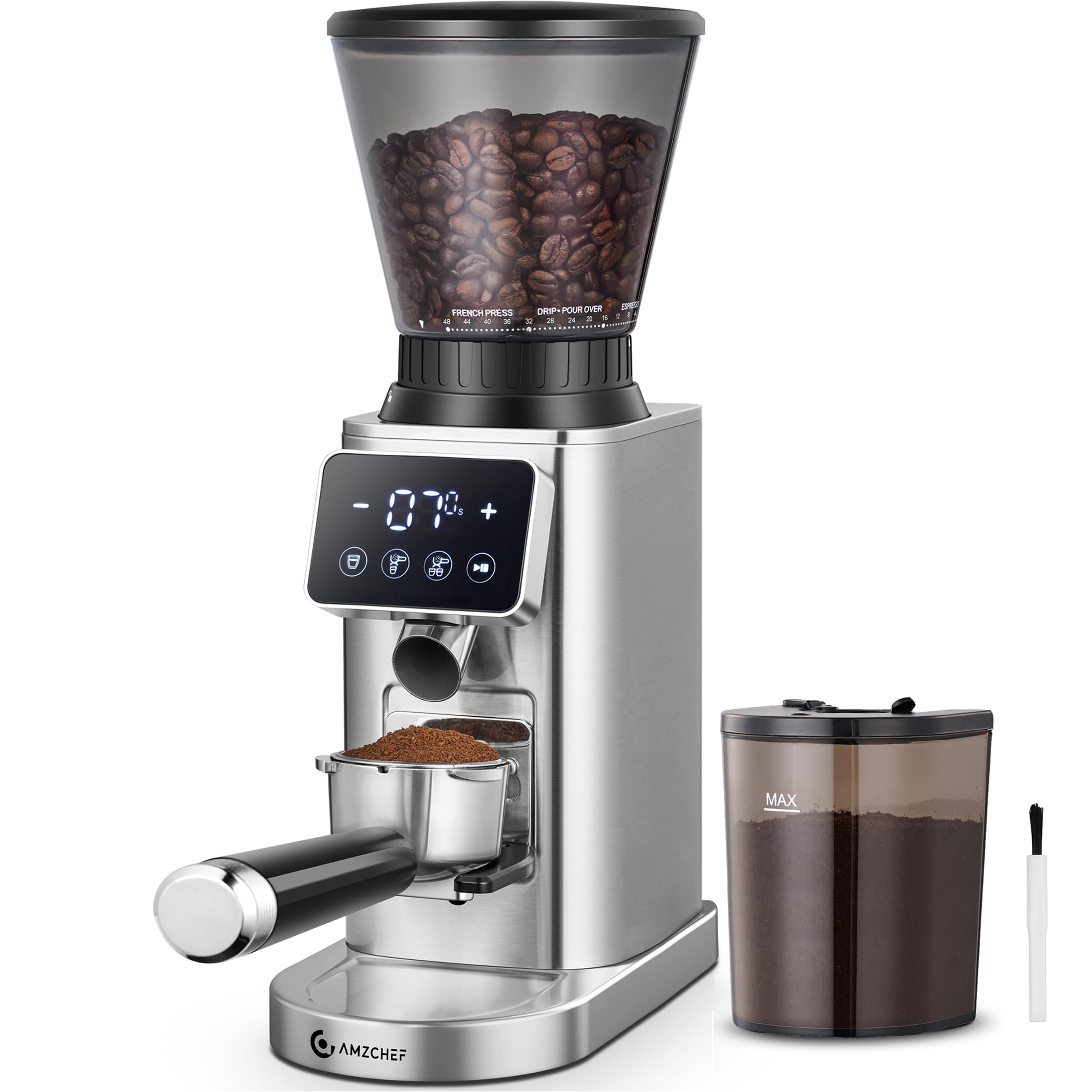
A static-free electric grinder with a sleek LED touchscreen that owners say “punch above its weight.”
This AMZCHEF model uses a 40mm stainless steel conical burr running at 450 RPM, the same low speed as the Tuni G1, to reduce static and heat buildup. The LED control panel with touch-sensitive switches lets you choose to grind by cup count, by time (in 0.5-second steps), or for single-or-double espresso shots. Owners mention the anti-static design works so well that one reviewer who previously owned a grinder says this one leaves “no static in the grounds container” at all.
The bean hopper holds 10.6 ounces — the biggest capacity on this list — and the 100-gram photophobic grounds container keeps coffee fresh. It comes with a portafilter holder compatible with 50mm baskets, plus a pad to steady the holder. A reviewer noted the portafilter holder can be loose on its mounts, but a simple tape gasket fixed it. At 5.4 pounds, versus the Tuni at 4.8 pounds, it feels sturdy. Reviewers mention the grind is “consistent” and “intuitive,” with setting 10-12 ideal for espresso.
Why It Shines
- Highest bean hopper capacity at 10.6 ounces
- LED touchscreen with 0.5-second timer adjustments
- Anti-static design praised across multiple reviews
Room for Improvement
- Portafilter holder attachment can feel loose
- Grinder does not save last setting — you scroll to desired cup count each use
Best for: anyone who hates static mess and wants a large hopper for multiple brews or a busy household.
Consider a different pick if: you need a machine that remembers your previous setting — the morning scroll is a small annoyance.
4. Aromaster Conical Coffee Bean Grinder
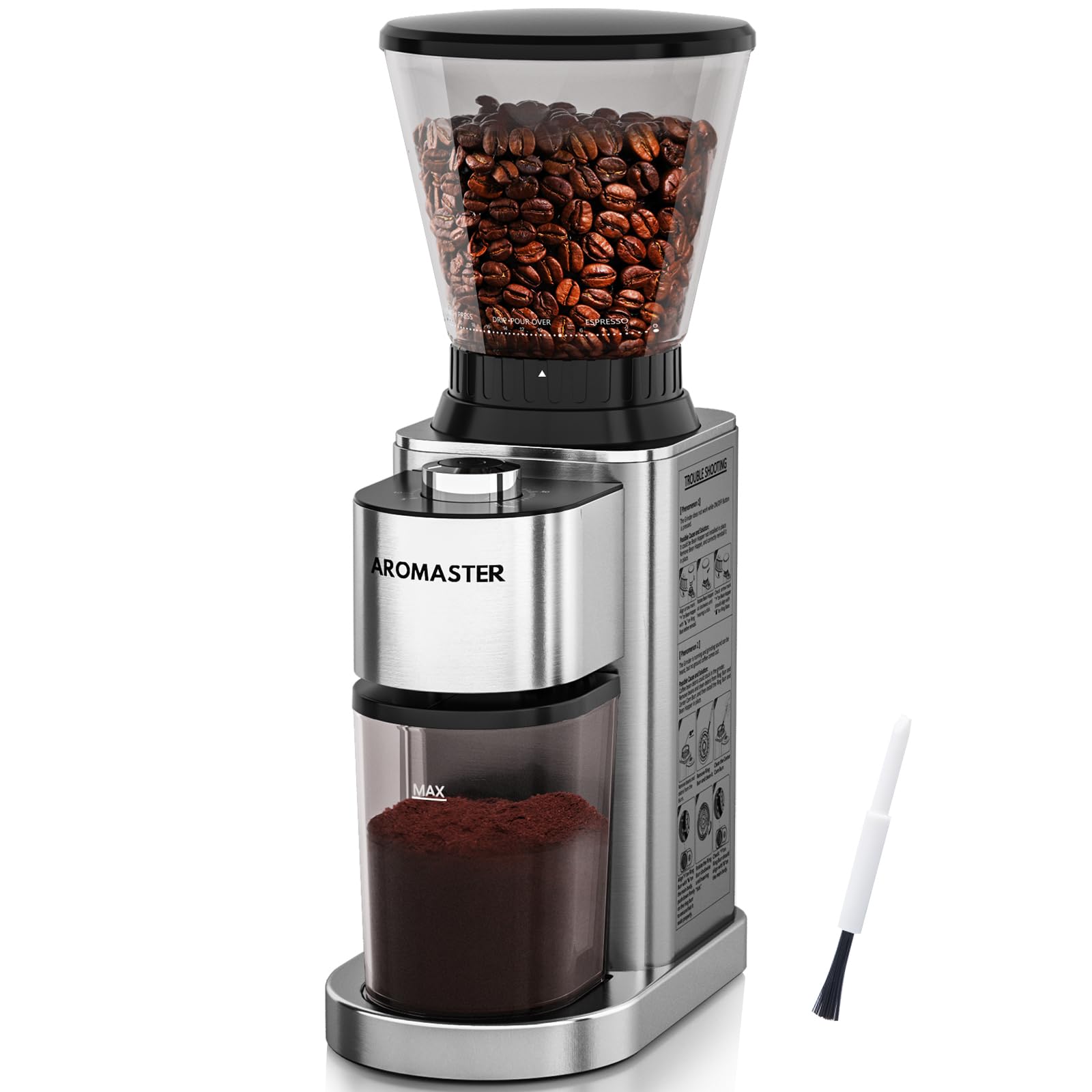
A quietly consistent grinder that one buyer called the “best grinder owned” in years of home brewing.
The Aromaster gives you 48 grind settings from fine espresso to coarse French press, with a 40-second adjustable timer to control portion size. Its stainless steel conical burrs grind slowly to preserve flavor, and the anti-static technology means coffee dust stays in the bin rather than flying across the counter. Buyers consistently describe it as “clean, quiet, consistent” — one reviewer who tried five different grinders said this one is the only one that is truly “static-free” and “mess-free.”
The large chamber holds up to 3.9 ounces — enough for a full pot or a large French press — and the built-in brush on the bean-hopper lid helps clear any clogs. The bin has a tawny design that cuts down UV light exposure to keep beans fresh. One reviewer noted the first unit was slow, but the seller sent a replacement quickly, and the second unit worked well. The Aromaster runs on 120V 60Hz and comes with a 12-month repair service. Its 3.9-ounce chamber is larger than the SHARDOR’s 1.4-ounce chamber for larger brews.
The top takeaway: If quiet operation and a mess-free counter matter most, this is the pick — buyers across multiple reviews agree on the consistent grind and low noise.
One thing to know: The timer and settings are easy to use, but the 3.9-ounce chamber means you may need to refill for very large gatherings.
5. OXO Brew Compact Conical Burr Coffee Grinder

A slim 4-inch-wide grinder that tucks into tight corners yet delivers reliable burr consistency.
If counter space is tight, the OXO Brew Compact is the smallest electric option here at 3.75 inches wide, 3.75 inches deep, and 10.75 inches tall — about the size of a tall water bottle. It offers 15 settings plus 29 micro-adjustments, so you still get fine control despite the lower number of labeled steps. The stainless steel conical burrs provide high grind quality for drip, pour-over, or French press, and the upper and lower burrs are removable for easy cleaning.
The hopper holds up to 50 grams (1.76 ounces) of beans — enough for about 6 cups of coffee — and the container is made from Tritan Renew, a recycled plastic. At only 11 inches tall, you can store it in a cabinet. One trade-off: the OXO is 11 inches tall and 4 inches wide, while the SHARDOR is 13.5 inches tall and 7.4 inches wide, and the OXO’s 50-gram capacity means you are refilling more often if you brew large pots. But for single servings or small households, the compact footprint is a real advantage.
Space Saver
- Ultra-compact dimensions fit small counters
- Removable burrs for easy cleaning
- Micro-adjustments give fine control beyond the 15 steps
The Catch
- Small 50-gram hopper requires frequent refills
- 15 grind settings are fewer than the 48 offered by mid-range picks
A great fit for: apartment dwellers or anyone who brews one or two cups at a time and needs to stash the grinder in a drawer.
skip it if: you regularly brew large pots or want espresso-specific fine-tuning — the step range is better suited to drip coffee.
6. TIMEMORE Chestnut C2S Manual Coffee Grinder

A hand grinder that weighs just 700 grams yet holds 8.8 ounces of beans for serious travel brewing.
The TIMEMORE Chestnut C2S is the upgraded version of the popular C2, swapping the plastic top cap for a full metal unibody that solves the earlier model’s breakage issue. It uses a 38mm CNC-machined stainless steel conical burr with a double-bearing central axis, which keeps the grinding motion smooth — the handle continues to spin for a moment even after you let go, a sign of the bearings at work. There are roughly 36 adjustable coarseness levels, adjusted by rotating a nut: clockwise for finer, anti-clockwise for coarser.
This manual grinder holds 8.8 ounces of beans — the same as the Tuni G1 electric but in a much smaller, portable body at 52mm in diameter. It is easy to disassemble for cleaning with just a brush. Buyers who prefer hand grinding for the lack of noise and the ability to take it camping or traveling appreciate the compact shape. At 700 grams (about 1.5 pounds), it weighs less than the electric models here, which range from 4.5 to 6.2 pounds, but still feels substantial. The 55-58 HRC hardness burr produces uniform grounds with minimal fine powder, so your pour-over or AeroPress gets an even extraction.
Why it stands out: It matches the bean capacity of large electrics (8.8 ounces) in a 700-gram, hand-driven package ideal for travel.
One honest limitation: Manual grinding takes effort and time — not ideal for mornings when you want a quick electric push.
7. Cuisinart Coffee Grinder DBM-8P1
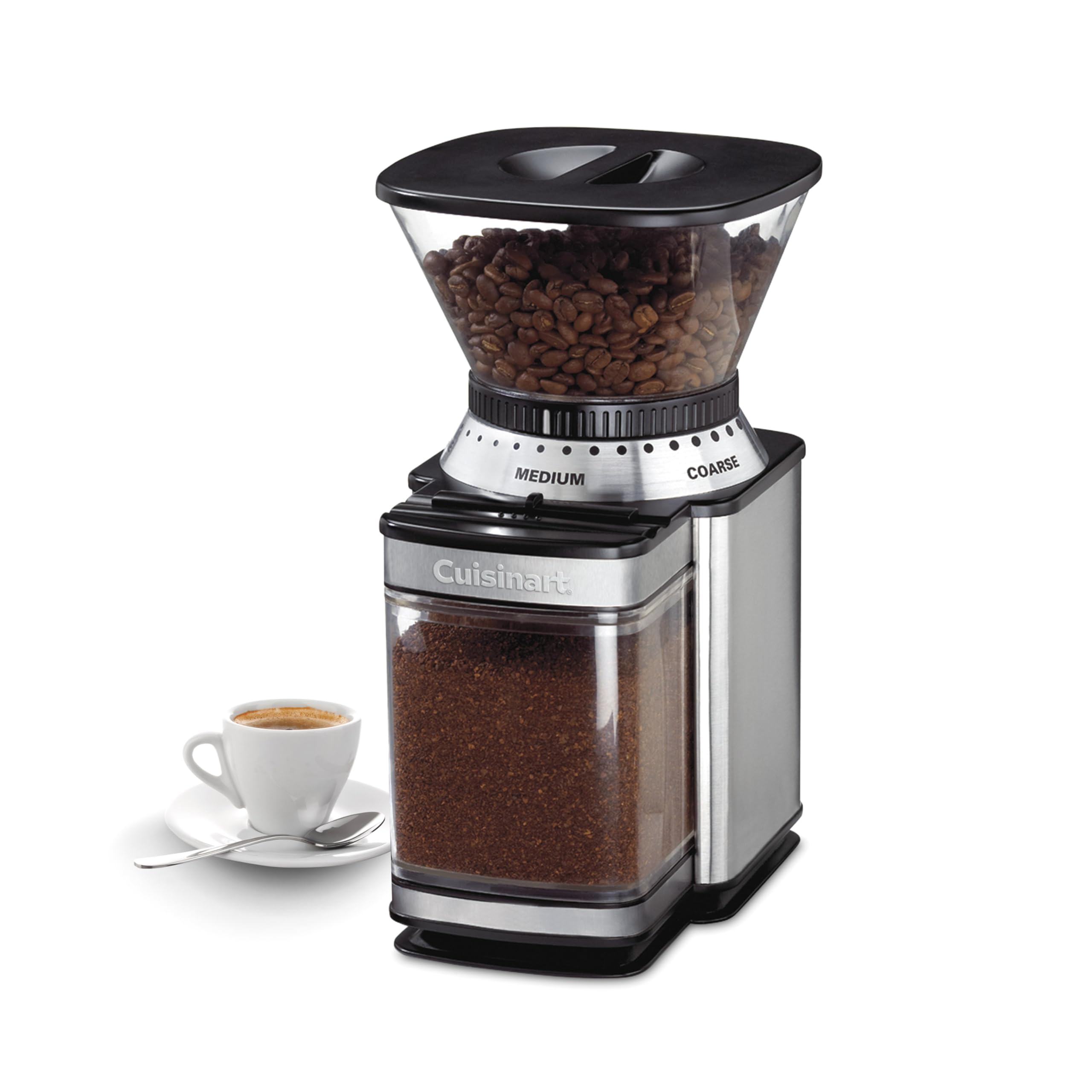
A classic flat-burr electric grinder with an 18-position dial and a big 8-ounce hopper for batch brewing.
The Cuisinart DBM-8P1 is a long-standing entry-level option with 18 grind positions that go from ultra-fine to extra-coarse, controlled by a slide-dial selector. Its flat burr design delivers uniform grounds, and the 8.16-ounce bean hopper is removable for easy cleaning — a nice touch when switching bean types. The grind chamber holds enough ground coffee for 4 to 18 cups (one “cup” is about 5 ounces), and the one-touch power bar includes an internal timer that shuts off automatically when the cycle is finished.
At 4.5 pounds, versus 6.2 pounds for the SHARDOR and 5.4 pounds for the AMZCHEF, it is easier to move around or store. The included cord storage and a scoop/cleaning brush add convenience. Note that this is a flat-burr grinder rather than conical, which means it runs a bit faster and can generate more heat — but for drip coffee and French press, most home brewers will not notice the difference. The 18-position dial is simpler than the 48-setting models above, but for someone who mainly makes morning drip coffee, fewer steps mean less time dialing in.
Budget Champion
- Large 8.16-ounce bean hopper handles multiple brews
- 18 grind positions cover most home methods
- Removable hopper and chamber for easy cleaning
Compared to Others
- Flat burr can create more heat than conical alternatives
- Fewer grind settings than the 48-step electrics above
Best for: everyday drip coffee drinkers who want a reliable, budget-friendly electric grinder with a big hopper.
Look elsewhere if: you need espresso-grade fine-tuning — the 18 settings lack the precision for dialing in espresso.
Understanding the Specs
Grind Settings
The number of grind settings (commonly 15 to 51) controls how fine or coarse the coffee becomes. Espresso needs a very fine, consistent powder to create the right pressure for extraction; French press needs coarse, chunky grinds. More settings let you fine-tune for specific brew methods. For instance, the SHARDOR’s 51 steps give you room to adjust for different espresso machines, while the OXO’s 15 plus micro-adjustments still work well for drip coffee but are less precise for espresso.
Anti-Static Technology
Static buildup makes fine coffee dust cling to the container walls, causing a mess when you open the bin. Anti-static designs (found on the AMZCHEF, Aromaster, and SHARDOR) reduce this cling by using special coatings or slower burr speeds (like 450 RPM). Without it, you may need to tap the container or wipe it clean after every use. Buyers consistently rank anti-static as a top feature because it keeps the counter clean.
FAQ
What is the difference between a conical burr and a flat burr grinder?
How many grind settings do I need for espresso?
Will a coffee burr grinder fit under a standard cabinet?
How do I clean a burr grinder?
Is a manual burr grinder better than an electric one?
What does anti-static mean in a coffee grinder?
Can I grind directly into a portafilter with these grinders?
How long do burrs in a coffee grinder last?
Final Thoughts: The Verdict
For most people, the coffee burr grinder winner is the SHARDOR Conical Burr because its 51 precise grind settings and 0.1-second timer give you the control needed for both espresso and drip while staying affordable. If you want a larger hopper and an ultra-quiet operation for family brewing, grab the Aromaster 204. And for portable, no-electricity grinding that still holds 8.8 ounces of beans, the TIMEMORE Chestnut C2S is the one to get.
How We Picked
We do not accept paid placement. Every pick is matched to a real buyer and a real use-case; we do not hands-on test units.
Sources & Methodology
Specifications: manufacturer listings and product documentation. Review insights: verified customer reviews, as of July 2026. Pricing: not shown on this page (it changes often); check the current price via the retailer link.
As an Amazon Associate, WellFizz earns from qualifying purchases. This does not affect which products we feature.

Mo Maruf
I created WellFizz to bridge the gap between vague wellness advice and actionable solutions. My mission is simple: to decode the research and give you practical tools you can actually use.
Beyond the data, I am a passionate traveler. I believe that stepping away from the screen to explore new environments is essential for mental clarity and physical vitality.