Our readers keep the lights on and my smoothie glass nicely filled. As an Amazon Associate, I earn from qualifying purchases.
Specs are compiled from manufacturer listings and verified buyer reviews and can change over time — please confirm the key details on the product page before buying.
You need a room to feel cold, not just cooler, but you are also deciding between a window unit that blocks your view and a portable model that rolls between rooms — and the wrong BTU number will leave you sweaty either way. This guide covers nine of the most popular window and portable options with real cooling specs, floor area ratings, and honest buyer experiences. That way you pick a unit that fits your room without overspending or guessing.
I’m Mohammad Maruf — the founder and writer behind WellFizz. This guide is built by comparing the manufacturers’ published specifications and the patterns across verified customer reviews, so you get each pick’s real strengths and trade-offs instead of marketing spin.
The right cold air conditioner for you depends on matching cooling power to your room’s square footage, your noise tolerance, and how much installation hassle you can handle.
Quick Picks
- ZAFRO Smart Inverter Portable Air Conditioner, 16,000 BTU — Top Performer
- DREO Portable Air Conditioner 515S, 12,000 BTU — Best Value
- DREO Portable Air Conditioner 318S, 8,000 BTU — Compact Smart
- YLEOOB 16,000 BTU Smart Portable Air Conditioner — Large Room Ready
- EnerGlow 12,000 BTU Portable Air Conditioner — Mid-Range Workhorse
- Coolblus 8,400 BTU Portable Air Conditioner — Quick Spot Cooler
- Hykolity 8,000 BTU Smart Window Air Conditioner — WiFi Window Unit
- Midea 5,000 BTU Window Air Conditioner — Budget Window Pick
- Frigidaire 6,000 BTU Window Air Conditioner — Entry Level
How To Choose The Best Cold Air Conditioner
Start with one number: the BTU rating (British Thermal Units, a measure of cooling power). Too few BTUs and the unit runs nonstop without cooling the room. Too many and it cycles on and off too fast, leaving the air clammy. The general rule is about 20 BTUs per square foot of floor area, but ceiling height, sun exposure, and window quality all shift that figure.
Window vs. Portable — The Trade-Off
Window air conditioners are generally more efficient for a given BTU because their hot exhaust goes straight outside. Portable units sit on the floor and use a hose to push hot air out a window, which is less efficient but lets you move the cooler from bedroom to living room as needed. If you are a renter who cannot modify a window frame permanently, a portable model is often the only option.
Noise Matters More Than You Think
For bedroom use, a unit rated at 52 decibels (dBA, a sound-pressure scale that matches how the human ear hears loudness) or lower on low fan should let you sleep through the night. Many buyers report that a 52 dBA window unit is fine for a bedroom, while anything over 60 dBA is better reserved for a living room where you are awake.
Quick Comparison
| Model | Best For | Cooling Power (BTU) | Floor Area (sq. ft.) | Noise Level (dBA) | Amazon |
|---|---|---|---|---|---|
| ZAFRO 16,000 BTU Dual Hose | Large rooms & energy savings | 16,000 | 800 | 42 | Amazon |
| DREO 515S | Smart cooling for medium rooms | 12,000 | 150 | 45 | Amazon |
| DREO 318S | Small room smart control | 8,000 | 100 | 45 | Amazon |
| YLEOOB 16,000 BTU | Large open spaces & pre-cooling | 16,000 | 750 | 42 | Amazon |
| EnerGlow 12,000 BTU | Apartments that ban window units | 12,000 | 600 | 42 | Amazon |
| Coolblus 8,400 BTU | Quick spot cooling | 8,400 | 350 | 52 | Amazon |
| Hykolity 8,000 BTU | WiFi control & medium rooms | 8,000 | 350 | — | Amazon |
| Midea 5,000 BTU | Budget-friendly small rooms | 5,000 | 150 | 52 | Amazon |
| Frigidaire 6,000 BTU | Tiny bedrooms & guest rooms | 6,000 | 250 | 52 | Amazon |
In‑Depth Reviews
1. ZAFRO Smart Inverter Portable Air Conditioner, 16,000 BTU
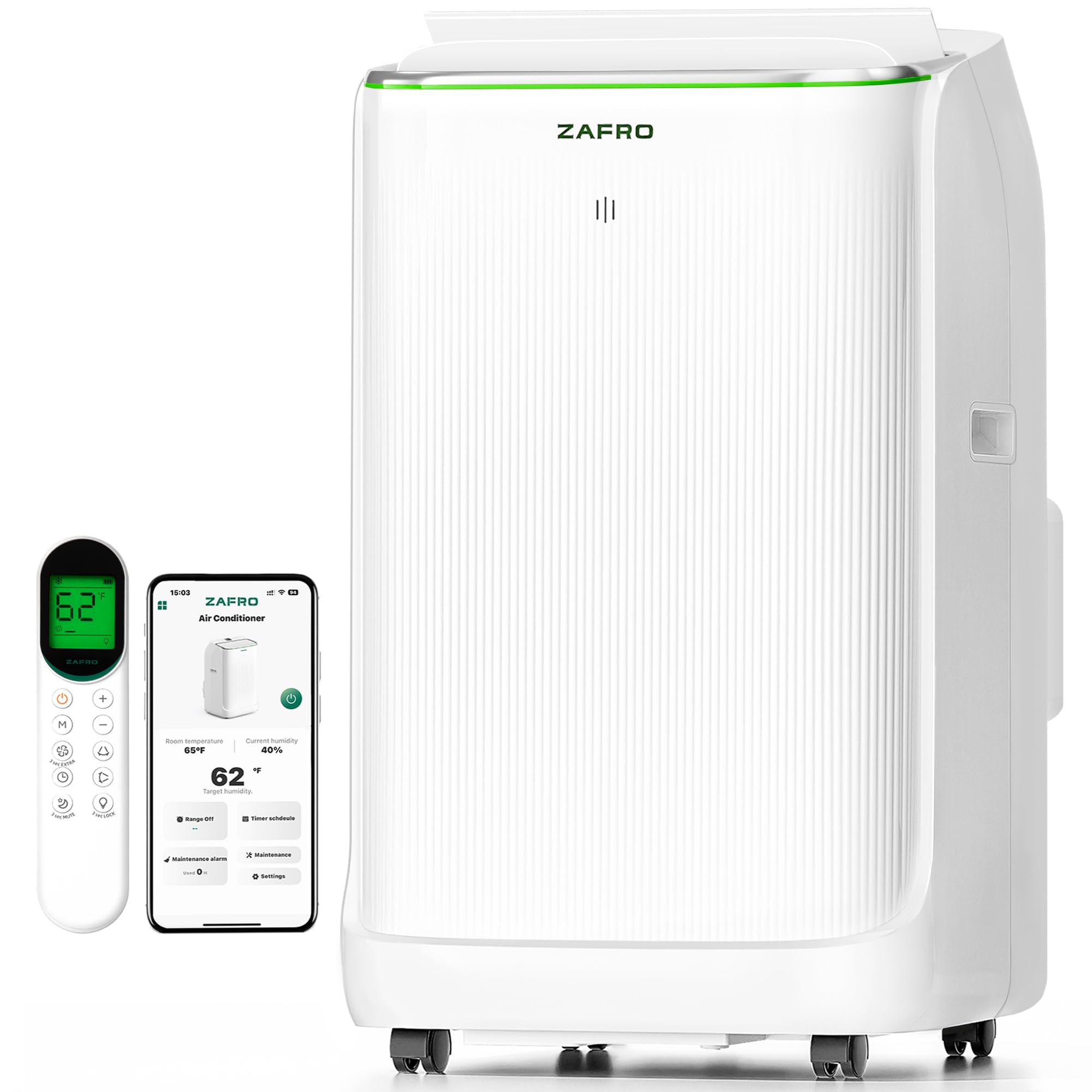
The dual-hose inverter that chills an 800-square-foot space while sipping power — this is the one to beat for sheer coverage per watt.
This is the most powerful portable in the roundup. It uses a dual-hose design (one hose pulls outside air for the condenser, a second exhausts hot air) and an inverter compressor (a variable-speed compressor that adjusts power instead of cycling on/off). The result: a CEER (Combined Energy Efficiency Ratio, the measure of cooling output per watt) of 12.8, well above the typical 7.83 for portables, so your electricity bill stays lower than you expect from a 16,000 BTU unit. It covers up to 800 square feet — nearly double the Coolblus 8,400 BTU below — and sleep mode runs at 42 dBA, quieter than a library.
Owners mention cooling a 500-square-foot room in about one hour. They also note the self-evaporating system (condensation evaporates through the exhaust instead of collecting in a bucket) handles humidity under 90% for up to 72 hours before needing a drain hose. Some feedback: the remote can be flaky and the window panel lets in a little hot air, but customer support is responsive.
The Inverter Advantage
- 16,000 BTU cools rooms up to 800 sq. ft. — dominant coverage
- CEER of 12.8 saves energy versus standard portable units
- Dual-hose design prevents cooling efficiency loss
- Sleep mode at 42 dB is genuinely quiet for night use
The Real-World Catch
- Some owners say the remote control is unreliable
- Window sealing panel can allow hot air to leak back in
- Heavy unit; wheels are necessary but not ideal on carpet
- Premium price puts it near the top of the budget
Ideal for: Anyone with a large open floor plan or a single big room who wants efficient, quiet cooling and does not want to deal with emptying a water tank.
One trade-off you live with: The window seal kit is functional but not airtight — a roll of foam tape fixes the gaps.
2. DREO Portable Air Conditioner 515S, 12,000 BTU
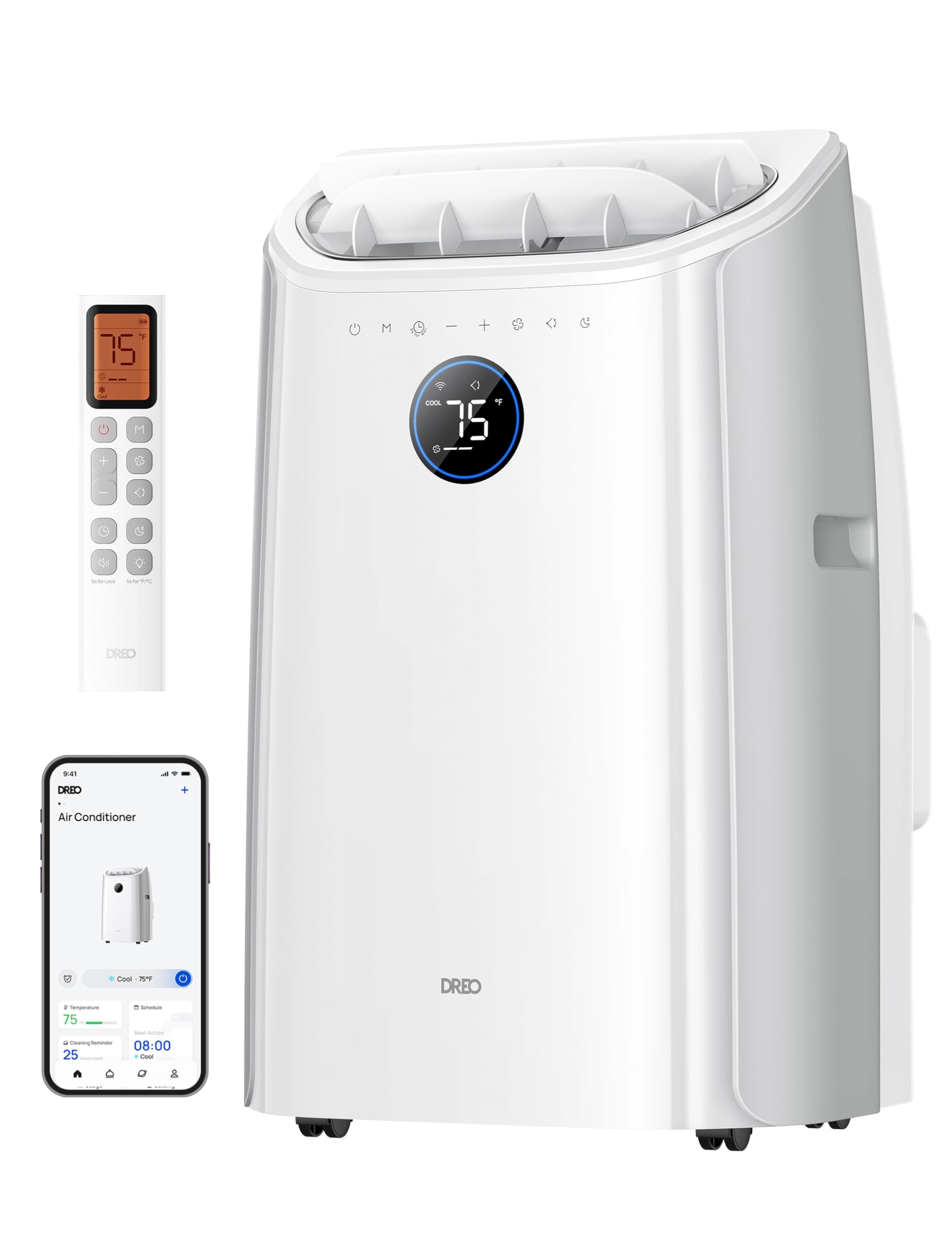
A smart portable that talks to Siri and drops the temperature fast without rattling the windows — quieter than the Coolblus below by 7 dBA.
Rated at 12,000 BTU ASHRAE (the older standard; the Department of Energy’s newer, more honest SACC rating is 8,000 BTU DOE), the 515S covers up to 150 square feet per the spec sheet. Customers note it handles larger open areas comfortably. Unlike the ZAFRO’s dual-hose setup, this is a single-hose portable, but DREO’s patented Noise Isolation System keeps the compressor rumble down to 45 decibels — impressive for this BTU class and noticeably quieter than the Coolblus’s 52 dB. The real standout is the app and voice control: you can tell Siri, Alexa, or Google Home to start cooling before you walk in the door.
Reviewers point out the room feels noticeably cooler in about 30 minutes and praise the magnetic remote holder and the dimmable display light. One reviewer compared it favorably to a previous SereneLife unit, calling the DREO’s window mounting system much better (no sawing required). The drainage-free system works below 90% humidity, but reviewers in very humid climates mention needing to hook up the drain hose and empty the bucket fairly often.
Why It Earns the Spot
- 12,000 BTU ASHRAE cools medium rooms quickly and steadily
- 45 dB noise level is genuinely quiet enough for sleep
- Voice and app control let you pre-cool the room remotely
- Setup is straightforward with included window kit and foam
The Limitation
- Single-hose design is less efficient than dual-hose models
- At 150 square feet rated, the DOE rating is conservative
- Drainage-free only works below 90% humidity
- Price is mid-premium, not budget-friendly
Best suited for: Tech-savvy owners who want app and voice convenience in a medium bedroom or home office without sacrificing quiet operation.
Who should look elsewhere: If your room is over 500 square feet, the ZAFRO or YLEOOB 16,000 BTU units offer better coverage.
3. DREO Portable Air Conditioner 318S, 8,000 BTU
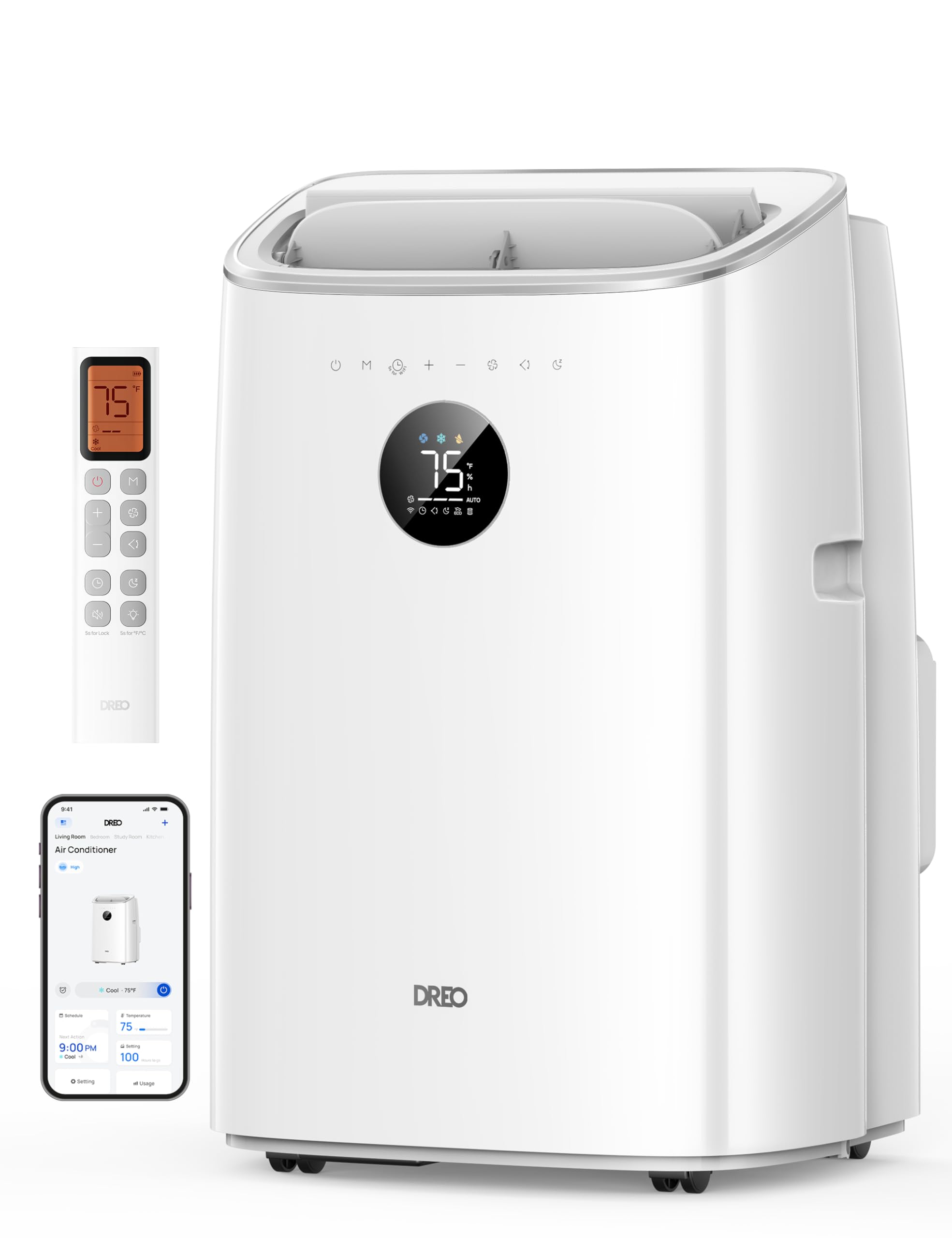
The smaller DREO with the same 45 dB whisper and smart features — but cut the room size in half compared to the 515S.
This is the 8,000 BTU ASHRAE (5,000 BTU SACC — the newer, stricter Seasonal Adjusted Cooling Capacity rating) version of DREO’s portable line, rated for rooms up to 100 square feet. For a small bedroom or a home office, that is the right zone. It shares the same IceCool system (a focused airflow design that pushes cool air up to 14 feet) and the same 45 dB noise level as the bigger 515S. The big difference is the coverage: 100 square feet vs 150 on the 515S, and 800 on the ZAFRO — a clear tier.
Shoppers say the 318S pulls a small bedroom from 80°F to 68°F in minutes and note that after weeks of use they have never needed to drain the water tank. One reviewer noted that the unit is heavy at 50 pounds and the wheels struggle on thick carpet, but on hard floors it rolls fine. The window kit is high quality and the app control works well, letting the owner monitor ambient temperature and set a sleep curve.
The Main Appeal
- Quiet 45 dB operation makes it a strong bedroom pick
- True drainage-free cooling saves daily hassle
- Smart app with voice control via Siri, Alexa, Google Home
- Setup takes about 15 minutes with included window kit
A Room-Size Reality
- Rated for 100 sq. ft. — too small for open living areas
- Heavy (50 lbs) and wheels are not ideal on carpet
- Fan noise is present on higher speeds; it is not silent
- Premium price for a 5,000 BTU DOE unit
Reach for this if: You want a smart, quiet portable for a small bedroom or nursery and you value the convenience of never emptying a water bucket.
The honest trade-off: At 5,000 BTU SACC, the cooling capacity is modest — if your room gets direct afternoon sun, consider stepping up to the 515S.
4. YLEOOB 16,000 BTU Smart Portable Air Conditioner
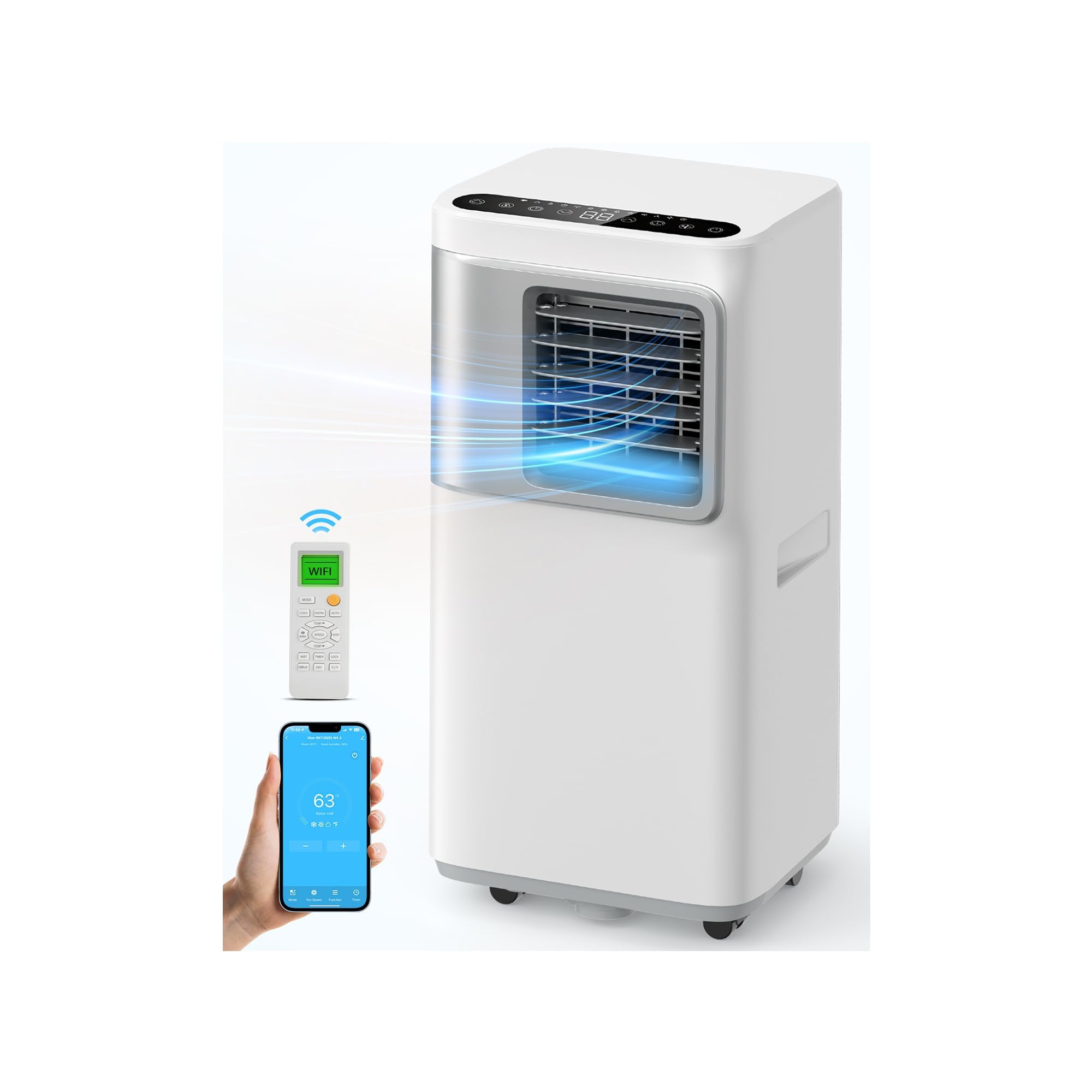
A 5-in-1 powerhouse that cools 730 square feet and doubles as a massive dehumidifier — but it is a single-hose design, unlike the ZAFRO.
The YLEOOB matches the ZAFRO’s 16,000 BTU rating and covers up to 750 square feet, putting it in the same large-room tier. It goes a step further with a 5-in-1 design: cooling, a dehumidifier that pulls up to 120 pints per day, a 3-speed fan, intelligent sleep mode, and a 24-hour timer. The built-in self-evaporation system (water is automatically evaporated through the exhaust during cooling) means you do not have to manually drain water under normal conditions — a clear advantage over older portable models that fill a bucket fast.
Buyers highlight the quiet sleep mode at 42 dB and the strong long-distance airflow that eliminates hot spots. One buyer mentioned this unit uses less energy than the three window units it replaced. Setup is straightforward with the included window kit, and the four 360-degree wheels with hidden handles make it easy to roll from room to room, despite the unit’s weight.
Why It Stands Out
- 16,000 BTU cools large rooms up to 750 sq. ft.
- 120-pint dehumidifier removes humidity aggressively
- Drainage-free in cooling mode; no bucket to empty
- WiFi app lets you pre-cool the room from your phone
The Reality Check
- High upfront cost, even among premium portables
- Single-hose design; less efficient than the ZAFRO’s dual-hose
- Heavy unit; moving it up stairs is a two-person job
- No inverter compressor; less energy efficient than the ZAFRO
Who should buy: Anyone with a large living room or open-concept apartment who wants powerful single-hose cooling plus heavy dehumidification — and does not mind the premium price.
Who should skip it: If energy efficiency is your top concern, the ZAFRO’s dual-hose inverter design gives you better long-term savings.
5. EnerGlow 12,000 BTU Portable Air Conditioner
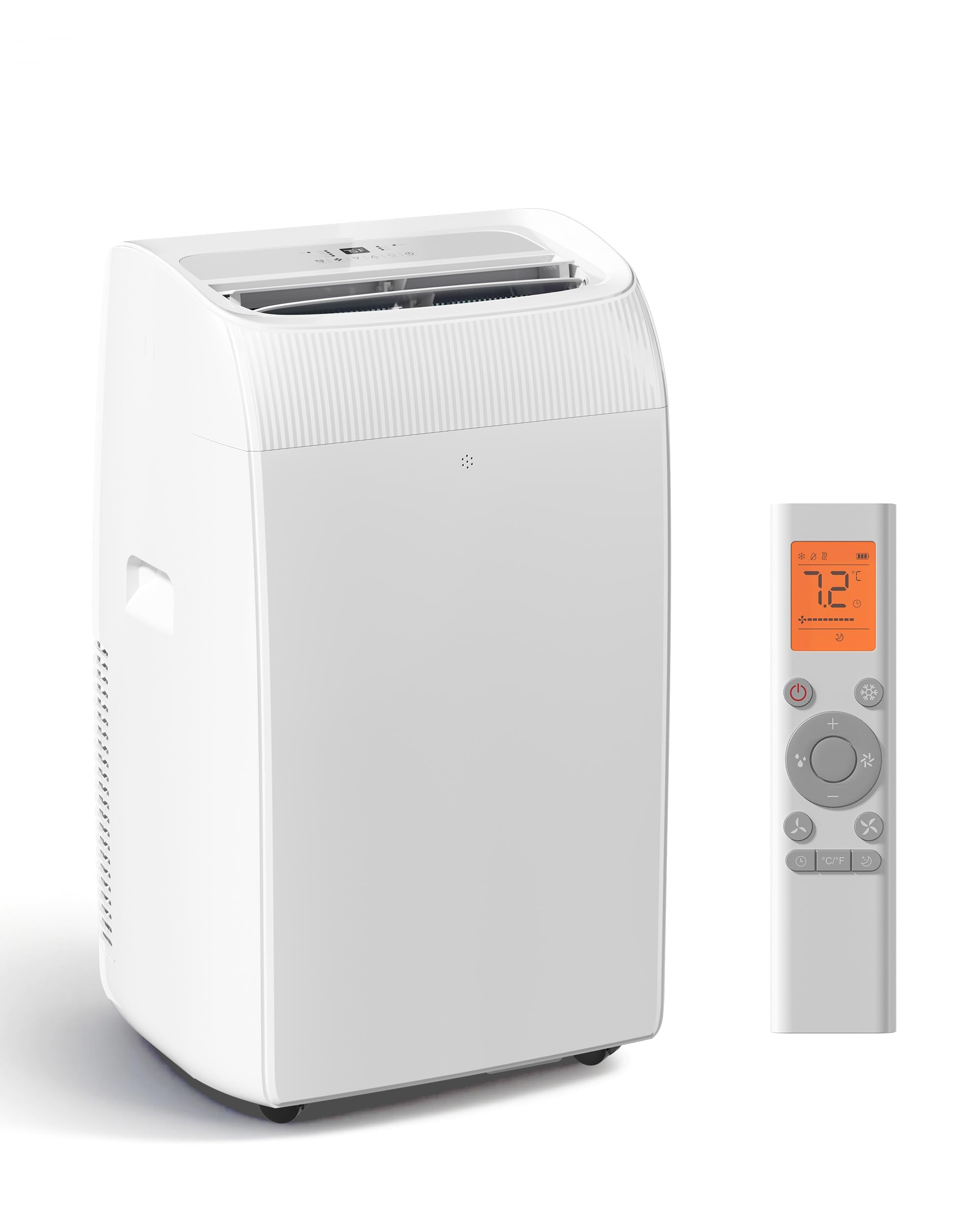
A 58.9-pound floor unit with a turbo mode — less efficient than the DREO 515S of the same BTU, but covers 4x the square footage.
The EnerGlow is a full-size portable rated at 12,000 BTU ASHRAE (8,050 BTU SACC) with a 600-square-foot coverage claim. Turbo mode locks the temperature at 64°F and runs the fan on high for immediate cooling relief. The four cooling speeds (low, med, high, auto) combined with auto-swing distribute air more evenly than a static vent, which matters in rooms with hot corners. In dry mode, the unit pulls up to 80 pints of moisture per day — a useful feature for humid climates.
Buyers report it cools three bedrooms effectively in apartments where window units are banned, and that sleep mode at 42 dB with a dimmed display is genuinely unobtrusive. The remote works across the room, and the 24-hour timer lets you schedule the unit to turn on before you arrive home. Some owners note that the noise level is typical for a portable AC and the 58.9-pound weight requires the four 360-degree wheels to be functional on your flooring.
The Strong Points
- 12,000 BTU ASHRAE with turbo mode for fast cooling
- Auto-swing circulates air to eliminate hot spots
- 80-pint daily dehumidification keeps air dry
- Child lock prevents accidental button presses
Where It Falls Short
- At 58.9 lbs, it is one of the heavier portables
- No WiFi or smart home integration
- Single-hose design loses some cooling efficiency
- Some owners mention fin rattle noise on straight fan
Best for: Apartment dwellers who cannot install a window unit and need a powerful, no-frills portable that moves easily between rooms on hard floors.
The main compromise: No smart control and a high weight mean it is less convenient than the app-connected DREO models.
6. Coolblus 8,400 BTU Portable Air Conditioner
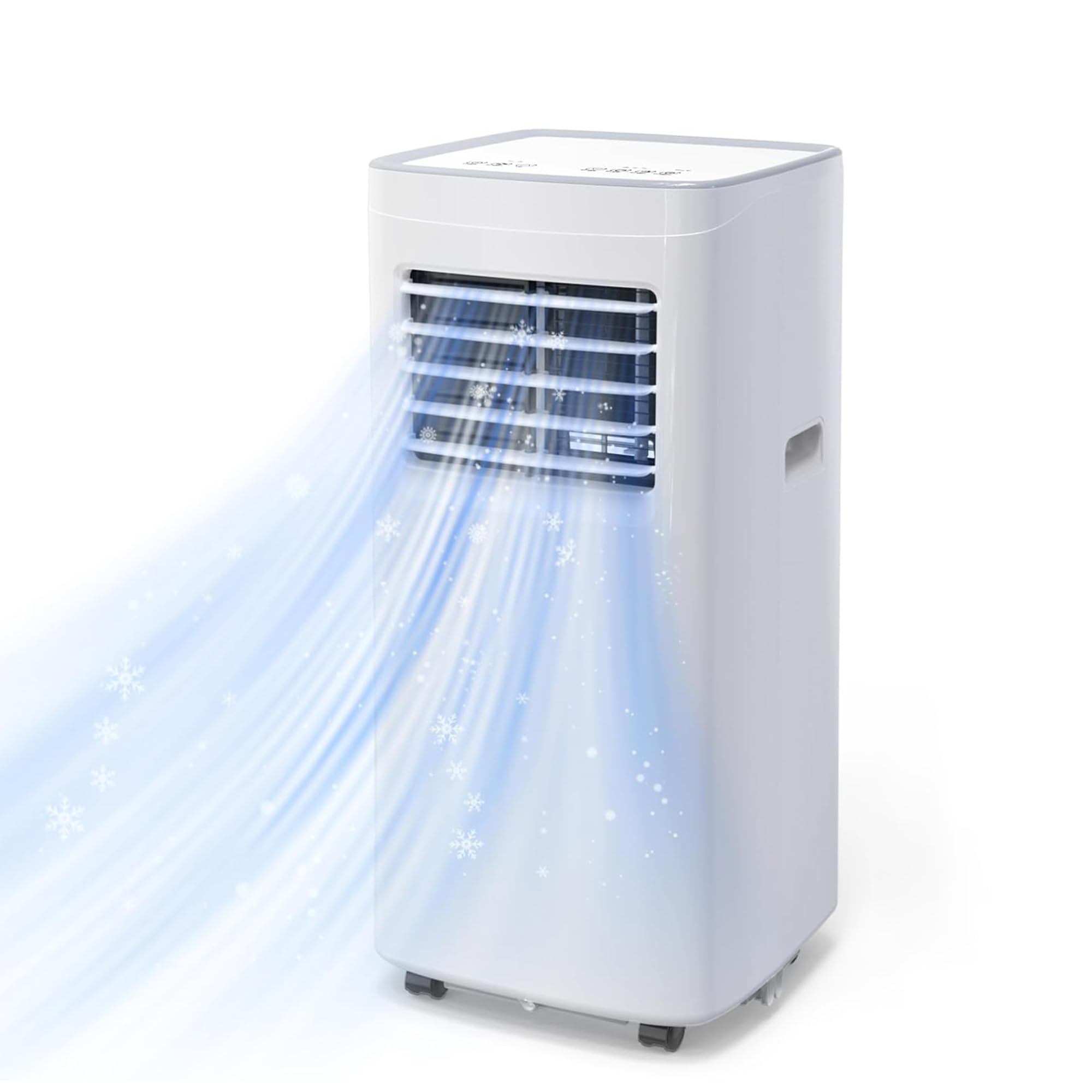
The 8,400 BTU portable that claims to drop a room 10°F in 15 minutes — and most buyers agree, though the flimsy tubing is a DIY fix.
Coolblus rates this unit at 8,400 BTU (ASHRAE) and says it covers up to 350 square feet. That is 350 square feet versus the Midea 5,000 BTU window unit’s 150 square feet — so it works for a small living room or a large bedroom where a window unit might not fit. The 3-in-1 design (cool, fan, dehumidify) includes a dehumidifier that pulls up to 45 pints per day. In sleep mode, the unit runs at 52 dB, which is fine for a living room but may be borderline loud for a light sleeper.
Buyers praise the cooling speed and say the controls are intuitive. One owner reported the vent tubing is flimsy and requires foil tape to stay connected. Another reviewer reported the unit worked for only one week before the compressor failed. The included 1.5-meter exhaust hose and window adapter make installation straightforward, but the plastic window vent feels brittle — handle it carefully.
The Good Stuff
- 8,400 BTU cools up to 350 sq. ft. — versatile for medium rooms
- Cools faster than many portables of similar BTU
- 45-pint dehumidifier helps with summer humidity
- 360° wheels and built-in handles for easy room changes
The Not-So-Good
- Flimsy vent tubing requires aftermarket foil tape
- Sleep mode at 52 dB is louder than premium competitors
- Several reviews report compressor failure within weeks
- Plastic window vent is brittle and can crack during install
Reach for this if: You need a portable for a medium-sized room on a mid-range budget and you are comfortable handling a few DIY tweaks (foil tape on the hose, careful window panel handling).
The quiet buyer’s alternative: Pay more for the DREO 515S (45 dB) or the ZAFRO (42 dB) — both have significantly fewer failure reports.
7. Hykolity 8,000 BTU Smart Window Air Conditioner

A smart window unit with a CEER of 11.0 — the most energy-efficient window pick here — but delivery damage is a gamble.
This Hykolity window AC puts out 8,000 BTU and covers up to 350 square feet. The big differentiator is the CEER (Combined Energy Efficiency Ratio) of 11.0 — higher than many window units in this class, which means it costs less to run. You can set the temperature between 61°F and 88°F and choose from cooling, dry, fan, or auto modes. The SmartLife-SmartHome app (a free iOS and Android app for controlling smart home devices) lets you turn it on from your phone, so you can pre-cool the room before coming home.
Customers note the cooling is impressive for the price — one customer observed it chills an entire apartment that normally needed two units. Another mentioned the unit arrived damaged (non-functional fan, dents on coils) but Amazon issued a quick refund. The filter is washable and easy to clean, and the timer allows settings from 0.5 to 24 hours. Installation is standard for a window unit and fits windows 23 to 36 inches wide with a minimum height of 14.5 inches.
what separates it
- CEER of 11.0 is energy-efficient for an 8,000 BTU unit
- WiFi app control lets you schedule cooling from anywhere
- Covers 350 sq. ft. — strong for a mid-sized window AC
- Washable filter and 0.5-24 hour timer reduce maintenance
The Risks
- Multiple reports of units arriving damaged or non-functional
- Customer support for the seller (Zelang) is pushy and unhelpful
- Heavier than 5,000 BTU units; not ideal for second-story windows
- Noise level is standard — not designed for silent operation
Best for: Someone comfortable with a window installation who wants energy savings and app control in a medium-sized room — and is okay with the risk of needing an Amazon return.
skip it if: You cannot tolerate a potential DOA unit or if you want a portable that moves between rooms.
8. Midea 5,000 BTU Window Air Conditioner

The 5,000 BTU window AC that fits small rooms and even smaller budgets — and it is inherently more efficient than any portable of the same BTU.
At 5,000 BTU, the Midea EasyCool is built for spaces up to 150 square feet — think a guest bedroom, a home office, or a small nursery. The Coolblus portable above covers 360 square feet (a 2.4x advantage), but the Midea is a window unit, meaning no hot exhaust hose leaks cooled air back into the room. It runs as low as 52 dB (decibels, a measure of sound level) on low mode, and the 3-in-1 system offers cooling, a 3-speed fan, and dehumidifier mode.
Reviewers point out it cools quickly and is surprisingly quiet for the price. One user highlighted that the remote only works when aimed directly at the unit — you need to listen for the beep to confirm a temperature change. Another mentioned that the Eco mode caused a PC monitor to flicker when plugged into the same circuit. The reusable filter is easy to clean, and the installation accessories are all included, though you may want to add custom weather stripping for a tighter seal.
What Works
- 5,000 BTU is the right size for small bedrooms up to 150 sq. ft.
- Window AC design is more efficient than portables at this BTU
- 52 dB on low mode is quiet enough for light sleepers
- Easy-to-clean reusable filter adds long-term value
The Shortcomings
- No vertical airflow direction control — the vent blows straight
- Accordion side panels feel flimsy and may not seal well
- Remote has a narrow angle; must point directly at the unit
- Eco mode may cause electrical interference with sensitive electronics
Grab this for: A small, budget-conscious bedroom or office where you want efficient window cooling without spending on a smart portable.
Consider the Frigidaire instead if: You need 250 square feet of coverage — the Midea is rated for 150 sq. ft., while the Coolblus portable is rated for 350 sq. ft., but this unit costs significantly less.
9. Frigidaire 6,000 BTU Window Air Conditioner

A 6,000 BTU window unit with a scroll compressor — but multiple shoppers say it stops blowing cold air after one year.
The Frigidaire is one of the more affordable window options, cooling up to 250 square feet with 6,000 BTU. It uses a scroll compressor (a type of compressor known for being quieter and more reliable than rotary compressors) and includes a remote control, a 24-hour on/off timer, Eco Mode, Sleep Mode, and a Clean Filter alert. At 52 dBA on low, it is rated as quiet for a window unit, making it a candidate for a bedroom or small living space. The 6-way directional airflow lets you point the cold air where you need it.
Buyers had mixed experiences. Some praised the low electricity consumption and solid build quality, noting the unit survived a 2-story drop with only cosmetic damage. “Buyers report it works well once installed” — but others report a common failure pattern: “After one year, stopped blowing cold air (blows 79°F when set to 62°F), causing high electric bill.” Multiple reviews mention the unit is loud on higher fan speeds, and installation requires tilting the unit outward for proper drainage.
The Upside
- 6,000 BTU covers 250 sq. ft. — more than the Midea at similar price
- Scroll compressor is generally more reliable than rotary types
- Remote control and 24-hour timer add convenience
- Eco Mode and Sleep Mode help manage energy use
The Downside
- Several reviews report compressor failure after one year
- Loud on higher fan speeds; some call it “jet engine” noise
- Installation is fussy and may require tilting the unit for drainage
- Sleep Mode and Auto mode can trigger loud cycling
Consider this for: A guest room or temporary setup on a tight budget, where if it lasts one or two seasons you still got your money’s worth.
pass on it if: You need a long-term, quiet bedroom unit — the Midea above has a better track record on noise and fewer early failure reports.
Understanding the Specs
BTU — British Thermal Units
This is the standard measure of cooling power. One BTU is the energy needed to raise one pound of water by one degree Fahrenheit — but for an air conditioner, think of it as “how much heat the unit can push out of the room per hour.” A 5,000 BTU unit handles a small bedroom (up to 150 sq. ft.), while a 12,000 BTU unit covers a living room (up to 600 sq. ft.). Matching BTU to room size is the single most important decision: too low and the AC runs constantly; too high and it short-cycles, leaving the air humid.
CEER — Combined Energy Efficiency Ratio
CEER (pronounced “seer”) measures how much cooling you get per watt of electricity. A higher CEER means lower energy bills. The US Department of Energy sets minimums around 7.8 for portable units and 11.0 for window units. The ZAFRO portable achieves a CEER of 12.8, which is well above the minimum, while the Hykolity window unit hits 11.0. Every point higher on the CEER scale saves you roughly 7-10% on cooling costs.
dBA — Decibels (Sound Level)
Decibels on the A-weighted scale measure how loud the unit sounds to the human ear. A whisper is about 30 dBA, normal conversation is around 60 dBA. The Frigidaire and Midea both run at 52 dBA on low, which is fine for a bedroom. The DREO and ZAFRO sleep modes drop to 42-45 dBA, which is genuinely library-quiet. Anything above 55 dBA on low fan is best kept in rooms where you are awake — an open-plan living room or a basement workshop.
SACC — Seasonal Adjusted Cooling Capacity
SACC (Seasonally Adjusted Cooling Capacity) is a newer, more honest rating from the Department of Energy that measures how much cooling a portable AC provides over a typical season. Most portable units have a higher ASHRAE (the older standard) number and a lower SACC number. For example, the DREO 515S is 12,000 BTU ASHRAE but only 8,000 BTU SACC. Always compare SACC numbers between portables to get a fair picture; window units do not use SACC.
FAQ
What size air conditioner do I need for my room?
Is a portable air conditioner less efficient than a window unit?
Can I use a portable air conditioner without a window?
What does drainage-free mean on a portable AC?
Do I need a smart air conditioner with WiFi?
How loud is too loud for a bedroom air conditioner?
Can a portable AC cool multiple rooms?
How often should I clean the filter on my air conditioner?
What is the difference between a rotary compressor and a scroll compressor?
How do I know if an air conditioner is energy efficient?
Final Thoughts: The Verdict
For most people, the cold air conditioner winner is the ZAFRO Smart Inverter 16,000 BTU because it combines the highest CEER rating (12.8) with a dual-hose design and 800 square feet of coverage, making it both powerful and efficient. If you want smart voice and app control in a more compact package, grab the DREO 515S. And for a tight budget in a small room, the Midea 5,000 BTU window unit delivers reliable cooling at a low entry cost.
How We Picked
We do not accept paid placement. Every pick is matched to a real buyer and a real use-case; we do not hands-on test units.
Sources & Methodology
Specifications: manufacturer listings and product documentation. Review insights: verified customer reviews, as of July 2026. Pricing: not shown on this page (it changes often); check the current price via the retailer link.
As an Amazon Associate, WellFizz earns from qualifying purchases. This does not affect which products we feature.

Mo Maruf
I created WellFizz to bridge the gap between vague wellness advice and actionable solutions. My mission is simple: to decode the research and give you practical tools you can actually use.
Beyond the data, I am a passionate traveler. I believe that stepping away from the screen to explore new environments is essential for mental clarity and physical vitality.