Our readers keep the lights on and my smoothie glass nicely filled. As an Amazon Associate, I earn from qualifying purchases.
Specs are compiled from manufacturer listings and verified buyer reviews and can change over time — please confirm the key details on the product page before buying.
Saltwater fishing eats mediocre fishing line for breakfast. Between the sun’s UV rays, abrasive barnacle-covered rocks, and the sudden surge of a bull redfish or a grouper heading for the bottom, your line needs to be more than just colorful — it needs to survive. The right color line for saltwater fishing does two jobs at once: it stays visible enough for you to track its movement, yet disappears underwater so the fish never get spooked. This guide breaks down five real contenders, from budget-friendly braids to premium workhorses, and explains exactly what you get with each.
I’m Mohammad Maruf — the founder and writer behind WellFizz. This guide is built by comparing the manufacturers’ published specifications and the patterns across verified customer reviews, so you get each pick’s real strengths and trade-offs instead of marketing spin.
Whether you are chasing speckled trout in the surf or dropping a jig on a deep wreck, finding a durable color line for saltwater fishing that holds up trip after trip is what separates a good day on the water from a frustrating one where you are retying knots every ten minutes.
Quick Picks
- Yo-Zuri Superbraid — Best Overall
- SpiderWire Ultracast Braid — Trusted All-Rounder
- Reaction Tackle Braided Fishing Line — Top Value Braid
- HI-SEAS Quattro Monofilament Fishing Line — Budget Mono Specialist
- ROCRETA Geode Braided Fishing Line — Entry-Level Braid
How To Choose The Best Color Line For Saltwater Fishing
Picking the right line for the ocean depends on three things: the material, the strength, and the color. Nail those, and you will spend more time fighting fish and less time cutting off wind knots.
Braided vs. Monofilament: What Saltwater Does to Each
Braided lines, like those from Yo-Zuri and Reaction Tackle, are made from polyethylene fibers woven tightly together. They have almost no stretch, meaning you feel the lightest tap on the bait instantly. They also handle the sun and salt better over time. Monofilament, like the HI-SEAS Quattro, is a single strand of nylon. It stretches more, which can act as a shock absorber during a hard strike, but it degrades faster under UV light and holds memory (coils) if left on the reel too long.
Breaking Strength: Matching the Line to the Fish
This number, measured in pounds, tells you how much force the line can take before snapping. You do not need the heaviest line for every situation. A 20-pound test is plenty for inshore species like speckled trout and bluefish. If you are throwing lures around heavy structure or chasing larger fish like striped bass or grouper, a 50-pound braid gives you the muscle to pull them out of the rocks.
Color and Visibility: Who Needs to See It
The best color line for saltwater fishing serves two audiences. You need to see the line to detect strikes and control your cast. The fish needs to not see it at all. Camouflage patterns, like the 4-color camo on the HI-SEAS Quattro or the Aqua Camo on the SpiderWire Ultracast, break up the line’s silhouette. Solid blue or green lines work well in clear water because those colors fade first underwater. If you are fishing stained or murky water, a high-visibility yellow or chartreuse can help you track the line, but you will want a fluorocarbon leader to hide it from the fish.
Quick Comparison
| Model | Best For | Breaking Strength | Length | Line Type | Amazon |
|---|---|---|---|---|---|
| Yo-Zuri Superbraid | Heavy cover / big fish | 50 Pounds | 300 Yards | Braided | Amazon |
| SpiderWire Ultracast Braid | Versatile all-around braid | — | 164 Yards | Braided | Amazon |
| Reaction Tackle Braid | All-around braided value | 20 Pounds | 300 Yards | Braided | Amazon |
| HI-SEAS Quattro Mono | Budget-friendly mono | 20 Pounds | — | Monofilament | Amazon |
| ROCRETA Geode Braid | Entry-level camo braid | 34.5 Pounds | 150 Yards | Braided | Amazon |
In‑Depth Reviews
1. Yo-Zuri Superbraid

Heavy-duty braid that yanks big fish out of nasty structure without a fight.
When you are fishing around rocks, pilings, or oyster beds, abrasion resistance is the spec that keeps your line intact. Yo-Zuri uses a special heat integration process that makes this line rounder and smoother, and the company claims it has more than twice the abrasion resistance of a traditional braided line. That is the difference between landing a grouper and watching it cut you off on a barnacle. The blue color gives you clear visibility on the surface in saltwater and very clear freshwater so you can watch your line for strikes.
At 50 pounds of breaking strength and 300 yards of length, this line offers more raw power than a 20-pound option like the HI-SEAS Quattro monofilament. It also gives you 300 yards versus the ROCRETA Geode braid’s 150 yards, giving you plenty of backing for long runs. The tighter braid reduces resistance through the guides, so you get noticeably better casting distance on a jigging setup.
The Muscle
- 50-pound breaking strength handles heavy cover and big fish
- Special heat process gives it high abrasion resistance
- Blue color stays visible to you, fades from fish view
The Trade-Off
- Premium price point compared to budget braids
- Overkill for light inshore species like trout or flounder
Who needs this: Anglers targeting striped bass, redfish, or grouper around heavy structure who need every pound of abrasion resistance they can get.
Consider something else if: You fish mostly open sand or grass flats where a lighter 20-pound braid will serve you fine and save some cash.
2. SpiderWire Ultracast Braid

An eight-strand braid built with a cold-fusion process that inshore and offshore anglers trust year after year.
SpiderWire is a name that does not need much introduction in fishing circles, and the Ultracast Braid lives up to the reputation. It is constructed using a cold-fusion process that bonds the strands for added durability and abrasion resistance. The line has a reduced diameter at the same strength as larger braids, meaning it glides off the reel for easy casting — especially important when you are throwing light lures into the wind. The Aqua Camo color pattern helps it blend into the water column while staying visible enough for you to track.
Buyers report using 30lb, 20lb, and 10lb braid on various reels for up to two years with no break-offs. They also note it is softer on the fingers than other braids, which matters during long days of casting. One experienced angler mentioned it is good for heavy cover and fights fish well, but noted it is still prone to wind knots — though more forgiving than other braids when they do happen.
Why It Gets Recommended
- Cold-fusion construction adds durability and abrasion resistance
- Reduced diameter casts farther with less effort
- Buyers trust it for trolling, casting, and jigging across multiple seasons
The Catch
- At 164 yards, it offers less line per spool than the 300-yard options
- Wind knots can still occur despite the forgiving construction
Best for the do-it-all angler: Whether you are fishing inshore for reds or offshore for tuna, this braid handles a wide range of techniques without a steep learning curve.
Check the yardage first: If you need a full 300-yard spool for deep water or large reels, you will want a longer option like the Yo-Zuri or Reaction Tackle.
3. Reaction Tackle Braided Fishing Line

A budget-friendly braid that gives you 300 yards of 20-pound test without the premium price tag.
Reaction Tackle’s braid is made from ultra high molecular weight polyethylene, one of the strongest woven fibers you can get. The line uses colorfast technology with UV resistant pigments, so the Blue Camouflage color does not wash out after a few trips. That is a common headache with cheaper braids — they look great fresh on the spool but turn pale after one afternoon in the sun. The compact, zero-stretch weave lets you feel every nibble and strike, which is critical when you are fishing lures that need a hard hookset.
One reviewer noted that the Moss Green 15lb version had no staining issues and the color lasted after a dozen trips. The same reviewer did mention the line snapped while untangling a backlash on a baitcaster, likely from a prior snag, so it pays to check the line regularly. Another angler who fished the line weekly for months said it survived many snags and actually broke the rod before the line — a serious testament to its knot strength.
What You Get for the Money
- 300 yards of line at a very competitive price point
- UV resistant color technology prevents fading
- Zero-stretch weave delivers high sensitivity and solid hooksets
Keep in Mind
- Some buyers reported the line snapping during backlashes, so inspect for nicks
- Not as abrasion-resistant as the premium Yo-Zuri braid for heavy structure
Grab this if: You need a long spool of reliable braid for inshore fishing or light freshwater work without spending top dollar.
Look higher if: You regularly fish around razor-sharp rocks or barnacles where premium abrasion resistance can save your trip.
4. HI-SEAS Quattro Monofilament Fishing Line
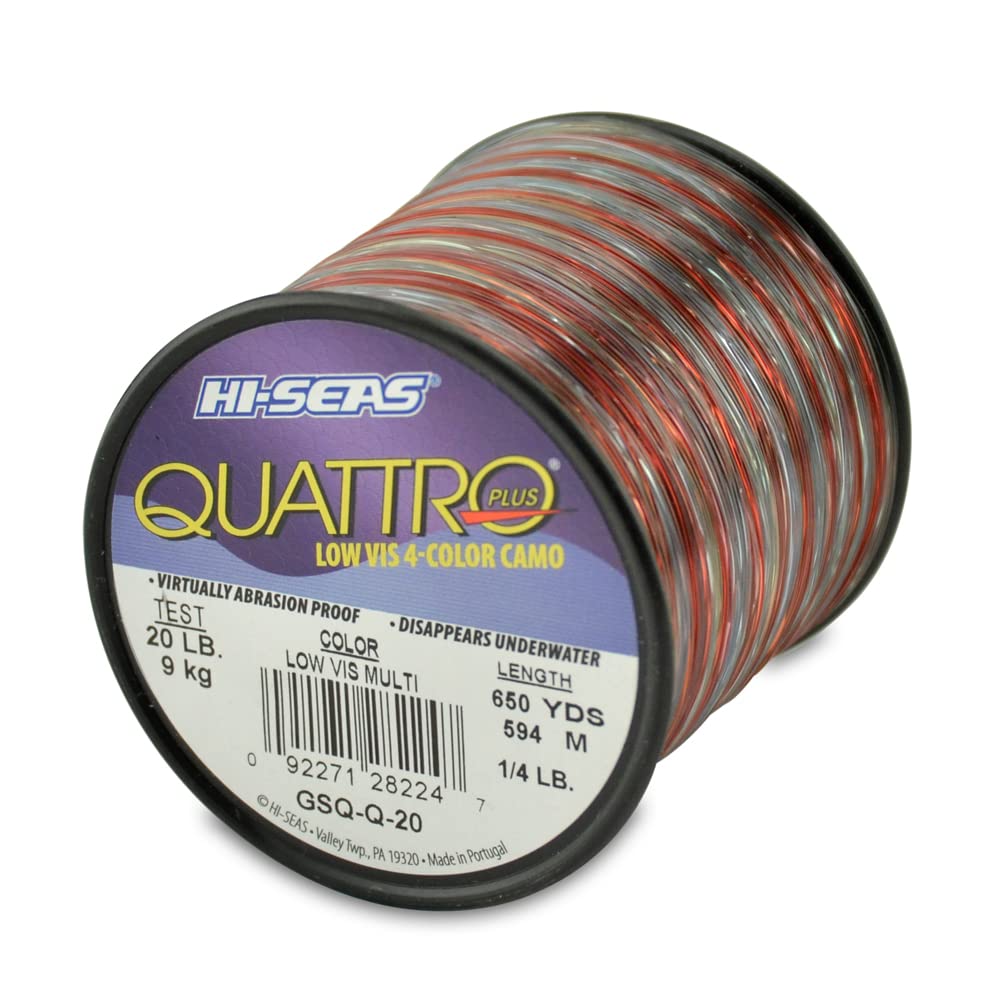
A low-vis monofilament with a 4-color camo pattern that disappears underwater better than any solid color line.
Monofilament has a different job than braid. It stretches, which acts as a shock absorber when a big fish hits a fast-moving lure. The HI-SEAS Quattro is designed specifically for saltwater main line use — targeting stripers, bluefish, marlin, and grouper. The four scientifically selected colors (black, blue, green, and red) are patterned in short lengths to break up the visual impact and disappear. At 20 pounds of breaking strength with a diameter of.018 inches, it is a solid choice for anglers who prefer the handling characteristics of mono over the feel of braid.
Buyers consistently mention the line’s reliability. One buyer mentioned landing some large fish and the line did not break. Another said HI-SEAS is the only fishing line they trust for toothy fish like speckled trout, noting that the tri-colored camo is invisible underwater and that the line has low memory and no backlashes. The main trade-off versus a braid is that the 20-pound breaking strength is well below the Yo-Zuri’s 50-pound line, so it is not the best choice if you are pulling fish out of dense structure.
Why Mono Works Here
- 4-color camo pattern is highly effective at disappearing underwater
- Low memory design minimizes coiling and backlashes
- Buyers trust it for catching speckled trout, bluefish, and stripers
The Limits
- 20-pound test is light for heavy cover or big grouper
- Monofilament degrades faster in UV than braid over extended use
Choose this for stealth: If you are fishing clear water where a visible braid line would spook wary fish, the Quattro’s camo pattern is a real advantage.
Switch to braid if: You need maximum strength and abrasion resistance for fishing around structure or need a line with zero stretch for deep-water jigging.
5. ROCRETA Geode Braided Fishing Line
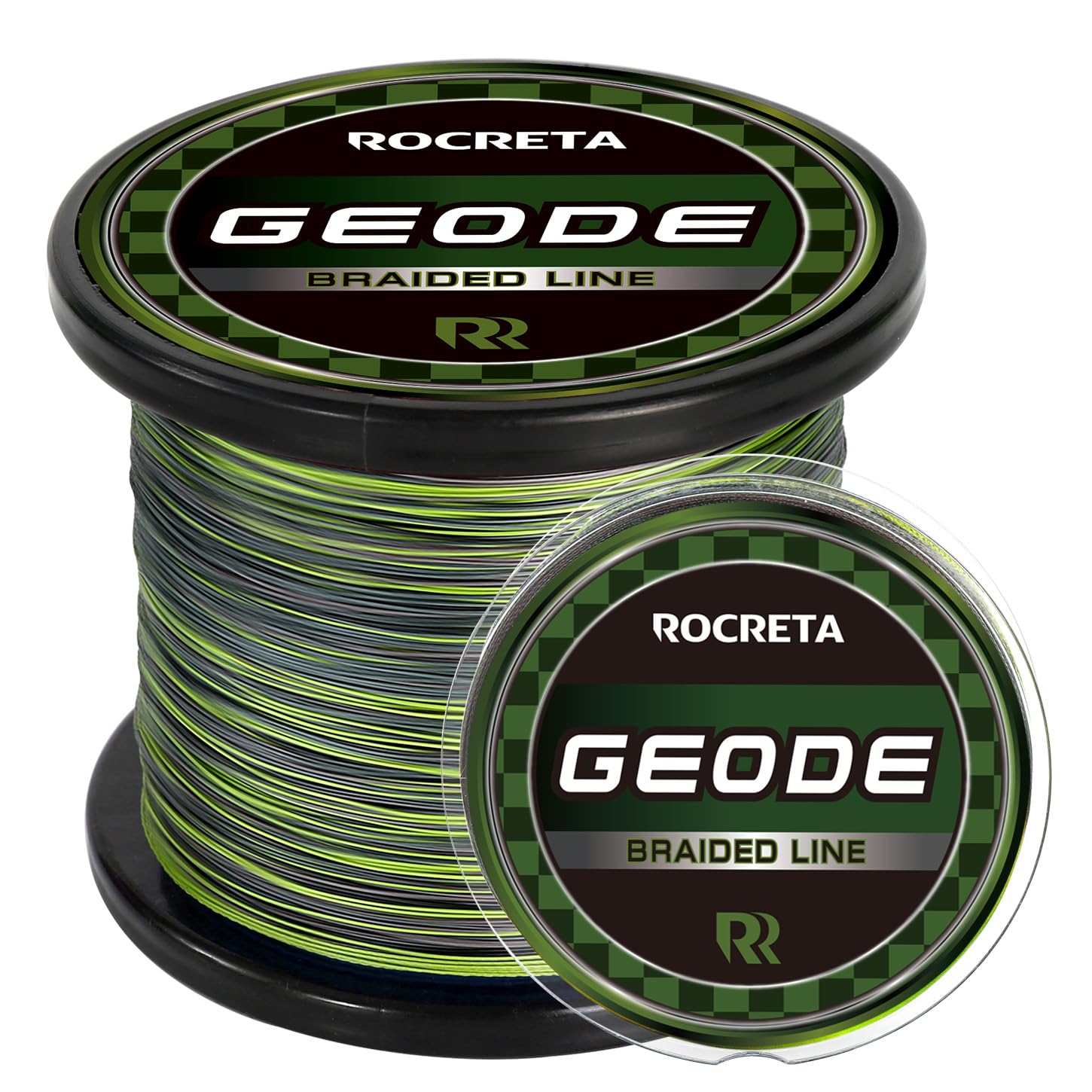
A new-brand braid that offers 34.5 pounds of breaking strength at a very accessible price point for beginners.
ROCRETA is a newer name in fishing gear, and the Geode braid is their attempt to win over skeptical anglers with real specs rather than marketing hype. The line uses a tight vertical braiding process that makes it nearly stretch-free, so you feel even subtle fish movements transmitted straight to your rod. It also features an SR-TP resin coating, which is a high-tech layer meant to increase abrasion resistance and prevent water absorption. The Camo Green color is a good choice for blending into stained or green water.
The maker claims the tested pulling force is actually 15% higher than the marked 30-pound rating, which is an unusual claim that positions it as an honest alternative to over-hyped lines. However, at 150 yards, this line is shorter than the 300-yard Reaction Tackle spool. That is enough for most inshore setups, but if you fish deep water or run a long leader, you will run out faster. The 34.5-pound breaking strength sits between the 20-pound lines and the Yo-Zuri’s 50-pound behemoth, making it a middle-ground option for anglers who want more muscle than a light 20-pound braid but do not need the full heavy artillery.
What Stands Out
- 34.5-pound breaking strength offers good margin over 20-pound lines
- SR-TP resin coating improves abrasion resistance for a budget braid
- Nearly zero-stretch weave keeps you connected to the bait
The Shortcoming
- 150 yards is shorter than the longer 300-yard spools
- Newer brand with less long-term track record than established names
Good starting point for: Beginner and intermediate anglers who want the benefits of braid — zero stretch and high sensitivity — without spending premium money.
Not ideal for: Anglers who spool large reels or fish deep water offshore where a longer 300-yard spool is needed to avoid running out of line mid-fight.
Understanding the Specs
Breaking Strength
This is the amount of force, measured in pounds, that it takes to snap the line. A 20-pound line is plenty for most inshore fish like speckled trout and bluefish. A 50-pound line, like the Yo-Zuri Superbraid, gives you the muscle to pull fish out of heavy cover without worrying about the line giving out. Match the breaking strength to the size of the fish you are chasing and the structure you are pulling them through.
Line Type: Braid vs. Monofilament
Braided lines are made from woven polyethylene fibers. They have very low stretch, which means you feel every bite instantly, and they resist UV damage better than mono. Monofilament is a single nylon strand. It stretches more, which can cushion a hard strike, but it holds memory and degrades faster in the sun. Braid is the better choice for saltwater if you want longevity and sensitivity; mono works well for topwater and applications where shock absorption matters.
FAQ
What color fishing line is best for saltwater?
Is braided or monofilament better for saltwater fishing?
How many pounds of test do I need for saltwater fishing?
Does colored fishing line fade in saltwater?
Can I use freshwater fishing line in saltwater?
How often should I replace my saltwater fishing line?
What does the Camo color pattern do underwater?
Why does braided fishing line have less stretch than monofilament?
Do I need a leader with a colored braided fishing line?
Can I use the same color line for inshore and offshore fishing?
Final Thoughts: The Verdict
For most people, the best color line for saltwater fishing is the Yo-Zuri Superbraid because its 50-pound breaking strength and high abrasion resistance give you the confidence to fish heavy structure without worrying about cut-offs. If you want a versatile all-around braid that inshore and offshore anglers trust across seasons, grab the SpiderWire Ultracast Braid. And for the budget-conscious angler who needs a 300-yard spool of reliable 20-pound braid, the standout is the Reaction Tackle Braided Line.
How We Picked
We do not accept paid placement. Every pick is matched to a real buyer and a real use-case; we do not hands-on test units.
Sources & Methodology
Specifications: manufacturer listings and product documentation. Review insights: verified customer reviews, as of July 2026. Pricing: not shown on this page (it changes often); check the current price via the retailer link.
As an Amazon Associate, WellFizz earns from qualifying purchases. This does not affect which products we feature.

Mo Maruf
I created WellFizz to bridge the gap between vague wellness advice and actionable solutions. My mission is simple: to decode the research and give you practical tools you can actually use.
Beyond the data, I am a passionate traveler. I believe that stepping away from the screen to explore new environments is essential for mental clarity and physical vitality.