Our readers keep the lights on and my smoothie glass nicely filled. As an Amazon Associate, I earn from qualifying purchases.
Specs are compiled from manufacturer listings and verified buyer reviews and can change over time — please confirm the key details on the product page before buying.
A CO2 regulator that drifts just a few PSI can turn a perfect pint into a foamy mess overnight. The real trick isn’t finding a cheap box of metal; it’s finding the valve that holds your pressure setting steady as the tank drains, the room warms up, and time passes. This guide cuts through the marketing on four real-world regulators so you pick the one that won’t let you down mid-party.
I’m Mohammad Maruf — the founder and writer behind WellFizz. This guide is built by comparing the manufacturers’ published specifications and the patterns across verified customer reviews, so you get each pick’s real strengths and trade-offs instead of marketing spin.
Every one of the four regulators below uses a CGA-320 fitting, but the differences in build quality, gauge size, and locking mechanisms can make or break your kegerator experience. Here is what you need to know before you buy a co2 regulator.
Quick Picks
- SPARC Premium Gen2 Triple Tap CO2 Regulator — Premium Pick
- Taprite T742HP Primary Double Gauge CO2 Regulator — Best Overall
- Hilangsan Dual Stage CO2 Regulator — Locked & Stable
- FERRODAY Dual Gauge CO2 Regulator — Budget Champion
How To Choose The Best CO2 Regulator
A regulator’s job is simple: reduce high tank pressure (up to 3000 PSI) down to a steady serving pressure around 10-15 PSI for beer, or higher for soda and kombucha. The complexity shows up in how accurately and reliably it holds that number.
Dual Stage vs. Single Stage
A dual-stage regulator drops the pressure in two steps, which keeps your output pressure rock steady even as the CO2 tank empties. If you carbonate multiple kegs or run a draft system for long sessions, this is the design you want. Single-stage models are cheaper but drift as tank pressure falls.
Gauge Readability
You need a low-pressure gauge you can actually read without squinting behind a tower or through a fridge gap. Look for gauges with clear markings, anti-fog covers, and at least a 2-inch face. A shockproof case adds a layer of durability if the regulator gets bumped during keg swaps.
Locking Mechanism
A locking collar or nut beneath the adjustment knob stops accidental pressure changes. Without one, a casual brush against the knob can push your serving pressure off by 5 PSI and ruin your carbonation level.
Quick Comparison
| Model | Best For | Output Pressure Range | Stages / Design | Gauge Size | Amazon |
|---|---|---|---|---|---|
| Taprite T742HP | Reliable daily driver | 1–50 PSI | Single stage | Standard 2-inch | Amazon |
| SPARC Gen2 Triple Tap | Multi-keg & high-volume setups | 0–60 PSI | Dual stage | 2-3/8 inch oversized | Amazon |
| FERRODAY Dual Gauge | Budget builds & secondary tasks | 0–50 PSI | Dual stage | Standard 2-inch | Amazon |
| Hilangsan Dual Stage | Locked-and-forget stability | 0–50 PSI | Dual stage | Standard 2-inch | Amazon |
In‑Depth Reviews
1. SPARC Premium Gen2 Triple Tap CO2 Regulator
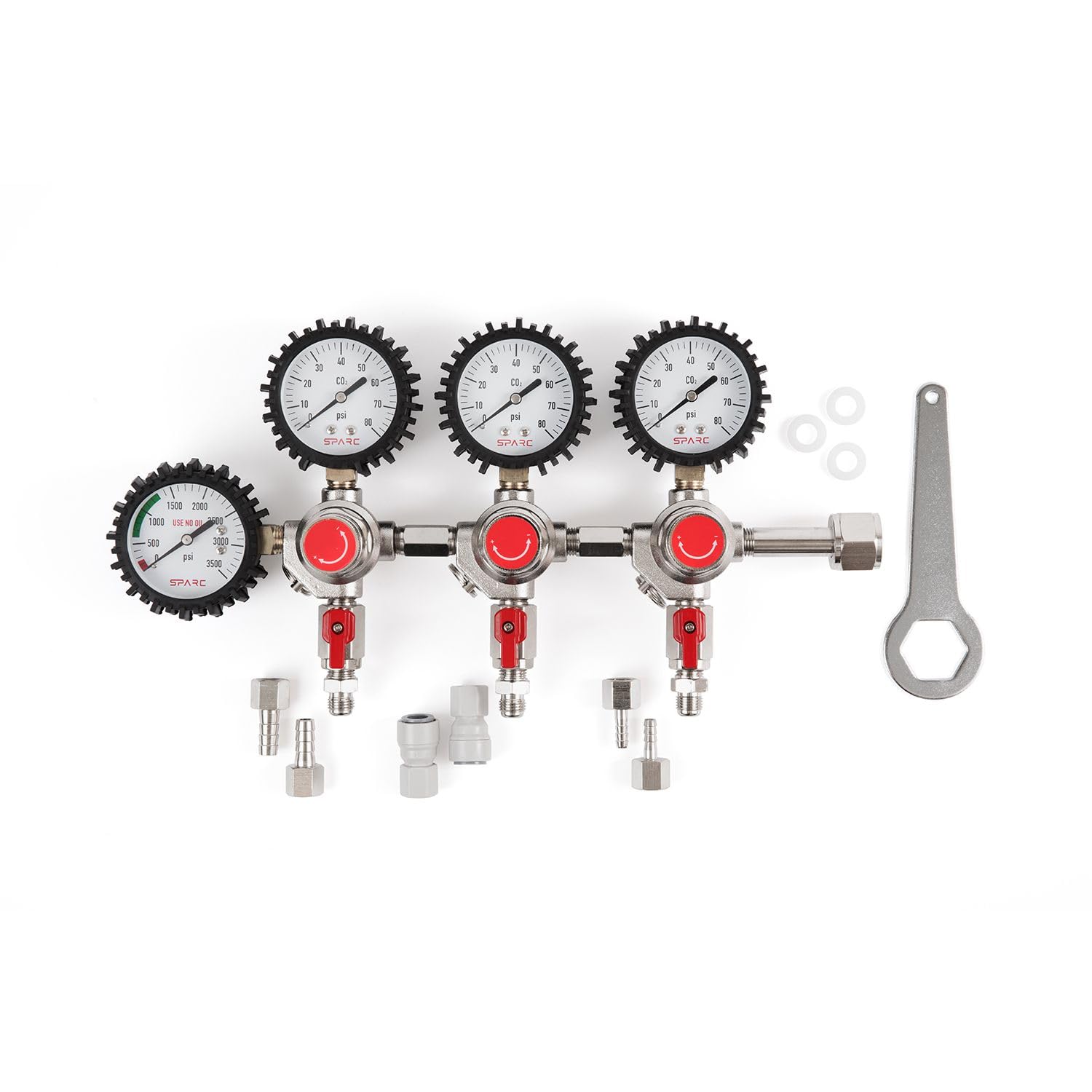
The triple-output powerhouse for anyone running multiple kegs at once.
You can carbonate beer, soda, and kombucha at three different pressures from one tank with the SPARC Gen2 because it has three independent output lines. Each line has its own oversized gauge — the gauges are 2-3/8 inches, which is larger than the typical 2-inch faces you see on most regulators like the Taprite T742HP, so you can read your pressure at a glance even in dim light behind a bar. The body is metal and covered in a nickel finish that resists rust better than chrome-plated brass in a damp kegerator environment.
At 15 x 8 x 2.5 inches, this unit is longer than the Taprite T742HP’s 6 x 6 x 6 inch body, which means you need to measure your kegerator collar clearance before buying. It accepts input pressure up to 3000 PSI and regulates output from 0 to 60 PSI (the gauges themselves read up to 80 PSI), so you can push soda or kombucha carbonation levels without maxing out the dial. The kit includes three 1/4-inch and three 3/8-inch hose barb fittings plus three push-to-connect fittings, giving you flexible line options right from the start.
The included CGA-320 bottle nut wrench stays attached to the regulator body, so you never have to hunt for a tool when swapping tanks. SPARC backs it with a 2-year USA-based warranty against manufacturing defects — a level of support that matches the premium price point.
What makes it worth the money
- Triple independent outputs let you carbonate beer, soda, and kombucha at different pressures simultaneously
- Oversized 2-3/8 inch gauges are easier to read than the standard 2-inch gauges on most competitors
- Nickel finish resists corrosion better than brass in humid kegerator environments
- Comes with three types of fittings and a captive tank wrench for tool-free bottle changes
The main trade-off
- At 15 inches long, it requires ample collar space — much longer than the Taprite’s 6-inch cube design
- Premium tier pricing is overkill if you only run a single keg
Best for serious setups: If you have three kegs, a soda line, or a kombucha tap all running off one tank, this regulator handles them without needing splitters or extra secondary regulators.
One real limitation: The 15-inch length means you must measure your kegerator clearance before ordering — this will not fit in a narrow coffin-style tower.
2. Taprite T742HP Primary Double Gauge CO2 Regulator

The plain-Brass workhorse that homebrewers trust for consistent pours.
You get consistent pours without fuss from the Taprite T742HP because it is assembled and tested in the USA and uses a brass body that seals reliably. The low-pressure gauge on top shows your output to the keg from 1 to 50 PSI, and the side high-pressure gauge tells you how much gas is left in the tank — the maximum downstream delivery is capped at 50 PSI, which means you cannot accidentally over-pressurize a standard soda or beer keg.
One design detail that sets this apart from budget regulators like the FERRODAY is the duckbill check valve (a one-way rubber valve that stops liquid from flowing back into the regulator) inside the output port, which helps prevent beer or cleaning solution from backing up into the regulator body — a common failure point when you leave a keg connected with liquid in the line. The body measures a compact 6 x 6 x 6 inches, making it a nearly perfect cube that fits into tight kegerator collars where the SPARC’s 15-inch length would not squeeze in. No locking nut is built in, so you will need to be careful not to bump the adjustment knob during keg changes or party traffic.
Veteran homebrewers often keep this regulator as their primary and use a cheaper unit like the FERRODAY for cleaning or transfer duties because the Taprite holds pressure more consistently over the life of a tank. Buyers report the brass construction handles years of regular use without corrosion, though the lack of a locking ring means you should check your setting after any jostle.
The reliable choice
- Duckbill check valve stops liquid backup from ruining the regulator internals
- Assembled and tested in the USA, which means tighter quality control than most import models
- Compact 6-inch cube form factor fits into tight kegerator collars
- Brass body resists corrosion and seals dependably year after year
What could be better
- No locking nut on the adjustment knob — a bump can shift your pressure setting
- Single output means you need a splitter for multi-keg setups
- Standard 2-inch gauges are smaller and harder to read than the SPARC’s 2-3/8 inch faces
Your everyday driver: This is the regulator to buy when you want dependable sealing, US assembly, and a shape that fits anywhere — it is the reference standard for single-keg homebrew systems.
skip it if: You need to control three kegs at different pressures from one tank, or you absolutely need a locking collar to prevent accidental knob turns.
3. Hilangsan Dual Stage CO2 Regulator
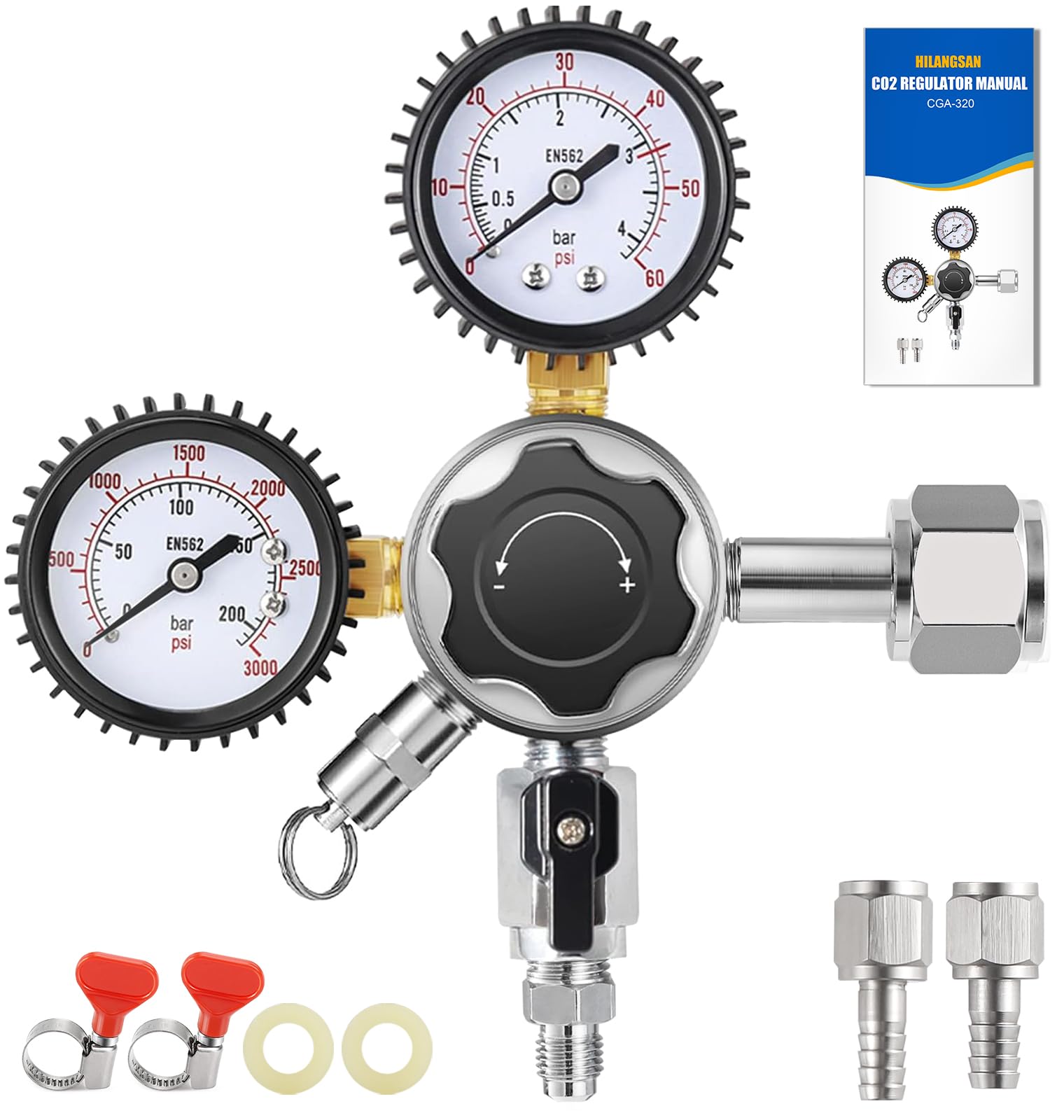
A dual-stage regulator with a locking nut that actually holds the PSI you set.
You can set your PSI and forget it with the Hilangsan because its adjustment knob has a locking nut underneath that locks the setting in place so a casual bump while loading kegs or reaching behind the fridge cannot throw off your carbonation. That matters because even a 2-3 PSI shift changes how much foam you get at the tap. The shut-off valve turns only 90 degrees to close, which means you can stop the gas flow instantly without spinning a knob multiple times.
It uses a dual-stage design (it drops the pressure in two steps instead of one) so the output stays constant from a full 3000 PSI tank all the way down to an almost-empty bottle — something a single-stage regulator like the Taprite T742HP cannot match. At 2.59 pounds, it is slightly heavier than the FERRODAY model at 2.48 pounds, which comes from the chrome-plated brass body and the shockproof case that protects the gauge faces from dents. The high-pressure gauge reads 0-3000 PSI for tank level, and the low-pressure gauge reads 0-60 PSI for fine-tuning your serving pressure between roughly 8 and 15 PSI for most beers.
One flexible feature is the swivel thread end fitting: you can install either a 1/4-inch or a 5/16-inch barb, or attach your own push-on fitting for modern EVA barrier tubing. Hilangsan backs the unit with a 2-year warranty and lifetime technical support — a solid safety net at this price tier. No customer reviews were available at the time of writing, but the dual-stage design with a locking nut is a proven formula among brewers who have had a bad experience with drift on cheaper single-stage units.
Why it stands out
- Locking nut prevents accidental PSI changes during keg swaps or fridge movement
- Dual-stage regulation keeps pressure steady as the tank empties
- Shockproof gauge case adds durability against bumps in tight kegerator spaces
- Swivel barb fitting works with both 1/4-inch and 5/16-inch gas lines
Things to know
- Heavier chrome-plated brass body (2.59 lb) compared to the lighter FERRODAY (2.48 lb)
- No customer reviews available yet to confirm long-term reliability
- Single output — you need a splitter to run multiple kegs
Ideal for forget-and-forget carbonation: If you have had a regulator drift on you before, the locking nut here is the exact feature that fixes that problem — set your PSI and walk away.
One honest caveat: Without existing buyer feedback to confirm the dual-stage performance over months of use, this is a bet on specs and warranty coverage rather than time-tested reputation.
4. FERRODAY Dual Gauge CO2 Regulator

The cheapest dual-stage option that still includes a lock ring and a PRV.
You get a lock ring for your PSI setting and a safety pressure release valve (a PRV that automatically pops at about 50 PSI) at an entry-level price with the FERRODAY. Most regulators at this cost skip the lock ring entirely, but this one includes one beneath the big adjustment knob so you can lock your PSI in place. The forged brass body is heavy-duty, and the CGA-320 inlet includes a sintered metal filter in the stem to keep debris from entering the regulator from the tank.
Owners mention that the regulator “initially lost 5 PSI over 2 days, but later held setting” — the kind of settling-in period many new regulators show as the internal diaphragm seats. The same reviewer noted the seller proactively offered help. Other buyers mention this works fine as a secondary regulator for cleaning kegs or transferring beer between vessels, where the slight drift is not critical. A few owners did experience a defective gauge or purge valve leak on arrival, though the seller response in multiple cases was fast replacement by the next day. The controls are not as sensitive as the Taprite T742HP, and the gauges are not certified for laboratory accuracy, but for the cost, it seals well and includes a spare gasket in the box.
Weighing 2.48 pounds, it is lighter than the Hilangsan at 2.59 pounds, making it one of the lighter dual-stage brass regulators available. The lock ring is a genuine difference-maker here — the Taprite at a higher price point does not include one. If you treat this as a competent budget tool for secondary keg work or as a starter regulator, it delivers solid value. Expecting Taprite-like precision on the first pour from the start may lead to disappointment.
What punches above its price
- Lock ring under the knob holds your pressure setting — absent on some more expensive regulators
- Pressure relief valve automatically vents at 50 PSI for safety
- Sintered metal filter in the stem keeps tank debris out of the valve seat
- Spare sealing gasket included for quick replacement
Where it cuts corners
- Customers note a settling-in period where pressure drifts 5 PSI before stabilizing
- Controls are less sensitive than the Taprite, making fine adjustments harder
- Gauges are not highly accurate — fine for transfers but not ideal for precision carbonation
Best for secondary tasks: Use this for cleaning kegs, pressure transfers, or as a backup — the lock ring and PRV are features you want on a utility regulator at this budget price.
Look elsewhere if: You need dead-on accuracy for a delicate German wheat beer carbonation on the first pour, or you cannot tolerate even a few PSI of initial drift while the diaphragm seats.
Understanding the Specs
Dual Stage vs. Single Stage Regulation
A dual-stage regulator uses two internal chambers to drop the pressure gradually, which means the output pressure stays exactly where you set it regardless of how much gas is left in the tank. A single-stage regulator drops the pressure in one step, and the output will climb slightly as the tank empties — a real problem if you carbonate a keg and leave it for weeks. Dual-stage is the safer bet for anyone who wants consistent carbonation over the full life of a CO2 cylinder.
Locking Nut / Lock Ring
This is a physical collar that sits under the adjustment knob and tightens down to prevent rotation. Without one, a bump from a passing hip, a dropped wrench, or a sharp fridge-door close can spin the knob and change your pressure. On a regulator with no lock, you should check the gauge reading every time you touch the tank. The FERRODAY and Hilangsan both include this feature; the Taprite does not.
FAQ
Will a CGA-320 regulator fit my CO2 tank?
How do I know if my regulator is leaking?
What PSI should I set for beer vs. soda?
Can I use one regulator for two kegs at different pressures?
What does the duckbill check valve do?
What size gas line should I use?
How often should I replace the sealing washer?
Is a chrome-plated brass body better than raw brass?
What does the PRV (pressure relief valve) do on a regulator?
Can I leave my CO2 tank valve open all the time?
Final Thoughts: The Verdict
If you want one dependable pick, the co2 regulator winner is the Taprite T742HP because it combines proven USA assembly, a compact 6-inch cube shape, and a duckbill check valve that prevents the most common regulator-killing failure mode. If you want the ability to run three kegs simultaneously with independent pressure control, grab the SPARC Gen2 Triple Tap. And for a dependable secondary or budget-first build, the FERRODAY Dual Gauge delivers dual-stage performance and a lock ring at an entry-level price.
How We Picked
We do not accept paid placement. Every pick is matched to a real buyer and a real use-case; we do not hands-on test units.
Sources & Methodology
Specifications: manufacturer listings and product documentation. Review insights: verified customer reviews, as of July 2026. Pricing: not shown on this page (it changes often); check the current price via the retailer link.
As an Amazon Associate, WellFizz earns from qualifying purchases. This does not affect which products we feature.

Mo Maruf
I created WellFizz to bridge the gap between vague wellness advice and actionable solutions. My mission is simple: to decode the research and give you practical tools you can actually use.
Beyond the data, I am a passionate traveler. I believe that stepping away from the screen to explore new environments is essential for mental clarity and physical vitality.