Specs are compiled from manufacturer listings and verified buyer reviews and can change over time — please confirm the key details on the product page before buying.
The biggest mistake when buying a hand grinder is thinking any crank will do — burr quality decides if your morning cup tastes muddy or clean. This guide focuses entirely on manual, hand-crank coffee grinders (no batteries or motors) and breaks down what separates a frustrating grind from a smooth one, so you can pick the one that fits your brew routine.
I’m Mohammad Maruf — the founder and writer behind WellFizz. This guide is built by comparing the manufacturers’ published specifications and the patterns across verified customer reviews, so you get each pick’s real strengths and trade-offs instead of marketing spin.
Whether you are dialing in for espresso or packing for a camping trip, the right coffee hand grinder will outlast any electric model and deliver consistently fresh grounds without taking up counter space.
Quick Picks
- TIMEMORE Chestnut C2S Manual Coffee Grinder — Best Overall
- KINGrinder K6 Manual Coffee Grinder — Precision Pick
- Vivaant Coffee Grinder Manual Capacity 32g — Largest Capacity
- HEIHOX Manual Coffee Grinder Capacity 30g — Stable Performer
- 1Zpresso J Manual Coffee Grinder — Premium Build
- Premium Manual Coffee Grinder by Alpaca Ventures — Entry-Level Metal
- KINGrinder P0 Lightweight Manual Coffee Grinder — Ultra-Light Travel
How To Choose The Best Coffee Hand Grinder
Picking a hand grinder depends on how you brew, how much you grind, and how long you want it to last.
Burr Type and Material
Conical steel burrs — especially stainless steel — deliver uniform grounds without shredding beans like a blade grinder. Steel stays sharp much longer than ceramic and handles darker, oilier roasts without clogging. The burr diameter (typically 38 mm to 48 mm) also affects grinding speed: larger burrs crush beans faster with less effort.
Grind Adjustment Range and Clicks
The number of click settings tells you how precisely you can dial in the grind size. More clicks per rotation (30–60) mean finer control between espresso-fine and French-press-coarse. External adjustment rings are easier to switch mid-brew than internal nuts, especially if you swap brew methods often.
Capacity and Portability
Single-serve grinders hold 20–25 g of beans (enough for one or two cups), while larger models pack 30–35 g for a full pot. If you travel or camp, weight and body material matter: ABS plastic models are lighter than all-metal ones, but metal bodies are more durable and feel more stable during grinding.
Quick Comparison
| Model | Best For | Burr Material | Capacity | Weight | Amazon |
|---|---|---|---|---|---|
| 1Zpresso J | Premium durability | 48 mm Stainless Steel | — | — | Amazon |
| TIMEMORE Chestnut C2S | Best Overall mid-range | 38 mm Stainless Steel | 25 g | 700 g | Amazon |
| KINGrinder K6 | Precision espresso tuning | Stainless Steel | 25–35 g | — | Amazon |
| Vivaant | Extra capacity for groups | Stainless Steel Conical | 32 g / 1.14 oz | — | Amazon |
| HEIHOX | Double bearing stability | 38 mm Stainless Steel | 30 g | 0.87 kg | Amazon |
| Alpaca Ventures | Budget entry-level metal build | 420 Stainless Steel | — | 16 oz | Amazon |
| KINGrinder P0 | Ultra-light travel | Stainless Steel | 20 g | 330 g | Amazon |
In‑Depth Reviews
1. TIMEMORE Chestnut C2S Manual Coffee Grinder

The full-metal upgrade that solved the fragile top-cover issue and grinds evenly every time.
The TIMEMORE Chestnut C2S replaces the older C2 with a unibody metal frame, so that common break point at the top cover is gone. It uses a 38 mm stainless steel conical burr (the S2C type) with a hardness of 55–58 HRC (a measurement of steel hardness) machined via 5-axis CNC, which keeps fines — the ultra-fine dust that makes coffee taste bitter — to a minimum. You get about 36 grind levels by turning the adjustment nut, and the double-bearing center axis keeps the burr stable as you crank.
Buyers report that the C2S holds roughly 24 g of beans per load, and it grinds two espresso scoops in about a minute. One reviewer called it “affordable, effective, well made” and noted the flavor improvement over cheaper grinders. Another pointed out that changing the grind setting is slightly fiddly because you rotate the nut, so this is best if you tend to stick with one brew method rather than switching daily. At 700 g, it is light enough to throw in a camping bag but dense enough to feel premium in your hand.
Solid Foundation
- Wider 25 g capacity than the KINGrinder P0 (20 g), a 25% increase per load
- Even particle size with low fine dust, thanks to the 5-axis CNC burr
- Double bearing for smoother cranking without wobble
One Trade-Off
- Internal grind adjustment nut is slower to change than a numbered ring
- Not ideal if you switch between espresso and French press daily
Who this fits: Home brewers who make pour-over or drip coffee most days and want a durable metal grinder that outperforms electric models at the same price point.
A fair warning: If you plan to jump between fine and coarse settings multiple times per session, the nut-style adjustment can feel slower than an external dial.
2. KINGrinder K6 Manual Coffee Grinder
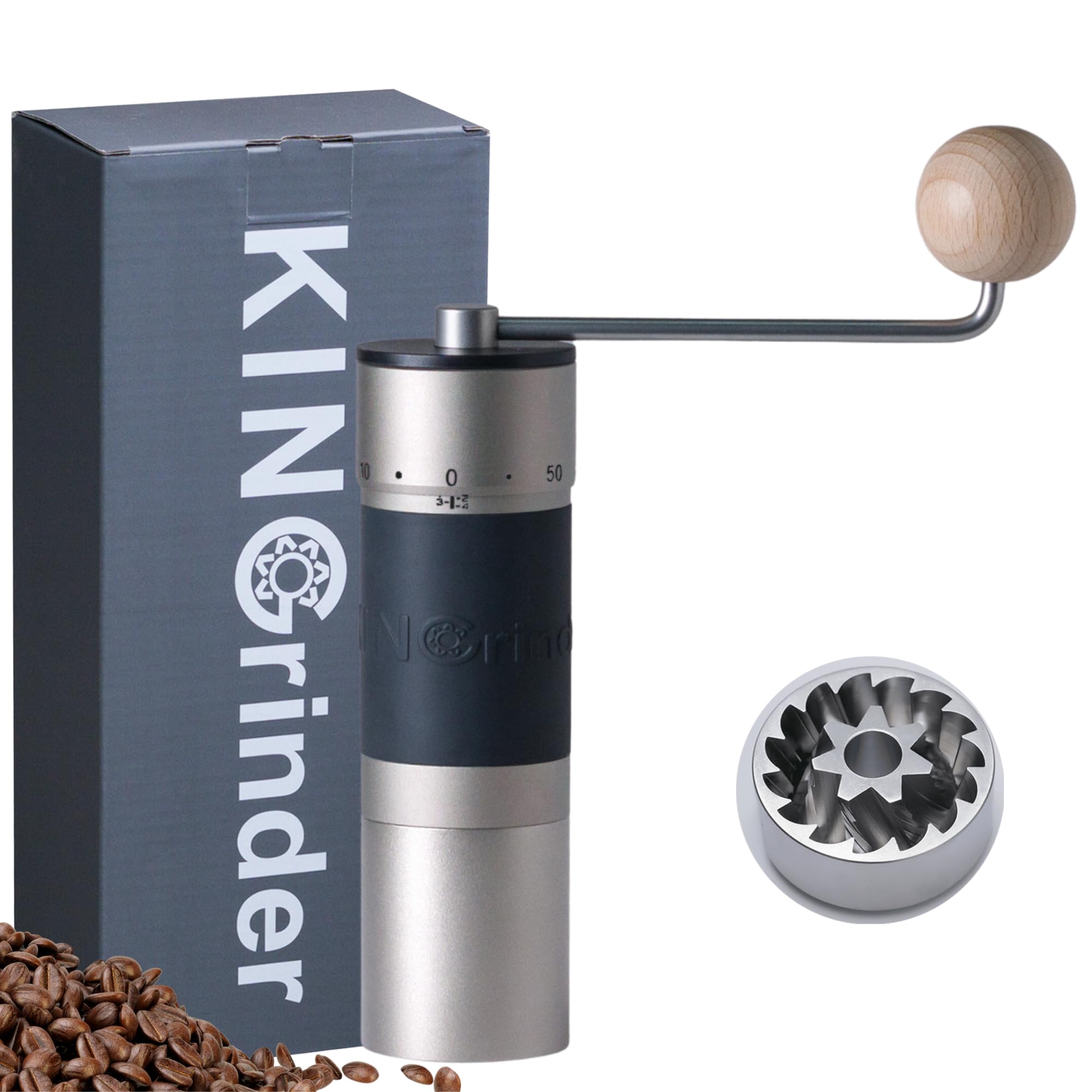
The external adjustment ring gives you micro-fine control without taking anything apart.
Where the TIMEMORE C2S uses an internal nut, the KINGrinder K6 puts the grind adjustment on the outside — a numbered nut that clicks 60 times per full rotation, with a total of 4 full rotations available. Each click changes the particle size by just 16 microns (a micron is one-thousandth of a millimeter), giving you extremely fine control for dialing in espresso shots or tweaking a pour-over recipe. The body is aluminum with a stainless steel burr set and dual bearings, so the crank stays aligned and stable even under pressure.
The hopper holds between 25 g and 35 g of beans, which beats the TIMEMORE C2S by up to 10 g per load — handy if you brew for two. It is also fully disassemblable by hand for cleaning. A YouTuber with 2 million subscribers gave it a glowing review, but the real draw is the external numbered adjustment that makes recipe-switching easy.
Micro-dial verdict: If you tune your grind size by single clicks for espresso, this is the most precise hand grinder in this lineup — the 16-micron step is tighter than most entry-level electrics.
The trade-off: At a mid-premium price point, you are paying for that external mechanism and metal build, so if you only brew French press at a single setting, you may not need this level of granularity.
Best for: Coffee tinkerers who adjust their grind depending on the bean origin or brew method and want repeatable results without guesswork.
skip it if: You only drink one type of coffee and never change settings — a simpler grinder will save money and still deliver uniform grounds.
3. Vivaant Coffee Grinder Manual Capacity 32g

The 32 g hopper and glass jar make it the best option for brewing a full pot without refilling.
That extra capacity means one load produces roughly 4 oz of ground coffee, which reviewers confirm is enough for a full French press or a large pour-over carafe. The “Dragon Tooth” stainless steel conical burr is designed to grind twice as fast as ceramic burrs, according to the manufacturer, and the numbered ring (settings 1 through 6) sits on the outside of the grinder so you can adjust without disassembling anything.
The set comes with a glass jar marked for measuring, plus a lid for storage. Buyers mention that the glass jar can break if dropped, but the company responded quickly with a replacement jar — one reviewer noted customer service “replaced shattered glass jar quickly with properly marked one.” The grinder body is a mix of metal and plastic, which keeps it light enough for camping, and the quiet operation means you can grind early morning without waking the house.
Big Batch Advantage
- 32 g capacity handles a full pot in one grind, unlike smaller 20 g models that need two loads
- External numbered dial (1–6) makes method switching simple
- Fast grinding — reviewers report ~6 tbsp in about a minute
Fragility Concern
- Glass jar can shatter if dropped
- Plastic components feel less premium than all-metal alternatives
Reach for this if: You regularly brew for two or more people and want a single-fill solution that still fits in a travel bag.
Look elsewhere if: You are rough with gear or need an indestructible all-metal build for heavy camping use.
4. HEIHOX Manual Coffee Grinder Capacity 30g

A double-bearing unibody structure that keeps the burr aligned batch after batch.
The HEIHOX uses a double-bearing central axle (two bearings support the spinning shaft instead of one) to keep the 38 mm stainless steel conical burr stable as you crank. This reduces wobble, which means the grounds stay more uniform across the full grind range. It offers over 24 click settings through an internal adjustment dial, so you can go from Turkish-fine to cold-brew-coarse, though the internal mechanism takes a moment to get used to compared to an external ring.
The body is aluminum, which prevents coffee oils from sticking, and it disassembles with a simple twist for cleaning. It includes a drawstring bag and a brush, and at 2.2 x 7 inches, it is compact enough for hiking or backpacking. The manufacturer claims a service life 5 times longer than a blade grinder, but this is an unverified claim. One practical note: at 0.87 kg, it is heavier than the KINGrinder P0 (330 g), so it feels more stable on the counter but less ideal for ultra-light packing.
Counter-stability pick: The extra weight and double-bearing design give this grinder a planted feel that cheaper plastic models lack — you can crank without holding the body steady.
One caveat: The internal adjustment dial is less convenient for frequent brew-method changes; stick with one setting most of the time for the best experience.
Best for: Home users who grind mostly one style of coffee and value build stability and durability over portability.
pass on it if: You need a lightweight travel companion or an external numbered ring for fast setting changes.
5. 1Zpresso J Manual Coffee Grinder

The largest burr in this lineup at 48 mm, engineered for 100–200 kg of grinding life.
The 1Zpresso J stands apart with its 48 mm stainless steel conical burr — larger than the 38 mm burrs on the TIMEMORE C2S and HEIHOX. A bigger burr crushes beans faster with each rotation, and 1Zpresso backs it with a claimed lifetime of 100 to 200 kg of grinding (that is potentially hundreds of thousands of cups before the burr wears out). The internal adjustment offers 30 clicks per rotation, factory-calibrated for alignment, so the burr stays centered and wobble-free even after heavy use.
It features a foldable handle that pushes, twists, and tucks away to prevent tipping on narrow countertops — a smart design for small kitchens or RV travel. Tool-free dismantling makes cleaning straightforward, and it includes a cleaning brush. The price is at the top end of this group, but you are essentially buying a burr set that rivals dedicated electric grinders in consistency, without the motor noise or heat that can stale the coffee.
Durability First
- 48 mm steel burrs grind faster and last longer than smaller 38 mm burrs
- Foldable handle is space-saving and prevents the grinder from tipping
- Rated for 100–200 kg of grinding — a true long-term investment
Premium Price, Basic Adjustment
- Internal adjustment is less intuitive than external dials found on the KINGrinder K6
- Heftier than budget plastic models, so not the lightest travel option
Who this fits: Serious home baristas who want one grinder that will outlast multiple electric machines and deliver café-quality grind consistency for years.
The honest catch: At this price point, you get a burr that competes with + electrics, but the internal adjustment takes a few uses to memorize.
6. Premium Manual Coffee Grinder by Alpaca Ventures

A 420 stainless steel burr and dual bearings at a price that gets you into metal build territory.
The Alpaca Ventures grinder uses 420 stainless steel for its conical burrs and an aluminum body, giving you an all-metal feel without the premium price of the 1Zpresso J or TIMEMORE C2S. It has a dual-bearing design (a bearing at the top and bottom of the axle) so the handle moves smoothly with less wobble than single-bearing grinders. The adjustment dial offers 12 settings for grind size, and the handle attaches via a 5.5 mm socket — a detail that owners mention makes the crank feel solid with zero play.
Customers note one real-world limitation: “Con: must grind 1.5x capacity for pour-over,” meaning the chamber is smaller than the typical 25–30 g models, so you will need to reload for a single large cup. One reviewer praised it for grinding whole cloves as a spice grinder (15 clicks from stop, 50 turns), showing the burr handles tough non-coffee jobs too. The included brush helps with cleaning, and at 16 oz, it is heftier than the 330 g KINGrinder P0 but still portable for camping or office use.
Budget-metal gateway: If you want to move past plastic grinders but cannot justify +, this dual-bearing aluminum body gives you a sturdy, repairable option with decent grind consistency.
Size reality: At 5.5 x 1.9 x 6.3 inches, it is noticeably taller than the KINGrinder P0 (1.97 x 1.97 x 5.12 inches) — a 2.8x height difference — so check your counter or travel bag space.
Best for: First-time hand grinder buyers who want a metal body and reliable burrs without spending for premium features like external micro-adjustment.
it’s not for you if: You regularly brew pour-over for one and do not want to grind 1.5 loads per session.
7. KINGrinder P0 Lightweight Manual Coffee Grinder

The featherweight that climbs without wheezing — just 330 g with 30 precise click settings.
The KINGrinder P0 is built from ABS plastic (a tough, lightweight polymer) with a stainless steel burr, and it weighs just 330 g — less than half the weight of the HEIHOX (0.87 kg) and roughly the same as a can of soda. That makes it the clear choice for backpacking, hiking, or tossing into a carry-on. Despite the plastic body, the burr is genuine stainless steel, and the adjustment mechanism offers 30 clicks per rotation, with each click representing a 0.0333 mm change in particle size.
The hopper holds 20 g of beans per load, which is enough for about one standard mug of coffee. While that is the smallest capacity in this guide — compare it to the Vivaant’s 32 g — it matches the reality of a single-serving travel grinder. A cleaning brush is included, and the whole unit disassembles without tools. A YouTuber with 2 million subscribers gave it a glowing review, but the value is straightforward: a capable stainless steel burr grinder that disappears into your pack.
Travel Champion
- Lightest in the guide at 330 g, ideal for camping and air travel
- 30 click settings with fine 0.0333 mm increments for decent control
- Stainless steel burr in a lightweight body — better than plastic blade grinders
Compromises for Weight
- ABS plastic body feels less premium than metal alternatives
- 20 g capacity means you will reload for anything beyond a single cup
Reach for this if: Portability is your top priority — backpackers, van-lifers, and travelers who want fresh grounds on the trail without adding bulk.
Look elsewhere if: You brew for multiple people or prefer a heavy, stable metal grinder that stays planted on the counter.
Understanding the Specs
Conical Burr and Burr Size
The burr is the pair of ridged cones that crush coffee beans into evenly sized particles. A larger burr diameter (like 48 mm on the 1Zpresso J) grinds faster and with less effort than a smaller one (like 38 mm on the TIMEMORE C2S). Steel burrs also stay sharp much longer than ceramic ones and handle oily roasts without clogging.
Click Settings and Grind Adjustment
The number of clicks tells you how precisely you can change grind size. More clicks per rotation means tighter control. For example, the KINGrinder K6 offers 60 clicks per rotation with each click shifting particle size by 16 microns, while the KINGrinder P0 gives 30 clicks per rotation with a 0.0333 mm change. External adjustment rings (like on the KINGrinder K6 and Vivaant) are easier to change mid-brew than internal nuts (TIMEMORE C2S, 1Zpresso J).
FAQ
How many grams of beans does a typical hand grinder hold?
What is the difference between ceramic and stainless steel burrs?
Will a hand grinder work for espresso?
How do I clean a manual coffee grinder?
How long should a hand coffee grinder last?
Is a hand grinder better than an electric burr grinder?
What is double bearing and why does it matter?
Can I use a hand grinder for French press and pour-over?
What does “external adjustment” mean on a coffee grinder?
Is a lightweight ABS hand grinder durable enough for daily use?
Final Thoughts: The Verdict
If you want one dependable pick, the coffee hand grinder winner is the TIMEMORE Chestnut C2S because it combines an all-metal unibody build, a precise 36-level grind adjustment, and a 38 mm stainless steel burr that delivers uniform grounds without the fragile top that earlier versions had. If you want micro-adjustment for espresso tuning, grab the KINGrinder K6 with its 16-micron clicks and 60-click per rotation external dial. And for backpackers who count every gram, the KINGrinder P0 at 330 g gives you stainless steel burr quality in a lightweight ABS body that disappears into your pack.
How We Picked
We do not accept paid placement. Every pick is matched to a real buyer and a real use-case; we do not hands-on test units.
Sources & Methodology
Specifications: manufacturer listings and product documentation. Review insights: verified customer reviews, as of July 2026. Pricing: not shown on this page (it changes often); check the current price via the retailer link.
As an Amazon Associate, WellFizz earns from qualifying purchases. This does not affect which products we feature.

Mo Maruf
I created WellFizz to bridge the gap between vague wellness advice and actionable solutions. My mission is simple: to decode the research and give you practical tools you can actually use.
Beyond the data, I am a passionate traveler. I believe that stepping away from the screen to explore new environments is essential for mental clarity and physical vitality.