Our readers keep the lights on and my smoothie glass nicely filled. As an Amazon Associate, I earn from qualifying purchases.
Specs are compiled from manufacturer listings and verified buyer reviews and can change over time — please confirm the key details on the product page before buying.
You walk into a room and feel foggy, irritable, or just plain tired — even after a full night’s sleep. That sluggishness often comes from too much carbon dioxide building up in a sealed space. A reliable CO2 sensor gives you a clear number so you know exactly when to crack a window and bring fresh air back in.
I’m Mohammad Maruf — the founder and writer behind WellFizz. This guide is built by comparing the manufacturers’ published specifications and the patterns across verified customer reviews, so you get each pick’s real strengths and trade-offs instead of marketing spin.
The real question is which model fits your home, office, or travel needs without wasting money on features you won’t use. Here is the breakdown of the best CO2 sensor options for every scenario, based on accuracy, battery life, and real buyer feedback.
Quick Picks
- GoveeLife Smart Air Quality Monitor — Best Overall
- SwitchBot CO2 Detector — Best Value
- Temtop M10+ 6-in-1 CO2 Meter — Longest Battery
- 16-in-1 Air Quality Monitor (YNAK) — Big Screen Pro
- 16-in-1 Air Quality Monitor (flazecon) — Compact All-Rounder
- KDWKD Indoor Air Quality Monitor — Budget Champion
- 22 HOBBIES Air Quality Monitor — Entry-Level Pick
How To Choose The Best CO2 Sensor
Picking the right CO2 sensor depends on matching the device to where you will use it and what else you want to measure. A bedroom monitor might only need CO2 and humidity, while a home office or classroom could benefit from tracking fine dust (PM2.5) and chemical fumes (TVOC). Start with the sensor type, then think about power, portability, and alerts.
Sensor Type: NDIR vs Photoacoustic
The gold standard for CO2 measurement is an NDIR (non-dispersive infrared) sensor, which shines a light through an air sample and measures how much infrared the CO2 molecules absorb. This method stays accurate for years without drifting. Some newer sensors use photoacoustic NDIR, like the SCD4x chip found in the GoveeLife model, which uses sound waves from light absorption — it is just as accurate but in a smaller package. Avoid cheaper chemical sensors that wear out quickly.
Power Source: Battery or Always Plugged In
Battery-powered models let you move the sensor from room to room or take it in the car. Look for at least 8 hours of runtime if you plan to carry it, or long battery life measured in months if you set it on a shelf and forget it. AC-powered units, like the GoveeLife, run 24/7 with no recharging — better for a fixed spot like a nursery or home office where you want constant monitoring.
Alerts and Smart Features
A simple buzzer that sounds when CO2 passes 1000 ppm (parts per million, the standard measurement unit) is enough for many people. App-connected sensors add trend graphs, push notifications, and sometimes trigger smart plugs to turn on a fan or humidifier. Decide if you want a standalone device that just beeps or a Wi-Fi-enabled unit that feeds data to your phone and voice assistant.
Quick Comparison
| Model | Best For | Sensor Type | Battery Life | Measurements | Amazon |
|---|---|---|---|---|---|
| GoveeLife Smart Air Quality Monitor | 24/7 Home Monitoring | Photoacoustic NDIR | AC Powered | CO2, Temp, Humidity | Amazon |
| SwitchBot CO2 Detector | Accurate Portable Use | Swiss NDIR | Up to 12 Months | CO2, Temp, Humidity | Amazon |
| Temtop M10+ 6-in-1 | Long Battery & E-Ink Display | NDIR | Up to 60 Days | CO2, PM2.5, TVOC, Temp, Humidity | Amazon |
| 16-in-1 Air Quality Monitor (YNAK) | Large Display & Multi-Parameter | NDIR | Up to 8 Hours | CO2, PM2.5, PM1.0, PM10, HCHO, TVOC, Temp, Humidity | Amazon |
| 16-in-1 Air Quality Monitor (flazecon) | Compact Multi-Sensor | NDIR | Rechargeable | CO2, PM2.5, PM1.0, PM10, HCHO, TVOC, Temp, Humidity | Amazon |
| KDWKD Air Quality Monitor | Budget All-in-One | NDIR | Up to 9 Hours | CO2, PM2.5, PM10, HCHO, TVOC, Temp, Humidity | Amazon |
| 22 HOBBIES Air Quality Monitor | Entry-Level Value | NDIR | 9-10 Hours | CO2, TVOC, HCHO, AQI, Temp, Humidity | Amazon |
In‑Depth Reviews
1. GoveeLife Smart Air Quality Monitor
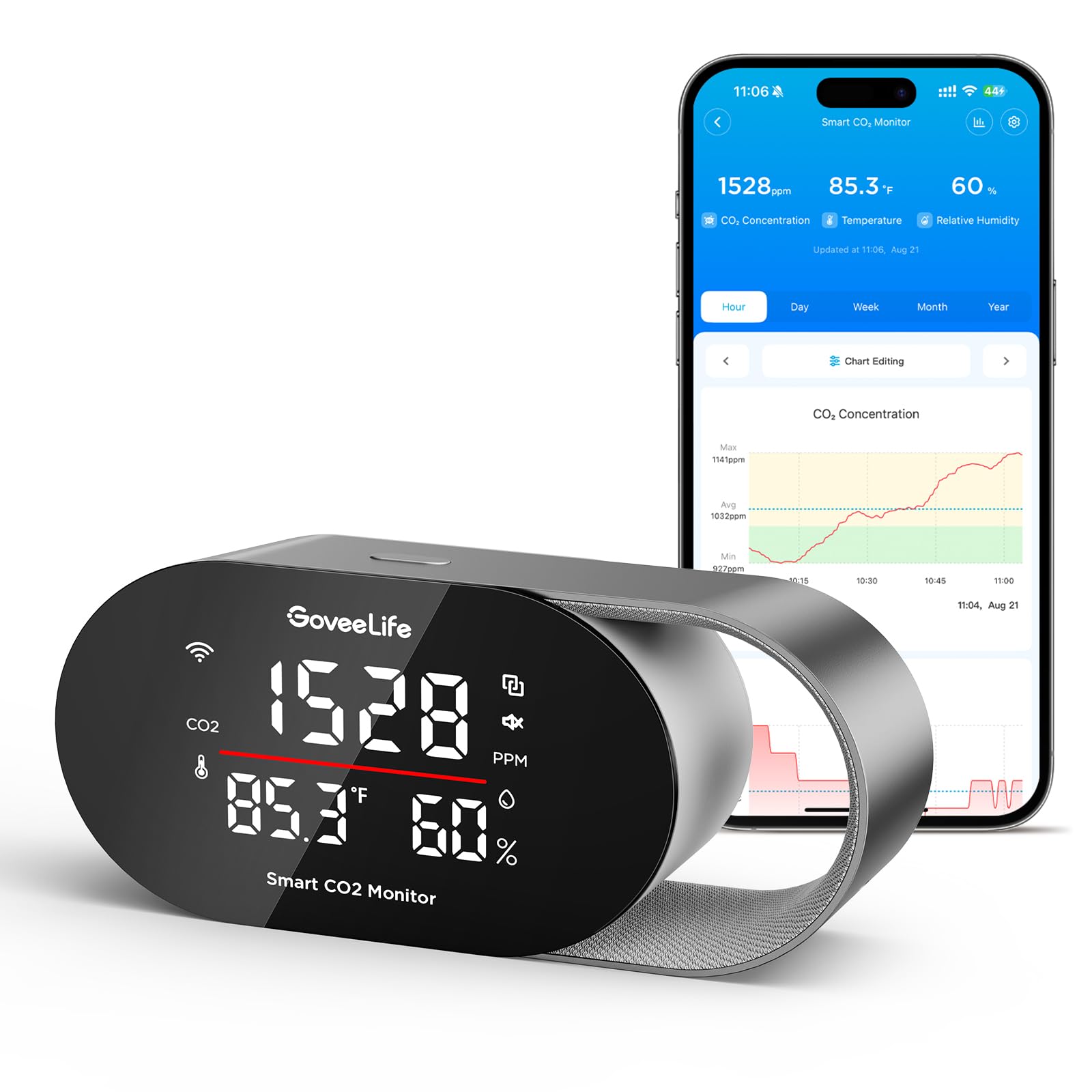
Always-on CO2 tracking that never asks for a battery swap.
This is the set-and-forget champion for people who want continuous monitoring without ever thinking about recharging. Its SCD4x photoacoustic NDIR sensor — the same principle as an NDIR but using sound waves from light absorption to measure CO2 — delivers accuracy of ±(40ppm + 5%) with a fast 5-second refresh rate. You plug it in via the included Type-C cable and it runs 24/7, showing CO2, temperature, and humidity on a 4.82-inch display with an auto-dimming tri-color light bar that adjusts brightness based on your custom day/night schedule in the app.
Buyers report that the app tracks up to two years of historical data, and the triple alert system — a built-in buzzer, app notifications, and email reports — catches CO2 spikes from gatherings, which one reviewer called “the Ultimate Party Pooper (In the Best Way Possible).” The sensor also triggered a smart fan automatically to fix ventilation. Unlike the 22 HOBBIES model that relies on a 1200 mAh battery, the GoveeLife never sleeps, making it ideal for bedrooms and nurseries where you need consistent overnight data.
One downside: some users note Wi-Fi connectivity can drop if the unit sits far from the router. Also, it does not measure particulate matter like PM2.5, so if you also want dust or smoke detection you will need a different or additional device.
Always-On Edge
- AC-powered so no battery anxiety — runs 24/7 without interruption.
- Photoacoustic NDIR sensor with ±(40ppm + 5%) accuracy and 5-second refresh.
- Triple alert system (buzzer, app, email) with smart home triggers for fans and humidifiers.
- Tri-color LED auto-dims on a schedule so it does not disturb sleep.
The Trade-Offs
- No battery backup — a power outage means a gap in data.
- Wi-Fi connectivity can be spotty if placed far from the router.
- Only measures CO2, temperature, humidity, and dew point — no PM2.5 or TVOC.
Reach for this if: You want round-the-clock CO2 monitoring in a fixed spot like a nursery, home office, or bedroom and do not want to mess with batteries.
Look elsewhere if: You need to move the sensor between rooms or also track particulate matter and chemical VOCs.
2. SwitchBot CO2 Detector

Lab-grade Swiss sensor at a price that undercuts the competition.
The SwitchBot packs a Swiss-made NDIR sensor (NDIR stands for non-dispersive infrared, a type of sensor that uses an infrared light beam to detect CO2 concentration) that measures every 1 second with an accuracy of ±50 ppm and a wide range of 400 to 9000 ppm. At 0.3 pounds it is noticeably lighter than the 16-in-1 flazecon monitor which weighs 0.49 pounds — a 63% weight difference that makes the SwitchBot easy to toss in a bag or mount on a wall with its included bracket.
Owners mention that outdoor readings match the expected 400-450 ppm range, confirming its baseline accuracy. It also matched another detector within 0.61% (1140 vs 1147 ppm) in one reviewer’s test. The 92-millimeter screen shows CO2, temperature, humidity, time, date, and a comfort level all at once. Alerts come three ways: an audible buzzer, a visual screen warning, and app notifications if you add a SwitchBot Hub.
A key strength is battery life — the built-in cells last up to 12 months, so you can set it on a desk and ignore it for nearly a year. One reviewer noted that on battery power the CO2 reading updates every 5 minutes to save energy, but plugged in via USB the readings can freeze for hours, so it is best used cordless. The app graphs are sometimes glitchy, but for raw accuracy and long runtime this is a top pick.
Why It Wins
- Swiss-made NDIR sensor with ±50 ppm accuracy and 1-second response time.
- Up to 12 months of battery life on a single charge — nearly maintenance-free.
- Large 92mm display shows CO2, temp, humidity, time, and comfort level simultaneously.
- Wall-mountable with included bracket and adjustable stand.
Keep in Mind
- Connected to USB power, readings can freeze for hours — best used on battery.
- App connectivity occasionally drops and the graphs can glitch.
- No PM2.5 or TVOC sensing — CO2 and basic climate only.
Best for: Someone who wants a highly accurate long-lasting CO2 detector that can sit on a shelf for a year without worry — perfect for home or office.
skip it if: You need room-to-room portability without leaving it in one spot, or you want multi-pollutant coverage.
3. Temtop M10+ 6-in-1 CO2 Meter

E-ink display and ultra-low power for weeks of uninterrupted reading.
The Temtop M10+ stands out with a crisp e-ink display — the same paper-like screen tech found on e-readers — that draws almost no power, letting the device run up to 60 days on a single charge. It tracks CO2, PM2.5, TVOC (total volatile organic compounds, which are chemical vapors from paint, cleaning products, or new furniture), temperature, and humidity, all in a compact 9.6-ounce package.
Customers note that the readings are “very sensitive” and confirmed accurate when tested against other monitors. One buyer mentioned that you can set it to display CO2 ppm (parts per million, the standard measurement unit for CO2 concentration) for weeks of charge, switching to other metrics only when needed via the Temtop app. The app also supports over-the-air (OTA) updates so the firmware stays current without plugging into a computer. The adjustable alarm can be muted completely — a thoughtful touch for bedrooms.
The e-ink display is exceptionally readable in normal or bright daylight, though it updates slower than a standard LCD. Some users found the app “feature-limited,” and if you cycle through all measurements constantly the battery drains much faster. Still, for the combination of multi-sensor coverage and the longest real-world battery, this is a strong pick.
Standout Strengths
- Up to 60 days of battery life thanks to the e-ink screen and energy-efficient algorithm.
- E-ink display is crisp and readable in bright light, with no distracting screen glow at night.
- Measures CO2, PM2.5, TVOC, temperature, humidity in one device.
- Supports OTA firmware updates and app connectivity for data history.
Watch For
- E-ink updates slower than an LCD — not ideal for real-time minute-by-minute scanning.
- Battery drains quickly if you cycle through all measurements constantly.
- App is feature-limited according to some users.
Ideal for: People who want a multi-pollutant monitor that can run for two months on a charge and does not light up the bedroom at night.
Consider another if: You need a fast-refresh screen for watching live CO2 changes second by second.
4. 16-in-1 Air Quality Monitor (YNAK)
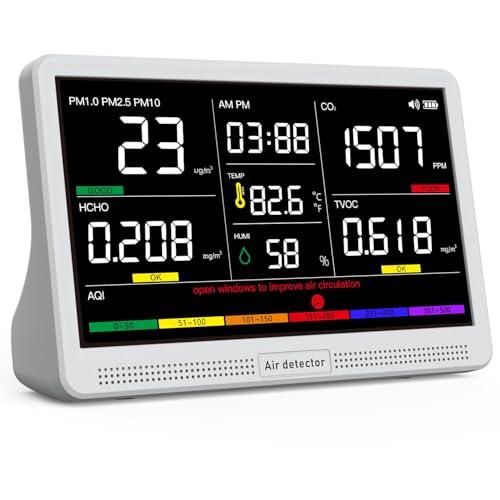
A 7-inch screen that puts every air metric front and center.
If you want to see all your air quality data at a glance without navigating menus, this YNAK model delivers with a 7-inch LED display that shows CO2, PM2.5, PM1.0, PM10, HCHO (formaldehyde), TVOC, temperature, humidity, AQI (Air Quality Index), and time simultaneously. It is the largest screen in this lineup and includes three brightness settings so it works in a dark bedroom or a sunny office.
The built-in 2500mAh battery powers it for up to 8 hours cordless, which is shorter than the Temtop’s 60 days but enough to move it from room to room for a day. It comes with a charging adapter and USB-C cable, and the front indicator glows red during charging so you know it is connected. Seven distinct AQI alert buzzers cover different pollutants, and there is a mute button to silence them.
One consideration: at 1.48 pounds and 7.91 inches tall, it is the heaviest and bulkiest model here, so it is less portable than the lightweight SwitchBot or the compact 22 HOBBIES. It is best suited for a fixed location like a living room or classroom where the big display becomes a constant visual reminder to ventilate.
Why It Impresses
- Massive 7-inch LED display shows all nine parameters at once — no scrolling.
- 2500mAh battery gives up to 8 hours of cordless use for room-hopping.
- Seven distinct AQI alert buzzers with a mute option for quiet nights.
- Includes charging adapter and USB-C cable for easy setup.
The Drawbacks
- Heavier and bulkier than any other pick — not a travel-friendly device.
- 8-hour battery is short for a full day away from a power outlet.
- No smart home or app connectivity — standalone unit only.
Best for: A central place like a living room, classroom, or open office where a large visible display helps everyone in the room see air quality.
Pass on it if: You need a portable sensor to move between rooms regularly or want app-based historical data.
5. 16-in-1 Air Quality Monitor (flazecon)

Packs nine air metrics into a lightweight box you can carry anywhere.
This flazecon model squeezes 16 functions into a 0.49-pound package — tracking CO2, TVOC, PM1.0, PM2.5, PM10, HCHO (formaldehyde), temperature, humidity, and AQI with 7 different alarm alerts. Reviewers point out that the device is very handy for checking different rooms, noting that TVOC and PM2.5 readings spike noticeably during cooking, and the CO2 reading explains that morning grogginess you feel in a sealed bedroom.
One reviewer described it as “eye-opening” and praised how it tracks PM1.0, PM10, formaldehyde, humidity, temp, and AQI all on one screen. The display has three-level brightness adjustment, and a single button lets you toggle the temperature unit between Fahrenheit and Celsius. The rechargeable battery is convenient for taking it from the kitchen to the home office to the hotel.
Unlike the GoveeLife that runs on AC power, this one uses a rechargeable battery, so you have to remember to charge it. The 22 HOBBIES model is lighter at 0.41 pounds but measures fewer parameters (no PM2.5 or PM10). If you want the broadest sensor coverage in a portable size at a mid-range price, this flazecon strikes the best balance.
What It Does Well
- Measures 9 air metrics including PM1.0, PM2.5, PM10, HCHO, TVOC, and CO2.
- Lightweight at 0.49 pounds — easy to move from room to room.
- Three-level brightness display with unit toggle between °F and °C.
- Alert system with mute button for quiet operation during sleep.
Limitations
- Battery-powered with no AC passthrough — needs periodic charging.
- No Wi-Fi or app connectivity for data logging or remote alerts.
- Slightly heavier than the 22 HOBBIES model (0.49 vs 0.41 pounds).
Perfect for: A family that wants to monitor a wide range of pollutants throughout the house, moving the sensor from the kitchen to the nursery.
Not ideal if: You want a permanent always-on unit that tracks data remotely through an app.
6. KDWKD Indoor Air Quality Monitor
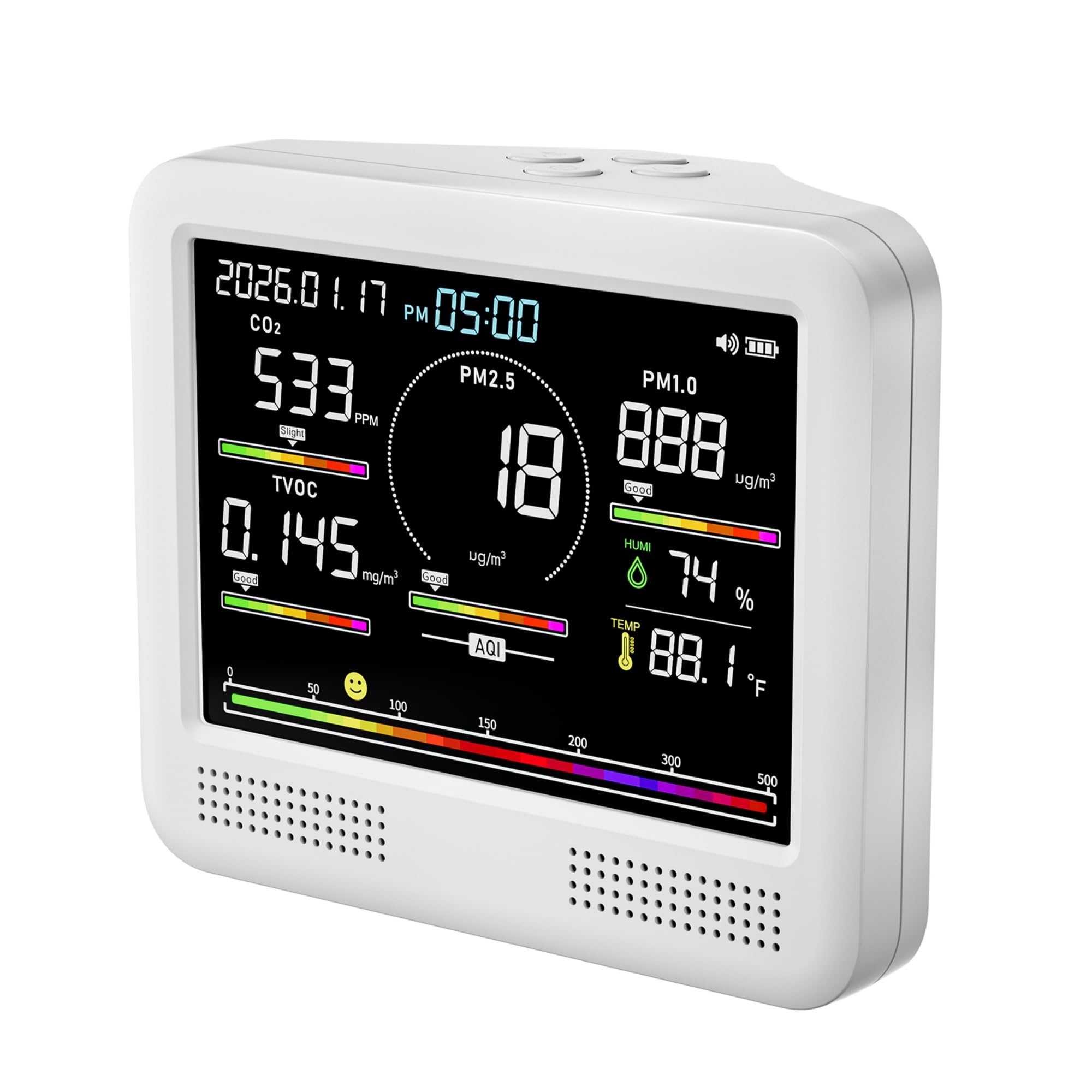
The entry-level ticket to tracking CO2 plus fine dust and fumes.
The KDWKD monitor tracks CO2, PM2.5, PM10 (both fine and coarse particulate matter), HCHO (formaldehyde), TVOC, temperature, and humidity — all in one compact device with a large color screen. Its built-in rechargeable battery runs for up to 9 hours, giving you enough time to test air quality across several rooms, the office, or even an RV on a weekend trip.
It has an audible alarm that sounds when pollutant levels go above safe thresholds, and the color-coded display shows AQI levels at a glance. At 2 by 5 by 3 inches and made of ABS plastic, it is sturdy but light enough to tuck into a bag. It is designed to pick up changes from cooking smoke, wildfire smoke, pet odors, dust, paint fumes, and new furniture off-gassing.
Compared to the premium YNAK 16-in-1, this model has a smaller screen and fewer measurement parameters (no PM1.0), but it covers the essentials for a much more accessible price tier. It lacks app connectivity, so you cannot log data or get push notifications — it is purely a live-read-and-react device.
Budget Benefits
- Measures CO2, PM2.5, PM10, HCHO, TVOC, temperature, and humidity.
- Up to 9 hours of battery life on a single charge for room-to-room monitoring.
- Large color screen with AQI color coding for quick readability.
- Audible alarm for exceedances without needing a smartphone app.
Compromises
- No Wi-Fi, Bluetooth, or app for data history or remote alerts.
- Does not measure PM1.0, which the flazecon and YNAK models include.
- 9-hour battery is shorter than the Temtop’s 60 days.
Grab this if: You want the most affordable way to check CO2 and key pollutants in multiple rooms without spending on app-connected features.
Pass it by if: You need app-based data tracking, PM1.0 readings, or battery life measured in weeks.
7. 22 HOBBIES Air Quality Monitor
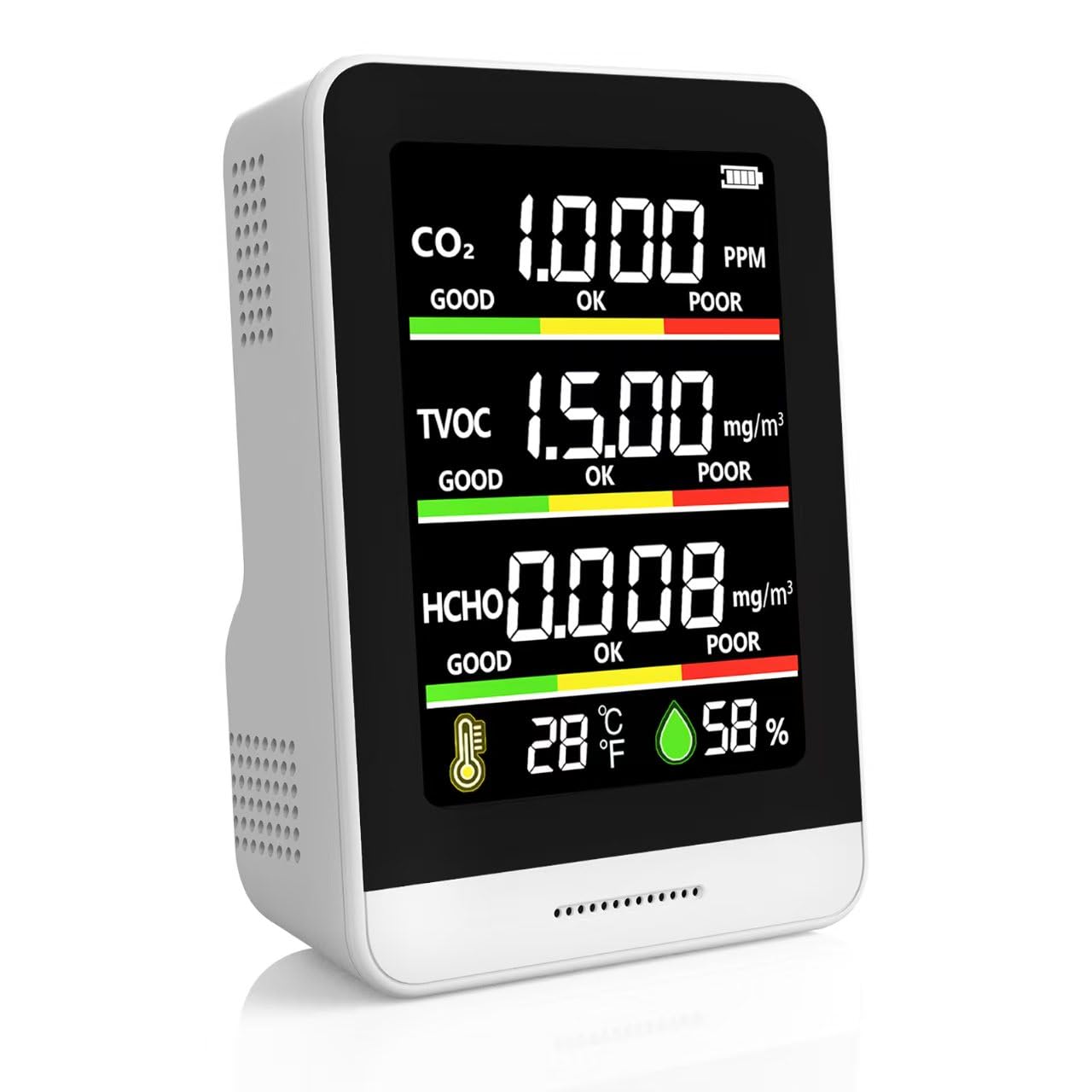
A simple, colorful start to understanding CO2 in your home.
This 22 HOBBIES monitor is the lightest option at just 0.41 pounds, measuring CO2, TVOC, HCHO (formaldehyde), AQI (Air Quality Index), temperature, and humidity on a colorful screen that changes colors to show air quality at a glance. The 1200 mAh battery runs for 9-10 hours on a full charge and takes 3-4 hours to refill via the USB-C port on the back.
Shoppers say that the device is accurate for CO2 readings and easy to use with one-button operation, but they caution that “minimal battery life, best used plugged in; battery is backup only.” That means if you want it running all day, keep the USB cable connected. The screen is large enough to read from a desk, and the audible alarm will buzz when CO2 or other pollutants hit concerning levels.
Compared to the flazecon 16-in-1, this model skips PM2.5 and PM10 entirely — so if you care about dust, smoke, or pollen, this is not the right sensor. It also does not connect to any app. It is a straightforward no-frills entry point for someone who just wants to see CO2 and basic VOCs on a small budget.
Simple Strengths
- Lightest option at 0.41 pounds — easy to move and hold.
- Colorful screen with one-button operation for fast reading.
- 9-10 hours of battery life with USB-C charging.
- Audible alarm for high pollutant levels.
Shortcomings
- Battery is best used as a backup — needs to stay plugged in for continuous monitoring.
- Does not measure particulate matter (PM2.5 or PM10), only gases.
- No app, Wi-Fi, or Bluetooth connectivity for data logging.
Consider it if: You want the cheapest way to start monitoring CO2 and VOCs in a single room and do not mind keeping it plugged in.
pass on it if: You need PM2.5 tracking, long cordless runtime, or smart home integration.
Understanding the Specs
NDIR vs Photoacoustic Sensors
NDIR (non-dispersive infrared) is the standard technology for CO2 measurement. It shines an infrared light through an air sample and measures how much light the CO2 molecules absorb — the more CO2, the more light absorbed. This type of sensor stays accurate for years with little drift. The photoacoustic NDIR used in the GoveeLife model works on the same principle but detects CO2 by the sound waves created when light pulses heat the gas. Both are reliable; the key is avoiding cheap chemical sensors that degrade quickly.
Refresh Rate and Accuracy
Refresh rate tells you how often the sensor updates its reading. A 1-second refresh (like the SwitchBot) gives you near-instant feedback when CO2 rises from someone entering the room or a door closing. A 5-minute refresh on battery mode saves power but can miss short spikes. Accuracy is stated as ±X ppm — the lower the number, the closer the reading is to real CO2 levels. For most homes, ±50 ppm is plenty precise; anything above ±100 ppm may give misleading numbers.
Measurement Range vs Your Environment
Most sensors measure CO2 from 400 ppm (fresh outdoor air) up to 5000 or 9000 ppm. Typical indoor CO2 stays between 400 and 2000 ppm. A sensor that tops out at 2000 ppm is fine for homes but may not cover greenhouses or industrial spaces where levels climb higher. The SwitchBot goes up to 9000 ppm, which covers virtually any indoor scenario.
Alerts and Connectivity
An audible alarm is the most basic alert — it beeps when CO2 passes a set threshold, usually around 1000 ppm. App-connected sensors can send push notifications, store historical data, and even trigger smart plugs to turn on fans. If you want to track trends over weeks, look for models with app support or data export. Standalone units with just a buzzer are simpler but leave you with no record to compare day over day.
FAQ
Where should I place a CO2 sensor for the most accurate readings?
What is a normal CO2 level indoors?
How often do I need to calibrate a CO2 sensor?
Can a CO2 sensor also detect smoke or gas leaks?
Do I need a CO2 sensor with Wi-Fi or app connectivity?
Will a CO2 sensor help with sleep quality?
How long do CO2 sensors last before needing replacement?
Can I take a battery-powered CO2 sensor in the car with me?
Final Thoughts: The Verdict
If you want one dependable pick, the co2 sensor winner is the GoveeLife Smart Air Quality Monitor because it provides continuous always-on AC-powered monitoring with a fast 5-second refresh and smart home integration. If you want a highly accurate portable sensor that lasts up to a year on battery, grab the SwitchBot CO2 Detector. And for long battery life with multi-pollutant coverage in a sleek e-ink package, the standout is the Temtop M10+ 6-in-1.
How We Picked
We do not accept paid placement. Every pick is matched to a real buyer and a real use-case; we do not hands-on test units.
Sources & Methodology
Specifications: manufacturer listings and product documentation. Review insights: verified customer reviews, as of July 2026. Pricing: not shown on this page (it changes often); check the current price via the retailer link.
As an Amazon Associate, WellFizz earns from qualifying purchases. This does not affect which products we feature.

Mo Maruf
I created WellFizz to bridge the gap between vague wellness advice and actionable solutions. My mission is simple: to decode the research and give you practical tools you can actually use.
Beyond the data, I am a passionate traveler. I believe that stepping away from the screen to explore new environments is essential for mental clarity and physical vitality.