Our readers keep the lights on and my smoothie glass nicely filled. As an Amazon Associate, I earn from qualifying purchases.
Specs are compiled from manufacturer listings and verified buyer reviews and can change over time — please confirm the key details on the product page before buying.
If you have venous insufficiency, every step can feel like your legs are dragging. The right compression stocking does one thing that matters most: it squeezes hardest at your ankle and gradually loosens upward, pushing blood back toward your heart so swelling, heaviness, and achiness fade during your day. This list focuses on medical-grade 20-30 mmHg stockings — the pressure range doctors most often recommend for chronic venous insufficiency — and cuts through the confusion between fashion socks and real therapeutic support.
I’m Mohammad Maruf — the founder and writer behind WellFizz. This guide is built by comparing the manufacturers’ published specifications and the patterns across verified customer reviews, so you get each pick’s real strengths and trade-offs instead of marketing spin.
if you need thigh-highs, pantyhose, or open-toe options, these compression stockings for venous insufficiency each bring a slightly different design to the same medical-grade pressure, so you can match the style to your daily life and body shape.
Quick Picks
- Myshear Medical Compression Stockings Thigh High Closed Toe — Best Overall
- Myshear 20-30 mmHg Open Toe Thigh High Compression Stockings — Toe Freedom Pick
- Myshear Medical Compression Tights 20-30 mmHg Footless — Full Leg Coverage
- Beister 20-30 mmHg Thigh High Compression Stockings Closed Toe — Durable Fabric
- NURCOM 20-30 mmHg Open Toe Compression Pantyhose — Waist High Value
How To Choose The Best Compression Stockings For Venous Insufficiency
Venous insufficiency means your leg veins struggle to send blood back up to your heart, causing blood to pool in your lower legs. Graduated compression stockings provide an external squeeze that helps your veins do that work. But not every stocking on a pharmacy shelf is strong enough for this condition — here is what a buyer should actually check.
Compression Level: 20-30 mmHg Is the Target
Fashion compression socks typically sit at 8-15 mmHg, which is too weak to help with chronic venous insufficiency. You want 20-30 mmHg, sometimes labeled “medical grade.” This range provides firm enough pressure at the ankle to reduce swelling and prevent blood from pooling, while still being safe for daily wear without a prescription in most cases.
Length: Thigh High vs Waist High
Thigh-high stockings stop just below the gluteal fold and are easier to put on by yourself. They are a good choice if your swelling is mainly in the calves and lower thighs. Waist-high pantyhose or tights cover the entire leg up to the waist, which helps if you have swelling higher up your thighs or if thigh-highs tend to roll down. The trade-off is that waist-high styles are warmer and a bit more work to put on.
Silicone Grip Band and Fit
Thigh-highs need to stay up without being so tight that they cut off circulation. Many brands use a silicone dot strip along the top band to hold the stocking in place. Some people find silicone irritating on sensitive skin — in that case, you can flip the cuff outward for a looser hold. Always measure your ankle, calf, and thigh circumference against the brand’s chart; a bad fit will either slip down or cause a tourniquet effect that makes swelling worse.
Open Toe vs Closed Toe
Closed-toe stockings provide full compression coverage and are warmer, but the toe seam can press on toenails or cause discomfort in people with neuropathy or toe swelling. Open-toe styles leave your toes free and are cooler in warm weather, but the compression stops before your toes, so any foot swelling will still need an additional sleeve if required.
Quick Comparison
| Model | Best For | Style & Length | Fabric | Weight | Amazon |
|---|---|---|---|---|---|
| Myshear Thigh High Closed Toe | All-day stay-put wear | Thigh High, Closed Toe | 75% nylon, 20% spandex, 5% elastic fibers | 3.53 oz | Amazon |
| Myshear Thigh High Open Toe | Toe comfort & flexibility | Thigh High, Open Toe | 75% nylon, 20% spandex, 5% elastic fibers | 3.53 oz | Amazon |
| Myshear Footless Tights | Full leg & waist coverage | Waist High, Footless | 75% nylon, 25% spandex | 5.29 oz | Amazon |
| Beister Thigh High Closed Toe | Durable medical-grade fabric | Thigh High, Closed Toe | Cotton Fiber, Spandex | — | Amazon |
| NURCOM Waist High Open Toe | Full leg & waist support | Waist High, Open Toe | 70% Nylon, 25% Spandex, 5% Elastane | 4 oz | Amazon |
In‑Depth Reviews
1. Myshear Medical Compression Stockings Thigh High Closed Toe
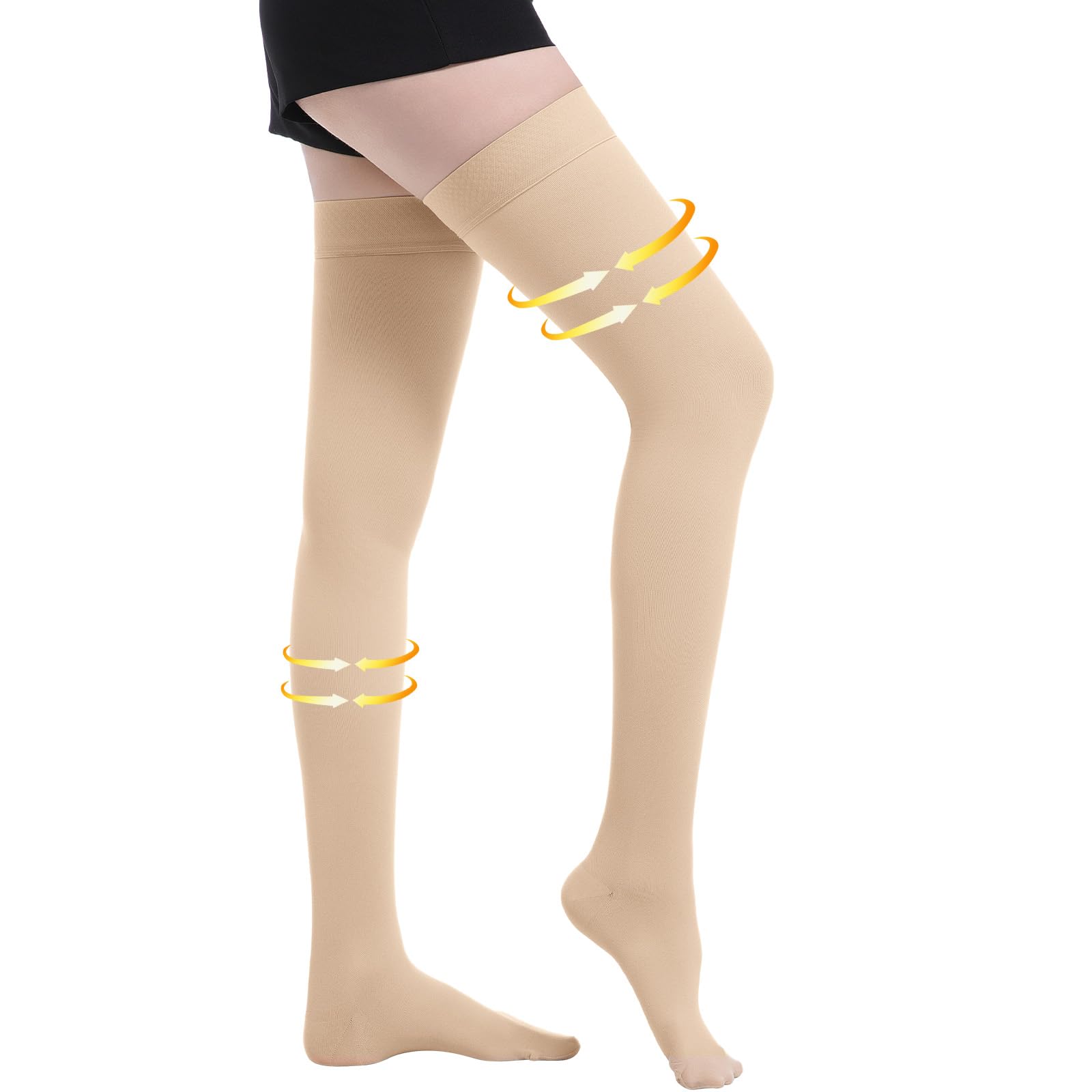
A thigh-high that actually stays put and delivers even, medical-grade pressure all day long.
The Myshear thigh-highs give you the full 20-30 mmHg graduated pressure across five zones — strongest at the ankle, then stepping down as it moves up your leg — and that pattern is exactly what venous insufficiency needs to push blood upward and keep leg swelling down. The 75% nylon, 20% spandex blend (plus 5% elastic fibers) makes the fabric strong without feeling like a tourniquet, and the silicone dotted grip strip along the top edge stops them from rolling down, a complaint buyers report with many drugstore stockings.
Unlike the Beister pair below, these weigh 3.53 ounces and are less likely to create a pinching sensation at the toe. One reviewer noted, “I wore them for my 8 hour car ride & never had any problems with them!” — a real test since prolonged sitting is exactly when venous insufficiency acts up. If the silicone band feels tight, you can flip the cuff outward for a looser hold without losing compression lower down.
What Works Well
- Five-zone graduated compression from 20-30 mmHg targets the ankle-to-heart flow pattern
- Silicone grip strip prevents the rolling-down problem common with thigh-highs
- Reinforced heel and stitching hold up through months of regular washing
The Main Drawback
- Some buyers with larger thighs find the upper band area uncomfortable above the knee
Reach for these if: you need a closing-toe thigh-high that stays in place during long work shifts, flights, or drives and delivers consistent medical-grade pressure without slipping.
Look elsewhere if: you have very large thighs that might make the upper band feel restrictive, or you prefer an open-toe design for toe freedom.
2. Myshear 20-30 mmHg Open Toe Thigh High Compression Stockings
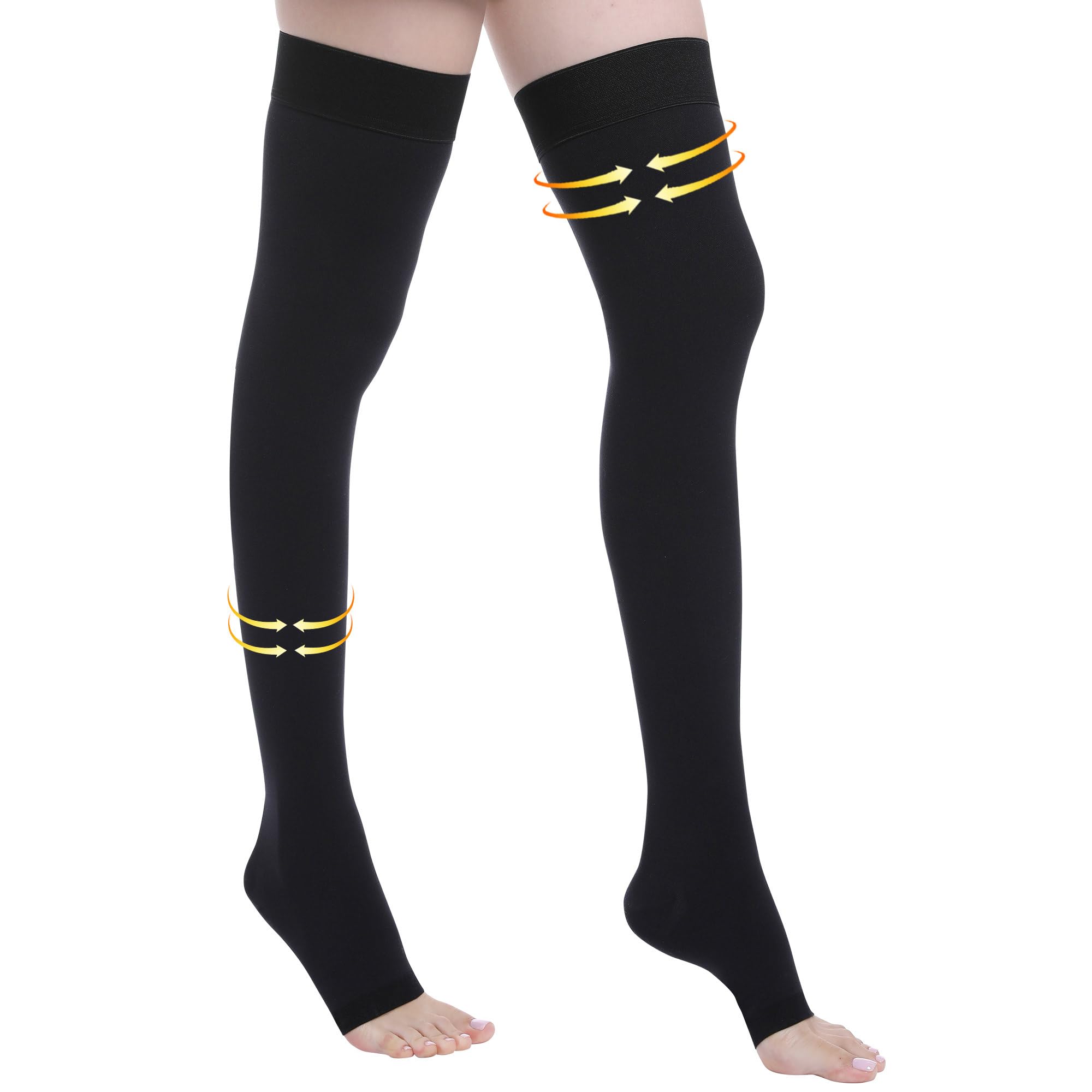
Same brand, same 20-30 mmHg pressure, but your toes stay free and flexible.
If the closed-toe style above is perfect for full coverage, this open-toe version solves a specific problem: toe discomfort. People with neuropathy, hammer toes, or general toe swelling often find the enclosed seam of closed-toe stockings painful after a few hours. The Myshear open-toe design cuts off compression before the toes so you still get the five-zone 20-30 mmHg graduated pressure that pushes blood upward, but your toes can move freely inside a shoe or around the house.
At 3.53 ounces it is the same featherlight weight as the closed-toe version — noticeably lighter than the Beister pair, which reviewers describe as thicker and denser. The same silicone grip band and reinforced heel carry over, and the latex-free breathable fabric (75% nylon, 20% spandex, 5% elastic fibers) helps with all-day wear. One thing to keep in mind: the lack of toe coverage means any foot or toe edema will not be addressed by the stocking itself, so this is best for people whose swelling stops at the ankle or above.
Smart trade-off: you trade full foot coverage for zero toe pinching — a worthwhile swap if your toes are the first place you feel discomfort in other stockings.
Best suited for: buyers with toe sensitivity, neuropathy, or toe swelling who still want medical-grade 20-30 mmHg compression in a thigh-high format.
Consider the closed-toe version if: your doctor recommends full foot compression or you want the extra warmth of a covered toe in cold weather.
3. Myshear Medical Compression Tights 20-30 mmHg Footless

When your swelling travels higher up the leg, these waist-high tights carry the pressure all the way.
Thigh-high stockings are great, but some people with venous insufficiency experience swelling that extends above the knee or into the upper thigh. That is where the Myshear footless tights shine: the same 20-30 mmHg graduated compression (strongest at the ankle, stepping down as it moves up) covers your entire leg without a gap at the mid-thigh. The high-waist elastic band stays in place without rolling or slipping, and the footless design means no toe compression at all — making them a good choice if foot swelling is not your problem.
At 5.29 ounces these are heavier than the thigh-high Myshears (3.53 ounces) due to the additional fabric, and the dimensions are larger at 7.87 x 6.69 x 1.34 inches. The fabric blend swaps to 75% nylon and 25% spandex (no elastic fibers listed), which makes them stretchier but still tear-resistant. Owners mention the flat lock seams minimize friction. A caveat: the full-leg design runs warmer than thigh-highs, so if you live in a hot climate or tend to overheat, the thinner thigh-high styles might be more comfortable for summer months.
Reasons to Choose
- Waist-high coverage addresses swelling that reaches above the knee
- Reinforced gusset and flat lock seams improve durability for daily wear
- Footless design eliminates any toe-pinching complaints
Consider Before Buying
- Heavier and warmer than thigh-high styles — less ideal for very hot weather
- Putting on waist-high tights takes more effort than thigh-highs
Grab these if: your swelling consistently reaches above the mid-thigh or you want the security of a waist-high band that will not roll down.
Pass if: you only need compression below the knee or you prefer a cooler, more breathable feel during daily wear.
4. Beister 20-30 mmHg Thigh High Compression Stockings Closed Toe
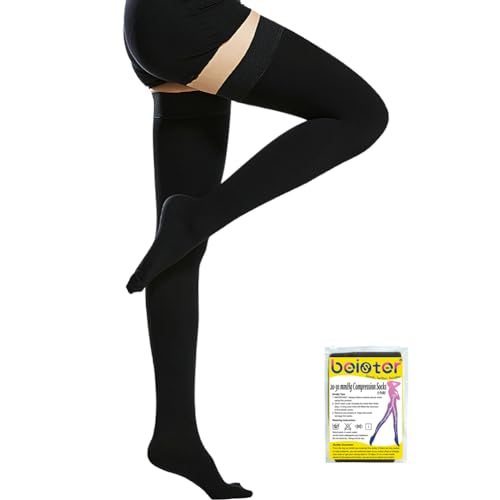
German-engineered fabric that holds its compression shape wash after wash.
Beister takes a different approach from the Myshear lineup: instead of lightweight stretch, they use a thicker, denser fabric made with German specialized machinery and medical-grade materials. The 20-30 mmHg graduated compression across five intervals still delivers the same ankle-strong pressure pattern that venous insufficiency needs, but the feel is more substantial — reviewers describe the material as “excellent tough” and note it survives repeated washing without losing its spring.
Make no mistake, these are heavier-duty than the 3.53-ounce Myshear thigh-highs, and some buyers mention the toe seam can press uncomfortably under toenails after about 20 minutes — a complaint that does not appear with the open-toe Myshear. On the plus side, the silicone dot band and wide cuff hold the stocking in place reliably; one buyer who tried about 10 other brands said “this is the only compression socks that stay up.” Size carefully: the chart runs differently from other brands, and several reviewers suggest sizing up if you are between measurements.
Real trade-off: thicker fabric means better durability and opacity but less breathability and a greater chance of toe-seam discomfort — pick your priority.
Ideal for: someone who wears compression stockings daily and needs fabric that resists runs and tears over months of use.
skip it if: you have sensitive toes or neuropathy that makes any toe-seam pressure painful, or you prefer a lighter, more breathable feel.
5. NURCOM 20-30 mmHg Open Toe Compression Pantyhose

Lab-verified compression in a waist-high, open-toe design that fits a pregnant belly too.
NURCOM brings a rigorous manufacturing process — they use the Swiss SAG MST MKV device to test and verify that their pantyhose deliver genuine 20-30 mmHg graduated compression across five zones. That matters because some brands claim the pressure but do not actually hit it at every interval. The open-toe design frees your toes, and the waist-high cut means compression extends all the way up your leg without a thigh-high band cutting in.
The fabric blend of 70% nylon, 25% spandex, and 5% elastane provides a stretchy, opaque feel that customers note is thick enough to resist runs. A buyer who is 6 months pregnant reported the top band accommodated the belly comfortably while still providing firm compression to the legs — a nice detail if you are dealing with pregnancy-related venous insufficiency. At 4 ounces it is lighter than the Myshear footless tights (5.29 ounces) but heavier than the thigh-highs. The main drawback: one Florida buyer noted the dense material feels too warm for hot climate wear, so breathability is limited compared to thinner thigh-high styles.
Solid Points
- Swiss lab-tested compression ensures the 20-30 mmHg claim is accurate
- Stretchy waistband accommodates pregnancy or abdominal swelling without digging in
- Open-toe design prevents toe seam discomfort
Watch Out For
- Dense fabric runs warm — not ideal for hot weather or high activity
- Some shorter wearers (5’4″) report bunching at the knee that creates a constriction point
Choose the NURCOM if: you want lab-verified compression in a waist-high, open-toe format and your daily environment is cool enough for a denser fabric.
Look at the Myshear footless tights instead if: you need a cooler, more breathable waist-high option for warmer climates or higher activity levels.
Understanding the Specs
Graduated Compression and mmHg
“Graduated” means the pressure is not the same across your whole leg — the tightest compression is at your ankle, and it decreases gradually as the stocking moves up your leg toward your heart. This design actively pushes blood upward instead of just squeezing everywhere equally. The mmHg (millimeters of mercury) number tells you how much pressure the fabric exerts. For venous insufficiency, 20-30 mmHg is the standard medical-grade range: strong enough to reduce swelling and improve circulation but safe for daily wear without a prescription in most cases.
Fabric Blend and Durability
Most medical stockings mix nylon (for smoothness and opacity), spandex or elastane (for stretch and compression memory), and sometimes elastic fibers or cotton for added comfort. A higher spandex percentage (20-25%) generally means better shape retention wash after wash. Nylon content around 70-75% gives a dense, opaque finish that resists runs. The trade-off is breathability: denser blends tend to trap heat, so if you live in a warm climate or plan to exercise in your stockings, a thinner blend with a higher spandex ratio might feel more comfortable.
FAQ
Can I wear 20-30 mmHg compression stockings without a prescription?
How do I measure my legs for the right size?
Is it better to use open toe or closed toe for venous insufficiency?
How long can I wear compression stockings each day?
Why do my compression stockings roll down and how do I fix it?
What is the difference between thigh-high and waist-high stockings?
How should I wash my compression stockings so they last?
Can compression stockings make my venous insufficiency worse?
How often should I replace my compression stockings?
Can I wear two pairs of compression stockings for more pressure?
Final Thoughts: The Verdict
For the majority of shoppers, the compression stockings for venous insufficiency winner is the Myshear Medical Compression Stockings Thigh High Closed Toe because it delivers the verified 20-30 mmHg graduated pressure across five zones at a light 3.53 ounces with a silicone grip band that buyers confirm stays up during long drives and work shifts. If you prefer an open-toe design for toe freedom, grab the Myshear Open Toe Thigh High. And for full leg and waist coverage that still provides the same medical-grade compression, the standout is the Myshear Footless Compression Tights.
How We Picked
We do not accept paid placement. Every pick is matched to a real buyer and a real use-case; we do not hands-on test units.
Sources & Methodology
Specifications: manufacturer listings and product documentation. Review insights: verified customer reviews, as of July 2026. Pricing: not shown on this page (it changes often); check the current price via the retailer link.
As an Amazon Associate, WellFizz earns from qualifying purchases. This does not affect which products we feature.

Mo Maruf
I created WellFizz to bridge the gap between vague wellness advice and actionable solutions. My mission is simple: to decode the research and give you practical tools you can actually use.
Beyond the data, I am a passionate traveler. I believe that stepping away from the screen to explore new environments is essential for mental clarity and physical vitality.