You want a reliable espresso routine — consistent, uniform grounds that extract evenly with minimal static mess and without waking up the whole house. The difference between a frustrating morning and a perfect shot of espresso often comes down to that single grinding mechanism inside your machine.
I’m Mohammad Maruf — the co-founder and writer behind WellFizz. This guide is built by comparing the manufacturers’ published specifications and the patterns across verified customer reviews, so you get each pick’s real strengths and trade-offs instead of marketing spin.
From anti-clogging single-dose models to award-winning espresso-first grinders, these six picks cover the real differences you need to know to find the best conical burr grinder for espresso for your setup and budget.
How To Choose The Best Conical Burr Grinder For Espresso
The right grinder for your espresso setup comes down to a few key decisions. Here is what matters most when you are comparing models.
Grind Settings and Adjustability
Espresso needs a fine, precise grind. More steps between settings (48 or 51, for example) give you the ability to dial in your shot by tiny increments. Fewer settings can leave you stuck between too fast and too slow a pour.
Retention and Static Control
Retention is the amount of old grounds trapped inside the burrs after grinding. Low retention — under 0.3 grams — means fresher coffee and less waste. Anti-static coatings or ionizers also keep grounds from flying everywhere when you pull the cup out.
Motor Speed and Noise
Slow-turning burrs (around 450 RPM) generate less heat and static, preserving the oils in your beans. Faster motors grind quicker but can be louder and may heat the coffee slightly. A quiet motor under 50 decibels makes early-morning or shared-kitchen use much friendlier.
Portafilter Docking and Workflow
If you want to grind directly into your portafilter basket, check whether the grinder includes a compatible holder (usually 50mm to 58mm). Otherwise, you will grind into a dosing cup and transfer — which still works fine but adds one extra step.
Quick Comparison
On smaller screens, swipe sideways to see the full table.
| Model | Category | Best For | Key Spec | Amazon |
|---|---|---|---|---|
| Viesimple Gen 4 | Premium Single-Dose | Low-noise single-dose espresso | 48mm burrs, <50dB noise | Amazon |
| AMZCHEF CG209-SV | Mid-Range | Versatile home brewing | 48 settings, 10.6oz hopper | Amazon |
| Homtone BD-CG018ES | Mid-Range | Hands-free portafilter grinding | 51 settings, 6.5 lbs | Amazon |
| Tuni G1 | Mid-Range | Value-conscious espresso fans | 48 settings, 450 RPM | Amazon |
| AMZCHEF CG209-SV (Alt) | Mid-Range | Espresso with portafilter holder | 48 settings, 100g container | Amazon |
| Baratza Sette 30 | Premium Entry-Level | Award-winning espresso performance | 30 settings, 5g/sec speed | Amazon |
In‑Depth Reviews
1. Viesimple Gen 4 Single Dose Grinder
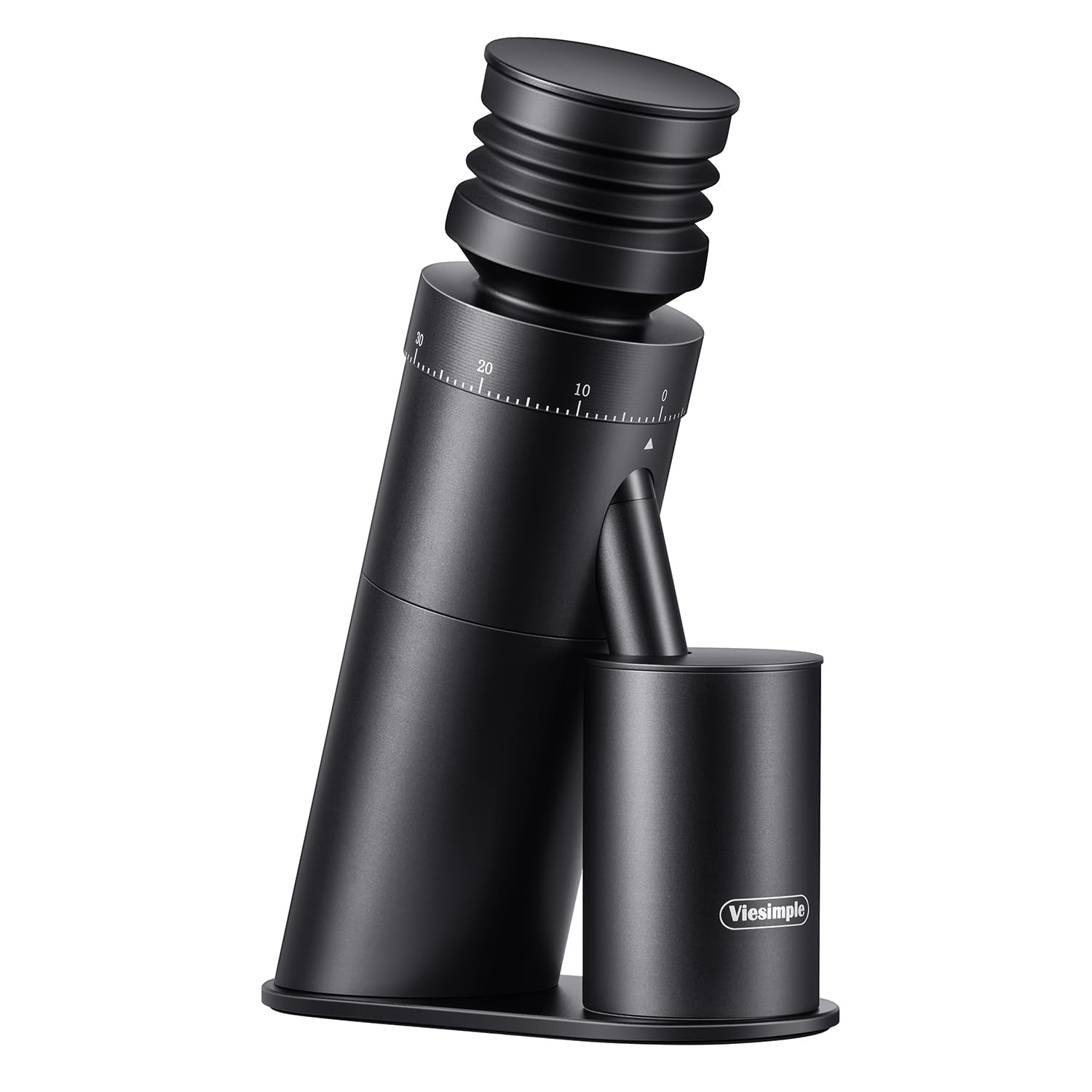
The Viesimple Gen 4 runs at under 50 decibels — quiet enough that you can grind before anyone else gets up — while its 48mm conical burrs produce the uniform grind espresso requires, making it the top pick for the home barista who values a calm, peaceful morning routine and consistent single-dosing without waking the house.
Its patented anti-clogging powder channel and anti-static coating keep retention below 0.2%, so you waste almost nothing between doses. The magnetic dosing cup snaps right into place, and the blow-out funnel lets you purge any leftover grounds into the basket. Buyers report it produces “clean with little static” and that the grind is fine enough to choke a Breville machine at settings 10 to 18, giving you plenty of room to dial in.
The 30-gram bean chamber is designed for single doses only, so this is not the grinder for making a full pot of drip coffee in one go. Verdict: if quiet, precise single-dosing is your priority, this is the grinder to beat.
Why it’s great
- Very quiet motor under 50 dB
- Near-zero retention with bellow system
- All-aluminum body, sturdy build
Good to know
- Small 30g capacity, single-dose only
- Grind markers slightly misaligned
- External power adapter required
2. AMZCHEF Conical Burr Coffee Grinder (CG209-SV)

The AMZCHEF CG209-SV matches the Viesimple’s 48 grind settings but packs a 10.6-ounce hopper — more than double the capacity of the single-dose Viesimple — giving you the flexibility to grind for drip, pour-over, or cold brew without constant refilling. It falls short of the Viesimple on noise (no decibel rating claimed), but its 40mm stainless steel conical burrs deliver the same uniform grind for espresso.
Its smart LED touchscreen lets you set grind time in 0.5-second increments up to 40 seconds, and you can select 2 to 12 cups. The anti-static design minimizes cling, and the UV-blocking hopper keeps beans fresher longer. One buyer reports that the “superior design with clean chute, no mess or static, uniform grind” makes cleanup easier than on pricier models they have owned.
At 5 pounds, it is also 1.5 pounds lighter than the Homtone below, making it easier to move around your counter. Choose the AMZCHEF over the Viesimple if you regularly brew multiple methods or larger batches and want one versatile grinder that handles it all.
Where it shines
- Large 10.6oz hopper for batch brewing
- Touchscreen with 0.5s timer precision
- Anti-static design reduces mess
Worth noting
- No portafilter holder included
- Motor may warm up on long grinds
- Plastic housing, not all-metal
3. Homtone Conical Burr Espresso Coffee Grinder
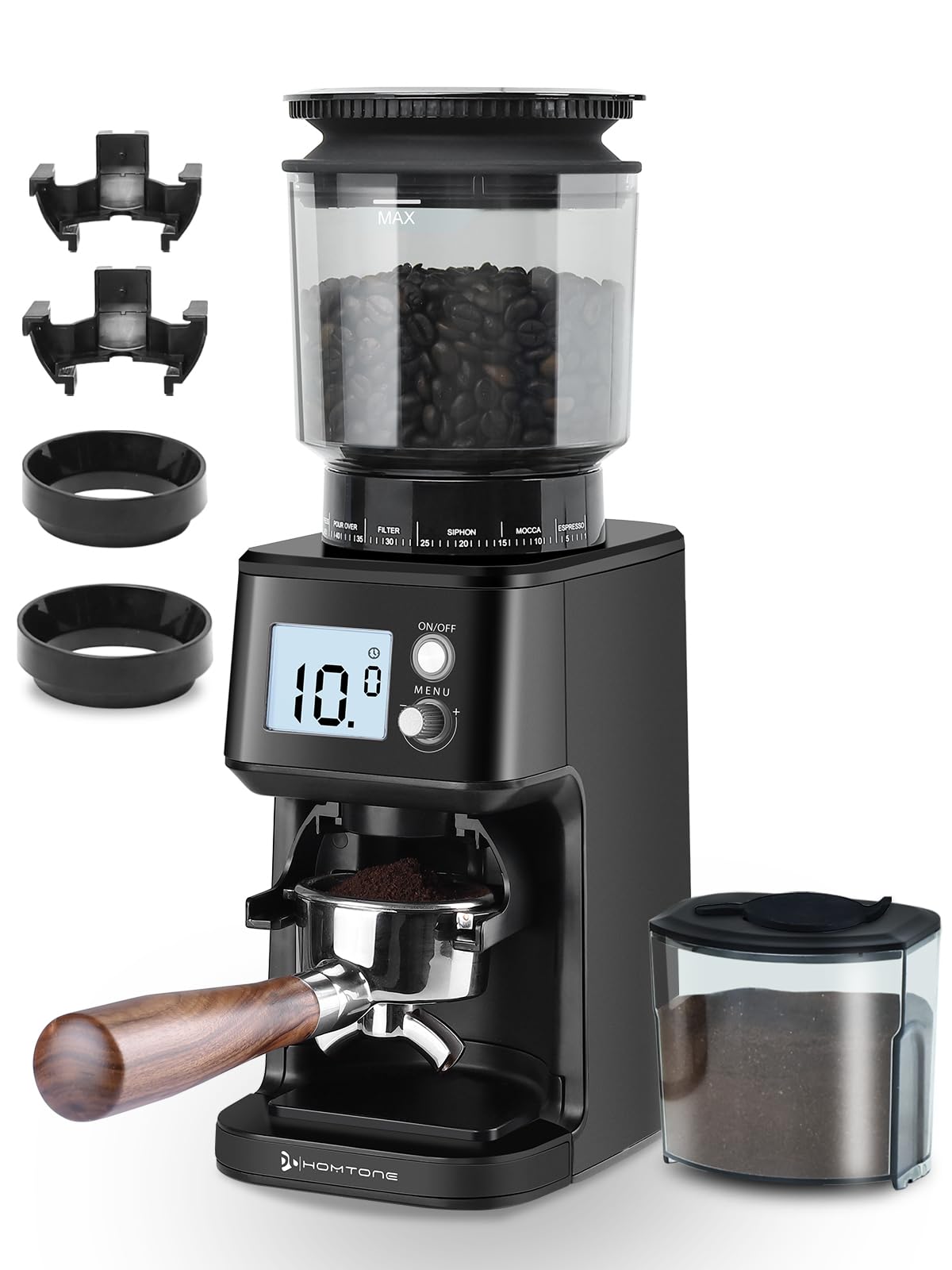
Imagine grinding directly into your portafilter with no separate cup — the Homtone is built for that exact workflow. It includes a portafilter holder that fits 51mm to 58mm baskets and auto-starts grinding when you dock the portafilter, then stops when you remove it. For anyone who makes two or more espresso drinks back-to-back each morning, this hands-free setup cuts your prep time noticeably.
With 51 grind settings (more than any other grinder in this lineup except the others at 48), you have fine enough control to dial in light roasts or dark roasts precisely. At 6.5 pounds, it is the heaviest grinder here by a 35% margin over the Tuni G1 (4.8 pounds), giving it a planted feel on the counter. Owners mention it is “quieter and static-free compared to previous grinders” and that the “ground coffee doesn’t stick” to the chute.
A notable drawback: the auto-dose timer has a minimum 5-second grind time, which overfills a single-shot basket if you only want a small dose. If you always brew double shots, this is a minor annoyance; for single-shot fans, it is a real limitation.
What stands out
- Hands-free auto-dosing with portafilter
- 51 grind settings for fine control
- Heavy 6.5-lb build for stability
The trade-offs
- Minimum 5-sec grind time for singles
- Portafilter holder can misalign
- No power-off switch, bright standby light
4. Tuni G1 Conical Burr Coffee Grinder

The single number that matters most in a conical burr grinder for espresso is low retention. The Tuni G1 scores exceptionally well here — buyers consistently report retention of only 0.1 to 0.2 grams, meaning nearly every bit of coffee you put in comes out as fresh grounds. Its 40mm patented conical burr spins at a slow 450 RPM, which produces less heat and less static than faster grinders.
If you brew multiple pots, you will refill more often. The grind consistency, however, rivals grinders costing twice as much, customers note it “punches way above its price” and delivers uniform grounds excellent for French press as well as espresso.
It includes a detachable portafilter holder compatible with 54-58mm baskets and a dosing cup, plus a soft brush clipped to the hopper lid for easy cleaning. For the price-to-performance ratio, this grinder stands out as the smartest buy for a dedicated espresso beginner who wants electric convenience without overspending.
The upsides
- Very low retention (0.1-0.2g)
- Slow 450 RPM reduces heat and static
- Includes portafilter holder and dosing cup
Keep in mind
- Light roasts may need DIY shim mod
- 8.8oz hopper smaller than some rivals
- Long-term durability unproven
5. AMZCHEF Coffee Grinder (CG209-SV Alt) with Portafilter Holder
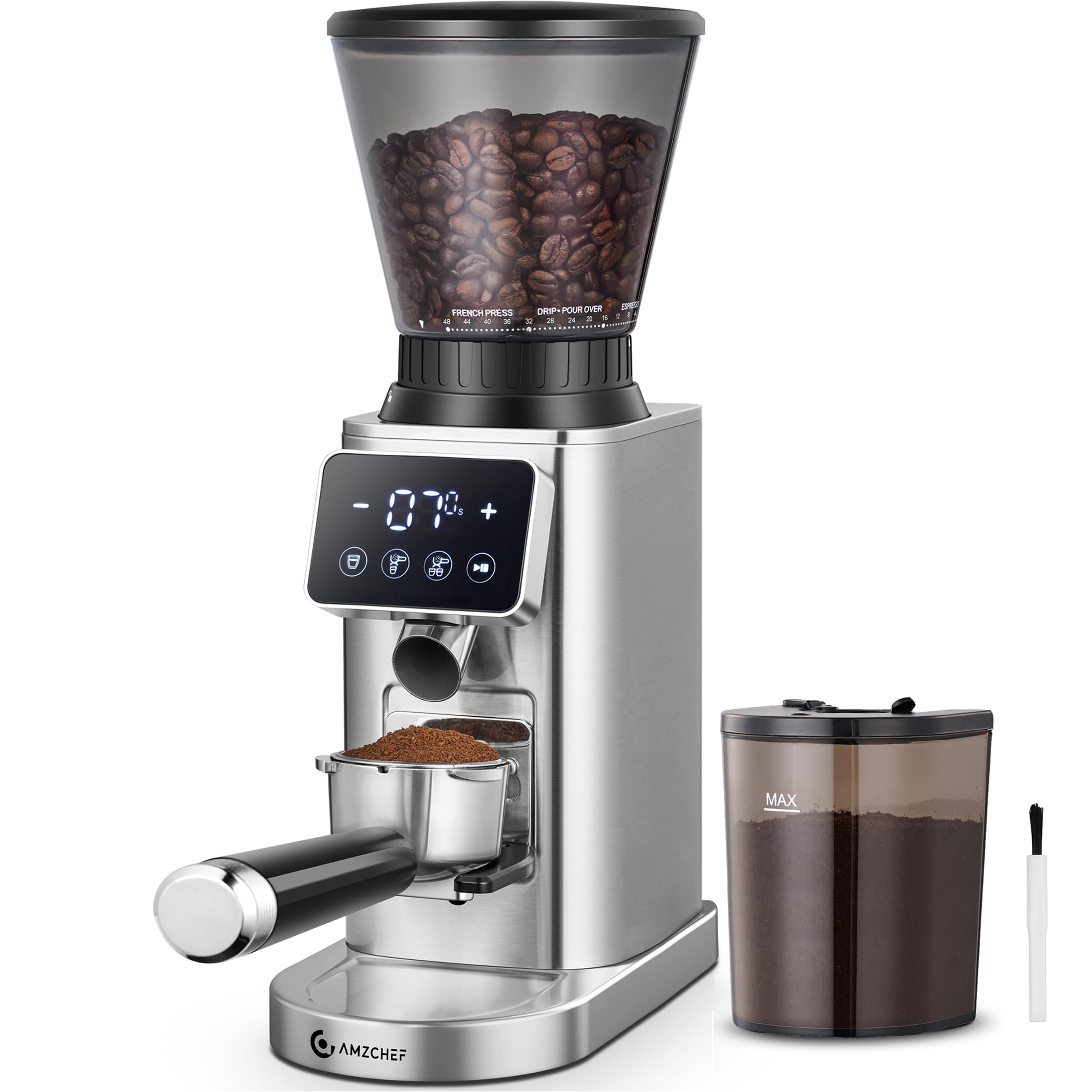
At a budget-friendly price point, this AMZCHEF variant gives you the same 40mm stainless steel conical burr and 48 grind settings as its sibling above, plus a dedicated portafilter holder pad designed for 50mm espresso baskets. What you actually get is a fully equipped espresso grinder with a 100-gram photophobic (light-blocking) dosing cup that keeps grounds fresh while you work.
What you give up compared to the Homtone is the automatic start-stop feature — here you must press the touchscreen to begin and end the grind manually. The catch is a lower price and a much simpler interface that avoids the overfill issue. Reviewers report that “setting 10 is ideal for espresso” and praise its “consistent results” with no static cling, a stark contrast to their previous grinder that was extremely messy.
This is the exact buyer it is perfect for: someone on a tighter budget who still wants a burr grinder with a portafilter holder, does not mind pressing a button, and values an anti-static design that keeps the counter clean.
Why we’d pick it
- Portafilter holder included for 50mm baskets
- Anti-static design, very little mess
- Intuitive touchscreen operation
A few caveats
- No auto-start when docking portafilter
- Portafilter holder may be loose on some mounts
- Does not save last grind setting
6. Baratza Sette 30 Conical Burr Grinder

The Sette 30 is perfect for the espresso enthusiast who prioritizes long-term repairability and serviceability over initial cost or quiet operation. On price alone, the Baratza Sette 30 sits at the premium end of this list. That premium buys you a Specialty Coffee Association award-winning design with burrs made in Europe and a straight-through grind path that keeps retention near zero. It grinds at up to 5 grams per second, so a full double shot is ready in about 3 seconds.
What that money actually gets you is a digital timer with 0.1-second resolution (much finer than the 0.5-second precision of the other grinders here) and exceptional repairability — Baratza’s customer support is famous for sending free replacement parts even years after purchase. One buyer reports that after 5 years of daily use, the burrs “are still pristine” and the grinder required only a single low-cost repair. The downside is the noise: buyers describe it as “loud like a tornado siren,” much louder than the Viesimple’s under-50-decibel operation.
The one reason to choose the Sette 30 over the field is if you plan to keep your grinder for 5+ years and want the most serviceable, well-supported machine available — the parts ecosystem and warranty support are unmatched in this price tier. Just be aware that its noise level is a significant trade-off compared to quieter competitors.
Strong points
- Very fast 5g/sec grinding speed
- Outstanding repairability and support
- Near-zero retention, straight-through design
Before you buy
- Very loud during operation
- Only 30 grind settings (fewer than others)
- Plastic gearbox, not all-metal
Understanding the Specs
Conical Burrs vs Flat Burrs
Conical burrs (the kind used by every grinder on this list) crush and grind coffee between a cone-shaped inner burr and a ring-shaped outer burr. They tend to run slower, produce less heat, and are generally quieter than flat burrs. For espresso at home, conical burrs are the safer choice because they produce a slightly more forgiving particle distribution that reduces channeling (when water finds a weak spot and rushes through unevenly).
Grind Settings and Micron Steps
Each grind setting represents a physical change in the gap between burrs, measured in microns. A grinder with 48 settings has smaller jumps between sizes than one with 30 settings, meaning you can fine-tune your shot more precisely. For espresso, you typically work within a range of about 10 to 15 settings — the extra steps beyond that let you dial in for different roast levels and bean origins.
Retention and Static Control
Retention is the amount of ground coffee that stays inside the burr chamber after grinding. Good espresso grinders hold back less than 0.5 grams per dose. Anti-static technology — either through a coating, ionizer, or slow burr speed (450 RPM) — prevents those retained grounds from clumping or flying out. Higher static means more mess and more wasted coffee.
Motor Speed and Heat Buildup
Slower motors (around 450 RPM) grind more gently, preserving the volatile oils and aromatic compounds in your coffee beans. Faster motors (over 1000 RPM) grind quicker but can heat beans slightly, which may affect flavor in lighter roasts. Noise is a direct trade-off: slower motors are generally quieter under 50 decibels, while fast ones can exceed 70 decibels — loud enough to disturb others.
FAQ
Can I use a conical burr grinder for other brew methods besides espresso?
What is the difference between 30 grind settings and 48 grind settings for espresso?
How do I clean a conical burr grinder without damaging it?
Why does my conical burr grinder produce clumpy grounds for espresso?
Is a heavier grinder always better for espresso?
Final Thoughts: The Verdict
For most home baristas, the best conical burr grinder for espresso winner is the Viesimple Gen 4 because it combines whisper-quiet operation, near-zero retention, and consistent single-dose performance at a price that undercuts similarly equipped premium grinders. If you want the versatility of a large hopper for multiple brewing methods, grab the AMZCHEF CG209-SV. And for the best long-term investment with unbeatable support and repairability, the Baratza Sette 30 remains the choice for espresso enthusiasts who plan to keep their grinder for a decade.

Mo Maruf
I created WellFizz to bridge the gap between vague wellness advice and actionable solutions. My mission is simple: to decode the research and give you practical tools you can actually use.
Beyond the data, I am a passionate traveler. I believe that stepping away from the screen to explore new environments is essential for mental clarity and physical vitality.