You are looking for a concrete fire pit that will sit in your yard year after year, not a fragile metal ring that rusts in two seasons. The problem is that most concrete fire pits are either too small to warm your guests, too fragile to last, or so incredibly heavy that you regret buying them the moment they land on your doorstep. This guide cuts through the marketing to find the concrete fire pits that deliver real warmth, actually last, and look good doing it.
I’m Mohammad Maruf — the co-founder and writer behind WellFizz. This guide is built by comparing the manufacturers’ published specifications and the patterns across verified customer reviews, so you get each pick’s real strengths and trade-offs instead of marketing spin.
Knowing which concrete fire pit offers the right balance of heat output, durability, and usable table space is the difference between a purchase you love and one you regret.
How To Choose The Best Concrete Fire Pit
A concrete fire pit is a heavy investment for your outdoor space, so getting the right one means understanding what actually separates a good pit from a headache. Here are the three things to lock in before you click “buy.”
Heat Output: BTU Ratings and Real Warmth
BTU stands for British Thermal Unit — it is a measure of how much heat the fire pit produces per hour. For a concrete fire pit sized for a standard patio, look for at least 40,000 BTU if you want to feel warmth from several feet away on a cool evening. At 50,000 BTU, you are warming a group of 4–6 people comfortably. Anything below 30,000 BTU will mostly be for ambiance rather than actual heat.
Material and Weight: Concrete vs Cast Concrete
Real concrete is heavy — expect 70 to 180 pounds depending on size — and that weight is what keeps the pit stable in wind and safe around kids and pets. Cast concrete or fiberglass-reinforced concrete is lighter but can chip more easily. If you plan to leave the pit in one spot for years, heavier solid concrete is the better call. If you need to move it around your yard, a lighter concrete blend is worth the catch.
Fuel Type and Safety Certification
Most concrete fire pits run on propane from a standard 20 lb tank (the same one your gas grill uses), but some are set up for natural gas with a direct line to your home. Propane gives you portability; natural gas saves you from refilling tanks. Whichever you choose, look for CSA certification — that means the fire pit has been independently tested to North American safety standards for gas appliances, covering leak-proof connections and stable operation.
Quick Comparison
On smaller screens, swipe sideways to see the full table.
| Model | Category | Best For | Key Spec | Amazon |
|---|---|---|---|---|
| SUNBURY Square Stonecrest | Premium | High heat & heavy-duty use | 50,000 BTU | Amazon |
| UPHA 38-inch Round | Premium | Large gatherings & table function | 38-inch diameter | Amazon |
| Senjoys 30-inch Round | Mid-Range | Smaller spaces & easy assembly | 72 Pounds | Amazon |
| HOMPUS 20-inch Square | Mid-Range | Compact patios & portability | 20 Pounds | Amazon |
| Elementi Granville 60-inch | Premium | Large rectangular space & natural gas | 176 Pounds | Amazon |
In‑Depth Reviews
1. SUNBURY Square Stonecrest Gas Firepit
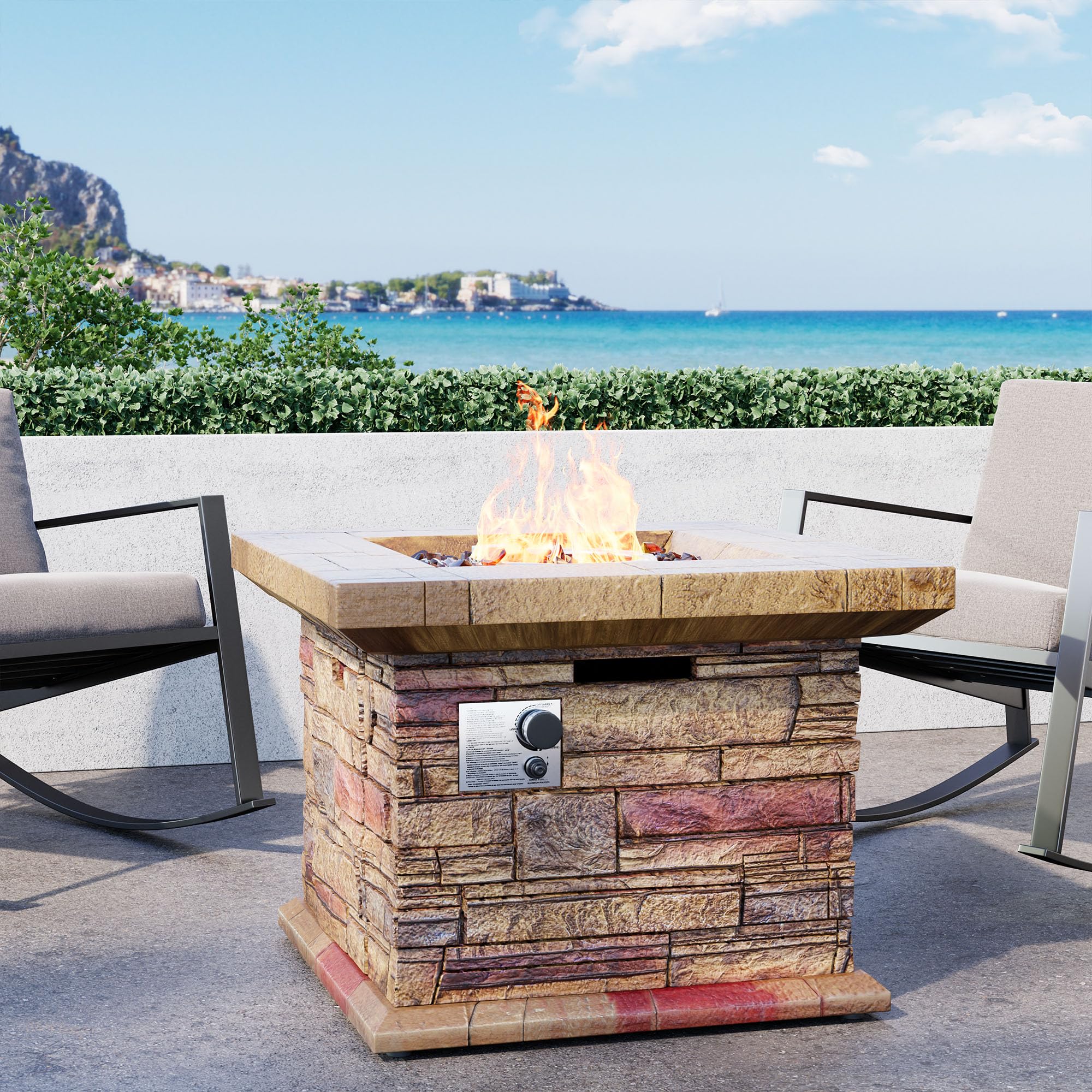
With 50,000 BTU and a 109-pound concrete body, the SUNBURY Square Stonecrest Gas Firepit is the top pick for anyone who wants real heat output from a fire pit that looks like a permanent stone fixture on the patio — enough warmth for 4 to 6 people even on a cool evening, and heavy enough to stay planted in a strong wind.
Buyers report that assembly is nearly zero — the unit arrives ready to go, with one reviewer noting they “virtually had no assembly” and that it looks “very solid, not cheap looking.” The built-in adjustable knob lets you shift between three flame levels to match the mood or the weather.
The honest trade-off is that the propane door doesn’t fit perfectly — one reviewer after a year of use noted it needed a bit of filing — and the included cover can develop mildew over time if left out in wet weather. For sheer heat and solid build, this is the concrete fire pit to beat.
Why it’s great
- 50,000 BTU output for real warmth
- Nearly zero assembly required
- Adjustable three-level flame control
- CSA certified for safety
Good to know
- Propane door may need slight filing for perfect fit
- Cover can develop mildew in wet climates
- 109 pounds is heavy to move once placed
2. UPHA 38-inch Round Concrete Fire Pit Table
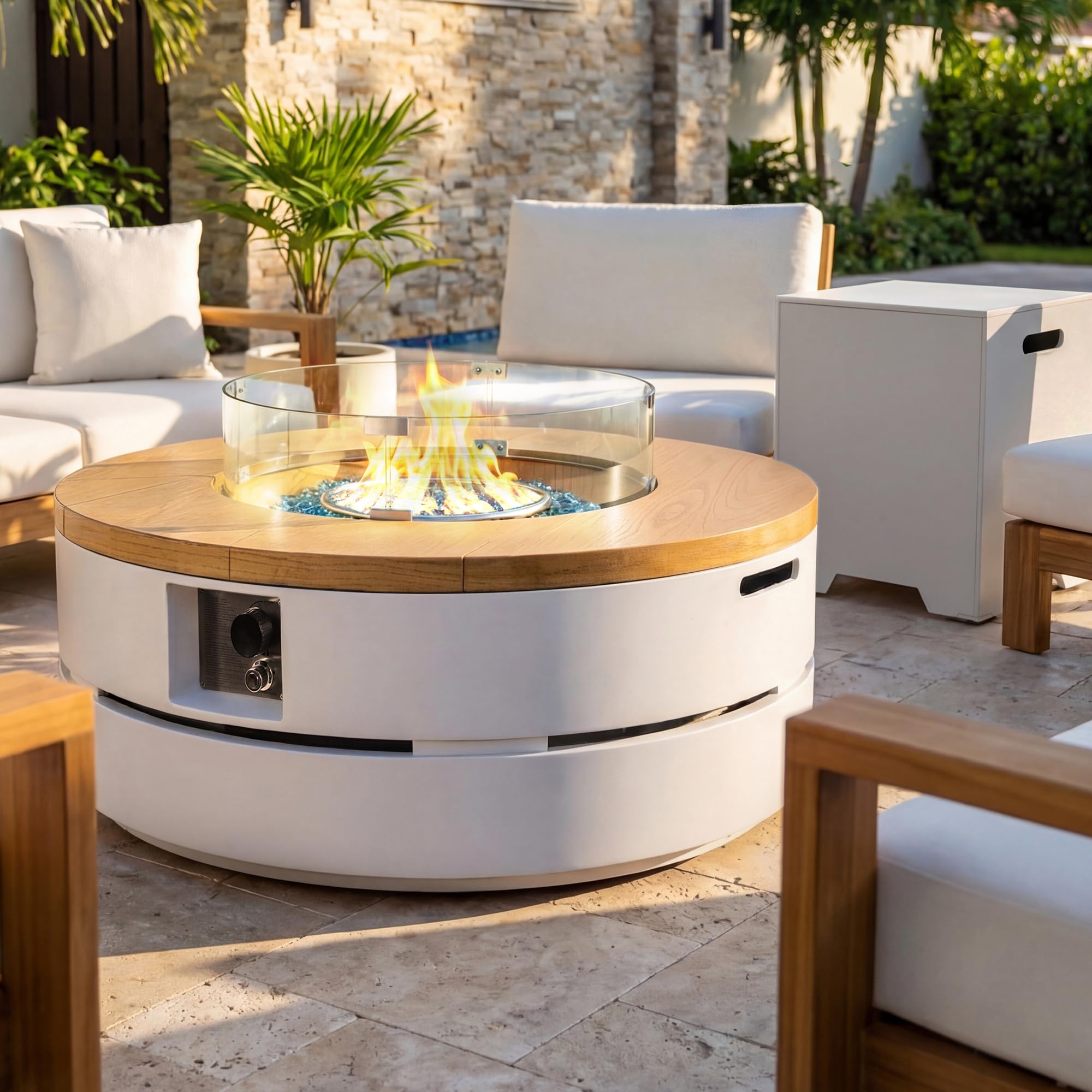
If your gatherings mean drinks and plates need a place to land, the UPHA 38-inch Round is your pick — at 38 inches in diameter, it offers nearly twice the tabletop surface of the 20-inch HOMPUS. It also packs 50,000 BTU, matching the SUNBURY’s heat output but in a bigger footprint that easily seats six people around it.
What sets the UPHA apart is the included ABS tank table — a separate stand that hides the 20 lb propane tank inside, so you don’t see a bulky green canister sitting beside your nice concrete pit. It also ships with a glass wind guard, blue fire glass, and a rain cover. Buyers consistently call it “sturdy” and say it “transformed the patio into a high-end space.”
The downside is weight and shipping — the fire pit weighs 100 pounds and arrives in two separate boxes, so you will want a hand getting it into place. At 38 inches across, it also needs a generous patio footprint. Choose the UPHA over the top pick if you need a larger entertaining surface and a hidden propane tank, and you have the space and help to handle a 100-pound unit.
Where it shines
- 38-inch diameter provides generous table space
- 50,000 BTU for powerful warmth
- ABS tank table hides the propane tank neatly
- Includes wind guard, fire glass, and rain cover
Worth noting
- Weighs 100 pounds and ships in two boxes
- Needs a larger patio area for proper placement
- Blue fire glass may not match every decor style
3. Senjoys 30-inch Round Concrete Gas Fire Pit
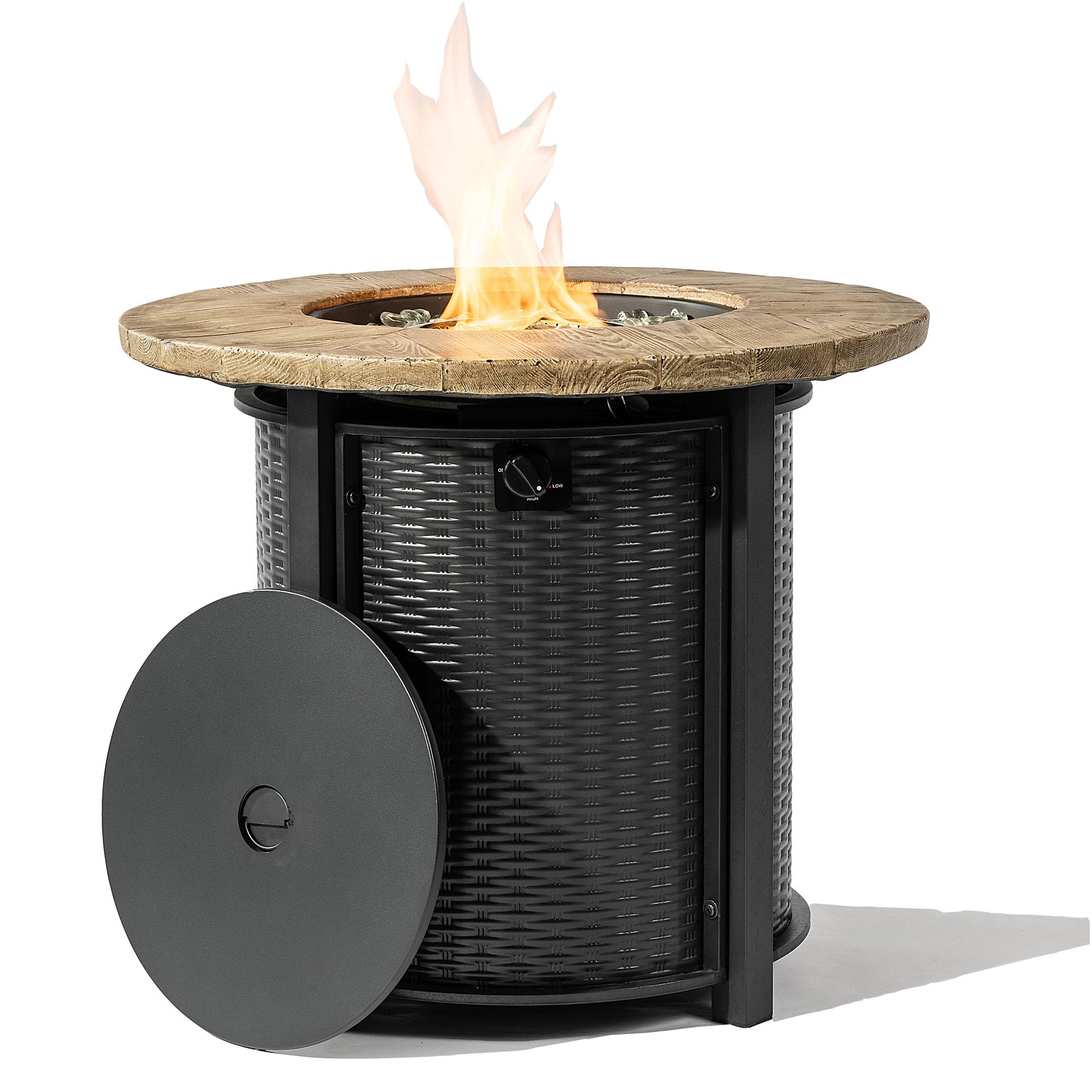
If your patio is on the smaller side — a balcony, a covered porch, or a cozy corner of the deck — the Senjoys 30-inch round pit gives you a full 50,000 BTU of heat without overwhelming the space. That is the same heat output as the larger SUNBURY, but in a 30-inch diameter that fits tight corners. Owners mention it is “perfect for a smaller area” and “the right size” for a porch setup.
Assembly is straightforward — reviewers mention doing it solo in under an hour — and the fire pit includes a center cover that sits over the lava rocks so the whole surface can function as a table when the flame is off. The concrete tabletop is handmade, so each unit has a slightly unique pattern, which adds a custom feel you don’t get with mass-produced metal pits.
A few customers note the built-in igniter can be finicky — one reviewer says “it works quite well, but the igniter doesn’t work very well” and they keep a lighter handy as a backup. The manufacturer also sent a replacement lid quickly when one was missing from a shipment, which speaks well to their support. That 50,000 BTU output matches the guide’s largest pick, but in a 30-inch diameter that fits where others won’t.
What stands out
- 30-inch diameter fits smaller patios perfectly
- 50,000 BTU for strong heat output
- Center cover doubles as a table surface
- Handmade concrete with unique patterns
The trade-offs
- Built-in igniter may be unreliable for some users
- At 72 pounds, still heavy to move around
- Minor assembly required
4. HOMPUS 20-inch Square Propane Fire Pit
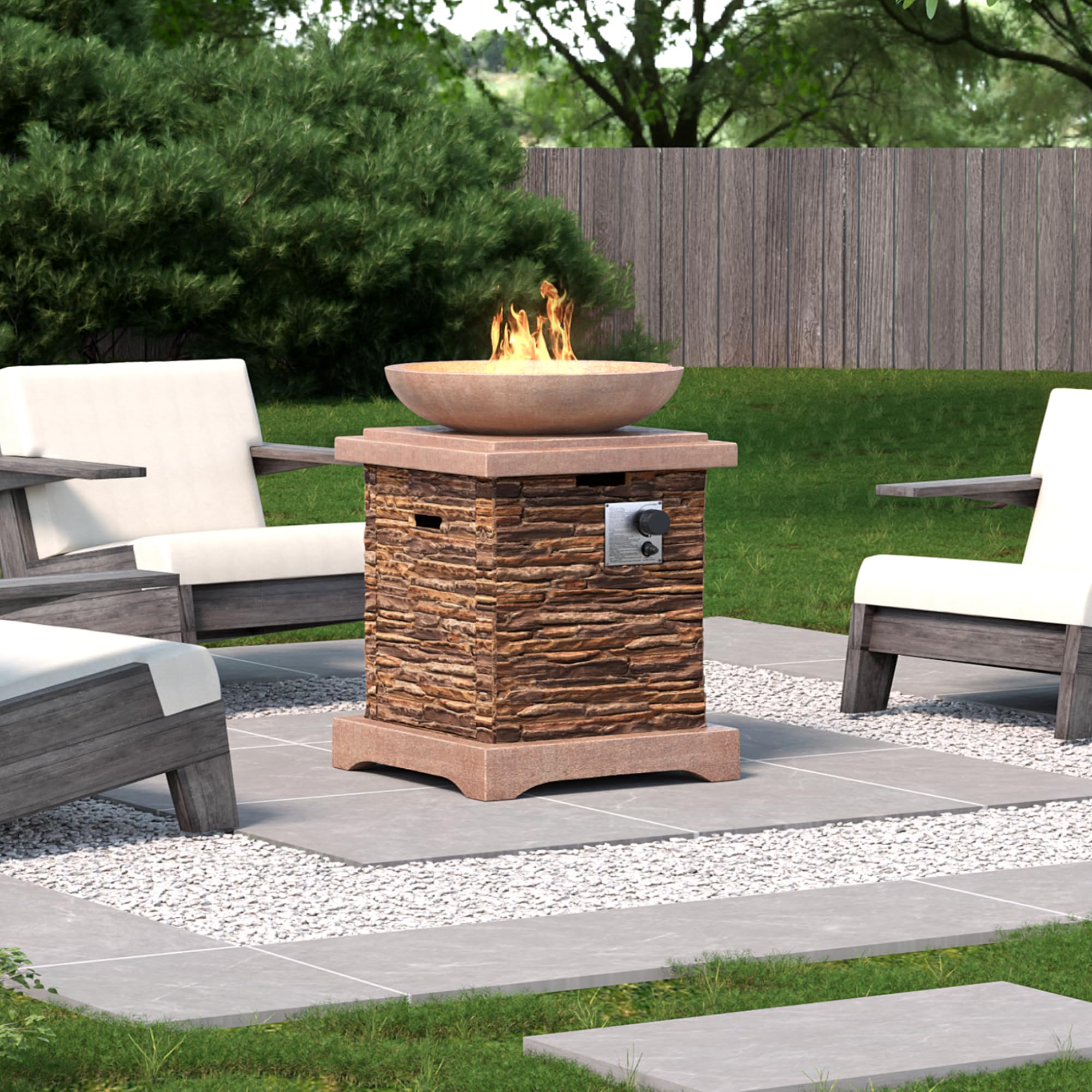
At just 20 inches square and 20 pounds, the HOMPUS is the lightest concrete fire pit on this list — 100 pounds lighter than the UPHA — which means you can actually carry it from the garage to the patio without calling a friend. It also has built-in handles on the sides to make moving even easier.
This is a concrete fire pit designed for portability, but 40,000 BTU still provides real warmth for a small gathering on a cool evening. The compact ledgestone finish looks like carved stone, and the pulse-ignition system lights the flame with a single push. Reviewers point out the unit is “very solid and beautiful” and that customer service responded quickly when a unit arrived damaged — sending a replacement plus free blue fire glass.
One clear trade-off is the small tabletop area — at 17 inches by 17 inches, it is big enough for a couple of drinks but not for a full spread. Also, several reviewers mention the photos and actual color don’t match perfectly, so be prepared for the finish to look a bit different in person.
The upsides
- Only 20 pounds — truly portable with side handles
- 40,000 BTU provides real warmth for small groups
- CSA certified for safety
- Excellent customer service reported by buyers
Keep in mind
- Small tabletop space for drinks only
- Color in photos may not match actual unit
- Wind direction affects heat distribution
5. Elementi Granville 60-inch Rectangular Fire Table

The Elementi Granville delivers a 60-inch-long, 176-pound cast-concrete fire table with a 304 stainless steel burner and CSA certification, set up for natural gas connection to your home’s line — no propane tanks to refill. It comes with lava rocks and a canvas cover, ready to use out of the box.
This fire table produces 45,000 BTU across a rectangular flame bed designed to warm a long seating arrangement, and it doubles as a coffee table when paired with the compatible windscreen (sold separately). Shoppers say the “packaging was excellent, finish flawless” and that it works as a “great centerpiece for your patio.”
Two things to accept upfront: at 176 pounds, you absolutely need two people and furniture movers to get this into position — it is not going anywhere once placed. And at full power, some users report a whistling sound from the burner, which may bother those who want a silent flame. This is the perfect permanent centerpiece for a budget buyer who already has a natural gas line and wants a large, heavy, low-maintenance fire table that stays put.
Why we’d pick it
- 60-inch length provides generous table space for large patios
- Natural gas connection means no tank refills
- 45,000 BTU with CSA certification
- Doubles as a coffee table with optional windscreen
A few caveats
- 176 pounds requires two people and equipment to move
- Full-power operation may produce a whistling sound
- Optional windscreen and propane conversion sold separately
Understanding the Specs
BTU — What It Really Means
BTU stands for British Thermal Unit, and it is the standard measure of heat output for gas appliances. One BTU is the amount of heat needed to raise the temperature of one pound of water by one degree Fahrenheit. For a concrete fire pit, 40,000 BTU is enough to warm two to four people sitting nearby, while 50,000 BTU can comfortably heat a group of six. If the number is below 30,000 BTU, you are buying ambiance lighting, not a heater.
CSA Certification — Why It Matters
CSA stands for Canadian Standards Association, but in practice CSA International tests gas appliances to both US and Canadian safety standards. A CSA-certified fire pit has been tested for leak-proof gas connections, stable flame operation, and proper shut-off behavior. This certification matters because an uncertified fire pit could have gas leaks, unreliable ignition, or burners that don’t handle wind well — real safety risks when you are running propane or natural gas near your home.
Concrete vs Cast Concrete vs Fiberglass
True concrete fire pits are heavy (70–180 pounds) and durable, but they can crack if exposed to freeze-thaw cycles without a proper seal. Cast concrete is a mix of concrete and lightweight aggregates — it is easier to move but can chip at edges. Fiberglass-reinforced concrete is the lightest option but doesn’t feel as substantial underfoot. For a permanent patio fixture, solid concrete is the best long-term value. For something you might rearrange, cast concrete is a better fit.
Propane vs Natural Gas — Which One Works for You
Propane fire pits use a standard 20 lb tank (like a gas grill tank) and are portable — you can move the fire pit around the yard or take it to a friend’s house. A 20 lb tank typically powers a 50,000 BTU fire pit for 6–8 hours on high. Natural gas fire pits connect directly to your home’s gas line and never need refueling, but they are permanently installed in one spot. Natural gas also produces slightly less heat per cubic foot than propane, so you may need a larger burner to match the same warmth.
FAQ
Can I leave my concrete fire pit outside in winter?
How do I clean the concrete surface of my fire pit?
Does a concrete fire pit need to be on a fireproof surface?
Why does my fire pit whistles when turned to high?
Final Thoughts: The Verdict
For most buyers, the concrete fire pit winner is the SUNBURY Square Stonecrest because it delivers maximum 50,000 BTU heat output with a solid concrete build and nearly zero hassle to set up. If you need a bigger table surface for entertaining and want to hide the propane tank completely, grab the UPHA 38-inch Round. And for smaller patios where space is tight, the Senjoys 30-inch Round gives you the same heat output in a footprint that fits comfortably on a porch or deck corner.

Mo Maruf
I created WellFizz to bridge the gap between vague wellness advice and actionable solutions. My mission is simple: to decode the research and give you practical tools you can actually use.
Beyond the data, I am a passionate traveler. I believe that stepping away from the screen to explore new environments is essential for mental clarity and physical vitality.