Our readers keep the lights on and my smoothie glass nicely filled. As an Amazon Associate, I earn from qualifying purchases.
Most people buy car speakers that look right but sound hollow once installed. A 6.5 component speaker system separates the woofer (the part that handles lows) from the tweeter (the part for highs), giving you a much wider soundstage (the sense of instruments spread left-to-right and front-to-back) than a standard coaxial speaker (which puts both drivers in one unit) can ever achieve. But picking the wrong pair usually means harsh treble, weak bass, or a set needing more power than your car can deliver.
I’m Mohammad Maruf — the co-founder and writer behind WellFizz. This guide is built by comparing the manufacturers’ published specifications and the patterns across verified customer reviews, so you get each pick’s real strengths and trade-offs instead of marketing spin.
After sorting through the factory numbers and thousands of buyer experiences, these seven sets stand apart. Here is the final list of the best 6.5 component speakers that actually deliver on their promises, ranked for real-world use and honest value.
How To Choose The Best 6.5 Component Speakers
Picking a component speaker set is not just about finding one that fits your door — it’s about matching its capabilities with your amplifier’s power and your taste in sound. Three numbers and one design element define the entire decision.
RMS Power Handling
This number tells you how much continuous power a speaker can handle from an amplifier without distorting or breaking. You need an amp that delivers roughly the same RMS (Root Mean Square — a speaker’s continuous power rating) per channel. Under-powering a high-RMS speaker means it never reaches full potential, and you will turn the volume up too high, pushing the amp into distortion — the fastest way to damage a speaker. For most setups, 50–80 watts RMS per channel is the sweet spot, so lows stay tight and highs stay clear at highway speeds.
Tweeter Design
The tweeter handles the high frequencies — cymbals, vocals, and strings. A soft-dome tweeter (made of textile or silk) tends to sound smoother and warmer, while a metal-dome or PEI-dome tweeter (polyetherimide, a tough plastic) can be brighter and more detailed but risks sounding harsh if not matched well with your car’s acoustics. Choose based on whether you prefer a laid-back or a lively top end, so long drives don’t fatigue your ears.
Crossover Network
The crossover is the small circuit board that splits the audio signal, sending only low frequencies to the woofer and only high frequencies to the tweeter. A high-quality crossover with adjustable settings (like tweeter level attenuation — a volume control for the tweeter) lets you fine-tune the balance so the transition between woofer and tweeter sounds seamless. Cheap crossovers often leave a gap or an overlap that makes music sound thin or muddy.
Quick Comparison
On smaller screens, swipe sideways to see the full table.
| Model | Category | Best For | Key Spec | Amazon |
|---|---|---|---|---|
| HERTZ Mille Pro MPK 1653 | Premium | Audiophile sound at high power levels | 180W RMS bridged handling | Amazon |
| Focal KIT 165AS Access | Premium | Open, detailed soundstage | 60-20,000 Hz frequency response | Amazon |
| Focal ASE165 Auditor EVO | Mid-Range | Entry-level Focal quality | 75W RMS each channel | Amazon |
| Rockford Fosgate P165-SI Punch | Mid-Range | Built-in concealed crossover for clean installs | 60W RMS / 120W Max power handling | Amazon |
| Alpine S2-S65C | Mid-Range | Hi-Res Audio certified entry-level set | 240W Max / 80W RMS per channel | Amazon |
| Infinity Reference 6530CX | Value | Great sound on a moderate amp | 60W RMS amplifier sweet spot | Amazon |
| KICKER 46CSS654 CSS65 | Value | Solid upgrade from factory sound | 50W RMS per channel (head unit) | Amazon |
In‑Depth Reviews
1. HERTZ Mille Pro Series MPK 1653

180W RMS bridged power handling makes the HERTZ Mille Pro MPK 1653 the top pick for audiophiles who run a powerful amplifier and want the deepest mid-bass from a 6.5-inch driver. Its pure copper voice coil and Tetolon fiber soft dome tweeter (a woven synthetic fabric dome) manage to sound clear without ever becoming harsh, even at high volumes.
Buyers report these speakers still sound amazing after five years of use, and the tweeter has a subtle roll-off (a gentle reduction in the very top frequencies) that keeps treble from fatiguing your ears on long drives. A few owners mention the factory crossover can sound slightly bright out of the box, so a DSP (digital signal processor — a device that fine-tunes audio settings) helps dial them in perfectly.
Choose this set over the Focal KIT 165AS if you have a powerful amplifier and want the deepest mid-bass from a 6.5-inch driver. skip it if your budget is tight or you do not plan to add a DSP, since its full performance comes at a high price. For deep, fatigue-free bass that lasts for years, this is the set to beat.
Why it’s great
- Phenomenal clarity at both low and very high volumes
- Mid-bass impact is unusually deep for a 6.5-inch woofer
- Build quality that reviewers praise as still excellent after years of use
Good to know
- Requires a high-quality amplifier and DSP to really shine
- Price is significantly higher than the rest of the field
- Low mounting depth might need adapters for some vehicles
2. Focal KIT 165AS Access Series
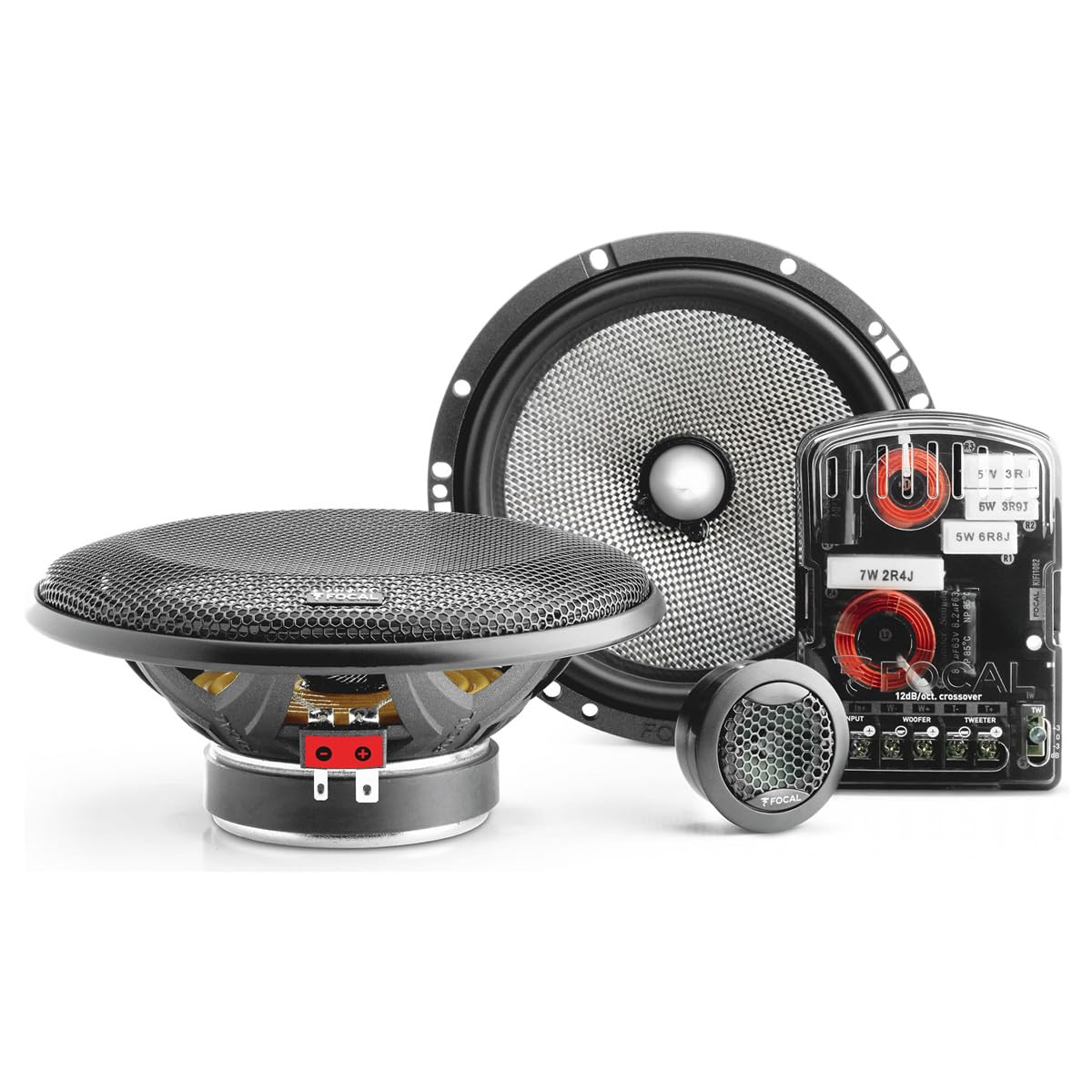
Where the HERTZ MPK 1653 focuses on raw detail, the Focal KIT 165AS prioritizes an open, airy soundstage that makes instruments feel placed around you rather than coming from door panels. Its 91.3 dB sensitivity (how loud it gets with 1 watt of power at 1 meter away) means it gets loud with less amplifier power, making it more flexible than the HERTZ for setups with moderate-amp power (in the 40–60 watt RMS range).
One reviewer noted it made their truck sound “crispy” compared to the factory system, and the 60–20,000 Hz frequency response covers the full audible range without obvious gaps. The tweeter can sound bright — some listeners love the extra shimmer on cymbals and vocals, but a few buyers found it fatiguing over long sessions, especially with a high-power amp like the JL XD 400/4.
Choose this over the top pick if you value an expansive, three-dimensional soundstage over raw bass impact.
Where it shines
- High sensitivity (91.3 dB) means it works well with lower-powered amps
- Wide frequency response from 60 Hz to 20,000 Hz for full-range sound
- Creates a wide, immersive soundstage that fills the cabin
Worth noting
- Some buyers found the tweeter too bright and fatiguing on long drives
- Low power handling (6-60W RMS) limits pairing with powerful amps
- A few reviews noted a “honky” midrange that needed EQ adjustment
3. Focal ASE165 Auditor EVO

You are upgrading from factory speakers and want Focal’s famous French engineering, but your budget does not stretch to the KIT 165AS — the ASE165 Auditor EVO is the entry point that still delivers that signature clarity and handles 75W RMS per channel, which is a healthy amount for a clean, mid-level amplifier setup. Customers note that paired with a Kicker Key 200.4 amp, the sound fidelity and dynamic range are phenomenal.
Some report the highs can sound a bit “tinny” — easily fixed with a little EQ adjustment in the head unit. The tweeter bracket is well-constructed and the black lacquered finish looks premium behind factory grilles, but the mid-bass is noticeably lacking compared to the pricier Focal set, so plan on adding a subwoofer for full-range sound. The Hi-Res Audio certification (reproducing frequencies up to 40kHz, double the human hearing limit) gives extra headroom for digital music files encoded at high sample rates, keeping sound accurate even with lossless streaming.
This is for the buyer who wants Focal clarity on a tighter budget and has an aftermarket amp ready. pass on it if you want strong mid-bass without a subwoofer, or if you prefer a warmer treble — but for the price, no other speaker in this guide reproduces frequencies up to 40kHz.
What stands out
- Hi-Res Audio certified for reproduction up to 40kHz
- 75W RMS power handling matches well with most aftermarket amps
- Easy to amplify and fits into most factory locations
The trade-offs
- Mid-bass is weak — a subwoofer is almost necessary for full sound
- Highs can sound tinny without EQ tweaking
- Entry-level Focal; does not have the same refinement as the Access series
4. Rockford Fosgate P165-SI Punch

The single number that matters most in this category is power handling, and the Rockford Fosgate P165-SI scores 60W RMS — the continuous power it can handle without distorting — making it compatible with a huge range of amplifiers while still getting loud enough for most listeners. The integrated concealed crossover (the circuit that splits frequencies, built into the speaker instead of a separate box) hides behind the door panel for a clean look, but installation is more complex — you run wires through the door panel with a fish tape (a flexible wire-pulling tool).
Once installed, the build quality is unmistakable: the injection-molded mineral-filled polypropylene cone and santoprene rubber surround (a durable synthetic rubber) are designed to survive years of heat and vibration. One buyer mentioned great sound with “high power handling without distortion.” The 4-ohm impedance (the electrical load the speaker presents to the amp) works with almost any aftermarket amplifier.
Choose this if you want a speaker that will last and you are okay with a harder install. it’s not for you if you want an easy plug-and-play setup or need a tweeter that fits perfectly in very small factory grilles — this is a price-to-value read where durability and power handling justify the effort for those willing to install it.
The upsides
- Rock-solid build quality with mineral-filled polypropylene cone
- 60W RMS power handling matches common amplifier power levels
- Integrated concealed crossover makes for a clean, hidden installation
Keep in mind
- Installation is more complex due to the internal crossover needing fish tape
- Tweeters are larger than some factory grilles may accommodate
- One owner reported bass is a bit lacking without a subwoofer
5. Alpine S2-S65C S-Series

At this price, you get Hi-Res Audio certification (reproducing frequencies up to 40kHz) — the same certification found on speakers costing three times as much — along with 80W RMS power handling, which beats the Focal ASE165 by 5 watts and the Infinity Reference by 20 watts. The HAMR surround (High Amplitude Multi-Roll — a specifically shaped foam edge) allows the cone to move further for deeper bass response, though physics still limits a 6.5-inch driver.
What you give up is low-end bass authority: even with an 80W amp, reviewers point out the bass is decent but cannot replace a subwoofer, and running these off a stock head unit wastes their potential entirely — a reviewer noted an underpowered head unit “wastes potential” and that these need “~80W RMS to perform.” A removable tweeter housing fits flush or angled in almost any location.
This is the exact set for the buyer with a good 4-channel amplifier (75–100W per channel) who wants modern certification at a price that does not hurt. look elsewhere if your car runs on a factory head unit alone, or if you want bass that hits hard without a subwoofer.
Why we’d pick it
- Hi-Res Audio certified for high-frequency detail up to 40kHz
- 80W RMS power handling is generous for this price tier
- HAMR surround allows more cone movement for deeper bass response
A few caveats
- Requires an external amplifier to sound its best; stock head units are insufficient
- Bass is still limited without pairing with a subwoofer
- Some buyers needed a separate amp harness for installation
6. Infinity Reference 6530CX
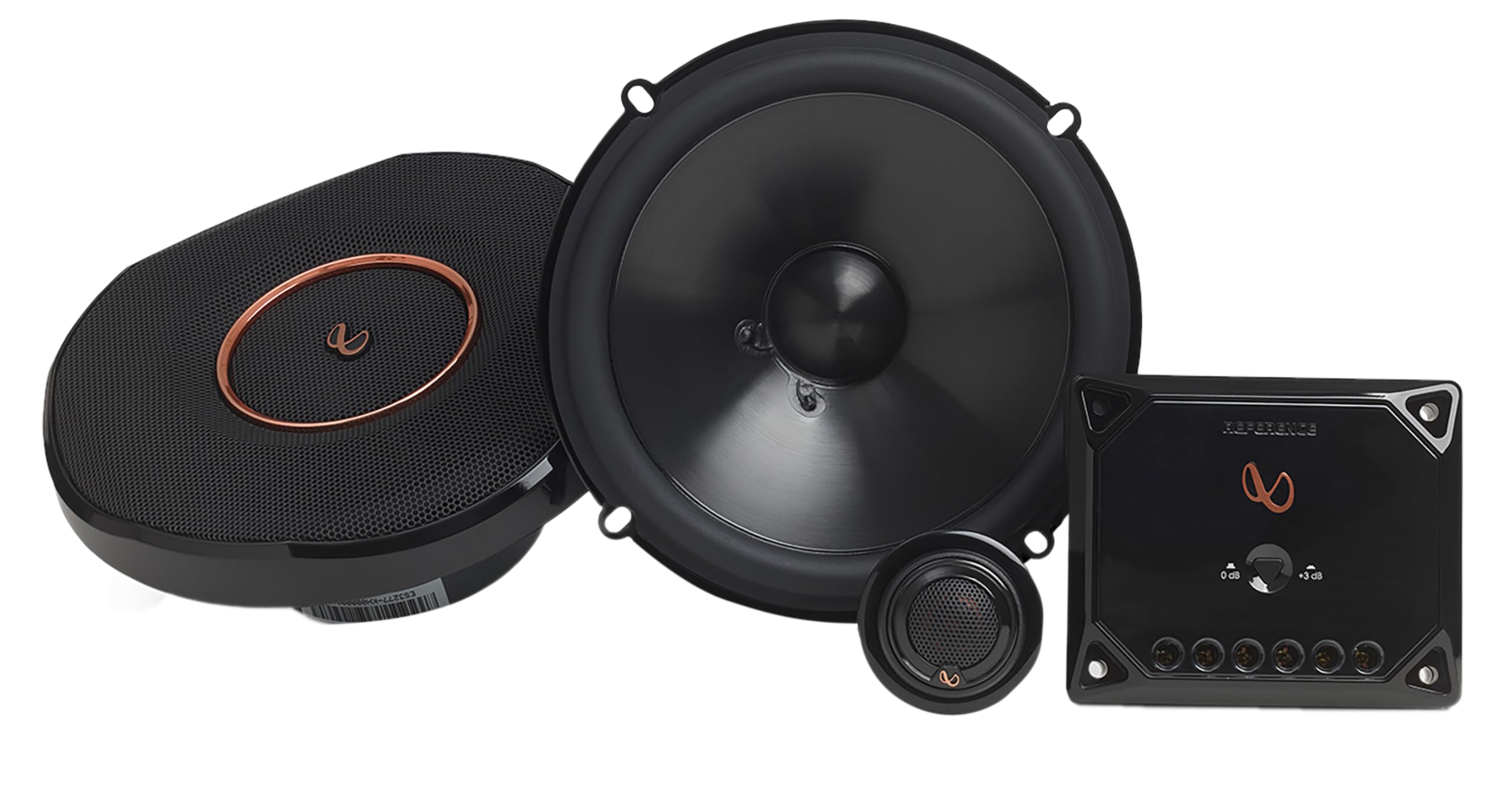
The Infinity Reference 6530CX is for the listener who values sweet, smooth treble above all else — the edge-driven textile tweeters (a fabric dome driven at its edge for lower distortion) deliver high frequencies that are clean and well-rounded without the screechy brightness that plagues many budget component speakers, and shoppers say they are superior in this regard to the JBL GTO and Pioneer A-Series.
That smooth top end serves someone who listens to a lot of acoustic music, female vocals, or jazz, where harsh treble ruins the experience. The Plus One woofer cones have more surface area than standard woofers, which translates to better mid-bass punch at moderate volume levels. However, buyers report it “performs best with 60W RMS amp” and factory volume is noticeably lower without one. The crossovers are physically large (harder to hide in tight door panels) and the tweeter wire is only 4 inches long — most installations will need extra 16-gauge speaker wire to reach the crossover location.
For the price, no other set balances smooth highs with solid midrange this well. steer clear if you plan to run speakers from the head unit alone without an amplifier.
Strong points
- Edge-driven textile tweeters produce some of the smoothest highs in this price range
- Plus One woofer design gives more surface area for better mid-bass
- Buyers consistently rate it as a top pick for sound quality per dollar
Before you buy
- Crossovers are large and may be hard to fit in tight door panels
- Tweeter wire is only 4 inches; extra 16-gauge wire is needed for most installs
- Needs a 60W RMS amplifier to really wake up; weaker head units leave it quiet
7. KICKER 46CSS654 CS-Series CSS65

Compared to the Infinity Reference, the KICKER CSS65 costs less but gives you phase plugs (small cones in the center of the woofer that stop sound waves from bouncing around inside the pole piece, reducing distortion) and a UV-treated poly-foam surround that resists cracking in direct sunlight — a practical advantage if your car sits in the sun all day. The EVC (Extended Voice Coil) design helps the woofer produce deeper lows than you would expect at this price.
One customer observed replacing the factory Toyota speakers in a Corolla: the sound became much clearer with mids and highs at ear level, dramatically improving music enjoyment. Another reviewer mentioned the radio supplies 50W RMS per channel and the speakers “would improve with more power.” The three tweeter mounting options (flush, angled, or surface pods) let you position the highs exactly where your ears need them.
This is the right set for the first-time upgrade buyer who wants a real component system without buying a new amplifier yet — it runs fine off a decent head unit and gives you flexible tweeter placement. It’s the budget champ here, but if you have the cash, the Infinity Reference offers smoother highs.
What we like
- Phase plugs eliminate woofer distortion for clearer midrange
- UV-treated poly-foam surround resists sun damage better than standard foam
- Three tweeter mounting options for flexible installation
The downsides
- Will benefit from more amplifier power than a typical head unit provides
- Low-end bass is limited; pairing with a subwoofer is recommended
- Some buyers found the included grilles less secure than expected
Understanding the Specs
RMS vs. Peak Power
RMS (Root Mean Square) is the amount of continuous power a speaker can handle over time — it is the real-world number that tells you what amplifier to pair with it. Peak power is a marketing number that shows what the speaker can survive for a split second. Ignore peak power; look at RMS. A 60W RMS speaker needs an amplifier that delivers around 60 clean watts per channel, so you get distortion-free sound at high volumes.
Impedance (Ohms)
Impedance is the electrical resistance the speaker presents to the amplifier, measured in ohms. Most car audio speakers are 4 ohms. A lower impedance (2 ohms) draws more power from the amp and gets louder, but can overheat the amp if it is not stable at that load. A 4-ohm speaker is the safest, most universal choice for any amplifier setup, avoiding overheating risk.
Sensitivity (dB)
Sensitivity measures how loud a speaker gets with 1 watt of power at a distance of 1 meter. A higher number (91 dB or above) means the speaker produces more volume with less amplifier power — great if you are using a stock head unit. A lower sensitivity speaker (85 dB) needs a more powerful amp to reach the same volume level, so you get less from the same power.
Frequency Response (Hz)
This range shows the lowest and highest frequencies the speaker can reproduce. The human ear hears roughly 20 Hz to 20,000 Hz. A speaker with a response that starts at 60 Hz means you will miss the lowest bass notes — that deep rumble below 60 Hz. That is why a subwoofer is often paired with component speakers that have a higher low-end cutoff, to fill in that missing depth.
FAQ
Can I run 6.5 component speakers off my factory head unit?
What is the difference between component and coaxial speakers?
Do I need a subwoofer with 6.5 component speakers?
What does Hi-Res Audio certification mean for car speakers?
Final Thoughts: The Verdict
For most buyers, the best 6.5 component speakers winner is the HERTZ Mille Pro MPK 1653 because it offers audiophile-grade clarity and deep mid-bass that no other 6.5-inch set on this list can match. If you want a set that opens up a wide, immersive soundstage at a more accessible price, grab the Focal KIT 165AS Access Series. And for the budget-conscious buyer who still wants solid build quality, the KICKER 46CSS654 CS-Series CSS65 gives you phase plugs and UV-treated surrounds at a low price.

Mo Maruf
I created WellFizz to bridge the gap between vague wellness advice and actionable solutions. My mission is simple: to decode the research and give you practical tools you can actually use.
Beyond the data, I am a passionate traveler. I believe that stepping away from the screen to explore new environments is essential for mental clarity and physical vitality.