Our readers keep the lights on and my smoothie glass nicely filled. As an Amazon Associate, I earn from qualifying purchases.
The most frustrating thing about playing a competitive shooter with a standard controller is the moment your aim drifts mid-gunfight or your thumb has to leave the stick to jump, costing you the round. A proper FPS controller fixes that with rear paddles or buttons so your thumbs never leave the sticks, and with joystick technology that stays precise long after a standard pad would start wobbling. This guide breaks down the six best controller for FPS right now, comparing the specs that actually matter — polling rate (how often it reports your stick position), trigger response, back-button placement, and joystick durability — so you can pick the one that suits your platform, budget, and grip style.
I’m Mohammad Maruf — the co-founder and writer behind WellFizz. This guide is built by comparing the manufacturers’ published specifications and the patterns across verified customer reviews, so you get each pick’s real strengths and trade-offs instead of marketing spin.
The market is split between PlayStation, Xbox, and PC-native designs, but the best controller for fps gaming needs to combine immediate trigger actuation with anti-drift sticks and programmable rear inputs for jump-crouch-reload combos.
How To Choose The Best Controller For FPS
Not all “pro” controllers are built the same, and features that look good on paper can be uncomfortable in your hands. Here are the three things you need to check before buying.
Joystick Type: Standard vs Hall Effect vs TMR
Standard joysticks use physical potentiometers (small mechanical contacts that wear down over time), which is why a six-month-old controller often develops a slight drift. Hall Effect joysticks use magnets to sense position instead, with no physical contact, so they can last years without drifting. TMR (Tunnel Magneto-Resistance, a precise magnetic sensor) joysticks are the newest and most sensitive magnetic type — they offer even finer micro-adjustments for tracking a moving target at long range, plus adjustable tension that lets you dial in the resistance.
Paddle or Back Button Count and Placement
The whole point of a premium FPS controller is to keep your thumbs on the sticks while you jump, crouch, reload, and ping. The number of back controls matters less than where they land under your middle and ring fingers. Some controllers place them high and flush (like the SCUF Valour Pro), while others use long paddles that sit lower (like the Xbox Elite). A bad layout means you’ll accidentally press them — so if possible, check reviews about ergonomics before buying.
Trigger Stops and Polling Rate
Trigger stops let you switch from a full-length trigger pull to a short, hair-trigger click — the difference between a slow squeeze and an instant shot in a game like Call of Duty. Look for a physical switch you can toggle mid-game (not a software-only setting). Polling rate, measured in Hertz (Hz), tells you how often the controller reports its position to your PC — 1000Hz (once every 1 millisecond) is now standard for competitive play, and the Razer Raiju V3 Pro offers up to 2000Hz (once every 0.5 milliseconds) on PC for an even tighter feel.
Quick Comparison
On smaller screens, swipe sideways to see the full table.
| Model | Category | Best For | Key Spec | Amazon |
|---|---|---|---|---|
| NYXI Imperial | Best Overall | PC & Switch FPS on a budget | 1000Hz polling rate, TMR joysticks, 15hr battery | Amazon |
| SCUF Valour Pro | Best Value | Xbox & PC wired competitive play | 4 rear paddles, Hall Effect sticks, click triggers | Amazon |
| NACON Revolution 5 Pro | Premium Pick | PS5 & PC drift-free endurance | Hall Effect sticks & triggers, 10hr battery | Amazon |
| PlayStation DualSense Edge | Top Performer | PS5 loyalists wanting modular sticks | Swappable stick modules, adjustable triggers | Amazon |
| Razer Raiju V3 Pro | Fastest Charging | Serious PS5 & PC esports players | 2000Hz wired polling rate, 6 remappable buttons | Amazon |
| HEXGAMING PHANTOM | Most Versatile | PS5 players who want maximum customization | Hall Effect sticks, 8 interchangeable thumbsticks, 6 profiles | Amazon |
In-Depth Reviews
1. NYXI Imperial
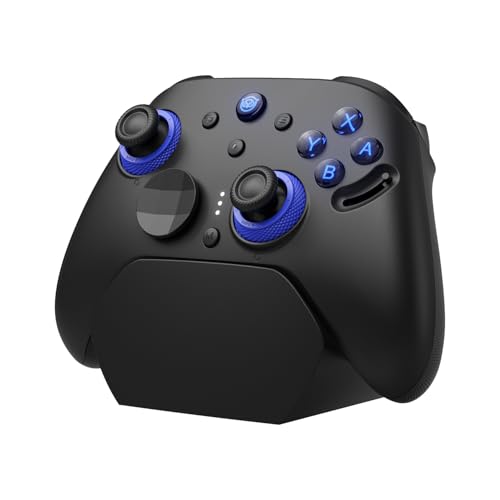
TMR joysticks and a 1000Hz polling rate for under $100 make the NYXI Imperial the top pick for PC and Switch players who want responsive aim without drift. Its 1.2-pound weight feels substantial in hand — a 2.1x difference compared to the lighter SCUF Valour Pro at 0.57 pounds — but the catch is a solid, planted feel that helps with stability during long aim-duels.
You can dial the joystick tension continuously from a light 40gf to a stiff 80gf — softer for all-day comfort on the couch, tighter for snappy flicks in competitive matches. The dual-mode triggers let you flip a hardware switch between a hair-trigger click for FPS headshots and a full analog pull for racing games, all without software. Reviewers consistently report that the 1200mAh battery delivers the advertised 15-hour life, which buyers report “lasts several days” of regular play, and the magnetic charging dock means you never fumble for a cable.
The downside is platform compatibility — this controller works with PC, Switch, and Android, but not Xbox or PlayStation. For PC and Switch players who want wireless freedom and adjustable joystick tension without minding the extra weight, the NYXI Imperial is the clear winner.
Why it’s great
- Adjustable-tension TMR joysticks (40gf to 80gf) resist drift indefinitely
- 1000Hz polling rate over wired/2.4GHz for responsive inputs
- 15-hour battery life with a smart magnetic charging dock
Good to know
- Not compatible with Xbox or PlayStation consoles
- At 1.2 pounds, it is noticeably heavier than most wired controllers
2. SCUF VALOR PRO Wired Performance Xbox Controller

While the NYXI Imperial wins on wireless features and joystick adjustability, the SCUF Valour Pro beats it on rear-paddle ergonomics and sheer value for Xbox and PC players — it packs four embedded rear paddles and Hall Effect anti-drift sticks into a 0.57-pound wired shell that feels smaller and more nimble than almost any competitor. The wired connection means zero battery anxiety and the lowest possible latency, and the Instant Triggers (a physical switch that eliminates the full trigger pull) are a genuine competitive edge in games where milliseconds decide gunfights.
The wraparound bumpers have more surface area than the Xbox Elite’s, which owners mention makes faster movements feel natural, and the audio control system on the controller lets you adjust game/chat mix on the fly without pausing. “Gained 30 SR and hit Diamond” in COD ranked play, one verified reviewer reported, crediting the paddles for keeping thumbs on sticks during jump-slide combos. The matte rubberized grip prevents slipping, and the Hall Effect joysticks mean no drift even after months of use.
Choose the SCUF Valour Pro over the NYXI Imperial if you mainly play on Xbox or want a lighter, wired controller that never needs charging, and you value paddle count and trigger speed above all else.
Where it shines
- Four responsive rear paddles with up to 16 programmable functions
- Instant Triggers eliminate trigger pull for faster shots
- Anti-drift Hall Effect joysticks and a premium matte grip
Worth noting
- Wired only — no wireless option and no battery to charge
- Some early units had USB-C port connectivity issues reported by buyers
3. NACON Revolution 5 Pro
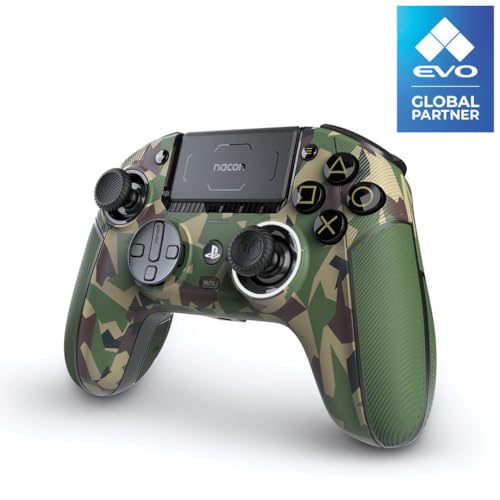
Imagine playing Call of Duty on PS5 for two years straight, picking up the controller daily, and never once feeling your aim drift — that is the exact promise of the NACON Revolution 5 Pro’s Hall Effect joysticks (magnetic sensors that never touch, so they cannot wear down), and verified buyers confirm “zero drift after 2 years” in their reviews. The magnetic sensors on both the sticks and the triggers eliminate the physical contact that causes standard pads to fail, giving you a durability edge that makes the higher upfront cost feel like an investment rather than an expense.
The trigger-blocker switches let you toggle between long and short pulls on the fly, so you can switch from a sniper’s slow squeeze to a rapid-fire hair-trigger instantly without software. Four Omron micro-switch back paddles (small, fast mechanical switches under your fingers) sit at ergonomic points under the controller, and the asymmetrical Xbox-style layout means your left thumb sits higher for more natural movement on the stick. It weighs 0.3 kilograms (about 0.66 pounds), making it slightly larger than a stock DualSense but with rubberized grips that customers note “prevent cramping” during long sessions.
The battery life is rated at 10 hours — a 50% gap behind the NYXI Imperial’s 15 hours — and the recessed USB-C port forces you to use the proprietary cable for charging. For a PS5 player who wants Hall Effect reliability and does not need haptic feedback, the Revolution 5 Pro is the most durable controller in this list.
What stands out
- Hall Effect joysticks and triggers eliminate stick drift permanently
- Four Omron micro-switch back paddles with fast, tactile feel
- Includes interchangeable weights and thumbstick sizes in a carrying case
The trade-offs
- No PS5 haptic feedback or adaptive triggers
- Requires a PC app for full customization; the web app was flagged as malicious on Mac
4. PlayStation DualSense Edge Wireless Controller

The single number that matters most in this category is the ability to replace your own joystick modules — and the DualSense Edge is the only first-party controller that lets you do that. When a standard DualSense starts drifting after a few months, you buy a whole new controller; with the Edge, you swap in a fresh stick module for much less, making it a future-proof investment if you play shooters daily. The adjustable trigger lengths let you set a short travel distance for faster shots in games like Overwatch 2, or a longer pull for precision racing.
The trade-off is the battery life: while the NYXI Imperial lasts 15 hours and the NACON delivers 10, the DualSense Edge manages only 3-4 hours of heavy wireless play, which buyers describe as “super quick” and “way worse than my regular DualSense.” You can play wired to bypass the issue, but the battery reality is disappointing at this price tier. The two swappable back button sets are functional but not as ergonomic as the four-paddle setups on the SCUF or NACON — they sit flush and require a slightly different grip to activate.
If you are a dedicated PS5 player who wants official Sony build quality, modular stick repair, and the ability to save three control profiles for different shooters, the DualSense Edge delivers where it counts, but be prepared to keep it plugged in during long sessions — a price-to-value read that trades battery life for repairability and customization.
The upsides
- Replaceable stick modules save long-term cost when drift appears
- Adjustable trigger travel distance for faster FPS aim
- Three swappable stick cap shapes for different grip styles
Keep in mind
- Battery lasts only 3-4 hours wireless, far less than stock DualSense
- Only two back buttons, fewer than most competitors
5. Razer Raiju V3 Pro Wireless Esports Controller
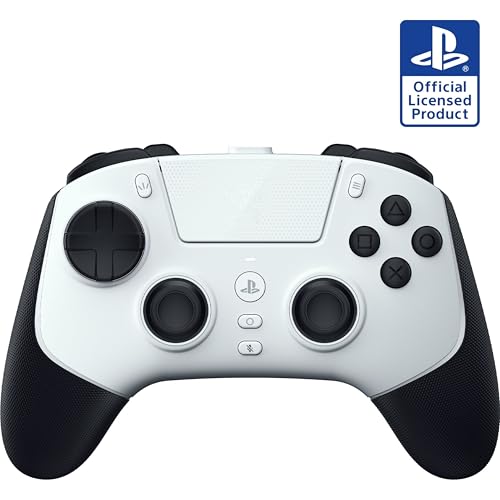
The Razer Raiju V3 Pro is built for the player who wants the absolute highest data rate available — when connected by wire to a PC, it reports its position at 2000Hz (once every 0.5 milliseconds), which means input lag is roughly half that of a 1000Hz controller and four times better than a standard 500Hz pad. For tracking a strafing enemy in Apex or flick-shotting in Valorant, that extra responsiveness can be the difference between a clean one-tap and a bullet that misses by a pixel. It is fully licensed for PS5 and PC, with TMR thumbsticks that resist drift and fast mouse-click actuation on both the triggers and the four removable back buttons.
The controller includes two extra claw-grip bumpers on top, bringing the total programmable controls to six — more than any other controller on this list. Buyers praise the “premium feel” and “lightweight” 0.57-pound design, and note that the included carrying case makes tournament travel easy. The Razer Mobile App lets you tweak thumbstick sensitivity and save up to four profiles, though some users find the app options “fewer than competitors.” The 2.4GHz HyperSpeed wireless dongle keeps latency low on PS5.
One limitation is that the controller is designed for medium-to-large hands; buyers with smaller grips report the raised RT/LT position feels awkward, and the touchpad edge can require a harder press over time. For a competitive PC or PS5 player who wants the fastest polling available and the most programmable buttons, the Raiju V3 Pro is the sharpest tool in the esports shed.
Why we’d pick it
- 2000Hz wired polling rate on PC for near-instant input response
- Six remappable controls (4 back buttons + 2 claw bumpers)
- Anti-drift TMR thumbsticks and mouse-click HyperTriggers
A few caveats
- Too large and high-profile for smaller hands, per buyer feedback
- Customization options in the mobile app are less deep than on PC software
6. HEXGAMING PHANTOM Controller

The HEXGAMING PHANTOM is perfect for the PS5 player who demands extreme physical customization—someone who wants to swap between eight different thumbstick shapes (concave, domed, and extended variants), adjust Hall Effect centering and outer range without a PC, and save six onboard profiles for instant mid-session swap across different shooters.
Built on the original DualSense form factor, it keeps the familiar PS5 layout but adds rubberized grips and tactile micro-switch back buttons. Reviewers who have tested it against the DualSense Edge, SCUF, and Elite 2 call it “the best controller tested” for its Hall Effect accuracy and hair triggers, though they caution that the back button placement requires a slightly looser grip than some alternatives. The wireless connection is stable, and buyers praise the “lifetime warranty” that can replace units that develop issues.
The honest limit is the price-to-performance ratio — at its premium tier, it is significantly more expensive than the DualSense Edge and nearly double the cost of the NACON Revolution 5 Pro.
Strong points
- Eight interchangeable thumbsticks for precise grip customization
- Hardware recalibration tool for Hall Effect stick centering
- Six onboard profiles switchable on the fly without software
Before you buy
- Premium price significantly higher than comparable PS5 controllers
- Battery drains faster than standard DualSense, and no cable is included
Understanding the Specs
Polling Rate (Hz)
Polling rate is the number of times per second your controller tells your PC or console where the sticks are. A standard controller sends data at 125Hz or 250Hz, which creates a tiny but noticeable delay. Most premium FPS controllers use 1000Hz (1 millisecond reporting), and the Razer Raiju V3 Pro pushes to 2000Hz (0.5 milliseconds). The higher the number, the more responsive your aim feels — especially during rapid flicks or tracking a fast-moving target.
Joystick Technology: Hall Effect vs TMR vs Potentiometer
Standard potentiometer joysticks rely on physical metal brushes rubbing against a resistive track. Over time, the friction wears the track down and causes drift. Hall Effect joysticks use a magnet and a sensor that never touch, so they resist drift almost indefinitely. TMR (Tunnel Magneto-Resistance) joysticks are a more sensitive version of magnetic sensing — they detect smaller movements, which helps with micro-adjustments for long-range aim, and many TMR sticks also offer adjustable tension so you can choose between a light or stiff feel.
Trigger Stops and Hair Triggers
Trigger stops are physical switches that shorten the distance you have to pull a trigger before the game registers a shot. In a shooter like Call of Duty, a standard trigger pull might travel 1cm before the shot fires; with trigger stops, that travel drops to 1-2mm. Some controllers use “hair triggers” that click like a mouse button instead of a gradual pull, giving you an instant shot with minimal finger movement. Look for hardware switches (not software-only settings) so you can toggle mid-match.
Back Buttons vs Paddles
These are extra controls on the underside of the controller that let you jump, crouch, reload, or ping without moving your thumbs off the joysticks. “Paddles” are usually longer, curved levers that sit under your middle or ring fingers, while “buttons” are smaller, flush surfaces you press directly. Paddles are generally easier to find by feel but can be accidentally pressed; back buttons require more deliberate pressure but are less prone to accidental activation. The number matters less than how natural they feel for your grip style.
FAQ
Do I need a wired or wireless controller for competitive FPS?
What is stick drift and how do I avoid it?
How many back buttons do I actually need for shooters?
Can I use an Xbox controller on PS5 or a PS5 controller on Xbox?
Final Thoughts: The Verdict
For most buyers, the best controller for fps is the NYXI Imperial because it packs adjustable-tension TMR joysticks, a 1000Hz polling rate, and a 15-hour battery with a charging dock at a price that undercuts the competition. If you want a wired Xbox/PC controller with four paddles and instant triggers, grab the SCUF Valour Pro. And for PS5 players who refuse to compromise on drift-free longevity, the NACON Revolution 5 Pro is the most durable option you can buy.

Mo Maruf
I created WellFizz to bridge the gap between vague wellness advice and actionable solutions. My mission is simple: to decode the research and give you practical tools you can actually use.
Beyond the data, I am a passionate traveler. I believe that stepping away from the screen to explore new environments is essential for mental clarity and physical vitality.