Our readers keep the lights on and my smoothie glass nicely filled. As an Amazon Associate, I earn from qualifying purchases.
You are at your front door with arms full of groceries, fumbling for keys in the dark — or worrying that a dead battery will lock you out of your own house. A combination door lock lets you punch in a code and walk right in, no keys needed. The real choice is between a mechanical lock that never runs out of power and an electronic one with backlit keys and auto-lock convenience.
I’m Mohammad Maruf — the co-founder and writer behind WellFizz. This guide is built by comparing the manufacturers’ published specifications and the patterns across verified customer reviews, so you get each pick’s real strengths and trade-offs instead of marketing spin.
After comparing the specs and what actual buyers report, the most reliable option for most homes is a fully mechanical combination door lock — it never leaves you stranded, and you can change the code in seconds without tools.
How To Choose The Best Combination Door Lock
A combination door lock boils down to one big choice: mechanical or electronic. Mechanical locks use a set of internal tumblers that spin when you press the right code — no batteries, no circuits, and nothing to fail. Electronic locks have a keypad that sends a signal to a motorized deadbolt, so they need power and are more convenient but also more fragile. Here is what to look for in each type.
Mechanical vs. Electronic: The Core Decision
A mechanical combination lock (sometimes called a “push-button” lock) uses physical pins or dials. You press the correct sequence, and the tumblers line up so you can turn the knob. The biggest benefit is that it simply cannot die — no low-battery warnings, no firmware glitches, and no lockouts from dead cells. The catch is that the buttons are usually small, you often need light to see them, and changing the code requires removing the lock and rearranging tiny metal inserts. An electronic lock gives you a backlit touchscreen so you can see the numbers in the dark, auto-locks behind you after a set time (often 5 seconds), and lets you change codes by pressing a few buttons on the keypad. The downside is that the electronics, motor, and batteries are all potential failure points, and several owners mention units dying after a few months.
Fit and Installation: Measure Before You Buy
Most combination locks fit standard US doors with a 2-1/8-inch borehole (the big hole for the knob) and a backset of 2-3/8 or 2-3/4 inches (the distance from the door edge to the center of the borehole). Your door thickness must be between 1.38 and 1.96 inches for mechanical locks, or 1-3/8 to 1-3/4 inches for electronic ones. If your door has a double-bore setup (a separate deadbolt hole above the knob), the mechanical locks that combine the knob and deadbolt into one unit will only work if you install them on the top bore. Always measure these three numbers before ordering or you might end up with a lock that does not fit at all.
Code Length and Security
Most mechanical locks let you set a combination of 4 to 8 digits, with no repeated digits allowed (so you cannot use “1122” or “1234”). Because the digits cannot repeat, the total number of possible codes is capped at around 8,000 combinations — not extremely secure against someone who really wants to guess, but fine for everyday home use. Electronic locks usually let you use repeated digits and longer codes (up to 10 or 12 digits), and some offer “anti-peep” technology where you can type random numbers before and after your real code so someone watching does not learn your password. If security against a determined stranger is your main concern, an electronic lock with anti-peep is the better bet.
Quick Comparison
On smaller screens, swipe sideways to see the full table.
| Model | Category | Best For | Key Spec | Amazon |
|---|---|---|---|---|
| Bravex Keyless Entry Deadbolt | Mechanical | No-battery reliability | 4-8 digit code, mechanical tumbler | Amazon |
| HIDALIFE Keyless Entry Lock | Electronic | Backlit keypad & auto-lock | Touchscreen, auto-lock in 5s | Amazon |
| STEINBRÜCKE Keyless Entry Lock | Mechanical | Heavy-duty stainless build | Stainless 304, 4-8 digit code | Amazon |
| Voltstorm Keyless Entry Deadbolt | Mechanical | All-season outdoor use | Stainless 304, 8,000+ combos | Amazon |
| Amazon Basics Electronic Deadbolt | Electronic | Entry-level electronic convenience | ANSI Grade 3, backlit keypad | Amazon |
In‑Depth Reviews
1. Bravex Keyless Entry Door Lock Deadbolt Keypad Sabbath Lock Stainless Steel

100% mechanical tumblers with no batteries make the Bravex the top pick for anyone who wants a set-and-forget lock that works the same on day one as on year ten.
This lock lets you set a combination between 4 and 8 digits (no repeats allowed), and because the code can be entered in any order, it is genuinely hard for someone watching to figure out what your password is. The deadbolt is made from stainless steel 304, which resists rust far better than standard zinc — important if your door gets hit by rain or humidity. Customers note that installation is straightforward for existing deadbolt holes, though the small Allen wrench can make the process feel a bit tedious.
The honest limit: you need some ambient light or a phone flashlight to see the keypad numbers at night, and since the lock does not auto-lock, you have to remember to turn the knob yourself when you leave. Still, for pure, drop-dead reliability, this is the lock that will never, ever let you down.
Why it’s great
- Completely mechanical, zero battery risk
- Stainless steel 304 resists corrosion
- Code can be entered in any order for security
Good to know
- Keypad not lit, hard to see at night
- Does not auto-lock, must be manually closed
- Install uses small Allen wrench, a bit finicky
2. HIDALIFE Keyless Entry Door Lock with Keypad and Handle

Compared to the Bravex, the HIDALIFE is way more convenient day-to-day — it has a blue backlit touchscreen so you can see the numbers in complete darkness, and it auto-locks behind you in 5 seconds so you never have to wonder if you left the door unlocked. The trade-off is that it runs on batteries with electronics inside, so unlike the mechanical Bravex, it can fail.
In real use, the auto-lock is the standout feature: you walk out, close the door, and 5 seconds later it locks itself. Good for busy families and anyone who has ever driven away wondering if they locked the front door. The anti-peep password feature lets you type a bunch of random numbers before and after your real code, so anyone watching does not learn your password. Reviewers point out that the matte black finish looks expensive on the door and the installation takes about 15 minutes with only a screwdriver.
But here is the caution: at least one reviewer noted getting locked inside when the electronics failed after just two days — the code stopped working and even the key would not turn. A 100% reliability record it is not. If you are willing to accept that small risk for the everyday convenience of backlit keys and auto-lock, choose this over the top pick.
Where it shines
- Blue backlit keypad for easy night use
- Auto-locks in 5 seconds after you close the door
- Anti-peep password lets you type fake digits for safety
Worth noting
- Electronic, potential for battery or circuit failure
- Some units reported dead after a few days
- Must touch panel first before entering code
3. STEINBRÜCKE Keyless Entry Door Lock (Gray)
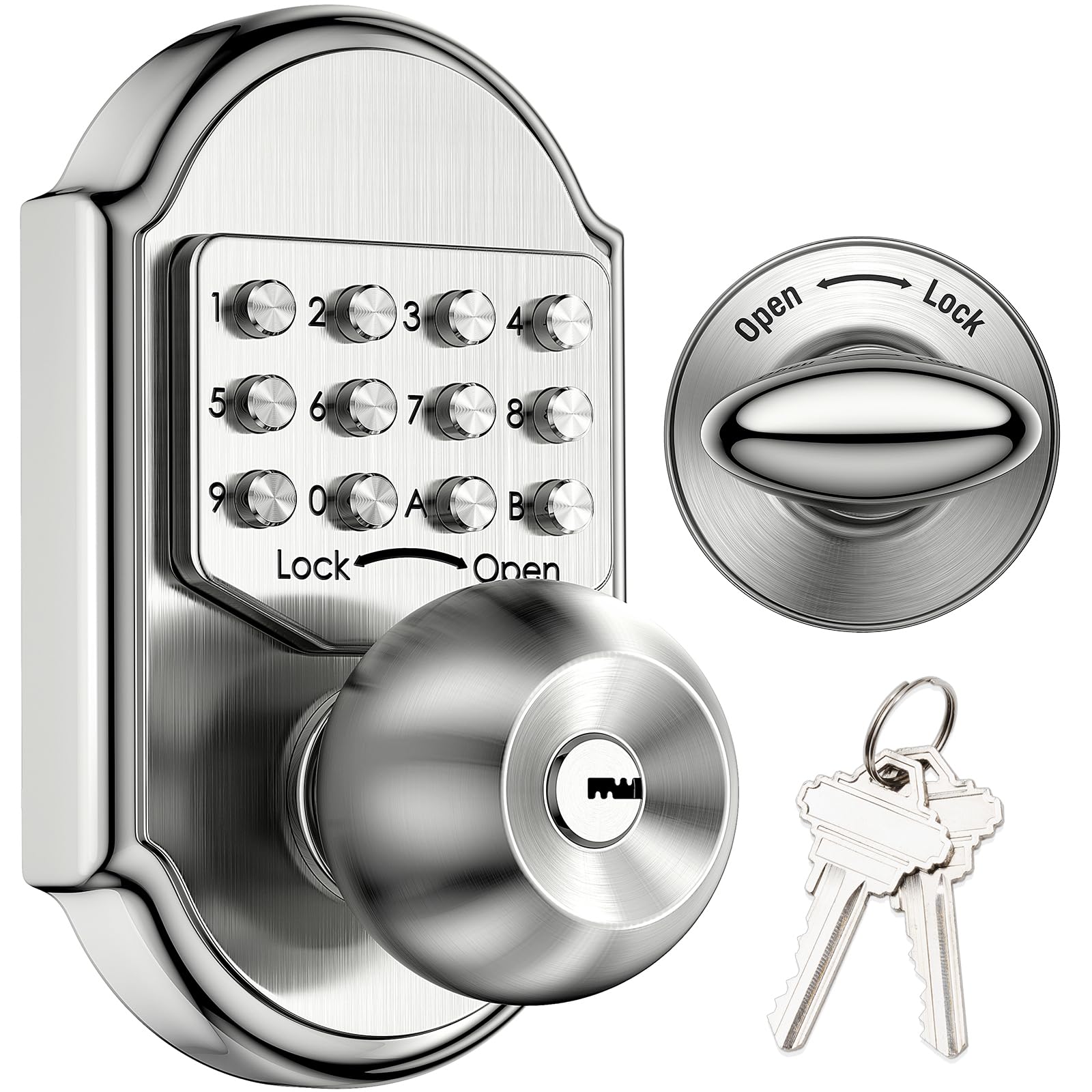
If you need a lock that can take a beating — on a garage, shed, rental property, or a door that sees harsh weather — the STEINBRÜCKE uses the same mechanical tumbler design as the Bravex but with a heavy duty stainless steel 304 body that buyers describe as “solid” and “well-made”. It is exactly the right choice for high-traffic or outdoor doors where a zinc electronic lock would corrode or break.
The mechanical design means zero batteries, zero electronics, and zero lockouts from dead cells — you set a 4 to 8 digit code (again, no repeats) using small metal tumblers inside, then the lock works by turning the knob. One thing that sets this lock apart is the “wear-free keypad material” that does not leave finger-grease patterns, so a thief cannot guess which numbers you press most often. Buyers do mention that the installation instructions could be clearer — one buyer mentioned a “10-min project became 30 min” because the bolt’s direction flap had to face inside and the mounting plate instructions were misleading.
The standout spec here is the anti-corrosion surface treatment on the stainless 304 steel, which is rated 5 to 15 times more corrosion-resistant than standard zinc.
What stands out
- Stainless steel 304 body, highly rust-resistant
- Fully mechanical, no batteries needed ever
- Wear-free keypad leaves no fingerprint clues
The trade-offs
- Install instructions are poorly written
- Code change requires disassembly of the lock
- Small internal keypad hard for large fingers to press
4. Voltstorm Keyless Entry Door Lock Deadbolt Stainless Steel 304

The single number that matters most in this category is “no batteries” — and the Voltstorm delivers that with a mechanical design that gives you over 8,000 possible combinations (4-8 digit codes, no repeats). At its price point, this lock punches above what you would expect from a budget-tier item by using stainless steel 304 instead of cheaper zinc.
One limitation you accept here is that the instructions are confusing and the knob only locks when turned to the left, then opens by turning right — a setup some buyers found awkward at first. Reviewers also note that the included wood screws are short, so you may need to buy longer ones if your door frame is thick or the existing holes are deep. It is not the most polished lock in this list, but it does the fundamental job reliably.
Where this lock really shines is price-to-performance: you get a solid stainless 304 mechanical deadbolt with a passcode or key option for a price that undercuts most electronic alternatives. Good for a secondary door or a tight budget where reliability cannot be compromised. Consider it instead of the pricier Bravex if you need two locks for the same budget.
The upsides
- Stainless steel 304 construction resists corrosion
- Mechanical design with 8,000+ possible combinations
- Works with key or code for double security
Keep in mind
- Instructions are confusing and poorly written
- Knob only locks left, opens right (takes getting used to)
- Included screws are too short for thicker doors
5. Amazon Basics Contemporary Electronic Keypad Door Lock

For the price of an entry-level electronic lock, the Amazon Basics gives you a backlit keypad, a motorized deadbolt, and the ability to add or delete user codes in seconds by just pressing a few buttons on the keypad. It also meets ANSI Grade 3 security standards, which means it passes basic industry testing for strength and durability — a nice assurance at this budget level.
What you give up is reliability: while some shoppers say this lock has run perfectly for over five years on the same set of batteries, a significant number of verified reviews report units that died after one day or a few months, leaving the door unlocked or impossible to open. The lock is also marked “for indoor use only,” so you cannot put it on a door exposed to rain or direct sunlight. Installation takes about 25-30 minutes with just a screwdriver and fits standard 2-1/8-inch boreholes.
This lock is perfect for a budget-minded buyer who wants a taste of keyless electronic convenience — a backlit keypad and auto-lock — but is willing to accept that it might fail within the first year. If you need something you can bet your evening on, go mechanical with the Bravex or Voltstorm instead.
Why we’d pick it
- Backlit keypad for easy night entry
- ANSI Grade 3 certified for security
- Easy code programming without disassembly
A few caveats
- Reports of units failing after 1 day to a few months
- Indoor use only, not weather-resistant
- Button beeps are loud, cannot be silenced
Understanding the Specs
Mechanical vs. Electronic
A mechanical lock uses physical tumblers and pins that you press into the right position with a code. No electricity, no batteries, no parts that can corrode or short out. An electronic lock uses a battery-powered circuit board that sends a signal to a motor inside the deadbolt to turn it. Electronic locks are easier to use (backlit keys, auto-lock) but introduce a failure point: if the battery dies or the circuit board fails, you are locked out. For most people, the choice is between “never fails but slightly less convenient” (mechanical) and “very convenient but might fail someday” (electronic).
Code Length and Repeats
Mechanical locks usually limit your code to 4 to 8 digits, and they will not let you repeat any digit — so you cannot use “1122” or “1234”. This limits the total possible combinations to about 8,000, which is fine for home use but not high-security. Electronic locks typically let you use repeated digits and longer codes (up to 10-12 digits), so you can create far more combinations. Some also offer “anti-peep” technology, where you can type random numbers before and after your real secret code, so someone watching from behind cannot memorize your password.
Door Fit: Borehole, Backset, and Thickness
Three measurements decide whether any combination lock fits your door. The borehole is the main round hole through the door, usually 2-1/8 inches (54mm) for US standard doors. The backset is the distance from the edge of the door to the center of that borehole — most locks fit 2-3/8 inches (60mm) or 2-3/4 inches (70mm). Door thickness must be between 1.38 and 1.96 inches for most mechanical locks, and between 1-3/8 and 1-3/4 inches for electronic ones. If your door has a second borehole above the main one (a double-bore setup), you must install a combination lock on the top hole — it will not work in the lower hole.
Material: Stainless Steel vs. Zinc
Stainless steel 304 is the standard for combination lock durability. It resists corrosion far better than zinc or painted steel, so it lasts longer on doors exposed to rain, humidity, or salt air (like near the ocean). Zinc is cheaper and less rust-resistant — fine for indoor use or protected entryways, but it will begin to corrode after a couple of years outdoors. Most premium mechanical locks advertise “stainless steel 304” as a key spec; if you see just “alloy steel” or “zinc” without a grade, expect a shorter lifespan in wet conditions.
FAQ
Can a mechanical combination lock be hacked or picked easily?
What happens if my electronic combination lock runs out of battery while I am outside?
Are combination door locks safe to use on an exterior door in freezing weather?
Final Thoughts: The Verdict
For most buyers, the combination door lock winner is the Bravex Keyless Entry Deadbolt because it is 100% mechanical, uses stainless steel 304, and never risks a battery-related lockout. If you want the backlit keypad and auto-lock convenience of an electronic lock, grab the HIDALIFE Keyless Entry Lock. And for a door that sees rain or harsh weather, the standout is the STEINBRÜCKE Keyless Entry Lock with its heavy stainless steel 304 body and anti-corrosion coating.

Mo Maruf
I created WellFizz to bridge the gap between vague wellness advice and actionable solutions. My mission is simple: to decode the research and give you practical tools you can actually use.
Beyond the data, I am a passionate traveler. I believe that stepping away from the screen to explore new environments is essential for mental clarity and physical vitality.