Our readers keep the lights on and my smoothie glass nicely filled. As an Amazon Associate, I earn from qualifying purchases.
Whole bean coffee loses its aroma and flavor in as few as three days after roasting. The only way you get coffee that tastes as the bean was meant to every morning is to roast it yourself at home. This guide compares eight roasters based on specs and real-world buyer feedback — batch size, heat control, build quality, and long-term reliability — so you pick one that matches your skill level and budget without wasting money.
I’m Mohammad Maruf — the co-founder and writer behind WellFizz. This guide is built by comparing the manufacturers’ published specifications and the patterns across verified customer reviews, so you get each pick’s real strengths and trade-offs instead of marketing spin.
Whether you are just starting out at the stovetop or looking for a machine with digital profile control, you’ll find the best coffee roasting equipment for your pace, batch size, and budget.
How To Choose The Best Coffee Roasting Equipment
The right roaster depends on your weekly coffee consumption, where you roast, and how much control you want. Here are the three things to figure out first.
Batch Size: How Much Coffee Do You Drink Per Week?
A machine’s “capacity” (for example, 226 grams or 8 oz for the Fresh Roast SR800) is the maximum weight of green beans it can handle. That yields roughly two to four days of coffee for a couple of moderate drinkers. If you drink a pound a week, look for a roaster in the 300-gram to 500-gram range, such as the Mago Maga Roma Pro (300g) or the NIASIA PKF-500g (500g), so you do not have to roast multiple times a week.
Heating Type: Air vs. Drum
Fluid-bed (air) roasters like the Fresh Roast SR800 suspend the beans on a column of hot air. They heat evenly, cool down quickly, and produce almost no smoke if you keep the chaff collector (a container that catches the papery skins that fly off the beans) clean. Drum roasters like the Fatamorgana 450g use a rotating metal drum heated by a flame or direct element. Drum roasters can give you a richer flavor for dark roasts, but they tend to be louder and heavier — the Fatamorgana weighs 17 pounds versus the SR800’s 6.2 pounds — and often need more attention to avoid burning the beans.
Control vs. Simplicity: Auto, Manual, or App-Based?
Beginner-friendly machines have pre-set auto profiles: press a button and walk away. The Mago Maga Roma Pro offers an auto mode for standard green beans. Mid-range machines like the Fresh Roast SR800 give you real-time knob control over heat and fan speed without a screen. Premium roasters like the Sandbox Smart R1 use a smartphone app to guide your roast — convenient for saving recipes, but if the app or company stops supporting it, the machine might become unusable.
Quick Comparison
On smaller screens, swipe sideways to see the full table.
| Model | Category | Best For | Key Spec | Amazon |
|---|---|---|---|---|
| Fresh Roast SR800 | Fluid Bed | Best Overall / Mid-Volume | 226g per batch / 6.2 lb | Amazon |
| Mago Maga Roma Pro | Fluid Bed | Smart Auto/Manual Modes | 300g capacity | Amazon |
| Fresh Roast SR540 | Fluid Bed | Best Entry-Level Fluid Bed | 120g capacity | Amazon |
| NIASIA PKF-500g | Drum | Large Batch Home Roasting | 500g capacity / 500g weight | Amazon |
| Precision PKF-500 | Drum | Auto Modes with Touchscreen | 1 lb capacity | Amazon |
| Fatamorgana 450g | Drum | Direct-Fire Drum for Experimenters | 450g capacity / 17 lb | Amazon |
| Sandbox Smart R1 | Drum | App-Controlled Home Roasting | 100–150g capacity | Amazon |
| NIASIA 1kg Commercial | Drum | High-Volume / Pro Use | 1kg capacity / 240V | Amazon |
In‑Depth Reviews
1. Fresh Roast SR800 Coffee Roaster
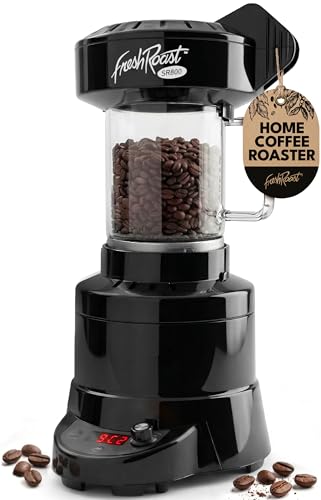
The Fresh Roast SR800 earns the top spot because its 226g batch capacity gives you 88% more green beans per roast than the SR540 — enough for 12 to 14 cups of coffee from one load — while still weighing just 6.2 pounds, so you can store it in a cabinet between uses. This machine is for you if you have already tried an air popper and want real control over heat and fan speed without moving to a drum roaster.
The SR800 replaces smaller programmable roasters easily. Buyers confirm the capacity jump from 90 grams on its predecessor to 226 grams makes a real difference in weekly workflow. The nine-level power settings (1 through 9 for heat, 1 through 9 for fan) and the real-time temperature display let you watch the beans as they hit “first crack” (the popping sound at roughly 385°F, or 196°C, that signals a light to medium roast) and “second crack” (at around 430°F, or 221°C, for dark roasts), so you can stop exactly at the profile you want — light City or dark French. At 6.2 pounds, it is also light enough to store in a cabinet between uses.
The honest limit is that the glass roasting chamber is not clipped in securely — some buyers report it can lift up during the cycle, and the two-piece chaff collector top is not positively locked. However, the even fluid-bed heating, the easy cleanup, and customer service that repaired one unit for free after 18 months make this the most reliable home buy for the money. If you want a set-it-and-forget-it experience, skip this and look at the Mago Maga Roma Pro for its auto mode.
Why it’s great
- Large 226g batch size (88% more than SR540) lets you roast 14-28 cups per batch
- Real-time temperature display and nine heat/fan levels give you pro-style control
- Fast 10-minute roast cycle with even fluid-bed heating
Good to know
- Glass chamber and chaff top are not tightly secured — need careful handling
- Underpowered in cold weather — many users run 170g batches instead of 220g
2. Fresh Roast SR540 Automatic Coffee Bean Roaster
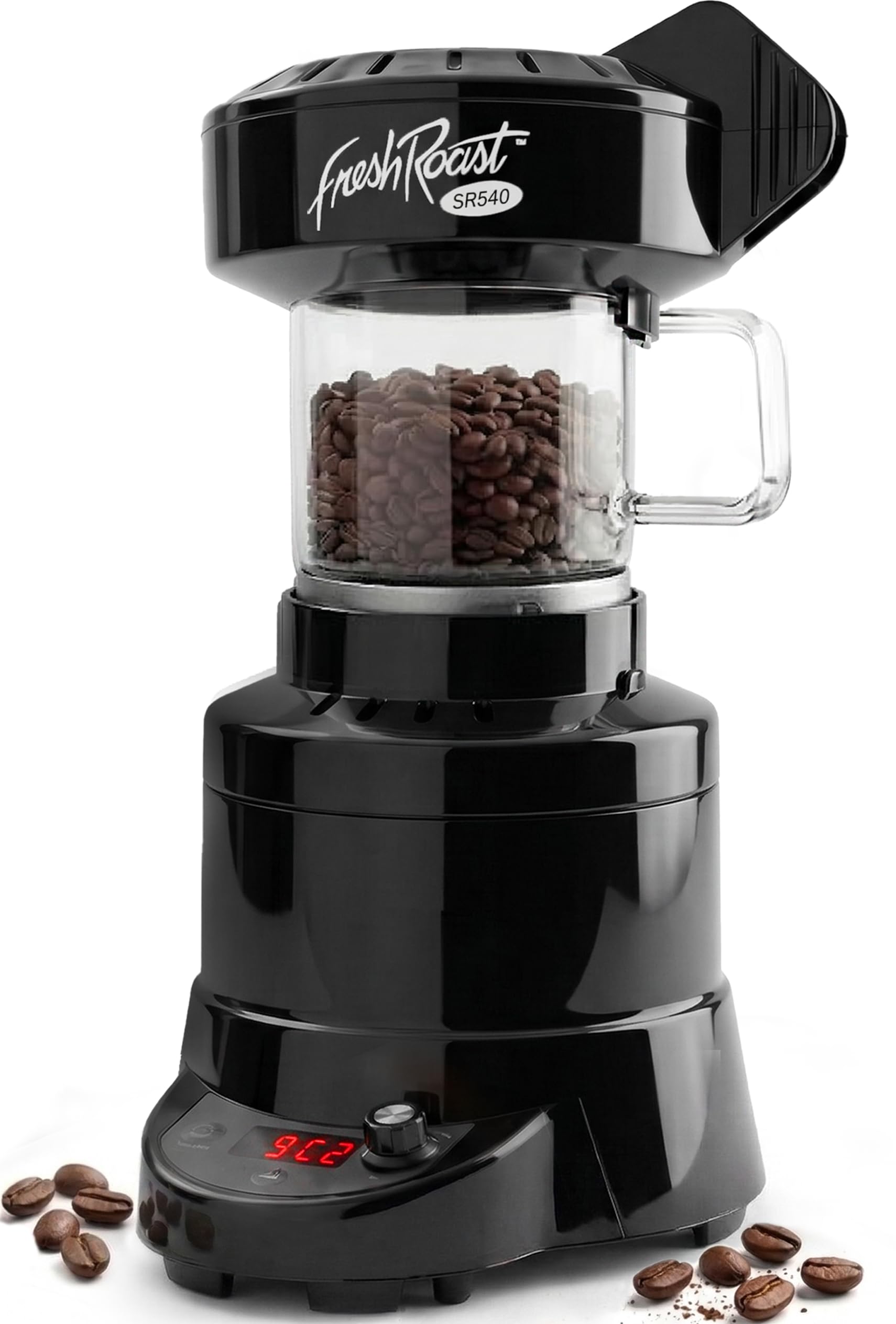
The SR540 is the budget entry into the Fresh Roast lineup, and it shares the same fluid-bed technology and controls as the larger SR800. The key trade-off: it holds only 120 grams of green beans per batch (about 7 to 14 cups of coffee), compared to 226 grams on the SR800. If you drink one cup a day and want the freshest possible roast without paying for extra capacity, this is the smarter buy than the SR800.
What you get at this lower price is consistent, even roasts in under 10 minutes. Owners mention running “hundreds of batches since late 2021” with the same unit, and many say they will never buy pre-roasted coffee again. The controls work the same as the SR800 — you dial heat level (1-9) and fan speed (1-9) and watch the digital temperature display — so the learning curve is identical. One long-term reviewer notes the analog power knob became “wonky” after heavy use, but the manufacturer sent a free replacement motherboard even after the warranty expired.
The catch is batch size: 120 grams is about enough green beans for 7 to 14 cups of coffee, so you will roast more often. For a household that drinks one pot a day, that is a roast every two to three days — a rhythm many users enjoy. If you are a heavy drinker going through a pound a week, the SR540 will feel repetitive; skip it for the SR800 or the NIASIA PKF-500g.
Where it shines
- Same proven fluid-bed technology as the SR800 at a lower starting point
- Easy to learn for absolute beginners — controls are intuitive with heat, fan, and time
- Long-term reliability — one reviewer noted hundreds of batches since 2021
Worth noting
- 120-gram capacity is small — you will roast every 2-3 days for moderate consumption
- Analog knob can become imprecise over time; some units needed replacement
3. Mago Maga Roma Pro Coffee Bean Roaster
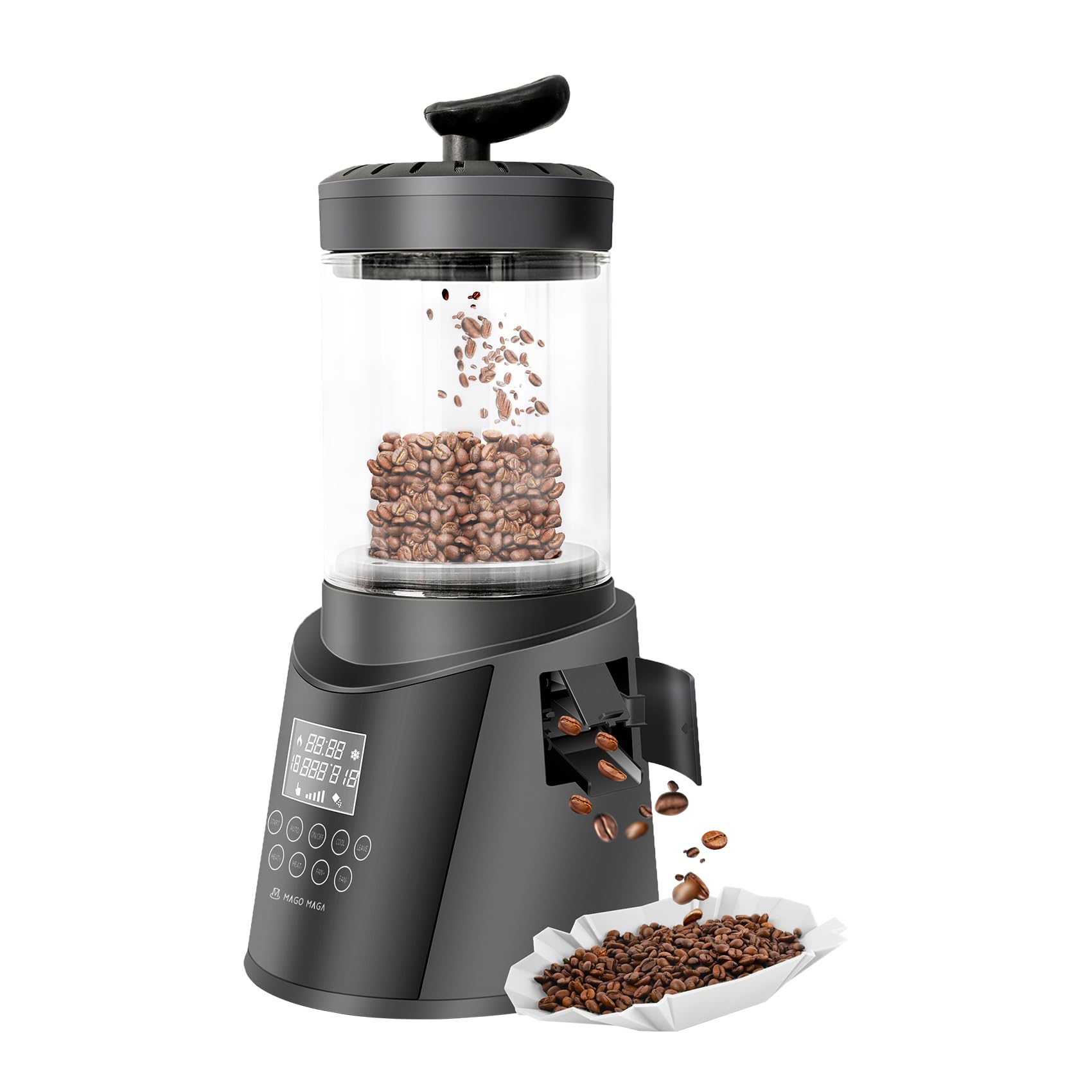
If you want fresh coffee but do not want to babysit a knob for 10 minutes, the Roma Pro solves that with two distinct modes. Auto runs a pre-set roasting profile for most standard green beans, and Manual lets you adjust heat and fan timing when you want to experiment. It also won a 2025 SCA Best New Product Award, according to the brand.
Its double-layer glass window lets you see the beans change from pale green to golden brown without opening the chamber. Customers note that the auto function delivers “consistent roasts across beans” and that the 300g capacity is “perfect for weekly lattes.” The automatic cooling cycle kicks in as soon as the roast ends, locking in the flavor profile. It also runs cleaner than a drum roaster — the ultra-low smoke chaff collector keeps the kitchen air bearable.
One spec worth noting: the temperature display has a °C/°F switch, so you avoid confusion when using German or American recipe guides. The honest risk is that the heating element on at least one unit failed after about 50 pounds roasted (roughly 6 months of daily use), though the vendor quickly offered a replacement. This is for the beginner who wants a close-to-set-and-forget experience that still allows manual growth. skip it if you want app-based recipe saving — the Sandbox Smart R1 does that better. But for a countertop roaster that earned a 2025 SCA Best New Product Award, the Roma Pro sets the bar for beginner-friendly precision.
What stands out
- 300g capacity is the largest in the fluid-bed class — excellent for weekly meal-prep style roasting
- Auto mode works reliably for standard beans; manual mode unlocks custom profiles
- Ultra-low smoke chaff collection makes indoor roasting actually pleasant
The trade-offs
- Some units showed heating element failure after ~50 lbs of roasting
- Not designed for decaf beans in auto mode — needs manual settings for decaf
4. NIASIA PKF-500g Automatic Coffee Roaster

The single number that matters most in this category is batch size: the NIASIA PKF-500g delivers 500 grams per batch — more than double the SR800’s 226 grams — enough to roast a full week’s supply for a heavy-drinking household in one go. A drum roaster made of stainless steel, it includes a separate cooling tray that cools beans within a couple of minutes to lock in flavor. The best actual batch size is 350 to 400 grams, which still leaves you plenty for the week.
The downside for this capacity is noise and complexity. The drum motor is loud enough that you cannot hear first crack happening, so you must rely on sight and smell. The included smoke filter works for light roasts only; for medium and dark roasts, the manufacturer recommends using the supplied aluminum smoke pipes to vent outdoors. One long-term buyer who has roasted over 50 pounds through the machine says the sweet spot is 350 to 400 grams — he always roasts outside because the smoke can be overwhelming.
At its price, the PKF-500g sits between entry-level fluid beds and premium app-based drum roasters. One reviewer who upgraded from an 80g batch machine after 5 years of home roasting calls it “the perfect upgrade for serious home roasters” who want to stop doing small batches every other day. If you prefer a quieter machine with app control, the Sandbox Smart R1 is a better fit, but it holds only 100 to 150 grams per batch — a price-to-value read that favors the NIASIA for volume-focused roasters.
The upsides
- 500g capacity means one batch covers a week of coffee for a heavy-drinking household
- Separate high-speed cooling tray locks in roast profile immediately
- Auto mode has 9 roasting profiles covering light, medium, dark, and specific process beans
Keep in mind
- Drum motor is very loud — you cannot hear first crack audibly
- Smoke filter only suitable for light roasts; dark roasts require outdoor venting
5. Precision Coffee Roaster PKF-500
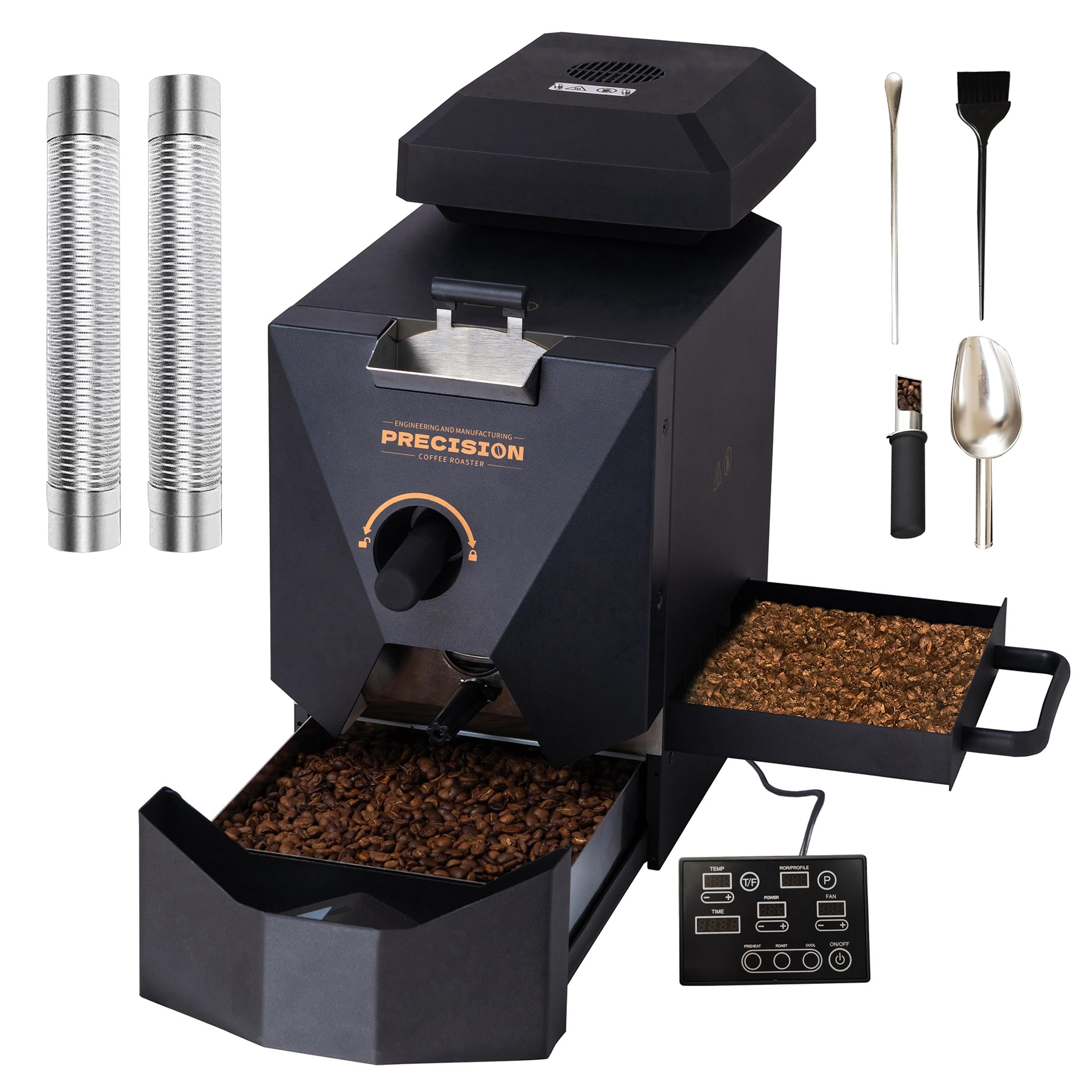
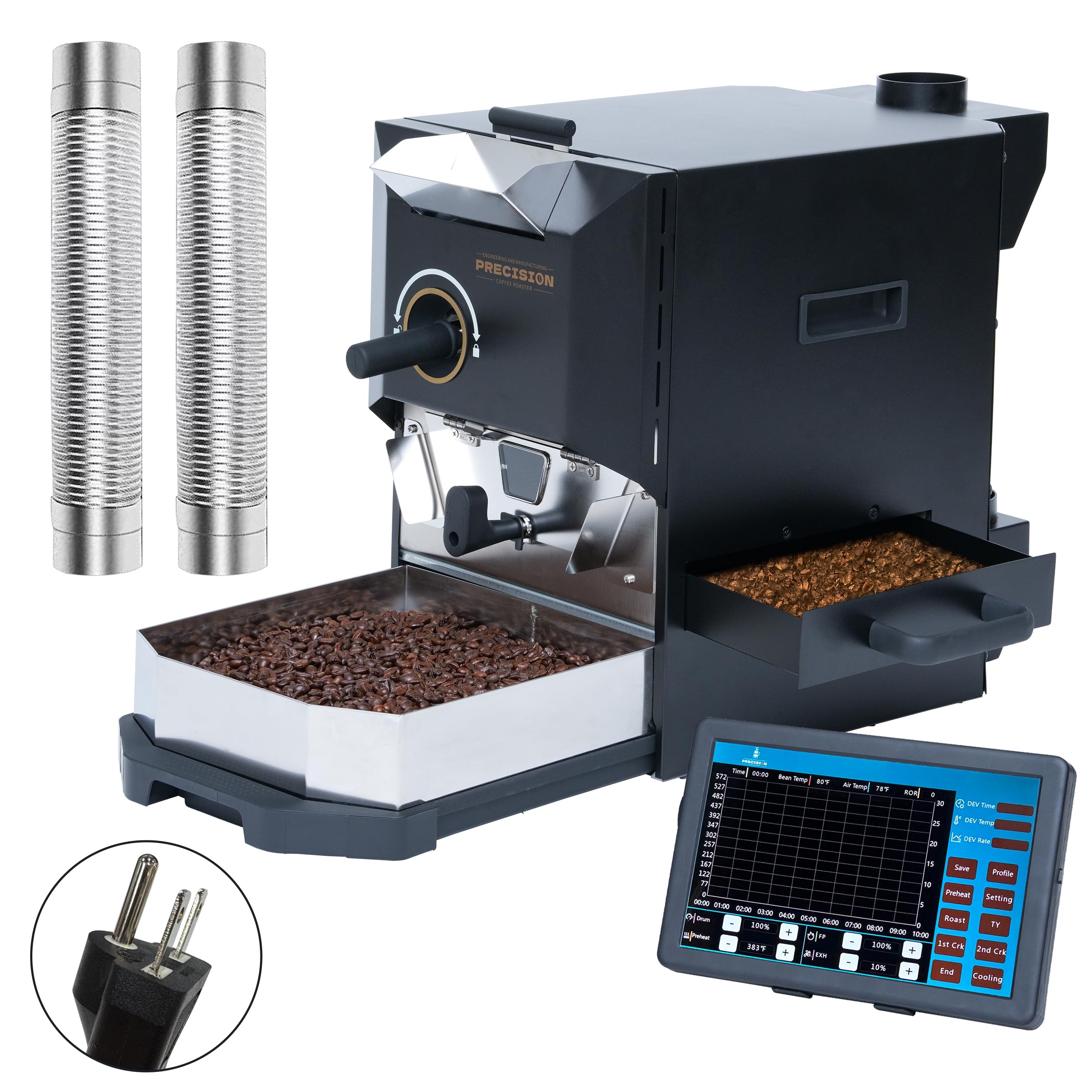
At its lower price, you get a 1-pound (454g) capacity drum roaster with a full touchscreen interface, three modes (automatic, assisted, and manual), and a built-in smoke filter system with a vent pipe for routing smoke outdoors. The one reason to choose this over the similarly-sized NIASIA PKF-500g is the user interface: the touchscreen and pre-set profiles make it friendlier for a first-time drum roaster owner who does not want to manually manage heat and drum speed.
The automatic mode is the main draw: pick from several pre-set profiles, load your beans, and let the machine run. One buyer who has used auto for over 50 pounds calls it “good value for the money” and says he would buy it again, though he warns that you must pull the beans as soon as the roast is done or they will continue cooking. The observation window and included sample spoon let you check color and progress mid-roast without opening the drum — useful for dialing in a specific profile. The touchscreen is bright and responsive, though some reviewers found the on-screen labels hard to read.
The trade-off is long-term reliability: moisture from the exhaust has been known to leak onto the circuit board, causing control loss. The manufacturer helped resolve it, but you may need to let the machine cool down between consecutive roasts. Steer clear if you need a machine that runs back-to-back batches easily — the NIASIA PKF-500g handles heavy rotation better. This is the perfect pick for the budget buyer who wants a drum roaster’s flavor profile and a friendly touchscreen but roasts only occasionally and can wait between batches.
Why we’d pick it
- 1-pound capacity is generous for a home drum roaster
- Touchscreen interface with auto, assisted, and manual modes for all skill levels
- Observation window and sample spoon let you inspect beans mid-roast without interrupting the cycle
A few caveats
- Moisture from the exhaust can leak onto the circuit board causing controls to glitch
- Beans continue to roast if not cooled fast enough — an external bean cooler helps
6. Fatamorgana 450g Direct Fired Heating Nut Roaster
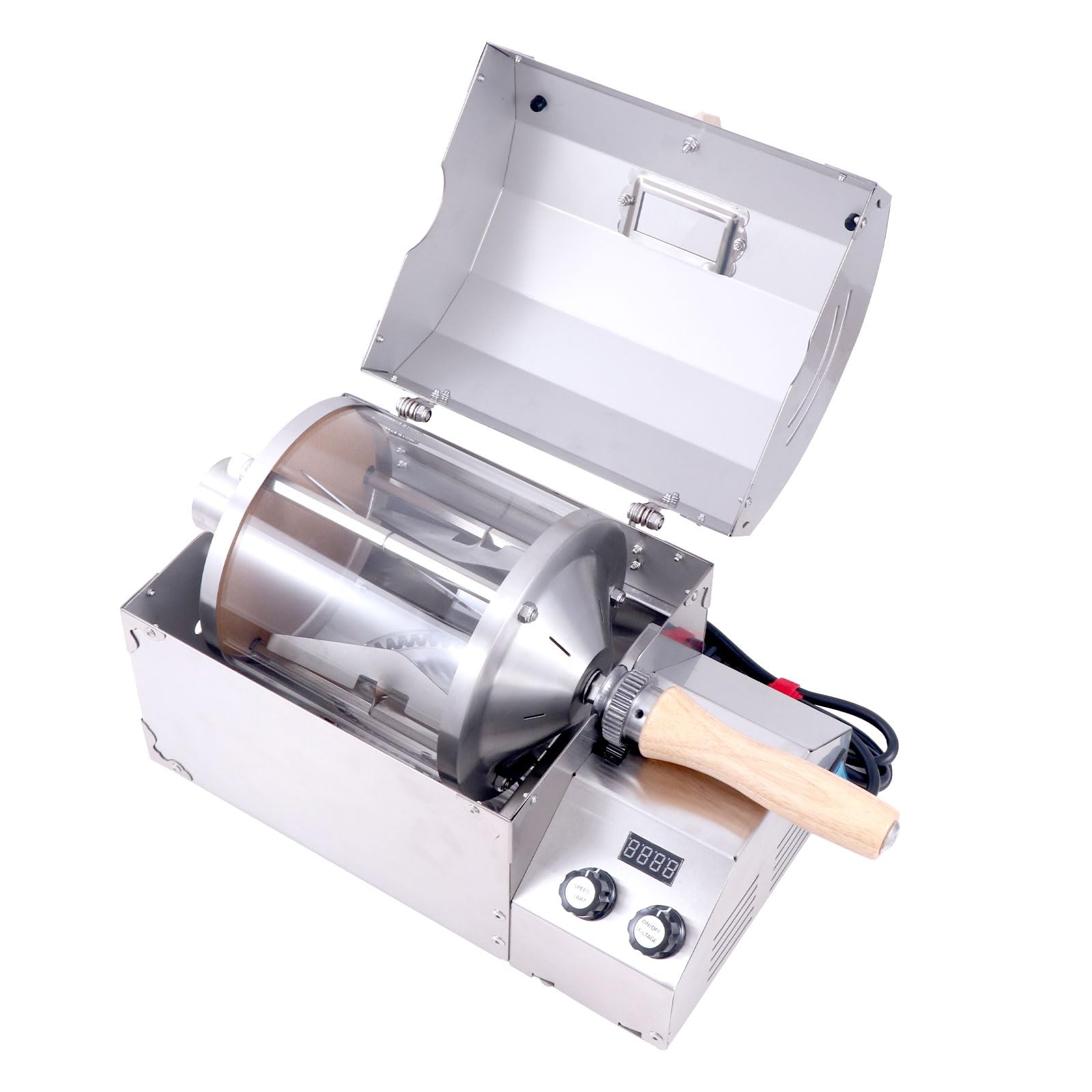
The Fatamorgana is a direct-fired drum roaster with a quartz glass window (5mm thick) so you can watch the entire color change from pale green to dark brown without stopping the machine. At 17 pounds, it is the heaviest home roaster here — 10.8 pounds heavier than the SR800 — and that weight comes from its stainless steel shell and thick quartz window. This machine is for someone who already understands the basics, knows what first crack sounds like, and wants to experiment with a direct-flame method. It can also roast nuts and seeds, as long as they are larger than 2mm in diameter.
The 450-gram capacity is generous, and the direct heat (the drum is heated by a flame, not hot air) produces a flavor that according to some users is richer than air-roasted beans. Cleaning is easy: you rotate three spring screws by hand to remove the quartz glass. The included filter cartridge helps manage smoke, though you will want to crack it open after a dark roast.
The honest limit is reliability. One verified review states the unit “arrived damaged; motor failed on second use,” and other buyers mention sharp edges and loose screws out of the box. The instruction manual is basic, and the machine requires preheating and fast bean charging for consistent results. This is a hands-on roaster for the experimenter willing to work through some rough edges. pass on it if you want a polished, out-of-the-box experience — the Fresh Roast SR800 is much more user-friendly.
Strong points
- Direct-fired drum creates a richer, more traditional flavor profile than air roasters
- 5mm thick quartz glass window gives a clear view of the entire color change during roasting
- Versatile — can roast coffee, cashews, peanuts, sunflower seeds, and other similar-sized dried fruit
Before you buy
- Reliability is inconsistent — some units arrived damaged or with motor failure after a few uses
- No manual, sharp edges, and loose screws reported by some buyers
7. Sandbox Smart R1 Home Coffee Roaster

The Sandbox Smart R1 sits at a premium price point compared to most home roasters, offering app-based automation that few competitors match at this level. For the cost, you get a fully digital experience with 16 built-in roasting presets and roast history tracking, though the value is tempered by the risk of future subscription fees for advanced features.
The R1 roasts 100 to 150 grams per batch, enough for about 7 cups of coffee. The drum design produces very little smoke or chaff — reviewers point out it works well in an apartment. The cooling tray is integrated, and the cleanup drawer catches silverskin conveniently. It also connects to a community recipe library, so you can download profiles other users have shared.
This is a premium-priced roaster. The concern is software dependency: the heating element has been reported to cut out mid-roast without explanation, and advanced profiles moved behind a paid subscription after purchase. One reviewer notes it produces “better coffee than a Freshroast SR700 or Behmor 1600,” but the value equation is complicated by the ongoing subscription risk. The one clear reason to choose it is if you want data-driven repeatability from a smartphone-controlled machine that saves and shares roasting profiles with a tap.
What we like
- App-based control with 16 preloaded roasting profiles and community-shared recipes
- Excellent smoke and chaff management for indoor and apartment use
- History saving function makes it easy to repeat your best roasts
The downsides
- Requires the app to operate — no manual controls if the app or company support stops
- Advanced profiles moved behind a paid subscription after purchase
8. NIASIA 1kg Commercial Electric Coffee Roaster
The NIASIA 1kg roasts 1kg per batch, making it the top pick for a cafe, roastery, or serious home enthusiast who wants to produce 20kg of roasted beans per day. It requires a 240V outlet (standard home outlets in North America are 120V), so it is not a plug-and-play upgrade for a kitchen counter. Buy this when the 500g batch roasters start feeling like a bottleneck.
What that price buys: dual heating tubes with infrared direct flame technology, dual temperature sensors (one for bean temperature, one for air temperature), and siphon exhaust that removes chaff and smoke efficiently. It supports Artisan software, the open-source industry standard for roast profiling, so you can automatically replicate roast curves from other professional roasters. The large LCD interface is straightforward, and the machine has 10 built-in auto curves plus manual control. The 2000W brushless motor handles continuous daily use.
The clearest difference between the 1kg NIASIA and the 500g NIASIA PKF-500g is volume and electrical requirements: double the batch size at 240V, making it a genuine commercial tool. For anyone roasting more than 5 pounds per week, the 1kg machine will pay for itself in saved labor time. For everyone else, the PKF-500g is the more practical choice. If you need a 120V machine, skip this and look at the SR800 or the Roma Pro instead. For serious volume, this is the clear winner.
Why it’s great
- 1kg batch capacity is truly commercial-grade — supports up to 20kg of green beans per day
- Artisan curve replication allows you to copy professional roast profiles automatically
- Dual temperature sensors (bean and air) provide near-zero deviation for consistent repeatable roasts
Good to know
- Requires a 240V power outlet — not compatible with standard US home circuits
- Stock UI is confusing; many users run it with Artisan software for full control
Understanding the Specs
Batch Size: What Actually Fits
The listed capacity (say 226g for the SR800) is the maximum wet-processed green beans the machine can handle in one load. In practice, most roasters work better at 80–90% of that number because overloading gives uneven roasts. For reference: 100 grams of green beans yields roughly 85 grams of roasted beans — enough for about 7 single cups of coffee. If you drink 14 cups a week, a 226g batch covers you for that week.
Fluid Bed vs. Drum: Which Heats Better
Fluid-bed (air) roasters suspend beans in a column of hot air. They are fast, even, cool down quickly, and produce less smoke — the SR800 and SR540 are fluid-bed machines. Drum roasters tumble beans in a rotating metal drum heated directly or by a flame. Drum roasters can produce richer flavor for dark roasts but are heavier (the Fatamorgana weighs 17 lb vs the SR800’s 6.2 lb), louder, and often require more attention to avoid scorching.
First Crack, Second Crack, and Roast Level
First crack is the audible popping sound beans make at roughly 385°F (196°C) when internal moisture turns to steam and breaks the bean structure — this signals the start of a light to medium roast. Second crack (around 430°F / 221°C) is a sharper, quieter snap that indicates the bean structure is breaking down into a dark roast. A roaster with a temperature display — like the SR800 — lets you stop the cycle right at the crack you want.
Chaff Collection and Smoke Management
Chaff is the thin papery skin that burns off green beans during roasting. Roasters like the Roma Pro and Sandbox Smart R1 include effective chaff collectors that catch this material before it floats around your kitchen. Smoke management matters more for dark roasts — the Precision PKF-500 comes with a vent pipe to route smoke outdoors, while the NIASIA PKF-500g recommends connecting pipes for dark roast sessions. Without good smoke management, plan to roast in the garage or near an open window.
FAQ
Can I use a home coffee roaster indoors without a vent?
How long does a 226g batch of green beans last for a typical coffee drinker?
What is the difference between an auto mode and a manual mode on a coffee roaster?
Can I roast nuts or seeds in a coffee roaster?
How do I clean a home coffee roaster?
Final Thoughts: The Verdict
For the majority of shoppers, the best coffee roasting equipment winner is the Fresh Roast SR800 because it combines a generous 226g batch size, precise manual control of heat and fan, and proven reliability at the right price point — all without needing an app subscription or a dedicated 240V outlet. If you want a smarter, almost set-and-forget experience with larger capacity, grab the Mago Maga Roma Pro. And for heavy-duty weekly roasting where batch size is your priority, the NIASIA PKF-500g delivers 500 grams per batch — more than double the SR800 — so you roast once and forget it for the week.

Mo Maruf
I created WellFizz to bridge the gap between vague wellness advice and actionable solutions. My mission is simple: to decode the research and give you practical tools you can actually use.
Beyond the data, I am a passionate traveler. I believe that stepping away from the screen to explore new environments is essential for mental clarity and physical vitality.