Our readers keep the lights on and my smoothie glass nicely filled. As an Amazon Associate, I earn from qualifying purchases.
You want fresh-ground espresso without the countertop sprawl, but most all-in-one machines either skip the grinder or take up too much space. A built-in grinder saves you from buying a separate one, and a compact size means it actually fits your kitchen. This guide compares five machines that grind whole beans, pull a proper shot, and stay small enough for a real kitchen.
I’m Mohammad Maruf — the co-founder and writer behind WellFizz. This guide is built by comparing the manufacturers’ published specifications and the patterns across verified customer reviews, so you get each pick’s real strengths and trade-offs instead of marketing spin.
Here is the detailed breakdown to help you find the best compact espresso machine with grinder for your counter and your morning routine.
How To Choose The Best Compact Espresso Machine With Grinder
You don’t need to be a barista to pick the right machine. Focus on three things: the grinder’s quality (a conical burr grinder, which uses two serrated discs to crush beans evenly, is the gold standard), the temperature control (PID control, or proportional-integral-derivative, which keeps water at a steady temperature within ±1°C so your shot never tastes burnt), and the physical footprint (measure your counter height — anything over 16 inches tall might block your upper cabinets).
Grinder Type and Adjustability
The grinder is the single most important part because stale pre-ground coffee ruins any espresso machine. A built-in conical burr grinder gives you consistent particle size, which means even extraction and better flavor. Look for at least 15 grind settings so you can dial in from a fine espresso powder to a coarser cold brew grind. Avoid machines with blade grinders (they chop unevenly and overheat the beans).
Pump Pressure and Temperature Control
A 15-bar pump is enough to produce good crema (the golden-brown foam on top of a proper espresso shot), while a 20-bar pump gives more headroom for consistent extraction with different beans. But pressure alone doesn’t matter if the temperature drifts. PID temperature control (a small computer chip that holds water at a fixed temperature) prevents the machine from cycling hot and cold, so your second shot tastes as good as the first. Without PID, you might find yourself microwaving the cup because the brew isn’t hot enough.
Footprint and Water Tank Capacity
Compact means different things to different machines. Measure your space: a depth around 12 inches and a width under 15 inches fits most standard counters. The height matters for under-cabinet clearance — anything over 16 inches likely won’t slide under upper cabinets. Tank capacity between 2 and 2.8 liters (about 68 to 95 ounces) means you refill every few days rather than every morning. Larger tanks also mean more counter space taken, so prioritize tank size only if you drink multiple shots daily.
Quick Comparison
On smaller screens, swipe sideways to see the full table.
| Model | Category | Best For | Key Spec | Amazon |
|---|---|---|---|---|
| EUHOMY CM002 | Best Overall | Precision and crema quality at home | 20-bar pump + PID (±1°C) | Amazon |
| Gevi ECMI0-SS0A1 | Best Value | Beginners wanting Breville-like quality for less | 20-bar pump, 9.3 lbs | Amazon |
| De’Longhi La Specialista Touch | Premium Pick | Touchscreen precision and 10 drink presets | 3.5″ touchscreen, 15 grind settings | Amazon |
| Terra Kaffe Demi | Compact Design | Ultra-small footprint for tight spaces | 7.5″ wide, 17 lbs | Amazon |
| Electactic CM8031 | Budget Champion | Entry-level with anti-clog grinder | 15-bar pump, 18 lbs | Amazon |
In‑Depth Reviews
1. EUHOMY CM002 Espresso Machine with Grinder
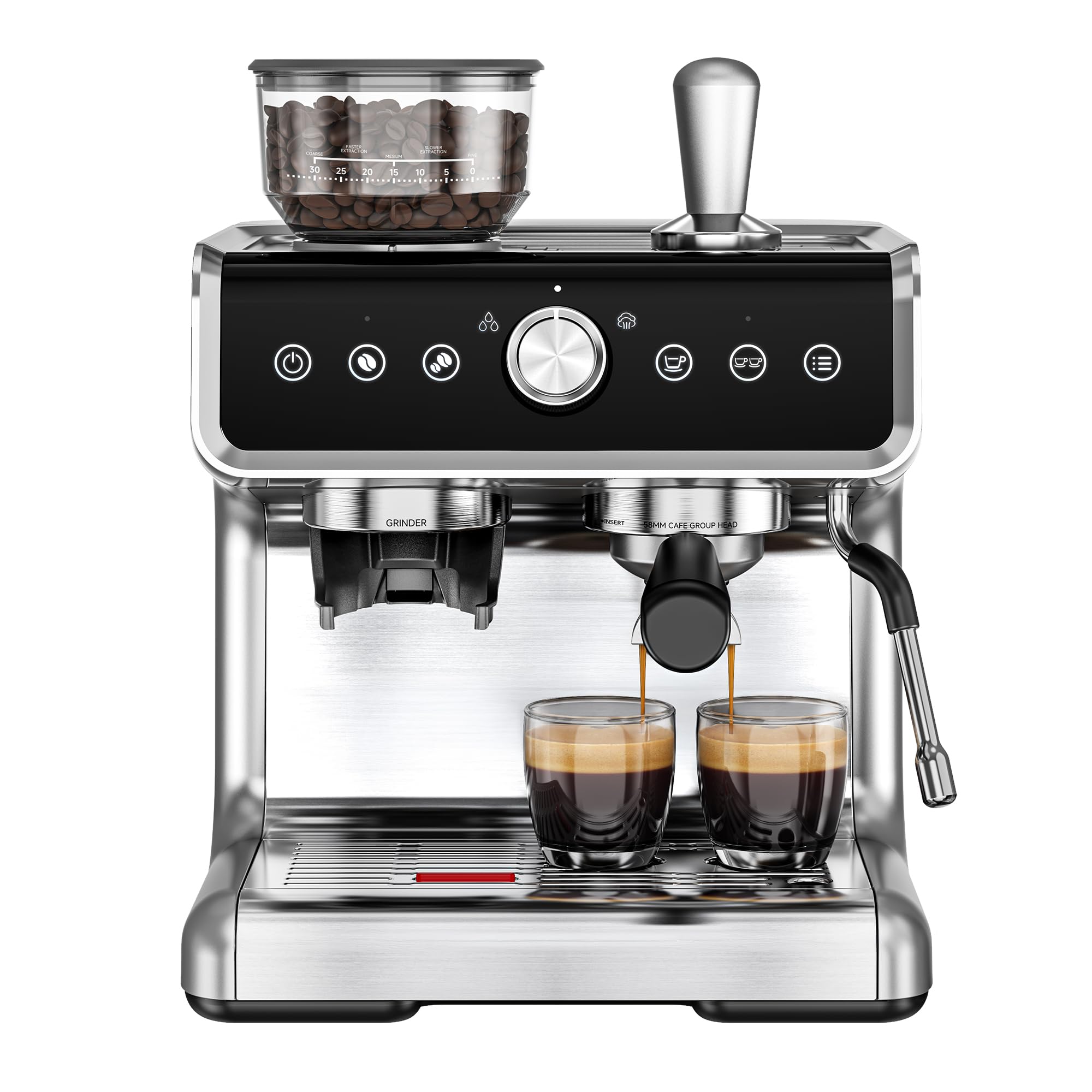
20-bar pump pressure and a PID thermal controller (±1°C stability) make the EUHOMY CM002 the top pick for the home barista who wants restaurant-grade shot control without a commercial price tag.
The 30 micro-adjustment grind settings and 58mm professional portafilter (the same diameter used in café machines) let you dial in from fine espresso powder to coarse cold brew. At 25 pounds, it is 2.7x heavier than the Gevi — dense build quality that absorbs vibration during grinding. Buyers report the “highlight is surprisingly high-quality grinder; best at grind setting 15 for amount and brew ease.”
The catch: at 16.2 inches tall, it might not slide under upper cabinets if your counter clearance is tight, and some users note the espresso comes out slightly cool and needs microwaving. For the balance of precision, crema quality, and built-in versatility, this is the machine to beat.
Why it’s great
- PID temperature control (±1°C) prevents bitter shots
- 30 grind settings for fine espresso to coarse cold brew
- 58mm commercial portafilter for even extraction
- Anti-clog polished chute handles oily dark roasts
Good to know
- At 25 pounds, it is heavy for a compact machine
- 16.2-inch height may not fit under some cabinets
- Some users report needing to microwave the espresso
2. Gevi ECMI0-SS0A1 20 Bar Espresso Machine
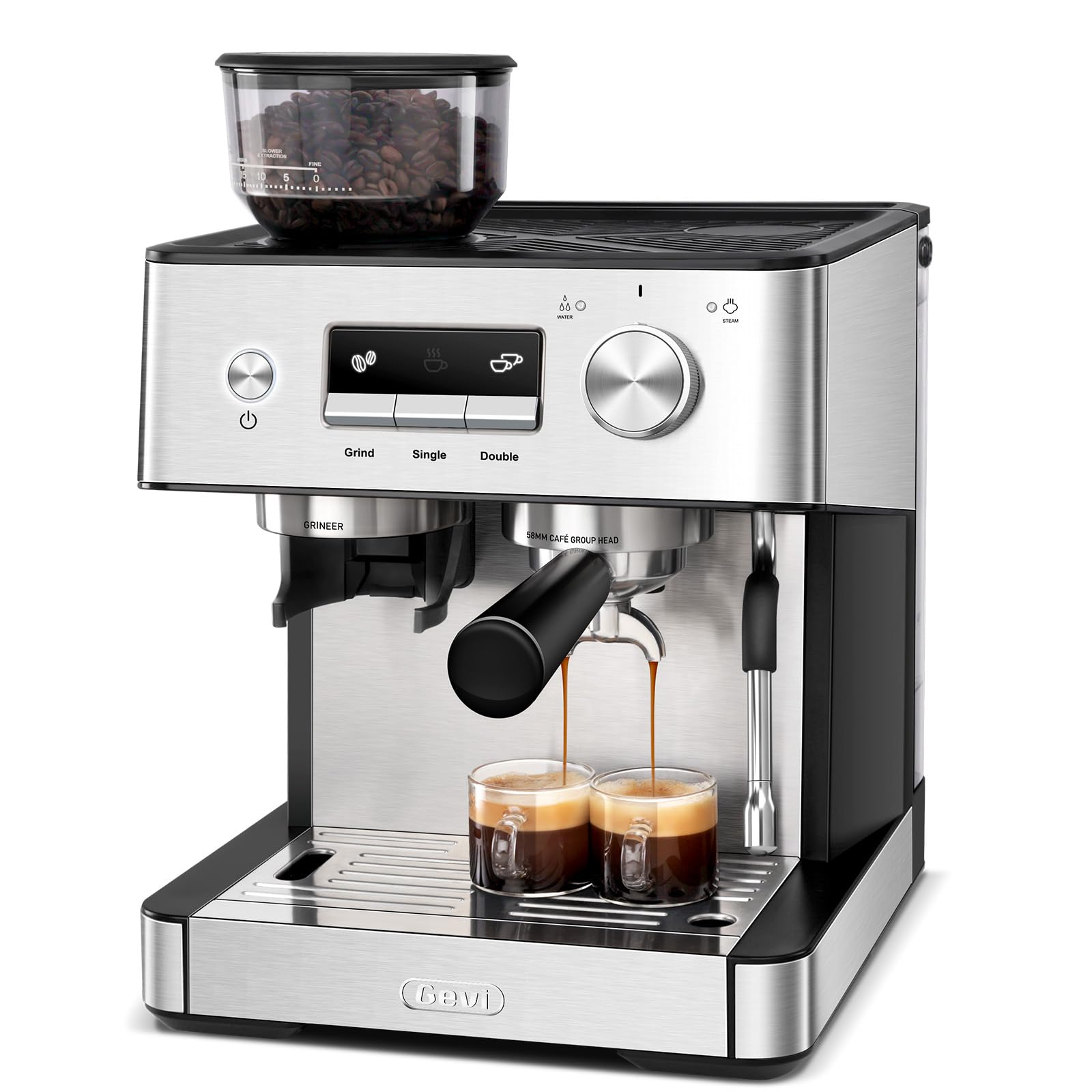
The Gevi undercuts the EUHOMY on price and weight — at 9.3 pounds, it is nearly 16 pounds lighter — but it also gives up the PID temperature control that keeps shots consistently hot. It matches the EUHOMY’s 20-bar pump and 30 grind settings, and owners mention it delivers “great value vs. Breville” at a fraction of the cost. One coffee snob reviewer noted grind setting 5 works best because the finest settings clog the group head.
The semi-automatic operation means you control the shot volume yourself, which is ideal if you want to learn the craft rather than let a machine decide. Customers note that after a learning curve of about 15 cups, the machine produces consistently good espresso.
Choose the Gevi over the EUHOMY if you want Breville-level results at a lower price point, you prefer a lighter machine you can move around, and you are comfortable dialing in the grind setting yourself rather than relying on automatic temperature stability.
Where it shines
- 30 gear-adjustable grind settings for fine-tuning
- 58mm dual-wall filter baskets for beginner-friendly crema
- Lightweight at 9.3 pounds for easy repositioning
- Water tank is removable for easy filling
Worth noting
- No PID temperature control — shots may vary in heat
- Finest grind settings can clog the machine
- Steamer requires manual technique practice
3. De’Longhi La Specialista Touch
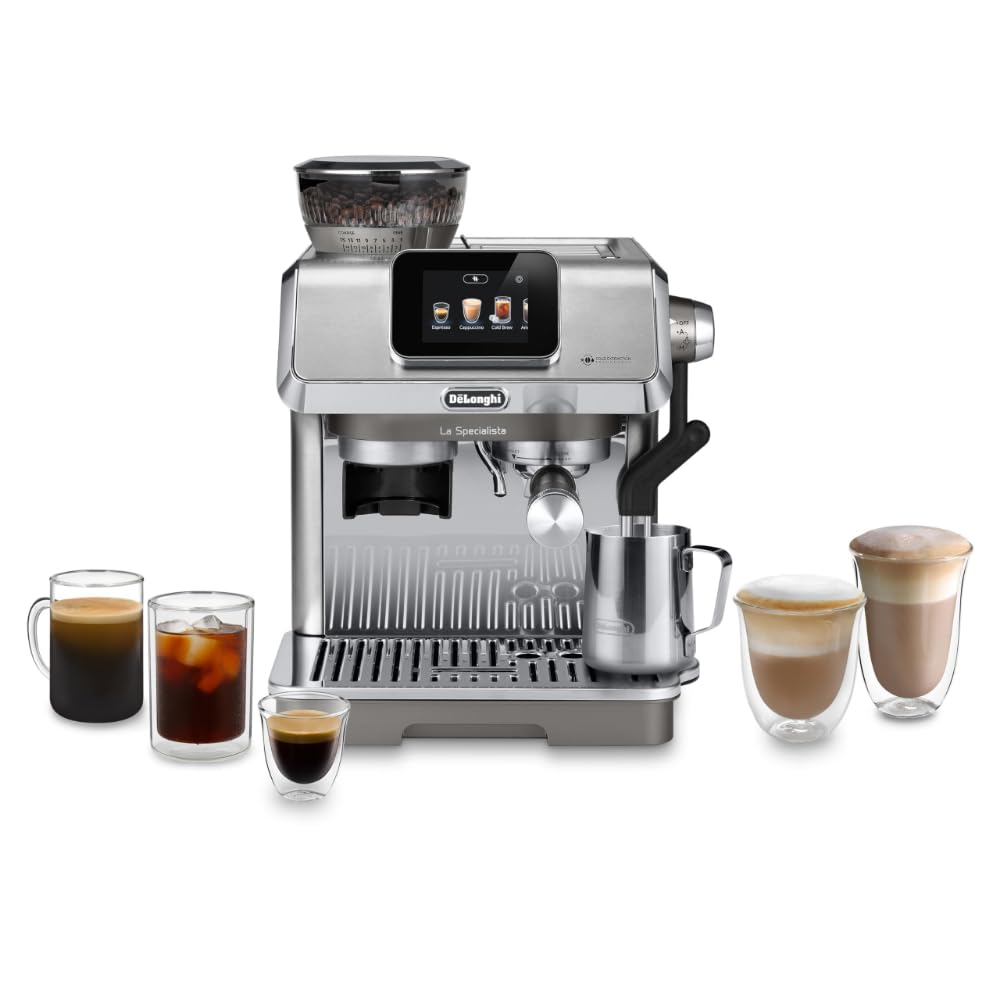
The De’Longhi La Specialista Touch is for the espresso enthusiast who wants a guided, tech-assisted experience — a 3.5-inch touchscreen walks you through bean selection, grind setting, dose level, and brew temperature using what De’Longhi calls Bean Adapt technology (a visual guide that gives you real-time feedback on your extraction). It holds 56 fluid ounces (about 1.7 liters) and offers 10 preset drink recipes from cold brew to flat white.
Its Italian-made conical burr grinder offers 15 settings, and the automatic steam wand adjusts between 5 froth levels and 4 temperature settings for dairy or plant-based milk. The proprietary Cold Extraction Technology (which bypasses the thermoblock to brew at a lower temperature) makes a cold brew in under 5 minutes, not the usual 12-24 hours. One reviewer who chose this over a Breville said the tamping guide made it easy to get consistent shots after initial bean adjustments.
The standout spec is the 2025 Red Dot and iF Design Awards for its Italian design — it looks as good as it brews.
What stands out
- Interactive touchscreen with Bean Adapt guided dial-in
- 10 preset drink recipes including cold brew in 5 minutes
- Automatic steam wand with 5 froth levels and 4 temp settings
- Award-winning Italian design from De’Longhi
The trade-offs
- 23-pound weight makes it less portable
- 14.37-inch depth requires more counter space
- Reported grinder defect issues with difficult returns
4. Terra Kaffe Demi Fully Automatic Espresso Machine
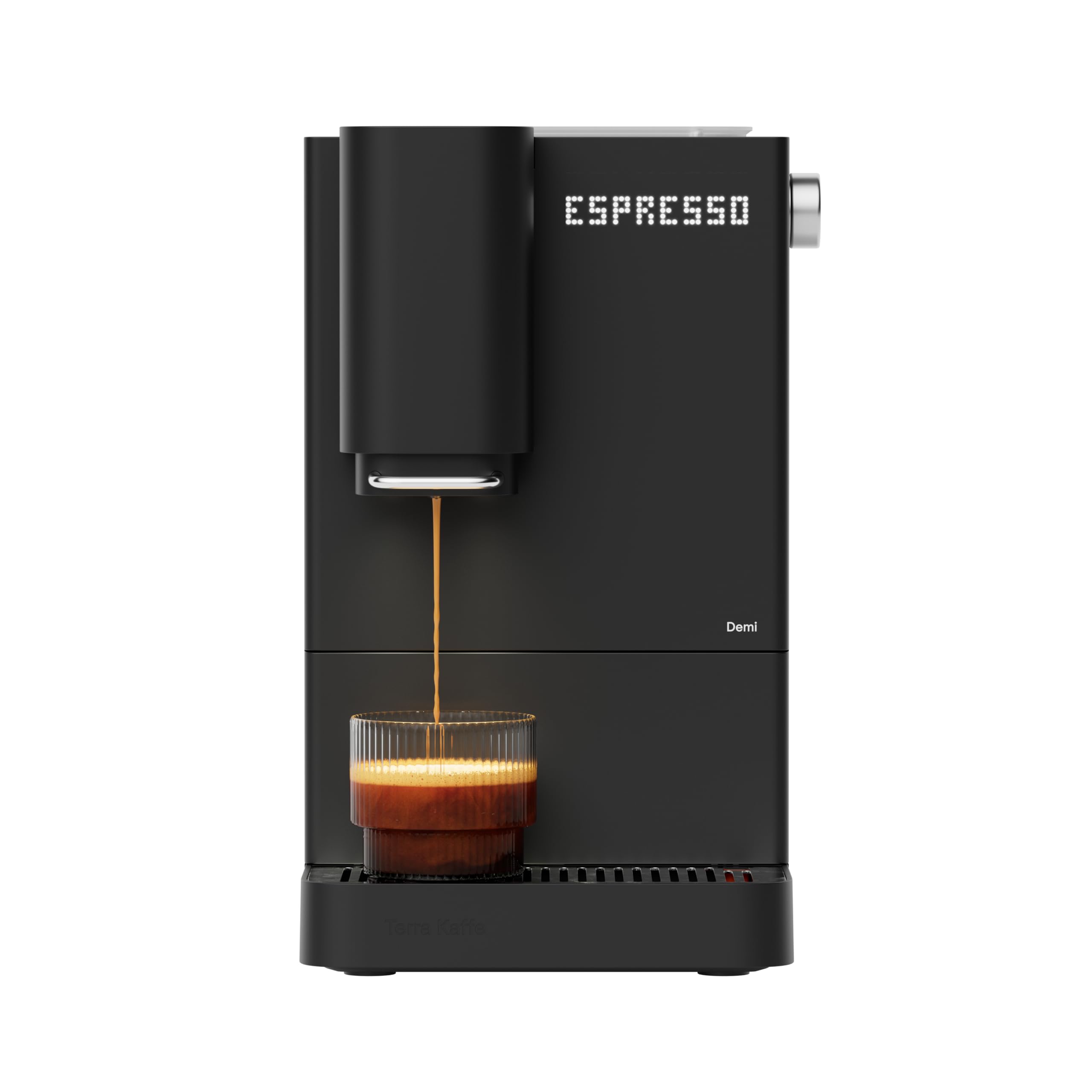
If counter space is your #1 constraint, the Terra Kaffe Demi’s 7.5-inch width is the smallest footprint in this lineup — it is 3.7 inches narrower than the 11.22-inch De’Longhi and 4.7 inches narrower than the EUHOMY. It is a fully automatic machine (you press a button and it grinds, doses, brews, and discards the puck), which removes most of the hands-on work compared to the semi-automatic EUHOMY or Gevi.
Its integrated conical burr grinder and 17-pound build deliver consistent espresso, lungo, Americano, and drip-style coffee at the touch of a button. The intuitive stainless-steel dial lets you control brew strength, water temperature, and drink volume. Reviewers point out “excellent, consistent espresso with rich crema” and that it “replaces coffee shop visits.” The self-cleaning system and front-loading drip tray keep daily maintenance simple.
The downside: the 37.2 fluid ounce (1.1 liter) water tank is the smallest here — you will refill it daily if you drink multiple shots. Also, a small number of shoppers say repeated failures including leaking and brew unit jams, so reliability is a risk. Only choose it if counter space is your absolute priority and you can handle more frequent refills.
The upsides
- 7.5-inch width fits tiny kitchens and office break rooms
- Fully automatic: grinds, doses, brews, and self-cleans
- Intuitive dial controls brew strength and temperature
- Quiet grinder reported by buyers
Keep in mind
- Smallest water tank (37.2 oz) requires daily refills
- Reported reliability issues with leaking and jams
- No PID temperature control for precise brew heat
5. Electactic CM8031 15 Bar Espresso Machine

The Electactic CM8031 is the entry-level option that gets the essentials right for a lower cost: a 15-bar pump, a built-in anti-clog grinder with a 20% wider polished chute and reinforced helical auger (a spiral blade that pushes grounds through without jamming), and a 77.8-ounce (2.3-liter) removable water tank. It weighs 18 pounds and measures 11.5 inches deep by 13.03 inches wide, which is compact enough for most counters but not as tiny as the Terra Kaffe.
What you give up: a 15-bar pump instead of 20-bar means slightly less crema consistency, and the machine has no PID temperature control. Buyers report that startup can require patience — one reviewer noted they “had startup issues (no water flow) resolved after 15 attempts.” However, once running, the machine produces “good espresso quality” and consistent shots according to multiple verified purchasers. The included 58mm portafilter and four filter baskets give you room to improve as you learn.
This machine is perfect for the budget-conscious beginner who wants a built-in grinder and a 58mm portafilter without spending premium money.
Why we’d pick it
- Anti-clog grinder path with 20% wider polished chute
- Large 77.8 oz water tank reduces refill frequency
- Includes 58mm portafilter and four filter baskets
- ETL certified for safety
A few caveats
- 15-bar pump produces less crema consistency than 20-bar
- Reported startup issues with no water flow
- Milk frother works slowly between functions
Understanding the Specs
PID Temperature Control
PID stands for proportional-integral-derivative, a small electronic controller that holds the water temperature steady within ±1°C of your target. Without PID, the heating element cycles on and off, causing the brew temperature to swing by 5-10°C — that swing is what makes some shots taste burnt and others sour. Machines with PID, like the EUHOMY CM002, give you the same consistent heat that commercial espresso machines use. This is the single spec most likely to improve your daily cup quality.
20-Bar vs 15-Bar Pump Pressure
The pump pressure rating (measured in bars, where 1 bar is atmospheric pressure at sea level) determines how much force pushes water through the coffee puck. A 15-bar pump is enough to produce good crema; a 20-bar pump gives extra headroom for consistent extraction, especially with denser, fresher beans. However, the actual brew pressure at the group head is typically 9 bars for espresso — the extra pump capacity just ensures the machine can maintain that pressure even if the puck is packed tightly. Both 15 and 20-bar machines can make excellent espresso; the difference matters most with very fine grinds.
Burr Grinder vs Blade Grinder
A burr grinder uses two serrated discs (called burrs) to crush beans into uniform particles, while a blade grinder uses a spinning blade to chop them unevenly. For espresso, particle consistency is critical because uneven grounds extract at different rates — fine particles over-extract and taste bitter, while coarse particles under-extract and taste sour. All five machines in this guide use conical burr grinders, which is the minimum requirement for drinkable espresso. The number of grind settings (15 to 30) determines how precisely you can dial in the grind size for different beans and roast levels.
58mm Portafilter and Basket Size
A 58mm portafilter is the standard professional size used in commercial espresso machines. The larger diameter means the coffee puck is wider and shallower, which allows water to flow more evenly through the grounds compared to smaller 51mm or 54mm portafilters found on cheaper home machines. All of our picks except the Terra Kaffe Demi (which uses an integrated system) include a 58mm portafilter. This means you can use standard accessories like tampers, distributors, and bottomless portafilters if you upgrade later.
FAQ
How often do I need to clean the built-in grinder on a compact espresso machine?
Will a 16-inch tall espresso machine fit under my kitchen cabinets?
Can I use pre-ground coffee in a compact espresso machine with a built-in grinder?
How long does it take for a compact espresso machine to heat up?
What is the difference between a semi-automatic and a fully automatic compact espresso machine?
Final Thoughts: The Verdict
For most buyers, the best compact espresso machine with grinder is the EUHOMY CM002 because its PID temperature control and 58mm portafilter deliver consistent, café-quality shots at a reasonable price. If you want Breville-class results for less money, grab the Gevi ECMI0-SS0A1. And for the tightest counter space where every inch matters, the Terra Kaffe Demi at 7.5 inches wide is the most space-efficient choice.

Mo Maruf
I created WellFizz to bridge the gap between vague wellness advice and actionable solutions. My mission is simple: to decode the research and give you practical tools you can actually use.
Beyond the data, I am a passionate traveler. I believe that stepping away from the screen to explore new environments is essential for mental clarity and physical vitality.