Our readers keep the lights on and my smoothie glass nicely filled. As an Amazon Associate, I earn from qualifying purchases.
You reach for a chef’s knife for nearly every meal prep, but under $50, many blades lose their edge within weeks or feel so unbalanced they wobble on the cutting board. This guide picks five that skip those problems, so you know exactly how each performs before you buy.
I’m Mohammad Maruf — the co-founder and writer behind WellFizz. This guide is built by comparing the manufacturers’ published specifications and the patterns across verified customer reviews, so you get each pick’s real strengths and trade-offs instead of marketing spin.
Your choice comes down to whether you want edge retention for daily prep, a lightweight blade for long slicing, or the durability to survive a busy kitchen. We looked at blade steel, handle comfort, weight, and real owner feedback to separate the keepers from the duds, so you can finally buy a chef’s knife under 50 with confidence.
How To Choose The Best Chef’s Knife Under 50
To pick a good knife under $50, look at where the manufacturer put the money — good steel, a solid handle, and balanced weight. These three factors separate a daily driver from one that dulls fast in a drawer.
Blade Steel and Hardness
The steel type decides how long the edge stays sharp and how easy it is to re-sharpen. High-carbon stainless steel gives you the best balance — it resists rust better than pure carbon steel while holding a harder edge than basic stainless. Look for a hardness rating around HRC 60 (a measure of how hard the steel is on the Rockwell scale, a standard industry test); above that, the blade stays sharp but gets brittle, and below that, you will need to hone it every few meals.
Weight and Balance
A too-heavy knife tires your wrist during long prep, but a too-light one lacks the momentum to cut through dense squash or thick carrots. For most home cooks, a blade around 6 to 8 ounces (0.37 to 0.5 pounds) hits a sweet spot — heavy enough to slice firm vegetables with a gentle rock, light enough to use for 20 minutes without fatigue. The balance point should sit where the blade meets the handle, not at the tip or the end of the grip.
Handle Material and Grip
Your hand grips this handle for hundreds of meals, so the material matters. Pakkawood (layered wood soaked with resin) feels warm and looks traditional but needs hand-washing. Fibrox or textured polypropylene (a slip-resistant plastic) is more practical if you want a secure grip with wet or oily hands — both are common in pro kitchens. Avoid anything slippery or too narrow, because a loose grip is how you get cut.
Quick Comparison
On smaller screens, swipe sideways to see the full table.
| Model | Category | Best For | Key Spec | Amazon |
|---|---|---|---|---|
| Victorinox Fibrox Pro | Premium | All-around daily use | 5.7 oz, stamped blade | Amazon |
| SAMCOOK Damascus | Mid-Range | Style and sharpness | VG-10, 67 layers | Amazon |
| SHAN ZU Genbu | Mid-Range | Long edge retention | K133 Japanese steel | Amazon |
| Dexter-Russell SANI-SAFE | Premium | Professional kitchen use | NSF certified, USA made | Amazon |
| Sunnecko 8 Inch | Budget | First chef’s knife | 12-15° edge angle | Amazon |
In‑Depth Reviews
1. Victorinox Fibrox Pro Chef’s Knife, 8 Inch
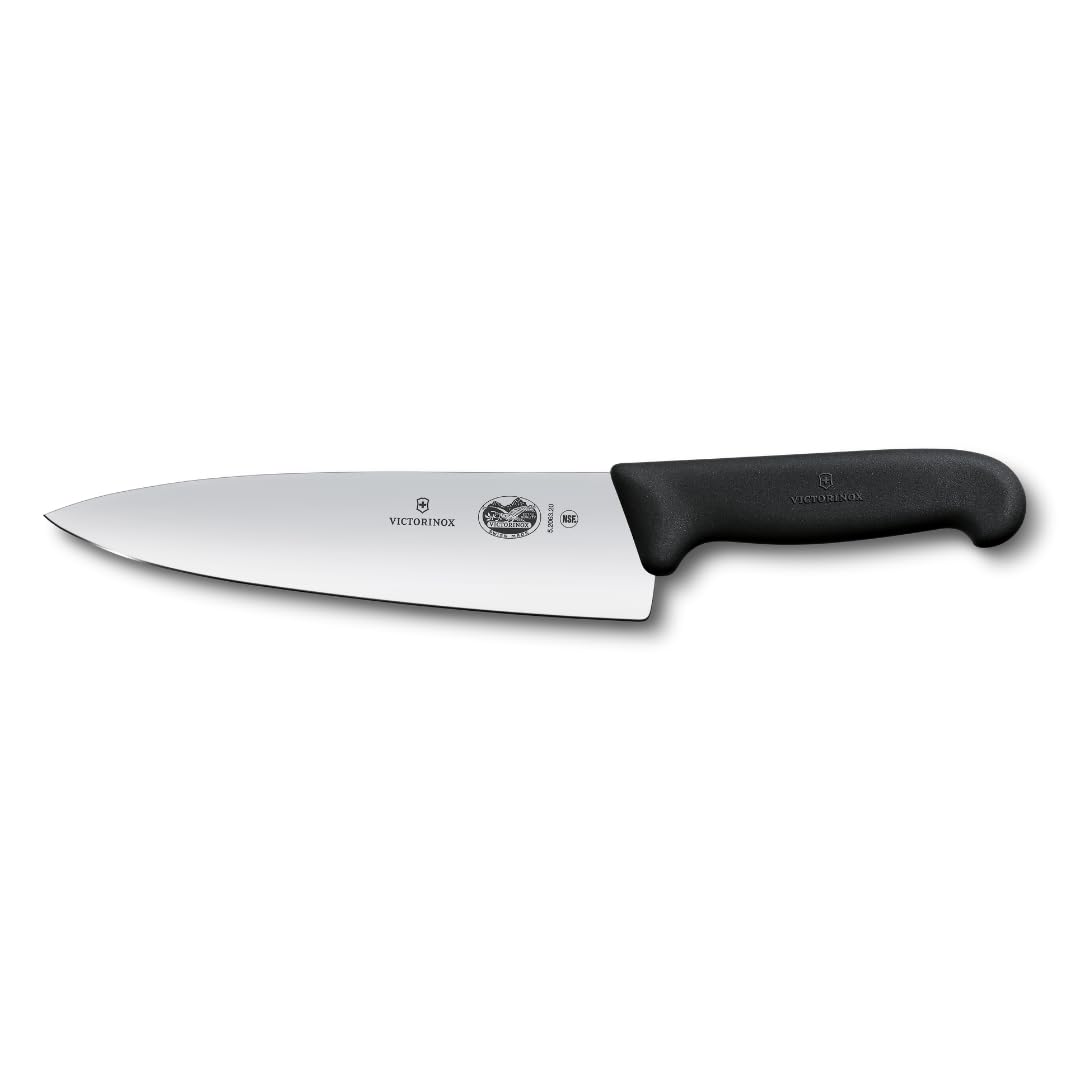
At 5.7 ounces with a stamped, laser-tested stainless steel blade, this is the knife America’s Test Kitchen picked as top under $50 year after year — and it is for the home cook who wants a scalpel-sharp edge out of the box that cuts through thick cantaloupe and slippery fish with almost no downward force, so you chop faster and tire less.
The real achievement is the Fibrox handle — made from a thermoplastic elastomer (TPE) that gets grippier when wet, so your hold never slips even with oily hands or tomato juice on them.
The catch: the steeper edge angle means you will want an Asian-style sharpener (about extra) when it finally dulls, pushing your total cost closer. Still, for the balance, non-slip grip, and proven record, this is the knife to beat under $50.
Why it’s great
- Light and well-balanced at 5.7 oz, reducing hand fatigue.
- Non-slip Fibrox handle stays secure even when wet.
- Holds its edge for 2.5+ months of frequent use, buyers report.
Good to know
- Requires an Asian-style sharpener (~) for the steeper edge.
- Not truly dishwasher safe despite being labeled as such; hand wash recommended.
2. SAMCOOK Damascus Chef Knife, 8 Inch

The SAMCOOK delivers a forged VG-10 high-carbon stainless steel core with 67 Damascus layers — sharper out of the box than the Victorinox’s stamped blade, especially for precision slicing through tomatoes and sushi rolls. At 1.1 pounds, it is heavier than the Victorinox’s 5.7 oz, which gives you more momentum for chopping dense vegetables but also means your wrist might tire a bit faster during long prep sessions.
Owners mention this knife as “Excellent value, sharp out of box, well-balanced,” and the blue resin wood handle offers a warm, smooth grip that looks striking on a magnetic strip. The blade’s HRC 60±2 hardness (equal to many Japanese knives costing triple the price) means you get superb edge retention for delicate work like dicing herbs or slicing boneless fish.
If you value an heirloom-looking 67-layer blade that is ready to shave paper from the moment you open the box, and you do not mind a slightly heavier knife that demands careful handling, the SAMCOOK beats the Victorinox on pure sharpness and aesthetic. It falls slightly behind on grip security when wet, but for home cooks who want show-stopping performance under , this is the one.
Where it shines
- Forged 67-layer VG-10 Damascus steel with HRC 60±2 hardness.
- Beautiful blue resin wood handle with a comfortable ergonomic grip.
- Arrives in a premium gift box, ready to use.
Worth noting
- At 1.1 lbs, significantly heavier than many competitors.
- The handle can become slippery when oily; a secure pinch grip is essential.
3. SHAN ZU 8 inch Japanese Chef Knife, Genbu Series

Imagine you’re a line cook pulling double shifts, and after a full year of daily 10-hour use, your knife still glides through produce like new — that’s the real-world feedback behind the SHAN ZU Genbu. Its Japanese K133 super steel blade, forged through the traditional Honbazuke three-step sharpening process, aligns the steel grain for extreme durability, and at just 0.42 pounds it’s the lightest of the five picks here, making fast rocking motions effortless.
The black K133 core resists chipping better than many VG-10 knives at this price, and the 32-step manufacturing process ensures every edge is hand-sharpened to a surgical finish. One reviewer notes it “cuts carrots as if it was butter,” a hallmark of a blade that doesn’t require you to force it through anything.
The downside: the sharp edge runs all the way to the rear of the blade with no guard, so you must watch your finger placement on the choil area — especially when washing. But if you want a knife that survives a year of professional abuse without needing a sharpening session, the SHAN ZU is your pick.
What stands out
- K133 super steel blade with exceptional edge retention.
- Only 0.42 lbs — extremely lightweight for fatigue-free work.
- Hand-sharpened through 32 manufacturing steps.
The trade-offs
- Sharp edge extends to the handle without a safety guard.
- Dishwasher safe by spec, but hand washing preserves the edge longer.
4. Dexter-Russell 8″ Chef’s Knife – SANI-SAFE Series
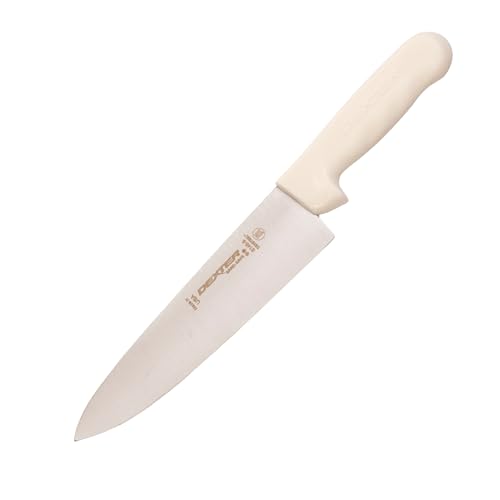
When the stainless steel blade is individually ground and honed in the USA and the knife carries NSF certification (a sanitation standard required by professional health inspectors), you know it is built for volume — not for show. The Dexter-Russell S145-10PCP handles the heavy lifting of dicing onions, trimming fat from meat, and mincing garlic without chipping or rolling its edge, and at only 0.45 pounds it stays nimble during long shifts.
The trade-off you accept for that professional pedigree is a textured white polypropylene handle that feels cheaper than the Pakkawood or resin alternatives — reviewers describe it as “hard plastic with a bubbled texture” that can be uncomfortable if you grip tightly. But that same material is exactly what makes it non-slip even with greasy hands and easy to sanitize in a commercial dishwasher.
For dedicated home cooks who want a blade that can survive daily use without fear of breaking the bank, this is the price-to-performance leader. It is not the sharpest out of the box, and the handle finish is purely functional, but the edge holds up through a restaurant’s worth of prep.
The upsides
- NSF certified and made in the USA for professional sanitation standards.
- Slip-resistant textured handle stays secure with wet hands.
- At 0.45 lbs, light enough for extended use.
Keep in mind
- Hard polypropylene handle feels less premium than wood or resin.
- Not intended for hacking through bone or hard gourds despite its durability.
5. Sunnecko 8 Inch Chef Knife
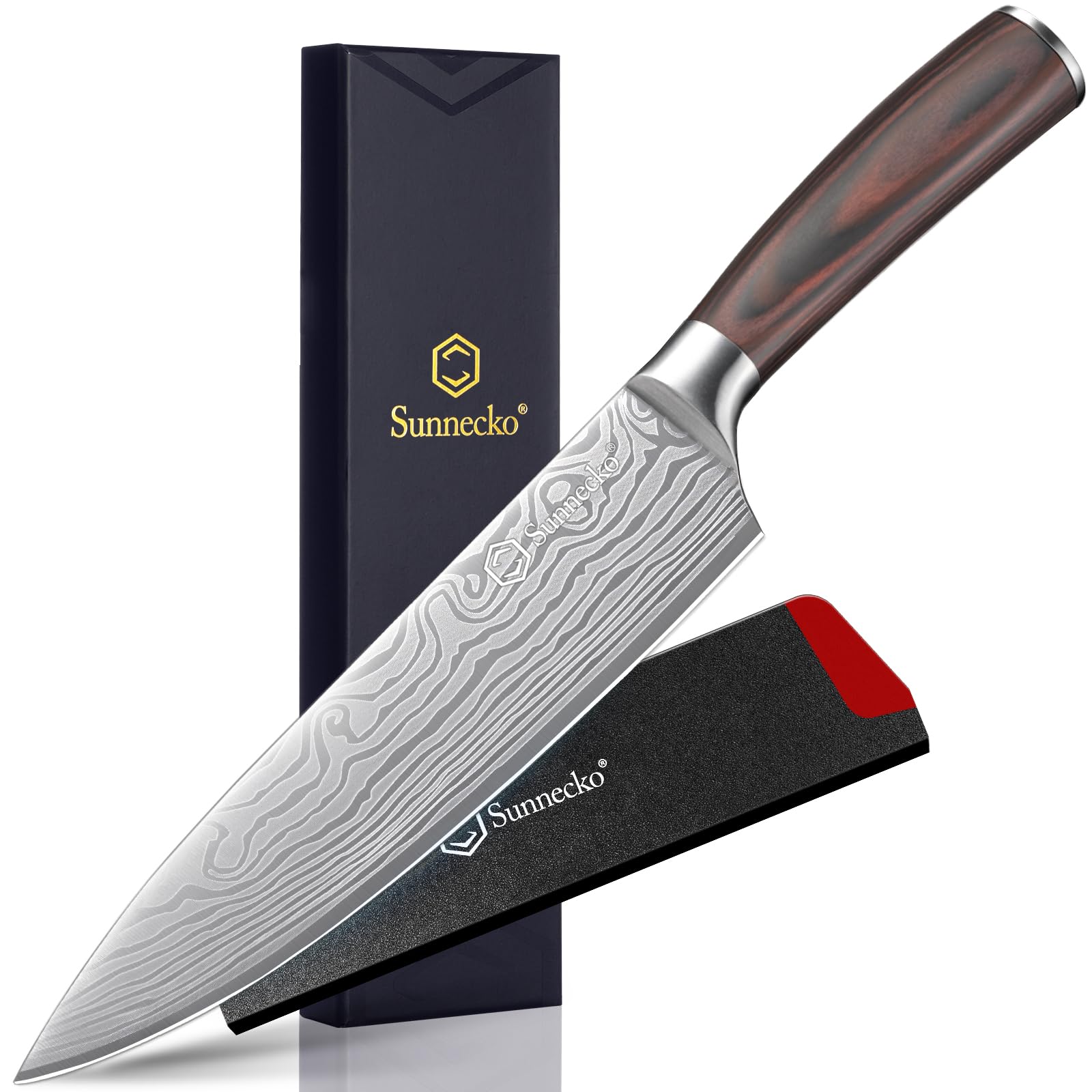
What you actually get at this lower price is a hand-sharpened 12-15 degree edge on high-carbon stainless steel with a real Pakkawood handle and a fitted PVC sheath — for a shockingly low cost. Customers note it is “razor sharp out of box, cuts paper/hair,” and the laser-etched pattern on the blade gives it the visual weight of a knife costing twice as much.
What you give up is long-term certainty — the high-carbon stainless is easier to maintain than pure carbon but the edge is thin, so you should not use it on bones or frozen food, and the Pakkawood handle requires hand washing to avoid cracking. The included sheath is a nice safety touch, but the blade is thin enough that you need to be mindful not to flex it on hard squash.
This is the starter chef’s knife for a college student, a first apartment, or a camping kitchen where you do not want to risk an expensive blade — making it the exact budget buyer it is perfect for.
Why we’d pick it
- Hand-sharpened 12-15° edge for razor-sharp out-of-box performance.
- Comes with a Pakkawood handle and a protective PVC sheath.
- Incredible value for the entry-level price.
A few caveats
- Thin edge may flex under heavy chopping of dense vegetables.
- Pakkawood handle is not dishwasher safe and requires hand washing.
Understanding the Specs
HRC Hardness
HRC stands for Rockwell Hardness scale, which measures how hard the steel is. A chef’s knife with a rating of HRC 58-62 is ideal — hard enough to hold a sharp edge for a long time, but not so hard that it becomes brittle and chips easily. All the knives in this guide fall into that sweet spot, with the SAMCOOK hitting HRC 60±2.
Stamped vs. Forged Blade
A stamped blade is cut from a large sheet of steel, then heat-treated and sharpened — it is lighter and cheaper to produce but not as durable as a forged blade. A forged blade is heated and hammered into shape, which compresses the steel grain for greater strength and a better balance. The Victorinox and Dexter-Russell are stamped (but well-made), while the SAMCOOK is forged, which contributes to its heavier feel and robust performance.
FAQ
Can I put my chef’s knife under in the dishwasher?
What does a 12-15 degree edge angle mean in real cooking?
Why do professional kitchens use Dexter-Russell or Victorinox instead of fancy Damascus knives?
Final Thoughts: The Verdict
For most people, the chef’s knife under 50 winner is the SAMCOOK Damascus because it marries a forged VG-10 core with a stunning handle at a price that outperforms its cost by a wide margin. If you want a lighter, grippier blade for all-day prep, grab the Victorinox Fibrox Pro. And for the best edge retention on a tight budget, the standout is the SHAN ZU Genbu.

Mo Maruf
I created WellFizz to bridge the gap between vague wellness advice and actionable solutions. My mission is simple: to decode the research and give you practical tools you can actually use.
Beyond the data, I am a passionate traveler. I believe that stepping away from the screen to explore new environments is essential for mental clarity and physical vitality.